F-Classers — you better get your ammo loaded and your bags packed. The 2013 F-Class U.S. National Championship commences this Sunday, August 18, 2013 with an official practice day. The United States National Championship matches start on Monday with Registration and Squadding at 0700-0730. (Don’t over-sleep and miss the action.) There will be individual matches on Monday, Tuesday, and Thursday, with a U.S. Championship Team Match on Wednesday.
The F-Class World Championships follow immediately after the U.S. Championships, with the Worlds running Friday August 23rd (practice day) through Tuesday, August 27th. This back-to-back scheduling means that many foreign shooters can come early and participate in the U.S. Championship matches as well. It looks to be an exciting week-and-a-half of competition. Good Luck to all individual shooters and teams. Here is the schedule for the U.S. Nationals:
U.S. F-Class Championships Shooting Schedule
Sunday, August 18, 2013
There will be a squadded practice at 1000 yards for individuals and teams. Squadding at 0700-0730. Commence firing 0800. Squadded practice fee is included in the match entry fee. There will be four relays, 20 minutes per relay. The range will be closed the remainder of the day.
Monday, August 19, 2013
DAY 1: F-Class 1000 Yards
Registration/Squadding at 0700-0730. Opening ceremonies 0720
Commence fire 0800. Three individual 15-record-shot 1000-yard matches plus Aggregate.
Tuesday, August 20, 2013
Day 2: F-Class 1000-Yards
Squadding at 0700-0730, commence fire at 0800
Three individual, 15-record-shot 1000-yard matches plus Aggregate.
Wednesday, August 21, 2013
Day 3: F-Class Team Matches
Team Captains will draw for target assignments 0720, commence fire at 0800
Two, four-person 1000-yard slow fire prone team matches, plus aggregate. Two sighting shots and 20
shots for record per team member.
Thursday, August 22, 2013
Day 4: F-Class 1000-yards
Squadding 0700-0730, commence fire 0800
Two 1000-yard individual 20-record-shot matches plus Aggregate.
The National Championship will be awarded based on Individual Grand Aggregate (total of matches 1-3, 5-7, 9-10). The Award Dinner/Ceremony will be held at the Coors Building at 6:00 PM Thursday, August
22, 2013. Free to all competitors. $10.00 for guests.
The Aussies Are Coming!
The first contingent of the Australian F-Class Team is heading our way. South Australian members Richard Braund, Stuart Braund, Dave Zerbe, and Mike Willment, received an enthusiastic send-off by fellow F-Class shooters in Adelaide, before the foursome jetted off to Sydney. They will join other Aussie team members in Sydney before flying to Los Angeles, and then heading on to Raton, NM.
Coming all the way from the Southern Hemisphere requires hauling a ton of gear through multiple airports. We don’t want to even think about the “excess baggage” charges. At least these intrepid Aussies will be racking up the frequent flyer miles. Sydney to Los Angeles and back again is roughly a 15,000 mile round-trip.
Report by John Cranwell of South Australia, who tells his countrymen: “Go Aussie!”.
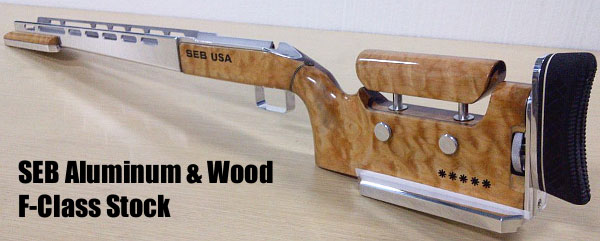
Sebastian (“Seb”) Lambang, creator of the SEB Coaxial Rests and new Coaxial Joystick Bipod, has engineered an impressive new wood and aluminum F-Class stock. The stock features a long, box-section aluminum fore-end with a wood rear section and wood-trimmed “wings” on the front bag-rider. The aluminum fore-arm has “buick vents” for weight reduction. From the end of the action rearward, the stock is mostly wood, with light and dark fancy wood laminates on opposite sides (left and right).
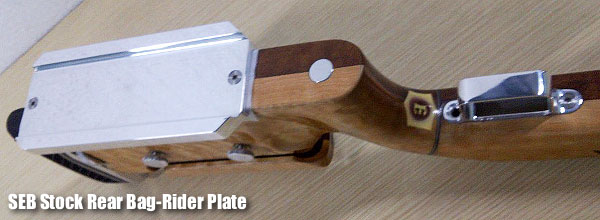
The foot of the buttstock has a very wide aluminum rear bag-rider with rails. The rear wood section appears to be two solid pieces of wood — but that is deceiving. Seb explains: “To save weight, the buttstock is hollow (using thin-walled wood)”. To strengthen the construction, Seb added carbon fiber inside the buttstock. So what you see is a wood outer shell with carbon fiber layers on the inside. The stock sports vertically-adjustable cheek-piece and buttplate. The thick, rubber buttpad should diminish felt recoil even when shooting big cartridges with heavy bullets.
This is an interesting, innovative stock design. And as with everything Seb produces, the craftsmanship, fit and finish are superb. We may get a chance to see how well this new stock shoots at the F-Class World Championships later this month in Raton, New Mexico.
Seb also crafted a handsome set of angled scope rails with beautifully-machined scope rings. Imagine being able to custom-make one-off products of this quality in your own machine shop!
When you’re shooting an F-Class match, the last thing you want is for your fancy front rest to sink into soft ground, hop on hard ground, or otherwise move around from shot to shot. And with more F-Open shooters shooting heavy (180gr+) bullets these days, F-Class front rests have to cope with more torque and recoil than ever before. Well, our buddy John Perkins from 21st Century Shooting has a solution. The new 21st Century Phoenix Foot features unique, bell-style geometry. This allows your rest to sit securely in turf and the feet are very stable even on loose soil or gravel. The Phoenix Foot, shown here with 21st Century’s Front Rest, is compatible with a variety of front pedestal rests with 1/2″-diameter adjustment legs. The bell-shaped foot design (narrow at the bottom and flaring at the top) makes it easy to level the rest front-to-back and side-to-side. Price for a set of three (3) Phoenix feet is $99.00.
21st Century’s Impressive Crank-Windage Front Rest
Also shown in the photo is 21st Century’s impressive new Front Rest, proudly CNC-machined in the USA from aircraft aluminum and stainless steel billet barstock. This big boy, which retails for $1095.00, features a super-large-diameter mariner’s wheel for elevation adjustment, and an ultra-smooth crank adjustment for windage (horizontal). Finish and function are impressive. Elevation and windage can be easily adjusted with fingertips (this is made possible by the ball screw design). This “Rolls Royce of rests” is made to last — all aluminum parts are anodized and the base is machined from 1″-thick 6061 T6 aircraft billet aluminum. If you’re interested, call 21st Century at (260) 273-9909. When production permits, rests usually ship out 3-6 weeks after an order is placed.
Product Tip from EdLongrange. We welcome reader submissions.
On his Facebook page, Hall-of-Fame shooter and ace gunsmith Thomas “Speedy” Gonzalez unveiled an impressive new F-Open rifle built for Bret Solomon. The rifle features Speedy’s new low-profile F-Class stock.
Bret’s gun is chambered for his 300 Solomon wildcat, shooting heavy 210gr bullets, so it can can be a real shoulder-buster, without some kind of buffer. The stock is fitted with a Ken Rucker’s Bump Buster hydraulic recoil reduction system to tame the recoil. The Bump Buster was originally designed for shotguns and hard-hitting, big game rifles. It is interesting to see this hydraulic buffer adapted to an F-Open rig.
Here you can see Bret shooting the gun, coached by Nancy Tompkins and Michele Gallagher:
Bret’s gun features a stainless Viper (Stiller) action, barrel tuner, and an innovative Speedy-crafted wood stock. Speedy says this stock design is all-new: “It is a true, low Center-of-Gravity F-Class stock, not a morphed Palma stock merely cut out on the bottom”. See all the details in this short video:
Stock Features: Glue-in or Bolt-In and Optional Carbon Pillars and Cooling Ports
Speedy explained the features of the new stock design: “Terry Leonard and I started working on an F-Class version of his stocks last year during the F-Class Nationals and came up with what he and I consider the first true low-CG stock in the sport. As you can see by the videos, there is very little torqueing of the stock during recoil. I add the carbon fiber tunnel underneath the forearms to save Terry some time. This bonds very well to his carbon fiber skeleton within the stock adding addition stiffness to the forearm to support the heavy barrels found on the F-Class rigs. We are playing with both glue-ins like we benchresters use and bolt-ins as well. The rifles on the videos are glue-ins. Bret just took delivery today of his first bolt-in employing carbon fiber pillars and the first Leonard stock ever to have cooling ports.”
Need for Recoil Reduction Follows F-Class Trend to Bigger Calibers and Heavier Bullets
In recent years we have seen F-Open competitors move to bigger calibers and heavier bullets in pursuit of higher BC. There is no free lunch however. Shooting a 210gr .30-caliber bullet is going to produce much more recoil than a 140gr 6.5mm projectile (when they are shot at similar velocities). Does this mean that more F-Open shooters will add hydraulic buffers to their rigs? Will a recoil-reduction system become “de rigueur” on F-Open rifles shooting heavy bullets?
Our friend Boyd Allen observes: “You may imagine that shooting a short magnum, or even a .284 Win with heavy bullets, involves a fair amount of recoil, and in the prone position this can be more than a little wearing. It can in fact beat you up over the course of a match. Some time back, Lou Murdica told me about having a hydraulic recoil absorbing device installed on one of his F-Class rifles, chambered in .300 WSM. Lou is shooting heavy (210-215gr) bullets so the recoil is stout. According to Lou, the hydraulic recoil-reduction system made all the difference.”
Story tip from Boyd Allen. We welcome reader submissions.
F-Class shooting (both F-Open and F-TR) is one of the fastest-growing forms of rifle competition. Each season many new shooters hit the line and attendance at the big matches increases every year. But if you’re new to the game, you may ask “Where can I shoot an F-Class match?”. Well, Forum member Rod V. (aka Nodak7mm) has compiled a useful list of 109 ranges around the USA where F-Class matches are held (plus 6 “possibles”). With venues from Alabama to Wyoming — you should find an F-Class program not too far from home. The list, in Excel spreadsheet format, provides range locations and weblinks (where available). Click the link below to download the F-Class Range List (.xls file):
Note — this list, now in its 19th Revision, is augmented regularly, but info is still being gathered. No claim is made that the list is comprehensive. But it still covers the the lion’s share of the important F-Class venues nationwide. If you know of a range that should be added to the list, please post the location on our F-Class Range List Forum thread. Rod will update the list as new range info is received. Rod writes: “Range information is wanted and welcomed. I would like your help on collecting specific info on Clubs/Ranges where known F-Class matches are held.” Here’s a partial sample from Rod’s list:
Take heed — if you want to compete at the 2013 U.S. F-Class Nationals and F-Class World Championships this July in Raton (NM) you need to register right away. Don’t delay! Individual registration for both of these events will close on June 15, 2013. That’s just one week away. Match organizers tell us that: “No entries will be accepted after that date.” Also Team entries for the F-Class Worlds will be closed as of June 15, 2013. There will be no late entries accepted at the range.
However, per program announcements, Team entries for the F-Class Nationals (not the Worlds) will be accepted at the range. But individuals MUST still register by June 15, and Teams for the World Championships must be registered by that date also. Currently, 31 teams have registered for the event: 6 F-Open National Teams, 13 F-Open 4-man teams, 7 F-TR National Teams, and 5 F-TR 4-man Teams.
The 2013 F-Class Nationals and World Championpships are being hosted by the Bald Eagles Rifle Club. Click the links below to download further information on the U.S. F-Class Nationals and World Championships at Raton, NM:
Editor’s Comment: All long-range competitive shooters should watch this excellent video — whether you shoot with a team or as an individual. Three cameras were used so you can watch the shooter, the range flags, and the target simultaneously. After a discussion of scoring, the actual shooting starts at the five-minute mark in the video. Under the guidance of wind coach Gary Rasmussen, U.S. F-Class Open Team Captain Shiraz Balolia shoots 100-7X for ten shots, following Gary’s wind calls.
Team Shooting with a Coach Shiraz tells us: “We come across a lot of shooters who have never shot under a coach. This video was produced to give shooters a basic understanding of shooting with a coach and the importance of releasing a good shot. In a team setting, you basically leave all the decision-making to the coach and aim where you’re told to aim. I’ve worked with Gary many times and it shows in the comfort level we have with each other. The coach plots the shots or a plotter advises the coach of any grouping that is not centered.”
Watch Gary Call the Wind and Shiraz Shoot 100-7X for Ten Shots
For best viewing, click the YouTube settings button to watch in 720p or 1080p HD (high definition).
Shiraz was shooting a 7mm F-Open rig: “My .284 Shehane rifle takes about 10 to 12 shots to settle down and that is probably why we made several scope adjustments while shooting. It is a great caliber and a step up from a straight .284 Winchester. The wind was relatively calm, but sometimes that slow wind with subtle angle changes can be very deceiving.”
The video was shot the first week of May 2013 at a range in Custer, WA located about 20 miles from Bellingham, Washington. The production team included Shiraz Balolia, Gary Rasmussen, three cameramen, and a target puller. Big Thanks to Grizzly Industrial for providing the camera crew and post-production talent.
Forum member Keith T. (aka “KT”) is in the U.S. Navy, so he has a fondness for seafaring, nautical color-schemes. Here is KT’s new F-Open rifle, smithed by Accurate Ordnance out of Winder, Georgia. The gun is chambered in .284 Winchester for Lapua brass (necked up) and 180gr Berger Hybrids.
KT admits, “It’s a little bit different than most in appearance!” But KT likes it that way: “When I had Accurate Ordnance build it, the only thing I specified was the stock, action, caliber and barrel length. I left the rest up to them. I think they did a pretty awesome job.”
The gun features a Pierce cone-bolt long action (with Jewell trigger) in a McMillan F-Class stock. The barrel is a Brux 31″, 1:9″ twist in the Brux “F-Class contour”. Sitting on top is the new Nightforce 15-55x52mm Competition scope with turrets and sun-shade coated blue to match the blue-coated action, bolt handle, rings, trigger guard and barrel.
The build came out great, but there were a few “bumps on the road”. KT explains: “This rifle took a long time to finish. When it comes to building guns I always joke and say if it weren’t for bad luck I wouldn’t have any luck at all. We started ordering parts in September 2012. Somehow I managed to order the stock from McMillan for the wrong Pierce action. After a bunch of scrambling and hard work on Accurate Ordnance’s part we were able to get my screw-up fixed. Then we ran into a few more snags. AO wanted to have the scope on hand before doing the coating. The first trigger was not up to standard with AO so they ordered another one and the list goes on. The rifle is finally done though and I couldn’t be happier.”
In most of the country “March Madness” is all about hoops. But in the Sacramento (CA) area, “March Madness” is a popular multi-match shootfest that brings out some of the top F-Class and sling shooters in the region. During this year’s Folsom Shooting Club March Madness series, Forum member Bob A. (aka “Killshot”) brought out his “Forum Classifieds Special” and beat all comers in the F-Class Division in both the American-Canadian Match and the Long Range Regional Match (See Results). Bob’s 6mm Dasher sports a blue-printed Rem 700 action. Who says you need a high-dollar custom action to run with the big dogs? In fact, this same gun, built with components sourced from Forum Classifieds, set a Sacramento F-Class range record of 200-17X. In this story, Bob talks about the build, and he explains his methods for loading ultra-accurate Dasher ammo.
Bob’s Budget-Build Dasher F-Classer
I’m a newcomer to F-Class competition and shot my first match in 2010. After getting accustomed to the match format and seeing what others were using, I wanted to build a proper rifle for F-Open but needed to keep it simple and, well, cheap. I found a solid “base” to build on in the form of a Dave Bruno-built, “pre-owned” 6-6.5×47 Lapua that I located in the AccurateShooter Forum classifieds in late 2011. The base action was a trued and blue-printed Remington 700 receiver circa 1971 with a spiral-fluted bolt. It was in a Shehane ST1000 stock painted sky blue and had a Jewell 1.5-oz BR trigger. I sent the bolt to Greg Tannel (Gretanrifles.com) to have the firing pin hole bushed and sleeved, the ejector removed and the hole filled and the face trued. I ugraded to Tannel’s Light Steel firing pin assembly while it was out.
Having the working bits completed, I needed a barrel. So I went to the AccurateShooter classifieds again and found a 1:8″-twist, 30″ x 1.25″ (diam.) Bartlein with a 0.236″-land bore. I called Dave Kiff and explained my pursuit and he recommended his PT&G “world record” 6 Dasher reamer (.2704″ no-turn neck and .104″ freebore). A month or so later the reamer and gauges arrived.
I had the barrel chambered by Marc Soulie of Spartan Precision Rifles (510-755-5293, Concord, CA). Marc is a great builder and I’m pleased to call him a friend. He is an outstanding shooter himself and developed his lathe skills from several “name smiths” I won’t mention here, all while he continued in his previous profession. Marc went into building custom rifles full-time a couple of years ago and is at the point in his career that word of his work has spread. He was recently selected by Frank Galli to create 25 rifles, each customized to the buyer’s specs, for the Sniper’s Hide 2013 Group Build. Marc has also built a number of tactical-style rifles for the Northern California Practical Precision Rifle Club’s shooters, several of whom have won or placed high in major matches.
After his great shooting in March, Bob reports: “I could not be happier with my little budget build. With a few more good scores I might even stop looking at BAT Machine’s website — my little old Remington action seems able to hold its own with the BATs and Kelblys just fine.
The rifle got its good looks from a Pennsylvania artist named Kenny Prahl. His Prahl Designs shop (724-478-2538) added the white ghost-flames over the existing sky blue metallic paint. Kenny’s work with an airbrush floored me, he does everything from stocks to mailboxes to gas tanks equally well.
“I use a Nightforce Benchrest 12-42x56mm with a NP-2DD reticle. To help my aging eyes I use a 3.5X BulzEyePro lens booster, I found it helped with mirage and target clarity enough that I rarely dial down the magnification even when mirage is bad.”
Looks Great, Shoots Better
Fire-forming showed great promise — ten-shot groups of half an inch at 200 yards were typical. I lost only one case to a split neck and the “blow lengths” are good and consistent.This was followed up with load development which saw 100-yard, five-shot groups in the .1s and .2s as the rifle showed its preference for Reloder 15 over Varget powder, and for CCI 450s over all other primers. The bullet of choice is the ever-popular Berger 105gr Hybrid Target.
In February 2012 I began shooting the Dasher in monthly club matches at the Sacramento Valley Shooting Center, the home range of a number of excellent F-Class, Benchrest and High Power shooters. Using a Farley Coaxial rest up front (also picked up from a WTB ad on AccurateShooter’s Forum) and an Edgewood bag in the back, I gradually improved my gun-handling to the point where I could shoot a respectable score. This was very different from the bipod shooting I’d done in the past in F/TR.
Like many others, I settled on the high-node dose of Reloder 15. Shooting F-Class puts a good number of rounds down the tube in a short time-frame. That can be hard on throats. At roughly the 1,200-round mark the groups started to grow as the throat wore. So, a barrel set-back was needed. The barrel was rechambered by another great California gunsmith, Ken Breda (831-334-2386, Aptos, CA). Ken, a sling shooter and all-around good guy, was able to get me back shooting with little down-time. When I went back to the range, I found the now 1.25″-shorter barrel shot equally well, even with the same load I had previously used.
An October Surprise — New Range Record, 200-17X
The chamber setback and muzzle cleanup brought the Dasher back to life and it was was really shooting well with several “cleans” shot at a few distances at club matches this summer. I shot the Folsom Shooting Club’s October match, this one a 3×600. I drew relay number two and settled in to spot and score for the shooter who drew relay one. The wind was very light and good scores were being posted. I set up for my first string and fired four sighters: three 10s and one X.
“Here we go”, I thought as I went for record. Happily, the first six shots found the X-Ring before a 10 came up out of the pits. The next six shots also found the X-Ring, then another 10 came up. Shots 15 thru 19 were all Xs and I finished the string of twenty shots with a final 10. I’d cleaned the 600-yard F-Class target with 17 Xs! This was by far my best “clean” at any distance.
I followed the first string up with a 199-6X and a 195-7X as the wind was beginning to harrass everyone on their third strings. My final score of 594-30X gave me my first win in F-Open by one point. I was very happy and received many congratulations from fellow shooters after the match. It wasn’t until I arrived at the range for November’s match that I learned that my 200-17X was a new range F-Class record.
I couldn’t believe it. Considering the quality of shooters and the number of big matches held at Sacramento Valley, setting a range record of ANY type there is an accomplishment. I have been fortunate to meet and shoot with some absolutely fantastic people at the Sacramento Valley Shooting Center. It took a little while to find out just how talented some of them were — several are national champions and record-holders but you’d never know it talking to them. These guys have always been helpful to others. Likewise, I try to help out when new shooters need a hand.
Dasher Loading Tips
My chamber is set up for Lapua’s current iteration of 6mmBR brass, in the blue plastic boxes. My case preparation is straight-forward. I fire-form with virgin cases right out of the box. I don’t size them but I will give the primer holes a good look and clean up the flash hole with a .058″ bit in a pin vise. To fire-form, I seat a Berger 108gr BT .030″ into the lands over a standard 6mmBR load of Varget.
For my match load, I use Alliant Reloder 15. We shoot year-’round in Northern California. It was a brisk 28º at the start of our January match this year. Your load needs to be able to carry you from that cold to the 100º+ heat we get in the summer months. While Varget is less sensitive to temperature changes, RL15 gives me lower spreads and better long range control.
I clean my fired cases with stainless steel media in a Thumler’s rotary tumbler after every firing. I anneal after every other firing using a Bench-Source machine which is very well made and easy to operate. I use a Whidden full length bushing die with Redding bushings for sizing.
After sizing, I chamfer the inside of the neck with the K&M tool which has a pilot rod centered in the flash hole. Then I’ll give the neck and mouth a “once over” with some 0000 steel wool. I finish loading off with a Redding Competition Seating Die with the micrometer top.
I use a carbide ball on the expander rod of the full length sizing die. I use a .266″ TiN-coated bushing and the ball just kisses the inside walls of the sized neck. I get very consistent neck tension this way and have had no issue with split necks.
Seating Depth Considerations
With fire-formed brass, the junction of the bullet’s bearing surface and boat-tail is above the neck/shoulder junction of the case, so I have no issues with donuts. You can see how a loaded round looks in the photo at left. For occasional trimming, I use a very nice little Possum Hollow trimmer that indexes on the case shoulder.
Our IT guy, Jay (aka ‘JayChris’ in the Forum) shoots F-Class with a 31.5″-barreled rifle. He wanted a quality soft-case that could protect his F-Class rifle and the large Nightforce 12-42 NSX scope on top. After looking at many options, Jay selected the Bald Eagle BE1021 Long Rifle Case. Jay tells us: “I just bought one of these, after seeing a couple guys with them at the range. They can easily handle a long prone or F-Class rifle and have good padding (similar to the Creedmoor case) and seem well-built. I also noticed a lot of the sling shooters showing up with them.” Bald Eagle offers this case design in two colors: black (BE1021) or red (BE1020). The BE1020/21 soft cases measure 55″ long by 13″ tall. There is a large, zippered compartment on both sides of the case.
Amazon Buyer Review (by Gonzos):
This is a well-made, sturdy case for large rifles with a scope. Easily fits my 31-inch barreled F-Class rifle with a 12X42 Nightforce scope on it. I have no problems with it at all — in fact this is my third one. I wish the side pocket was full length (to hold a cleaning rod) but other than that it is perfect.


 The Aussies Are Coming!




 On his


 Shiraz tells us: “We come across a lot of shooters who have never shot under a coach. This video was produced to give shooters a basic understanding of shooting with a coach and the importance of releasing a good shot. In a team setting, you basically leave all the decision-making to the coach and aim where you’re told to aim. I’ve worked with Gary many times and it shows in the comfort level we have with each other. The coach plots the shots or a plotter advises the coach of any grouping that is not centered.”


 “Here we go”, I thought as I went for record. Happily, the first six shots found the X-Ring before a 10 came up out of the pits. The next six shots also found the X-Ring, then another 10 came up. Shots 15 thru 19 were all Xs and I finished the string of twenty shots with a final 10. I’d cleaned the 600-yard F-Class target with 17 Xs! This was by far my best “clean” at any distance.
 Dasher Loading Tips
 I use a carbide ball on the expander rod of the full length sizing die. I use a .266″ TiN-coated bushing and the ball just kisses the inside walls of the sized neck. I get very consistent neck tension this way and have had no issue with split necks.


