|
|
February 8th, 2013
Report by Monte Milanuk
With the proliferation of wide bipods for competitive F-TR shooting, we’ve seen a lot of cool gear hitting the market. Whatever you can imagine, someone is either building now, or working on prototype plans. One new design that seems to have stayed under the radar thus far is the FLEX bipod by Dan Pohlabel.

The FLEX bipod’s designer, Dan Pohlabel, offers these instructions:
The bipod feet are shipped loose. Note there is a left foot and a right foot. Mount them as shown in the diagram above. Determine the balance point of your rifle and mount the bipod approximately two inches forward of that point. You may want to move it further forward after shooting. Experiment with its placement to minimize movement of the bipod. When setting up, first grab each foot and ‘dig’ them in to the shooting surface, dirt, gravel, grass, carpet — it doesn’t matter. After making sure each foot has a hold, raise or lower the bipod to your target and use the cant adjustment to level your rifle. Loading the bipod with your shoulder is the preferred method of position. Contact me with any FLEX bipod questions you may have: danielp123 [at] earthlink.net.
The FLEX bipod is a very simple design — no Mariner’s wheel for vertical adjustment, no joystick head, no changing width as it goes up and down. And the FLEX bipod is very light (as are most, these days), but also very durable. I haven’t actively tried to destructively test it, but so far it’s held up to being tossed in the back of the truck, hauled around to the range and everywhere else in between. It definitely has not been ‘babied’ in any way, and it’s not noticeably any worse for wear. An added bonus is that it breaks down very flat for airline travel. Once I take the feet off, remove the ratchet lever (with screw), the whole bipod nestles very nicely in the bottom layer of foam in my gun case (with cuts for the head etc. in the foam). I’m definitely not worried about it in there. If someone bashes the case hard enough to damage what is essentially a plate of spring steel, then I’ve got bigger worries.

This view (below) shows a bit of the adjustment controls. Each leg has independent control for height, and there is a ratcheting locking lever that controls the cant. Instead of being directly centered like most other designs I’ve seen, this one is off-set a little, allowing a fair amount of movement without allowing it to completely ‘flop’ over to one side. (By contrast, using other bipod designs, I’ve had guns literally flip over as they tipped over too far.) Also having the tilt control relatively close/tight to the bore of the gun helps with the stability as well.

Inventor Dan Pohlebel developed the FLEX bipod for use in his native Ohio, where apparently grassy firing lines are the norm. Here in the Pacific Northwest, I seem to encounter concrete or gravel more often, which is why I usually place a mat under the bipod to keep it from sinking in too far. On Dan’s newest models, the “feet” have teeth to give better traction on hard surfaces such as the hard-pack clay/dirt (beneath a skim layer of gravel) that you’ll find at Raton, NM.
Why would you want more traction? Well, not everyone wants a bipod that slides around like a hog on ice. Some people manage to get things tracking straight back and forth, almost like it was constrained by a front rest. Personally, I have a hard time doing that in a repeatable fashion. While the FLEX Bipod shoots quite well with a [loose] hold, it was designed for those of us who like to ‘lean’ into the gun a bit. Quite literally, the idea is that you get the feet to dig in slightly, and push against the rifle butt with your shoulder and the bipod will ‘flex’ or bow forward slightly. It is one of those things that sounds wonky until you try it. It may take a few times to get a feel for it, but once you do, it is surprisingly repeatable.

The system does have a few quirks to it. Personally, I wish the rail attachment had a ratchet lever like the pivot control. Currently you need a separate tool to take the bipod on/off the gun. Also, the FLEX bipod seems to work better mounted somewhat further back than other designs. Some experimenting may be necessary to find what works best. Then again, we all need more trigger time….
February 7th, 2013
How Easy it is to Have Fun with Rifles and Equipment You Probably Already Have….
Forum member Rod Vigstol (aka Nodak7mm) has written a great Introduction to F-Class for shooters getting started in this rewarding discipline. Rod’s article, which appears in German Salazar’s Rifleman’s Journal website, covers F-Class basics and addresses concerns that “newbies” may have when trying a new shooting sport. Rod stresses that most guys who own a varmint-hunting or tactical rig likely have nearly all the gear they need to give F-Class competition a try.

CLICK HERE to read Rod Vigstol’s ‘Getting Started in F-Class’ article on Rifleman’s Journal.com
Rod explains: “If you’re reading this, you have more than just a general interest in the shooting sports and in the awesome rifles that shoot tiny groups at insane distances. You probably even have friends that enjoy shooting as much as you do. The quandary you may find yourself in is your friends haven’t quite jumped into it head-first like you have and they haven’t spent a lot of money and time obtaining the equipment you have to go shoot these matches. But you know what? Your prairie-dog shooting buddy or coyote-hunter friend can attend these matches and shoot alongside with you. He or she more than likely already has the basic equipment needed to shoot a match.” Most varmint shooters already have a suitable, accurate rifle and the following equipment:
• A variable-power scope in the 4.5-14x range or higher.
• A front bipod like the trusty old Harris 9″-13″, or maybe even a basic pedestal front rest.
• A rear sand-bag or similar sand-sock to rest the butt stock.
• A basic shooting mat from Midway or at least a piece of carpet or canvas to lay on.

Rod also provides a handy checklist of items to bring to the range. These include: Canvas or carpet strip (to set under bipod), Notebook, Kitchen Timer, Cleaning Rod, Camp Chair, Elbow Pads, Shooting Hat, and Open Bolt Indicator (OBI). Along with rifle, bipod (or front rest), rear bag, and ammo, that’s pretty much all you need.

Rod encourages all shooters to give F-Class a try — even novices. Rod explains: “We have all been rookies, newbies, new kids on the block or whatever. So we all have a good idea of what may be going on in your mind, the questions and concerns you may have. I’m telling you this sport is full of fantastic people who deep down find it far more fulfilling to help a new shooter get started than running a clean target. You just have to take the first step to get involved.”
CLICK HERE To read the entire article on Rifleman’s Journal.com. We’ve only provided a small sample of Rod’s article; it is definitely worth reading in its entirety.
January 31st, 2013
Forum member K.W., aka ‘CigarCop’, has spotlighted his handsome long-range F-Class and Bench Rifle in our Forum’s Show Off Your Bat! thread. This is built with a BAT Multi-Flat action, Brux barrel, and a fiberglass McMillan F-Class stock. As you can see, it’s one handsome rifle. Be sure to click the image below to see the much more impressive wide-screen image!


The smithing was done by Bob Green and CigarCop was full of praise for Bob’s work: “I can’t really say enough about Bob Green, his attention to every detail and his ability to build an awesome shooting rifle… but once again he turned a pile of parts into a masterpiece! Picked this one up yesterday and enjoyed a Cigar with him as well. Built on a Bat MB Multi-flat in .284 Win with a Brux 1:8.5″ twist barrel. I put ten rounds through her today to get her up and running! It’s almost identical to my 6.5x47L that [Bob] also built. Once again, thanks Bob!”

Bob Green told us: “There was nothing really unusual about this build — this is the quality we try to maintain on all our guns. The barrel was chambered with the client’s reamer to a min-spec SAAMI .284 Win. The Multi-Flat BAT is pillar-bedded and bolted in, with no extra weight added to the stock. CigarCop provided the nice metal spacers on the buttstock and I polished them up. The finish is plain black but it looks good.”


Based in York, Pennsylvania, Bob Green is one of AccurateShooter.com’s recommended gunsmiths. To learn more about his Bob’s work visit GreensRifles.com, email Bob [at] Greensrifles.com, or call (717) 792-1069.
January 13th, 2013
Following shoulder surgery, our Contributing Editor German Salazar moved to F-TR shooting, replacing his sling and iron sights with bipod and scope. German has done remarkably well for an F-TR newbie, winning his first two 500-yard matches (in F-TR class) at Phoenix-area ranges. German has been shooting his “old Palma rifle with a scope and bipod attached”. This rig features a Gilkes-Ross action in a Robertson/Sitman Highpower Prone stock with an Anschütz 5020 trigger and 30″ 1:11″-twist Krieger barrel. The rifle is fitted with a Canadian-made Rempel “Ski” bipod and a Leupold BR 24X scope.
On his Riflemans’ Journal website, German has crafted a helpful article with advice for “sling shooters contemplating a busman’s holiday into F-Class.” Even seasoned F-Class shooters can learn something from German’s observations in his F-TR: Scoping it Out article. Here are some highlights from the article:
Carpet Under the Bipod
“I quickly learned that a piece of carpet was an essential component under the bipod. Without the carpet, [on dirt surfaces] the bipod tends to dig into the dirt with every shot, resulting in odd elevation shots. On the concrete it isn’t quite as essential, but it smooths the recoil movement appreciably and is worthwhile. [I used] a short-nap carpet remnant for this, but my car floor mat also worked well.”

Clicking vs. Holding Off
“I’ve been shooting iron sights and clicking sight knobs for most of my life; trying to hold off made me very uncomfortable and the reflex pull of the trigger just wasn’t there. Once I returned to holding center and clicking, I was more comfortable and was able to execute my shots more quickly and cleanly. By zeroing the windage knob I can also easily return to a previous setting when conditions warrant.”
Reading Mirage with Spotting Scope
“In conversations with other F-Class shooters in our club, I found that few were using a spotting scope to see mirage; they were largely relying on the rifle scope. However, the rifle scope is focused on the target, as it must be to eliminate parallax, and thus cannot show mirage with the same clarity as a spotting scope that is focused roughly halfway down the range.”

Positioning Your Spotting Scope
“I position the spotting scope in the same manner as I did when shooting from the sling. It is very close to me and can be used without moving the head from the cheekpiece. The object, as always, is to minimize movement in order to maintain a consistent position and to minimize the time lost between the last glance at the mirage and breaking the shot.”
CLICK HERE to Read Full F-TR Article by German Salazar
German’s F-TR article first appeared in 2011. Since then German has had another shoulder surgery, but he is progressing well.
January 4th, 2013

In 2012’s final week, the Port Malabar Rifle & Pistol Club of Palm Bay, Florida held the Fifth Annual Snowbird X-Miss Midrange Prone and F-Class Match. This NRA Registered Tournament drew almost 60 competitors from around the country plus Fritz Braun from Brazil. For the first time ever, the Snowbird had a 300/500/600 event the first day with 600-yard match the second two days. Competitors saw various kinds of weather varying from chilly to 74 degrees. There were some drizzles on the last day of the individual matches but the rain held off long enough for all to complete the event
Kent Reeve took the High Overall 3-Day aggregate for the Mid-Range Prone with a score of 1797-132X. Second overall went to Sam Yarosh with a score of 1793-109X. Third overall to Wayne Forshee with 1788-91X. In F-Open, reigning FL State F-Open Champion Mark Finizio won the 3-day event with a score of 1790-100X. Second was Ken Adams, 1780-77X and third place overall went to Tom Goodman, 1778-68X. Complete results are listed on www.pmrpcrifle.com.

Many Record-Setting Performances at the X-Miss Match
Numerous NRA National Records were set at the 2012 Snowbird X-Miss event. Kent Reeve shot an incredible 200-22X at 600 yards. LeeAnn Finizio set F-Open Ladies’ records at two yardages: 300 yards, (197-[?X]); 600 yards ( 200-14X). Sam Yarosh shot a new record of 197-12X in the 500-yard any sight police category.
Team Event on Sunday
On Sunday, December 30, 2012, there was a team match. The F-Class Open Division saw a tight race among Miami’s Signal 20 F-Class Team, the S&S Precision Rifle Team, and the BNX F-Class team. Team BNX ended up in first place ahead of runner-up S&S Precision Team, shown below.

The Snowbird X-Miss Match was conceived to let folks shoot in the dead of winter when they can’t compete at home. At the Snowbird X-Miss Match NRA classifications are used AND rifles are classed by type: Palma, Iron Sight, Service Rifle, and Scoped Rifle. And the usual F-Open and F-TR divisions are recognized. Awards are given to all these types. Thus a shooter with a 6.5-2284 scoped rifle is not competing against someone with an iron-sighted AR15 Service Rifle. The Snowbird will be held again next season at the end of 2013.
Major sponsors this year included Sinclair International, S & S Precision Rifles, D & B Supply, Bartlein Barrels, Krieger Barrels, Berger, and Sierra. Others included Creedmoor Sports, PMA, K & M, Lee Precision, Forester Products, Redding, Dewey, Precision Reloading, and Jim Owens.

December 25th, 2012
The Arizona Desert Sharpshooters website offers a complete collection of competition plot sheets. These plot sheets were created by shooter Reid Perry. High Power and F-Class shooters can use these to mark their shot locations and record their wind calls. All the Plot Sheets are created in Adobe Acrobat (.pdf) format so they’ll print consistently from any computer. See sample plot sheet for 600 Yards.
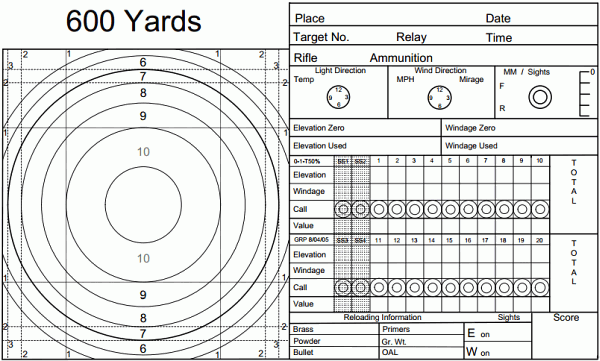
Right click and “save as” the links below to download full-size plot sheets. On the Desert Sharpshooters site you’ll find other free plot sheets, including ISSF (300m) and ICFRA Plot Sheets (300 to 1000 yards), plust sight-setting and score-keeping plot sheets.
|
|
DCRA (Canada) Plot Sheets
|
December 13th, 2012

We recently reported on the new Jennings F-TR stock with integrated bipod. When we first saw this rig we thought, “OK, it looks cool, but how does it shoot?” Well, we had a chance to test a .308 Win F-TR rifle built by Chesebro Rifles using the Jennings stock, Barnard action, and 32″ Bartlein barrel. With the gun on the bench, we first shot a few rounds to confirm zero and test for function.

Then gun-builder Mark Chesebro set the rifle on the shooting mat, opened up a box of Federal 168gr Gold Medal Match (GMM) .308 Win ammo, and got down to business — from the ground. What happened next can only be described as “shock and awe”. Mark nailed three successive groups that left us shaking our heads in amazement. The Jennings stock works. Does it ever. This gun hammers.
All groups were shot from the ground, bipod-supported, with Federal factory GMM ammo.
 
 
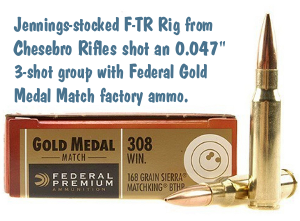 Mark’s first three-shot group had two shots in one hole, then the third leaked a bit high for a 0.184″ group. Then Mark dialed down 2 MOA elevation, and drilled an astonishing 3-shot .047″ group. (For reference, the black diamond in the orange paster is 1/4″ from point to point.) Mark’s first three-shot group had two shots in one hole, then the third leaked a bit high for a 0.184″ group. Then Mark dialed down 2 MOA elevation, and drilled an astonishing 3-shot .047″ group. (For reference, the black diamond in the orange paster is 1/4″ from point to point.)
I was watching through a Swarovski spotting scope and I saw all three shots track into one hole that just got a little whiter in the middle with each successive round. I yelled out “Stop shooting!” because I wanted to measure the group. It was an easy mid-zero — and honestly it looked like just one bullet hole from a pistol. That is amazing with factory .308 Win ammo, particularly in a barrel throated for 185s, not the 168gr SMKs Federal uses in its Gold Medal Match .308 ammunition.

After measuring Mark’s 3-shot bughole, we walked back to the firing line and Mark shot a full 5-shot group. This would have been a two-flat, but he flinched a bit and his third shot went a little high to open the group to a 0.233″. Still darn impressive with factory ammo…
Editor’s Comment: This Gun is Ultra-Stable and Tracks Straight Back
I had a chance to shoot the gun from the ground. I can tell you this — the stock design really works. With the wide-track bipod, the gun is incredibly stable. As you’re aiming there is virtually zero horizontal movement in the crosshairs. All you need to do is squeeze the ears to set your vertical Point of Aim and pull the trigger. This thing is one of the easiest guns to shoot accurately (from the ground) that I’ve ever tried. You don’t have to struggle for stability at all — the gun wants to stay dead calm.

With the large, cylindrical Delrin feet placed on a mat, the gun tracks straight back. And there is no hop, no bounce, no roll. In fact, the gun tracked so well that I could see my bullets impact on the paper target. That’s surprising for a .308 Win with no muzzle brake. After a shot I could slide the gun forward and the crosshairs were right where they should be — the only thing I had to do is squeeze the ears to re-set my vertical. All I can tell you is the thing is very easy to shoot well.
 I don’t know whether it is because of the forward-angle geometry of the legs, or the Delrin feet, or the properties of the carbon fiber tube that supports the front end, but the gun seems to have more damping than other metal-chassis stocks I’ve tried. Some metal-stocked guns seem to “ring” and transmit a sharp pulse to the shooter. This Jennings stock doesn’t do that — it seems to soak up vibration somehow. And the recoil is very mild, I think because the Delrin feet slow the gun down as they slide back smoothly. I don’t know whether it is because of the forward-angle geometry of the legs, or the Delrin feet, or the properties of the carbon fiber tube that supports the front end, but the gun seems to have more damping than other metal-chassis stocks I’ve tried. Some metal-stocked guns seem to “ring” and transmit a sharp pulse to the shooter. This Jennings stock doesn’t do that — it seems to soak up vibration somehow. And the recoil is very mild, I think because the Delrin feet slow the gun down as they slide back smoothly.
Bottom Line: We came away very, very impressed with this rifle and the Jennings stock. I have never experienced a bipod-equipped rifle (in any caliber) that is easier to aim and hold steady, or which is easier to return to precise point of aim after each shot. And, without question, this is one of the most accurate .308 Win rifles we have ever shot from the ground. And that was with factory ammo, not tuned handloads!
Making a Great Design Even Better
Could the rifle be improved? Yes. While there is some rear elevation adjustment (via an eccentric bag-rider that rotates) we would like to see more rear-end elevation adjustment, so the gun could better adapt to uphill and downhill target placements. Also we’d like to see a higher mounting point for the bag-rider so you could use a taller, beefier rear bag. We discussed these points with Mark Chesebro, and he’s agreed to start prototyping some upgrades. This may include a thumbwheel-adjustable bag-rider (sort of like an upside-down adjustable cheekpiece). At our suggestion, the vertically adjustable bag-rider may be offered in two versions — straight and angled. With an angled bag-rider (i.e. with a slight amount of drop front to rear), you could adjust your vertical point of aim by sliding the gun forward or aft in the rear bag.
We will supplement this test report with more photos and video in a few days. We know you want to see how well it tracks. The video tells the story better than words can…
December 8th, 2012
by Steven Blair, 2012 California State Long Range F-Open Champion
Assess the Terrain and How the Wind Will Interact with It
Before you begin a match, take a few minutes to look around the range at the terrain, any obstructions, range topography (berms and backstop), and trees, buildings or structures that could affect wind flow over the range. Imagine what might happen if the wind was from the left or right, headwind or tailwind. Depending upon the direction, significant effects may be seen on range. A head or tail wind may ripple across the berms, causing elevation changes, both high and low. A tall side berm, like the east side berm at Ben Avery, may cause turbulence when the wind comes from that direction. Blocking features might shield most of the wind but a break along the range can funnel strong gusts through the gap with no other indications. Take a few notes about the effects of different wind directions and refer to them if the prevailing direction changes. (Tip courtesy Tony Robertson.)

Use a Spotting Scope, Even When Shooting a Scoped Rifle
A good spotting scope can “see” mirage much more clearly than even an expensive rifle scope. Take your spotting scope to the line and position it as sling shooters do, close enough to use without much movement. Focus the scope approximately 1/3 of the way down range or where the most significant wind effects are likely to occur. Take a quick look while waiting for pit service, glance at the flags and compare to your scope sight picture. I often see ambiguous indications at the target through the rifle scope, but see a clear indication of wind direction and speed through the spotting scope at the shorter distance. When shooting the Arizona Palma Championship at Ben Avery last weekend, I was scoring while the wind was coming from the east. Shooters up and down the line were out to the left, losing points. Mirage at the target looked moderate and the flags weren’t indicating strong wind. As I focused the spotting scope back, the mirage suddenly looked like it was flowing twice as fast around 500 yards than it was closer or farther. It wasn’t until I realized that the access road cut through the berm there that I understood what was happening. (Tip courtesy Gary Eliseo.)

Don’t Over-React to Something That May Be an Anomaly
On ranges with sizable berms, a headwind or tailwind can cause significant elevation problems. It is generally not possible to see or predict when this will occur. When the conditions exist that cause elevation changes and other competitors are experiencing the same problem, the best strategy is to ignore it. Certainly, avoid shooting when the head or tail wind is gusting, the same as you would in a crosswind. But, if you react to random, range-induced elevation changes, the only likely result is to make it worse. Whether the problem is caused by range or ammunition, maintain your waterline hold until you have evidence that something has fundamentally changed.

My .284 Shehane will usually require a click or two down during a string as the barrel warms. That is normal and manageable. But, if your shots are just bouncing up and down in the 10 ring, leave it alone. The same is also true of an occasional gust pushing a shot into the 9 ring. If the conditions have not changed and one shot just went out, it may be the result of a random occurrence that was not predictable. (Tip courtesy “School of Hard Knocks”.)
Adjust Spotting Scope Focus and Magnification as Needed to View Mirage vs. Target Details
In F-Class we only need to see mirage, spotters, and scoring disks. That does not take a lot of magnification. My scope is a Nikon 25-75x82mm ED. It is a superb scope for the money and makes it trivial to see minor variations in mirage. It is good to have the high magnification available, and it can always be reduced if necessary. I use different power settings for different situations.
 Setting Magnification Levels Setting Magnification Levels
During a match, in very good viewing conditions, I set my spotting scope at 75X, full power. The mirage is more subtle in the morning and greater magnification is needed.
During a match with heavy mirage I set my spotting scope at about 40X. I have no problem seeing mirage, even at this magnification.
When practicing at 300 yards or closer I set my spotting scope at max power (75X) so I can see the little 6mm holes from my 6BR rifle. I usually need to focus back and forth between shots to see both bullet holes and mirage.
Steven Blair, 2012 California State Long Range F-Open Champion, has been shooting since childhood and competing for over 30 years. Before retiring, Steve spent 16 years in Engineering and IT with General Atomics. He has held Engineering and Marketing positions with several firearms companies and worked on projects from pistols to 155mm howitzers.
December 2nd, 2012
In our Shooters Forum, one newcomer wanted some advice on selecting a reticle for F-Class optics. He wondered about the advantage of Forward Focal Plane (FFP) vs. conventional scopes and also wondered if one type of reticle was better for “holding off” than others.
In responding to this question, Forum regular Monte Milanuk provided an excellent summary of aiming methods used in F-Class. For anyone shooting score targets, Monte’s post is worth reading:
Aiming Methods for F-Class Shooting — by Monte Milanuk
 F-Class is a known-distance event, with targets of known dimensions that have markings (rings) of known sizes. Any ‘holding off’ can be done using the target face itself. Most ‘benefits’ of forward focal plain (FFP) optics are null and void here — they work great on two-way ranges where ‘minute of man’ is the defining criteria — but how many FFP scopes do you know of in the 30-40X magnification range? Very, very few, because what people who buy high-magnification scopes want is something that allows them to hold finer on the target, and see more detail of the target, not something where the reticle covers the same amount of real estate and appears ‘coarser’ in view against the target, while getting almost too fine to see at lower powers. F-Class is a known-distance event, with targets of known dimensions that have markings (rings) of known sizes. Any ‘holding off’ can be done using the target face itself. Most ‘benefits’ of forward focal plain (FFP) optics are null and void here — they work great on two-way ranges where ‘minute of man’ is the defining criteria — but how many FFP scopes do you know of in the 30-40X magnification range? Very, very few, because what people who buy high-magnification scopes want is something that allows them to hold finer on the target, and see more detail of the target, not something where the reticle covers the same amount of real estate and appears ‘coarser’ in view against the target, while getting almost too fine to see at lower powers.
Whether a person clicks or holds off is largely personal preference. Some people might decline to adjust their scope as long as they can hold off somewhere on the target. Some of that may stem from the unfortunate effect of scopes being mechanical objects which sometimes don’t work entirely as advertised (i.e. one or two clicks being more or less than anticipated). Me personally, if I get outside 1-1.5 MOA from center, I usually correct accordingly. I also shoot on a range where wind corrections are often in revolutions, not clicks or minutes, between shots.
Some shooters do a modified form of ‘chase the spotter’ — i.e. Take a swag at the wind, dial it on, aim center and shoot. Spotter comes up mid-ring 10 at 4 o’clock… so for the next shot aim mid-ring 10 at 10 o’clock and shoot. This should come up a center X (in theory). Adjust process as necessary to take into account for varying wind speeds and direction.

 Others use a plot sheet that is a scaled representation of the target face, complete with a grid overlaid on it that matches the increments of their optics — usually in MOA. Take your Swag at the wind, dial it on, hold center and shoot. Shot comes up a 10 o’clock ‘8’… plot the shot on the sheet, look at the grid and take your corrections from that and dial the scope accordingly. This process should put you in the center (or pretty close), assuming that you didn’t completely ignore the wind in the mean time. Once in the center, hold off and shoot and plot, and if you see a ‘group’ forming (say low right in the 10 ring) either continue to hold high and left or apply the needed corrections to bring your group into the x-ring. Others use a plot sheet that is a scaled representation of the target face, complete with a grid overlaid on it that matches the increments of their optics — usually in MOA. Take your Swag at the wind, dial it on, hold center and shoot. Shot comes up a 10 o’clock ‘8’… plot the shot on the sheet, look at the grid and take your corrections from that and dial the scope accordingly. This process should put you in the center (or pretty close), assuming that you didn’t completely ignore the wind in the mean time. Once in the center, hold off and shoot and plot, and if you see a ‘group’ forming (say low right in the 10 ring) either continue to hold high and left or apply the needed corrections to bring your group into the x-ring.
Just holding is generally faster, and allows the shooter to shoot fast and (hopefully) stay ahead of the wind. Plotting is more methodical and may save your bacon if the wind completely changes on you… plotting provides a good reference for dialing back the other way while staying in the middle of the target. — YMMV, Monte
November 17th, 2012
 There are few master craftsmen who can create a truly “bespoke” wood stock customized for the owner. Ireland’s Enda Walsh is one such talent. Through Gun Stocks Ireland, Enda creates high-quality stocks for hunters, prone shooters, and F-class competitors. Enda first started building stocks in 2001 for himself and friends, and grew the business over a decade. Enda explains: “Demand gradually increased until in 2009 the decision was taken to make it my full-time occupation. In 2010 I obtained my RFD licence and haven’t looked back. My goal with Guns Stocks Ireland is to manufacture precise custom rifle stocks to the highest standard, tailored in every detail to best serve the shooters requirements.” Enda adds: “I started Gun Stocks Ireland to produce custom, individually-tailored gunstocks. I build from hand casts so your gun is genuinely an extension of your arm.” There are few master craftsmen who can create a truly “bespoke” wood stock customized for the owner. Ireland’s Enda Walsh is one such talent. Through Gun Stocks Ireland, Enda creates high-quality stocks for hunters, prone shooters, and F-class competitors. Enda first started building stocks in 2001 for himself and friends, and grew the business over a decade. Enda explains: “Demand gradually increased until in 2009 the decision was taken to make it my full-time occupation. In 2010 I obtained my RFD licence and haven’t looked back. My goal with Guns Stocks Ireland is to manufacture precise custom rifle stocks to the highest standard, tailored in every detail to best serve the shooters requirements.” Enda adds: “I started Gun Stocks Ireland to produce custom, individually-tailored gunstocks. I build from hand casts so your gun is genuinely an extension of your arm.”
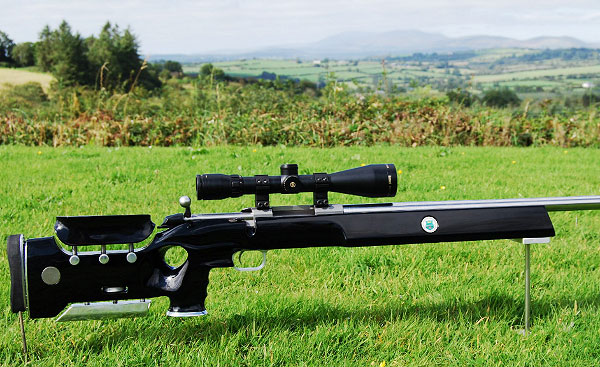

Walsh offers many stock designs, including a wide variety of thumb-hole and vertical grip stocks. Many of these feature hand-relieved grip areas customized for each guns’ owner. The hand-grip section literally fits the shooter “like a glove”. How does Enda create an ergonomically perfect grip for each customer? He actually makes a casting of the customer’s hand: “I send customers a hand cast kit so the shooter can make a plaster cast with his hand in shooting position. Done correctly there will be no tension in the shooter’s hand no matter how tight a hold is employed.” Enda’s stocks aren’t cheap, but they are a good value considering the amount of expert labor involved. Typical price for a fitted, bedded, and finished fully-adjustable F-Class stock is 1500 Euros.
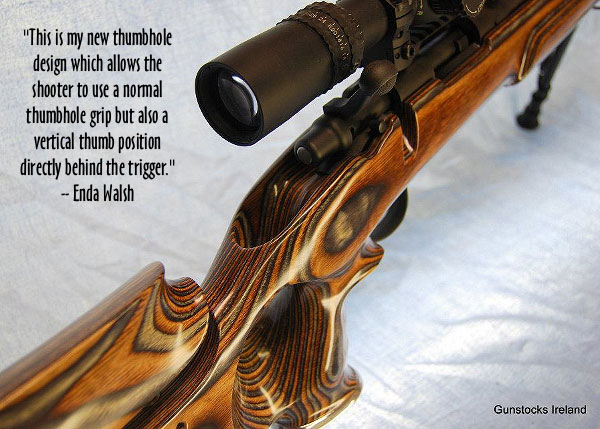

Enda’s stocks, as you can see from the photos, are labors of love. Each stock may require up to 80 hours of work from start to finish. That includes fitting of special features, such as adjustable buttplate, adjustable cheek-piece, and a unique bag-rider that adjusts up and down for elevation control and rifle balance. We think the adjustable bag-rider is a great idea that American stock-makers should emulate.

Vertically Adjustable Bag Rider Permits Easy Elevation Adjustment
“For F-Open shooters the benefit of the [adjustable] bag runner is it allows precise elevation adjustments shot to shot without having to reach forward to adjust the front rest, taking the shooter out of his natural position. For ‘bag squeezers’ it eliminates the variable settlement during a shot causing vertical variances. The adjustable bag runner allows elevation changes to be dialed in easily and precisely with one hand.” — Enda Walsh


This is a .308 Win Savage in a fully adjustable F-TR stock. This rifle always performs well at the LRRAI shoots in Castlemaine Rifle & Pistol Range.
 Enda Walsh Shoots What He Builds Enda Walsh Shoots What He Builds
Enda Walsh is a very talented shooter as well as a master stock-maker. He recently won a Silver Medal at 1000 yards at the 2012 European F-Class Championships at Bisley. He also shared a team Gold Medal at 1000 yards, shooting with an Irish F-TR team, and making wind calls as well.
Enda says: “I was very happy to take a silver at Bisley this year. This was my first trip to Bisley and first Euro Championships. The experience gave me some ideas on how to improve things for next year….”
Gun Stocks Ireland
Contact: Enda Walsh
Currabaha – Dungarvan
County Waterford
Ireland
E-mail: info [at] gunstocksireland.com
Phone in Ireland: 011-353-[0]87-661-1993

|


