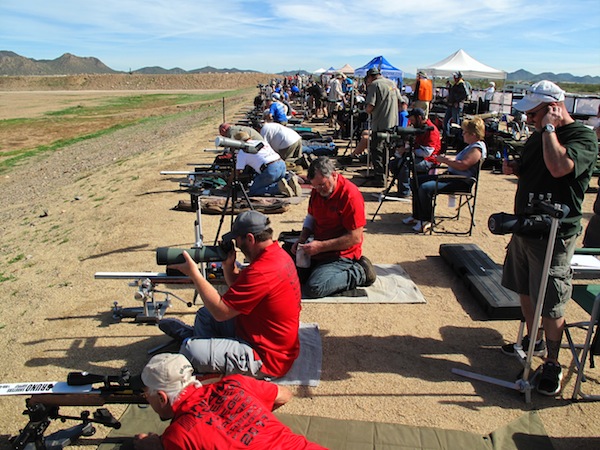
Thursday was TEAM DAY at the Berger Southwest Nationals (SWN). In the Sling, F-TR, and F-Open classes, dozens of 4-person teams shot under coaches at 800, 900, and 1000 yards. The key difference between the team game and individual competition is that (for the most part) shooters function as trigger pullers only. Wind and elevation calls are typically made by the coaches, who sometimes even dial clicks for the shooters. In the above photo Bryan Litz is just about to click his shooter’s elevation turret.
This year the Scottish Thistle Team won the Sling division, lead by a strong 449-27X performance by Angus McLeod. The Hayes Rays of Sunshine Team finished second, six points back. In the highly competitive F-TR class, North by Southwest took the team title, with Da Bulls in second.
In the F-Open class, the Cluster Ducks (clever name) took the win, edging out second place The Longshots by a single point. Third in F-Open was Tex-Mex #1. Kudos to AccurateShooter’s own Jay Christopherson, our site systems manager, who lead 4th Place Team Lapua/Brux with a strong 448-25X. Jay keeps our servers running smoothly — and he’s a great shooter in his own right.
Here’s Team Krieger (foreground) getting ready on the 1000-yard line.
Anette Wachter (in chair) shot a 450-36X in the Team Match — not dropping a single point. Outstanding!
TEAM EVENT TOP THREE in SLING, F-OPEN, and F-TR
SLING
1st Place — Scotland Thistle 1786-100X
Angus McLeod, 449-29X
Sandy Walker, 447-27X
Ian Shaw, 445-24X
Michael Barlow, 445-21X
2nd Place — Hayes Rays of Sunshine 1780-97X
3rd Place — Sabine 1775-88X
NOTABLES: Annette Wachter, 450-36X (4th Place Team High)
F-OPEN
1st Place — The Cluster Ducks 1789-100X
James Laney, 450-27X
Kevin Shepherd, 448-24X
Norman Harrold, 448-21X
Joe Meyer, 443-28X
2nd Place — The Longshots 1788-103X
3rd Place — Tex-Mex #1 1781-93X
NOTABLES: Jay Christopherson, 448-25X (4th Place Team High)
F-TR
1st Place — North by Southwest 1773-74X
Daniel Lentz, 445-22X
Ian Klemm, 445-17X
Daniel Pohlabel, 443-18X
Ken Klemm, 440-17X
2nd Place — Da Bulls 1770-81X
3rd Place — Michigan F-TR Team 1764-85X
NOTABLES: Mike Plunkett 447-16X (4th Place Team High)
NEW F-OPEN TEAM Record: The Cluster Ducks set a new National Team Record for 800/900/1000 yards with their 1789-100X Score. In fact, the second-place Longshots also broke the previous 1786-104X record, set by Team Grizzly in 2014. Because the Cluster Ducks edged The Longshots by one point the Ducks will go down in the record books. But both teams can rightfully say they broke the then-current 1786-point F-Open record. Well done shooters!
Team Thunder-Struck from the Land Down Under brought along an inflatable mascot.
GUNS and GEAR HIGHLIGHTS
Interesting Competition Hardware at Ben Avery
Eliseo F-Class Chassis with Two-Piece Barrel Block
Christine Harris was shooting a new prototype Eliseo F-Class stock with a two-part barrel block. This is similar to the Eliseo F1 stock but the bolt-together barrel block allows easier exchange of barreled actions.
Stunning F-Open Rig from Cerus Rifleworks Cerus Rifleworks showed us a jaw-dropping new F-Open rifle. This is an amazing combination of beauty and advanced performance. The CNC-milled stock is stiff and straight, with tolerances that put most wood stocks to shame.
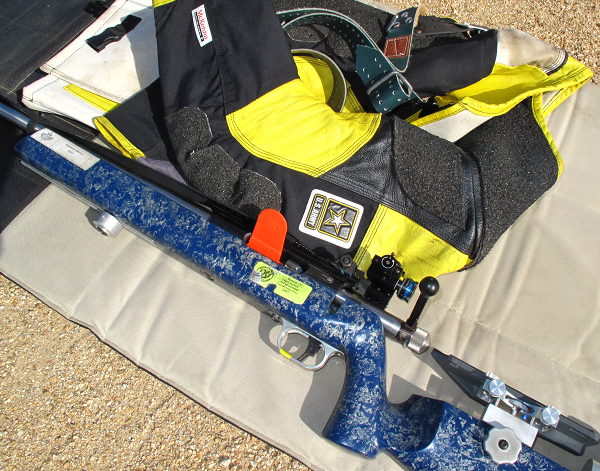
A Lady Soldier’s Coat and Rifle
This Monard shooting coat belongs to SSG Amanda Elsenboss, a shooter with the USAMU Team. The rifle features a Barnard action in what appears to be a classic Robertston Composites H&H-style prone stock. Nice hardware for a talented lady soldier.
Pair of ‘Pods
We saw many SEB Joy-Pods on the front end of F-TR rifles. These light-weight bipods offer quick and easy aiming via a joystick-controlled coaxial head. The large flat feet allow the rifle to move back smoothly on recoil, and then slide right back on target.
Gear-Hauler for Many Seasons
This cart has seen countless matches over the years. Those stickers are markers in time, recording decades of shooting matches in many venues. How many stickers can you identify?
Distinguished Rifleman’s Spotting Scope
The stories this old spotting scope could tell — how many targets has it seen over the years? The most important sticker, “Distinguished Rifleman”, bears witness to its owner’s skill and commitment to the sport.
Nightforce Optics Competition Scopes
Nightforce, a major sponsor of the Berger SW Nationals, had a variety of scopes mounted on viewing rigs. You could quickly compare one scope vs. another. We’d like to see more optics makers demo their scopes at major matches.
Forum member Bill Goad’s 6XC II Hunter Rests in a Whitetail Rack taken this past year.
One of the most popular items in our Shooters’ Forum is the ongoing “Pride and Joy” thread. Since 2009, Forum members have posted photos and descriptions of their most prized rifles. Here are some of the most recent “Pride and Joy” rifles showcased in our Forum. Do you have a gun you’d like to see featured there? Just Register for the Forum and you can add your favorite gun to the list.
TT Freestyle’s Husband and Wife Borden Benchrest Rifles
Here’s a pair of “His and Hers” rigs delivered by Santa in December. Forum member TT Freestyle reports: “After our rookie year in Short Range Benchrest with good used equipment, my wife and I decided we liked it enough to get two new Bordens for Christmas!”
FalconPilot’s Fabulous F-Classer in Shurley Claro Walnut Stock
This beauty belongs to Forum member FalconPilot. He tells us that his “Lastest F-Classer features a Shurley Brothers SOD stock in beautiful Claro Walnut.” Components include Bat M action, Bix-N-Andy trigger, and Nightforce Comp scope. FalconPilot has several barrels for this Open-Class rig, including tubes chambered for .284 Win and 6mm Dasher.
Eric’s Blacktical .308 Win for Precision Rifle Series
Forum member Eric32 spent months building out this rifle, “getting it to work just right for PRS”. Designed for practical/tactical matches, this rugged rig features a blue-printed Rem 700 action (with 1.5-lb 40X trigger) in an XLR Element chassis. On the end of the .308 Bartlein 5R barrel is a JP brake. Other components include: PiG skins barricade grips, Atlas Bipod, and GGG bungee sling. On top is a SWFA HD 5-20x50mm optic with Vortex scope level and custom throw-lever.
Forum member Willow reports: “Here is my new F-Open gun. It features a hydro-dipped LowBoy stock and LH Barnard Model P action with ‘V’ bedding block. The barrel is a straight profile 32″, 1:8.5″ twist Bartlein 5R, chambered in 280AI by Matt Paroz”. On top is a Vortex 10-60x52mm Golden Eagle in a Spuhr 3001 mount. Willow says his lightning bolt rig is a shooter: “After 42 rounds through the barrel, I’m liking what I am seeing so far”. Check out that trick aluminum base for his rear Edgewood bag.
Stinnett’s 6.4×47 Lapua Tactical Rig
Forum member Stinnett tells us: “This is my third 6.5×47 Lapua rifle — the 6.5×47 is the best cartridge ever! I’m not a huge fan of muzzle brakes. I look at them as tools — use the correct tool for the job. The ’47 doesn’t need a brake. .308 Winchester and up need muzzle brakes. For this rifle, I’m going to start out with 123gr Scenars and Reloder 15. I also like to shoot the 123gr SMKs and Varget. The SMKs are much less seating-depth sensitive. Very easy to find a load! Also gonna try the Berger 130 Hybrids and H4350.”
Components: McMillan A5 adjustable stock in GAP Camo, Stiller TAC 30 A/W action, Jewell HVR trigger, Badger bottom metal and DBM, Atlas Bipod, Nightforce NXS F1 3.5-15×50 with MLR 2.0 reticle. Metal has been Cerakoted graphite black.
6mm BRX Benchgun with Home-Made Cherry/Redheart Stock
You have to give credit to a guy who crafts his own custom wood stock. This 6mm BRX benchgun features a custom-built laminated stock featuring Cherry wood with vivid Redheart pieces on the sides and Redwood Burl on the buttplate. The front of the stock is 4″ wide. The action is a Benchrest Borden RBLP Right Eject unit, with custom titanium scope rings on top. Owner Erick C. is proud of this stock, saying it is “the best one I’ve built so far”. We agree it’s a beauty.
Get ready for a revolution in the F-Open, ELR, and Long-Range Benchrest games. Sierra just introduced a new 7mm bullet with a stunning 0.780 G1 BC. This new 197-grain HPBT MatchKing is one of the highest-BC, jacketed .284-caliber projectiles ever offered to the public. By comparison, Sierra’s own advanced 183-grain 7mm Matchking has a .707 G1 BC. That means the new 197-grainer has a 10% higher BC than the already slippery 183-grainer. That’s an impressive achievement by Sierra.
We expect top F-Open and long-range shooters will be trying the new 197-grainer as soon as they can get their hands on this new projectile. They may need new barrels however, as Sierra states: “This bullet requires a barrel twist rate of 1:7.5″ or faster”. Sierra expects to start shipping these slippery 7mm 197s very soon. You can order directly from Sierra’s website, stock code #1997, $54.20 for 100 bullets.
Factory Uniformed Bullet Tips
Sierra has officially announced that the 197gr SMK will come “pointed” from the factory. These impressive new 197s will have a “final meplat reducing operation” (pointing). This creates a higher BC (for less drag) and also makes the BC more uniform (reducing vertical spread at long range). Our tests of other factory-pointed Sierra MKs have demonstrated that Sierra does a very good job with this pointing operation. The “pointed” MatchKings we’ve shot recently had very nice tips, and did hold extremely “tight waterline” at 1000 yards, indicating that the pointing process does seem to enhance BC uniformity. Morever, radar-derived “real-world” BCs have been impressively uniform with the latest generation of pointed Sierra MKs (such as the new 110gr 6mm MatchKing).
Here is the statement from Sierra about the new bullets:
Shooters around the world will appreciate the accuracy and extreme long range performance of our new 7mm 197 grain HPBT (#1997). A sleek 27-caliber elongated ogive and a final meplat reducing operation (pointing) provide an increased ballistic coefficient for optimal wind resistance and velocity retention. To ensure precise bullet to bore alignment, a unique bearing surface to ogive junction uses the same 1.5 degree angle commonly found in many match rifle chamber throats.
While they are recognized around the world for record-setting accuracy, MatchKing® and Tipped MatchKing® bullets are not recommended for most hunting applications. Although MatchKing® and Tipped MatchKing® bullets are commonly used for varmint hunting, their design will not provide the same reliable explosive expansion at equivalent velocities in varmints compared to their lightly jacketed Hornet, Blitz BlitzKing, or Varminter counterparts.
New product tip from EdLongrange. We welcome reader submissions.
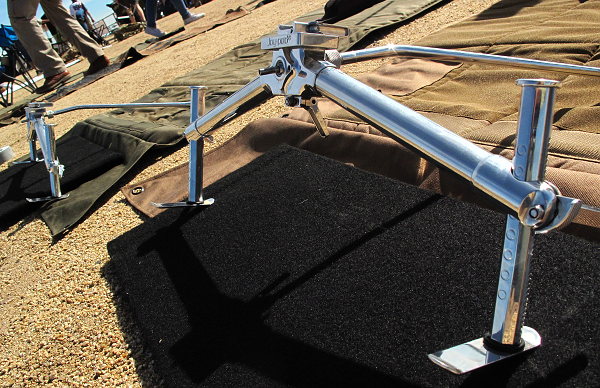
SEB Rests, producers of the SEB NEO rest and innovative JoyPod bipod, have released an all-new, portable tripod-base Co-Axial rest, the SEB Mini. This is a very impressive bit of engineering by Sebastian Lambang. Weighing about 12 pounds, the SEB Mini is easy to transport yet stable and versatile in the field. A joystick lever-arm allows the shooter to move the front head (with sandbag) in any direction with a smooth continuous motion. The Mini delivers about 30 MOA vertical travel by 45 MOA horizontal travel with the same smooth, fluid feel as the NEO rest.
The Mini is now in full production and testers in the USA and UK have returned very positive test results. The Mini combines the smooth controls of a full-size Co-Axial front rest, yet is much easier to transport. Based on reports from testers Dan Bramley and Vince Bottomley, we predict the Mini will become extremely popular with F-Open competitors as well as all shooters currently using pedestal-style front rests for recreational shooting or load testing. Price for the complete unit (with front bag) is $675.00 shipped in the lower 48 states.
Inventor Seb Lambang told us his design goals in creating the Mini, which was named after “Mini” his pet Chihuahua: “The Mini rest is designed to be simple, compact, and light. It has has equal smoothness and MOA travel as the larger NEO rest.”
The new SEB Mini is a joystick (coaxial) rest with a height-adjustable single center column fitted on a base with three foldable legs. The top can be rotated 360 degrees and locked securely by the two adjustable locking levers. The lowest setting is about 6.25″, the highest is just over 10″. The SEB Mini can be used for F-Class shooting, bench rest shooting, varmint shooting, or load development. The joystick handle is compatible with the SEB NEOs and MAX co-axial rests. The Mini ships complete with a one-piece front sandbag in the buyer’s choice of width.
Key Features:
12-lb carry weight
Large Footprint, yet very portable
Legs adjust with individual thumbwheels
Mariner Wheel offers 40mm of Vertical Adjustment
Measures 5″ x 7″ x 16.25″ when folded
Lowest height approx 6.25″, highest 10″ or more
Head can be rotated independent of base assembly (to assist alignment)
Head unit can be purchased separately and fitted to different tripod base.
SEB Mini REVIEW by Dan Bramley:
Sebastian Lambang, the creator of the ever-popular SEB NEO and SEB MAX co-axial front rest, was kind enough to send me a SEB Mini for review. The point of this review is to give a shooter’s perspective. I will just say that the adjustments and movements are plenty sufficient to shoot in F-Class in High Power and rimfire.
Positives: The SEB Mini has all of the fine craftsmanship of the NEO. The fit and finish is excellent. This thing is SOLID! When the screws are all locked down it does not budge. The engineering is excellent and well thought-out. It comes in at 12.0 lbs with sand in bag and ready to shoot. To me this weight appears to be optimal, light enough to travel with but heavy enough to be stable.
Shootability: For me shooting off the SEB Mini was no different than shooting off the SEB NEO. The fluid motion of the coaxial top and stability were consistant with the NEO. Set-up was quick and the ability to set it down in reasonably close alignment and release the clamps on the Acme screw to allow perfect rest alignment was a nice feature. Course adjustment was quick with the large mariner wheel and the joystick has the same size collet as the NEO for those who may have made custom joysticks.
I shot my rimfire off of it at first, on concrete, and it didn’t move at all. No surprise there. So I figured I would shoot my biggest rifle off of it in an attempt to punish this little “Mini”.
Conclusion: This thing is just awesome! It folds up quite compact and would likely fit in a bag, instead of a pelican case, for travel. I have often thought of shooting my open rifle off of a JoyPod when traveling by air but that requires a rail etc. for mounting. I would not hesitate to shoot off this Mini in competition.
Vince Bottomley Tests the New Seb Mini
Our friend Vince Bottomley acquired a Seb Mini and had a chance to test it out in competition at the Diggle Range in the UK. Vince was very impressed with the Mini, which he says is very solid and smooth running, yet easy to set up. Vince used his new Mini to win a match, proving the unit is “competition-ready”: “When you do a range test like this, it’s always great if you can post a decent result and I’m pleased to be able to report that I won Open Class….”
Vince liked the smooth operation and broad windage/elevation adjustment range offered by the Mini:
“The joystick offers plenty of movement at 600 yards so staying on target throughout the shoot was no problem and, more importantly, I could swing onto my competitors’ targets as a final wind-check. Each of the three legs has its own ‘angle’ adjustment — enabling you to obtain a steady, level set-up on the most uneven of firing-points. The center pedestal can be raised and lowered using a mariner wheel and of course, there is the familiar joystick adjustment.”
Vince said it was easy to level the Mini and align the head with his rear bag: “Drop it on the point, then level the bubble using the leg-adjuster thumb-screws (photo right). Because the screws are at the pivot point they move the legs very quickly — as opposed to screwing the feet to level a NEO. Wind up the mariner wheel to get on target, nip up the locking levers and the rest is perfectly aligned, thanks to the swiveling head.”
Vince also liked the fact that the Mini is significantly lighter than a SEB NEO rest, but still stable because it has a wide footprint. See the comparison photo below.
Vince tells us that the Mini is truly easy to transport: “I’ve fixed a strap to my Mini so, by slinging it over my shoulder, I can carry rifle, mat and back-bag with ease — so that’s a big ‘plus’ right off.”
Conclusion: “The SEB Mini lived up to expectations and ticked all the boxes –lighter to carry, easy to set up, plenty of adjustment, very stable. Thank you Seb… You have a winner here!” — Vince Bottomley
Product Information from SEB Rests:
The complete SEB Mini includes Head unit, foldable legs, fore-end stop, aluminum bag bracket (with bubble level), joystick, leveling screws, and front bag. The base features three foldable legs, each of which can be adjusted/tilted for elevation via a thumb screw. We recommend setting the base/legs in the highest position initially, then lowering each leg via the thumb screws.
The Mini is offered in three (3) configurations. The complete Mini with base, foldable legs, and carry case is $800.00, including shipping to the lower 48 States. For considerable less there are two legless options. Option 1 is the Mini without the foldable legs. This could work for customers who may wish to fit the top to a solid base plate. Option 2 includes just the head unit with center post, mariner wheel and needle thrust bearing. Option 2 could suit customers who already have a Bald Eagle or Caldwell base with 1″ diameter center hole/post. However some machining may be required. Call Ernie Bishop at 307-257-7431 for current option prices and availability.
Net weight approx. 5.5 kilograms (12 lbs)
Top can be rotated 360° and locked securely in any position
Measures 5″ x 7″ x 16.25″ when folded
Joystick is compatible with SEB NEO, MAX and JoyPod
Lowest height approx 6.25″, highest 10″ or more
Foldable legs can be individually adjusted up/down with thumb screws
Extra wide footprint, leveling screws are about 17 inches apart
Ambidextrous, and can be used either “Up for Up” or “Up for Down”
Made from 6061 and 7075 aircraft grade aluminum
Head has removable fore-end stop
Standard fold-able base for traveling with tiltable legs
Comes with standard one-piece 3″-wide front bag 3″ wide (Optional bags*: 2-1/4″, wide sporter (for 1.5″-2″ stock), narrow sporter (for 1″-1.5″ stock)
For more information, visit SEBRests.com. The USA dealer is Ernie Bishop:
F-Class has become one of the fastest-growing types of mid-range and long-range rifle competition. Because of that popularity, a market for specialty equipment has been created, including stocks. McMillan Fiberglass Stocks offers a variety of stocks for both F-TR and F-Open disciplines. Shown above and below is the new Kestros*, McMillan’s upgraded, second-generation F-Open stock. This is an impressive offering, with good stiffness, a torque-taming low-profile design, and good adjustability for the shooter. Our friend Boyd Allen had the chance to test drive a Kestros recently.
McMillan Kestros “First Look” Range Review by Boyd Allen
McMillan’s first-generation F-Open stock was well-received, and this new GEN II Kestros includes some significant improvements, making it even better. To achieve increased stiffness, the fore-end was filled out and its fill density was increased. (F-Open rifles have a rather generous 22-lb. weight limit, so the slight increase in stock weight should not be a problem.)
Because F-Open Shooters typically shoot long, heavy bullets through fast-twist barrels, torque control is an issue, which is why the base of the front section of the fore-end is close to the barrel. This low-profile design counters torque. By maximizing the angle defined by the bottom corners of the stock and the bore’s centerline, this stock geometry increases resistance to roll.
As tested, this Kestros stock features a nice three-way adjustable butt, as well as an adjustable cheek piece. Symmetrical palm swells and the symmetrical cheek piece make the stock truly ambidextrous. We believe that the cheekpiece locking knob can be switched to either side, adapting to both lefties and righties.
Comments by Tester Boyd Allen
Wanting some visual pop for pictures, and knowing that this was to be a range-only rifle, I ordered a tri-color flame pattern gel coat, the most durable of stock finishes, because it is part of the stock rather than being an applied, surface-only finish.
McMillan has been in the stock business for a long time, and when you sit down behind this one, you understand why. This company really knows what it is doing. The Kestros is a real pleasure to shoot, tracking perfectly. As the saying goes, it falls readily to hand.
My test Kestros stock came very accurately CNC-inletted for my action, with the optional aluminum pillars. The fit is so good that I am doing a full load work-up before doing final bedding, so I can see just how much (if any) bedding improves accuracy. For this test I have chosen a 6PPC barrel (yes it does look short with this stock.) because it will allow me to make finer distinctions in this area. Later I will be working with other calibers (and longer barrels). So far I have been very impressed with this stock — ergonomics, tracking, stability, build quality, and inletting have all been excellent.
* The original Kestros (aka “Kestrosphendone” or “Cestrus”) was an ancient Greek military weapon, a type of sling used to hurl heavy, arrow-like finned projectiles.
Forum member Rardoin’s handsome F-Open rig features the new Borden BRM-XD action.
One of the most popular items in our Shooters’ Forum is the ongoing “Pride and Joy” thread. Since 2009, Forum members have posted photos and descriptions of their most prized rifles. Here are some of the most recent “Pride and Joy” rifles showcased in our Forum. Do you have a gun you’d like to see featured there? Just Register for the Forum and you can add your favorite gun to the list.
Bill Goad’s 6PPC Hunter “Ranch Rifle”
Forum member Grimstod tells us: “This is the personal rifle of Bill Goad. He has been experimenting with it on several levels. It is shooting great and has several matches on it now. Please enjoy these photos. More can be found on the website www.PremierAccuracy.com. We like the subtle barbed wire effect on the stock.
Twin-Upper AR with Custom Wood Furniture
This very unique AR belongs to Forum member Nuto-BR. He tells us: “Here are the two uppers I built. The top one is am X-caliber in 20 Practical with 24-inch, 1:11″-twist barrel. The bottom one is a WOA in .223 Rem, with 20″, 1-12″ twist barrel. They both shoot 1/2 MOA or better. Both stocks are laminated Maple and Walnut. I reversed the order of the two woods to tell them apart.”
Two Dashers and a Rimfire for Fun
Courtesy Forum member Dan H., here are two red-stocked Dashers plus an Anschutz 54.30 (Benchrest Stock) to make it a trio. Dan says: “The Anschutz provides good practice in trigger-pulling. It’s amazing what you can learn from a rifle that is as sensitive as this one.”
Dream Hunting Rifle with Custom Camo
Here is Forum member TyDaws’s “Dream Hunting Rifle” in 6.5-280 Ackley Improved. We love the custom paint work by by Melodie Yarbrough. Smithed by West Texas Ordnance, this rifle features a Rem 700 action with fluted bolt, PT&G tapered recoil lug, and Timney 510 2-lb trigger. The barrel is a fluted 26″ 1:8″-twist Bartlein 5R #3 contour. On top is a Huskemaw Blue Diamond 4-16x42mm optic in Warne Maxima rings. That’s an Atlas bipod up front.
Three Guns for Mr. Big
Forum Member Mr. Big offered up another trio of rifles — two bench guns and a tactical rig. Mr. Big says: “Here are the rifles I shoot most: Farley 6mm PPC, Stiller .243 Win, and Rem 6.5×47 Lapua. They will do just about anything I ask them to…” Challenge: Can you identify the makers of the three different stocks shown in this picture (and the different materials used in each)?
Dasher in Robertson Spider Web Stock
Here is Forum member Vahena’s 6mm Dasher. It has a no-turn-neck chamber in a 28″, 1:8″-twist barrel with 1.25″ straight contour. This has an original Robertson fiberglass stock with spider web graphics. This rifle was originally built as a 6.5×284 with a fluted barrel. Now it sports a bigger barrel for a smaller cartridge. The front rest is a SEB Neo with counterweight up front.
Report by Des Parr
With every new season, standards in the F-Class game are climbing ever higher. Shooter are improving their skills set while equipment and loading techniques are improving (thanks in part to websites such as this). Evidence of the level of improvement in F-Class shooting comes from the UK, where a talented shooter drilled a new GBFCA record score. One of our rising stars on this side of the pond is F-Open shooter Paul Hill. He hails from England’s wide-open flat lands where the wind blows strongly in from the North Sea and where a shooter must soon learn to read the wind.
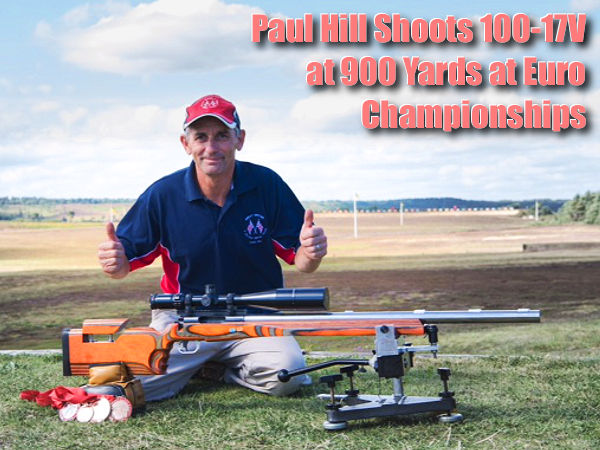
At the European Championships held in September at the Bisley ranges, Paul set a new record score at 900 yards — a 100-17V! That’s 17 shots placed in a five-inch circle the size of a CD (compact disc) at over half a mile. [NOTE: At Bisley, the maximum score is FIVE points, not ten points. So the maximum score for 20 shots is 100. Also what Americans call an “X” is called a “V” at Bisley.]
Record Set with Slower Pair Firing Method
Bear in mind the style of shooting here in Great Britain is pair-firing. Under this procedure, each of two competitors shoots alternately, taking turns from shot to shot. Each shooter has 45 seconds to get his shot off. Allowing for the target pullers to do their jobs, this means that each shot can take up to one minute. As Paul was pair firing, he had to concentrate for up to 40 minutes to get all 20 shots off! You can imagine how many times the wind changed course in those 40 minutes — pick-ups, let-offs, changes of angle and direction. Paul had to counter each change and still managed to keep 17 shots in that 5-inch circle!
Paul Hill Sets Record with His First-Ever DIY-Chambered Barrel
What makes this new GBFCA record all the more significant is that Paul did it by barreling his own rifle — and for the first time! By simply taking great care and attention he has chambered and fitted a barrel himself to the very highest standards. Paul chambered the Krieger 1:9″-twist barrel for the .284 Winchester cartridge. His action was a Barnard. The stock is by Joe West.
Record Shot with Lapua 180gr Scenars and Russian Primers
We should note that Paul Hill is a very keen fan of Lapua’s 180gr Scenar-L bullet. It has to be said that this bullet doesn’t have the highest BC, yet whatever it lacks in that department it more than makes up for by being remarkably consistent — and consistency counts for a lot. Paul is also a fan of the Russian KVB-7 primers. His achievement is proof that Lapua Scenars and KVB-7 primers are every bit as good as the premium-priced alternatives. The powder was Vihtavuori N160. [Editor: For its 180gr Scenar-L, Lapua lists a 0.661 G1 BC, and a 0.332 G7 BC. Those numbers may not top the charts, but they are still very impressive.]
Records are made to be broken, but we think it will be quite a while before Paul’s 200-17X is surpassed in European competition. If you feel up to that challenge, consider competing in next year’s European Championships in late September 2017.
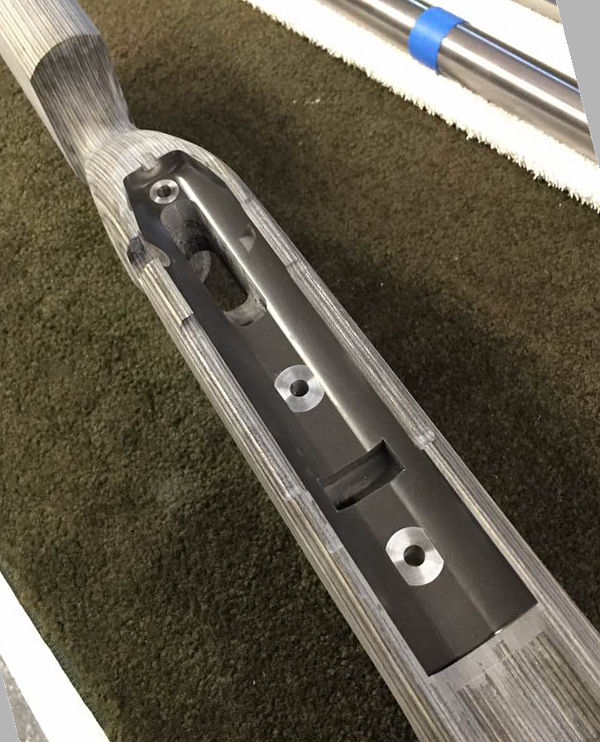
Here is a very interesting rifle, a true metal/wood hybrid that combines an aluminum front section with figured walnut in the rear half. As you can see, this unique rifle also features a barrel block that allows the Savage action to float. You may be wondering “how is the metal section connected to the wood?” The gun’s owner/builder epoxied a stainless steel tube in the wood and that tube is secured in the aluminum fore-end with set screws.
Forum member Justin V. reports: “Sometime last fall my buddy wanted to build barrel-blocked Bavage. He is a machinist by trade so he was able to build all of the custom components himself. I know he put a ton of time into this thing over the winter, taking his time to get it done right. If you shoot in Cadillac or Midland, Michigan you will probably see him around. He tried to shoot a match this past weekend but was rained out. Hopefully it will stop raining in Michigan so he can see what it can do at 600 yards. Here are the results….” Learn more about this gun in this FORUM Thread.
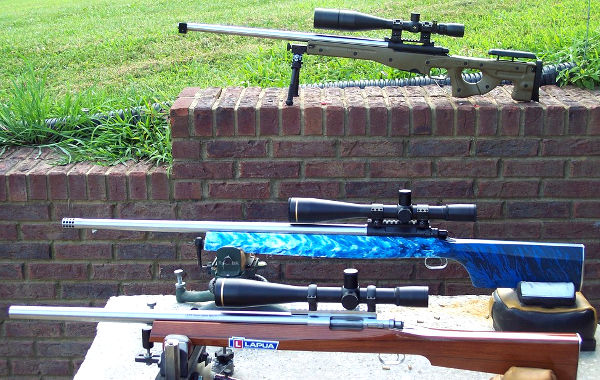
Forum member Keith W. (aka “Cigarcop”) is a talented riflesmith whose projects display outstanding finish work and attention to detail. Keith does some of the best bedding work we’ve ever seen. Recently Keith completed a rifle for tool-maker John Perkins, owner of 21st Century Shooting. John, who recently competed at the F-Class Nationals in Lodi, WI, wanted a new F-Open rifle with top-of-the-line hardware and a sweet-tracking stock. We think John will be impressed with this gun — and we bet it proves to be an tack-driving “hammer”. John will use the 21.5-lb rifle for F-Open competition and some mid-range and long-range benchrest competition in HG class.
This stock sports 12 coats of Urethane, wet-sanded between each coat.
This competition rifle features a melonited BAT “M” action (with Bix’N Andy trigger), a pair of 7mm Brux barrels chambered in .284 Win, and a Precision Rifle & Tool (PRT) Low-Boy stock. As you can see from these photos Keith posted in our Shooters’ Forum, this is a beautifully-finished rifle. If you have questions about this project, direct them to Cigarcop in this FORUM Thread.
Build Details for a Beautiful F-Open Rig
Keith reports: “The rifle is built on a PRT Laminated Low-Boy F-Class Stock with a Bat M Melonited Action, +20 MOA rail, Pillar bedded in Devcon 10110. After bedding and inletting I clear-coated the stock with 12 Coats of a 3-part Urethane finish which was wet-sanded between each coat and sanded out to 2000 before final polishing. John Perkins provided two Brux 1:9″-twist, 1.250″-contour barrels. They are both finished at 31″ and chambered in straight .284 Win with .313″ neck and .213″ freebore to shoot the 180gr Berger Hybrids.
Cigarcop does superb bedding work, as you can see…
John chose the Bix’N Andy trigger after sampling one of Erik Cortina’s rifles at the Berger SW Nationals. “I tried the BNA trigger on Erik’s gun and I was so impressed. It is very light but 100% consistent. After an injury I’ve lost some feel in my trigger finger and the BNA helps because it is so smooth. I would never go back to anything else.”
New Seating Die from 21st Century
While talking about his new rifle, John Perkins revealed that he has developed a very sophisticated new micrometer seating die: “This is something very new, and unlike anything else on the market. Each die is tailored to the dimensions and ogive curve of your particular bullet which we measure with an optical comparator. The customer provides fired, sized brass and sample bullets and we can produce a perfect match.”
John says his new seating dies produce ultra-consistent base-to-ogive load lengths along with exceptionally low run-out. “This new die produces incredibly straight ammo — there are some special features inside the die that help straighten the bullet during the seating process”. That delivers “truly superior concentricity” according to John. 21st Century Shooting will be taking orders soon for the new seating die. Call (260) 273-9909 for more information.
The 2016 F-Class Nationals kick off in nine days. The nation’s top F-Class shooters head to Lodi, Wisconsin for the Mid-Range Championship (Sept. 23-27) followed by the Long-Range Championship (Sept. 27 – Oct. 1). If you want to polish your skills with some last-minute practice at your home range, here’s a handy option for F-Class shooters. Here are some reduced 300-yard target centers that let you duplicate the MOA size of the official F-Class targets, but at closer range.
These reduced-size target centers were created by Forum member SleepyGator, an F-Class competitor who needed practice targets he could use at 300 yards. There is an official reduced-distanced standard for 300-yard F-Class matches. This utilizes the NRA No. MR-63FC – F-Class Target Center which is pasted over the MR-63 target. It provides a 1.42″ X-Ring, 2.85″ 10-Ring, and 5.85″ Nine-Ring. (The dimensions of F-Class targets are found in the NRA High Power Rules, Sec. 22, part 4, page 70 — see sample below.)
To duplicate the 300-yard target, SleepyGator has prepared a printable version of the MR-63FC Target Center, along with a pair of training targets with two bulls and five bulls. The two-bull and five-bull targets mirror the scoring rings on the MR-63FC, but they display only the innermost three rings and two rings respectively. All three targets are Adobe Acrobat (PDF) files that can be easily printed. You may need to adjust the scale (sizing) on your printer to get the dimensions exactly correct. As noted above, when printed, the 10-Ring on all three targets should measure 2.85″. This should provide some handy practice targets you can use between matches. Thanks to SleepyGator for providing these targets. You can download all three as a .Zip archive. After downloading the .Zip file, just click on the .Zip archive to extract the individual targets.







 “The joystick offers plenty of movement at 600 yards so staying on target throughout the shoot was no problem and, more importantly, I could swing onto my competitors’ targets as a final wind-check. Each of the three legs has its own ‘angle’ adjustment — enabling you to obtain a steady, level set-up on the most uneven of firing-points. The center pedestal can be raised and lowered using a mariner wheel and of course, there is the familiar joystick adjustment.”