U.S. Rifle Team (F-TR) Selects New Berger 200.20X Bullet for 2017 World Championships
Berger Bullets has released new .30 caliber bullet that could be a game changer for the F-TR discipline — a bullet with exceptional accuracy and very high BC. Berger’s NEW 200.20X Hybrid Target Bullet is the result of extensive research and development in partnership with the U.S. Rifle Team (F-TR), world champion shooters, and accuracy enthusiasts within the long range shooting community.
The new 200.20X has a 0.640 G1/0.328 G7 BC compared to 0.616 G1/0.316 G7 for the older 200 grain .30 caliber Hybrid. That’s a significant reduction in drag. Recommended twist for the new bullet is 1:10″, same as with the earlier 200-grainer.
Berger Chief Ballistician and U.S. Rifle Team (F-TR) member Bryan Litz said, “This is the ideal bullet for F-TR and similar long-range disciplines. The 200.20X has a longer boat tail and nose, with shorter bearing surface which equates to less drag, a higher ballistic coefficient, and fewer points lost to the wind. The BC of the new 200.20X is 4% higher than the existing 200 grain Target Hybrid (G7 BC of 0.328 vs. 0.316). The shorter bearing surface also makes the 200.20X easy to load and shoot in standard chambers. New shooters won’t need special reamers or costly gunsmithing to make this bullet perform.” Bryan himself is switching to the new 200.20X: “After winning the 2015 National Mid-Range and Long Range F-TR Championships with the Berger 215 grain Target Hybrid, I’m switching to the 200.20X because it’s an even better option.”
Bryan tells us that new 200-20X bullet requires a 1:10″ twist to achieve full stability and performance (BC) in most conditions, but you can shoot it out of a 1:11″ twist with a minor decrease in BC. For a stability analysis, enter this bullet in the Berger Stability Calculator with a weight of 200.2 grains, and a length of 1.508″ to get stability results for your particular rifle and atmospheric conditions.
After extensive field testing, this new 200.20X bullet has been adopted as the official .30 caliber match projectile for the U.S. Rifle Team (F-TR). The team verified that this new bullet offers very impressive performance — the higher BC equates to less wind drift, and this bullet has shown exceptional ability to “hold waterline”. Check out this 1000-yard group by Team member Dan Pohlabel, as shown on an electronic target monitor.
To learn more about the new .30 caliber 200.20X Hybrid Target Bullet and its development, visit the Berger Bullets Blog for details. These 200.20X bullets are available right now through your favorite authorized Berger Bullets vendors.
About the U.S. Rifle Team (F-TR)
The two- time World Champion, U.S. Rifle Team (F-TR) is comprised of 30 shooters and coaches who have dedicated themselves to four years of training and preparation to represent the United States at the 2017 World Championships to be held in Canada. They compete all over the world at various ranges out to 1,000 yards.
Buy Bullets and Support U.S. Rifle Team (F-TR)
Eric Stecker, President of Berger Bullets said, “We are proud to be the Official Bullet of the U.S. Rifle Team (F-TR). To support our team, Berger Bullets will donate $1.00 for every box of 200.20X bullets sold towards U.S. Team expenses for the upcoming 2017 F-TR World Championships, which will be held at the Connaught Ranges in Ottawa, Canada.”
Many of the world’s best F-Class shooters have traveled to Ottawa, Ontario, Canada this week to compete at the Canadian F-Class National Championships. F-Open ace Shiraz Balolia, who won back-to-back Canadian F-Open Championships in 2015 and 2014, will pursue a “three-peat” at Canada’s Connaught Ranges. There will be plenty of F-TR talent on hand as well, including Bryan Litz, reigning U.S. Mid-Range and Long-Range F-TR Champion. The first challenge for the shooters will be the weather, which can be notoriously wet and windy at Connaught. The weather forecast looks good for today and tomorrow, but thunderstorms (and rain) are predicted for Friday and Saturday.
U.S. F-TR Rifle Team Prepares for the Canadian Championships:
Shown above is the U.S. F-TR Rifle Team, which will compete in the F-TR division. In the America Match, teams from Canada, South Africa, and the United States will battle head-to-head for national honors.
Many Companies Help Sponsor U.S. F-TR Rifle Team
It takes significant resources to field a large shooting team in international competition. The U.S. F-TR Rifle team is fortunate to have many great sponsors helping the team with equipment and financial support. The team’s top-level “Gold Medal” sponsors, are, in alphabetical order: Berger Bullets, Gemtech, Kelbly’s, McMillan Fiberglass Stocks, Nightforce Optics, Pierce Engineering, and 5.11 Tactical. CLICK HERE for a list of all sponsors.
We know you guys like do-it-yourself (DIY) projects. And we also know that our readers like anything that helps a rifle sit more securely in the bags, and track better on recoil. Here’s a little accessory you can make yourself for pennies that will help rifles with conventional (non-benchrest) stocks ride the rear bag better.
This DIY Bag-Rider is simple in design and easy to make. The invention of Forum member Bill L. (aka “Nomad47″), this is simply a short section of PVC pipe attached to the bottom of a wood stock with a couple of screws. The back half of the PVC tube is cut at an angle to match the lower profile of the stock. Nomad47 painted the PVC Bag-Rider black for sex appeal, but that’s not really necessary.
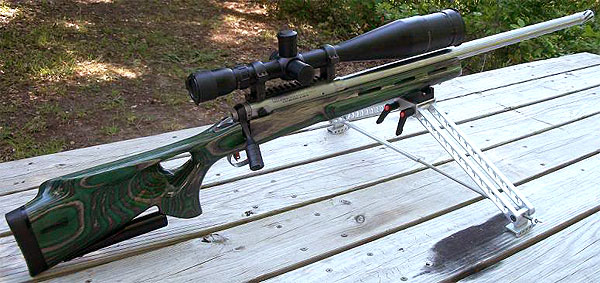
In the top photo you can see Nomad47’s bagrider attached to a Savage varminter. In the photo below, the PVC bag-rider tube is fitted to an F-TR style rig with a green, laminated thumbhole stock. This rifle also features a Savage action with a custom barrel and “wide-track” bipod. (Note: to be legal in F-Class competition, the muzzle brake would have to be removed.)
Derek Rodgers, the only shooter to win both the F-Open and F-TR National Championships, has done it again. While shooting the Santa Fe Trail LR Regional match in Raton, New Mexico, it looks like Derek set a new 1000-yard record. Derek nailed his 1000-yard target, recording a 200-14X score — that’s twenty (20) shots for record, all tens with 14 in the X-Ring. Derek told us: “Yesterday at Raton New Mexico’s Whittington Center, I shot a 200-14X, which should be a new pending F-TR National Record at 1000 yards.” Derek took special pride in this accomplishment, as he held the F-TR record before: “I’m happy to have the record back. I have had three of the last four records”. Well done Derek!
Derek Rodgers .308 Win F-TR Rifle Equipment List:
McMillan Xit stock, Kelbly Panda LBLP action, Bartlein .308 Win barrel (32″, 1:11.25″ twist), Nightforce NXS 8-32x56mm scope. Note that Derek shoots right-handed, but with a LEFT BOLT. This allows him to stay in position better while cycling the bolt with his LEFT hand.
This impressive performance by Derek shows that the best F-TR rifles can rival the big F-Open rigs for pure accuracy, even though the favored F-Open chamberings, such as .284 Win and .300 WSM, are still ballistically superior to the venerable .308 Winchester used by nearly all F-TR competitors. For his record-breaking load, Derek used Berger 200gr Hybrid Target bullets in Lapua .308 Win (small primer pocket) brass, pushed by Hodgdon Varget powder.
There are hundreds of cartridge types capable of winning in F-Open. For F-TR you can shoot either the .223 Rem or .308 Win, but you have many load options. This article will focus on proven choices, currently used by the top F-Class shooters in the world. Our discussion will analyze cartridge selection based on the four different F-Class sub-disciplines: Open Mid-Range, Open Long-Range, F-TR Mid-Range, and F-TR Long Range.
Click image to view full-screen photo.
Mid-Range F-Open Cartridges
For starters, a .300 WSM is certainly capable of winning mid-range matches but it is not ideal. So what is ideal, and why? F-Class Mid-Range matches usually are usually shot at 300, 500, or 600 yards — or all three. At those distances the 6mm and 6.5mm cartridges rule. In moderate conditions, the 6mm Dasher is unbeatable. Its low recoil along with its super grouping ability and good ballistics make it my number one choice for Mid-Range.
Best bullets for the 6mm Dasher are: Vapor Trail 103gr, Berger 105 Hybrid, 108 BT, and 105 VLD (hunting). Best powders are: Varget, H4895, and Reloder 15.
Choices for Mid-Range in Tougher Conditions:
We all know that conditions are not always “moderate” that’s why something a little bit bigger will save you a “Nine” or two. The 6.5X47 Lapua was designed for 300-meter competition, but as soon as it was released, it was adopted by F-Class, benchrest, and tactical shooters. It offers great ballistics with very low recoil and big “accuracy window”. Lapua makes great brass for it (no surprise there) and Berger makes great bullets: 130gr VLD, 140gr VLD, 140gr Hybrids. Best powders in most barrels are Varget and H4350, I don’t use double-based powders such as Reloder 17 and the Vihtavuori N500 series because of their unpredictable performance day to day (greater temp sensitivity).
The 6.5X47 Lapua necked down to 6mm is also a great option for mid range matches. I was able to easily get 3200 fps with 105 hybrids and H4350.
Choice for Long-Range F-Open Competition
In Long-Range F-Open Class (out to 1000 yards), the big, high-BC bullets rule. If I had to pick one cartridge for F-Class (both mid- and long-range) I would pick the .284 Winchester or one of its variants. The .284 Win is currently dominating in F-Open competition. It offers great barrel life, it is super-easy to tune and its recoil is very manageable. The best bullets for it by far (in my opinion), are the Berger 180 Hybrids. But Sierra’s new 183gr MK bullet (with factory-uniformed meplats) seems to perform very well as does the Berger 180 VLD. Best powders for the .284 Win are H4350 and H4831SC.
Long-Range Only F-Open Cartridge
As much as I like the .284 Win, for long-range competitions I like the .300 WSM even more. If you look at a .300 WSM and a 6mm Dasher side by side, they appear almost identical in geometry — the .300 WSM looks like an “super-sized” Dasher. Both cartridges are currently the “darlings” of long-range benchrest due to their extraordinary grouping ability and huge “node’’ windows. Big accuracy windows allow loads to perform well in different conditions and geographical locations. That’s obviously very important if you travel to compete. The .300 WSM loaded with Berger 215gr or 230gr Hybrids is very tough to beat at long range, and it is currently my number one choice.
The 7mm RSAUM is another outstanding long-range round. It resembles a 6BR on steroids and it is almost as easy to tune. Best bullets for it are Berger 180gr Hybrids, 195gr EOLs, and Sierra’s 183gr MatchKing. Best powders for the 7mm RSAUM are: H4350, H4831SC, and VV N160.
Top Caliber/Bullet Combos for F-TR
In F-TR competition, the choice is clear — a .308 Win throated for Berger 185gr BTLRs and 200gr Hybrids will win in mid-range AND long-range comps. Many championships have been won, and many records set with those two bullets in the .308 Win. To quote Danny Biggs (a two times FTR National Champion) “The 185 BTLR is the best bullet for .308 Win ever made”.
The Berger 215gr Hybrids have been used to win many competitions including recently the 2015 F-Class Nationals. Bryan Litz won both the Mid-Range and Long-Range 2015 Championships using 215s. Bryan’s rifle is shown below:
I recommend chambers throated for the 185/200 grain projectiles over the 215/230 grain bullets. The reason is that if you have your barrel throated out for the 215s or the 230s, you could have a “slow” barrel and max out on pressure before the desired velocity is reached. Optimum freebore for the 230s is too long for the 185/200s, so you would be limited to using only 215/230gr bullets in that barrel.Furthermore, the recoil increase with heavier bullets is substantial, causing the rifle to be more difficult to shoot.
.223 Rem — Not A Competitive Option
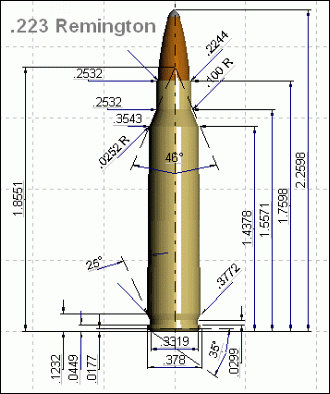
I would stay away from the .223 Remington. On paper the 90gr VLD will shoot inside most .308 Win loads even at a 1000 yards. But in reality, on average, the .223 Rem, regardless of what powder/bullet combo is used, cannot compete with the .308 Win. [Editor: The equipment lists at major F-TR matches will confirm Kovan’s conclusion here.]
Conclusion (and Other Options)
This article covers only the (currently) most popular cartridge/bullet combos for F-Class (F-Open and F-TR). As I said in the beginning, many cartridge types are capable of winning but are not listed due to their low popularity, case design, or lack of quality components. All of the above information is based on my personal experience and it is meant to help new shooters choose the right cartridges for F-Class matches. Thanks for reading and good luck — Emil Kovan
Emil Kovan Competition History:
– 2014 F-Class Open National Champion
– 2015 F-Class Open National Championship, Silver Medal
– F-Class Open National Championship Teams, 2015, 2014, 2013, Shooting Team Member
– Over 15 wins in Regional and State Championships in Palma, F-TR, F-Open
Old “Number 2″ belonging to Ray Gross. Click Photo for full-screen Image.
Ray Gross is captain of the United States F-TR Team. While he’s mostly involved in F-Class shooting these days, that wasn’t always the case. Ray is an experienced service rifle shooter, who secured his Distinguished Rifleman Badge 21 years ago. Ray has shot many different rifles during his competitive shooting career, but the rifle above has a special place in Ray’s heart. This old semi-auto earned Ray his Distinguished Badge, and he’ll never forget that…
“I said goodbye to an old friend last week…
Affectionately known as ‘Number 2′, she is the rifle that I earned my Distinguished Rifleman Badge with in 1995 (#1159).
That rifle was also responsible for a fair amount of Venison in the ’90s, as well. But since then, she has spent a lot of time in the closet. Last time I got her out was to destroy a bunch of hard drives containing evidence collected during my Computer Forensics days. She deserved better than that.
I will miss the beautiful sound of all that American steel slamming into battery when I tripped her bolt.” – Ray Gross
Do you shoot with a SEB joystick-equipped bipod, or are you considering acquiring a “Joy-Pod” for your F-TR rifle? Then you should read this article. Here Sebastian (“Seb”) Lambang, the inventor and builder of the SEB joystick bipod, offers tips on shooting with this impressive piece of engineering. Seb explains some techniques that can help with tracking and getting back on target. You can ask SEB questions about his Joy-Pod in this Shooter’s Forum Thread.
Joy-Pod Shooting Tipsby Seb Lambang
1. Be sure that the rear bag is settled before starting to shoot. Tap your stock into the bag. Then move your rifle back and forth, while checking your reticle. If it tracks straight, vertically perfect, and comes back to the original point of aim, it’s fine. If not, re-adjust.
2. If you use the Pod-Pad, be sure it is fully settled before starting to shoot. Tap the top where the feet rides on using your palm — you wan to create a flat top. To be sure the Pod-Pad does not move or slide, remove any gravel or pebbles under the pad — these can act as roller bearings.
3. Be sure your shooting mat is NOT springy or spongy. This is very important. Use a proper mat, or cut it if possible so your rear bag rests directly on the ground. Use a heavy rear bag. You can use a sand-filled doughnut (not a rigid spacer) to stabilize the bag on uneven ground. These doughnuts are relatively inexpensive and really work.
4. Be sure your whole body position is correct, so your shoulder is square. “Follow” the recoil with your shoulder, don’t push “against” it. Don’t move too much. Don’t make unimportant movements during your shooting string. Always be as consistent as you can in all things — how you hold the rifle, even how you breathe before taking the shot.
This young lady shooter is using a first generation Joy-Pod. The newer versions have flat, ski-like feet.
5. Be sure your rifle and rear bag are aligned. You want the slot between the ears of the bag perfectly aligned with your barrel. (You can use a yardstick or a piece of string to help with the alignment).
6. Use a heavy rear bag. The heavier and the more stable, the better.
7. It does not matter (from my own experience) whether you light-hold the joystick or leave the joystick in the air when you shoot (see Darrell Buell video — he shoots “hands off”). I believe the bullet already exits the muzzle before the joystick moves in your fingers. I lightly hold the joystick myself, just as I would hold a billiard stick.
Watch Darrell Buell shooting his .375 CheyTac equipped with a counter-balanced Joy-Pod. Note how the gun comes straight back, and how Darrell can release the joystick before breaking the shot.
SUMMARY — When It All Comes Together
If everything is set up right, and done correctly, your rifle will track beautifully straight and your reticle will come back or very close to the original point of aim, every time. If you have to change the Joy-Pod, rear bag, or your body position after a shot, there could still be something wrong with your set-up, alignment, or body position. When everything is right, you can also see your own score in the scope after every shot you make (after initial recoil). You also should not have to change the bipod’s setting, the height, the cant etc., at all. You only need to adjust for the current condition with the joystick, the joystick will do it all. That’s why we call our bipod the JOY-Pod.
SEB JOY-POD Joystick Bipod, and POD-PAD
Weighing in at just 18 ounces (510 grams), the Gen 2 Joy-Pod is unlike any other bipod on the market. Designed specifically for weight-restricted shooting classes, the Joy-Pod offers smooth and precise joystick-controlled aiming. The Gen 2 model offers up to 14 degrees of cant and an improved design that functions with up to 50 pounds of rifle weight. Each Joy-Pod comes with a Weaver rail adapter. The optional Pod-Pad accessory is designed expressly for the Joy-Pod. It works filled or unfilled with the Joy-Pod’s sleds to bring you back to your shooting position easily. CLICK HERE for more information, or visit SebRests.com.
.308 Win Tactical Rifle fitted with Joy-Pod on Pod-Pad. CLICK HERE for Video.
Criterion Barrels Inc. (CBI) has a policy of rewarding excellence. As a way of supporting top shooters, Criterion will provide a new, free barrel to any shooter who sets or ties a national record when using a Criterion product. To explain, you get a new Criterion barrel for free if you set (or tie) a national shooting record using a Criterion barrel on your rifle.
Criterion Barrels hopes to increase awareness of its free barrel for record sectors program. Over the last few years a number of F-Class and vintage military competitors have benefited from this program, receiving a complimentary barrel of their choice after setting a new national record in their shooting discipline. Past record breaking shooters have included David Mark Honeycutt (with a 300-yard F-Class score of 600-50X), Samantha Huhtala (four records set in 600-yard F-TR competition), and Victor Betzold (M1 Carbine with a score of 375-6X).
Criterion may, in the future, create a rewards program for winners of national, regional, and local rifle matches. Potential earned rewards by match winners could include equipment sponsorships, barrel discounts, and free apparel items.
Set a Record with a Criterion Barrel? Then Give Criterion a Call…
If you or someone you know has set a pending national record with a Criterion barrel, have the shooter contact Criterion Barrels. Send email to contact[at]criterionbarrels.com or call (262) 628-8749.
Once the shooter’s information is verified and the record is confirmed by the governing body of their appropriate shooting discipline, the order will be processed and shipped to the new record-holder.
About Criterion Barrels, Inc.: Criterion Barrels, Inc. was founded in 1999 as a division of Krieger Barrels, Inc. in response to demands of rifle builders and firearms manufacturers for quality match grade barrels at a lower cost. Our company is now completely independent from Krieger Barrels, featuring a separate facility, personnel, and ownership.
Report by Vince Bottomley Victrix Armaments, an Italian company, has developed new technology that could be a major “game-changer” in the world of precision rifles in general, and F-Class in particular. Victrix’s leadership group knows all about excellence — and winning. Giuseppe Valtorta, CEO of Victrix Armaments, is a top competitive shooter who won Gold with his F-TR rifle at the 2015 European F-Class Championships.
A New Breed of F-Class Rifle
Turn back the clock half a century — George Farquharson is happily shooting a modified military rifle with iron sights and sling. He hasn’t even dreamt of F Class…
Benchrest however is beginning to gather momentum. Accuracy seekers are demanding the ultimate in precision engineering. They will go to their favorite gunsmith and, if they’re very lucky, procure one of the new custom actions from Hart or Shilen.
In the last 50 years, what’s changed? Benchrest is still with us but F-Class has emerged as a world discipline and, to some extent, brought new challenges to our accuracy rifle builders. But, whilst the rest of the planet has reveled in the speed and precision of CNC machining, we still love to place our faith in the gunsmith and his trusty old lathe!
But, of course, there is a reason for this. CNC equipment is expensive and geared towards the rapid multiple production of precision parts, whereas the custom gunsmith is dedicated to the ‘one-off’ build.
Also, even with a limited run, CNC does not readily lend itself to chambering our cut- or button-rifled barrels. Good as our barrels are, there are issues that have made CNC machine problematic. Each barrel demands loving care at the hands of our chosen gunsmith – if it is to perform to our expectations.
5-Axis CNC vs Manual Barrel Chambering
What if — What if the whole barrel-fitting and chambering process could be made “CNC compliant” and produce a rifle which would equal (or even exceed) the accepted standard. And do it every time, time after time! Cost could be reduced and also waiting times.
Good as our custom barrels are, they still need to be scrupulously checked — for uniformity of the bore, the lands, the grooves — for straightness, consistency of diameter, and concentricity. This could be achieved, using some pretty sophisticated measuring equipment — but that would be outside the realms of the custom gunsmith.
Even then, how could the barrel be easily accommodated in a CNC five-axis machining center to ensure a set-up for the best possible chamber and threading? Remember, bores are rarely concentric to the outside diameter and seldom straight, so the set-up would need to ensure that any deviation would be in the vertical plane when the barrel is screwed in the action and the chamber-section would need to be exactly aligned.
These are of course the issues faced every day by the custom gunsmith but currently, there are few CNC machines which could easily accommodate this requirement. But yes, there are a few….
Let me introduce you to Victrix, an Italian engineering company with an impressive multi-million euro factory crammed with the very latest in CNC machinery and a state of the art measuring laboratory. They already have a well-established background in the firearms manufacturing industry, at both military and sporting level. Never heard of Victrix? You soon will, for Victrix has chosen the prestigious 2016 IWA Show (Hall 9 – 423) to launch its new range of high-end rifles.
Victrix manufacturing facility in Italy is ‘crammed with the very latest in CNC machinery':
Whilst Victrix initially developed a range of tactical/military firearms — some of which will also be of interest to the sport shooter — the company has now turned its attention to the F-Class discipline. By working with those competing at the highest level of F-Class competition, Victrix has developed a range of “off the shelf” F-Class rifles that are “competition-ready” right out of the box. Incidentally, Victrix have chosen American barrel-maker Benchmark as its exclusive barrel supplier. Victrix has already perfected a way of accurately assessing barrels to adapt them to CNC working, and this is the key to the new project.
Victrix Target Trigger — Adjustable down to an Ounce
Victrix F-Class rifles will feature an advanced, new target trigger engineered by Victrix. This four-lever target trigger boasts an adjustment range of 1 to 2.5 ounces (30 – 70 grams). Another trigger (8 to 21 ounces pull weight), is used for the Victrix tactical rifles.
Victrix Action
For its new line of rifles, Victrix have developed its own proprietary actions. These actions employ some interesting ideas. The bolt is three-lug with a 60-degree lift and 105/105/150 degree lug-geometry. Testing verified that this arrangement provided a greater resistance to flexing in the locked position over the more traditional 120/120/120 geometry. This geometry also aids the pick-up and feeding of rounds from a magazine when used in a tactical configuration.
Above is Victrix’s new action. It’s impressive. Multiple configurations are offered: Right Bolt/Left Port, Right Bolt/Right Port and other variations. The action can be fitted with Victrix Target or Tactical trigger.
The action and bolt are machined from 17.4PH stainless steel and then hardened (body 48 Rockwell, bolt 45 Rockwell) and treated with PVD (physical vapor deposition). Finally the actions are coated with chromium nitride and nobium for wear-resistance and smooth operation. Tenon thread is M27x1.5 and of course, tolerances are ‘benchrest’ standard. Picatinny rails are screwed and pinned to the action.
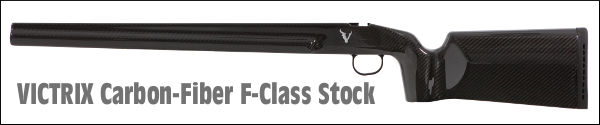
Victrix has certainly done its homework. The company will offer rifles for both F-Open and F-TR classes. Stocks will be offered in a variety of materials: wood, wood-laminate, aluminum, and carbon-fiber. The stocks share a no-nonsense, straight-forward design, specifically for shooting a rested rifle.
Whilst we are focusing on their F-Class rifles, we shouldn’t forget the Victrix tactical range. Although designed with military and police use, they will appeal to anyone who enjoys tactical-style shooting. There is no compromise on quality or accuracy so, expect the same build standard but with stocks CNC’d from 7075 mil-spec aluminum with a hard-anodized coating. The Victrix three-lever tactical trigger adjusts from 8 to 21 ounces (250 – 600 grams).
Victrix has chosen March Scopes UK (IWA Hall 3A – 110) as its business partner in launching the new Victrix F-Class rifles. This was a wise choice, as March Scopes UK proprietor Gary Costello is a former World F-Class Champion. Gary, well-known to F-Class competitors, continues to shoot with the Great Britain Team.
We look forward to taking a closer look at the Victrix F-Class rifles and hope to provide an in-depth range report in the not-too-distant future. Check out the Victrix website at www.Victrixarmaments.com.
Our British friend Vince Bottomley has field-tested the brand new Vortex 15-60x52mm “Golden Eagle” riflescope. We first viewed this scope at SHOT Show and were impressed. Now Vince, in a Target Shooter Magazine review, has confirmed that that the scope works great in the real world. It has good glass, excellent tracking, and the image stays sharp even at full magnification. Vince says this 15-60X Vortex will give other high-magnification scopes a run for their money. In fact the Vortex Golden Eagle may be the new Performance-for-Price leader in the category. Price in the USA will be $1500.00.
Vince writes: “The Vortex deserves to line up alongside the competition – namely the March 10-60, the Nightforce 15-55 and the Leupold 7-42. The price is remarkable at [$1500.00 in the USA, under £1500 in the UK]. If you are contemplating the purchase of a scope in this magnification range, the Vortex must be on your shopping list.” This new Vortex features ED glass, and weighs 29 ounces, just one ounce more than the 15-55X Nightforce Comp. Two reticles are available — a Fine Cross-Hair (FCH), and the Vortex ECR-1 reticle with MOA-based windage and elevation hold lines. Turrets have 1/8 MOA clicks.
Precision of Clicks: Does one MOA (i.e. eight 1/8 MOA clicks) on the Golden Eagle’s turret translate to one MOA on the target? Vince fired one shot on target then wound on 20 MOA of elevation and fired another. Vince reports: “The shot-holes should be 20.94″ (20 x 1.047″) inches apart. They actually measured 21.5 inches — an excellent result. I don’t think I’ve ever had a scope better this.”
Elevation Travel: F-TR shooters using the .308 Win will need about 30 MOA to get from a 100-yard zero to 1000 yards. Vince maxed out the Golden Eagle with roughly 22 MOA of “up” elevation. He concluded that “a +20 MOA scope-rail is a ‘must’ if you’re intending to shoot out to 1000 yards. These days, almost everyone uses a 20 MOA scope rail anyway.”
Tracking Test: Vince did a “box test” running the Vortex to the limits of elevation and windage and then back again to verify that the scope returned to the starting zero. Vince observed that the scope tracked great, “with the first and last shots over-lapping. No problem there.”
Glass Sharpness and Clarity: Vince put the the Golden Eagle alongside a 10-60 March, with both scopes mounted on F-TR rifles. Vince was impressed by the optics quality of the Vortex — it held its own vs. the “superb” March: “Firstly, we viewed the target on 40 power, the magnification which seems most popular with F-Class shooters. Both scopes registered bright, crisp images — no difference between the two. I know the March will stay sharp at maximum magnification but will the Golden Eagle? Yes! No loss of crispness in the image at 60X.”




 .223 Rem — Not A Competitive Option
 Emil Kovan Competition History: