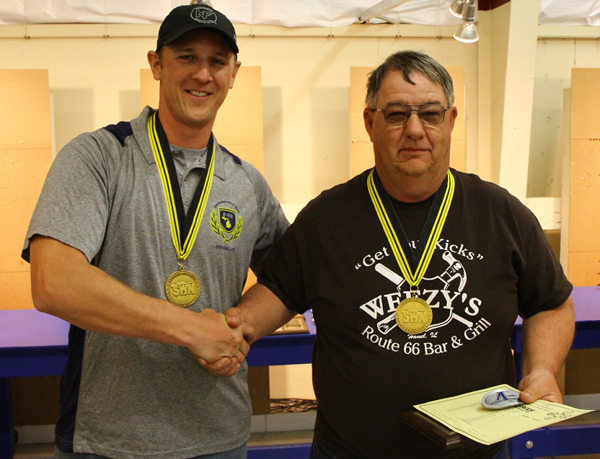
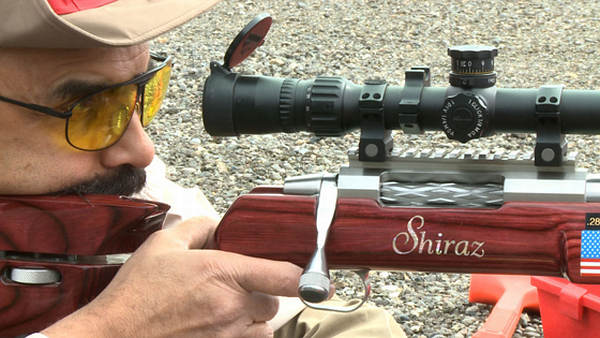
This video includes interviews with Walt Berger and tube-gun builder Gary Elesio. This is our final Berger SW Nationals video for 2016, so enjoy the highlights from Ben Avery — see you next year.
The 2016 Berger Southwest Nationals are now history. This was a great match, with an incredible level of talent. There were numerous “big names” on the line, including reigning F-Open World Champion Kenny Adams, 10-time National High Power Champion Carl Bernosky, past National Long-range Champion John Whidden, current National Mid- and Long-Range F-TR Champion Bryan Litz, and Derek Rodgers, who won the F-TR division at last year’s SW Nationals. With a strong performance this week, Derek topped the F-TR field again, securing his second straight SW Nationals F-TR title.
Top Five Shooters by Class
F-TR Top Five
F-Open Top Five
Sling Division Top Five
Derek Rodgers
James Crofts
Niklas Montin
Bryan Litz
Ian Klemm
John Myers
Larry Bartholome
Jim Murphy
Emil Kovan
Danny J. Biggs
Patrick McCann
Oliver Milanovic
Robert Stekette
Nancy Tompkins
Tom Whitaker
In team competition, the Michigan F-TR Team scored a narrow victory over tough competition from the USA F-TR Team and the X-Men. In the F-Open Division, Team Lapua-Brux shot superbly at 1000 yards to capture the Aggregate title, finishing ahead of Team Grizzly and Team Berger. The Ethnic Fringe Team from the UK had strong performances in the Sling Division Team events.
With his 2016 victory, Derek Rodgers has secured back-to-back F-TR titles at the Berger Southwest Nationals. He says he likes his new McMillan F-TR stock. View yesterday’s feature video for a revealing interview with Derek. In that video, Derek discusses the best bullet and powder choices for F-TR.
Members of the winning Lapua-Brux F-Open team were all smiles. They deserved to be proud — they set a new SWN record in the 1000-yard team match. Left to right: Bob Sebold, Pat Scully, Erik Cortina, Steve Harp.
Here is F-Open Winner John Myers of Texas, along with Berger’s F-Open Perpetual Trophy. John is interviewed in today’s video, linked at the top of this story. John’s F-Open rifle is chambered for the 7mm Walker, a .284 Win Improved similar to the .284 Shehane.
Sling Division (Palma rifle) winner Patrick McCann is congratulated by Bryan Litz of Applied Ballistics. Pat has recently returned to competitive shooting after a lengthy hiatus. Pat’s a great competitor who has won the National XTC Championships Twice. Nancy Tompkins lead the “Any Rifle” Sling category. As Forum member Rheurer observed: “No intro needed for the nicest person in the sport.”
Our friend Vince Bottomley in the UK has written an excellent article for Target Shooter Magazine. Vince offers “solid-gold” advice for new F-TR and F-Open shooters. Vince reviews the cartridge options, and offers suggestions for a shooter’s first (and hopefully affordable) F-Class rifle. Vince also reviews various bipod choices for F-TR and discusses optics options (from $300 to $3000).
The 2016 Berger Southwest Nationals event is less than a week away. If you need some last-minute practice before this match and you don’t have the time (or money) to load a couple hundred rounds of centerfire ammo, consider rimfire practice. Past F-TR National Champion James Crofts attributes much of his success to plenty of trigger time with his rimfire training rifle.
Rimfire Training for F-Classers
2014 and 2012 U.S. National F-TR Champion James Crofts is one of America’s top F-Class shooters. A member of the 2013 World Championship-winning F-TR Team USA squad, James knows a thing or two about long-range shooting, that’s for sure. But you may be surprised to learn how James sharpens his shooting skills at relatively short distances. You see, James often practices with a .22 LR rimfire rifle at distances from 50 to 200 yards. James tells us: “Shooting my F-Class rimfire trainer saves me money and improves my shot process and wind-reading abilities.”
Remington rimfire 40X barreled action in PR&T LowBoy stock with PT&G bolt.
Rimfire Training Teaches Wind-Reading Skillsby James Crofts
Training with the rimfire is extremely useful and can be done from 25 yards out to 200 yards. I am lucky and can shoot 50 yards right off my back deck. That is far enough that any miscue on rifle handling will show up on the target. I use a two dry-fire to one actual shot routine for my practices. This gives me much more positive reinforcement without any negative reinforcement.
Wind reading is extremely important with a .22 LR rifle. I use a set of smallbore flags to aid my wind calls. The smallbore flags are a must and force you to look at the flags and mirage on each and every shot. If you think the flags at Camp Butner move a lot, try smallbore flags around tall pine trees.
James Crofts — Photo by Kent Reeve.
Rimfire Training Is Cost-Effective
Rimfire ammunition is much less costly than centerfire ammo. Though .22 LR prices have risen in recent years (and rimfire ammo is harder to find), even now I can get a 500-round brick of .22 LR ammo for less than $75.00. That works out to fifteen cents a round. That’s a fraction of the cost of handloading .308 Win match ammo. Heck, you can pay 40 cents a piece for match-grade .308-cal centerfire bullets. Then you have to figure in brass, primers, and powder.
My CMP 40X Rimfire F-TR LowBoy Clone
My quest into the .22 LLR rimfire field started with an email from the Civilian Marksmanship Program (CMP) announcing Rem 40X stripped barreled actions for sale. I thought, “Hmmm… Could one of those little 40X barreled actions be turned into a F-Class training rifle?” My gunsmith Ray Bowman of Precision Rifle & Tool was brought in at this point.
After conferring with Ray, it was decided that he could indeed turn this into a F-Class training rifle. Ray contacted Dave Kiff of PT&G and ordered a new bolt for the Remington 40X rimfire action. Next was the stock decision. I decided to go with a PR&T Low Boy F-Class stock — this is an exact clone of the stock for my .308 Win F-TR competition rifle. Then a Jewell trigger was acquired to complete the components. Ray built this just like he would any custom rifle, other than using the stock barrel. The project turned out awesome. The rifle was a hammer from the beginning even with the stock barrel.
Here’s a bit of Britain in blue — a 270-7mm WSM F-Classer belonging to Elwood in the UK.
One of the most popular items in our Shooters’ Forum is the ongoing “Pride and Joy” thread. Since 2009, Forum members have posted photos and descriptions of their most prized rifles. Here are some of the most recent “Pride and Joy” rifles showcased in our Forum. Do you have a gun you’d like to see featured there? Just Register for the Forum and you can add your gun to the list.
1. Dasher LowBoy. CigarCop just completed a lovely 6mm Dasher in a yellow/gray laminated PR&T LowBoy stock. CigarCop did the stock inletting and finish work himself. Very nice work indeed.
2. Varmint Special. Here’s a handsome varminter with a beautifully-figured walnut stock. This is one of three rifles Forum Member Dan Hall posted this month.
3. 6mm Trifecta. DixiePPC served up not one but THREE pretty rifles, all with pearlescent paint jobs. Details of the three rigs are provided below. Click the image to see a full-screen version.
Top: 6 PPC for 10.5-lb NBRSA LV Class, 1:14″, .262″-necked SS Hart Barrel chambered and fitted by Doug Pascal, Pearl Black Kelbly Stock, RB/RP Blueprint & Trued 40X Short Action (Glued) with a Doug Pascal Bolt Release. This gun is a 1994 build by Doug Pascal of Craftsmith.
Middle: 6 PPC 13.5lb NBRSA HV Class, 1:14″, .262″-necked SS straight-countour Hart Barrel, Pearl White Kelbly Stock/Aluminum Butt Plate, RB/RP Stolle Panda Action (Glued). Kelbly Double Screw Rings. 1994 Vintage Leupold/Premier BR 36X. This gun is a 1992-vintage Kelbly build for NBRSA Unlimited Class.
Bottom: 6mmBR 17-lb IBS Light Gun Class, 28″, 1:8″, .268″-necked SS Bartlein 5R Barrel tipped with a SS Harrell Spiral Muzzle Brake, Pearl Rust Orange 90s-vintage Lee Six Stock with home made Aluminum Butt Plate, RB/RP Blueprinted and Trued 1995-Vintage 700 Short Action.
4. Simple Elegance. This is Chopper Duke’s handsome 6mm PPC. It features a Remington action in a classic older-style benchrest stock. We like the flawless pale-green finish. Subtle but nice.
5. (Nearly) Identical Duo. Here are a matching pair of customs from Forum member NHM16. He tells us: “I sold my two Savages I was using for F-Open, and had these two built in their place. One reason I upgraded was so I could have two (nearly) identical rifles. The nice thing about these rifles is that most everything interchanges, including the barrels.”
Here Are Specs for Both Guns:
— Panda F-Class action (LRBP, no ejector, 20 MOA dovetail scope base, one action is polished, the other unpolished so I could easily tell them apart).
— PR&T LowBoy stocks with adjustable buttplates, with vents on the side and the bottom.
— Both have Bartlein 32″ 7mm, 1:8″-twist, 5R barrels, chambered in 7mm Walker (basically a .284 Shehane with the addition of a 40 degree shoulder).
— Rifles were built by Richard King (“Kings X” in Forum) in Arlington, Texas, though I did the clear coating myself.
6. First Custom. Here is Forum member Barrys’s very first custom rifle, and it’s a nice one. It features a BAT Machine VR action, Krieger #17 heavy varmint contour, chambered for the 6mmBR Norma with 0.272″ neck. The stock is a Shehane Varmint Tracker with a Walnut-color laminated Obeche stock. On top is a Sightron SIII 8-32x56mm scope in BAT Machine rings.
7. Basic Black. David P. offered this F-TR rig: “A buddy of mine just finished up new rifle for NRA F-TR competition. This rifle is built on a Kelbly action, chambered in .308 Win with a custom, tight-neck match chamber. It’s sitting in a PR&T stock, with a Broughton 32″, 1:11″-twist 5C barrel. The rifle was chambered and built by Brian at Plainfield Precision in Shelby, NC.
F-Class shooting (both F-Open and F-TR) is one of the fastest-growing forms of rifle competition. Each season many new shooters hit the line and attendance at the big matches increases every year. But if you’re new to the game, you may ask “Where can I shoot an F-Class match?”. Well, Forum member Rod V. (aka Nodak7mm) has compiled a useful list of 112 ranges throughout the USA where F-Class matches are held. With venues from Alabama to Wyoming — you should find an F-Class program not too far from home. The list, in Excel spreadsheet format, provides range locations and weblinks (where available). Click the link below to download the F-Class Range List (.xls file):
Note — this list, now in its 19th Revision, is augmented regularly, but info is still being gathered. No claim is made that the list is comprehensive. But it still covers the the lion’s share of the important F-Class venues nationwide. If you know of a range that should be added to the list, please post the location on our F-Class Range List Forum thread. Rod will update the list as new range info is received. Rod writes: “Range information is wanted and welcomed. I would like your help on collecting specific info on Clubs/Ranges where known F-Class matches are held.” Here’s a partial sample from Rod’s list:
Benchrest Hall-of-Famer Thomas “Speedy” Gonzalez has teamed up with the Shurley Brothers on a new ARK series of wood laminate competition stocks. Speedy has combined the best features of various popular F-Class and Long-range Benchrest stocks into new designs to be produced by Shurley Brothers Custom in Austin, Texas. These stocks should be very straight and geometrically correct as they will be crafted on the Shurley Brothers’ new CNC mills. These stocks will be made with new-generation precision technology, not old school duplicating machines.
Initially two models will be offered: the “Hand of God” (HOG) and the “Spear of Destiny” (SOD). Both are designed for multiple shooting disciplines, so they should work well both for benchrest and for prone F-Open shooting. (FWIW, John Myers used a Speedy-crafted stock to win the 2015 Mid-Range National Championship). The forearm is 76mm (2.99″) to comply with F-Open limits. A wide variety of options will be available including adjustable Cheek Piece, adjustable length of pull, carbon fiber inserts, and exotic woods.
We like many aspects of the new stocks. First, the front of the stock is low profile, placing the barrel close to the bags for better tracking (and less hop). However, a deeper (top to bottom) section extends forward of the action — this is important. We have seen some low-profile stocks that suffer from forearm flex/hinging because they don’t leave enough wood under the action area. Speedy’s design eliminates this problem. Another nice feature of this stock is the subtle curve from the back of the action to the buttpad mount. Speedy calls this the “scooped cheek”. This allows the “driver” to shoot without face contact if he prefers, but it also allows for a higher buttpad position — which is useful when shooting heavy recoiling chamberings such as the .300 WSM.
Note how the comb area has a curve to provide clearance. For those shooters who prefer to have face contact on the gun, an adjustable Cheek Piece is offered.
Shurley Brothers Custom says these new ARK stocks are fully customizable for competition shooters with optional carbon fiber, adjustable R.A.D. systems, and many other features. The stocks, uninletted, will run $750.00. CNC-inletting (for action of your choice) is an additional $100.00. Here are some of the many available options:
— Pillar Bed and Inlet: $425.00
— Custom Wood Upgrade (Price Dependent On Wood): $100.00 – $500.00
— Full-length Carbon Fiber Stringers: $200.00
— Cheek Piece Addition: $100.00
— Cooling Ports (Buick Vents): $60.00
— R.A.D. System #2A: $335.00 (plus $100.00 to install)
— 3-Way Butt Plate: Call for Price
— Adjustable Neodymium Magnetic Cheek Piece: Call for Price
— Install Neodymium Magnetic Cheek Piece: $150.00
— Stock Finish & Clear Coat: $350.00
— Carbon Fiber Forearm Tunnel: $300.00
The underside of the forearm is relieved in the center, leaving twin outboard rails. This helps stabilize the rifle and aids tracking. (A conventional, flat forearm without rails tends to rock if there is any hump in the middle of the sandbag). Between the rails is a carbon-fiber stiffening insert.
We have two new National Champion F-Class Teams. At the 2015 Long-Range Team Championships in Phoenix yesterday, Team Grizzly won the F-Open Division while the X-Men team secured the F-TR Title. The teams had to deal with tough conditions, requiring wind coaches to bring their “A Game”. James Crofts of the X-Men said: “The highest level of winds in recent nationals memory greeted all on the line today.” And Shiraz Balolia, who finished with the highest score (395-17X) among all shooters, observed: “High winds in the second match really made a huge difference in scores.”
Team Grizzly Wins 2015 F-Open Long-Range National Championship
Team Grizzly finished first in the F-Open Division with a 1560-49X score. In second, nine points back with 1551-49X, was the Tex-Mex Squad, while local favorites the Wide Nines team finished third with 1548-45X. Team Grizzly’s 9-point winning margin was impressive — Leo Ahern joked that: “9 points is more like a spanking than a win!”
Team Grizzly Captain Shiraz Balolia had the top score (395-17X) of all shooters participating in the team event. (This is a file photo from previous match).
Team Grizzly’s Captain Shiraz Balolia said: “My hat is off to our coach, Trudie Fay, who has coached and won us the last three consecutive Team matches at the National Championships. I have been fortunate to have been a shooter and Captain of all three gold medal wins, three years in a row, one with Team USA and two with Team Grizzly. Trudie did a great job and my Team gun just hammered!” Along with Faye and Balolia, Team members included Kenny Adams, Emil Kovan, and John Myers.
X-Men Team Tops F-TR Field
Hail the Orange and Green invaders. The X-Men are the 2015 US Long Range National F-TR Champions. The Team included shooters Tracy Hogg, Phil Kelley, Ian Klemm, and Dan Lentz, along with Wind Coach James Crofts and Captain Ken Klemm. Crofts said: “Big thanks to our remaining X-men teammates Joseph Conley, Mike Hardy, and Radoslaw Czupryna. Special thanks to Ray Bowman as we were all shooting PR&T hammers. We have great respect for Team Sinclair (that has motivated us for a long time) and Team Michigan, our friends from up North. Today was a good day!”
All four X-Men rifles featured Precision Rifle & Tool (PR&T) Low Boy stocks. PR&T’s Ray Bowman observed: “Ian Klem built his rifle on our stock, PR&T stocked Dan Lentz’s rifle and we built Phil Kelley’s and Tracy Hogg’s “HAMMER” rifles.” Gunsmith Ryan Pierce chambered two of the X-Men barrels.
It was sunny but quite windy on Friday for the Team Match (Sherri Judd Photo).
Finishing second in the F-TR division was the Michigan Rifle Team, winners of the Mid-Range F-TR National Championship. The Team was coached by newly-crowned, Mid-Range F-TR Nat’l Champ Bryan Litz. Shooters include Doug Boyer, Jim Grissom, Bill Litz (Bryan’s father), and gunsmith John Pierce. Grissom shot a great match, finishing with 385-12X, but it was not enough to carry the Michiganders to victory. The squad finished with 1524-29X, six points behind the winning X-Men (1530-33X). Team Sinclair placed third with 1512-35X.
Ben Avery 10/30/2015 panorama photo by Tracy Hogg. CLICK HERE to zoom image.
Today is the Team Match Day at the F-Class Long-Range National Championships. F-Open and F-TR team shooters will have to deal with damp conditions on the range, as a storm front recently dropped rain at the Ben Avery Shooting Facility outside Phoenix. James Crofts says: “The 2×1000 Team match today is going to be a good day. Wind will be up to 10 mph and quartering.”
In the F-TR division, competition will be fierce. The Michigan F-TR Team, winner of the Mid-Range Championship earlier this week, looks to add a matching 1000-Yard National Team victory today. The shooters of Team X-Men, lead by 2014 individual F-TR Champion James Crofts, hope to reverse their fortunes, and win at the longer distance. And Team Sinclair, the “winningest” squad in F-Class history, looks to grab another title. Team Sinclair boasts multiple champions on its squad, including Derek Rodgers, the only man to have won both the F-TR and F-Open National Championship.
Yes, “Old Guys Rule” — at least at Mid-Range. At the NRA Mid-Range F-Class Nationals, a squad of seasoned veterans outshot their younger competitors, taking the F-Open Team Title with a 1598-102X score. The SEB/Berger Team Aggregate of 1598-102X is believed to be a new National Mid-Range Team Record. Think about that — the entire squad dropped only two points (out of 1600 possible) over the entire event. That’s superb shooting by a talent-loaded team.
The winning SEB/Berger team features shooters Larry Bartholome, Danny J. Biggs, Robert Bock, and Don Nagel, along with Coach Jim Murphy and Captain/sponsor Sebastian Lambang. Remarkably, all the “Three Bs” (Bartolome, Biggs, and Bock) shot 400s (not dropping a single point), and Danny Biggs totaled a superb 400-31X to finish as high man for the event.
Finishing second in F-Open team competition, with 1590-96X, was the local favorite, Team Wide Nines. Coached by Scott Harris, this squad features shooters Dan Bramley, Milton Gillette, Christine Harris, and Allan Rosenthal (also Captain). Dan Bramley finished the match with 400-24X, not dropping a point.
Individual F-Open Results
The individual Mid-Range F-Open Championship was a tightly-fought affair. Just six points separated the Top 10 shooters. John Myers took the title with a very impressive 1794-111X. Runner-up David Gosnell (1792-105X) edged third-place Danny J. Biggs (1792-100X) on X-Count. Jeff Cochran (1790-110X) was fourth, while Jim Murphy (1790-100X) finished fifth. While gains have certainly been made in the F-TR division, the Open-Classers proved that they still have the edge, shooting larger cartridges from a front rest. The best F-TR score, 1782-96X by Bryan Litz, was still 12 points and 15 Xs shy of Myer’s F-Open-winning performance.
Michigan Squad Wins F-TR Team Championship
In F-TR Team competition, the Michigan F-TR crew took top honors. Lead by newly-crowned Mid-Range F-TR Champion Bryan Litz, the Michiganders finished with an impressive 1597-89X, nine points ahead of runner-up Team Sinclair (1588-83X). Along with Bryan, Michigan shooters included Doug Boyer, Jim Grissom, and gunsmith/action-maker John Pierce. As a historical footnote, we believe this is the first time Team Sinclair has been beaten in a major match. However Team Sinclair’s Paul Phillips posted the top individual performance in the team event. Paul shot a superb 400-25X, not dropping a single point.
This past weekend, Bryan Litz of Applied Ballistics LLC, topped a field of great shooters to win the 2015 NRA F-TR Mid-Range National Championship. Bryan shot very well, mastering conditions that were tricky and sometimes bewildering, particularly at the shortest range, 300 yards. Consider this, Lou Mudica had the top score on Day Two (all 600 yards), yet he was way down at 41st position on Day One (300/500/600 yards). Finishing Second Overall was Scott Harris. Bryan’s Michigan team-mate Jim Grissom was third, while Bryan’s father (and MI team-mate) Bill Litz was fourth.
F-TR Top Ten at Mid-Range National Championship
Bryan was using a low-profile, carbon/composite-stocked rifle built by John Pierce. Bryan told us: “This was the same rifle and almost the same load with which I won the Midwest Palma match in the summer of 2014. (Story HERE.) My gear consisted of Pierce rifle, Bartlein barrel, Nightforce scope, Berger bullets, Lapua brass, Hodgdon powder (All those companies are sponsors of the USA F-TR team as well as the Michigan F-TR team.) My load for the Mid-Range Nationals was 43.0 grains of Varget with the Berger 215gr Hybrid bullet seated 0.005″ off the rifling.”
Click Image for Full-Size Version:
A lot of wind shooting strategy isn’t just about knowing exactly where to hold at any given point in time. A big part of it is recognizing periods of predictable readable conditions versus UNpredictable unreadable conditions and avoiding shooting in them. — Bryan Litz
At the Mid-Range Nationals, wind conditions at the shorter yardages caught many competitors by surprise. As a result, many shooters, including 2014 F-TR National Champion James Crofts, shot better at 600 yards than at 300. That seems surprising… but there is a reason. Bryan Litz explains that conditions at shorter distances are sometimes more difficult to read than at 1000 yards.
Bryan Litz Talks about Mid-Range Wind-Reading Strategies
Mid-Range is marked by more uncertainty than long range shooting. At long range you can see more flags, more mirage, and conditions tend to be more readable although they have a greater effect. At mid range, the closer you are to the target the less readable the conditions tend to be. Often times at 300 yards there is no mirage and very sparse flags to get a read on. You can still get blown out at 300 yards! 500 yards can be a little better and at 600 sometimes you can get a pretty good read on it, but the majority of strategy for shooting Mid-Range is managing the uncertainty. What is your plan for shooting blind?
Suppose you’re shooting along pretty well centered up in the 10 Ring. Suddenly you shoot a 9 out the side and can’t see an indicator that explains why. Stop! Clearly something is going on which is not readable. It’s likely to be around for a period of time. Its best just to wait for that uncertainty to blow through and start shooting again when things settle out again. How do you know when things have settled out? When everybody else is pretty much back into the 10 Ring for a little while, then you know that a stable condition has settled back in. Take your best guess and get back into it.
A lot of wind shooting strategy isn’t just about knowing exactly where to hold at any given point in time. A big part of it is recognizing periods of predictable readable conditions versus UNpredictable unreadable conditions and avoiding shooting in them. Good equipment is a must, and ballistic performance matters, but when it comes to winning a match versus placing in the top 10, it all comes down to who employs the winning strategy for the various different conditions. It can be more like a chess game then shooting. Competitive judgment is key.
Bryan Litz didn’t do too badly in the Mid-Range Team Match either, shooting a 200-10X. Bryan’s team-mate John Pierce shot a brilliant 200-15X. Looks like those low-profile Pierce-built rigs really hammer:
John Pierce (left) and Bryan Litz, who is holding his Pierce-built F-TR rifle.