|
|
October 25th, 2015

The 2015 United States F-Class National Championships are underway now at the Ben Avery Shooting Facility in Phoenix. There’s a “hybrid” format this year. For 2015, the Nationals combine both Mid-Range and Long-Range competitions in one week-long mega-match. The Mid Range F-Class Nationals take place 24-27 October 2015, with shooting at 300, 500, and 600 yards. The Long Range National Championships then run October 28 through 31, with all targets at 1000 yards. The competition consists of two different divisions: F-Open and F-TR (Target Rifle).
The wind arrived early on Saturday…

It started off somewhat windy on Saturday, October 24 for the 300-yard and 500-yard matches. Bryan Litz mastered the conditions to end up leading the F-TR division. (Guess that knowing a thing or two about ballistics helps when the wind is blowing). James Crofts, 2014 F-TR National Champion, shoot well at 500 yards, but struggled at 300 yards (the X-Ring is just 1.5″ at 300 yards). He observed: “Not a bad day today — overall 13th. Bryan Litz has the overall F-TR lead. I’m down 20 for the day but there are lots of shots left to go.”

All the shooting today (Sunday, October 25th), will be at 600 yards. Jim posted from Phoenix: “It’s time to start Day Two of the F-Class Mid-Range Nationals. All 600 yards today and I’m ready. Looks like it could be a tricky day with gusty winds but it will be the same for everyone.”
James Crofts at the 500-yard line. He had a tougher time at 300 yards.

September 29th, 2015

Here’s 2014 F-TR National Champion James Crofts, with his PR&T-built rig.
Are you ready? The 2015 F-Class Nationals event is just three weeks away. The combined mid-range and long-range F-Class National Championships will be held October 23 – 31, 2015 in Phoenix, Arizona.
CLICK HERE for 2015 F-Class National Championships Program and Entry Form.
For 2015, the Nationals will include both Mid-Range and Long-Range competitions. The NRA F-Class Mid Range National Championship will be held 23-27 October 2015. The F-Class Long Range National Championship then runs from October 27 through 31. The competition consists of two different Divisions: F- Open and F-TR (Target Rifle). Each Division is made up of five different Categories: High Master, Master, Expert, Sharpshooter and Marksman. There will also be a series of four-person team matches. The event is limited to 320 competitors maximum. All matches will be held at the Ben Avery Shooting Facility outside Phoenix.
You’ll see some serious hardware on the firing line at Ben Avery. Here’s a modern F-Open rig with a handsome maple stock. The gun, belonging to David Mann of Texas, shoots as good as it looks.

Under Two Inches at 500 Yards
To be competitive at the Nationals, one needs a tack-driving rifle and an ultra-accurate load. Shown below is one of Paul Phillips’s F-TR load development targets at 500 yards. The total 5-shot group size is under two inches. Impressive. That’s with 200gr Bergers, Varget powder, and large primer Lapua brass. Paul tell us: “The X-Ring is 5 inches at 1000 yards (equivalent to 2.5 inches at 500). We strive to be all in the X-Ring. However, wind is the big obstacle. A gust of wind can move you 1-2 feet away.”

F-Class National Championship Registration and Deadlines
Competitors must submit the official Registration & Entry Form (include NRA Membership ID#). Entries MUST be accompanied by check, money order or NRA Points. Make Check payable to Desert Sharpshooters Rifle Club.
Fees are $375.00 for both Mid-Range and Long-Range matches (combined), or $200 for just one match only (either Mid-Range or Long-Range). Team Matches cost $60 per entry.
Mail Entry Forms and checks to:
Middleton Tompkins
P.O. Box 11684
Prescott, AZ 86304.
Phone: (928) 776-8576.
Entry Deadline: The deadline for entries is 6:00 PM Monday, 12 October 2015. Entries after this time are considered late entries and may be accepted to fill vacancies on existing relays only. An additional $20.00 will be charged for late entries, on top of the basic fees.

2014 F-Class Nationals Photos copyright Nightforce Optics, used with permission.
September 21st, 2015

 Derek Rodgers is a member of the Team Sinclair F-TR squad. This talented group of shooters hasn’t lost a team match in years. What’s the secret of Team Sinclair’s success? Well there is not one single factor. These guys have very accurate rifles, work hard on load development, and practice in all conditions. In this interview, Derek Rodgers talks about long range competition, reviewing the hardware (and skill set) it takes to win. He offers some great tips on developing loads. You’ll find a longer version of this interview on the Sinclair Int’l website. CLICK HERE to Read Full Interview. Derek Rodgers is a member of the Team Sinclair F-TR squad. This talented group of shooters hasn’t lost a team match in years. What’s the secret of Team Sinclair’s success? Well there is not one single factor. These guys have very accurate rifles, work hard on load development, and practice in all conditions. In this interview, Derek Rodgers talks about long range competition, reviewing the hardware (and skill set) it takes to win. He offers some great tips on developing loads. You’ll find a longer version of this interview on the Sinclair Int’l website. CLICK HERE to Read Full Interview.
Derek Rodgers BIOGRAPHY
Derek Rodgers (Albuquerque, NM), is the only shooter to have won BOTH the F-Open and F-TR National Championships. Derek shot his first NRA sanctioned-match in 2007, and just three years later Derek won the 2010 F-Open Nationals. He also won the 2013 F-TR Nationals, making him the only person to win both divisions. He has won other major F-TR matches, including the 2013 Sinclair East Coast Nationals and the 2015 Berger SW Nationals. Derek holds the current 1000-yard, 20-shot, National F-TR Record (200-12X). Derek enjoys spending his time outdoors with his wife and two daughters, ages 12 and 7. He is blessed by his faith and supported by his family. Derek’s goal is to pass on what he has learned to the next generation.
Q: What is your favorite reloading product?
I really like my BenchSource Case Annealer. There is something about watching fire that I find relaxing. I can watch those shells go around the wheel for hours.
Q: What’s your preferred front rest or bipod?
I’m currently using a Duplin bipod. At 17.2 ounces it allows me a solid platform to shoot from and the extra wiggle room to make weight with a heavy barrel and Nightforce NXS scope. Also, I can’t do without my board under the bipod. We shoot off sand at my local range and in most cases the feet will tend to dig holes if not supported. The board is necessary gear for me.
Q: What rear bag do you use?
I have an Edgewood bag that I’ve used for years. Recently, I got a SEB Bigfoot and like how it supports the gun and stays put under recoil.
Q: Explain your load development process. What’s your methodology?
I have two log books that have many combinations that work with 308s. I have tried to keep detailed notes in these books. Now I am reaping the rewards, as I can go back to a particular twist and barrel length and find something very close. I usually start with 3-shot groups and check the chamber behavior. If something looks promising I will go back to the range and load up 6-shot groups. If those shoot well, I take it to a match to verify it in a 20-shot string. If it passes that test it is either good to go or I table it and try another. I tend to pick mild loads that the cartridge shoots well — consistently.
Q: What piece of shooting gear helps your load development?
I use a MagnetoSpeed Chronograph to record velocities. Then I can slow down or speed up my loads to reach an accuracy node. It is amazing that most barrels will shoot very accurately when fired at certain known velocity nodes.
Q: What optics do you find most useful?
I would say Nightforce NXS Scopes.
Q: What do you carry in your range bag on Match days?
Multi-piece Brownells tool set, RX Glasses, Sunglasses, Range Rod, Towel, Empty Chamber Indicators, Jacket, Sunscreen, Foam Ear Protection, Ear Muffs, Data Book, Plot Sheets, Pen, Clip Board, iPod with ballistic data, and chewing gum.

Q: How did you get started shooting?
I was raised in New Mexico where outdoor activities are abundant. Once my father introduced me to a Crossman pellet gun, all I wanted to do was shoot and refine my skills. Shooting evolved into hunting and then into perfecting my skills in off-season matches. Shooting local F-Class matches made me better as a marksman. Now I feel like I am competitive with anyone. However, I will never forget that my roots started with hunting and still cherish the opportunity to hunt…
Q: What do you find most challenging? How do you learn from mistakes?
What I find most challenging about precision shooting sports is how great shooters are able to reflect on what was learned — both positively and negatively. It is important to slow down and perform this step. Stopping to reflect and learn from mistakes I’ve made on the firing line is challenging. Not many people enjoy accurately critiquing themselves. Also the wind usually blows here in New Mexico and choosing the right time to shoot and to stop is important. It’s often tempting to try to finish out a string of fire. But sometimes challenging yourself to quit and wait out some wind will pay off[.]
Q: What advice do you have for selecting a gunsmith?
The best recommendation I can give is for a person to get to know a gunsmith. If you can find a local gunsmith that is available — even better! If you run into a snag along the way, it is so nice to be able to work it out without sending things back and forth. Be honest, realistic with your expectations and tell the gunsmith what you want. If he only wants to do things his way, or takes extra or excessive time in meeting the goals, you may want to consider someone else.
Q: Who would you recommend for stock work on your rifle?
Alex Sitman from Master Class Stocks and Doan Trevor can build or fix most anything.
Q: What do you do to mentally prepare before a shooting competition?
I relax and try to remember I do this for fun. I anticipate what game plan I want to go to the line with. I also try to take small snapshots of the conditions. I do not like getting overloaded with staring down a spotting scope for long periods of time. I try not to get overwhelmed with the match and just shoot my game. My approach is “One shot at a time — good or bad”. I will usually tell my scorer what I’m going to do so he or she is ready as well.
Q: What advice would you give to novice competitors?
Partner up with an experienced shooter that is ranked nationally. Mentoring under a veteran shooter would be the best way to help save time learning instead of experimenting. Chances are an experienced shooter has already tried what you are considering. As a new shooter, do not get sucked into reading all of the opinionated blogs on the internet. Stick to good information. AccurateShooter.com | 6mmBR.com is a great resource with a wealth of information from knowledgeable writers. That site has articles that are based from facts and/or industry news and information.
Q: What is something you would NOT recommend before a shoot?
I do not recommend coming unprepared. If you are late, scrambling around, or do not have your gear in order, you will not perform at your best.
Q: How many rounds do you shoot in a year and how often do you practice?
I shoot 3000+ rounds a year. I try to shoot 1 x a week if I can get away in the evening or on the weekend. If I am close to finding a load I may try to get out more until I exhaust that load as an option. So there may be occasions that I will try to shoot three times a week. Fortunately, the winters are mild in New Mexico and it allows me to shoot year round. I actually shoot more when it is colder. The summer sun here can create mirage that makes it nearly impossible to learn anything.
September 10th, 2015

One recent trend in F-TR competition is the use of low-profile, benchrest-type stocks shot with a light hand-hold and little or no face contact. For this method of F-TR shooting to work, you need the right equipment, and practice a “minimalist” shooting technique. One of the pioneers in this style of F-TR shooting is action-maker John Pierce of Pierce Engineering. Above you can see John shooting one of his F-TR rifles at the 2015 Canadian F-Class Championships. Note the straight-line stock and see how the adjustable bipod is set quite low to the ground (in fact the bipod’s arms are almost straight out).

Members of the Michigan F-TR Team, including Bryan Litz, have used similar rigs with success. Bryan said it took a while to adapt his shooting technique to this kind of rig, but there is a pay-off. Armed with a Pierce-built F-TR rifle, Bryan won his first-ever F-TR Match. Bryan explains the technique he uses when shooting this kind of rifle:
“Coming over from sling shooting, I knew there would be unique challenges to F-TR which I wanted to learn prior to (not during) a major tournament. I learned a new shooting position which doesn’t involve drawing the right knee up. For F-TR I get more straight behind the gun rather than at an angle. I found that the rifle shoots best with very light cheek, shoulder and grip pressure, approaching free recoil. This is how Eric Stecker shot his similar rifle into second place in the SW Nationals [with high X-Count by a large margin]. I learned the rifle’s sensitivity to different bipod and rear bag supports, and found the best buttplate position to allow the rifle to track and stay on target after recoil. This set-up shot best with a mostly free-recoil approach, that means ‘hovering’ over the comb, rather than resting your head on the stock. This took some ‘getting used to’ in terms of neck and back muscle tone. These are the kind of details I think it’s important to focus on when entering a new discipline.”
Bryan’s Pierce-built F-TR rig is a tack-driver: “I can certainly vouch for this set-up! In last weekend’s mid-range State Championship in Midland, MI, I shot my Pierce rifle into first place with a 598-44X (20 shots at 300, 500 and 600). Once you get used to the positioning and way of shooting these rifles, they just pour shots through the center of the target.”
Pierce F-TR Rifles with Scoville Stocks
Shown below are three complete Pierce F-TR rifles, along with a barreled action for comparison. The carbon-fiber/composite stocks are built by Bob Scoville. These Scoville stocks are very light, yet very strong and very stiff.

August 30th, 2015

Dan Pohlabel is a member of the all-conquering Team Sinclair F-TR squad. This talented group of shooters hasn’t lost a team match in years. What’s the secret of Team Sinclair’s success? Well there is not one single factor. These guys have very accurate rifles, they work hard on load development, and they practice in all conditions. In this interview, Dan Pohlabel talks about F-TR competition, reviewing the hardware (and skill set) it takes to win. He offers some great tips on developing loads. You’ll find a longer version of this interview on the Sinclair Int’l website. CLICK HERE to Read Full Interview.
Q: What do you find most challenging in F-TR Shooting?
It has to be keeping up with the competition, our sport has grown so quickly with new talented shooters. Staying at the top requires having a laser of a rifle, perfect loads, near perfect wind reading, and, of course, breaking good shots.
Q: How can novice shooters improve their game?
Seek out the local F-TR shooters and go to matches with them, listen and learn. Attend team matches and offer to score for one of the teams. As a scorer, you will sit close enough to hear the coach make wind calls and see the results on the target. Through the spotting scope you will see changes in mirage and it’s the quickest way to learn the basics of wind reading. Choosing and buying equipment is relatively easy, learning to read the wind is a journey.
Q: What’s in your range bag for match days?
Rear bag, towel, shooting glasses, canned air, ear protection, data book, pen, rifle rain cover, hat, rifle tools, timer, ammo, and bug spray.
Q: What specialized gear can you not live without?
1. A good set of elbow pads. It’s hard to keep concentrating on shooting when your elbows are rubbed raw from days of competing on them.
2. Good bug spray. We shoot from the ground but our shooting mats aren’t that big. It’s hard to concentrate with bugs crawling or chewing on you.
Q: Load Development — How do you work up a load?
First, I call Derek Rodgers and get his load data, he is the best load development shooter I know! Otherwise, here is the procedure I recommend. Measure throat length with bullet of your choice, to determine how much room is left in the case. The above measurement determines what powders you can use. We use only Hodgdon Extreme powders. Shoot a ladder test, five rounds each in 0.2 grain increments, to find the accuracy node for that bullet/powder combination. Take the best two loads and do a jump test with five rounds each, test at .005″, .025″, .060″ jump. One of these groups will be significantly better than the rest, now you can tweak that measurement +/- .002” or .005” to get the best accuracy.
Test at least three different primers to determine which offers a little better ignition for your load, a 5-shot test will usually tell you which is the best. Go back and test the two best combinations in a 10-shot test at least twice, pick a cool overcast day and also a hot sunny day and compare results. Take your final “best load” back and do a “simulated match”, 20 shots, waiting at least 20 seconds between shots. If you like those results it’s probably a reliable and accurate load.
Q: What rear bag do you use?
I use a two-bag system, large bag on bottom with a smaller bag on top. I had the bags made of marine canvas, zippered and filled with plastic beads. I can adjust the amount of fill to make them a perfect height for my shooting position. Teammate Jeff Rorer uses a similar system and mine is nearly a copy of his rear bags.
Q: How often do you practice and how many rounds do you shoot per year?
In good weather I practice a couple times a week at the local range, a couple more dry-firing practices/week at home. I typically shoot between 2,000-2,500 rounds per year.
Q: How do you prepare mentally before a match?
[I do] lots of visualization — run the video in my head of what I expect to see and of my performance. I think about the correct strategy for the conditions, staying disciplined to the strategy.
Q: What do you avoid before a shoot?
No late nights or excessive alcohol. Very little caffeine in the morning. Leave your cell turned off. Avoid emotional people.
Q: What’s your procedure on a Match day?
I arrive early, get squadding card, move gear, watch wind speed/direction, check over rifle and gear, sit and relax, visualize and focus on the most important goal of the day. Most days we shoot three relays of 20 shots. It’s important to eat and hydrate continually all day. My focus and concentration are better when I snack all day with fruit and energy bars, and lots of water. While taking my turn in the pits, I try to relax and only focus on what is ahead of me and [not] what’s already happened.
Q: What is your favorite reloading product?
My favorite reloading product is the Sinclair Premium Neck Turning Tool with Handle, I also use the expander mandrels provided by Sinclair for sizing the brass in preparation for the turning process. Correct and repeatable neck tension begins with turning necks to a uniform thickness. Sinclair also has mandrels to size the necks after neck turning that accurately size the necks for a specific neck tension.
Q: What is your preferred scope?
The scope I find the most useful is the Nightforce Competition Scope. This scope is very light-weight, has 15-55X magnification, world-class quality glass, 10 MOA per revolution on the turrets, 1/8 moa adjustments. It’s perfect for F-Class competition.
Q: What advice do you have for someone wanting to get into the sport?
Find a local club with some F-TR shooters and ask for their help. Most shooters will be happy to take you with them to a match, listen and learn while you’re there. You may find out it’s not what you thought, or you may be hooked. If you decide to jump in, start with an inexpensive rifle. This sport is expensive and you don’t need a $5000 rifle to learn good wind-reading skills. Start with a used Savage F-TR rifle and learn the basics, shoot for a year at least before making a larger investment. The money you saved buying a used Savage rifle will help pay for your divorce lawyer, LOL.
Q: What training drills do you use?
Dry-firing the rifle at home is a good way to practice when you can’t get to the range and shoot. It allows me to practice set-up, rifle handling, and position. When I can practice at a local range, I also dry-fire between shots to increase the amount of repetitions and increase the time spent in position.
Q: Who has been your biggest influence in shooting?
Eric Bair, 2006 F-Open National Champion helped me get started and gave me great advice. Most of the shooters on Team USA and Team Sinclair help each other, nobody knows all the answers but we share what we have learned. Danny Biggs, 2008 and 2009 F-TR National Champion also helped me when I was struggling to learn some of the ranges. I learned a lot from Danny.
August 17th, 2015

The Canadian F-Class Championships took place last week at the Connaught Range outside Ottawa, Ontario. American shooters performed well, taking top honors in both the F-Open and F-TR divisions. In the F-Open class, Bullets.com President Shiraz Balolia won his second straight Canadian National Championship (he also won in 2014). This year he was shooting a .300 WSM. The long, heavy .30-Cal bullets offer a ballistic advantage… IF you can handle the additional recoil. Shiraz told us: “This [match] was particularly challenging and satisfying as there were some incredible shooters from around the world including two World Champions, three U.S. National Champions, Canadian National Champions, British Champions, and European Champions shooting alongside me. It was an honor to shoot alongside the best shooters in the world.”
A large number of American shooters ventured to Ontario for the Canadian F-Class Championships.

James Crofts shot consistently to win the F-TR division, and Paul Phillips finished second. Of Jim, the “man to beat” in F-TR, fellow competitor Tom Hittle said: “Congratulations to James Crofts for the overall win in TR. It was well deserved. Thank you for all the guidance and tips over the last couple of years.” After the match, James told us: “I want to thank a few companies that helped me get where I am. BRUX Barrels — I have now won three Nationals with Brux barrels. Jim Borden from Borden Actions — your action was smooth and precise. And Ray Bowman (PR&T) who, hands down, builds the best rifles available. I have used two different PR&T rifles to win U.S. F-TR Nationals. Proof is with the gold medals.”
In Team competition, a “dark horse” squad from North Carolina pulled off a real upset, taking Gold for the 4-man team event. The “Team NC” boys (James Hittle, Tom Hittle, Ed Shelley, and Greg Denekamp), benefited from good wind-calling by the Hittles plus some very accurate rifles. Tom Hittle remarked: “Ray Bowman of PR&T rifles were used by each team member. Thank you Ray for incredible-shooting hammers.”

August 9th, 2015

The Fullbore (Target Rifle) World Championships are now underway at Camp Perry. Held every four years (like the Olympics), the ICFRA World Target Rifle (Fullbore) Championships event is quite possibly the most important long-range rifle competition on the planet. This year the World Championships take place in the USA, at Camp Perry, Ohio. Teams from 11 countries are competing. Here we have some early reports from the August 8th Opening Ceremony…
Report by Ray Gross, Captain U.S. F-TR Team, 8 August, 2015
The U.S. Army Golden Knights parachuted in as part of the opening ceremony for the World Long Range Championships being held at Camp Perry, Ohio. Three of our sister teams, the U.S. Palma Team, the U.S. Veterans Team and the U.S. Under-25 Team will be competing against teams from around the world. Several members of our team, Ray Gross, Steve Hardin, Bryan Litz, and Lane Buxton, are part of the U.S. Palma Team.

The format is very similar to our own World Championships. Everyone entered in the Individuals will shoot 15 shoots for record at 800, 900, and 1000 yards and they will complete that course of fire three times over the next several days. The team event fires the same course twice.
The main difference from our style of shooting is that they will compete using aperture-type target sights and will be using an arm sling as support compared to the scopes and bipods that we use. The rings on our target are substantially tighter to account for the the greater stability and accuracy of the type of rifles that we use.
Report from Anette Wachter (aka 30CalGal), 8 August 2015
Day One of the World Long Range Championships — we had Opening Ceremonies this morning which had our U.S. Army Golden Knights jumping in and the flag raising of each participating country. Sherri Gallagher, former USAMU shooter and now a Golden Knight, led the team as the first and solo jumper. I was sort of hoping she would land in the prone position with a rifle and start the competition. The rest of the Knights fell from the sky and landed perfectly on the X.

The U.S. Fullbore Nationals consisted of individuals and various team events as well as the biggest event, the America’s Match. The USA has never lost the America’s Match at home. We won it three years ago here at Perry and last summer up in Canada. Yesterday was not in the cards. First let me congratulate Great Britain for some outstanding shooting. They lost a total of 17 points for 8 shooters all day and took the Gold. Australia came in second, South Africa 3rd and the USA in 4th. Very humbling yes. One of our coaches had to leave at the middle of the match for a family emergency as well. So I believe the kinks are done and we can move on successfully for this coming week of Worlds. We have the best shooters in the U.S. on our team. Things will turn around. Three women were in the top 25 of the Fullbore Nationals: Michelle Gallagher, Trudie Fay, and Jane Messer. Our Veterans and Under 25s had their World Championship team events as well. Our Veterans took the Gold and the USA Under 25s took the Bronze. The GB kids shot very well and received Gold and Silver medals.
Click HERE for Full-Bore Nationals Results

July 27th, 2015

The new F1 Chassis System from Competition Machine is now in production. This straight-line, all-metal chassis with ultra-low bore axis is optimized for F-Class competition. Designer/builder Gary Eliseo tell us that Competition Machine is now accepting F1 Chassis orders for fall 2015 delivery. To order or if you have questions, email Gary via his website contact page.
Gary tells us: “The new F1 Chassis System, designed specifically for F-Open class, has already begun to rack up awards. The system has several innovations that make it an excellent choice for your next build.” F1 Chassis has many design features that improve tracking and tame torque effect:
Low COG — Super low rider fore-end keeps the center of gravity as low as possible
Long Wheelbase — The long separation from front of stock to rear bag-rider improves tracking and reduces the tendency to jump or twist (torque).
Adjustable Offset — The bag-rider section of the fore-end can be adjusted left to right. This adjustable horizontal offset allows you to choose if you want the fore-end offset left, right or center.
Adaptable to All Shooters — The F1 Chassis System features adjustable length of pull, buttplate drop, and cheekpiece height.

Unique Bonded Barrel Block™ System
Stress is the enemy of accuracy. For this reason the F1 Chassis system features a “zero stress” barrel mounting system which uses a barrel block securely bonded to the barrel (with an epoxy-type adhesive). This allows the action to float, relieving all stress from the threaded joint between the barrel and action and all flexing of the action. With this unique “floating action” design, the F1 chassis is compatible with ANY round rifle action. Replacement barrel blocks are available so you can run multiple barreled actions with your F1 chassis. When it’s time to replace the barrel, the barrel block can be “unbonded” and adapted to a new, same-diameter barrel.

July 11th, 2015

F-Class shooting (both F-Open and F-TR) is one of the fastest-growing forms of rifle competition. Each season many new shooters hit the line and attendance at the big matches increases every year. But if you’re new to the game, you may ask “Where can I shoot an F-Class match?”. Well, Forum member Rod V. (aka Nodak7mm) has compiled a useful list of 109 ranges around the USA where F-Class matches are held (plus 6 “possibles”). With venues from Alabama to Wyoming — you should find an F-Class program not too far from home. The list, in Excel spreadsheet format, provides range locations and weblinks (where available). Click the link below to download the F-Class Range List (.xls file):
Download F-Class Range List, Revision 19 (12/30/2014) (.XLS file, right click to “save as”)
Note — this list, now in its 19th Revision, is augmented regularly, but info is still being gathered. No claim is made that the list is comprehensive. But it still covers the the lion’s share of the important F-Class venues nationwide. If you know of a range that should be added to the list, please post the location on our F-Class Range List Forum thread. Rod will update the list as new range info is received. Rod writes: “Range information is wanted and welcomed. I would like your help on collecting specific info on Clubs/Ranges where known F-Class matches are held.” Here’s a partial sample from Rod’s list:


June 30th, 2015

Way to go Team USA! The American F-Class squad won the prestigious Creedmoor Cup competition held June 28-29 at the Midlands National Shooting Centre in Tullamore, Ireland. This is a competition with a rich history, going back to the original Challenge Match in 1874 between American and Irish Teams in Creedmoor, New York. (Read Match History)
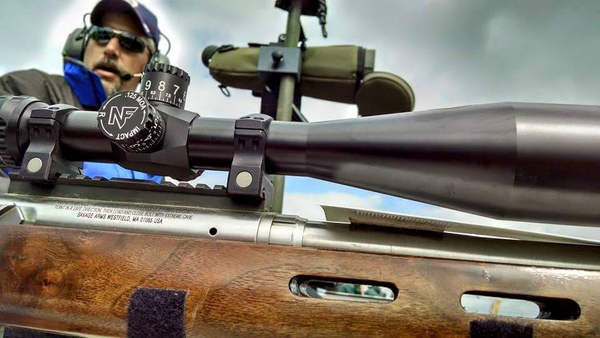
Photo by Matthew Schwartzkopf.
Phil Kelley wrote: “I never knew when planning for this trip the wonderful history that is the Creedmoor Cup, Ireland and U.S. rifle competition, and the hunger of the Irish for freedom. It is one of many things that has made this trip so enjoyable. J.P. Craven [opened] the Creedmoor competition with John Sigler, previous President of the NRA. John had the honor of the first shot with a rifle used to help gain Irish independence. The Irish, like Americans, have a rich history that ties the rifle and independence together. It has been an honor to be part of this event, with each and every individual that is part of it.”
|


