The 2025 European F-Class Championships took place September 1-8, 2025 at the famed NRA Bisley Shooting Centre in the United Kingdom. Hundreds of talented competitors attended the match, with shooters from the USA finishing at the top in both F-Open and F-TR class.
Here’s a report from the NRA UK Facebook Page: “That’s a wrap on the F-Class European Championship. As the biggest F-Class event in the world, it brought together the finest shooters to test their skills at our very own National Shooting Centre, Bisley. It was a true testament to the skill and dedication of every competitor, with Bisley’s Stickledown Range living up to its reputation as a challenging and dynamic range. The wind and conditions were relentless, but so were the competitors.
A huge well done to all the competitors who travelled from across the world to participate. And thank you to the incredible NRA staff and volunteers who made the event possible. We are so proud to have hosted this prestigious event at the National Shooting Centre and we are already looking forward to hosting the World Championships in 2026.”
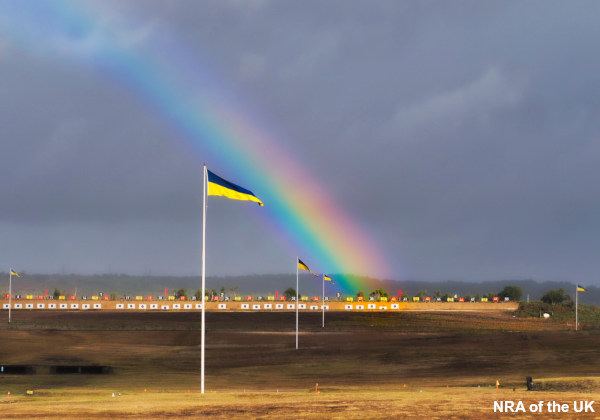
Stunning rainbow on the Stickledown range at Bisley, England, UK.
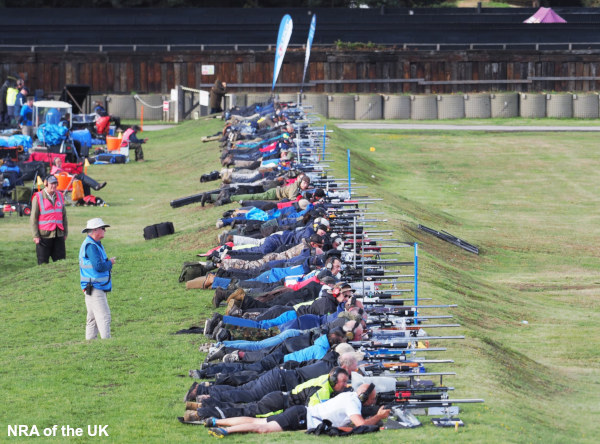
F-Class competitors on the firing line. CLICK HERE for more information about the famed Stickledown range at the NRA UK Bisley Centre.
The 2025 European F-Class Championships drew hundreds of shooters from around the globe, many from outside Europe. Top competitors from the USA wanted to gain experience at the challenging Stickledown range because the 2025 WORLD Championships will be held at the same venue. It was a demanding match, with very tough weather conditions during some sessions. CLICK HERE for full Individual and Team Results at 2025 Euro F-Class Championships.
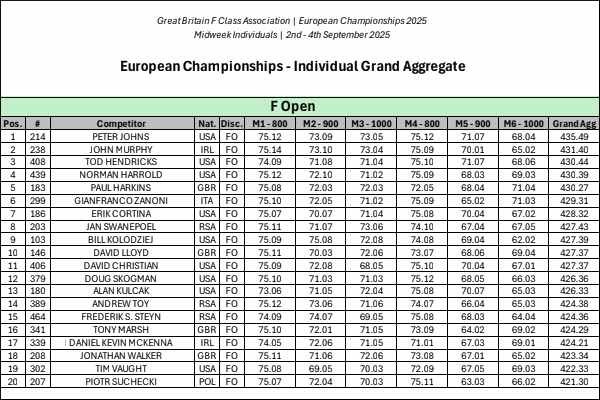
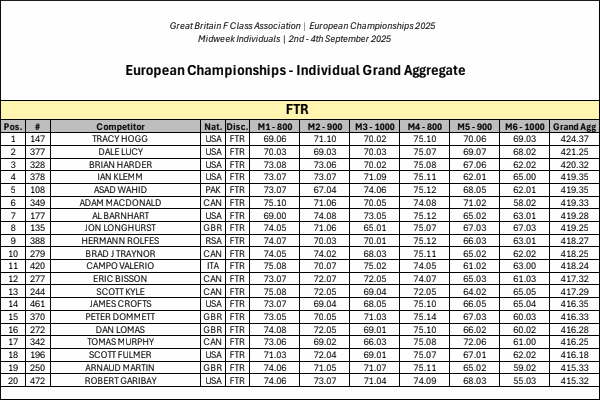
Top 20 Finishers at 2025 European F-Class Championships
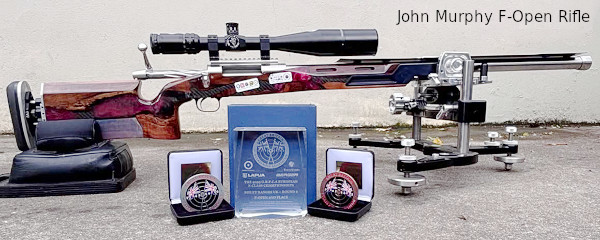
Congrats to F-Open Champion Peter Johns, who surpassed runner-up John Murphy of Ireland by 4 points. American shooters took three of the top five places in the F-Open competition.
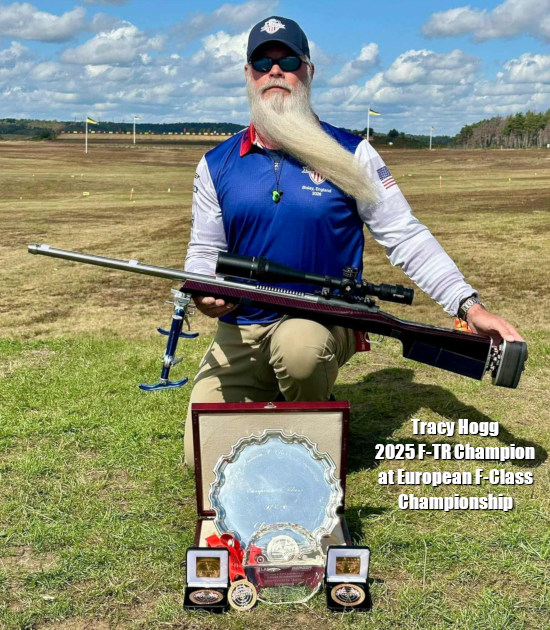
Praise to F-TR winner Tracy Hogg, who edged second-place Dale Lucy by 3 points. Americans took four of the top five place in the F-TR championships.
American Tracy Hogg Wins 2025 European F-TR Title
SEB Lambang, creator of SEB Rests and Joypod-X joystick bipods, posted: “Congratulations to Tracy Hogg for winning the 2025 F-TR European Championship!” Tracy, shown below with his awards, posted: “I’ll have to be honest I should have started years ago (using the Joypod-X). It really helped being able to move across the target so quickly in those tricky winds in Bisley”.
Report from John Murphy (2nd Place, F-Open)
American F-Open competitor John Murphy posted this report: “Finally back home and unpacked after an incredible week at the European F-Class Championship in Bisley. I’m thrilled to have finished 2nd overall [in F-Open], shooting through some of the toughest conditions I’ve ever faced and competing against many of the best in the world. Congratulations to Peter Johns on taking 1st place — he’s not only a world-class shooter but also a true gentleman.
A big thank you to Richie, the GBFCA, and the entire crew for organizing such a fantastic event. And of course, to my teammates, who made me proud in both the Team Matches and the America’s Cup. Already looking forward to seeing everyone again next August for the World Championships!”
Here’s a video report from Erik Cortina, who finished 7th overall in F-Open:
Rifle Images from the 2025 European F-Class Championships
F-TR competitor with alloy stock. Note the extremely low-profile bipod mounted close to bore axis. That helps minimize twist/roll on recoil.
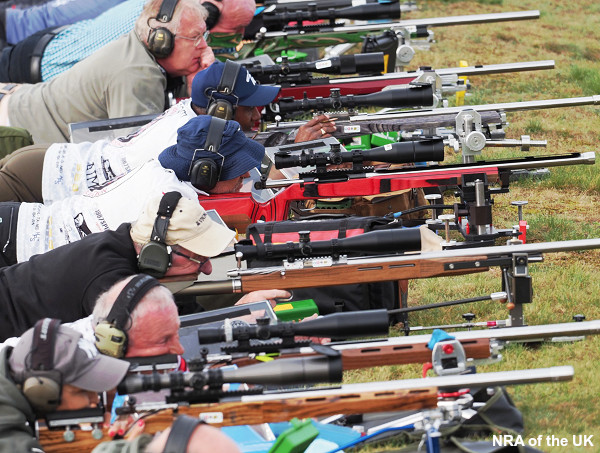
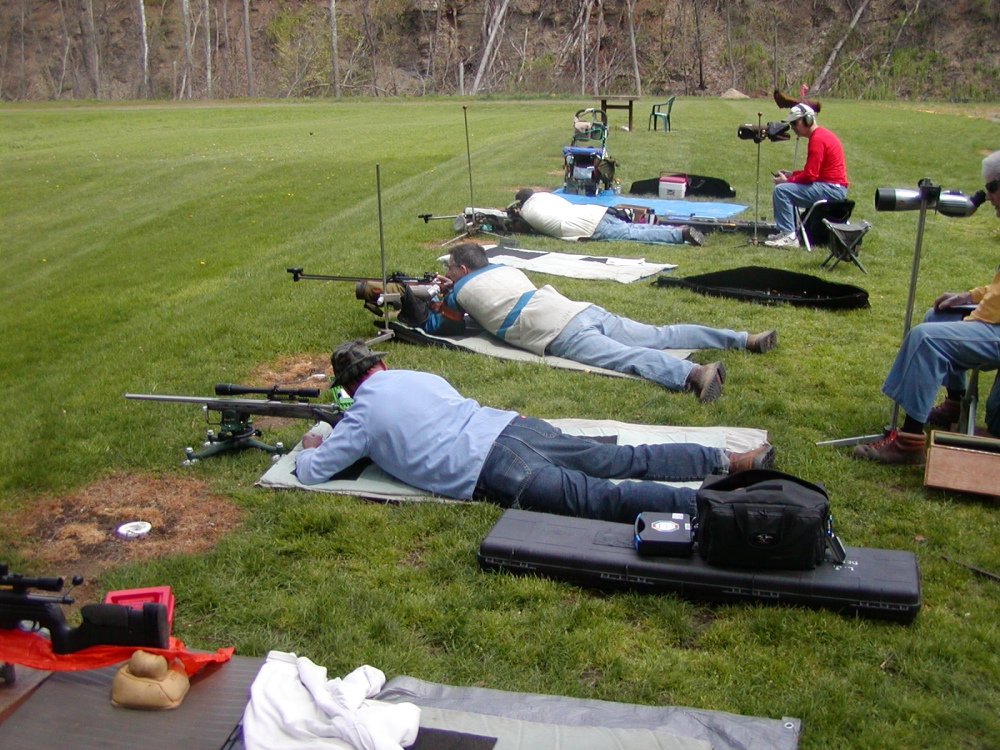
F-Class competitors on the firing line. All shooters shown here had laminated wood stocks.
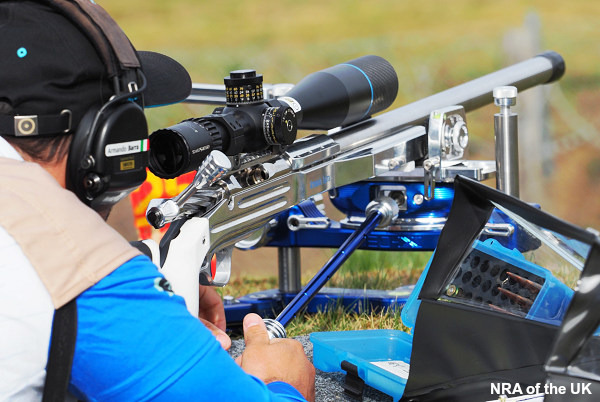
F-Open shooter with SEB NEO-X Front Rest. This rest folds compactly for transport yet is extremely stable during shooting, with superb joystick control.
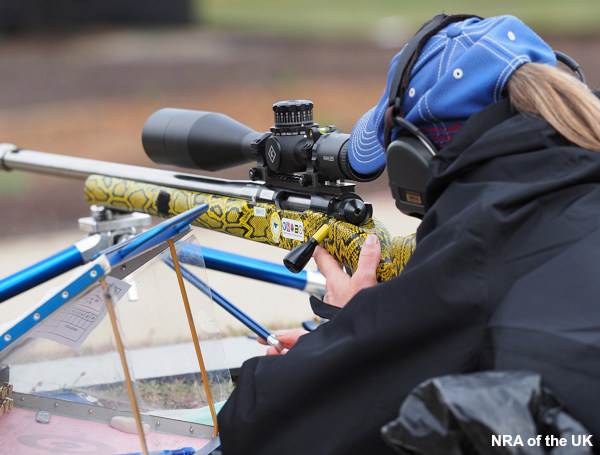
Lady F-TR competitor with a handsome gold snakeskin pattern on her stock, with matching gold bolt shaft.
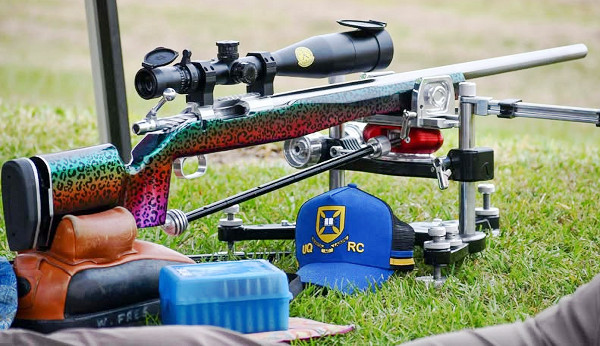
This rifle called “Sindy” features a leopard print on multicolour metallic. Very handsome. SEB Lambang posted: “Thank you Wendy LFree for sharing this lovely pix and for using my products!”
Heavy Rain and High Winds at Stickledown — Challenging Conditions
There were significant rainstorms during the 2025 F-Class Championship. Competitors needed tough wet-weather gear, and rainguards over their ammo and scoresheets. It was also wise to protect your scopes from moisture so that raindrops did not obscure the lens views.
Do you shoot with a SEB joystick-equipped bipod, or are you considering acquiring a “Joy-Pod” for your F-TR rifle? Then you should read this article. Here Sebastian (“Seb”) Lambang, the inventor and builder of the SEB joystick bipod, offers tips on shooting with this impressive piece of engineering. Seb explains some techniques that can help with tracking and getting back on target. You can ask SEB questions about his Joy-Pod in this Shooter’s Forum Thread.
Joy-Pod Shooting Tipsby Seb Lambang
1. Be sure that the rear bag is settled before starting to shoot. Tap your stock into the bag. Then move your rifle back and forth, while checking your reticle. If it tracks straight, vertically perfect, and comes back to the original point of aim, it’s fine. If not, re-adjust.
2. If you use the Pod-Pad, be sure it is fully settled before starting to shoot. Tap the top where the feet rides on using your palm — you wan to create a flat top. To be sure the Pod-Pad does not move or slide, remove any gravel or pebbles under the pad — these can act as roller bearings.
3. Be sure your shooting mat is NOT springy or spongy. This is very important. Use a proper mat, or cut it if possible so your rear bag rests directly on the ground. Use a heavy rear bag. You can use a sand-filled doughnut (not a rigid spacer) to stabilize the bag on uneven ground. These doughnuts are relatively inexpensive and really work.
4. Be sure your whole body position is correct, so your shoulder is square. “Follow” the recoil with your shoulder, don’t push “against” it. Don’t move too much. Don’t make unimportant movements during your shooting string. Always be as consistent as you can in all things — how you hold the rifle, even how you breathe before taking the shot.
This young lady shooter is using a first generation Joy-Pod. The newer versions have flat, ski-like feet.
5. Be sure your rifle and rear bag are aligned. You want the slot between the ears of the bag perfectly aligned with your barrel. (You can use a yardstick or a piece of string to help with the alignment).
6. Use a heavy rear bag. The heavier and the more stable, the better.
7. It does not matter (from my own experience) whether you light-hold the joystick or leave the joystick in the air when you shoot (see Darrell Buell video — he shoots “hands off”). I believe the bullet already exits the muzzle before the joystick moves in your fingers. I lightly hold the joystick myself, just as I would hold a billiard stick.
Watch Darrell Buell shooting his .375 CheyTac equipped with a counter-balanced Joy-Pod. Note how the gun comes straight back, and how Darrell can release the joystick before breaking the shot.
SUMMARY — When It All Comes Together
If everything is set up right, and done correctly, your rifle will track beautifully straight and your reticle will come back or very close to the original point of aim, every time. If you have to change the Joy-Pod, rear bag, or your body position after a shot, there could still be something wrong with your set-up, alignment, or body position. When everything is right, you can also see your own score in the scope after every shot you make (after initial recoil). You also should not have to change the bipod’s setting, the height, the cant etc., at all. You only need to adjust for the current condition with the joystick, the joystick will do it all. That’s why we call our bipod the JOY-Pod.
SEB JOY-POD Joystick Bipod, and POD-PAD
Weighing in at just 18 ounces (510 grams), the Gen 2 Joy-Pod is unlike any other bipod on the market. Designed specifically for weight-restricted shooting classes, the Joy-Pod offers smooth and precise joystick-controlled aiming. The Gen 2 model offers up to 14 degrees of cant and an improved design that functions with up to 50 pounds of rifle weight. Each Joy-Pod comes with a Weaver rail adapter. The optional Pod-Pad accessory is designed expressly for the Joy-Pod. It works filled or unfilled with the Joy-Pod’s sleds to bring you back to your shooting position easily. CLICK HERE for more information, or visit SebRests.com.
.308 Win Tactical Rifle fitted with Joy-Pod on Pod-Pad. CLICK HERE for Video.
Here’s 2014 F-TR National Champion James Crofts, with his PR&T-built rig.
Are you ready? The 2015 F-Class Nationals event is just three weeks away. The combined mid-range and long-range F-Class National Championships will be held October 23 – 31, 2015 in Phoenix, Arizona.
For 2015, the Nationals will include both Mid-Range and Long-Range competitions. The NRA F-Class Mid Range National Championship will be held 23-27 October 2015. The F-Class Long Range National Championship then runs from October 27 through 31. The competition consists of two different Divisions: F- Open and F-TR (Target Rifle). Each Division is made up of five different Categories: High Master, Master, Expert, Sharpshooter and Marksman. There will also be a series of four-person team matches. The event is limited to 320 competitors maximum. All matches will be held at the Ben Avery Shooting Facility outside Phoenix.
You’ll see some serious hardware on the firing line at Ben Avery. Here’s a modern F-Open rig with a handsome maple stock. The gun, belonging to David Mann of Texas, shoots as good as it looks.
Under Two Inches at 500 Yards
To be competitive at the Nationals, one needs a tack-driving rifle and an ultra-accurate load. Shown below is one of Paul Phillips’s F-TR load development targets at 500 yards. The total 5-shot group size is under two inches. Impressive. That’s with 200gr Bergers, Varget powder, and large primer Lapua brass. Paul tell us: “The X-Ring is 5 inches at 1000 yards (equivalent to 2.5 inches at 500). We strive to be all in the X-Ring. However, wind is the big obstacle. A gust of wind can move you 1-2 feet away.”
F-Class National Championship Registration and Deadlines
Competitors must submit the official Registration & Entry Form (include NRA Membership ID#). Entries MUST be accompanied by check, money order or NRA Points. Make Check payable to Desert Sharpshooters Rifle Club.
Fees are $375.00 for both Mid-Range and Long-Range matches (combined), or $200 for just one match only (either Mid-Range or Long-Range). Team Matches cost $60 per entry.
Mail Entry Forms and checks to:
Middleton Tompkins
P.O. Box 11684
Prescott, AZ 86304.
Phone: (928) 776-8576.
Entry Deadline: The deadline for entries is 6:00 PM Monday, 12 October 2015. Entries after this time are considered late entries and may be accepted to fill vacancies on existing relays only. An additional $20.00 will be charged for late entries, on top of the basic fees.
2014 F-Class Nationals Photos copyright Nightforce Optics, used with permission.
F-Class shooting (both F-Open and F-TR) is one of the fastest-growing forms of rifle competition. Each season many new shooters hit the line and attendance at the big matches increases every year. But if you’re new to the game, you may ask “Where can I shoot an F-Class match?”. Well, Forum member Rod V. (aka Nodak7mm) has compiled a useful list of 109 ranges around the USA where F-Class matches are held (plus 6 “possibles”). With venues from Alabama to Wyoming — you should find an F-Class program not too far from home. The list, in Excel spreadsheet format, provides range locations and weblinks (where available). Click the link below to download the F-Class Range List (.xls file):
Note — this list, now in its 19th Revision, is augmented regularly, but info is still being gathered. No claim is made that the list is comprehensive. But it still covers the the lion’s share of the important F-Class venues nationwide. If you know of a range that should be added to the list, please post the location on our F-Class Range List Forum thread. Rod will update the list as new range info is received. Rod writes: “Range information is wanted and welcomed. I would like your help on collecting specific info on Clubs/Ranges where known F-Class matches are held.” Here’s a partial sample from Rod’s list:
This past weekend, reigning F-TR National Champion James Crofts shot a match using the latest generation of the SEB Joy-stick Bipod, aka “Joy-Pod”. Apparently, James didn’t have any problems adjusting to the coaxial Joy-Pod. James definitely “felt the joy”, shooting a 200-9X score, his first-ever perfect 200 at 1000 yards in F-TR.
James reports: “I used the SEB Joy-Pod, it was amazingly stable. The Joy-Pod works amazing.” James is a “releaser” not a holder. When shooting with the Joy-Pod, he releases the joy-stick handle right as he fires: “I let go when breaking the shot”. Some other guys maintain light contact, allowing the joy-stick shaft to float back between/over their fingers during recoil. But it looks like James has a method that works.
SEB Joy-Pod Fitted on Savage-Actioned PR&T F-TR Rig
Here’s the rig James was shooting. Yes it has a Savage action, complete with AccuTrigger. James proves you don’t have to have a $1200.00+ custom action to shoot 10s and Xs at long range. The rifle was built by Ray Bowman of Precision Rifle & Tool. James wanted to thank Keith Trap (Forum member KT) for helping James do all of the testing on this rifle. James tells us: “I have decided this year I want to work more on myself as an individual shooter and not spend as much time [working with] my ammo and my rifles.”
CLICK PHOTO to See Full-screen image with more detail:
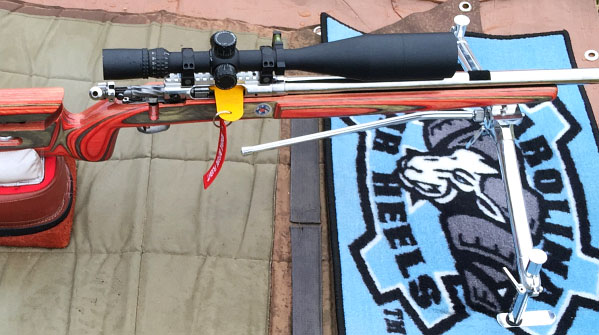
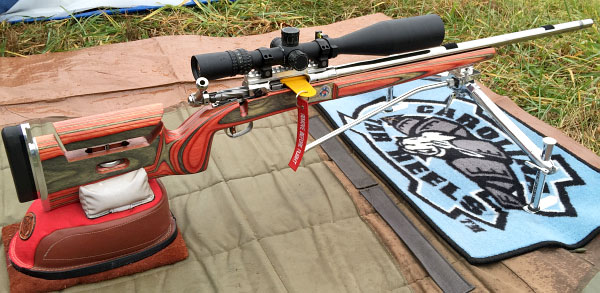
Yes, Virginia, there is a Santa Claus and yes that’s a Savage action in this rig!
Note the grippy suede base-pad under the Edgewood rear bag, which features low-friction ear material.
USA F-TR National Champion James Crofts. Photo by Kent Reeve.
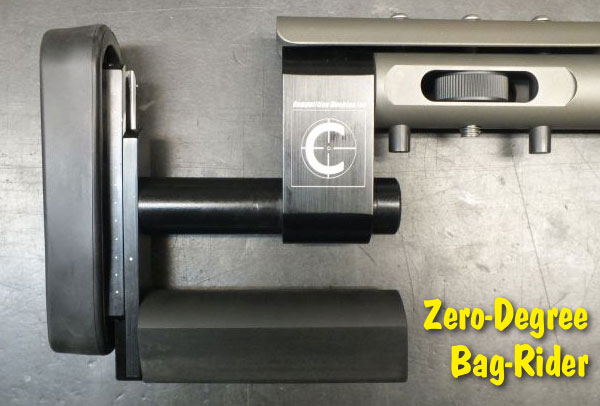
Tube-gunners take note. Gary Eliseo has just introduced a new wider, V-profile rear bag rider for his Competition Machine modular chassis systems. The new bag-rider is a wide V-shape that conforms to the shape and angle of popular rear sandbags. Gary tells us that “The new F-class rear bag rider will be available as an option in 2014. Constructed of Delrin, the new bag-rider is reversible with 0 degree and 5 degree mounting ends. The bottom of the bag-rider is sized to fit 3/4″-wide ear spacing.”
Editor’s Comment — This Kind of Bag Rider Really Works
We have tested a prototype, V-shaped bag-rider on an Eliseo 6mmBR Tubegun. The profile on our wooden prototype is very similar to Gary’s final design crafted from Delrin. We were really surprised at how much better the gun behaved with the wide, V-shaped bag rider, compared to a standard slab-sided skid. With the “V-Rider” the gun felt more “locked-in” with less side-to-side play. There also seemed to be less vertical bounce when shooting F-TR style with a bipod. But mostly the gun felt much more stable, with less tendency to roll. There was noticeably less side to side wobble, and the gun did track better.
The most important thing, is that the V-shaped bag-rider definitely made the gun easier to shoot — at least in the opinion of our three trigger-pullers. When we switched to our wide, V-shaped bag-rider, three different shooters were able to hold smaller groups with tighter horizontal. We saw fewer left/right shot impacts (away from the group center) that may have been attributable to little, last-micro-second movements of the rifle. The gun seemed to settle in the rear bag better, and after each shot, it seemed we could get back on target more quickly. The gun “locks in” to the rear bag faster and more solidly, so you spend less time fiddling with horizontal. With less wobble, the TubeGun feels less top-heavy. Understand that a V-shaped bag rider will not make your rifle more inherently accurate. However, it may help you steer the gun more consistently, and it make help the rifle track more consistently.
Product find by EdLongRange. We welcome reader submissions.
Darrell Buell recently posted a photo of the oh-so-scenic Alliance Rifle Club Range in Malvern, Ohio. This is where Darrell and the U.S. F-TR Team will be practicing this week. Wow — what a beautiful place to shoot. The Alliance Range looks more like a top-flight Championship golf course than a mere shooting range. All that green grass, rimmed by trees, looks like heaven to a Westerner accustomed to ranges that are hard-packed dirt, dust, and gravel. This Editor now has a new item on his “bucket list” — get out to Ohio and shoot a match with the Alliance Rifle Club.
Report based on story by Kyle Jillson inNRABlog.
There will be a new rifle discipline at Camp Perry this year — the NRA National Mid-Range Championships, slated for August 5-9. Created due to the rising popularity of F-Class shooting, the new 3000-point Mid-Range Championships will be shot from distances of 300, 500, and 600 yards and will add yet another fun sport to the annual Remington/NRA National Rifle and Pistol Championships. The new Mid-Range Championship isn’t just for F-Class Open and T/R rifles though. Sling shooters are allowed to compete with Service Rifles and Match Rifles and will be classified accordingly.
F-Class Basics
F-Class is target shooting with scoped sights and artificial support (bipods for F-TR and rests or bipods for F-Open). F-Class shooting is done entirely from the prone position. Originally started among older High Power shooters who were straining to see traditional iron sights and needed a little more support, the sport now includes young shooters as well as experienced shooters looking for a new challenge.
There are two F-Class divisions: Open Class (F-Open) and Target Rifle (F-TR). In F-Open, rifles can weigh up to 22 pounds, fire any caliber under .35 and may be shot off just about any type of rest. F-TR rigs are limited to 18.15 lbs (8.25 kg), must be shot off a bipod, and must be chambered for either the .223 Rem and .308 Win (or 7.62×51) cartridges. For F-TR, the bipods are counted in the weight of the rifle. Other F-class rules are found in the official NRA High Power Rulebook.
The Mid-Range Championships will be held alongside the High Power Rifle Championships August 5-9 at Camp Perry, Ohio. And if your thirst for F-Class has not been sated by then, the US F-Class National Championships are coming to the NRA Whittington Center in Raton, New Mexico from August 18-20. After that the Whittington Center will hold the F-Class World Championships from August 23-27.
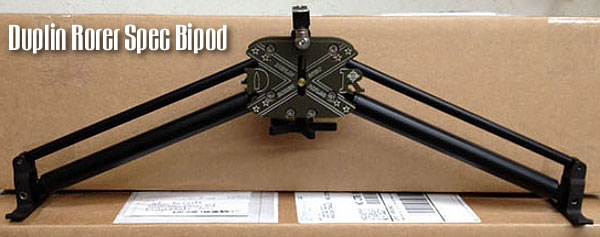
Following our story on the Sinclair Int’l East Coast Fullbore Nationals, folks wanted to know about the bipods used by the winning F-TR squad, Team Sinclair. Some sharp-eyed readers noticed that three out of four Team Sinclair shooters were sporting a compact, parallel-arm bipod. This nice piece of kit is the ultra-light-weight (17 oz.) Rorer Spec Bipod produced by Duplin Rifles in North Carolina. The Rorer Spec Bipod is sturdy and easily-adjusted, yet it is one of the lightest wide-track bipods on the market.
Duplin Rifles — Rorer Spec Bipod
Weight: 1 pound, 1 oz. (17 oz.) | Finish: Clear- or black-Anodized Aluminum
Price: $350.00 delivered in USA | Options: Custom faceplates; Custom mount engraving ($35)
For more information, or to place an order, contact Duplin’s main man, Clint Cooper. You can send email to clint [at] duplinrifles.com or call 910-289-8217.
Duplin Rifles
4527 Hwy 117 South
Rose Hill, NC 28458
Report by Richard King (King’s Armory, Texas; ‘Kings X’ on our Forum)
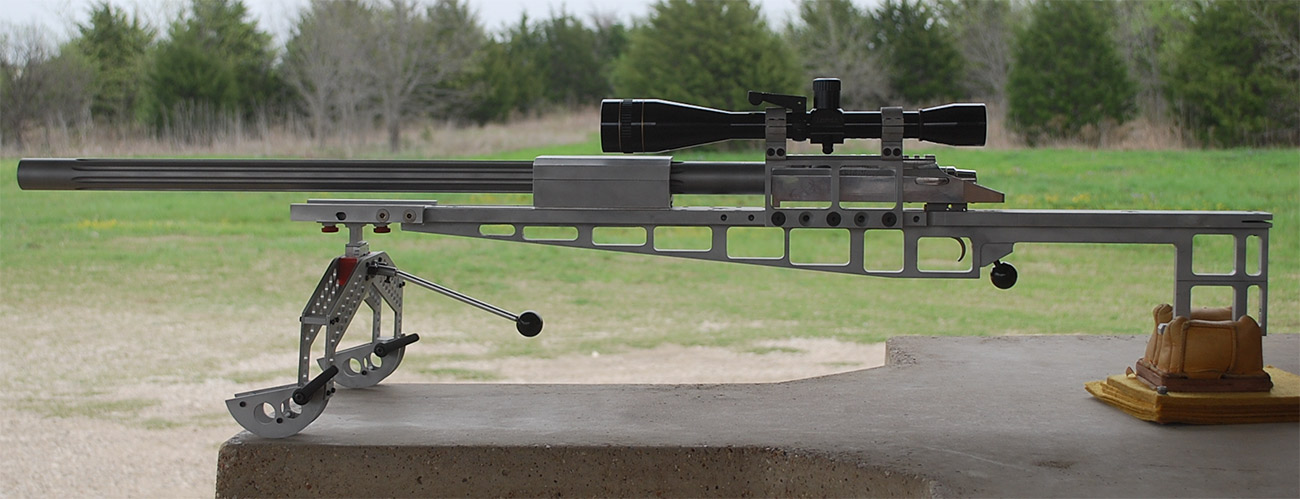
With all the talk from Vince Bottomley in the April issue of Target Shooter about aluminum stocks, I thought you might like to see my latest project. This is my personal gun, built the way I wanted it. I know it’s radical and some may not care for it. But it works.
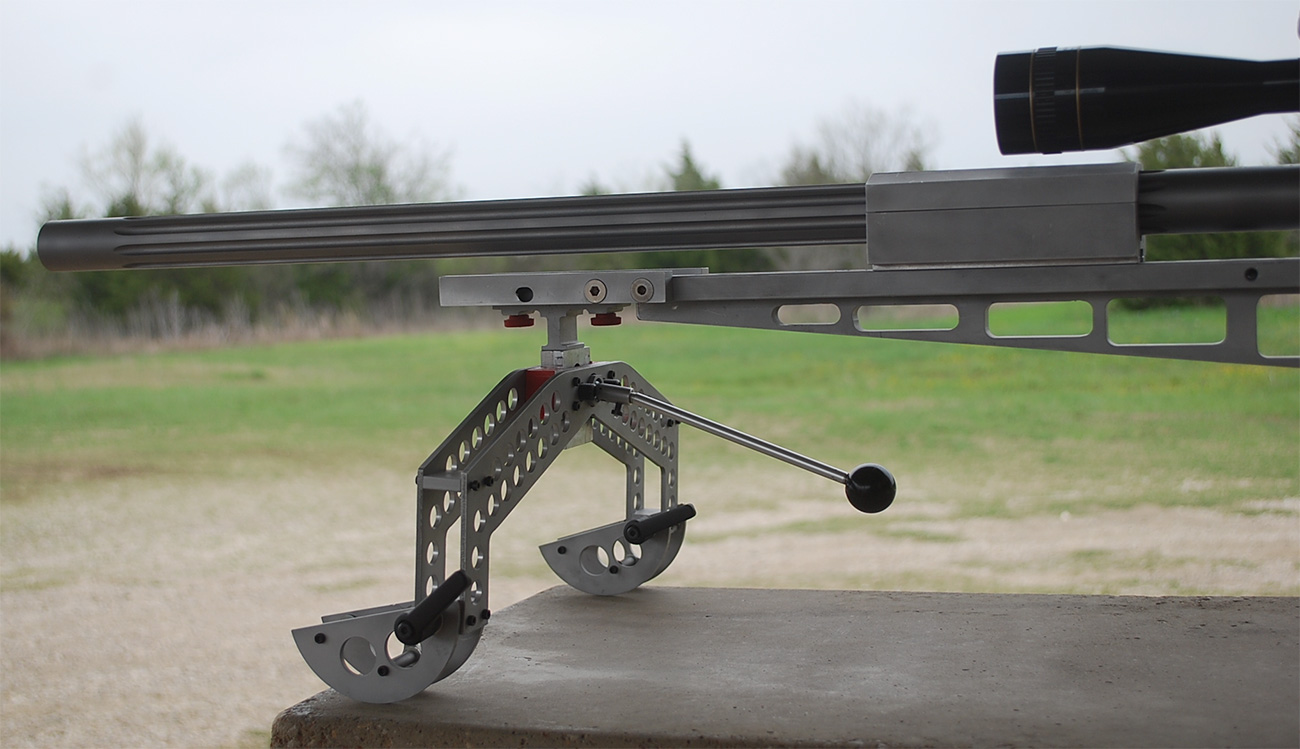
This is pretty much an all-aluminum rifle. The action is a Kelbly F-Class with a Shilen stainless steel competition trigger. The scope is a 1″-tube Leupold 36X with a Tucker Conversion set in Jewell spherical bearing rings. The .223 barrel is Pac-Nor 3-groove, 1:6.5″-twist mounted in a “V”-type barrel block. The bipod has vertical adjustment only via a dovetail slide activated by a stick handle. It works like a joy-stick, but for vertical only. I adjust for windage by moving the rear sandbag.
The 30″ barrel is 1.250″ in diameter. With the barrel block forward, the vibrations should be at a low frequency. Instead of one long rod whipping, I now have two short rods (barrel haves) being dampened. This is my fourth barrel block gun. They work, but so does a good pillar-bedded action. I just do stuff a little different.
The vertical “keel” down the bottom of the stock stops the “spring” of a flat-bar stock. There is little, if any, noticeable flex before or during recoil. The long length of the stock, the fat barrel, and the forward-mounted barrel block work together to keep the gun from rising off the ground. BUT, remember this is a .223 Rem rifle. A .308 Win version might act very differently. I may try a .308-barreled action soon, just to see what happens. But I will stick with the .223 Rem as my choice for match shooting.
The offset scope idea came from a benchrest “rail” gun. In truth, the whole concept came from a rail gun — just adapted to being shot off a bipod. Sure it isn’t directly over the bore. It is about 1.5″ over to the left. So if you want the scope to be zeroed on the center of the target, you have to adjust for the offset. At 100 yards that is 1.5 MOA. But at 300 it is only 0.5 MOA, at 600 only a ¼-MOA, and at 1000 about 1 click on my scope.
What the offset DOES do for me is eliminate any cheek pressure. My cheek never touches the stock. Since this is only a .223 Rem, I don’t put and shoulder pressure behind it. And I don’t have a pistol grip to hang on to, but I do put my thumb behind the trigger guard and “pinch” the two-ounce trigger.
The offset scope placement could interfere with loading a dual-port action from the left. That’s not a problem for me as I set my spotting scope up on the left side very close to the rifle. I have plenty of time to reload from the right side while the target is in the pits being scored.
Again — this is my rifle. It is designed for my style of shooting. It is not meant to be a universal “fit all” for the general public. However, I will say the design is adaptable. I can easily convert the system to run in F-Open Class. I would drop a big-bore barreled action into the “V” block, slide on a heavier pre-zeroed scope and rings, add plates on the sides up front to bring the width to 3”, and maybe a recoil pad. It might be interesting to offset the wings up from to counter torque of the big bullets. But I would also have to offset the rear bag rider to get the gun to recoil straight back.
How the Gun Performs
I have had “T” to the range only twice for load development. It groups like my present barrel-blocked 223 F-TR gun. But it’s much easier to shoot and it only moves about 3/4” — straight back. I tried to build am omni-directional joy-stick bipod but I could not get all the side-to-side wiggle out of it. So I have set it up so it only moves up and down (horizontal movement is locked-out). As it works now, the joystick on the bipod lets me set elevation on the target quickly (with up/down adjustment). Then, to adjust for windage, I slide my rear bag side-to-side as needed. Once set, I just tickle the trigger and smile.
Gun Handling — Shoot It Like a Bench-Gun
I basically shoot the gun with no cheek or body contact. I don’t grip it, other than maybe a pinch on the trigger guard. The scope was offset to the left to help the shooter move off the gun and avoid the possibility of head/cheek contact with the stock.
Listen to Richard King Explain How He Shoots his ‘Texas-T’ Rifle:
[haiku url=”http://accurateshooter.net/Video/RichKingTalks.mp3″ Title=”Richard King Talks”]






 This past weekend, reigning F-TR National Champion James Crofts shot a match using the latest generation of the SEB Joy-stick Bipod, aka “Joy-Pod”. Apparently, James didn’t have any problems adjusting to the coaxial Joy-Pod. James definitely “felt the joy”, shooting a 200-9X score, his first-ever perfect 200 at 1000 yards in F-TR.







 The offset scope idea came from a benchrest “rail” gun. In truth, the whole concept came from a rail gun — just adapted to being shot off a bipod. Sure it isn’t directly over the bore. It is about 1.5″ over to the left. So if you want the scope to be zeroed on the center of the target, you have to adjust for the offset. At 100 yards that is 1.5 MOA. But at 300 it is only 0.5 MOA, at 600 only a ¼-MOA, and at 1000 about 1 click on my scope.