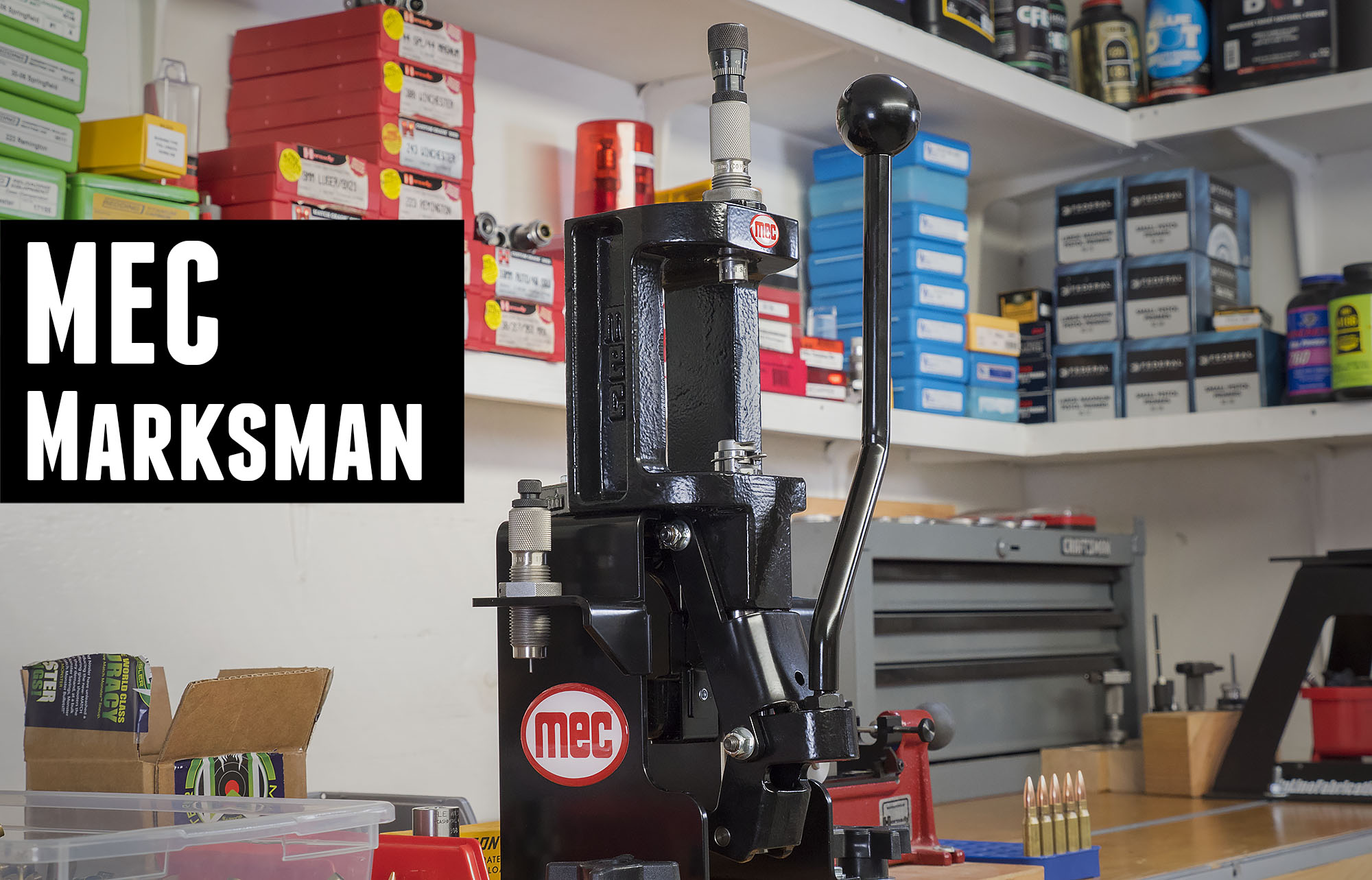
If you need a heavy-duty, single-stage reloading press, definitely look at the MEC Marksman, a beefy black single-stage unit with many impressive features. MEC, noted for its shotshell reloading machines, now offers the cast-iron MEC Marksman press, offering many features we really like. First, the rugged, cast-iron frame is strong enough for the toughest reloading jobs. Second, the Marksman features an OPEN front — that smart design makes it easier to insert and remove cartridge cases. It also makes it much easier to place your bullets during the seating stage.
This open-front design makes good sense — note that Hornady’s LNL single-stage press also has an open-front layout. Importantly, the MEC Marksman has an innovative, self-centering shell-holder. This patented design should help hand-loaders reload more efficiently.
We were impressed when we first saw the MEC Marksman press. The Marksman combines a sturdy cast-iron frame with a smart, user-friendly open-front design. With a $255.00 MSRP it is more expensive than an RCBS Rock Chucker ($214.16 MSRP), but the MEC Marksman offers some distinct advantages — such as the open front plus the patented floating shell-holder system.
MEC Marksman Press Review by Ultimate Reloader
Our friend Gavin Gear got his hands on a MEC Marksman press and put it through its paces. He came away impressed with the product, saying it delivers excellent performance, and has many impressive features. Gavin tells us: “Cast iron tools and machines are a lifetime investment. The made-in-USA MEC Marksman features ductile cast-iron construction, an open-front frame design for easy cartridge access, a new floating shell-holder design with a unique retention system, and ambidextrous handle setup.”
Gavin liked the Marksman’s system for holding spent primers. A tray sits behind the ram to catch spent primers exiting from a hole near the bottom of the ram. This is more foolproof than the plastic primer cups on some other single-stage presses. Expect less spent primer “spillage”.
The Marksman is sold as a stand-alone unit. However MEC also offers a very nice steel mount/riser for the Marksman. Gavin tested the Marksman with this riser, and he says it was sturdy and well-built. Gavin liked the riser. He said that elevating the Markman press up above the benchtop made it easier to handle cases and to operate the handle. You also get extra left- and right-side die-holders.
Manufacturer’s Product description: The MEC Marksman® is made from ductile cast iron for superior quality and durability. Our patented shell holder self-centers each cartridge. The MEC Marksman® is compatible with all 7/8-14 thread dies to change calibers quickly. Reloading .22 Hornet to .416 Rigby can all be done with one convenient machine.
When is a single-stage reloading press worth close to a thousand bucks? When it’s made in Germany with CNC technology and crafted to aero-space precision standards. UltimateReloader.com’s Gavin Gear recently got his hands on a Turban 120mm Heavy Präzipress. This unit retails for about 715 Euros (714,27 €), which is $858.88 U.S. Dollars at current exchange rates*. Gavin put the Präzipress through its paces, and came away VERY impressed. READ FULL REVIEW HERE.
Impressive Test Results
Sizing once-fired 6.5mm Creedmoor cases with the Präzipress, Gavin achieved great results for shoulder “bump” consistency. The sizing results were nothing short of spectacular. After zeroing the first of ten cases, the remaining nine were essentially identical, showing as “0.000”, meaning less than half a thousandth of variation.
The Präzipress also delivered ultra-low run-out when seating bullets using a Forster die. On all ten test cases, the run-out was +/- 0.001″ (one-thousandth) or less.
Is this kind of press worth the money? Gavin says “yes” if you demand the highest level of precision in sizing and seating: “When you use this press, it’s immediately clear that there are no details neglected, and I can’t imagine one of these presses ever wearing out. Based on the precision tests I did with ammunition loading, it’s clear that this level of precision DOES make a difference for ammunition dimensions and consistency.”
According to Gavin, the “Heavy” 120mm version of the Präzipress is massive and boasts many notable design features:
— Three guide rods with linear roller guides (I have not seen these on any other press)
— Ambidextrous operation (handle can be mounted on left or right side)
— Positive snap shellholder retainer (secure, but easy to insert/remove shellholder)
— 120mm opening accepts cartridges up to .408 CheyTac Size length
— Enclosed spent primer catch system which contains debris
— Optimized leverage (VERY powerful mechanical advantage for sizing)
— Oversized handle (bar diameter) that minimizes flex
There are now three (3) triple-column Präzipress sizes. Along with the 120 model press featured above, there are even larger 140 and 150 models:
* Stated price does NOT include shipping to USA and other fees. The Turban-shop.de website states: “In the case of delivering to a non-EU country, there can be charged extra tolls, taxes, and fees. Packaging costs will be charged separately.”
With the high cost and reduced availability of factory ammo, more shooters are loading their own ammo. When good 9mm pistol ammo was $10/box, it might be hard to justify handloading. Now that 50 rounds of 9mm can run $40 or more it certainly makes sense to reload. The same is true with rifle ammo if you shoot large quantities, or if you simply can’t find your preferred ammo for sale these days.
To increase productivity when reloading large quantities of ammunition, many shooters are thinking of getting a progressive press. Because multiple operations take place with a single pull of a lever, a progressive press can produce way more ammo in a given period of time than any single stage press. With a progressive, on the ram up-stroke, the multiple stations can simultaneously remove spent primer, full-length size case, drop powder, seat bullet, and crimp (if desired). Most progressives are also set up to prime cases with the ram in the lower position — though some guys prefer to prime manually.
Progressive presses aren’t just for high-output pistol ammo or bulk rifle ammunition. Good progressives can be adapted to do certain reloading tasks for top-on-the line match ammo. You might use a progressive for decapping, priming, and sizing, then throw powder and/or seat bullets separately. Some Champion shooters do use progressives to load their match ammo! For example 5-Time National Long Range Champion John Whidden and 2020 Berger SWN F-Open Champion Jay Christopherson both use progessive presses for some (but not all) operations.
To help you get started with progressive presses, here are five videos from UltimateReloader.com that cover six popular machines, from the elite Mark 7 Evolution to the affordable Lee Loadmaster. With many of these machines you can add separate vertical bullet feeder systems that further increase loading efficiency.
Area 419 has just introduced the all-new ZERO reloading press, a 9-station turret press with some very unique features. This press was designed to be the most precise turret ever created. As tested by Gavin Gear of UltimateReloader.com, the new ZERO turret press delivered very impressive shoulder-bump consistency and ultra-low seated bullet run-out (about +/- 0.0005″). The numbers were as good as you can get from a quality single-stage press, so Area 419 did some impressive engineering. We would expect that, as this is an expensive product — MSRP is $1200.00. SEE FULL REVIEW on UltimateReloader.com.
The ZERO turret press lets you install up to nine (9) different reloading dies in the large top turret, which revolves around a central axis. But unlike most turret presses, the ZERO doesn’t have flex or wobble when you’re loading. This is because Area 419 includes a clever system for locking the turret in position after you’ve selected the die from your array. Area 419 also uses a unique system for securing shell-holders (see video at 12:00). This, likewise, adds to the precision of the press.
In the video above, you can see how the turret is secured with a “wedge clamp”. By loosening the wedge clamp you can index the press easily to any station. Then, when you have selected your die, you tighten the wedge clamp again. You can see this important procedure at 13:20 – 13:35 timemark in the video.
ZERO Turret Press Has Very Smooth Operation
Gavin observed that this ZERO turret is both smooth and very precise, thanks to smart engineering and the use of multiple bearings. Area 419 describes the design features:
— Turret (zero-slop) eliminates variability induced when removing and resetting dies
— The turret head holds nine 7/8×14-threaded dies (1-1/4 thread in future)
— Available ram-stroke here is 4.4″, allowing use of very tall cartridge types.
— Adjustable/interchangeable handle setup for maximizing leverage/feel based on operation
— Internally contained primer-catch system, slide-out drawer
Important Features of ZERO Turret Press
1. Press frame: 6061 Aluminum, clear anodized
2. Wedge clamp (locks turret into indexed position)
3. Turret (7075 aluminum and steel construction)
4. Adjustable handle with roller knob (set either left- or right-handed operation)
5. Bearings: Ball bearing plus roller thrust bearings for side plates
6. Ram riding in self-lubricated linear bearing
7. Spent primer catcher drawer
Milled from American billet aluminum and stainless steel, this press employs 14 bearings, including a self-lubricating linear sleeve bearing for the precision-ground 1.25″ ram. The linkage system also glides on bearings providing smooth operation with near-ZERO slop. The oversized ram features a 0.75″-diameter steel arm and ZERO-friction knob. The turret system is located with an oversized ball-detent system and secured using an over-sized, custom-made ZERO-point pull-stud. Locking the turret after indexing require only a half-turn of the supplied T-handle (see photo above). When indexing the turret, repeatability variance of the system should be less than .0005″.
The opening in the press will allow for sizing and seating of cases up to.338 Lapua Magnum, and will accept standard 7/8″ dies and standard shellholders. NOTE: Area 419 will be making and selling shellholders specifically fit to the system later in 2020.
SUMMARY — Impressive Press Delivers Precise Results
Gavin Gear was very impressed with Area 419’s new Zero Press, which he said offers the precision of a quality single-stage with the versatility of a turret: “There will always be people that prefer a traditional single-stage. Where the ZERO will be compelling is to those who want the precision of a single-stage without the need to screw dies in and out. Leaving your dies set can have benefits for precision as well — everything comes back to the ‘same place’ when dies are indexed into position. Screwing dies in and out can impose variation, and variation is the enemy of the ‘white lab coat shooter’. I plan on testing the ZERO press with ultra-high-end dies, and custom dies that I ream to my own specifications. I’m thinking that will show the true potential of this press!”
Area 419 ZERO Press Video with Operation Instructions
Every serious competitor needs a good spotting scope support. Spotting scopes are not just for iron sights shooters. Even if you have a powerful riflescope, the spotting scope, typically set at 15-25X magnification, lets you observe wind flags, mirage, and other shooters’ targets. If you are looking for a high-quality, made-in-USA support for your spotter, consider the Polecat V2 system from Creedmoor Sports. Our friend Gavin Gear of UltimateReloader.com recently posted this video review:
Creedmoor Sports has offered excellent products for competitive shooters for decades. The Made-in-USA Polecat V2 system is updated version of Creedmoor’s best-selling spotting scope stand. After collecting feedback from shooters across many disciplines for several years, the designers brought some major advances to this scope stand. First, no pretension are adjustments needed. Horizontal and vertical resistance is controlled by the knurled tightening knob. Second, the Polecat boasts a pre-aligned Delrin clamp so you don’t have to spin the clamp to align with the rods during stand assembly. You can order a Polecat V2 with 3/4″-diameter rod for $296.95 or get the 1″-diameter rod version for $364.95.
Either version can be used for both left-handed and right-handed shooters, with about 5″ standoff from the center of the stand to the scope’s centerline. Polecat V2 packages include head, stop collar, one extension rod, and base. Additional aluminum rods are available to extend height.
Polecat V2 Key Features
— Adjustable head (spotting scope mounts to head)
— Bump stop (protects spotting scope from accidental knock if dropped)
— Base with three fold-out legs
— Leveling adjustment for uneven ground (one leg can be adjusted downward, faced in downhill direction)
— Zero play (slop), giving you the ability to quickly and easily make adjustments
— One-handed operation/adjustment
— 1/4″-20 standard spotting scope thread
— The scope may be positioned above or below the scope head
Factory-loaded ammunition has become very hard to find, particularly pistol ammo. Concerns over social unrest, personal security, and the upcoming election have spiked demand for loaded ammo. Everyone is asking “where has all the ammo gone?”
Pistol Ammo Hard to Find
In particular, 9mm pistol ammo flies off the shelves as soon as it arrives, and even major online vendors such as Midsouth Shooters, MidwayUSA, and Natchez have very limited supplies.
Need Ammo? Load Your Own…
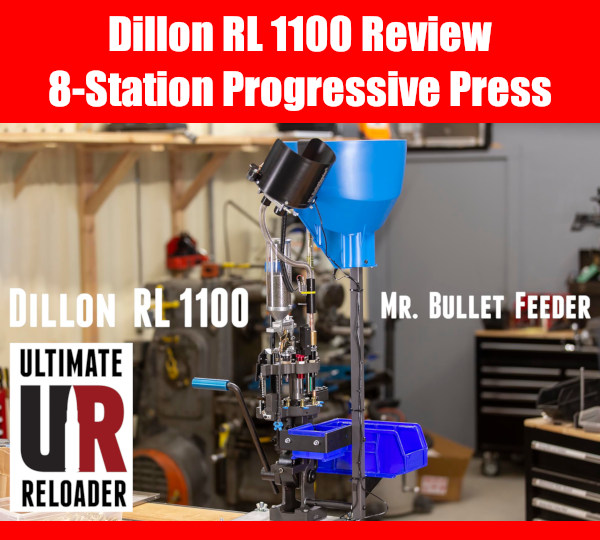
One answer to the ammo shortage is to load your own. And if you want to produce a large quantity of ammo in a short amount of time, the progressive press is the answer. There are many progressive press systems, from modest Lee progressives to high-end, automated systems from Mark 7 (Lyman). In this article we feature the “latest and greatest” progressive press from Dillon — the new eight-station RL 1100 Press with Case-Feeder.
Our friend Gavin Gear of UltimateReloader.com got his hands on Dillon’s impressive new RL 1100. In two videos, Gavin shows how to set up the RL 1100 and then he demonstrates how to produce 9mm pistol ammo with this impressive 8-station press.
Gavin says: “My Dillon RL-1100 is cranking out the 9mm, and in this video we bring it up to ‘full tilt’ speed” [with the MR. Bullet Feeder and the Dillon Case-Feeder]. If you watch the video, you’ll see Gavin produce 9mm ammo at a rate of nearly 50 rounds per MINUTE!
Gavin equipped his new RL 1100 with two cool products from Double Alpha Academy (DAA) — the Mr.Bulletfeeder® as well as an advanced, Magnetic Powder Check. When loading ammo you can never be too safe, so we definitely recommend the use of powder-check dies (we use a conventional RCBS powder-check die on our progressives). The DAA bullet feeding system is an important add-on that significantly increases output rates when used in concert with the Dillon Case-Feeder (blue funnel).
RL 1100 Reloading Stations with Powder Check and Bullet Feeder
RL 1100 Stations shown above:
1. Case inserter
2. Sizer/De-Primer
3. Swager (with hold-down)
4. Priming (no die)
5. Powder charge and expansion (expansion for pistol cartridges only)
6. Double Alpha Magnetic Powder Check
7. Mr. Bullet Feeder bullet feed die
8. Bullet seating and Crimping
Note: In order to accommodate the magnetic powder check die AND the bullet feed die, bullet seating and crimping were combined at the last station.
The RL 1100 has some very impressive features that allow faster and easier ammo production. An Eccentric Roller Bearing Drive System reduces friction. The RL 1100’s heavier frame provides greater rigidity for more efficient cranking. The RL 1100 also boasts an improved shellplate indexing system. Priming is enhanced through a spring-loaded Priming Station Locator and Upgraded Primer Pocket Swager.
Dillon RL-1100 Set-Up Video:
Loading with the “Turbocharged” Dillon RL-1100
Gavin was very impressed with his RL-1100: “This reloading setup is [great]. Every crank of the lever yields a completed cartridge, and the attainable speeds are AMAZING. The case feeder and bullet feeder had no trouble keeping up with my quick pace using this setup. And it is great to know that every powder charge is being checked.
This press is very reliable and smooth, bridging the gap between lower cost home set-ups and six-figure commercial loading equipment packages. What’s next? I’ll be performing a caliber changeover to .308 Winchester.”
The DAA Magnetic Powder Check can be used on a variety of Progressive Presses.
If you have ANY interest in custom rifle actions, you MUST watch this video from UltimateReloader.com. Folks, definitely watch the video — it is VERY informative! To produce this video, Ultimate Reloader’s Gavin Gear visited the BAT Machine facility in Post Falls, Idaho, and interviewed BAT owner Bruce Thom.
In the video Bruce Thom demonstrates how BAT Machine actions are created from start to finish. Bruce shows every stage of the process, employing multiple high-tech machines. It’s impressive — Forum members say that this is a “must-watch” video. Gunsmith Jackie Schmidt noted: “Great Video. Even though I have been in the machine shop business for 50 years, I still marvel at the new innovations in precision machining. Bruce has a very down-to-earth, common sense approach to explaining what to many seems like machining wizardry.” And Mark T. posted: “Watched it last night. Excellent video and excellent machining practices — precision from beginning to end.”
Click Arrow to Watch Video
For further explanation of the action production processes, with step-by-step listing of how receivers and bolt assemblies are created, read Gavin Gear’s full BAT Machine Article on UltimateReloader.com.
BAT Machine Company Was Started 29 Years Ago
Back in 1991, Bruce Thom started BAT Machine Company, which was incorporated later in 1996. Bruce’s shop stared with manual machines, quickly moving to CNC machines later in the 1990s. BAT Machine quickly achieved a following among benchrest shooters for crafting superb actions that exhibited flawless function and superb machining. Those qualities, benchrest competitors realized, helped produce tiny groups, win matches, and set benchrest records. BAT Machine now makes rifle actions for a wide variety of disciplines: F-Class, PRS, ELR, hunting, and of course short- and long-range benchrest.
BAT Action Body Machining Stages
As shown in the video, here are the major stages for the fabrication of a BAT Machine receiver body:
1. Start: raw 17-4 stainless round bar (higher toughness than typical barrel/receiver steel)
2. Heat treat
3. Bore central hole (for EDM wire), face ends
4. EDM machining (cut bore and raceways)
5. True OD, cut receiver threads and lug seats
6. Cut tang and related features
7. Finish machining including body OD, integral lug (if equipped)
Final Production Stages — Polishing and Deburring
After the receiver body and bolt are machined, they go through a deburring and polishing process.
In the image above you can see the stages. At left is a receiver body straight from machining. Some hand work is typically performed to break interior edges that are sharp from machining. In the center, the receiver shows can see the initial polish stage. During this stage, machining marks are removed by coarse polishing. Additionally for receivers that will be nitrided, that will be done next. But for actions that are NOT nitrided, a final polish brings the parts up to a high luster, as show on the right.
After polish (and nitriding if that applies) the bolts and receivers get a finish assembly, and testing for proper smooth functioning. The receivers are then registered with the ATF and shipped to the customer.
Our friend Gavin Gear of UltimateReloader.com often gets to test the latest and greatest reloading tools before they hit the market. He does a good job showing the features of new products with informative videos. Today we present three interesting products that Gavin has reviewed. First off is the impressive new RCBS Rebel reloading press. Next is the versatile three-head Case Prep Trio machine from Hornady. Third, Gavin reviews new Die Lock Rings and Breech Lock Die Bushings from Lee Precision.
RCBS Rebel Single-Stage Reloading Press
Most hand-loaders have used an RCBS Rock Chucker press at one time or another. Recently RCBS unveiled its new Rebel single-stage press. Like the Rock Chucker, the Rebel has a Cast Iron frame, but with a bigger base and taller arch (for a larger opening). The most important change is that this new Rebel press ejects primers out the bottom of the ram. This a big deal — just put a bin under the press to collect spent primers. However — take note — the Rebel has no on-press priming. You need to prime your cases separately. That’s not really a major issue, as we know the majority of our readers prime separately using hand or bench priming tools.
In this video Gavin loads ammo on the new the Rebel single-stage press and explains its notable features, including the primer ejection through the ram.
Note, RCBS is currently running a Buy Green Get Green Rebate Program. The Rebel Press qualifies for a $50.00 Rebate. And right now, MidwayUSA has the Rebel Press on sale for $186.99. So your net cost, after RCBS Rebate, is just $136.99. That’s a great deal on an excellent press.
Hornady Lock-N-Load Case Prep Trio
Hornady’s compact Case Prep Trio machine (item 050160) packs a lot of functionality in a small package. This triple-threat tool has a small footprint, yet it can perform three tasks as well as much more expensive, tower-style case prep units.
Gavin Gear does a nice job explaining the features of the Case Prep trio. Watch this video to see how it can help you perform chamfering, deburring, and pimer pocket uniforming tasks more efficiently.
With three active stations, you can chamfer, deburr and clean primer pockets without having to change tools. The Case Prep Trio ships with inside chamfer, outside chamfer, and deburr tools. You can also use the machine with other optional 8/32 threaded accessories such as primer pocket reamers and case neck brushes. We’ve used this machine and it works well. The only negative is that you will get metal shavings on your bench (unlike some of the larger case prep centers). We’ve seen some guys put a small pan under the power head — then you can just dump the shavings out of the pan.
New Lee Die Lock Rings and Spline Drive Breech Lock Bushings
New basic lock ring in left hand. Older non-splined ring in right hand.
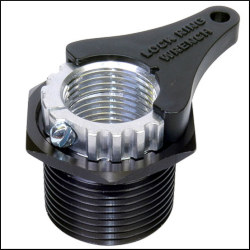
In this recent video Gavin Gear reviews three types of die accessories from LEE. These work for virtually all standard dies, not just LEE-brand reloading dies. The new LEE basic silver-finish die lock rings now feature splines for enhanced grip and compatibility with LEE’s new die lock ring wrench (photo right). They still boast a rubber 0-Ring that helps “float” the die for improved cartridge concentricity.
LEE’s new Ultimate Die Lock Rings have two major improvements — a colorful anodized finish, and a split-ring design with a tensioning screw, that allows these rings to be clamped securely to your dies. Available as a set, this package includes three ultimate die lock rings, and a plastic die lock ring wrench.
Gavin also reviews Lee’s new Spline Drive Breech Lock Bushings for use with presses fitted with LEE’s Breech Lock system. These new Breech Lock bushings allow rapid change-out of dies without modifying the setting. The colorful new bushings feature splines on top that work with the new Lee Lock ring wrench shown above. In addition, the Breech Lock Bushings have a clamp to preserve die depth setting.
Our friend Gavin Gear has just released an excellent video showing how to make a threaded Modified Case for use with the Hornady Lock-N-Load Overall Length Gauge. You can watch Gavin make a Modified Case start to finish in the video below:
Video Shows How to Drill and Tap Modified Case
Gavin has some clever tricks. First he uses a sizing die to hold the cartridge case during the threading process. Second he uses two drill bits in sequence — a smaller bit to ream out the primer pocket, and then a larger “M” bit to increase the hole diameter before threading the brass. Finally he leaves the threading tap IN the brass, locks the tailstock, and then “gently pulls on the quill” to remove the brass from the die held in his lathe (See 5:46 timemark).
Get the Correct 5/16″-36 RH Tap
Unfortunately, Hornady has selected an uncommon thread type for OAL Gauges. You probably won’t be able to buy the correct 5/16″ – 36 RH HSS Tap at your local hardware store. However you CAN order this special tap from Amazon for $9.99.
Modified Case Q & A — TECH TIPS
Why do I need a Modified Case?
Every serious reloader should have a Modified Case for each cartridge type they shoot. The reason is that this allows you to get very precise measurements of the length-to-lands in your chamber. When used with the Hornady OAL Gauge, with some practice, you should be able to get repeatable length-to-lands measurements within about 0.015″. We generally do 4-5 measurements with the OAL Gauge and usually 3 or 4 will be “on the money”. NOTE: We recommend a gentle, easy pressure on the plastic pusher rod. Don’t push too hard or you will jam the bullet hard into the lands, which produces inconsistent results.
Can’t I Just Buy a Modified Case?
Hornady makes a variety of Modified Cases sold on Amazon and through retailers such as Midsouth. While Hornady makes modified cases for many standard cartridges, if you shoot a wildcat such as the 6mm Dasher or .284 Shehane, you’ll need to create a custom modified case. And even if you shoot a standard cartridge such as the .308 Win, you can get more consistent measurements with a custom Modified Case.
If you do decide to make your own modified case, you’ll want to start with a case that’s been fired in your rifle. That way you get the best fit to YOUR chamber. Also, you won’t need to expand the neck to provide bullet clearance. Then you need to drill out the primer pocket and tap the base of the case to match the threads on the Hornady OAL Gauge tool. Make at least two modified cases, as you’ll probably misplace one at some point.
Erik Cortina Makes a Modified Case
If you want to learn more about making Modified Cases, top F-Class shooter Erik Cortina has also created a helpful video showing the process he uses to make modified cases. In Erik’s video, he shows how he taps a case to work with the Hornady Lock-N-Load Overall Length Gauge (formerly the Stoney Point Tool). Erik also explains how to get the best results when using the Modified Case to measure length to lands.
MORE INFORMATION: Want to learn more? We published a much longer story in which Erik explains in greater detail how to made the Modified Case. That article illustrates the 5/16″ – 36 RH HSS Tap required and shows how to set up the lathe to drill and tap your case. If you are serious about making your own Modified Cases, you should Read the Full Article.
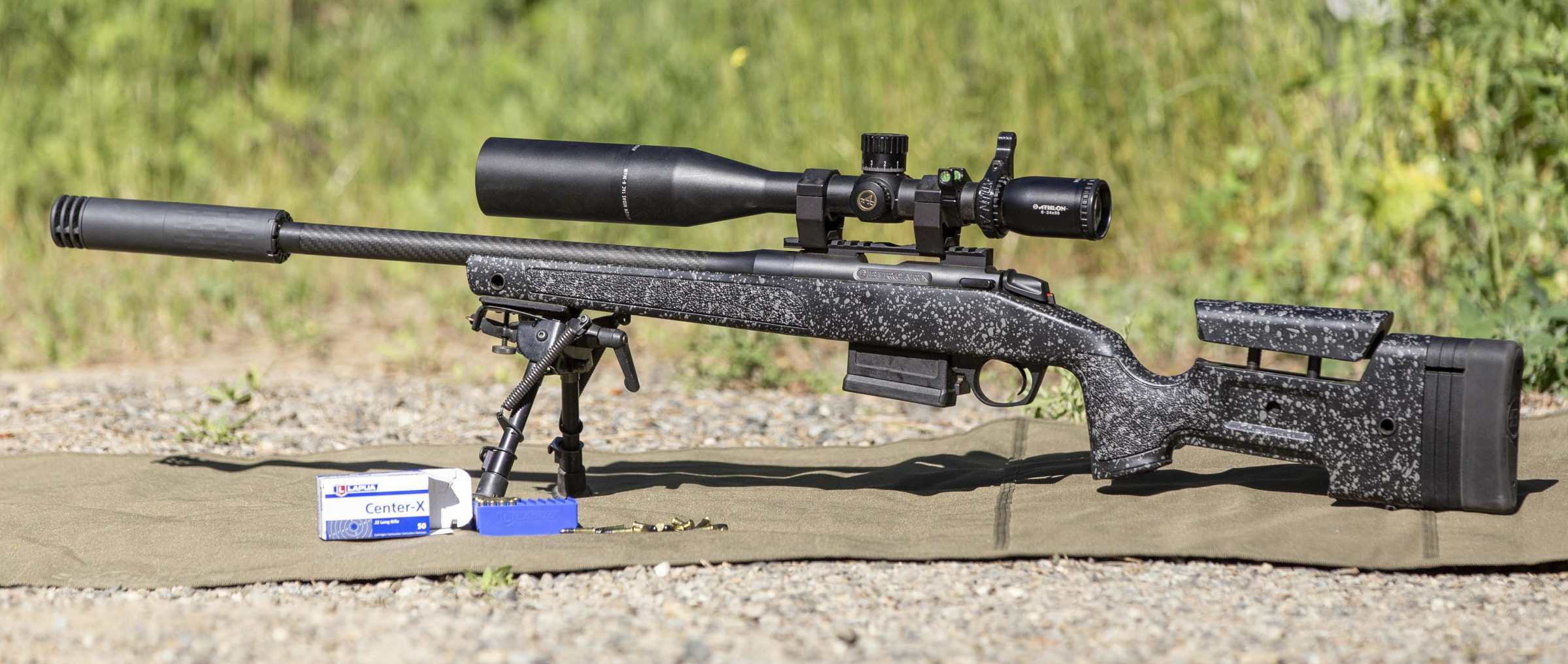
The Bergara B14-R is a high-quality, accurate .22 LR rimfire bolt-action rifle. The rifle’s accuracy and functionality make it a good choice for NRL22 competition. And with stock geometry and ergonomics that duplicate a full-size centerfire rifle, the Bergara B14-R is also an excellent choice for cross-training. By training with a rimfire rifle, you can get essential “trigger time” while saving money. Good centerfire ammo can cost $1.50 per round or more. Decent rimfire ammo can be found for $6.00 per 50rd box. That’s just 12 cents per round.
Click above photo to load full-screen high-rez image.
To find out how well the Bergara B14-R can perform, Gavin Gear of UltimateReloader.com recently tested a B14-R (carbon-covered barrel version) at his private range. Using a variety of Lapua and SK Ammo, this rig delivered impressive results. Watch this video to see the B14-R in action.
“The B14-R is a great shooter, and for me it felt very familiar. Just like shooting one of my centerfire match guns, but without all of the recoil!” — Gavin Gear
Gavin reports: “At the 2020 SHOT Show, Bergara announced the B14-R trainer. The concept? Take the B14 HMR series centerfire rifle formula, and adapt it for rimfire. The result is a .22 LR rifle you can shoot all day long without wearing out your arm or your wallet! It looks/feels like a centerfire long-range precision rifle. And that’s what makes this rifle a GREAT training platform for serious long-range shooters.”
The B14-R comes with a 18″-long 1:16″-twist threaded barrel. The single-stack .22 LR magazine is the same size as a short action AICS mag. The Bergara B14-R shares Rem 700 specs, so it is compatible with Rem 700 stocks and aftermarket triggers. Weight with standard barrel is 9.2 pounds without optics, or 8.1 pounds for the carbon version seen here. MSRP for basic version is $1150.00 and street price is $950.00.
Gavin told us: “I couldn’t wait to get the B14-R out to my new 50-yard ridgeline range to see how it would perform with premium .22 LR ammunition. Once I shot this rifle suppressed, I didn’t want to take off the can. The 18″ barrel really works well with the SilcencerCo suppressor to help keep the overall length reasonable, and balance is spot-on.” NOTE: This rifle has the optional carbon-covered barrel.
As tested, the rifle was equipped with these components:
Athlon Midas TAC 6-14x50mm FFP Scope with MK Machine lever, Lone Star bubble level SilencerCo Omega 300 Suppressor with 1/2×28 direct thread mount Harris S-BRM 6″-9″ Bipod with aftermarket swivel tension lever
Outstanding Accuracy with Lapua and SK .22 LR Ammo
Remarkable accuracy for a factory rifle earned this Bergara its Sunday GunDay selection. Shooting with bipod and rear sandbag, Gavin was able to achieve multiple, sub-half-inch groups at 50 yards. The best group shot with SK Match ammo was a remarkable 0.22″ as measured by Ballistic-X software (see below). That’s an impressive 0.42 MOA at 50 yards. If you watch the video above, starting at 14:40 time-mark, you can watch Gavin shoot that 0.22″ group.
Here are two more groups, both under 0.5″ at 50 yards. Lapua Center-X on left, SK Match on right. Gavin says that “with good conditions, 0.35″ 5-shot groups at 50 yards are easily attainable.”
B14-R Trigger Tested with TriggerScan TS-11
Gavin tested the Bergara’s trigger with the TriggerScan TS-11 from DVORAK Instruments, a very sophisticated, high-tech device. Gavin states: “This trigger works well, and mine was adjustable down to just over 2-lb peak force for pull weight. I ran a 3-scan pass on the B14-R trigger with the pull weight set to minimum [barely over 2 pounds].”
Gavin notes: “You can see how consistent this trigger is by how well the scan graph plots overlap! This trigger is great for an out-of-the-box rifle like this, and it’s great to know that I can always swap out triggers and use the same exact Remington 700-compatible trigger that I’m running in my match guns.”
Gavin Gear’s Closing Thoughts — More to Come
The Bergara B14-R rimfire trainer has been a great rifle to shoot and has exceeded my expectations. The B14-R feels like a full-size PRS rifle, has the same basic features, but is chambered in .22 LR. I have been amazed by the accuracy I’ve achieved with this rifle with Lapua and SK match ammunition — it’s very confidence inspiring.
This rifle feels right and shoots great. I can’t wait to get more steel targets setup, and to go deeper into calculating dope for the ammunition I will shoot with this rifle. Perhaps I’ll think about competing in an NRL22 match at some point. If you are looking for a rimfire trainer, look at the Bergara B14-R for sure. It checks all of my boxes for this type of rifle!


 If you need a heavy-duty, single-stage reloading press, definitely look at the MEC Marksman, a beefy black single-stage unit with many impressive features. MEC, noted for its shotshell reloading machines, now offers the cast-iron MEC Marksman press, offering many features we really like. First, the rugged, cast-iron frame is strong enough for the toughest reloading jobs. Second, the Marksman features an OPEN front — that smart design makes it easier to insert and remove cartridge cases. It also makes it much easier to place your bullets during the seating stage.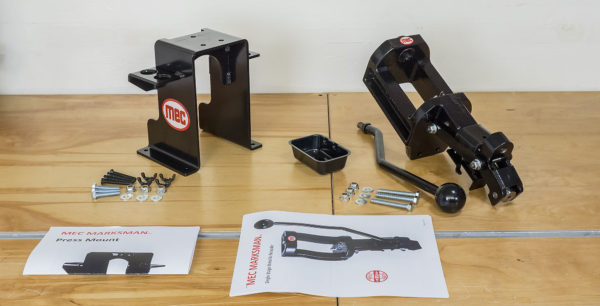

 Impressive Test Results


 Pistol Ammo Hard to Find



 In this recent video Gavin Gear reviews three types of die accessories from LEE. These work for virtually all standard dies, not just LEE-brand reloading dies. The new LEE basic silver-finish die lock rings now feature splines for enhanced grip and compatibility with LEE’s new die lock ring wrench (photo right). They still boast a rubber 0-Ring that helps “float” the die for improved cartridge concentricity.