So what’s in the closet in your man mansion? Here’s a well-equipped walk-in arsenal/haberdashery fit for “Bond, James Bond” (and maybe Jason Bourne as well). We really don’t need so many edged weapons, but we’re glad to see three (3) Accuracy International rifles, a half-dozen handguns, and plenty of ammo. Oh, and don’t forget the pair of umbrellas — you always need back-up, even if your adversaries are mere rain-drops.
Tip of the hat to our friend Jim de Kort for finding this photo. So, what do you think — is this the perfect set-up? How would you change/modify/augment this arrangement to suit your needs? (Post your comments below). This Editor would add a rimfire rifle, some revolvers, an F-Class rig, and a 6mm Dasher for 600 yards of course. (Plus some Hawaiian shirts and sandals — even 007 required a casual option now and then.)
October’s just around the corner — that means temperatures will be dropping soon in Northern climes. In a month or two, many of you will be putting your guns into storage for many months. To prevent rust from forming on your valuable firearms, you’ll want to control the temperature and humidity in your safe. By maintaining a warm temperature you can keep the relative humidity (in your safe) above the dew point and prevent moisture from condensing on your guns. One popular way to keep a safe warm is to use a Goldenrod. Though marketed as a “de-humidifier”, the Goldenrod tube is actually a simple electric heater. Placed in the bottom of your safe, the Goldenrod can help keep the relative humidity above the dew point.
Rope Lights — Light and Heat for Your Gun Safe
While Goldenrods work, they only provide heat, and Goldenrods typically retail for $20.00-$30.00. There is a less expensive solution that provides both light AND heat. A section of incandescent Rope Lighting will light up your safe AND warm the air. A 6-foot section of rope lighting costs about $6.00 at Lowes. The 6-foot strands can be linked together in longer chains. Rope Lighting can easily be installed in your safe with clips or velcro fasteners. One 6-foot long incandescent Rope Light draws about 18 watts of power — the same as an 18″ Goldenrod. Sheathed in plastic tubing, the incandescent Rope Lighting is slightly warm to the touch. A single 6-foot long strand of incandescent Rope Lighting maintains this Editor’s 23-cubic-foot indoor safe comfortably above 65° F all the time. (If you live in a colder area, or keep your safe in the garage, you may need a longer Rope Light, or a Rope Light in combination with a Goldenrod. Incandescent Rope Lights draw about 0.25 watts per bulb or about 3 watts per foot. Goldenrods draw about 12 watts per foot of length.)
Not All Rope Lighting is the Same — Incandescent vs. LED
Thus far, we’ve been talking about incandescent Rope Lights. For more money, you can also purchase energy-efficient LED ropes. LED Rope Lights draw much less electricity, but they won’t provide as much heat as incandescent Rope Lighting. It you use LED strands, you need to string longer sections to warm your safe. Or, just use LED strings for interior lighting only and then add a Goldenrod for heat.
Monitor Temp and Humidity with Thermometer/Hygrometer
To ensure that your safe’s interior is staying warm and dry, you can place a small temp/humidity sensor inside the safe. You can use either an Analog (dial-type) Thermometer-Hygrometer, or a battery-powered Thermometer-Hygrometer with digital read-out. Both digital and analog units can be purchased for $10 to $15 from internet vendors. Some of the digital units have dual temp sensors, so you can monitor the temperature both inside and outside your safe. That lets you gauge how well your safe-warming system is working.
WARNING: As with all electrical products, use caution with rope lighting. Follow manufacturer’s instructions. Avoid placing ropes in direct contact with paper or other flammable objects. Monitor surface temperatures.
Gunsafes can be fitted with either an electronic keypad-style lock, or a conventional dial lock. In our Gunsafe Buyer’s Guide, we explain the important features of both dial and electronic lock systems. Many safe-makers will tell you that consumers prefer electronic locks for convenience. On the other hand, most of the locksmiths we’ve polled believe that the “old-fashioned” dial locks, such as the Sargent & Greenleaf model 6730, will be more reliable in the long run.
Here is the opinion of RFB from Michigan. He is a professional locksmith with over two decades of experience servicing locks and safes of all brands and types:
What a Professional Locksmith Says:
For the convenience of quick opening, the electronic locks can’t be beat. However, for endurance and years of trouble-free use, the electronics can’t compare with the dial lock.
I’ve earned my living, the past 22 years, servicing locks of all types. This includes opening safes that can’t otherwise be opened. I do warranty work for several safe manufacturers (including Liberty). What I’ve learned in all those years is that manual dial locks have very few problems. The most common is a loose dial ring which can shift either left or right, which will result in the index point being in the wrong place for proper tumbler alignment. This is simple to fix.
Electronic locks, however, can have all kinds of issues, and none (except bad key-pad) are easy to fix, and when one goes bad, it must be drilled into to open it. IMO, it’s not a matter of ‘if’ an electronic lock will ultimately fail, but a matter of ‘when’ it will fail. Over the past 10 years or so, since electronics have become more and more prevalent, I’ve had to drill open bad electronic locks vs. bad manual dial locks on a ratio of about 20-1.
My professional opinion is to get the manual dial lock, unless you’ve got a good friend who is a locksmith/safecracker.
How Secure is Your Lock?
RFB tells us that both dial and electronic locks offer good security, provided it’s a good quality lock made by LaGard, Sargent & Greenleaf, Amsec, or Kaba/Ilco. However, RFB warns that “Some of the ‘cheaper’ locks (both manual and electronic) however, are very simple to bypass.
An electronic lock that’s glued or ‘stuck’ to the door with double-sided tape, and has its ‘brain’ on the outside of the lock in the same housing as the keypad, and merely sends power to an inner solenoid via a pair of wires through the door, is a thief’s best friend. The good ones have the brain inside the safe, inaccessible from the outside.
No amateur can ‘manipulate’ either a good manual or electronic lock. Both give you a theoretical one million possible combinations. I say ‘theoretical’ because there are many combinations that cannot, or should not, be used. You wouldn’t set your combo on a dial lock to 01-01-01 etc., nor would you set an electronic to 1-1-1-1-1-1, or 1-2-3-4-5-6.”
Tips for Dial Locks
RFB notes that “The speed, and ease of use, of a manual dial lock can be improved upon, simply by having your combo reset using certain guidelines. Avoid high numbers above 50. Having a 1st number in the 40s, 2nd number anywhere from 0-25, and 3rd number between 25 and 35 will cut dialing time in half, without compromisuing security. (For mechanical reasons I won’t get into here, the 3rd number of a good manual dial lock cannot — or should not — be set to any number between 95 & 20).”
Tips for Electronic Locks
Electronic locks can have the combination changed by the user much more easily than dial locks. But, RFB explains: “That can be a double-edged sword. More than a few times I’ve had to drill open a safe with an electronic lock that has had the combo changed incorrectly by the user, resulting in an unknown number that nobody can determine. Also, don’t forget that electronic locks have a ‘wrong-number lock-out’. I would NOT rely on the normal quickness of an electronic 6-number combo in an emergency situation. If for any reason (panic etc.) you punch in the wrong number several times, the lock will shut down for a 5-minute ‘penalty’.
LaGard electronic locks all come from the assembly line set to 1-2-3-4-5-6. Most safe companies (Granite-Winchester is one) leave it at that, and either the retailer or the end user must reset it. My local Walmart store had those same Winchester safes on display, and one day I was in the sporting goods section near the safe display, and another customer asked the Walmart employee if she could open the safe so he could look inside. She said “no, sorry, I don’t have the combination handy”. I walked over, never said a word… just punched in 1-2-3-4-5-6, turned the handle opening the door, and walked away… again not saying a word. They both just looked at me… dumbfounded that I could open it like that.
To get the most life out of that LaGard [or other electronic lock], you should change the battery at least once a year, whether it needs it or not. Low voltage won’t necessarily shut down the lock, but using it in a low voltage situation is bad for the electronics, and eventually will cause lock failure. C’mon, how much does a 9-volt Duracell cost? A few bucks is a good investment.”
IMPORTANT: If you do nothing else to maintain your digital-lock safe, replace the battery every year. And get a fresh battery (with a release date) from the store — don’t just pull a battery out of a storage bin, even if it’s never been used. Old batteries can degrade, even when in storage.
Safe Warranties — What is NOT Covered
RFB cautions that “With most gunsafes the ‘free repair/replacement’ warranty covers the lock only… not the door of the safe, which will have some holes drilled through it to remove that bad lock. The only proper way to repair those holes is to weld them. I don’t know about you, but most of my customers don’t like welding done inside their home, and the safe must be moved outside. Warranties typically won’t cover that moving cost if your safe is in a difficult to move outside location. Trust me, I’ve been there, done that.”
Would you like a handgun safe that opens instantly when you wave your hand over it? Science fiction? No, with modern RFID technology, this is now a reality. The Gun Box, a sleek, metal-boded handgun safe, employs the latest technology to offer instant access with high security. The basic RF Gun Box opens in response to a personalized RFID chip in a wristband or ring. The Biometric Gun Box offers both Fingerprint-scan and RFID (radio) opening. The premier-level Gun Box has both RFID and Biometric access PLUS a built-in, battery-powered GPS transmitter that tracks the unit’s location if the Gun Box is ever “lifted” by a thief. The top-of-the line model’s internal accelerometer even allows the Gun Box to notify the owner if it is moved, tilted, or opened.
Watch the Video to See How the Gun Box Works (this is pretty amazing).
We like it when an inventor comes up with a “better mousetrap”, or in this case, a better handgun safe. Ryan Hyde, the Utah-based inventor of the Gun Box, is seeking “crowd-funding” donations to move his innovative product to the next level (full production). The Gun Box is seeking $100,000 via its Indiegogo Campaign with funding options ranging from $10 to $390. You can pre-order a Gun Box, or just donate some cash in return for a T-shirt or other swag.
A next-generation gun safe, The Gun Box has many unique features:
RFID and/or fingerprint access (no traditional key or passcode).
Alert notifications when Gun Box is opened, moved, or tampered.
Strong, die-cast aluminum alloy shell 0.15 to .20 inches thick
(3-5 times thicker than most).
In order to promote safe and secure firearms storage, the National Shooting Sportz Foundation (NSSF) has launched its S.A.F.E. Summer Campaign. S.A.F.E. stands for:
Secure your firearms when not in use.
Aware of those around you who should not have unauthorized access to guns.
Focus on your responsibility as a firearm owner.
Educate yourself and others about safe firearm handling and storage.
NSSF has pledged $1 million to provide firearms safety kits (with a gun lock) to gun owners nationwide. Several lock-distribution events will be announced in the coming weeks. Safety information will be provided through social media and the Project ChildSafe website. NSSF reminds us that firearms owners have many ways to safely store their firearms when not in use. Here are some of your options:
Liberty Safe has just introduced the SAFELERT wireless monitoring system. This will notify the safe owner instantaneously if the safe is moved, if the safe door is opened, or if there is a notable change in safe temperature or humidity. Liberty’s SAFELERT is small, battery-powered sensing device placed inside your safe (easily hidden out of view). When something happens to your safe (e.g. movement, door opening, humidity change etc.) the device detects the activity and sends alerts (via texts or emails) directly to the safe’s owner.
The SAFELERT works wirelessly via your home or business network. You just need a WiFi router plus at least one networked device (computer, tablet etc.) on the system. If you can open an internet browser page and enter a few numbers, you can get the SAFELERT running in minutes. Communicating via the web-based elertus.com service, SAFELERT monitors your safe and immediately sends you (and up to 4 recipients) alerts when the “triggers” are activated by tampering, door opening, or temp/humidity changes (inside the safe). The SAFELERT also sends a message if its batteries run low or if your WIFI connection fails (hourly network checks). You can “test-drive” the system via Liberty’s SAFELERT demo page. Log in to set a trigger type and receive a simulated alert message.
By now you may be wondering — “what’s this high-tech gadget going to set me back?” Liberty’s SAFELERT Costs $199.00 and there is an ongoing service charge to maintain continuous monitoring. Annual fees are: 3 Years at $39.95/year; 2 Years at $49.95/year; 1 Year at $59.95/year.
As an extra incentive, Liberty is currently offering the first month of monitoring for free.
Optional Antenna for Enhanced WIFI Reception
In most cases, SAFELERT will function well with your wireless router (WiFi system) without a separate antenna. But for situations where WiFi network reception is weak, Liberty includes an antenna to enhance SAFELERT’s reception range. The antenna is placed on the exterior top/side of the safe, with a wire connecting it to the SAFELERT device hidden inside the safe.
Only as Secure as Your WiFi Connection
Writing in the Firearm Blog, Richard Johnson points out some issues with any WiFi-Based security system: “The system … connects to the internet via your home WiFi connection. Therein lies the point of failure. If thieves are breaking into your home, they might first hit your phone/cable connection which will prevent the SAFELERT from contacting you. A workaround would be to have a MiFi or similar device that connects to the internet via cell signal.” We should add that the elertus.com service does promise to check your WiFi connection every hour and send you a message if the WiFi connection drops. But a lot can happen in an hour….
In light of the tragic events in Connecticut, we strongly urge all readers to secure their firearms so they cannot be accessed by juveniles or mentally unstable persons in the household. If you don’t have a gun safe, get one. Don’t procrastinate because of cost factors — here is an affordable option you can get from Walmart. The $597.00 24-gun Cannon Safe is big enough to hold a large collection of arms and heavy enough that it would be difficult to remove — particularly if it is bolted down. Yes, there are better-built safes. But this $597.00 Cannon is a viable option if you can’t afford anything of higher quality. You want a safe that is big and heavy enough that it can’t be easily hauled off with a hand truck. For more information on Gun Safes, read our Gun Safe Buyers’ Guide
The Cannon Safari Series 24-Gun Capacity gun safe comes with a built-in door panel organizer, electronic lock, and a 30-minute fire rating. The interior is fully lined with lint-free fabric and the bottom is pre-drilled for bolting the safe to the floor. The electronic lock allows the owner to change the combination and a 9-volt battery is changed from the outside. Its door is locked with steel-active locking bolts on the left side and door wraps around the inside right side.
30-minute fire protection rating
Internal hinges and expandable smoke seal
Adjustable shelving
Dimensions: 59″H x 26″W x 22″D (depth includes handle and lock)
Model# 5926BLKEDOK
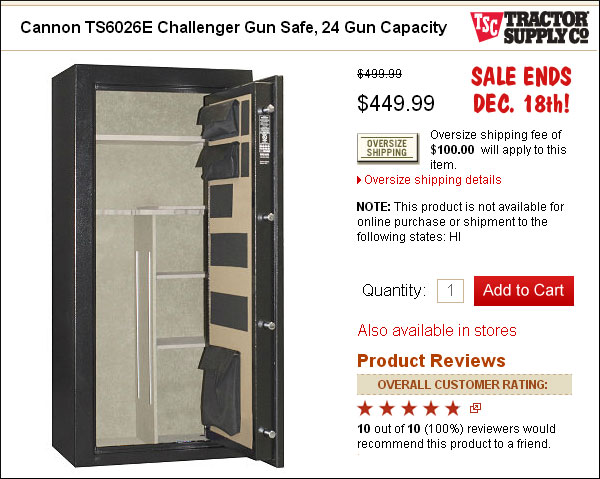
UPDATE: Bulletin Reader Michael found that TractorSupply.com has a similar 60″ x 26″ x 20″ Cannon TS6026E Challenger Gun Safe on sale for just $449.99 through December 18th, 2012. That’s the web price, but if you need delivery you have to add $100.00 for oversized shipping. If you can get to a local Tractor Supply Co. outlet near you and pick the safe up yourself, this may be an amazing deal if the store honors the web price. Don’t dawdle — Sale ends December 18th!
Caron Forensics produces a modular, rapid-access gun storage system that can place your defensive arms “at the ready”. Caron’s RAD (“Rapid Access Defense”) storage units are specifically designed for the fast presentation of defensive weapons in both home and office environments. RAD units come in two sizes: a 2-foot-long model, RAD2, and a 4-foot model, RAD4. They are surface-mounted horizontally or vertically, ideally in a concealed location, such as a bedroom closet, or office store-room. RAD lockers can store defensive weapons safely away from both children and thieves, while still providing gun owners with quick access. Download RAD Gun Locker Descriptive Flyer.
Watch RAD Product Demo Video
Weapon mounts clip to the twin rails inside RAD lockers. Accessories designed to hold weapons (such as the magnetic clip) have a protective plastic or foam coating. There are rubber-coated rifle/shotgun hooks, plus specific mounts for handguns, flash-lights, holsters and other items.
RAD cabinets feature a strong key-lock latch to keep unauthorized persons out. A unique gas spring deployment system opens the cabinet with a short pull, enabling the use of both hands to quickly access multiple tactical items.
EDITOR’s Comment: Of course, RAD units are NOT designed to replace a large, heavy-walled gun safe to store a collection of firearms and other valuables. RAD units provide only basic security (and fast access) for one or two defensive arms in a home, garage, or office.
One nice thing about the RAD2 is you could mount it on a wall with a false conduit and a “High Voltage” sticker. A would-be thief would never think it was a gun locker.
The National Shooting Sports Foundation (NSSF) has produced a GUN SAFETY Video that presents 10 fundamental rules of safe gun use. The video covers basic safe gun handling procedures, and it also explains how to transport guns safely, and how to secure them properly at home.
We know this stuff is familiar to most of our readers, but we recommend you watch the video as a refresher. Segments show how to safely unload different types of handguns and shotguns. That’s helpful for a rifle guy who may not have much familiarity with other types of arms. The video also explains how you can keep a handgun safe from kids and guests in the home, while still having quick access in an emergency. This video won’t win an Oscar, but it provides good, logical safety advice. If you help run a shooting club, you may want to embed the video into your club’s webpage.
We’ve received inquiries from readers who are looking for a gunsafe that is big and strong but can be broken down and transported more easily that a typical 800 to 1200-lb safe. One product that fits the bill is the Zanotti modular safe. It arrives in sections, none weighing more than 170 pounds. It is assembled in place, then can be dis-assembled when you need to move. The Zanotti is also well-suited for a gun-owner who lives in an apartment up many flights of stairs.
Zanotti Armor safes are ideal for gun owners who need to move frequently or who live in a location where it is difficult to position a conventional safe. Zanotti safes arrive in three or four discrete shipping boxes. The safe is assembled by the owner, on site, in six steps. The heaviest component is the door, weighing 110 pounds in the 16-gun ZAI safe, and 175 pounds in the largest 52-gun ZAIII model. Five safe models are offered, ranging from 350 to 925 pounds assembled weight, without interior. Zanotti safes are popular with military personnel and others whose jobs force them to re-locate often. The safe can be assembled in under 30 minutes with no tools other than a hammer, and all you need is a hand dolly to move any component.
Guns Magazine reports: “The panels are interlocked by 3/8 inch, nickel-plated steel “L” shaped pins that slip into steel tubing sections welded to the interior surfaces of the panels. The slip fit is held to a tolerance of .003 inch, and the safes are completely assembled and hand-fitted at the factory to insure the panels will align properly. The body is made from 1/8 inch and 3/16 inch steel; the door from 3/16 inch steel; the locking bolts are 3/4 inch steel.” This is heavier gauge steel than you’ll find on most conventional gun safes.
Zanotti offers many deluxe interiors including a system of roll-out sliding drawers in the bottom of the safe. We think the sliding drawers are ideal for storing handguns and expensive items such as cameras and binoculars that you want to keep out of plain view. Mark Zanotti, the innovative creator of these modular safes, can also customize any interior to suit the customer’s particular needs.
Editor’s Note: For most applications, a conventional safe is still the best choice. Bolted in place, a conventional safe with welded walls will provide the best security and a conventional safe can provide increased fire protection. Zanotti safes do not employ a separate layer of sheet-rock or ceramic fire lining. The Zanotti is a special product for gun-owners with special needs. The units are well-made and Zanotti offers many nice custom interior features that you won’t find even on much more expensive conventional safes.
To learn more about gunsafe features and fire-proofing, read our Gunsafe Buyers’ Guide.


 Gunsafes can be fitted with either an electronic keypad-style lock, or a conventional dial lock. In our
  Tips for Dial Locks
 LaGard electronic locks all come from the assembly line set to 1-2-3-4-5-6. Most safe companies (Granite-Winchester is one) leave it at that, and either the retailer or the end user must reset it. My local Walmart store had those same Winchester safes on display, and one day I was in the sporting goods section near the safe display, and another customer asked the Walmart employee if she could open the safe so he could look inside. She said “no, sorry, I don’t have the combination handy”. I walked over, never said a word… just punched in 1-2-3-4-5-6, turned the handle opening the door, and walked away… again not saying a word. They both just looked at me… dumbfounded that I could open it like that.


 By now you may be wondering — “what’s this high-tech gadget going to set me back?” Liberty’s SAFELERT Costs $199.00 and there is an ongoing service charge to maintain continuous monitoring. Annual fees are: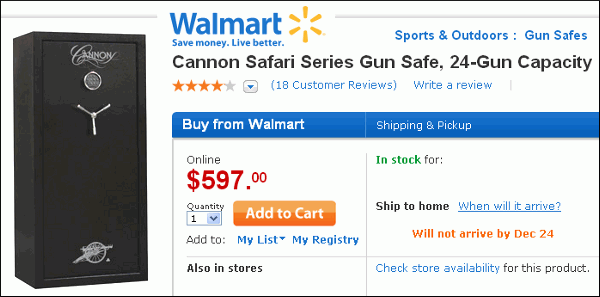


 The
The