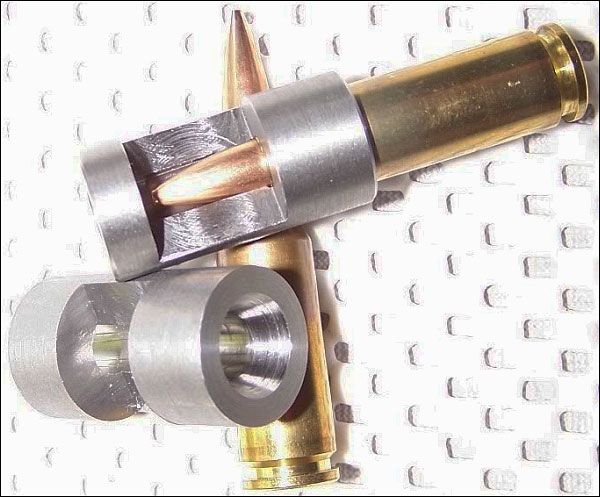
Next time you have a barrel fitted, consider having your gunsmith create a “stub gauge” from a left-over piece of barrel steel (ideally taken from your new barrel blank). The outside diameter isn’t important — the key thing is that the stub gauge is created with the same reamer used to chamber your current barrel, and the stub must have the same bore diameter, with the same land/groove configuration, as the barrel on your rifle. When properly made, a stub gauge gives you an accurate three-dimensional model of the upper section of your chamber and throat. This comes in handy when you need to bump your case shoulders. Just slide a fired case (with spent primer removed) in the stub gauge and measure from base of case to the end of the gauge. Then, after bumping, re-measure to confirm how much you’ve moved the shoulder.
In addition, the stub gauge lets you measure the original length to lands and freebore when your barrel was new. This gives you a baseline to accurately assess how far your throat erodes with use. Of course, as the throat wears, to get true length-to-lands dimension, you need take your measurement using your actual barrel. The barrel stub gauge helps you set the initial bullet seating depth. Seating depth is then adjusted accordingly, based on observed throat erosion, or your preferred seating depth.
Forum member RussT explains: “My gunsmith [makes a stub gauge] for me on every barrel now. I order a barrel an inch longer and that gives him enough material when he cuts off the end to give me a nice case gauge. Though I don’t have him cut that nice-looking window in the side (as shown in photos). That’s a neat option. You can tell how much throat erosion you are getting from when it was new as well. For measuring initial seating depths, this is the most useful item on my loading bench next to calipers. Everyone should have a case gauge made by there smith if you have a new barrel put on.”
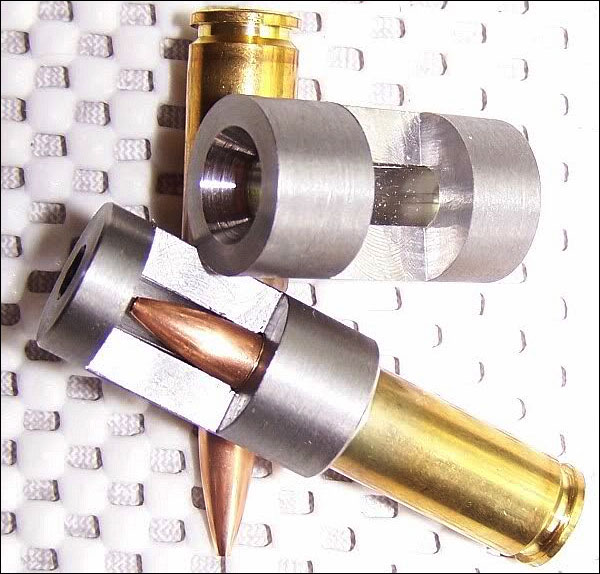
Forum member Lawrence H. has stub gauges made with his chamber reamers for each new barrel. He has his smith cut a port in the stub steel so Lawrence can actually see how the bullet engages the rifling in a newly-cut chamber. With this “view port”, one can also see how the case-neck fits in the chamber. Lawrence tells us: “My stub gauges are made from my barrels and cut with my chamber reamers. With them I can measure where my bullets are ‘touching the lands’ and shoulder bump dimensions. This is a very simple tool that provides accurate information.” To learn more about stub gauges, read this Forum Thread. The photos above and below show Lawrence’s stub gauges:
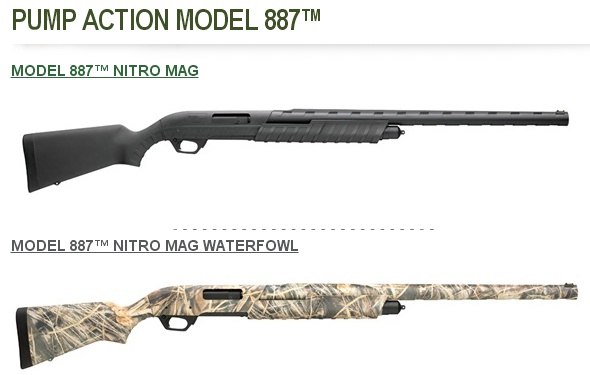
Remington is voluntarily recalling Remington Model 887 shotguns manufactured from December 1, 2013 to November 24, 2014. Remington has determined that some Remington Model 887 shotguns manufactured between December 19, 2013 and November 24, 2014 may exhibit a defect causing the firing pin to bind in the forward position within the bolt, which can result in an unintentional discharge when chambering a live round. Therefore, Remington is recalling ALL potentially affected products to fully inspect and repair. Remington has advised customers to immediately cease use of recalled shotguns and return them to Remington free of charge. The shotguns will be inspected, repaired, tested, and returned as soon as possible.
RECALLED: Remington Model 887 shotguns made from Dec. 1, 2013 to Nov. 24, 2014.
Owners of the recalled shotguns should not attempt to diagnose or repair the shotguns themselves. Remington has established a dedicated website and toll-free hotline to help Model 886 owners consumers determine whether their shotguns are subject to recall. Visit 887recall.remington.com or call 1-800-243-9700.
REMEDY/ACTION TO BE TAKEN: STOP USING YOUR SHOTGUN.
Any unintended discharge has the potential to cause injury or death. Immediately cease use of recalled shotguns and return them to Remington free of charge. Shotguns will be inspected, repaired, tested, and returned as soon as possible, at no cost to you. DO NOT attempt to diagnose or repair recalled shotguns yourself. For your safety, STOP USING YOUR SHOTGUN and immediately contact Remington.
Got fifty bucks? Well that’ll buy you an AR Lower this week. Quite simply, this is the best AR deal we’ve seen this year, and one of the best values on a firearm receiver we can remember. Right now, while supplies last, Brownells.com is offering Bushmaster-brand AR-15 stripped lower receivers for just $49.99. You read that right — you can get a major manufacturer AR lower for under fifty bucks. That’s a savings of $120.00 off the normal price. Get them while you can.
NOTE: Stripped lowers are considered the firearm, so this must be delivered to an FFL-holder. It is fairly easy to complete the lower with readily available parts and the trigger group of your choice.
Bushmaster Stripped Lower Receiver Product Description
Receiver is a rigid 7075 T6 aluminum forging with extra metal in the right places for added strength without unnecessary bulk. Features a beefy, M16A2-pattern reinforced area around the front pivot pin, a strengthening ridge over the receiver extension threads, and a ridge around the mag release button to guard against accidental magazine drop by preventing unintentional button activation. Bead blasted after machining to ensure a uniform, non-reflective surface before application of lusterless black military hardcoat A8625, Type III, Class 2 anodized finish that adds surface strength and resists abrasion. A final, nickel acetate seal coat provides extra protection against corrosion. Stripped lower is the perfect companion for Bushmaster Lower Receiver Parts Kit, available separately
Frank Galli, aka “Lowlight”, runs the popular SnipersHide.com website. A while back, Frank completed a gunsmithing course with Robert Gradous. Frank recounts the learning process in an informative, nicely-illustrated article on the ‘Hide. Frank explains how he put together a new 6.5 Creedmoor tactical rifle using a Bartlein barrel, Bighorn Action (Rem clone with floating bolt-head), and a “lightly used” Accuracy International 1.5 chassis. The HD video below shows the process start-to-finish. READ Full Article.
During Frank’s “hands-on” training sessions with Gradous, Frank learned to thread and chamber a barrel, fit a recoil lug, and install the barreled action in the AI chassis. Chambering was done with great care: “We spent the better part of the day working the barrel. I feel this is a critical component and seeing the attention to detail in Robert’s approach confirmed it for me. When it came time to chamber Robert had a custom tight chamber reamer there for a 6.5CM but I’m shooting a tactical rifle, tight chambers aren’t for me, and this was clear, as out came the standard SAAMI reamer.”
Frank also learned how to modify an aluminum chassis: “the AI chassis had the recoil lug opened up, but it was opened in the wrong direction. This was going to require milling increasing the gap to at least a 1/2″ in size. Robert was really leery of this, but my attitude was, ‘it’s just a chassis and nothing a little Marine Tex can’t handle’.” Thankfully the chassis mod came out OK.
Once the barreled action was complete and the AI chassis was successfully milled, Frank applied a tan Cerakote finish to the barreled action. This would give a proper tactical look to the rifle, while providing superior corrosion resistance for the metal parts. To learn more about Cerakote finishing, check out the Cerakote Application Video, published last week in the Daily Bulletin.
When the rifle was complete, Frank took it out for testing with a variety of ammo, both factory fodder and handloads. There were some initial worries about accuracy as it took a while for the barrel to break in. A few sessions of bore cleaning were required before the barrel stopped fouling and then — like magic — the rifle started printing really small groups.
By the end of his load testing session, Frank was getting good groups with Hornady 120gr GMX factory 6.5 Creedmoor ammo, and really superb groups with handloads. The 120gr GMX ammo “was going 3100 fps with no ill effects”. The best handloads were approaching 1/4 MOA for three shots, and Frank’s load with Berger 130 VLDs shot even smaller than that: “In my opinion the load development we did was worth its weight in gold. Where else can you build in a rifle in two days, then go out and develop a baseline load using everything from 120gr ammo to 140gr ammo with a few in between? My favorite load and clearly the rifle’s too, was the [Berger] 130gr VLD. This gave us great velocity, awesome groups [with some one-holers] and really nice results at distance.”
Lowlight’s Gunsmithing Story is a ‘Must-Read’
We recommend you read Frank’s story. It shows that, with the right tools, and the supervision of a master smith, even a novice can produce an ultra-accurate rifle. For those of you who have considered taking a gunsmithing class, Frank’s successful experience with gunsmith Robert Gradous should give you plenty of motivation.
When does a gunsmith become a “firearms manufacturer”? That’s an important legal question that professional gunsmiths need to consider. Normally, a gunsmith (with an FFL) can receive firearms, chamber/fit barrels, do bedding jobs, and install stocks without requiring a firearms manufacturer’s license. However, other gunsmithing tasks may spill over into “manufacturing activities”. Sometimes the distinctions are not so obvious. Consider these three examples provided by the Bureau of Alcohol, Tobacco, Firearms and Explosives (ATF):
Surplus Rifle Sales Version 1: A gunsmith purchases surplus firearms, cleans the firearms, then offers them for sale to the public.
ATF Verdict: The company does NOT need to be licensed as a manufacturer.
But consider this…
Surplus Rifle Sales Verson 2: A gunsmith buys surplus military rifles or pistols and removes the stocks, adds new stocks or pistol grips, cleans the firearms, then sends the firearms to a separate contractor for bluing. These firearms are then sold to the public.
ATF Verdict: This would be considered manufacturing of firearms and the gunsmith should be licensed as a manufacturer.
And “Sporterizing” an old military rifle can be considered “manufacturing” as well:
Surplus Rifle Sales Version 3: A gunsmith buys surplus military rifles, bends the bolts to accept a scope, and then drills the receivers for a scope base. The gunsmith offers these firearms for sale.
ATF Verdict: This would be considered the manufacturing of firearms and the gunsmith should be licensed as a manufacturer.
These three examples provided by the ATF suggest that gunsmiths need to study the law, and be mindful that the more a firearm is altered and modified (with the objective of resale), the greater the possibility that a manufacturer’s license would be required.
ATF Guidelines for Gunsmiths
On its Manufacturers FAQ Page, the ATF has provided some guidelines to help gunsmiths and FFL-holders determine when a manufacturing license is required:
“Generally, a person engaged in gunsmithing requires only a dealer’s license (type 01). However, there are circumstances in which a gunsmith might require a manufacturing license. Generally, a person should obtain a license as a manufacturer of firearms if the person is:
1. Performing operations which create firearms or alter firearms (in the case of alterations, the work is not being performed at the request of customers, rather the person who is altering the firearms is purchasing them, making the changes, and then reselling them), 2. is performing the operations as a regular course of business or trade, and 3. is performing the operations for the purpose of sale or distribution of the firearms.”
ATF Examples Showing When Manufacturer License Is or Is Not Required
Below are examples of gunsmithing operations with guidance as to whether or not such operations would be considered manufacturing under the Gun Control Act (GCA). A key factor is whether the “operations performed on the firearms were… for the purpose of sale or distribution”. (NOTE: These examples do not address the question of whether the operations are considered manufacturing for purposes of determining excise tax.) View ATF Manufacturer FAQ Page for more details.
Example 1: Completing Rifle on Customer-Supplied Action.
A company receives firearm frames from individual customers, attaches stocks and barrels, and returns the firearms to the customers for the customers’ personal use.
ATF Verdict: Manufacturer License NOT Required.
The operations performed on the firearms were not for the purpose of sale or distribution. The company should be licensed as a dealer or gunsmith, not as a manufacturer of firearms.
Example 2: Barrel-Making. A company produces barrels for firearms and sells the barrels to another company that assembles and sells complete firearms.
ATF Verdict: Manufacturer License NOT Required.
Because barrels are not firearms, the company that manufactures the barrels is not a manufacturer of firearms. [However], the company that assembles and sells the firearms should be licensed as a manufacturer of firearms.
Example 3: Single Gun Project. A company acquires one receiver, assembles one firearm, and sells the firearm.
ATF Verdict: Manufacturer License NOT Required.
The company is not manufacturing firearms as a regular course of trade or business and is not engaged in the business of manufacturing firearms. This company does not need to be licensed as a manufacturer.
Example 4: Production of actions or frames for direct sale. A company produces a quantity of firearm frames or receivers for sale to customers who will assemble firearms.
ATF Verdict: Manufacturer License IS Required.
The company is engaged in the business of manufacturing firearms and should be licensed as a manufacturer of firearms.
Example 5: Production of actions as parts suppliers. A company produces frames or receivers for another company that assembles and sells the firearms.
ATF Verdict: Manufacturer License IS Required
BOTH companies are engaged in the business of manufacturing firearms and each should be licensed as a manufacturer of firearms.
Example 6: Modification of Pistols. A gunsmith buys government model pistols and installs “drop-in” precision trigger parts or other “drop-in parts” for the purpose of resale.
ATF Verdict: Manufacturer License IS Required.
This would be considered the manufacturing of firearms, as the gunsmith is purchasing the firearms, modifying the firearms and selling them. The gunsmith should be licensed as a manufacturer.
Trigger Blue-Printing — Why It Can Be Important by Thomas “Speedy” Gonzalez
To Blueprint or Not? That is the Question.
I often get asked is it really necessary to blueprint a custom match trigger. “Abolutely” is my answer. Here is an example that demonstrates why. After I completed a recent rifle project, the gun’s owner and I took the rifle to the range to break-in the barrel. But we quickly noticed a problem. The owner Alex L’s first statement was: “This trigger sucks — better blueprint it when you get back.”
Not only did the trigger feel rough and scratchy, but it failed to hold the cocking piece 2 out of 10 times when cocking the rifle for the next shot. Not good.
No matter what we tried at the range, the problem persisted. As soon as we returned from the range, I had to take the trigger apart to solve the mystery.
As soon as I opened her up on the operating table it was evident to me where the problem was. I have only seen the inside of about 3000 of these rascals and the head of the Over-Travel Screw stuck out like a sore thumb. The head of the Over-Travel Screw was nearly twice as thick as its other brothers and sisters. This caused the relationship between travel adjustment and sear engagement to be nearly impossible to adjust. And that, in turn, created a serious safety issue.
To remedy the situation, I replaced the screw with [another screw with] standard head thickness and ALL PROBLEMS DISAPPEARED… Amazing! Had I blue-printed this trigger before going to shoot, this never would have happened.
So, should one blueprint a trigger? I say “Hell yeah” if you are serious about competiting and winning. Otherwise be prepared for the worst. — Speedy
Gunsmiths often have to serve as gun “doctors” as well as gun builders. Gunsmith (and Hall-of-Fame shooter) Thomas “Speedy” Gonzalez was recently asked to fix a trigger problem. A customer was complaining about a trigger that was erratic and “mushy”. Speedy quickly diagnosed the problem. The Jewell trigger was clogged with gunk and sludge — left-over solvents and lubricants had gummed up the mechanisms. Here’s how the cleaning process unfolded…
Speedy: “Gee why would I want to blueprint my Jewell trigger….it has just got a little mushy lately. It may just need some adjustment. Yeah right — take a look at this”:
Speedy: “Should I go get a tetanus shot now?”
Gunsmith Mike Bryant comments: “I’ve seen a lot of Remington 700 triggers that were gummed up like [that] Jewell was. Also have seen lots of 700 triggers that had the weight-of-pull screw adjusted [by the owner] to where it had no compression on the spring. I wonder how many of the Remington accidental discharges involved triggers with one or the other of these conditions.”
Speedy: “What?! Powder in trigger as well… hmmmmmm.”
Clean up done with Iosso Lubricant/Cleaner. Speedy says this is the “Best parts cleaner I have ever found if you don’t have an ultra sonic cleaning tank. I just melted that crud off with a Q-Tip”.
Same Jewell trigger all happy now — clean as a whistle.
Trigger ready for final re-assembly, looking better than new. Thanks Speedy!
Brownells’ 8th Annual Gunsmith Career Fair will be held at the Des Moines Marriot Downtown in Des Moines, Iowa, April 1-2, 2014. The Brownells Gunsmith Conference & Career Fair is expected to draw hundreds of attendees along with representatives from three dozen potential employers. As in past years, the Career Fair will include gunsmithing seminars along with opportunities for individuals to interview for jobs with arms-makers and government agencies.
Gunsmith CareerFair.com.
In addition to industry and government representatives, many trade schools and colleges offering gunsmithing programs will be exhibiting at the 2014 Gunsmith fair. Past exhibitors have included:
The first edition of Modern Custom Guns hit bookstores 16 years ago. Next month Gun Digest will release the long-awaited Second Edition of Modern Custom Guns. This is a richly-illustrated, 8.2″x11″ hard-cover book, with approximately 200 color photos. Written by Tom Turpin and published by Gun Digest Books, this 208-page volume is now available for pre-order, with a December 11, 2013 release date.
This 208-page Second Edition of Modern Custom Guns is not just a coffee-table book. In addition to the nice color photography, the book examines the processes and techniques used to craft ultra-high-end custom rifles. Author Turpin has interviewed many gifted rifle-makers and artisans who create showpiece rifles. Turpin explains how these craftsman work magic with wood and metal. Specific chapters are dedicated to: Stock-making, Metal-smithing, Actions, Barrels, Sights, Engraving/carving, and other topics. Chapter 10 spotlights two dozen master engravers, while Chapter 11 profiles 39 leading custom gun-builders. A helpful Appendix provides contact information for custom gun-makers and engravers.
About the Author – Tom Turpin has been a professional writer in the outdoor industry for over 40 years. He has written several hundred published articles, four books, and he is presently a contributing editor to the Gun Digest Annual.
In this new edition of Modern Custom Guns, Tom Turpin sought to showcase the exceptional craftsmanship found in high-end customs. Tom explains: “My preference runs to classic styling, and I follow the principle that if any one facet of a custom rifle immediately jumps out at you, it is surely overdone. Quiet elegance is best for me.”
Forum member Kenneth Skorpen (aka “Sal”) from Norway sells a variety of shooting products through the www.Vertebrae.no website. Among the more interesting products offered by Skorpen are a series of muzzle brakes that can be installed on your barrel with no gunsmithing required — if the barrel tip has already been threaded. Crafted in Norway by Vektor Maskin, these muzzle brakes employ an internal inside/outside threaded bushing with a stop nut that fits on the barrel. With the threaded bushing in place, you simply screw the muzzle brake onto the bushing, align it so the ports are horizontal, then set the stop nut and set-screws. (Note, the set-screws touch only the bushing — they do not impinge on the barrel itself.) The video below shows how Vektor spin-on muzzle brakes are installed:
There are compact, standard, and large size Vektor muzzle brakes. Adjustment and installation is the same for all three sizes. The small, compact model, with two rows of opposed horizontal ports, is designed for .223-caliber rifles. The medium (standard) size, with either double or triple sets of opposed ports, is suited for 6.5mm or .308 calibers. The largest size, with three rows of large ports, is configured for the .338 magnum calibers. Skorpen claims that all three sizes of Vektor brakes can reduce felt recoil by 70% to 80% The brake itself is SIS1914-04 steel with an oiled zinc phosphate finish. The internal socket is AISI 303 (SUS 303) stainless steel.
If your barrel is already threaded at the muzzle, the Vektor brakes can be installed with no metal-work or gunsmithing required. Otherwise, you will need a gunsmith to thread the muzzle end of the barrel. The Vector bushings can be machined to a variety of thread types: 1/2″-20/UNF, 1/2″-28, 5/8″-18/UNF, 5/8″-24, m14x1, m14x1.5, m15x1, m16x1, m17x1, and m18x1. Just indicate the thread pitch you require when ordering.
How to Order Vektor Muzzle Brakes
Skorpen’s company, Vertebrae Sikkerhet & Teknikk, exports these Vektor brakes at reasonable prices. With one (1) supplied bushing, the compact brake is $131.43 USD, standard brake is $167.64 USD, and the large (magnum) brake costs $198.49 USD. Extra bushings are available for around $20.00. While the website lists .223, 6.5mm, .308, and .338 caliber brakes, Vetebrae can produce brakes in other calibers on request (add 5 days to delivery time).
You can also purchase Vektor muzzle brakes by emailing joachim [at] vertebrae.no. (It may be cheaper to order direct via email.) Just send an email stating your desired caliber and thread pitch. Normal delivery time to the USA is one to two weeks.




 Once the barreled action was complete and the AI chassis was successfully milled, Frank applied a tan Cerakote finish to the barreled action. This would give a proper tactical look to the rifle, while providing superior corrosion resistance for the metal parts. To learn more about Cerakote finishing, check out the
  By the end of his load testing session, Frank was getting good groups with Hornady 120gr GMX factory 6.5 Creedmoor ammo, and really superb groups with handloads. The 120gr GMX ammo “was going 3100 fps with no ill effects”. The best handloads were approaching 1/4 MOA for three shots, and Frank’s load with Berger 130 VLDs shot even smaller than that: “In my opinion the load development we did was worth its weight in gold. Where else can you build in a rifle in two days, then go out and develop a baseline load using everything from 120gr ammo to 140gr ammo with a few in between? My favorite load and clearly the rifle’s too, was the [Berger] 130gr VLD. This gave us great velocity, awesome groups [with some one-holers] and really nice results at distance.”



 Trigger Blue-Printing — Why It Can Be Important


 Gunsmith CareerFair.com.

 There are compact, standard, and large size Vektor muzzle brakes. Adjustment and installation is the same for all three sizes. The small, compact model, with two rows of opposed horizontal ports, is designed for .223-caliber rifles. The medium (standard) size, with either double or triple sets of opposed ports, is suited for 6.5mm or .308 calibers. The largest size, with three rows of large ports, is configured for the .338 magnum calibers. Skorpen claims that all three sizes of Vektor brakes can reduce felt recoil by 70% to 80% The brake itself is SIS1914-04 steel with an oiled zinc phosphate finish. The internal socket is


