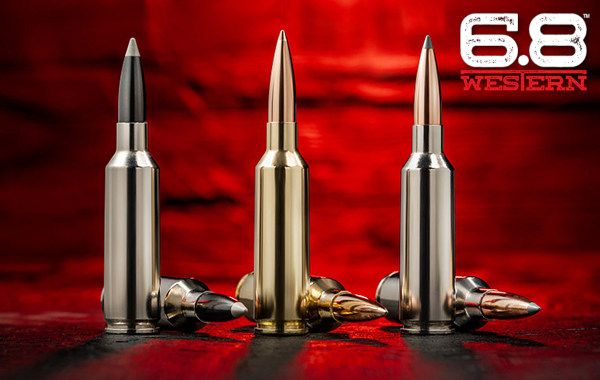
Winchester and Browning have introduced the new 6.8 Western, a new .277-caliber cartridge designed for long-range hunting. The new 6.8 Western is a high-capacity cartridge with a modern 35-degree shoulder, optimized for a conventional short action. The 6.8 Western is VERY similar to the existing .270 WSM. It shares the same 0.535″ rim diameter, and the same 0.277″ bullet diameter, however the 6.8 Western’s case length is slightly shorter. The .270 WSM has a 2.100″ case length, while the new 6.8 Western has a 2.020″ length. That’s just 80 thousandths shorter. Both cartridges, the 6.8 Western and .270 WSM, share a 35° shoulder, so in fact, the 6.8 Western is VERY close to the existing .270 WSM, just .080″ short. With a 1:8″ twist, the 6.8 Western should be able to shoot bullets up to 175 grains.
In designing this new cartridge, Winchester wanted WSM performance in a slightly shorter case: “The key feature… was to shorten up that shoulder, shorten up the OAL of the cartridge so we could get longer, sleeker, heavy-for-caliber bullets to really drive the G1 BC higher and higher, to get the flattest possible trajectory.” Winchester claims that the 6.8 Western is the “largest [cartridge] on the market to fit into lighter, short-action rifles like the Winchester Model 70, Winchester XBR, and Browning X-Bolt Pro”. That’s a bit deceptive, since the .300 WSM, with a 0.2100″ case length, will fit in many of those rifles with most bullets. Oh well — there’s always some marketing hype.
6.8 Western — High-BC Bullets, Good Knock-Down Power, Tolerable Recoil
What is the real advantage of the new 6.8 Western? Fundamentally it can be loaded with heavier, higher-BC bullets than a 6.5 PRC, while having less recoil than a .300 WSM (with most bullets). (But the same can be said of the older .270 WSM.) WideOpenSpaces.com states that with the 6.8 Western “recoil is much lower than the .300 Win Mag, .300 PRC, and the .300 WSM cartridge. At the same time, the 6.8 is said to deliver more energy to the target than a 6.5 PRC [or] 6.5 Creedmoor[.]” Winchester is even claiming more downrange energy than a 7mm Remington Magnum.
This video, with lots of field footage, explains the main features of the new 6.8 Western:
This video has great cartridge illustrations, with 3D Animations and comparative energy tables:
“When people think of the perfect long-range rifle cartridge, they want many key features — good precision, flat trajectory, large down-range energy, and manageable recoil.” — Keith Masinelli, Winchester
This video shows loaded ammo. Direct comparison with .270 WSM at 8:55 minute time mark.
Why Develop a New Hunting Cartridge So Similar to the .270 WSM?
With interest in long-range hunting growing rapidly, engineers at Winchester and Browning sought a solution that could offer magnum performance with a modern high-BC projectile, yet chamber in a short action rifle for shorter bolt-throw and less weight. The 6.8 Western was “designed to be capable in any big-game hunting scenario and a great fit for those who enjoy long-range target shooting”. For the 6.8 Western, the designers basically shortened the .270 WSM case to allow for longer bullets (with the same cartridge OAL limits), and possibly make the case a bit more efficient.
The First 6.8 Western Rifles from Browning and Winchester
Browning X-Bolt Pro in 6.8 Western
Browning will release a light-weight, X-Bolt Pro rifle chambered for the 6.8 Western. This will have a 26″ barrel with 1:7.5″-twist, so it should be able to shoot all the high-BC .277-caliber bullets. With a carbon-reinforced stock, this rifle is relatively light-weight — just 6 lbs., 12 ounces before optics. The rifle has a 3-lug bolt with 60° bolt lift. Trigger adjusts from 3-6 pounds, fine for a hunting rifle. According to Wide Open Spaces, the barrel and receiver are finished with Tungsten Cerakote to protect the rig in harsh weather conditions. On Browning’s website, the Browning X-Bolt in 6.8 Western has a $2,469.99 MSRP. At that price, it may make more sense to buy a used X-Bolt rifle and re-barrel it.
“The 6.8 Western cartridge brings a new perspective to long-range hunting and shooting,” said Ryan Godderidge, Senior VP of Sales, Marketing, and Firearms for Browning. “It provides magnum-level performance in our short action rifles, giving the shooter highly effective down-range energy, even at longer ranges, while allowing for a lighter-weight platform.”
Winchester Model 70 in 6.8 Western
Winchester will release a Model 70 chambered for the 6.8 Western. It will have a 24″ stainless barrel, stainless action with 3-round hinged floor-plate internal magazine. Wide Open Spaces reports: “Right now, it appears the Model 70 Extreme Weather MB is the first 6.8 Western that will roll off their factory floors. The stock is composite with a Pachmayr Decelerator recoil pad. At 44.25″ overall, this rifle is shorter than the Browning X-Bolts, but weighs slightly more at seven pounds even.” Listed MSRP is $1,599.99 for this new 6.8 Western Model 70.
There will be a new NRL competition series in 2021 — NRL HUNTER (NRLH). This will complement the popular NRL tactical series and NRL22 rimfire series. For its inaugural (first-ever) 2021 season, NRL HUNTER will host nine regional hunting matches, followed by the NRL HUNTER Championship — the Grand Slam Finale. The Season Championship will take place August 2-8, 2021 at the Cameo Shooting Complex in Grand Junction, Colorado. The championship match will be directed by NRL HUNTER developer Scott Satterlee and the NRL’s Director of Match Operations.
NRL HUNTER 2021 Series Schedule (Ten Events):
1. Nehawka, Nebraska – February 19-21, 2021
2. Farmington, New Mexico – March 5-7, 2021
3. Arbuckle, California – March 26-28, 2021
4. Mount Pleasant, Tennessee – April 16-18, 2021
5. Laramie, Wyoming – April 23-25, 2021
6. Dupuyer, Montana – May 6-9, 2021
7.Hammett, Idaho – May 21-23, 2021
8. Dalton, New Hampshire – June 25-27, 2021
9. Price, Utah – July 23-25, 2021
10. NRL HUNTER Grand Slam Season Championship
Grand Junction, Colorado – August 2-8, 2021
The first-ever NRL HUNTER match will take place in Nebraska, February 19-21, 2021:
NRL HUNTER, a division of National Rifle League (NRL), is a series of competitions for hunters by hunters. It provides a competitive format for new and seasoned hunters to learn about their skills, gear, and local hunting terrains. To participate in matches, hunters must purchase a $100 Annual NRLH membership ($75.00 for Young Guns). For more information, visit NRLHUNTER.org.
There will be three gear-based Classes: Open Heavy, Open Light and Factory. In addition there will be separate Ladies and Young Guns divisions.
NRL HUNTER’s founders state: “Hunting isn’t merely a hobby or pastime; it is our way of life. For us, it is about community, education, and a strong foundation of ethical harvesting. It is the desire to be the most proficient hunter possible, it is the passion that has driven NRL to develop the NRL HUNTER series[.]”
Bushnell will be the Title Sponsor of the 2021 season of NRL HUNTER. “We are truly honored to have Bushnell on board as our Title Sponsor for the NRL HUNTER Series,” stated Travis Ishida, NRL President. “This is a terrific partnership in which both groups share the same vision and passion for the hunting community.” Since 1948, Bushnell has offered a full line of products for hunters. Bushnell now sells riflescopes, binoculars, rangefinders, spotting scopes, and trail cameras.
Spending by hunters on their activities helps the economy and funding from hunters helps preserve wildlife. According to the NSSF, sportsmen contribute more than $2.9 billion every year for conservation. And over the last century sportsmen have paid many billions for on-the-ground projects in every state, protecting the natural environment and our fish and wildlife.
Unfortunately, hunters and hunting are under attack from misguided environmentalists who are seeking to ban hunting in many areas, as well as restrict or even eliminate traditional lead-based ammunition.
The NSSF video above and Infographic below address the issue of traditional ammunition, explaining why the attacks on lead ammo are misguided. Lead pollution is a real issue, but the amount of lead left in the wilderness from hunter’s bullets is miniscule compared to most important causes of lead pollution such as industrial waste and improper disposal of lead-compound batteries. What is REALLY going on, particularly in blue states like California, is that the leftists are attempting to use “green” strategies to advance their anti-gun agenda. This really isn’t about “getting the lead out” — it is about getting rid of guns.
Shooting Sports USA has an article of interest to competitive shooters who also enjoy hunting. This article was authored by Josh Honeycutt, a highly-accomplished hunter. To explain how competitive shooting can improve hunting skills, Honeycutt interviewed two leading pro shooters who both hunt: Doug Koenig and Bruce Piatt. The story outlines eight ways competitive shooting can help develop shooting skills and a mental awareness that will help hunters. Thorough the eight points, the article explains how skills learned in competition can help deliver better results during your hunts.
Thomas Haugland, a Shooters’ Forum member from Norway, is a long-range target shooter and hunter. He has created an interesting video showing how to gauge wind velocities by watching trees, grass, and other natural vegetation. The video commentary is in English, but the units of wind speed (and distance) are metric. Haugland explains: “This is not a full tutorial, but rather a short heads-up to make you draw the lines between the dots yourself”. Here are some conversions that will help when watching the video:
.5 m/s = 1.1 mph | 1 m/s = 2.2 mph | 2 m/s = 4.5 mph
3 m/s = 6.7 mph | 4 m/s = 8.9 mph | 5 m/s =11.2 mph
How to Gauge Wind Speed and Hold Off Using Reticles
This field video shows how to observe natural indicators — trees and vegetation — to estimate wind velocity. Then it shows how to calculate hold-offs using the reticle hash-marks. Thomas shoots a fast-cycling Blaser R93 rifle with Norma 6XC ammunition.
The Cartridge Comparison Guide is a remarkably comprehensive 340-page, spiral-bound book. Covering over 250 cartridges, the Second Edition of the Cartridge Comparison Guide is the product of many years of labor by Andrew Chamberlain, a Utah-based hunter. Andrew says his Guide “compares every factory available cartridge from the 17 calibers up to the 50 caliber cartridges”. (Sorry, most wildcat cartridges are not covered.) Chamberlain’s Guide also compiles cartridge data from major ammunition manufacturers such as Barnes, Federal, Hornady, Norma, Nosler, Remington, Sierra, Swift, Weatherby, and Winchester. It shows the optimal velocity achieved for each bullet weight and calculates bullet energy, recoil, and powder efficiency. Large color photos illustrate handgun and rifle cartridges.
The Cartridge Comparison Guide provides data for thousands of cartridge/bullet/velocity combos. Quick reference sheets and ballistics charts cover Trajectory, Velocity, and Energy out to 500 yards. The Cartridge Comparison Guide also offers a firearms lexicon, plus Appendices covering Cartridge Selection for Game Animals, Bullet Selection/Design, Bullet Expansion, and Wound Channel Characteristics.
New Content in Second Edition of Cartridge Comparison Guide
The Cartridge Comparison Guide (Second Edition) costs $29.99 plus shipping and tax. CLICK HERE to visit the Online Store where you can order the 340-page book. Here’s what’s new in the Second Edition:
Addition of Shotgun Ammunition (Both Slug and Shot loads).
Momentum Calculation for all Rifle, Shotgun and Handgun loads.
Integration of Shotgun Slug Ammunition with Center Fire Rifle Data Tables.
Factory Load Summary Added (Shows manufacturers and loads produced).
One factory load and one hand load for every bullet weight available in each cartridge.
Over 90 pages of additional ballistics content (roughly 35% more than in First Edition).
Great Resource for Hunters
One of Chamberlain’s main goals in creating the Cartridge Comparison Guide was to help hunters select the right cartridge for the job: “This started as a personal project to gather information on the more popular cartridges commonly used for hunting. I wanted to find the best all-around performing cartridge and rifle that a guy on a budget could shoot. I began comparing cartridge performance, versatility, bullet selection, powder efficiency, recoil generation vs. energy produced, standing ballistic data for different environments….”
Black Rifle Cartridge Comparison Guide
The Black Rifle Cartridge Comparison Guide (CCG) was created for semi-auto AR-platform and Modern Sporting Rifle users. The Black Rifle CCG covers virtually all popular rifle, shotgun, and handgun cartridge types used with magazine-fed, semi-automatic black rifles or AR “pistols”. There is information for 50 unique rifle cartridges plus shotgun and handgun cartridges. The book provides ballistics data for all these cartridges via easy-to-use data tables. The tables cover factory ammunition and handloaded cartridges, included the newer .224 Valkyrie.
The data tables compare standardized rifle and handgun cartridges from .17 caliber to up to .50 caliber. The book also provides data for 20-, 16-, and 12-gauge Shotgun cartridges. A handy summary table identifies each rifle cartridge presented and notes if it can be fired from a factory available MSR platform, a semi-custom platform/upper, as well as a semi-custom barrel. This 275-page, spiral-bound book is on sale now for $21.99.
Giant Cartridge Poster for Computer Wallpaper (1665×1080 pixels)
Here’s a great illustration of hundreds of cartridges and shotshell types. For dedicated reloaders, this would work great as desktop “wallpaper” for your computer. CLICK HERE for full-size image.
Vortex has assembled a variety of audio-visual resources to provide hunters with the info and tools they need to accurately sight-in their rifles, locate the right hunting gear, track game successfully, and then harvest and haul their game meat efficiently and safely. Here are two Vortex videos, plus a podcast that can help hunters with their late fall hunts.
How to Mount a Hunting Scope
This video shows, step-by-step, how to mount a scope on a hunting rifle. This explains how to ensure the rifle AND scope are level, and how to secure the rings properly. Then the video explains the best procedure for zeroing the scope at your desired distance.
Vortex Podcast with Hunting Advice from Expert Hunters
Learn to improve your whitetail ground hunting game with the podcast team here. This podcast covers tracking, stalking, equipment selection, hunt safety and many other important topics.
Meat Care After the Shot — Pro Tips
Ryan Lampers of Hunt Harvest Health discusses meat care techniques and tricks to ensure the game you take makes it to your table in the best condition possible. This video covers warm-weather hunts, keeping meet cool, gutting vs. the gutless method, how to take the heart, liver, and rib meat, shot placement, blood-shod meat, and avoiding contaminants. The video also covers all-night pack-outs, loading your pack with meat/gear, meat shelves vs. putting it in your pack, ageing meat, quarters Vs. boning, keeping your pack clean, kill kit items and more. For serious game hunters, this is a must-watch video.
Hunting Optics Selection — Scopes, LRFs, Binoculars
Here are some helpful hints on choosing optics for deer hunting. This Vortex promo piece discusses selection of riflescopes, rangefinders, and binoculars. Article: Choosing Glass to Conquer Whitetail Country.
As part of NRA Women TV, hunting guide Kristy Titus hosts a series of videos that explain important strategies and shooting skills for hunters. Titus is a certified instructor who has hunted around the globe. She grew up in the outdoors, running pack mules in Oregon with her father. In these videos, Kristy discusses demonstrates field positions that can be employed during a hunt. She also explains preparation for a hunt, including fitness training.
Shooting Positions and Rifle Support in the Field
Because of interferring terrain features, it’s not common to get a prone shot on game. That’s why hunters nead to practice shooting from various positions. You can use tree limbs or boulders for support (see above). In addition, many hunters bring bipods or tripods to help make that once-in-a-lifetime trophy shot. We have used telescoping Bog-Pod supports on varmint hunts. In this video, Kristy explains various shooting positions and training routines.
Fitness Training — Prepare for the Trek
Kristy explains: “Hunting can lead you into some steep, rough country. It’s really important that you train both your body and your mind to handle the elements and the rigors of hunting. With no two hunting situations being the same, we must train to be adaptable and make the most of every opportunity. The most important aspect of hunting success, ultimately, is the person behind the rifle. So, if you plan on going on a mountain hunt, get out and train your body. Train with your firearm. Get off the bench and have some fun with this. Do some positional shooting or, if you want to add a stress dynamic… have someone put you under a time parameter.”
“When it comes to bolt-action rifle fit, there is no ‘one size fits all’,” says Titus. “When picking out your rifle [consider options] after the purchase to ensure you are as comfortable as possible.”
Here is a simple but effective product that can benefit varminters and game-hunters. The slip-on, padded RRR (“triple R”) gun rest cushions your rifle on any surface and helps eliminate noise when shifting the gun from one shooting position to another. The RRR slip-on rest is made of neoprene (wet suit material) with a built-in, thick Armaflex foam cushion on the bottom. This $19.95 sleeve protects the finish of your rifle, while providing a cushioned layer between your rifle and the supporting surface.
Key Benefits of the RRR Slip-On Padded Fore-Arm Rest
1. The RRR sleeve cushions your rifle. This helps to keep the shot from going high even when the rifle is placed on a hard surface.
2. The RRR sleeve quiets the gun. The padded, neoprene covering acts like a sound deadener even when you set the gun on a metal frame or hard surface..
3. The RRR protects the finish on the stock of your rifle from scratches when resting on hard surfaces.
Today is National Hunting and Fishing Day. To help the avid hunters among our readers, here are Twenty Tips that can help ensure a safe and successful hunt. These tips have been compiled from our AccurateShooter Hunting Forum, with help from Hunting Editor Colton Reid (who has already been out hunting this month). Some items are preparatory — such as working with maps, sighting in the rifle, and improving physical fitness. We also talk about equipment — having the right gear, from proper boots to a GPS for multi-day hunts.
Of course there are entire volumes written on hunting, but these 20 Tips can benefit all hunters. Follow these suggestions and you should have a safer hunting experience with greater likelihood of success. If you liked these pointers, you’ll find two dozen more helpful hints on the NSSF Website.
Preparations Before The Hunt
1. Map Your Hunt and Notify Others — Before your hunt, make a plan and notify friends and family members about WHERE you are going and your intended return date and time. Print out a Google Satellite map and locate landmarks and trailheads. Mark where you plan to park your vehicle and give a copy of this map to friend and/or family members. A hunter may injure himself by falling off a rock, or tumbling in a creek-bed. After that kind of injury the hunter may be confused or unable to walk. If you get stranded in the wilderness, you want trusted persons to know where you are. So, before you leave on a trip, provide a map to a friend or family member. Show them where you will leave your vehicle, and where you expect to be every day of your hunting adventure.
2. Licenses and Permits — Make sure you have a valid hunting licenses and all the necessary tags. Begin this process with ample time before your intended hunt(s). The NSSF adds: “If you are crossing state or national borders, find out about any special considerations you must take care of. Border crossings can mean knowing about firearm transport laws or Chronic Wasting Disease-related regulations.”
3. Work on Your Fitness — On a multi-day hunt you may be trekking many miles. You need to be in good shape. If you are out of shape you may be putting yourself in a precarious situation, particularly if you underestimate the terrain difficulty. As the NSSF says: “Not being able to handle the conditions lessens your chances of success, can turn a great experience into an agonizing one and can endanger your health.”
4. Do Your Homework — Study the area you will be hunting. Talk to other hunters. Look at satellite photos. Get a real sense of the walking and terrain challenges. For a multi-day hunt, MAKE a PLAN. The NSSF states: “Eliminate surprises. Learn as much about where you will be staying, the area you will be hunting, what the weather might be like and what you need to bring[.]”
5. Rifle and Ammo — Make sure your rifle is sighted-in and your ammo is tested. Sight-in your rifle with the ammo you plan to use on your hunt. CLICK HERE for 4-Shot Sight-in Method. After sighting-in from the bench, confirm your zero by shooting from typical hunting positions (kneeling and with forearm supported on a rock or post).
6. Shooting Positions — Practice the shooting positions you will use in the field. Practice sitting, kneeling, and prone positions. You should also practice with shooting sticks, using your day pack as a rest, and with a bipod. Try to have a rock-steady rest before taking your shot.
7. Back-Up Irons — If possible, select a rifle with back-up iron sights. While modern scopes are very durable, they can and do fail (glass can crack). If you’ve invested a lot of time and money in your hunt, back-up iron sights can keep you in the game even if your riflescope fails.
8. Communications and GPS — Bring a GPS if you are in a wilderness area far from civilization. It’s a good idea to bring a cell phone, but you may not have coverage if you’re quite a distance from populated areas. A smart-phone also doubles as a digital camera to record your trophies. For navigation and safety, consider getting Garmin inReach Explorer+. This high-tech handheld unit features interactive SOS, connecting you to the GEOS 24/7 search-and-rescue monitoring center. They also allow you to send and receive text messages, no matter where you are, via advanced inReach satellite technology. Yes you can communicate even if you are miles from the nearest cell tower.
9. Select Good Gear — Make sure you have GOOD BOOTS that are comfortable — you’ll spend a lot of time on your feet. You may want a pack with harness for your rifle so you have both hands free. On a multi-day trip, make sure you can carry enough water, and that you will stay warm enough at night. Good practices for backpacking apply to multi-day hunts.
10. Make a Checklist — Create a complete checklist of the gear and supplies you need. That includes arms, ammunition, rangefinder, binoculars, proper clothing (including spare clothes), hunting accessories, sleeping gear (on multi-day hunts), toiletries, medications. Don’t forget a good first aid kit — lots of bad things can happen during any wilderness trip. You can cut a hand, break an ankle or worse.
During The Hunt
11. Have a Plan — know where you plan to go and when. Try to be where you want in the early morning and early evening hours when deer are likely most active.
12. Take Your Time — If you spot a deer and get too excited and don’t take your time you may spook him. Go slow and glass. If possible, wait for the animals to bed down and relax. Then work out the best way to approach your prey. Remember, “You get so few opportunities, don’t screw it up!”
13. Glass More, Walk Less — Let your eyes do the walking — get good binoculars and use them. With their heightened senses of smell and hearing, deer/elk are able to spot you way better than you can spot them. If you are walking around a lot, chances are you are getting spotted by your prey.
14. Riflescopes Are Not Binoculars — Never use a riflescope as a substitute for binoculars. The temptation to do so is real, but when one does this, one is by definition pointing the muzzle of the gun at unknown targets. We like binoculars with built-in rangefinders. When glassing at long range, try supporting your binoculars on your pack.
15. Be Sure of Your Target before Shooting — Every year during whitetail season, farmers everywhere are forced to spray-paint their cattle or risk having them “harvested” by hunters who don’t bother confirming the species in their sights. Hunters with “buck fever” can make mistakes. When in doubt, don’t shoot.
16. Know When to Unload — When finished hunting, unload your firearm before returning to camp. You should also unload your gun before attempting to climb a steep bank or travel across slippery ground.
17. Hearing Protection — While pursuing and stalking your prey you’ll want full sensory use of your ears. But when you’re finally ready to take the shot, slip in hearing protection. A shot from a large-caliber hunting rifle can exceed 170 decibels. Unprotected exposure to noise from a SINGLE 170+ dB shot can cause permanent hearing damage. (Source: ASHA.org). If you make a follow-up shot, you double that noise hazard. Therefore a hunter with a non-suppressed rifle should have hearing protection available.
You can keep a pair of quick-insert plugs on a cord around your neck. Or, get the Howard Leight Quiet Band QB2HYG. This is a plastic ring with earbuds, you can keep around your neck.
“Once a hunter is successful, the REAL work begins.” — Colton Reid
18. Harvesting the Animal — When dressing your animal, be careful with the meat. You’ll want very sharp knives. Some hunters prefer knives with replaceable, razor-sharp blades. Don’t rush the task. Make sure you don’t get moisture or dirt on meat. The three spoilers of meat are heat, moisture, and dirt.
19. Pace Yourself When Packing Out — If you DO succeed, and bring down a big buck, will you be able to dress the animal and carry out the meat? Always be prepared to hike out with extra weight. If you are successful, make sure not to waste the meat you worked so hard for. Choose a pack that can help you carry a heavy load. Remember, this is not an insignificant challenge — you may be carrying 60 to 100 extra pounds in addition to your other gear. Again, take your time. Rest as needed. Don’t hurt yourself.
20. Remember to Enjoy the Experience — Our Hunting Editor, Colton Reid, offers this sage advice to all hunters, but particularly to novices: “Have fun, and appreciate your hunt, whether you bag a buck or not. It is a privilege to experience the wilderness and to get away from the city. Enjoy it while you’re out there. And keep your spirits up. You may get tired, but remember that ‘comes with the territory’. At the end of the day, yes you may be exhausted. And you may want to quit and go home. But stay positive, stay focused. Be patient, the experience is worth it.”
CLICK HERE for Hunter Training/Mentoring Programs State-by-State.
Prepare For Your Hunt — Get Fit and Practice Positions
As part of the NRA’s Tips & Tactics video series, Kristy Titus explains how to prepare for a hunt. Titus, co-host of the Team Elk TV show has hunted around the globe. She grew up in the outdoors, running pack mules in Oregon with her father. In this video, Kristy discusses fitness training and demonstrates field positions that can be employed during a hunt.
Kristy explains: “Hunting can lead you into some steep, rough country. It’s really important that you train both your body and your mind to handle the elements and the rigors of hunting So, if you plan on going on a mountain hunt, get out and train your body. Train with your firearm. Get off the bench and have some fun with this. Do some positional shooting or, if you want to add a stress dynamic… have someone put you under a time parameter.”
Visit WhereToHunt.org
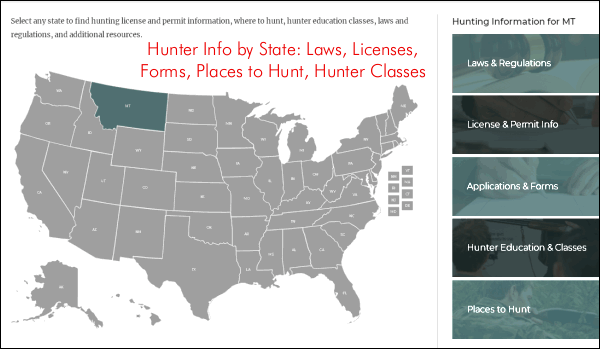
There’s a great online resource for hunters that will help you find game locations in your state and ensure you have all the proper permits and game tags. WheretoHunt.org features an interactive map of the country. For all 50 states, the NSSF has compiled information about hunting license and permits, where to hunt, hunter education classes, laws and regulations and more. For each state you’ll also find a link for required applications and license forms.




 The
The