It’s hunting season in many areas of the country already. If you’re planning a fall hunt you want to do your homework — make sure your gear is checked out, your rifle zeroed, and your hunting grounds plotted. You’ll want to sight in your rifle, get the right clothing, make sure you have your hunting license, deer tags, and other needed paperwork.
Cabela’s has a ton of helpful information for hunters on its Deer Nation website. You’ll find numerous videos as well as articles from expert guides and experienced hunters.
This episode of Cabela’s Whitetail Season highlights ground hunting. While some hunters prefer a stand, the cover provided by the background and tall grasses can help with your stalks.
In this video, Bill Winke, host of Midwest Whitetail, shows how he hunts over small food plots.
Cabela’s Deer Nation portal offers over 100 informative articles for hunters. Here are six of our favorite features:
It’s hunting season already in many areas of the country. Improve your chances of a successful hunt by working on your position shooting skills before heading into the backcountry. Here are tips from Team USA Olympian and ISSF World Cup Winner SFC Michael McPhail.
One of the world’s best smallbore shooters, McPhail is also an avid hunter, who enjoys harvesting game with centerfire rifles. In this excellent short video from the USAMU, McPhail shows how competition shooting positions can be adapted for hunters. McPhail shows how well-established positions can provide a more stable platform for hunters in the field. That can help ensure a successful hunt. McPhail demonstrates three positions: kneeling, supported prone, and sitting in a tree-stand.
Watch SFC McPhail Demonstrate Positions for Hunters (Good Video):
McPhail first demonstrates the kneeling position. Michael notes: “I like kneeling. It’s a little bit of an under-utilized position, but it’s almost as stable as prone. It allows you get up off the ground a little bit higher to [compensate for] vegetation. For kneeling start by taking your non-dominant foot and put that towards the target, while at the same time dropping down to a knee on the dominant leg. At the same time … wrap the sling around wrist and fore-arm, lean slightly into the target and take the shot.”
McPhail shows a nice “field expedient” use of your backpack. He shows how the basic prone position can be adapted, using the pack as a front rifle support. McPhail recommends pulling your dominant (strongside) leg forward, bent at the knee. According to Michael, this takes pressure off the abdomen, helps minimizes heart beat effects, and helps with breathing.
Last but not least, McPhail shows some clever treestand tricks. McPhail recommends a position with your weakside leg pulled up and firmly braced on the front rail of the treestand. You can then rest your support arm on your leg. (That would be the left arm for a right-handed shooter). This provides a rock-solid position when shooting from a stand. The second half of the video shows how this works.
Hunting season is right around the corner. For many of us, that means liberating a rifle that sits in a safe most of the year, grabbing a box of cartridges, and heading to the wilds. But this “once a year thing” carries with it potential risks.
It is all to easy to grab some rounds that may look right, but which are, in fact, a slightly different chambering. Likewise it is possible some hunting rounds got put in the wrong box after last year’s hunting trip. Be very careful when you get ready for a hunting trip — check the headstamp, cartridge dimensions, and bullet diameter of all your rounds. If you make an ammo selection mistake, the consequences can be disasterous, as this story reveals.
The .223 WSSM and 6mmBR Disaster Report by Dr. Jim Clary
Under most circumstances, shooters don’t have to worry about chambering the wrong cartridge into the wrong rifle. After all, the cartridges are well marked and we all know which rifle we are shooting on any given day. In many cases, incorrect cartridges cannot be chambered — larger cases will not fit in smaller chambers, for example. No problem! That being said, I can tell you that even an experienced, careful and normally safe shooter can make a mistake.
The following is an account of just such a mistake that could have resulted in death or dismemberment. Fortunately, the shooter was not hurt, but the rifle was completely destroyed.
Last year, a friend purchased a Savage Precision right bolt, left port, single shot bolt action in 6mmBR Norma. It was an incredible prairie dog gun and he spent the summer burning powder and busting dogs. In October, he purchased a stainless steel Browning A-Bolt Varmint in .223 WSSM. The weather in the upper Midwest turned sour by the time he got the brass tuned up and he only got to fire it a few times before he was “socked in” for the winter. Thus, he spent his evenings loading ammo for the spring thaw.
During a break in the weather, he grabbed both rifles and a couple of bags of .223 WSSM and 6mmBR cartridges and headed to the range to check out his new loads. In case you are not familiar, the 6mmBR is smaller in diameter and a mite shorter than the .223 WSSM. Because of this, it will chamber in a .223 WSSM, but the .243 caliber (6mm) bullet is too big for the .22 caliber bore. That is what happened to my friend.
The rest is history — when he squeezed the trigger, all hell broke loose. The entire bottom of the rifle blew out, including the magazine assembly. The explosion actually cut the stock into two pieces. However, the bolt held and amazing as it may seem, the .243 bullet was “swaged” right out of the .223 barrel.
6mmBR (left) and .223 WSSM (right) cartridges above the remains of Browning A-Bolt rifle.
One Small Mistake Is All It Takes
Now, realize that my friend has been shooting all manner of firearms, safely, for over half a century. He is meticulous, thorough and conscientious in his approach to reloading and shooting. However, he made one mistake. He put some lose 6BR cartridges in a baggie as he packed up from a prairie dog hunt last summer, without noticing that the baggie was marked .223 WSSM in black marker. Then, when the break in his winter weather came, he grabbed the bag, believing it to be the WSSM cartridges and didn’t check the head stamp.
Couldn’t happen to you? How many times have we emptied our pockets of cartridges and dropped them into a plastic container on the shooting bench? How many times have we set down to a marathon reloading session, loading several calibers in a row? How many times have we put the wrong bullets, cases or primers into the incorrect container? My point is that even the safest of us can make a mistake. So, look at the picture above and take a bit more time when you reload your ammunition at home or chamber a round in the field. It might save your life.
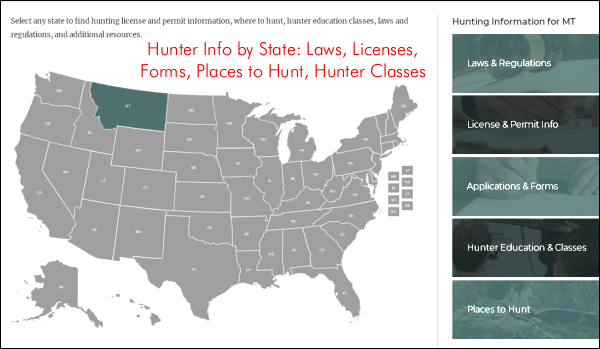
Click Map to launch interactive webpage with info for all 50 states.
Going hunting this year? Need to find out about hunting licenses, deer tags, local regulations, and the best hunting areas? Then visit WheretoHunt.org. This website has an interactive map of the country. Simply click on a state to find the info you need. For all 50 states, the NSSF has compiled information about hunting license and permits, where to hunt, hunter education classes, laws and regulations and more. For each state you’ll also find a link for required applications and license forms. Have a safe and productive hunt this year.
Hunting season is around the corner. We know many readers will be zeroing their hunting rigs in the next few weeks. Here is a very simple but effective way to zero any scoped rifle in a few minutes, with just four shots.
Follow this simple procedure to get a solid zero for a hunting rifle in just four shots. Of course you probably want to fire a few more rounds to confirm your zero before you head off to your hunting grounds, but this will let you get on-target with a minimum amount of time and ammo expended. (This assumes your scope is securely mounted, and the bases are not drastically out of alignment.)
QUICK-TIP: The Key to this procedure is Dialing to Shot One Point of Impact (POI). Re-aim at center of target after SHOT ONE. Then with the rifle motionless, use the turrets to put the middle of the cross-hair on the first shot location.
1. First, remove the bolt and boresight the rifle. Adjust the position of the rifle so that, looking through the bore, you can see the center of the target with your eyes. Secure the rifle in the rests to maintain its position as boresighted. Then, without moving the rifle, center the reticle. That should get you on paper. With the rifle solidly secured in front and rear rests or sandbags, aim at the center of a target placed at your zeroing distance (50 or 100 yards). Confirm there are no obstructions in the barrel! Then load and fire SHOT ONE. Then, return the gun to the exact position it was when you pulled the trigger, with the cross-hair centered on the target as before.
2. Locate, in the scope, where your first bullet landed on the target. Now, while you grip the rifle firmly so it doesn’t move, have a friend adjust the turrets on your scope. While you look through the scope, have your friend turn the windage and elevation turrets until the cross-hairs, as viewed through the scope, bisect the first bullet hole on the target. In other words, use the turrets to move the center of the reticle to the actual position of shot number one. IMPORTANT: Dial the crosshairs to the hole — don’t move the rifle.
3. After you’ve adjusted the turrets, now re-aim the rifle so the cross-hairs are, once again, positioned on the target center. Keep the rifle firmly supported by your rest or sandbag. Take the SECOND SHOT. You should find that the bullet now strikes in the center of the target.
4. Take a THIRD SHOT with the cross-hairs aligned in the center of the target to confirm your zero. Make minor modifications to the windage and elevation as necessary.
5. Finally, shoot the rifle from a field rest (shooting sticks, bipod, or rucksack) as you would use when actually hunting. Confirm, with SHOT FOUR, that your zero is unchanged. You may need to make slight adjustments. Some rifles, particularly those with flexy fore-arms, exhibit a different POI (point of impact) when fired from a bipod or ruck vs. a sandbag rest.
If you recently cleaned your rifle, you may want to fire two or three fouling shots before you start this procedure. But keep in mind that you want to duplicate the typical cold bore conditions that you’ll experience during the hunt. If you set your zero after three fouling shots, then make sure the bore is in a similar condition when you actually go out hunting.
If you haven’t checked out NormaUSA’s website, you should. There you’ll find Norma’s Cartridge of the Month Archive. This great resource provides a detailed history of popular cartridges, along with a discussion of these cartridges’ hunting and target-shooting uses. There are currently 26 Cartridge of the Month articles, the latest featuring the impressive .458 Winchester Magnum hunting cartridge.
Also on Norma-USA.com you’ll find information on Norma cartridge brass, bullets, powder and factory ammo. The site also offers a video archive plus links to Norma Reloading Data.
A mild cartridge by modern standards, the 6.5×55 has impressive credentials in both the hunting field and in competition. It was developed jointly by Sweden and Norway in 1894 – one of the very first smokeless, small-bore rounds for military rifles. When Sweden boosted 6.5×55 performance in Mausers, Norway stayed with original loads in the less robust Krag. The 6.5×55 defended Scandinavia for most of a century thereafter. In 1990 the National Rifle Association of Denmark, Norway and Sweden renamed this cartridge the 6.5×55 SKAN and standardized its specifications. Still hugely popular among moose hunters there, it has also excelled in 300-meter free-rifle competition.
The long tenure of this cartridge spanned the post-war wildcatting era. Unfortunately for shooters keen to make something new of the 6.5×55 hull, its head diameter is .01 greater than that of the 7×57 (and the .270 and .30-06). The rim is thicker too. At 2.16 inches, cases mike .15 longer than the .308’s and .08 shorter than those of the 7×57 – though as originally loaded, its overall length (3.15 inches) exceeds that of the 7×57. In fact, it falls just 0.1 inch shy of the finished length of the 7mm Remington Magnum! In my view, the 6.5×55 merits at least a mid-length action, such as on Melvin Forbes’s New Ultra Light rifles. Shorter (typical .308-length) actions require deep bullet seating that throttles performance.
You’ll look hard to find a better deer cartridge than the 6.5×55. Francis Sell, woodsman and rifle enthusiast whose book on blacktail deer hunting has no peer, favored the 6.5×55. Hunters coming of age in a magnum culture might question the round’s bona fides on animals as stout as elk and moose. But at modest ranges, with bullets like Norma’s factory-loaded 156-grain Oryx, it’s a sure killer. Modest recoil makes rifles pleasant to fire (read: accurate in hand!) and fast on follow-ups. In Africa the 6.5×55 – and similar 6.5×54 Mannlicher-Schoenauer – felled much bigger game than moose long before anyone necked down the .375 H&H! While its compact case won’t let the Swede match the likes of the .270 ballistically, it is a fine all-around choice for big game in the Lower 48.
Utah Monument photo by DOI. Inset graphic from Ammoland.com, DOI source.
U.S. Secretary of the Interior Ryan Zinke has announced the newly-appointed members of the Hunting and Shooting Sports Conservation Council (HSSCC). The Council, established on January 9, 2018, is intended to provide the Secretary of the Interior and the Secretary of Agriculture with advice regarding the establishment and implementation of existing and proposed policies and authorities with regard to wildlife and habitat conservation. The Advisory Council will meet at least twice a year.
The Council will also examine ways to benefit wildlife resources; encourage partnership among the public, the sporting conservation organizations, state, tribal, territorial, and federal government; and benefit recreational hunting and recreational shooting sports.
“We have assembled here some of the best conservationists in America,” Secretary Zinke said. “Over a century ago, Teddy Roosevelt established the American conservation ethic — best science, best practices, greatest good, longest term. These sportsmen carry on the American conservation ethic in the modern day. Bringing these experts together will be key to ensuring the American tradition of hunting and shooting, as well as the conservation benefits of these practices, carries on.”
Secretary Ryan Zinke (left) believes we can learn important conservation lessons from President Theodore Roosevelt (right), an avid hunter.
“America’s hunters and recreational shooters have a champion in Secretary Ryan Zinke,” said Chris W. Cox, executive director of the NRA’s Institute for Legislative Action. “Zinke is fighting for our sportsmen and women to have greater access to our public lands. I am pleased to work with the Trump Administration’s new Hunting and Shooting Sports Conservation Council to make it easier for Americans to enjoy our public lands.”
“Comprised of national leaders throughout the hunting and recreational shooting communities, the HSSCC is widely regarded as one of the most effective and productive federal advisory committees across the federal government,” said Lawrence Keane, NSSF Senior V.P. and General Counsel.
“What an exciting time for our hunting and shooting sports! This Shooting Sports Council is yet another way Secretary Zinke and staff is making the expansion of our great American heritage a priority,” said Smith & Wesson Pro Shooter Julie Golob.
“President Trump and Sec Zinke continue to make major positive structural changes to America’s land and wildlife conservation systems,” said Sportsmen for Fish and Wildlife Founder Don Peay. “This new Council, made up of the most accomplished hunter/conservationists in North America, will assist in revitalizing conservation of our nation’s natural treasures for generations!”
“I am very pleased and honored to be appointed to this Council by Secretary Zinke,” said Rocky Mountain Elk Foundation Chief Conservation Officer Blake Henning. “I look forward to representing the interests of big game and big game hunters as this Council does important work.”
“I am honored to be asked by Secretary Zinke to serve on the federal advisory council,” said Bob Model, Chairman of the Boone and Crockett Club. “Sportsmen and women are vital stakeholders in federal land management.”
Members of the Hunting and Shooting Sports Conservation Council are listed below
MEMBER NAME
ORGANIZATION
Mike Budzik
Retired Chief of the Ohio Department of Natural Resources
Chris Cox
Executive Director of the NRA’s Institute for Legislative Action (NRA-ILA)
Jeff Crane
President of Congressional Sportsmen’s Foundation (CSF)
John Devney
Vice President of U.S. Policy for Delta Waterfowl
Dan Forester
Vice President and Chief Conservation Officer, Archery Trade Association
Ward “Trig” French
Chairman of the Hunter’s Leadership Forum
Julie Golob
World and National Shooting Champion, Team Smith & Wesson
John Green
CEO of Crossroads Strategies and Board Member of the Congressional Sportsmen’s Foundation
Dale Hall
CEO of Ducks Unlimited and former Director of the USFWS
Blake Henning
Chief Conservation Officer for the Rocky Mountain Elk Foundation
Graham Hill
Principal and Founding Partner, Ice Miller Strategies LLC. NRA Board of Directors member
Larry Keane
Senior V.P. for Governmental and Public Affairs, Asst. Sec. and General Counsel for National Shooting Sports Foundation (NSSF); General Counsel, Sporting Arms and Ammunition Manufacturers Institutes (SAAMI)
Bob Model
Former President of the Boone & Crockett Club; President/CEO of Mule Deer Foundation; previous Deputy Director of Utah’s Div. of Wildlife Resources
Collin O’Mara
President and CEO of the National Wildlife Federation
Donald Peay
Founder and Former CEO of Sportsmen for Fish and Wildlife (SFW)
Eva Shockey
Co-Host of Jim Shockey’s Hunting Adventures on Outdoor Channel
David Spady
President of the Liberty and Property Rights Coalition
Report based on Press Release from U.S. Department of Interior
Continuing his efforts to increase access to public lands, U.S. Secretary of the Interior Ryan Zinke has proposed opening more than 248,000 acres to new or expanded hunting and fishing opportunities at 30 National Wildlife Refuges.
Opportunities include places like Hackmatack National Wildlife Refuge in Illinois and Wisconsin, and deer hunting in Philadelphia at John Heinz National Wildlife Refuge being proposed for the first time. The proposal also outlines expanded hunting and fishing opportunities at 136 national wildlife refuges. If finalized, this would bring the number of units of the National Wildlife Refuge System where the public may hunt to 377, and the number where fishing would be permitted to 312.
“As stewards of our public lands, Interior is committed to opening access wherever possible for hunting and fishing so that more families have the opportunity to pass down this American heritage,” Zinke said. “These 30 refuges will provide incredible opportunities for American sportsmen and women across the country to access the land and connect with wildlife.”
The U.S. Fish and Wildlife Service’s (USFWS) proposal would open more new acres to hunting and fishing than in the past and takes steps to simplify regulations to more closely match state hunting and fishing regulations. The changes would be implemented in time for the upcoming 2018-2019 hunting seasons.
Hunting, fishing and other outdoor activities contributed more than $156 billion in economic activity in communities across the United States in 2016 according to the USFWS’s National Survey of Fishing, Hunting and Wildlife-Associated Recreation, published every five years. More than 101 million Americans pursue wildlife-related recreation — such as hunting, fishing and birding. The Refuge System is an unparalleled network of 566 national wildlife refuges and 38 wetland management districts. There is a national wildlife refuge within an hour’s drive of most major metropolitan areas.
“Ensuring public lands are open for multiple uses supports local economies and provides important opportunities for recreation. Further, this proposal means that families and individuals across our nation will be better able to participate in our nation’s tradition of hunting and fishing. We appreciate Secretary Zinke and the Interior Department for advancing this priority, and we will continue to work to improve access to public lands for our sportsmen,” said Senator John Hoeven.
“Hunters, anglers and shooting sports enthusiasts play a crucial role in funding the management and conservation of North America’s wildlife,” said USFWS Principal Deputy Director Greg Sheehan. “We are providing sportsmen and women with more access to our national wildlife refuges and streamlining regulations to more closely align with our state partners. And that’s good news for our customers.”
Here’s a simple procedure that lets you get a solid zero for a hunting rifle in just four shots. Of course you probably want to fire a few more rounds to confirm your zero before you head off to your hunting grounds, but this will let you get on-target with a minimum amount of time and ammo expended. (This assumes your scope is securely mounted, and the bases are not drastically out of alignment.)
QUICK-TIP: The Key to this procedure is Dialing to Shot One Point of Impact (POI). Re-aim at center of target after SHOT ONE. Then with the rifle motionless, use the turrets to put the middle of the cross-hair on the first shot location.
1. First, remove the bolt and boresight the rifle. Adjust the position of the rifle so that, looking through the bore, you can see the center of the target with your eyes. Secure the rifle in the rests to maintain its position as boresighted. Then, without moving the rifle, center the reticle. That should get you on paper. With the rifle solidly secured in front and rear rests or sandbags, aim at the center of a target placed at your zeroing distance (50 or 100 yards). Confirm there are no obstructions in the barrel! Then load and fire SHOT ONE. Then, return the gun to the exact position it was when you pulled the trigger, with the cross-hair centered on the target as before.
2. Locate, in the scope, where your first bullet landed on the target. Now, while you grip the rifle firmly so it doesn’t move, have a friend adjust the turrets on your scope. While you look through the scope, have your friend turn the windage and elevation turrets until the cross-hairs, as viewed through the scope, bisect the first bullet hole on the target. In other words, use the turrets to move the center of the reticle to the actual position of shot number one. IMPORTANT: Dial the crosshairs to the hole — don’t move the rifle.
3. After you’ve adjusted the turrets, now re-aim the rifle so the cross-hairs are, once again, positioned on the target center. Keep the rifle firmly supported by your rest or sandbag. Take the SECOND SHOT. You should find that the bullet now strikes in the center of the target.
4. Take a THIRD SHOT with the cross-hairs aligned in the center of the target to confirm your zero. Make minor modifications to the windage and elevation as necessary.
5. Finally, shoot the rifle from a field rest (shooting sticks, bipod, or rucksack) as you would use when actually hunting. Confirm, with SHOT FOUR, that your zero is unchanged. You may need to make slight adjustments. Some rifles, particularly those with flexy fore-arms, exhibit a different POI (point of impact) when fired from a bipod or ruck vs. a sandbag rest.
If you recently cleaned your rifle, you may want to fire two or three fouling shots before you start this procedure. But keep in mind that you want to duplicate the typical cold bore conditions that you’ll experience during the hunt. If you set your zero after three fouling shots, then make sure the bore is in a similar condition when you actually go out hunting.
Kirstie Pike of Próis Hunting Apparel for Women created Mossberg’s wild game cookbook. Kirstie walks you through everything you need to know with 10 easy-to-follow recipes that even non-expert guy cooks can handle. Kirstie is not only passionate about her hunting, but also her cooking, “There is nothing like harvesting your own game and creating fabulous food that is healthy and organic. I love to create recipes that are not only flavorful, but also easy enough for any night of the week.”
The Wild Game Gourmet Cookbook includes:
— Ten easy-to-follow recipes
— In-depth preparation detail for each recipe
— High resolution photos to accompany each recipe
— Suggestions on altering recipes to suit the game you have on hand
— Tips on meat storage, general food preparation, and more…


 Hunting season is right around the corner. For many of us, that means liberating a rifle that sits in a safe most of the year, grabbing a box of cartridges, and heading to the wilds. But this “once a year thing” carries with it potential risks.