Swarovski makes fantastic hunting scopes. They feature extremely high-quality glass, that is bright and razor-sharp. Excellent light transmission ensures good performance at dawn and dusk. Right now, through the end of October, MidwayUSA has clearance-sale pricing on two Swarovski medium-range zooms suitable for varminting or long-range hunting.
The Swarovski PH 4-16x50mm (30mm) with Ballistic Reticle (item #676135) is marked down from $1,849.00 to $1,399.00, a $450.00 savings. The higher power Swarovski AV 6-18x50mm with Ballistic Reticle and 1″ main tube (item #220145) is $929.00 on sale, reduced from $1229.00. Whenever you can get a mid-range zoom Swaro for under a grand, it’s a pretty good deal. Both these scopes feature diopter-type eyepieces offering ample focus correction. That’s a big plus if you normally need glasses but don’t have prescription shooting glasses.
Both scopes are covered by Swarovski’s 30-year warranty. The AV 6-18x50mm is less expensive, but the PH model should provide enhanced lowlight performance.
IMPORTANT: both these scopes have metric, non-standard click-values. The PH 4-16x50mm moves 0.5 cm per click at 100 meters (about .18″ at 100 yards), while the AV 6-18x50mm moves 1.0 cm at 100 meters (about .36″ per click at 100 yards). Make sure you can live with metric clicks before purchasing either scope.
The 4R Rifle Club’s Team Hunting Challenge is one of the only matches in the country to mimic a long range hunting scenario. The match is held in central Oklahoma and has evolved over the last thee years to challenge not only the competitors’ marksmanship but also their ability to handle stress in the field.
A strict time limit puts pressure on the two-man shooter/spotter teams. In the 13-minute alloted time, the shooters attempt to find and range 12 wooden animal silhouettes and then score hits on the steel vital areas.
Shooters and spotters must work together and communicate well to get through all the targets in the given time. Plus, this year a Speed Shoot was added to the Hunting Challenge. This timed stage gave teams just 40 seconds to engage five (5) known-distance targets with one shot each. That works out to just 8 seconds per target, requiring the trigger pullers to be ultra-fast, AND accurate.
Surgeon Rifles Duo Tops Field
The Hunting Challenge was well-attended, with competitors coming from Missouri, Tennessee, and Utah, to join the usual group of shooters from Oklahoma and Texas. Small targets, improvised shooting positions, and constantly-switching winds made this a tough event, demanding high levels of skill and rifle accuracy. Preston Pritchett of Surgeon Rifles and his ace spotter Wade Stuteville came out on top with 65 out of 89 points. Preston and Wade put on a clinic, beating the second-place team, Dean Morris and Rick Jensen, by 15 points (equivalent to five first round hits). Finishing third was the team of Jeff Badly and Chase Tressler.
Hunting Challenge Teams Snag $30K Worth of Gear
This year’s Hunting Challenge prize table held over $30,000 worth of merchandise. Preston and Wade were each awarded a fully-outfitted Savage 10 Precision Carbine rifle, complete with Harris bipod, and 3.5-15x50mm NightForce NXS scope. Dean and Rick each took home a Vortex Razor HD rifle scope with rings. Two Swarovski SLC HD 10×42 binos were handed out to the third-place team. There were prizes for 24 of the 30 teams and the top 15 teams received a prize with a value that equaled or exceeded the $400 match entry fee. Full results, photos, and a sponsor list are posted on the Snipers’ Hide Forum.
Credit B.J. Bailey for this match report and photos.
Here’s a simple procedure that lets you get a solid zero for a hunting rifle in just four shots. Of course you probably want to fire a few more rounds to confirm your zero before you head off to your hunting grounds, but this will let you get on-target with a minimum amount of time and ammo expended. (This assumes your scope is securely mounted, and the bases are not drastically out of alignment.)
1. First, remove the bolt and boresight the rifle. Adjust the position of the rifle so that, looking through the bore, you can see the center of the target with your eyes. Secure the rifle in the rests to maintain its position as boresighted. Then, without moving the rifle, center the reticle. That should get you on paper. With the rifle solidly secured in front and rear rests or sandbags, aim at the center of a target placed at your zeroing distance (50 or 100 yards). Confirm there are no obstructions in the barrel! Then load and fire one shot. Then, return the gun to the exact position it was when you pulled the trigger, with the cross-hair centered on the target as before.
2. Locate, in the scope, where your first bullet landed on the target. Now, while you grip the rifle firmly so it doesn’t move, have a friend adjust the turrets on your scope. While you look through the scope, have your friend turn the windage and elevation turrets until the cross-hairs, as viewed through the scope, bisect the first bullet hole on the target. In other words, you use the turrets to move the center of the reticle to the actual position of shot number one. Dial the crosshairs to the hole — don’t move the rifle.
3. After you’ve adjusted the turrets, now re-aim the rifle so the cross-hairs are, once again, positioned on the target center. Keep the rifle firmly supported by your rest or sandbag. Take the second shot. You should find that the bullet now strikes in the center of the target.
4. Take a third shot with the cross-hairs aligned in the center of the target to confirm your zero. Make minor modifications to the windage and elevation as necessary.
5. Now shoot the rifle from a field rest (shooting sticks, bipod, or rucksack) as you would use when actually hunting. Confirm that your zero is unchanged. You may need to make slight adjustments. Some rifles, particularly those with flexy fore-arms, exhibit a different POI (point of impact) when fired from a bipod or ruck vs. a sandbag rest.
If you recently cleaned your rifle, you may want to fire two or three fouling shots before you start this procedure. But keep in mind that you want to duplicate the typical cold bore conditions that you’ll experience during the hunt. If you set your zero after three fouling shots, then make sure the bore is in a similar condition when you actually go out hunting.
Leupold has launched a dedicated website to educate hunters and shooters about the Custom Dial System (CDS™) feature for VX-3® riflescopes. The innovative CDS system is darn clever. Basically what Leupold has done is create calibrated elevation knobs that allow hunters and varminters to simply dial the yardage to their targets, rather than input a specific number of clicks. For example, to shoot a buck at 300 yards, you simply rotate the elevation turret to “3” on the scale. CDS helps hunters and shooters get on target at any range, with any load, by matching their scopes to the ballistics of their ammunition.
Leupold’s CDS system is a user-friendly invention that can really simplify shooting at multiple yardages. The big single-digit Arabic numerals on the elevation dial correspond to 100-yard intervals, while the smaller numbers show 50-yard intervals. (Click values are otherwise 1/4-MOA.) No longer do you have to remember specific come-ups for particular distances. For the CDS system to work correctly however, your load’s ballistics must match a set of master loads that Leupold uses to calibrate the dial scales. Hunters using most common cartridges should find a calibrated load that matches their muzzle velocity and bullet BC. CDS turrets are available on these scopes: VX-3 3.5-10x40mm, VX-3 3.5-10x50mm, VX-3 4.5-14x40mm, VX-3L 3.5-10x50mm and VX-3L 4.5-14x50mm.
Free CDS Calibrated Dials with Purchase of VX-3 Scopes
Leupold’s CDS system is explained at www.leupold.com/VX-3CDS. Visitors to the VX-3 CDS webpage will find an educational video and graphics, an overview of how the system works and its advantages, and details on a special offer. With the purchase of any VX-3 CDS riflescope, shooters receive two customized, ballistically-matched adjustment dials ($100 retail value) at no extra cost. This offer ends December 31, 2010. Click the image below to learn more (turn down your speakers before clicking as a loud video will auto-play).
Chrysler is offering a lockable gun storage compartment on its new series of Outdoorsman pickup trucks. These trucks can be configured with twin, lighted, lockable and watertight “RamBox” compartments — one on each side of the truck bed. The dual RamBox option costs $1895, and for $205 more Chrysler adds internal, vertical cradles that hold two rifles or shotguns. These cradles can be rotated 90 degrees to hold up to six fishing rods.
We think Chrysler’s built-in gun storage is a very cool feature — for the man who has everything. It will certainly create envious looks when you roll up to the shooting range in your new truck. From a practical standpoint however, it might be better to forgo the gun cradles in favor of open storage in both side-boxes. You could then use both lockable side compartment for any purpose. When you need to haul firearms, simply put cased guns inside one or both side compartments.
For more information on Chrysler’s Outdoorsman pickups, which start at $28,350, visit the Chrysler Truck Blog. Ram Outdoorsman trucks go on sale 3rd quarter 2010 (just in time for hunting season).
Last year saw a significant 5.4% increase in the number of female hunters in the United States — that means 163,000 new ladies hunting with firearms and/or bows. In fact, in 2009 the rate of increase in hunting participation is higher for women than for men, according to new figures from the National Sporting Goods Association (NSGA).
Data also show that women outpaced men among newcomers to target shooting. Female participation in rifle target shooting grew by 4.1%. That’s a big change in a single year. The number of women involved in Muzzle-loading activites showed a remarkable 134.6% annual increase.
The growth in new participation among women, perhaps counter-intuitive to traditionalists, is no surprise to Steve Sanetti, president of the National Shooting Sports Foundation (NSSF). Steve explained, “Over the past several years [we have] encouraged existing hunters and shooters to introduce their spouses, daughters and other newcomers to shooting sports and outdoor lifestyles. I believe these efforts are paying off.” Photo courtesy Próis hunting clothing for women.
For the first time in six years, Armalite is producing a special run of semi-auto AR-10 rifles chambered in .243 Winchester. The .243 Win chambering is excellent for long-range target shooting as well as hunting most North American deer species (you want a bigger round for Elk). The new Armalite features a 20″ barrel, 2-stage “tactical” trigger, and a flat-top receiver with Picatinny rail. Units should start shipping in late July, with an MSRP of approximately $1600.00.
Here is an interesting tool that lets shooters re-shape and uniform the tips of their .22 rimfire lead bullets. Paco Kelly’s Acu’Rzr comes in two basic versions, the “Phase III Nasti-Nose” and the “Phase IV Baby Scorp’n”. The Phase III tool produces a deep-dished hollowpoint (like an ash-tray) that opens quickly and efficiently. There is also a Phase III insert that creates a flatter, open dish HP for target shooting. The Phase IV Scorpion tool creates a deep hollow point with a central post. The internal post in the middle helps achieve deeper penetration in game. The designer claims that ammo modified with either tool is more accurate because the bullet diameter “comes out the same every time”. In addition to the Phase III & IV tools, which reform one round at a time, Paco offers a Maxi series for bulk production. These let you process either three rounds at once (Maxi 3) or four rounds at once (Maxi 4).
Why re-shape lead rimfire bullets? The first reason is accuracy. The tool’s designer, Paco Kelly, claims you can improve the accuracy of budget-priced ammo by using the dish nose rod with the Phase III tool: “The dish nose forming rod is for accuracy and paper targets. It makes very sharp and clean cut holes in paper. And the consistency of the [re-shaped] bullet diameter pulls the group together.”
The main reason to use Paco Acu’Rzr tools is to improve perfomance on small game such as squirrels, prairie dogs, and jack-rabbits. Kelly says: “Unlike most commercial 22 rimfire ammo with small holes and negligible HP expansion, the Nasti-Nose will open even with standard velocity ammo. Yet it will NOT explode on contact like the hyper-velocity ammo. For small eating game, such as squirrels, the Hyper ammo is too much and the medium-velocity, hollow-pointed commercial ammo often fails to open. But not so with the Nasti-Nose.” The idea, Kelly suggests, is that you get reliable expansion with medium-velocity ammo, without destroying the game the way hyper-velocity ammo does.
The Phase III tool costs $65.00, while the Phase IV tool costs $75.00. The Maxi 3 which does three (3) rounds at once, costs $100.00, and the four-round Maxi 4 is $128.00. All tools can be customized for target rifles or European chambers. To order, contact Paco Kelly, P.O. Box 1170, Cortaro, AZ 85652 or use this ORDER FORM.
EDITOR’s NOTE: Do NOT use this tool with premium-grade rimfire target ammo. It won’t help. Use it with the cheaper bulk-pack ammo. Also, we have not tested the reformed ammo on live targets, so you have to draw your own conclusions as to its benefits on small critters.
Sporting Classics, a specialty publisher, has released a new edition of 45 true-to-life Jack O’Connor stories from the pages of Outdoor Life, Field & Stream, Petersen’s Hunting and other popular magazines of his day. The new book, Classic O’Connor, is a sequel of sorts to Sporting Classics’ popular compendium, The Lost Classics of Jack O’Connor.
In the new 440-page book, Jack O’Connor recounts his worldwide hunting adventures, during which he pursued everything from ducks to grizzlies, pheasants to kudu. Classic O’Connor presents several of the author’s greatest gun stories and a large selection of never-before-published photographs of the celebrated sportsman and his family on hunting adventures around the world. The book is illustrated with 40+ drawings by acclaimed artist Ron Van Gilder. Hardcover with dust jacket, the book lists for $35, but it can be pre-ordered on Amazon.com for just $23.10, with an August 1st delivery date. To get the book a soon as possible, call Sporting Classics at (800) 849-1004 or visit www.sportingclassics.com.
Another O’Connor title worth reading is The Hunting Rifle, still considered one of the definitive works on selecting a hunting rifle and cartridge. One owner of The Hunting Rifle explains: “It would benefit every hunter to take the time and read this book. It offers a corrective to the spirit of things that have gripped the hunting scene lately. Today, if one reads a hunting magazine, [one is] offered the view that you need the fastest and loudest cartridges, rifles with special finishes and the most expensive of anything. Ole Jack reminds us that many have killed game with ‘lesser’ guns for a very long time, and that these new gimmicks will not make you a more lethal hunter.”
In recent years, environmental concerns over lead toxicity have inspired efforts to eliminate conventional lead-based ammunition. To protect endangered species from lead poisoning, California has banned hunting altogether on huge tracts of public land. In other areas which harbor protected species, hunters are forbidden to use lead-core or solid lead bullets. There is an ongoing FDA investigation into the health of venison taken with lead-core bullets. Responding to such concerns, in 2008, Barnes Bullets (now part of the Freedom Group), introduced its MPG™ (Multi-Purpose Green) lead-free bullets. These bullets are intended for hunting and for rifle training in locations where lead is restricted.
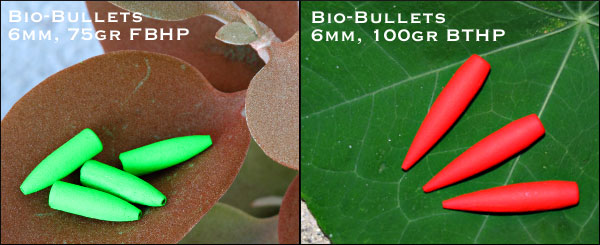
Following Barnes’ lead, BIO-Bullets, a small company in Wanganui, New Zealand has invented a jacketless bullet that is not only lead-free, but is also 100% non-toxic, and bio-degradable. The new bullets have zero lead content and are made from “all-natural”, organic compounds. Unlike conventional bullets formed in a die, the new BIO-Bullets are pressure-molded from a proprietary composite, using sintered mineral compounds in a silica matrix. The mineral compounds, interestingly enough, not only bind the bio-degradable bullet together, but they provide nutritional benefits for any game that might ingest the projectiles. If an animal eats the bullet, it won’t get sick — it will actually get healthier.
That’s right — these edible BIO-Bullets are not only non-toxic, they are actually nutritious. “When we came up with a non-toxic component mix, we realized we could actually provide a blend of flavorful nutrients in the matrix.” Said Trevor MacDiarmid, BIO-Bullets’ chief bullet designer. “It may seem far-fetched but just look at the label on a typical multi-vitamin supplement. You’ll see iron, chromium, magnesium, potassium, and zinc, among other minerals. These are all elements that can be combined into a durable bullet form that is actually healthy when ingested by an animal.” MacDiarmid, who holds a Ph.D in chemical engineering, explains that the health benefits of the BIO-Bullet came as an unexpected bonus: “Our first goal was simply to create a shootable, lead-free bullet that was non-toxic. But when our silica matrix proved more than hard enough to survive the friction, heat, and pressure of a 3500 fps trip through a rifle bore, we realized we could add additional minerals into the mix that would have a salutary effect on wildlife health.”
BIO-Bullet’s founder, Steven Williams, is a gregarious 45-year entrepreneur who earned his first millions promoting dietary supplements in his native New Zealand. Noting the growing interest in “eco-friendly” ammunition components, Williams expects a huge demand for his new BIO-Bullets. “Globally, the annual sales of hunting bullets exceed €500 million in value. And the military bullet market may be triple that number — as long as you Yanks keep fighting wars”, he joked. Williams believes his new company is in the right place at the right time: “Being based in eco-aware New Zealand gives us a strong marketing advantage in launching this new product.” Williams’ company has earned the coveted “100% Pure New Zealand” certification, signifying that Bio-Bullets are “all-natural” and organic.
A select group of New Zealand hunting guides has already been using prototype BIO-Bullets in the field. The new eco-friendly bullets have earned high praise from these tough-to-please outdoorsmen. “In terms of ballistics and knock-down power, I reckon the ‘greenies’ are as good as anything on the market”, reports veteran outfitter Bart Coutts. South Island guide and deer farmer Dennis Amon said, “I’ve used them for predator control, and, as a test I even fed them to some of our captive Red Deer. The Reds ate them up like they were candy. Ever since then we’ve been calling these BIO-bullets the ‘incredible edibles’.”
BIO-Bullets will initially be available in .224, 6mm, and .308 calibers starting at $40 (NZ) per box of 100. The varmint-grade, flat-based bullets will be finished with a day-glo green outer coating, while the longer, boat-tail match bullets will be fluorescent red. Said designer MacDiarmid: “Since our BIO-Bullets don’t use a conventional jacket, we can finish them in any color by adding non-toxic dyes to the silica matrix. It’s sort of like putting the colored shell on a jelly bean. I favored a more sedate color, but the boss wanted something bold and eye-catching. Steven’s the marketing guru, and he writes the checks, so we went with fluorescent colors. But any exterior color scheme is possible, even digital camo.”
BIO-Bullets is currently finalizing arrangements with North American distributors. The company expects its eco-friendly bullets to appear on American and Canadian store shelves in time for the traditional fall hunting season.


 The 4R Rifle Club’s Team Hunting Challenge is one of the only matches in the country to mimic a long range hunting scenario. The match is held in central Oklahoma and has evolved over the last thee years to challenge not only the competitors’ marksmanship but also their ability to handle stress in the field.


 Leupold’s CDS system is a user-friendly invention that can really simplify shooting at multiple yardages. The big single-digit Arabic numerals on the elevation dial correspond to 100-yard intervals, while the smaller numbers show 50-yard intervals. (Click values are otherwise 1/4-MOA.) No longer do you have to remember specific come-ups for particular distances. For the CDS system to work correctly however, your load’s ballistics must match a set of master loads that Leupold uses to calibrate the dial scales. Hunters using most common cartridges should find a calibrated load that matches their muzzle velocity and bullet BC. CDS turrets are available on these scopes: VX-3 3.5-10x40mm, VX-3 3.5-10x50mm, VX-3 4.5-14x40mm, VX-3L 3.5-10x50mm and VX-3L 4.5-14x50mm.

 Last year saw a significant 5.4% increase in the number of female hunters in the United States — that means 163,000 new ladies hunting with firearms and/or bows. In fact, in 2009 the rate of increase in hunting participation is higher for women than for men, according to new figures from the National Sporting Goods Association (NSGA).


 Following Barnes’ lead, BIO-Bullets, a small company in
  BIO-Bullet’s founder, Steven Williams, is a gregarious 45-year entrepreneur who earned his first millions promoting dietary supplements in his native New Zealand. Noting the growing interest in “eco-friendly” ammunition components, Williams expects a huge demand for his new BIO-Bullets. “Globally, the annual sales of hunting bullets exceed €500 million in value. And the military bullet market may be triple that number — as long as you Yanks keep fighting wars”, he joked. Williams believes his new company is in the right place at the right time: “Being based in eco-aware New Zealand gives us a strong marketing advantage in launching this new product.” Williams’ company has earned the coveted “100% Pure New Zealand” certification, signifying that Bio-Bullets are “all-natural” and organic.