To get the best accuracy out of any benchrest rifle, you need to find the optimal position of front rest and rear bag. The important point to remember is that each rig is different. One gun may perform best with the front rest right at the tip of the forearm (Position ‘D’ in photo), while another gun will work best with the rest positioned much further back. This Editor’s own 6mmBR rifle has a laminated stock that is pretty flexy in the front. It shoots best with the front rest’s sandbag located a good 6″ back from the forearm tip (position ‘A’).
Here’s some benchrest advice that can help you reduce vertical and shoot tighter groups… without spending another penny. Many benchrest shooters spend a fortune on equipment and devote countless hours to meticulous handloading, but they never experiment with their rifle’s position/balance on the bags. This article explains why you should test your rifle in various positions. What you learn may surprise you (and improve your scores).
Next time you go to the range, experiment with the position of your rifle on the front rest, and try a couple different positions for the rear bag. You may find that the rifle handles much better after you’ve made a small change in the placement of your gun on the bags. Recoil can be tamed a bit, and tracking can improve significantly, if you optimize the front rest and rear bag positioning.
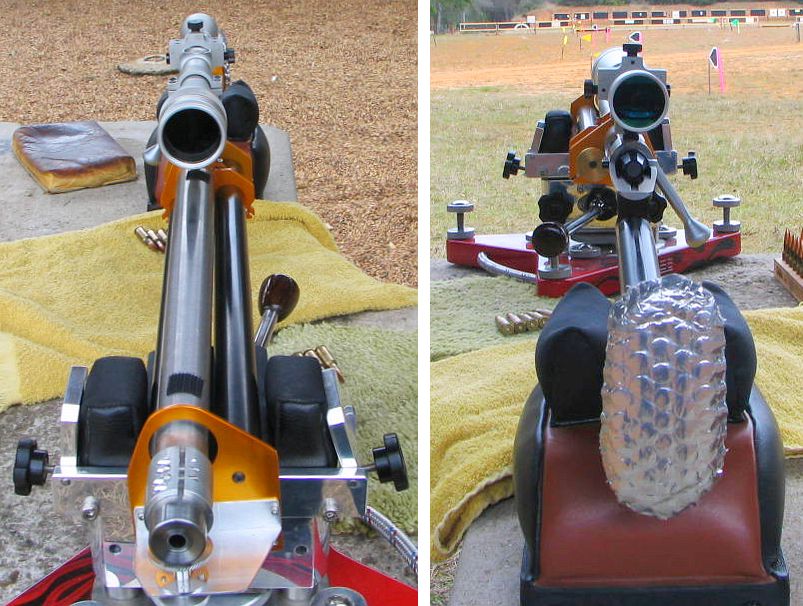
This competitor has the front rest positioned fairly far forward but not all the way out. Note the stop on the front rest — this limits forward stock travel.
A small change in the position of the forearm on the front rest, or in the placement of the rear bag, can make a big difference in how your gun performs.
Balance Your Gun BEFORE You Spend Hours Tuning Loads
In the pursuit of ultimate accuracy, shooters may spend countless hours on brass prep, bullet selection, and load tuning. Yet the same shooters may pay little attention to how their gun is set-up on the bags. When you have acquired a new rifle, you should do some basic experimentation to find the optimal position for the forearm on the front rest, and the best position for the rear bag. Small changes can make a big difference.
Joel Kendrick, past IBS 600-yard Shooter of the Year, has observed that by adjusting forearm position on the front rest, he can tune out vertical. He has one carbon-fiber-reinforced stock that is extremely rigid. When it was placed with the front rest right under the very tip of the forearm, the gun tended to hop, creating vertical. By sliding the whole gun forward (with more forearm overhang ahead of the front sandbag), he was able to get the whole rig to settle down. That resulted in less vertical dispersion, and the gun tracked much better.
Fore/aft stock position is important even with very wide fore-ends.
Likewise, the placement of the rear bag is very important. Many shooters, by default, will simply place the rear bag the same distance from the front rest with all their guns. In fact, different stocks and different calibers will NOT behave the same. By moving the rear bag forward and aft, you can adjust the rifle’s overall balance and this can improve the tracking significantly. One of our shooters had a Savage 6BR F-Class rifle. By default he had his rear bag set almost all the way at the end of the buttstock. When he slid the rear bag a couple inches forward the gun tracked much better. He immediately noticed that the gun returned to point of aim better (crosshairs would stay on target from shot to shot), AND the gun torqued (twisted) less. The difference was quite noticeable.
A small change in the position of the forearm on the front rest, or in the placement of the rear bag, can make a big difference in how your gun performs. You should experiment with the forearm placement, trying different positions on the front rest. Likewise, you can move the rear bag back and forth a few inches. Once you establish the optimal positions of front rest and rear bag, you should find that your gun tracks better and returns to battery more reliably. You may then discover that the gun shoots smaller groups, with less vertical dispersion. And all these benefits are possible without purchasing any expensive new gear.
Shown are funnel with ultra-long drop tube (which helps get more kernels in the cases), RCBS Chargemaster (in wood box), and Hood Press (similar to Harrell’s Combo press).
Loading at the range remains important in the Benchrest for Group discipline. In a Special Report below, past IBS President Jeff Stover explains how loading methods (and hardware) have evolved over the years. The advent of accurate, affordable electronic powder dispensers, such as the RCBS ChargeMaster and Frankford’s new Intellidropper, have changed the game and made it easier to load efficiently at the range. And quality manual powder measures are fast and can be very consistent, with a little practice. Loading at the range permits competitors to tune their load to the conditions, change seating depths, or even choose different bullets to suit the barrel’s preferences on any given day.
Although pre-loading is not uncommon, most 100/200-yard group shooters usually load at the match, often between relays. The goal is to shoot smaller groups by staying “in tune”. In a game where 5-shot groups “in the 1s and Zeros” is the goal, tuning loads for the conditions helps deliver match-winning accuracy. Nearly all competitors in this short-range discipline shoot the 6mm PPC cartridge, or a PPC variant.
Loading at the Range — Then and Now
In benchrest shooting for group, loading at the range has been de rigueur for decades. In the Score discipline, preloading is usually the custom. The main reason is that, in Score competition, only one Aggregate (warm-up match and five record targets) per day is usually shot. That would be less than 50 shots, assuming a few sighter shots. Also, the 30BR, the dominant Benchrest-for-Score cartridge, is very amenable to pre-loading.
By contrast, the Group discipline includes 21 targets (two warm-ups and twenty record targets) over a weekend, usually shot with 6PPC-chambered rifles. Many times, the 6PPC shooters may tweak their loads through the day given changing atmospheric conditions or simply trying to find the correct tune to “dot up”. This term, “Dot up”, means the shots are essentially going through the same hole, or closely so.
Loading at the range was a bit different when benchrest competition was in its infancy. The 1951 book, Modern Accuracy by Bob Wallack, is the best of the early benchrest books. Copies can be found, from time to time, on eBay or Alibris. It is a fascinating survey of benchrest as it existed more than six decades ago. There’s even coverage of a controversial target that was argued over at the time. In it, there is a photo of Wallack using the rear bumper of a car at the bench to clamp his reloading tools. Things have come a long way compared to the range loading set-ups of modern shooters. Here you can see Bob Wallack way back in 1950:
Modern loading bench set-ups shown in this Special Report belong to top shooters Howie Levy, Bob Hamister, and Kent Harshman.
Editor’s NOTE: Shelley Davidson passed away in 2008 after a courageous battle with cancer. He was one of the great innovators in benchrest rifle design. This article, written before Shelley died, showcases Shelley’s creative talents at their best. His “Tinker Toy” design will always be a tribute to Shelley’s fabricating skills and imagination.
Shelley Davidson — a brilliant innovator. R.I.P. Shelley — you will not be forgotten.
Shelley Davidson’s peers called his radical rifle the “Tinker Toy” gun. We call it revolutionary. Even now, 14 years after its creation, there’s nothing quite like it. This innovative, skeleton design threw conventional wisdom to the winds. Shelley readily concedes he “broke the rules” of benchrest rifle building. But this was inspired rule-breaking, because Davidson’s rifle shot like a house on fire. The Tinker Toy gun won its first matches, both for Score AND for Group. And this rifle also delivered many “zero groups” in Gene Begg’s Texas Tunnel. Hats off to Shelley for conceiving and building a truly radical rifle that was also wicked accurate and successful in competition.
Tinker Toy 30 BR — Radical As It Gets
Report by Shelley Davidson
Although I’m not big on naming rifles, my shooting buddies have christened the gun “Tinker Toy.” I can live with that as it does kind of look as if it was made with a Tinker Toy set.
Origins of the Project
This project began with some wild ideas I had in the fall of 2006 about using magnets to tune a barrel. My idea was to use one magnet on the barrel and another on the stock so they pushed against each other to counter gravity-induced barrel sag (and possibly) tame barrel vibration in a beneficial manner. The only way to test these ideas was to build the device and mount it on a gun. That meant I had to build a new rifle because there was no place to mount a magnet on the stock of a conventional benchrest rig. I had a Kelbly-stocked heavy varmint stock with a Michael Kavanaugh paint job on it. I didn’t think Kav would ever forgive me if I started drilling holes in one of his works of art. My light varmint was in a carbon fiber Scoville stock that costs about a grand. Drilling into the Scoville for an experiment just smacked of bad judgment. So, the magnet thing was my first motivation for designing a new stock. As long as I was building from scratch I decided to offset the barrel and action 0.75″ to the right to counteract the spin/torque from the bullet.
Although there’s nothing new here, my second motivation was to build a 30BR that could shoot in the 10.5 lb light varmint class in NBRSA. The magnetic tuner will automatically make this gun illegal in the IBS. The IBS has declared all barrel attachments un-safe and have outlawed them. I personally feel that the IBS really outlawed all barrel attachments to prevent experimentation and innovation. But at least we have NBRSA matches.
Designing the New Gun — Thinking “Outside the Box”
Once I’d decided to build a lightweight stock that could support experimental devices out near the muzzle, I started drawing up some rough plans. I also took a trip to Jerry Stiller’s shop in Wylie, Texas for a brainstorming session with Jerry, the maker of Viper and other Benchrest actions. Jerry is a school-trained mechanical engineer and thinks differently than I do. I came away from Stiller’s shop with my design roughed out and sketched on paper. The design violated several covenants of conventional wisdom for building competition BR rifles. For instance, two-piece stocks stress the action. Stress reduction is why most BR rifles are glued into the stock. Another myth is that metal stocks vibrate too much so wood or foam-filled fiberglass or carbon fiber are used.
Tinker Toy Rifle DESIGN FEATURES
Shelly Davidson’s Rifle was so innovative, that almost every feature, except the bare action, is very different than you’ll find on most Benchrest rigs. Accordingly we felt it would be useful to isolate and describe the key design features, from stem to stern. Click thumbnails to view FULL-SIZE PHOTOS.
Front Bracket with Magnetic Tuner
The tuner consists of one rare earth magnet attached to the stock and another attached to a barrel sleeve with the magnets oriented so as to make the magnetic force repel each other. The purpose is to counter “barrel droop” and, hopefully, dampen barrel vibration. The lower magnet is carried on a threaded shaft (with lock ring), allowing the magnet to be raised up and down to adjust the “up push” on the barrel.
Tubular Fore-Arm Supported by Brackets
Three brackets support two tubes, one on either side of the barrel. The rear-most bracket is sandwiched between the barrel and the action. Four inches forward (max distance allowed for barrel blocks) a second bracket grips the barrel. Near the muzzle a third bracket secures the ends of the tubes and holds the magnetic tuner. To allow barrel offset, the left tube is 1″ diameter tube while the right tube is 5/8″ diameter.
Offset Barrel The rifle rests on a 3″ wide plate attached to the underside of the two fore-end tubes. With the plate centered in the front sandbag, the barreled action is actually offset 0.75″ to the right (looking forward from the breech). The purpose of this offset is to keep more weight on the right side to counter the tendency of the rifle to torque counter-clockwise. Two different diameter tubes allow for the built-in offset.
Floating Action without Sub-Support or Bedding
On the Tinker Toy gun, the action serves as a load-bearing assembly, holding the barrel in the front, and the skeleton buttstock (or “keel”) in the rear. Shelley was told that accuracy would suffer if you stressed a benchrest action in this manner but that proved untrue. It is a very simple solution to building a rifle, and it eliminates the need to bed the action. The forearm attaches to the action via a bracket installed like a recoil lug.
Skeleton Rear “Keel” Affixed Directly to Action
Davidson’s Tinker Toy does not have a conventional rear buttstock. Instead there is low-profile, v-shaped metal “keel”, as Davidson calls it, that rides the rear bag. The keel is supported by a tubular backbone that attaches at the rear of the Diamondback action. At the butt end is an aluminum plate covered with bubble wrap that serves as a butt pad. The skeletonized rear section helps the rifle maintain a very low center of gravity.
Locked Scope with External Windage and Elevation Adjustment
Shelley ran an older Leupold 36X Benchrest Scope with front-adjusting objective. To eliminate slop or loose tolerances in the erector mechanism that could cause changes in point of impact, the internals have been locked up by Jackie Schmidt. To move the cross-hairs relative to the bore axis, Shelley has a special Jewell/Foster rear ring that allows a limited amount of lateral and vertical movement of the entire scope body.
TINKER TOY SPECIFICATIONS
Action: Stiller SS Diamondback Drop-Port (1/2″ short), with .308 Bolt Face.
Barrel: Shilen .308 caliber, 17-twist, HV.
Chambering: 30BR, .330″ neck, Pacific Tool & Gauge Robinett Reamer.
Stock: Davidson Custom Tubular Stock with 0.75″ Offset Barreled Action.
Tube Construction: 6061 Aluminum, 1″ diameter (left), 5/8″ diameter (right).
Load: H4198 powder and 118gr Ronnie Cheek bullets. Loaded to 2980 fps.
Trigger: Jewell, 2 ounce BR.
Tuner: Custom, Adjustable with Opposing Magnets.
Optics: Leupold 36X (locked by J. Schmidt).
Rings: Jewell Foster External Adjusting Rings.
Stiller Diamondback Action and Shilen 17-Twist Barrel
I had wanted to use an aluminum Stiller Cobra drop port with a 6mmBR bolt face but Jerry had none in stock and he estimated it would be a year before one was available. Although I’ve waited for up to a year for an action in the past, I wanted to build this rifle during the fall of 2006 while the weather was pleasant enough to work in my unheated and un-air-conditioned garage shop. Jerry did have a 1/2″ short stainless steel Diamondback in stock so I purchased it even though it would add 3 ounces to the gun compared to the aluminum Cobra. Three ounces is a lot of weight when you’re working with a 10.5-lb limit. I had a heavy varmint contour Shilen 17-twist barrel that would work nicely and I had a Jewell trigger on a rifle that I wasn’t using at the time. I also decided to use my Leupold 36X (locked-up by Jackie Schmidt) with the Jewell/Foster adjustable rings.
Building the Tube Fore-Arm and Brackets
I took a wild guess as to tubing thickness and settled on .035″ for the 1″ left fore-arm tube and .058″ for the 5/8″ right fore-arm tube. All of the flat stock and tubes are 6061 Aluminum. I did the lathe work and the mill work and every evening I’d put the parts together and think about the proper way to proceed.
When the parts were mostly made, I started thinking that this was a truly ugly rifle. I thought about painting it but that wasn’t a good option as many of the parts are designed to slide over others and glue together. Anodizing was the best answer so while looking on the Internet for local anodizing shops I Googled “Home Anodizing”. Sure enough there were a few sites that told about how to anodize at home. I picked up some battery acid from NAPA Auto Supply, some Rit Clothes Dye from Wal-Mart, and a bunch of distilled water from the grocery store. Using an old battery charger as my dc power supply I started anodizing and dying the eighteen parts that went into the stock. Although I had to strip and re-anodize some of the parts, the work turned out acceptable.
Putting it All Together–Lug-Mounting the Fore-Arm and Lots of Epoxy
The barrel contour had to be modified to work with the stock which attaches by way of a rear plate which mounts like a recoil lug and a plate that ties the barrel and the stock tubes together 4″ forward of the bolt face. The four-inch maximum distance is a NBRSA rule concerning barrel blocks.
The recoil lug-style stock mount is probably the only truly innovative thing I did other than the opposing-magnet tuner. Basically, the rear bracket is sandwiched between the receiver face and the barrel shoulder–positioned where a conventional recoil lug would go. I also added a brass ring (visible in photo) between the anodized bracket and the barrel. This was done to distribute loads over a wider surface area. (I was concerned that the bracket material was fairly soft and I didn’t want to crush it as I torqued the barrel in place.) After fitting the barrel and plates I glued the entire gun together using epoxy and various LocTite adhesives. The rest of the parts were assembled but I did not Loctite the scope bases since I thought I’d be disassembling the rifle for re-work after the first trials. That came back to bite me during later testing when the gun started shooting erratically and I went down a couple of blind alleys before finding the loose bases.
Range Testing–Results Are Very Positive
The first range session was a real shocker. Even though the wind was up to 10mph and twitchy, the rifle showed promise from the very first shot. I really didn’t expect that kind of performance without, at least, some rework. After sighting in, I shot five, 5-shot groups that, when averaged together, measured .223″. That’s good enough to win some benchrest group matches. But I wasn’t finished with the gun yet–I still wanted to try out my magnetic tuner concept.
The Magnetic Tuner
Next, I built the magnetic tuner. The tuner consists of one rare earth magnet attached to the stock and another attached to a barrel sleeve with the magnets oriented so the magnetic forces repel each other. In order to test the magnets and to determine if the rifle really shot as well as it seemed to, I took it to Gene Beggs’s shooting tunnel in Odessa, Texas. I spent two days at the tunnel testing loads and then installed the magnetic tuner. The gun shoots well with the magnets and shoots well without them. I suppose I can’t make any claims as to how much, if any, improvement the magnets make. Gene said that my gun was the most accurate rifle to be tested at his one-year-old shooting facility: “Shelley Davidson brought one of the most unusual rifles I had ever seen; he called it his ‘Tube Gun.’ And boy, did it ever shoot! It still holds the record in the tunnel as the rifle that shot more zeros than any other to date.” I definitely recommend Gene’s facility for testing and refining shooting techniques and loads.
Competition — Tinker Toy Won Both Score and Group Matches
Finally the big day arrived when I’d shoot the first match with my new gun. The North Texas Shooters Association was holding its first club match of the 2007 season. At the Denton, Texas matches we shoot a Score Match in the morning and a Group Match in the afternoon. The March event was at 100 yards and the April match will be at 200 yards and so on alternating throughout the benchrest season.
Match One–Tinker Toy Wins Score with a 250 – 17X
Since the gun is chambered in 30BR and that chambering is almost immune to tuning woes, I preloaded 130 rounds with H4198 powder and 118gr Cheek bullets. I used my SEB front rest and rear bag which are made by Sebastian Lambang in Indonesia. Everything came together, and Tinker Toy demonstrated that the accuracy it showed in the tunnel was no fluke. The gun shot great and I won the morning match with a 250, 17X. The day was quite windy and the next best shooter scored a 250, 15X. So I’d chalked up my first win.
Match Two–Tinker Toy Wins Group with a .2282″ Agg Tinker Toy won the afternoon group match I entered with a five-group Aggregate of .2282″. (The second place score was .2568″.) My groups were .149″, .197″, .243″, .302″ (oops), and .250″. You know how some folks say a 30BR can’t be competitive with a PPC? Well that .2282″ Agg won’t break any records, but it is good enough to win some regional registered BR matches. So this rifle has demonstrated an ability to win in both Score and Group matches. Obviously I have a very good Shilen barrel, great Cheek bullets and the rest of the components are doing their jobs as well. But, the stock is also working well.
Score Shooting vs. Group Shooting–The Rules
In a score match, the shooter shoots one bullet at each of five record targets, which are clustered on one target sheet. The Aggregate score of five of these targets determines the winner. If the shooter touches the 10 ring on all of his 25 targets he can score a “clean” 250 score. Usually there will be more than one shooter who scores a 250 so the winner is determined by the X-count. The 1/2″ 10-point ring has a 1/16″ dot in its center. Touching the X dot adds to the shooters X count. In short-range group matches, the shooter must try to put five bullets through the same hole. At each distance (100 or 200), five, 5-shot matches are scored, the group sizes are added together (MOA equivalent at 200) and the total is divided by five to arrive at an Aggregate score.
Look and be amazed. What you are seeing is the smallest 5-Shot group ever shot in 1000-yard competition. And it is also perfectly centered for a 50-5X max score, yes ALL Xs. Brilliant! This amazing group was shot by Mike Wilson in July of 2018 with his 17-lb Light Gun, chambered for a 6mmBR wildcat he calls the 6 BRAW (BR Ackley Improved Wilson). This spectacular feat of accuracy demonstrates the potential of the 6BR family of cartridges even at 1000 yards. For his record group, Mike shot Vapor Trail 103-grain bullets in Lapua 6mmBR fire-formed brass. He loaded Hodgdon H4895 powder with CCI 450 primers. The action was a BAT, the barrel a Brux.
The Best 5-Shot 1000-Yard Group in History
Story based on report by Sam Hall
Look at that target by Mike Wilson. This is one of the most remarkable displays of accuracy (and precision) in the history of long range shooting. This past weekend, Mike (aka “GA. Dawg” in our Forum) drilled a truly spectacular 1.087-inch, 5-shot group at 1000 yards, all centered up in the X-Ring. Yes, you read that right, a group barely over an inch at 1000, shot in competition at an official IBS benchrest match on July 21, 2018. Note, the group was measured at the range at an even smaller 1.068″ (see target). However, as certified by the IBS as a IBS Light Gun World Record, the group is listed as 1.087″.
How small is that in angular measurement? Well 1 MOA at 1000 yards is 10.47 inches, so Mike’s 50-5X masterpiece is 0.1038 MOA! Yes that is an IBS group size AND score World Record. And it is also smaller than the current NBRSA 1000-yard 5-shot LG world record, 1.473″ by Bill Schrader in 2002. This best-ever 1K group* was shot at an IBS registered 1000-yard match at Hawks Ridge Gun Club in North Carolina. Other records have been shot at Hawks Ridge in the past, but this is the most jaw-dropping.
Sam Hall (left, green shirt) holds record target by Mike Wilson (right, white shirt).
Sam Hall, past IBS National Champion and IBS 600-Yard Shooter of the Year, was stunned by Wilson’s accomplishment: “This is a truely awesome marksmanship feat — one of the best in history. I think I would trade all 14 of my 600-yard records for that one!”. Mike’s amazing target will be submitted for approval as new Group Size and Score IBS World Records. Official approval is pretty much a certainty. The previous 5-shot, 1000-yard IBS record is 1.397″ (50 score) by Tom Sarver in 2007. (The NBRSA 1000-Yard 5-shot LG record is 1.473″ by Bill Schrader in 2002.)
Posting on our Shooters’ Forum, Mike wrote: “Thanks everyone for the kind words. As humbling as this game is, when it comes together makes it all worthwhile! A very special THANK YOU to my traveling buddy, my son, Blake, and my wife Debra for allowing me to enjoy this crazy game.” Mike also wanted to thank his smiths and component suppliers.
Mike Wilson IBS 1000-Yard Light Gun Specifications
Action: BAT ‘B’ 1.550 Melonited Action with Jewell Trigger
Barrel: Brux HV 28″ Finished Length, 1:8″ Twist Rate
Chambering: 6 BRAW (6mmBR Ackley Improved Wilson), Chambered by Darrell Jones
Chamber Specs: 0.272″ No-turn Neck with 0.135″ Freebore
Stock: Shehane ST 1000 Fiberglass Stock (with stock work by Larry “Bullet” Archer)
Optics: Nightforce 12-42x56mm Benchrest NP-2 DD
LOAD Specs: Lapua 6mmBR brass (formed to 40° Ackley Improved), Vapor Trail 103gr bullets, Hodgdon H4895 powder, CCI 450 primers.
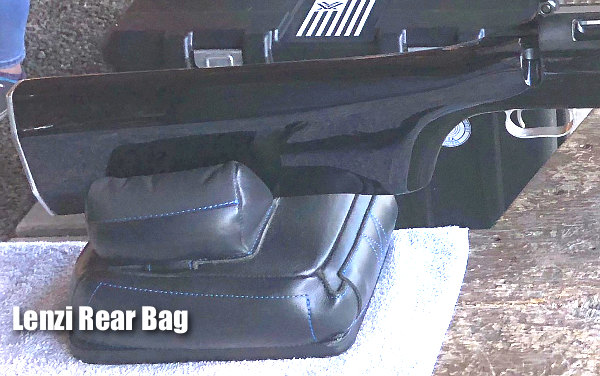
Leonard Baity front rest with Protektor Bag. Italian Lenzi bag in rear.
World Record-Setting Cartridge and Load
Mike was shooting a 40-degree Improved version of the 6mmBR Norma cartridge. Long popular with Benchrest and 300M shooters, the 6mmBR was the original inspiration for this website. Yep, we started as www.6mmBR.com. The Improved version has extra capacity, allowing about 100 FPS more velocity when chambered with a long throat. For his record group, Mike shot Vapor Trail 103-grain bullets in Lapua brass. He loaded Hodgdon H4895 powder with CCI 450 (small rifle magnum) primers.
Praise from Fellow Competitors
Here are some reactions to Mike’s amazing group by our Forum members:
“Amazing target Mike Wilson! Your group might last forever as ‘the goal’ of 1000-yard Benchrest! Heck that’s a great target even at 600 yards.” — Mike J.
“Think about this for a second. That group was barely larger than the size of your index finger’s first digit and he printed it at 1000 Yards.” — Carlos
“Unbelievable!! Doing that under chosen prime conditions is an amazing feat but to do that in competition and to have everything to come together is just unbelievable. Amazing how far skill, precision, knowledge, and the products of this sport have come. Never thought we would see a group this small and well placed especially in the hills of North Carolina where the wind always blows. Congratulations. A true lifetime achievement.” — Yote Hunter
“I think that one will stand for a while. Hard work does pay off, but it don’t hurt to be one of the givers in the sport. Mike, you are ‘The Man’!” — Bill Shehane
“Awesome, awesome. Now the goal is to shoot UNDER an inch!” — Alex Wheeler
The 6mmBR Ackley Improved
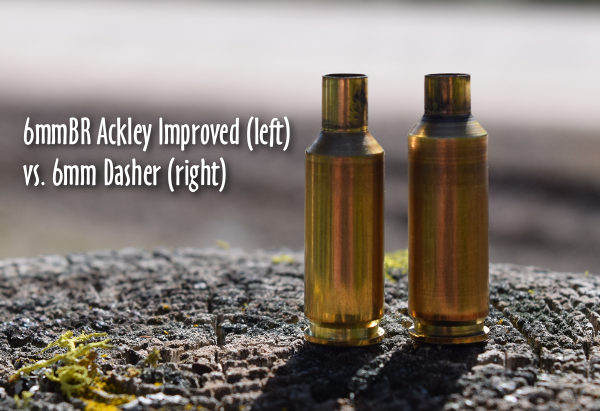
Mike Wilson shot his spectacular group with a 40° Improved version of the 6mmBR cartridge with less body taper than a standard 6BR — the design is 0.463 at the body/shoulder junction (vs. 0.460 for standard 6BR). Mike calls his version of the 6BR Ackley a 6BRAW (“W” for Wilson). Sam Hall explained: “The 6BRAW is pretty much the same as a 6BRA or 6BR-AI (Ackley Improved). I sold the reamer to Mike last year. This has a 0.272 ‘No-Turn’ chamber with a 0.135 Freebore”.
This photo shows a 40° 6mmBR Ackley Improved (6BRA), as used by Tom Mousel in Deep Creek, Montana. Mike Wilson’s 6BRAW may be very slightly different. For Mousel’s 6BRA with 28″ Krieger barrel, the accuracy node is about 2980-2990 fps, so this gives up only 30-50 fps compared to typical Dasher velocities. Mike Wilson’s load runs about 2980 fps also.
In the past couple of years, the 6BR Ackley-type cartridges have been hugely successful in 600-yard and 1000-yard Benchrest. Sam Hall notes: “This year the little 6BR-AI has shot the smallest groups ever fired in 600-yard and 1000-yard competition. Back in April 2018, bullet-maker Bart Sauter, using a 6BRA, shot a 0.311″ 50-score 5-Shot group at 600 yards.” (Read Sauter Story). Bart’s stunning 0.05 MOA group is now the 600-yard IBS HG World Record.(Note: Bart’s target was originally measured at 0.282″ but was later IBS-certified at 0.311″.)
Mike used an Italian Lenzi rear bag. Mike says the super-slick nylon on the ears of this high quality rear bag make for better tracking. The ears provide support but don’t “grab” the stock, reports Mike.
More Comments by Fellow Shooters:
“Truly an amazing feat. The 5X was the icing on the cake! Many shooters would be very happy with that group size at 200 yards.” — Mr. Zero
“Words cannot adequately express how many of us feel about your magnificent accomplishment at 1000 yards. Congratulations — that is terrific!” — Gene Beggs
“Truly amazing … well done on a great achievement… RESPECT!” — Elardus
“Bravo Mike pour ce tir incroyable. Ton exploit est sur le forum de tir longue distance en France bonne continuation.” — Frederic Riso
* There are two North American sanctioning bodies for 1000-Yard Benchrest, the IBS and the NBRSA. The previous 5-shot, 1000-yard IBS record is 1.397″ (50 score) by Tom Sarver in 2007. The existing NBRSA 1000-Yard 5-shot Light Gun record is 1.473″, shot by Bill Schrader in 2002.
Shown are funnel with ultra-long drop tube (which helps get more kernels in the cases), RCBS Chargemaster (in wood box), and Hood Press (similar to Harrell’s Combo press).
Loading at the range remains important in the Benchrest for Group discipline. In a Special Report below, past IBS President Jeff Stover explains how loading methods (and hardware) have evolved over the years. The advent of accurate, affordable electronic powder dispensers, such as the RCBS ChargeMaster and Frankford’s new Intellidropper, have changed the game and made it easier to load efficiently at the range. And quality manual powder measures are fast and can be very consistent, with a little practice. Loading at the range permits competitors to tune their load to the conditions, change seating depths, or even choose different bullets to suit the barrel’s preferences on any given day.
Although pre-loading is not uncommon, most 100/200-yard group shooters usually load at the match, often between relays. The goal is to shoot smaller groups by staying “in tune”. In a game where 5-shot groups “in the 1s and Zeros” is the goal, tuning loads for the conditions helps deliver match-winning accuracy. Nearly all competitors in this short-range discipline shoot the 6mm PPC cartridge, or a PPC variant.
Loading at the Range — Then and Now
In benchrest shooting for group, loading at the range has been de rigueur for decades. In the Score discipline, preloading is usually the custom. The main reason is that, in Score competition, only one Aggregate (warm-up match and five record targets) per day is usually shot. That would be less than 50 shots, assuming a few sighter shots. Also, the 30BR, the dominant Benchrest-for-Score cartridge, is very amenable to pre-loading.
By contrast, the Group discipline includes 21 targets (two warm-ups and twenty record targets) over a weekend, usually shot with 6PPC-chambered rifles. Many times, the 6PPC shooters may tweak their loads through the day given changing atmospheric conditions or simply trying to find the correct tune to “dot up”. This term, “Dot up”, means the shots are essentially going through the same hole, or closely so.
Loading at the range was a bit different when benchrest competition was in its infancy. The 1951 book, Modern Accuracy by Bob Wallack, is the best of the early benchrest books. Copies can be found, from time to time, on eBay or Alibris. It is a fascinating survey of benchrest as it existed more than six decades ago. There’s even coverage of a controversial target that was argued over at the time. In it, there is a photo of Wallack using the rear bumper of a car at the bench to clamp his reloading tools. Things have come a long way compared to the range loading set-ups of modern shooters. Here you can see Bob Wallack way back in 1950:
Modern loading bench set-ups shown in this Special Report belong to top shooters Howie Levy, Bob Hamister, and Kent Harshman.
With the 6mm Dasher cartridge becoming popular with PRS/NRL competitors as well as the benchrest crowd, we thought it was time to re-visit a special rifle chambered for the 6mm Dasher wildcat. This gun has a great story behind it. Forum member Bob A. (aka “Killshot”) used his “Forum Classifieds Special” to beat all comers in the F-Class Division in the American-Canadian Match and the Long Range Regional Match in 2013 in Sacramento, CA.
Bob’s 6mm Dasher sports a blue-printed Rem 700 action. Who says you need a high-dollar custom action to run with the big dogs? In fact, this same gun, built with components sourced from AccurateShooter Forum Classified Ads, set a Sacramento F-Class range record of 200-17X a few years back. In this story, Bob talks about the build, and he explains his methods for loading ultra-accurate Dasher ammo.
Bob’s Budget-Build Dasher F-Classer
I wanted to build a proper rifle for F-Open but needed to keep it simple and, well, cheap. I found a solid “base” to build on in the form of a Dave Bruno-built, “pre-owned” 6-6.5×47 Lapua that I located in the AccurateShooter Forum classifieds in late 2011. The base action was a trued and blue-printed Remington 700 receiver circa 1971 with a spiral-fluted bolt. It was in a Shehane ST1000 stock painted sky blue and had a Jewell 1.5-oz BR trigger. I sent the bolt to Greg Tannel (Gretanrifles.com) to have the firing pin hole bushed and sleeved, the ejector removed and the hole filled and the face trued. I upgraded to Tannel’s Light Steel firing pin assembly while it was out.
Having the working bits completed, I needed a barrel. So I went to the AccurateShooter classifieds again and found a 1:8″-twist, 30″ x 1.25″ (diam.) Bartlein with a 0.236″-land bore. I called Dave Kiff and explained my pursuit and he recommended his PT&G “world record” 6 Dasher reamer (.2704″ no-turn neck and .104″ freebore). A month or so later the reamer and gauges arrived.
I had the barrel chambered by Marc Soulie of Spartan Precision Rifles (510-755-5293, Concord, CA). Marc is a great builder and I’m pleased to call him a friend.
The rifle got its good looks from a Pennsylvania artist named Kenny Prahl. His Prahl Designs shop (724-478-2538) added the white ghost-flames over the existing sky blue metallic paint.
Looks Great, Shoots Better
Fire-forming showed great promise — ten-shot groups of half an inch at 200 yards were typical. I lost only one case to a split neck and the “blow lengths” are good and consistent. This was followed up with load development which saw 100-yard, five-shot groups in the .1s and .2s as the rifle showed its preference for Reloder 15 over Varget powder, and for CCI 450s over all other primers. The bullet of choice was the ever-popular Berger 105gr Hybrid Target.
In February 2012 I began shooting the Dasher in monthly club matches at the Sacramento Valley Shooting Center, the home range of a number of excellent F-Class, Benchrest and High Power shooters. Using a Farley Coaxial rest up front (also picked up from a WTB ad on AccurateShooter’s Forum) and an Edgewood bag in the back, I gradually improved my gun-handling to the point where I could shoot a respectable score. This was very different from the bipod shooting I’d done in the past in F/TR.
Dasher Loading Tips
My chamber is set up for blue box Lapua 6mmBR brass. My case preparation is straight-forward. I fire-form with virgin cases right out of the box. I don’t size them but I will give the primer holes a good look and clean up the flash hole with a .058″ bit in a pin vise. To fire-form, I seat a Berger 108gr BT .030″ into the lands over a standard 6mmBR load of Varget.
For match loads, I use Alliant Reloder 15. While Varget is less sensitive to temp changes, RL15 has given me lower extreme spreads and better long range control. [Bob acknowledges that every barrel is unique, so a different powder, such as H4895 might work better for you.]
I clean my fired cases with stainless steel media in a Thumler’s rotary tumbler after every firing. I anneal after every other firing using a Bench-Source machine which is very well made and easy to operate. I use a Whidden full length bushing die with Redding bushings for sizing.
After sizing, I chamfer the inside of the neck with the K&M tool which has a pilot rod centered in the flash hole. Then I’ll give the neck and mouth a “once over” with some 0000 steel wool. I finish loading off with a Redding Competition Seating Die with the micrometer top.
I use a carbide ball on the expander rod of the full length sizing die. I use a .266″ TiN-coated bushing and the ball just kisses the inside walls of the sized neck. I get very consistent neck tension this way and have had no issue with split necks.
Seating Depth Considerations
With fire-formed brass, the junction of the bullet’s bearing surface and boat-tail is above the neck/shoulder junction of the case, so I have no issues with donuts. You can see how a loaded round looks in the photo at left. For occasional trimming, I use a very nice little Possum Hollow trimmer that indexes on the case shoulder.
Want to see the details?CLICK HERE to view full-screen photo.
Check out those five targets. The Aggregate (average) of all five targets is a tiny 0.0840 inches! These were shot by Gary Ocock at 100 yards in a California benchrest match on August 6, 2017. Though Gary’s 0.0840 Agg beats existing records, this was not a “sanctioned” match, so Gary’s killer Agg was NOT submitted for IBS or NBRSA records. So, sadly, the Agg won’t appear in the record books, but this remains a spectacular, verified feat of rifle accuracy, accomplished in competition.
Gary’s red railgun is arguably the Most Accurate Gun Ever Built. As far as we can determine, no one has ever shot a smaller 5-target Agg anywhere, at any time. FYI, the NBRSA Unlimited Class 5×5 Aggregate World Record is 0.1242″ shot by Jerry Lahr in 2012. Gary’s 0.0840″ Agg is much smaller.
The Unlimited Benchrest Record That Will Never Be (Official)
Report by Boyd Allen
Gary Ocock’s stunning unlimited Aggregate is beyond amazing. That’s an average of five, 5-shot groups of .0840. Shot under sanctioned match rules, but at an unsanctioned 100-yard fun match, this Aggregate is well under the current 100-yard official records of the IBS (.1386), and the NBRSA (.1242). The fourth of the five groups measured a minuscule .018, less than half the size of the existing NBRSA Unlimited record of .049 (also shot by Gary). Check it out:
When the top 15 shooters all post teen Aggs, conditions must be pretty favorable. However there were some light switchy winds — Gary said that he shot better in the left to right condition.
GUN SPECIFICATIONS
Ocock’s red Jay Young Unlimited Railgun features one major difference from Young’s typical Railgun designs. The bottom of the barrel block is integral with the top (moving part), of the gun. The barrel is Ocock’s usual 1:13.5″-twist Krieger chambered for the 6 PPC. The BAT Neuvo action* is unusual in that its lugs are horizontal at lock-up instead of the usual vertical. With horizontal lugs, both lugs maintain contact with their abutments when the action is cocked. In the more normal configuration when cocked the top lug is forced off of its seat by a combination of the angle of the trigger cocking piece interface, the pressure of the striker spring, and bolt clearance at the rear of the action.
LOAD SPECIFICATIONS
Gary shot this remarkable Agg with well-used brass, Vihtavuori N133 powder, and self-made 66gr BT bullets** seated at “jam”. This amazing Agg was shot on the second day of a 2-day Unlimited Benchrest match. On Day 1 Gary had experimented with various loads using both surplus IMR 8208 and Vihtavuori N133, but was not satisfied with the results. For his first group on Day 2, Gary tried a light load of N133. After seeing the result, however, he decided to go to the other extreme — a super stout N133 load — with the same powder. As you can see, Gary’s willingness to experiment paid off.
Notably, Gary used light neck tension. Ocock found that for these bullets and this barrel, light neck tension worked best (contrary to “normal” N133 benchrest practice). Ocock used a bushing that only produces .001″ difference between the diameters of sized and loaded case necks.
This video shows a line-up of Rail-Guns. One of Gary Ocock’s Rails appears at the 0:35 time-mark.
Comment on Ocock’s Achievement
Congratulations to Gary Ocock for superb shooting (and smart loading). Even though the match was not sanctioned (so the Agg will never be a record), Ocock has raised the bar very high, and given us a new standard of ultimate accuracy.
Though this 0.0840 Aggregate and 0.018 group will never go into the record group, they are still noteworthy. There’s virtually no doubt that they would have survived inspection by any record committee. Except for the lack of fixed backers, an IBS requirement (for detecting cross-fires), all other conditions were met for an officially-sanctioned match.
Ocock Did Set Single-Group IBS World Record with Red Railgun
Photo credit: Ben Zentner
Here is Gary with his Red Railgun at a Visalia event in October 2017. Ocock let the event’s youngest competitor, 12-year-old Gavin Lichtenwalter, shoot Gary’s new Railgun for the last three matches on Sunday afternoon. The day before, 10/21/17, Gary shot an IBS Heavy Benchrest World Record putting five shots in just 0.045 inches, as certified by the IBS record committee. Here is that group, as first measured at the range at 0.039 inches. Gary also holds the Unlimited 5-Shot NBRSA 100-Yard Record with an 0.049 inch single group shot on 10/17/2009.
*The new BAT Neuvo actions are the result of a collaboration between Dwight Scott, and Bruce Thom, featuring Dwight’s ideas and BAT’s proven manufacturing expertise.
** Ocock shot his own, boat-tail match bullets, made with George Ulrich-crafted dies using Hood cores. Although he said that it had been a while since he had weighed any, his best guess was that they weigh something around 66.5 grains.
Think you need a relatively long case-neck for good accuracy? Think again. Stan Ware broke all the rules with his radical Wolfpup cartridge, proving that a near-no-neck design can deliver match-winning accuracy. Read on to learn how the Wolfpup works…
Retired gunsmith Stan Ware is a talented shooter who’s not afraid to think “outside the box”. Stan competes in both Hunter Benchrest (HBR) and Varmint for Score (VFS) disciplines. In his quest to build the ultimate Hunter Benchrest cartridge, Stan created the radical “Wolfpup” wildcat, based on a 6mmBR parent case. Noting the dominance of 30 BRs in VFS matches, Stan wondered if a stretched 30 BR could work in HBR competition. The challenge was case capacity. Under HBR rules the cartridge must hold at least 45.0 grains of water, equal to the capacity of the classic 30/30 case.
To get the requisite HBR case capacity, Stan figured he needed to boost the volume of a 30 BR case significantly, so he would have to move the shoulder forward — a lot. He did this by running a 30 BR reamer deeper and deeper, test-firing brass along the way. After three reamer passes, he ended up with the capacity he needed (the Wolfpup holds 45.3 grains of water). But then he looked at the finished product — a case with almost no neck, and he wondered “how could this possibly work?”.
From Trashbin to Winner’s Circle
Ware’s prototype Wolfpup ended up so short-necked, so unlike any “normal” cartridge, that Stan figured it was “dead on arrival”. Stan told us: “I said ‘this ain’t going to work’ and I threw the brass in the trash can. Honest. But later I thought I better shoot it and see what it does.” There was one problem — Stan didn’t have a seating die. He noticed the short neck provided a bit of tension after fire-forming, so he literally seated some bullets, BIB 118s and 125s, with his fingers. For powder he used H4198 and started with 35 grains, one grain more than a 30 BR load. Stan then did a pressure work-up: “I actually went up to 41.0 grains and didn’t have a sticky bolt. I ended up at 37.9 grains of Hodgdon 4198 — that gave 3150 fps, where the sweet spot is.” (Later testing revealed a second accuracy node at about 3020 fps, using 36.4 grains of H4198).
Stan’s radical short-necked Wolfpup shot great from the get-go. Once he found the right velocity node, the gun shot in the ones and zeros with both 7-ogive and 10-ogive bullets, both 118s and 125s. The Wolfpup proved easy to tune — it’s not finicky at all. And it’s a winner. Stan began shooting the Wolfpup in 2006 in both VFS and HBR matches and the ‘Pup’ started winning matches right away. In 2007, Stan won the Wisconsin State VFS Championship shooting the Wolfpup. In June 2010 at a Webster City, Iowa VFS match, Stan won the Grand Agg and posted high X-Count for the match, while placing first at 100 yards and second at 200 yards. How’s that for a cartridge that almost ended up in the trash bin?
Does Stan deserve an award for “most innovative benchrest cartridge design”? Stan chuckles at that notion: “I’m not a hero, not a genius. I really didn’t do anything. The fun part is thinking outside the box — for me anyway. Shooting is an age-old process of experimentation. You never learn it all.”
Why Does It Work?
How can such a radical case design perform so well? “That’s a good question,” Stan admitted. He then explained: “The 30 BR is inherently accurate, so I figured something based on the 30 BR should be accurate too. My personal belief is that the short neck doesn’t hurt you. Plus if the throat in the barrel is straight, the bullet can self-align. If the chamber is good, the bullet will self-center in the throat. In a regular case there’s not much room to do that, so a bullet can start off-center, and you don’t get the same results every time. A bullet in a conventional case is stopped from self-centering by the stiffer neck, particularly in a tight-clearance BR gun.”
Reloading the .30 Wolfpup
Stan’s Wolfpup chamber has a neck dimension of 0.330″. He turns his necks for a 0.327″ loaded round. Bullets are jammed .020″ forward of first contact with the lands. When he closes the bolt it pushes the bullet back in the case — almost a soft seat. Stan notes: “To start with I normally bump the shoulder .0005-.001″ so they go in easy. Just by doing that I get a little neck tension. I also use a bushing. Right now I’m running a .322, but it’s not particularly sensitive. I’ve tried one-thousandths increments up to a .325 bushing and couldn’t tell a lot of difference.” For bullet seating, Stan uses a Wilson 30 BR seater die into which he ran the chamber reamer. This gives perfect case fit during seating operations.
About the Illustrated Gunstock
You’ll notice Stan’s stock contains scenes from Vietnam and a quotation. Here’s the story. A Vietnam combat veteran, Stan served “in-country” with the Army’s 509th Non-Divisional Combat Unit (out of Fort Riley) from 1965-1966. Shortly before he left Vietnam, Stan went to a shop to have a souvenir lighter engraved. He asked the vendor for an appropriate inscription. The shop’s metal-worker engraved: “War is a tragedy. It takes mans’ best to do mans’ worst.” That message, along with the combat scenes, were hand-painted on Stan’s rifle by his wife Susan, a talented artist. She spent more than 20 hours painting the rifle stock.
Hardware Choices: Actions, Stocks, Barrels, Optics and More Tech Talk by Jeff Stover
This article was prepared by past IBS President Jeff Stover based on results from the 2019 IBS 100/200 Group Nationals held August 12-17, 2019 at the Holton Gun & Bow Club in western Michigan.
Let’s examine the Top Ten rifles from the IBS Group Nationals in the 10.5-lb Light Varmint Class. We’ll focus on the most popular rifle components — the choices for Actions, Stocks, Barrels, and Scopes.
Hall of Famer Jeff Gaidos taking aim at the 2018 IBS Group Nationals. He has a low-profile carbon-fiber stock with a Leupold fixed-power scope.
For some years now, BAT has been the predominant action. This year BAT actions held nearly 100% of the Top Ten places in all the Bag Gun equipment lists. Bruce Thom’s Idaho-crafted actions, except for a couple stray actions in Heavy Bench, swept the top rankings.
Next, look at barrels. Bartlein or Krieger seem to rule with upstate New York’s venerable Hart barrels as competitive. Shooters tend to go with winners, so Wayne Campbell and Jeff Peinhardt dominate as gunsmiths for the top benchrest shooters.
In stocks there seems to be variety, but there is some commonality. The Scoville and Scarbrough stocks, both Michigan-made, are laminated wood (balsa and other wood) with carbon fiber and wrapped in carbon fiber. The Scoville stock on my 10.5-lb rifle weighs 18 ounces but is full size with a nice long fore-end. Bob Scarbrough makes a very similar product. Both are winners — it’s a choice of Ferrari or Lamborghini. The Roy Hunter and Terry Leonard stocks among these top rifles take a different route to winner’s circle. Both are wood (cedar or other), but super high-tech as they are laminated with carbon fiber. They are beautiful to boot. High-magnification Leupold, March, and Nightforce scopes rule the roost among benchrest optics.
Bullets and Powder
Bullets are important. Really important. A hot bullet gives you “Teen Aggs” and lots of trophies. An average bullet does not. Most of these are 68 grain 6mm boattails. The Peinhardt (StaMoly Precision) bullet is well represented on this list, but some top shooters make their own as you can see. Bullet jackets are likely StaMoly or J4. For powder, nearly everyone shoots Vihtavouri N133 except a few guys running LT30/32 or surplus 8208.
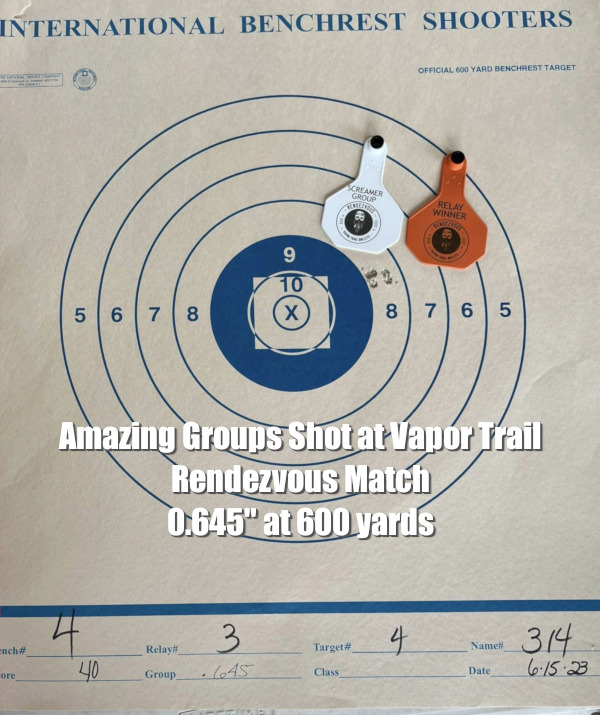
Modern long-range benchrest rifles are capable of remarkable accuracy. At the recent Rendezvous Match at the Vapor Trail Valley shooting club, some exceptional targets were shot. This is a special combined match with relays at both 600 and 1000 yards. Be amazed at the accuracy modern rifles can achieve at these distances. Match director Tom Jacobs reports: “We had two screamer groups under a inch at 600 yards, and six groups under 3″ at 1000 yards. Three of those were under 2.5″ screamers.”
New Range Record at 1000 Yards — 1.338″ 5-Shot Group
Dave Way set a new Vapor Trail 1000-yard Range Record for single 5-shot group. He had a wicked small 1.338″ group (0.128 MOA) with a 49 score.
New Single Target Small Group Record at 600 Yards — 0.645 (0.103 MOA)
At the Rendezvous, Jason Cohen set a new single-target small group range record at 600 yards. This was a 0.645″ group shot with a .284. That works out to 0.103 MOA (1 MOA is 6.282″ at 600 yards).
Multiple Agg and Overall Titles for Al Benarrock — and a $1500.00 Check
Al Benarroch had a phenomenal weekend. He won the 16 target 600yd/1000yd Ultimate Agg (Grand Overall), the 1000-yard 8-target group Agg with 4.953″, and the 1000-yard 8 target Overall. What a weekend for Al!
The match was a big success. Match director Tom Jacobs posted: “We had great weather at a match for once, temps were mild for us this time of the year, the winds were not bad at all but we did have quick switches, that the valley is known for. Mirage was bad at times, but no dam hurricanadors for once! We hung 778 targets down range, not including all the tuning targets throughout the week. We estimate 9336 rounds went down range for the match, not counting a week of guys tuning.”




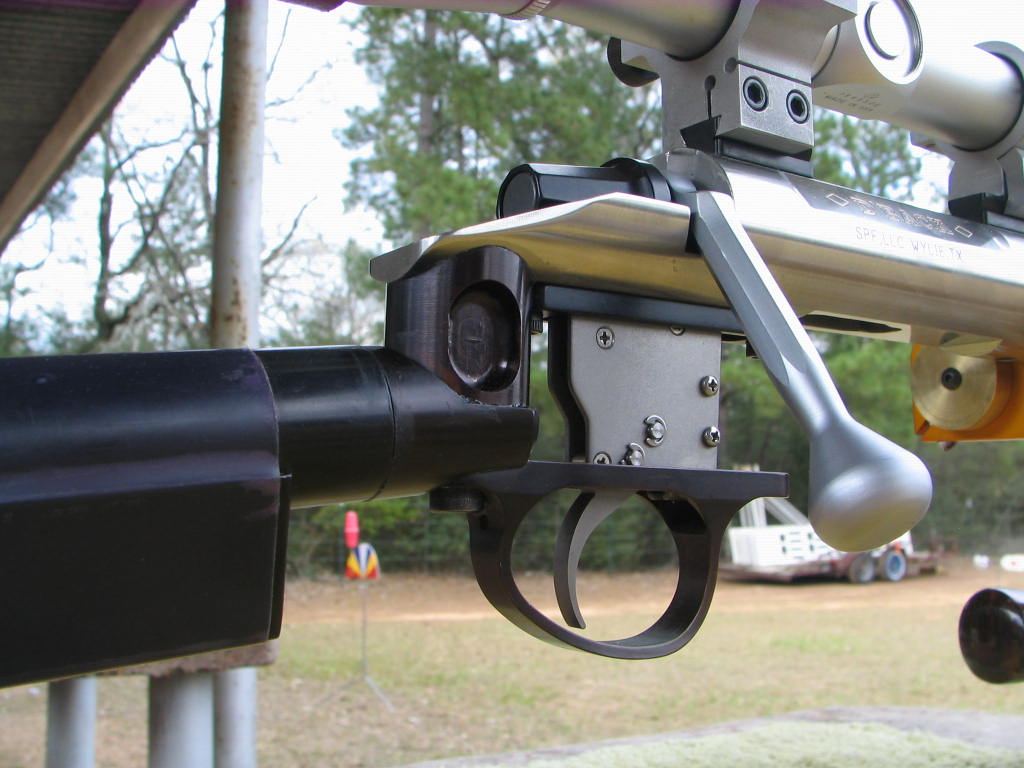


 The recoil lug-style stock mount is probably the only truly innovative thing I did other than the opposing-magnet tuner. Basically, the rear bracket is sandwiched between the receiver face and the barrel shoulder–positioned where a conventional recoil lug would go. I also added a brass ring (visible in photo) between the anodized bracket and the barrel. This was done to distribute loads over a wider surface area. (I was concerned that the bracket material was fairly soft and I didn’t want to crush it as I torqued the barrel in place.) After fitting the barrel and plates I glued the entire gun together using epoxy and various LocTite adhesives. The rest of the parts were assembled but I did not Loctite the scope bases since I thought I’d be disassembling the rifle for re-work after the first trials. That came back to bite me during later testing when the gun started shooting erratically and I went down a couple of blind alleys before finding the loose bases.

 Match One–Tinker Toy Wins Score with a 250 – 17X




 Dasher Loading Tips
 I use a carbide ball on the expander rod of the full length sizing die. I use a .266″ TiN-coated bushing and the ball just kisses the inside walls of the sized neck. I get very consistent neck tension this way and have had no issue with split necks.
 Check out those five targets. The Aggregate (average) of all five targets is a tiny 0.0840 inches! These were shot by Gary Ocock at 100 yards in a California benchrest match on August 6, 2017. Though Gary’s 0.0840 Agg beats existing records, this was not a “sanctioned” match, so Gary’s killer Agg was NOT submitted for IBS or NBRSA records. So, sadly, the Agg won’t appear in the record books, but this remains a spectacular, verified feat of rifle accuracy, accomplished in competition.


 Retired gunsmith Stan Ware is a talented shooter who’s not afraid to think “outside the box”. Stan competes in both Hunter Benchrest (HBR) and Varmint for Score (VFS) disciplines. In his quest to build the ultimate Hunter Benchrest cartridge, Stan created the radical “Wolfpup” wildcat, based on a 6mmBR parent case. Noting the dominance of 30 BRs in VFS matches, Stan wondered if a stretched 30 BR could work in HBR competition. The challenge was case capacity. Under HBR rules the cartridge must hold at least 45.0 grains of water, equal to the capacity of the classic 30/30 case.
 From Trashbin to Winner’s Circle
 Why Does It Work?