The IBS 2016 Long-range shooting season is starting soon, so we thought our readers might enjoy learning about a state-of-the-art 1000-Yard Benchrest rig. This article features the impressive .284 Shehane Light Gun used by Henry Pasquet to capture the 2013 IBS 1000-yard Nationals. With a 5″-wide “hammerhead” front and a special 3″-wide bag-rider plate in the rear, this 17-lb rig is ultra-stable in the bags, and tracks like a dream. In this story, Henry explains his set-up plus his processes for loading super-accurate ammo. Every long-range shooter can benefit from some of tips revealed here. And F-Class guys — if you’re shooting a .284 Win-based case in F-Open you should definitely read Henry’s precision reloading advice.
EDITOR: Guys, there is a ton of solid gold information in this article — take your time and read it carefully.
Yes old dogs can learn new tricks. Just five years ago Forum member Henry Pasquet (aka “HenryP”) got started in 1000-yard benchrest shooting. He was 66 at the time. Henry worked hard, learned fast, and pursued accuracy with a vengence. That all paid off when Henry won the 2013 IBS 1000-yard Nationals this summer, finishing as the Two-Gun Overall National Champion. Henry was kind enough to talk about his rifle, his reloading methods, and his strategy for success. In fact, Henry was eager to share “everything he knows, so that other guys can fast-track their learning process”. Henry told us: “I want to share every lesson I’ve learned, so that other guys can improve their game and enjoy the sport more.” Henry also wants to encourage other senior shooters: “If you pay attention to details (when reloading), and get a good rifle with a good barrel, age is not a handicap. With a good set-up, older guys can compete with anyone out there. This is one sport where you can be a champion in later life.”
Click on Rifle Photos to View Full-screen Versions
Q&A with Henry Pasquet, IBS 1000-Yard National Champion
Q: First, do you have any advice for older shooters getting started in their golden years?
Henry: You’re never too old. In this sport, you can excel even in your 60s, 70s and beyond. At this stage in life, we now have the time and money to get good equipment and rifles. Plus, our years of work experience help us to think, analyze, and thereby make progress. In this game, we older guys can definitely compete on a par with younger shooters.
HARDWARE
Q: Tell us about your Nationals-winning rifle and bench gear. Is there anything unique about your hardware that gave you an edge?
Henry: At the Nationals, I used my 17-lb Light Gun for both Light and Heavy Class. This rifle has a 1.55″, round BAT LP/RE action, fitted with a Bartlein barrel chambered for the .284 Shehane (an improved version of the .284 Winchester). The barrel was near-new; this was the first time I had used it this year. A great barrel and great batch of Berger 180gr VLDs all made a difference. Jay Cutright chambers my barrels. Jay’s metal-work is so precise that I can screw any barrel he’s chambered to any BAT action I own. The laminated stock was modified by Tommy Shurley from a standard 3″-wide fore-end to a 5″-wide True-Trac with an adjustable 3″-wide rear plate. It’s not pretty but it tracks like a Heavy Gun stock. Tommy made my other stocks as well.
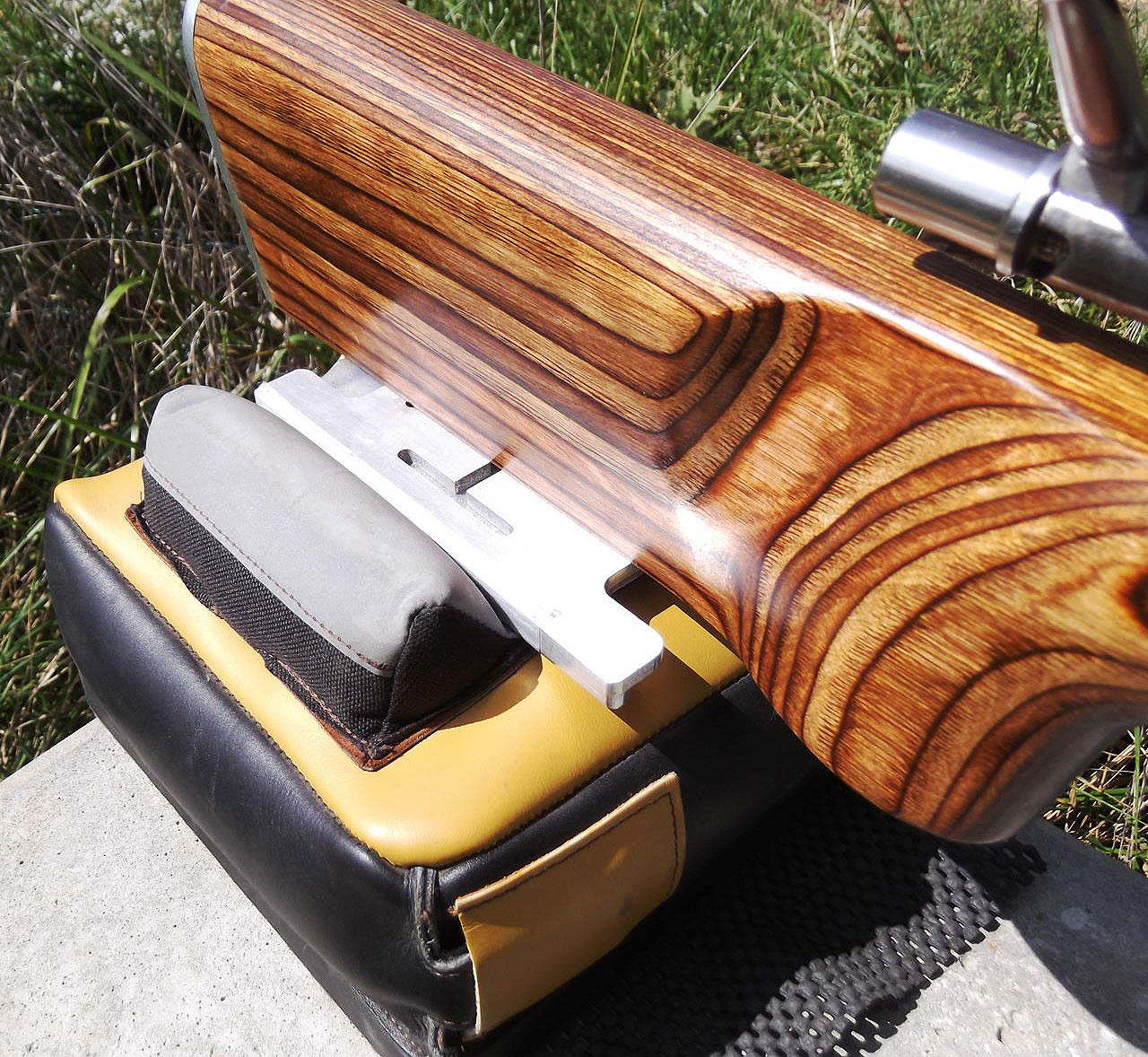
On top is a Nightforce 12-42x52mm Benchrest scope with CH-3 reticle. I used a Fulghum (Randolph Machine) front rest with an Edgewood bag made with the low-friction 3M material. In the rear I use a special-order Protekor rear “Doctor” bag with ears spaced 3 inches apart. The rear bag also has the new 3M material on contact surfaces (photo at right).
Q: During the Nationals, at the last minute you switched guns. Why did you go from a 6mm Dasher to a 7mm Shehane?
Henry: I had planned to use my Light and Heavy Dashers, but after placing the Dasher on the ready line, decided to switch to the .284 Shehane. It was still early in the morning and I felt that the heavier bullets would be easier to see against the berm. The Dasher had actually been giving tighter groups under perfect conditions, but seeing the impact is important.
Q: Tell us about the combined tuner/muzzle brake on some of your barrels. How does this improve rifle performance and how do you set the “tune”? Do you tune the barrel to the load?
Henry: I use a tuner or tuner/brake on every barrel. I started with Time Precision tuners. Art Cocchia advised getting a load with a good known accuracy node with minimum extreme spread, which controls vertical. Do not go for the hottest loads, which just reduces brass life. Then use the tuner and tune the barrel to the load. The .284 Light Gun needed a muzzle brake and tuner. I had a local gunsmith cut a thread on the muzzle brake for a tuner I got from Sid Goodling. (Eric Bostrom developed an almost identical unit at the same time. I use Eric’s tuner/brakes on all my new barrels.) Just before Nationals, I tried going up and down one marker. Down one mark cut the group in half! Think how much range time (and barrel life) that saved me. Using a tuner is easier than messing around changing loads and tweaking seating depths. Tuners definitely can work. Last year I shot a 3.348″ 10-shot group at 1000 with my .284 Win Heavy Gun fitted with a Time Precision Tuner.
Q: What are the advantages of your stock’s 5″-wide fore-end and 3″-wide rear plate? Is there a big difference in tracking and/or stability? Does the extra width make the rifle easier to shoot?
Henry: I had true Heavy Guns with 5-inch fronts and 3-inch rears. They tracked well. I felt the same result could be had with a Light Gun. I talked two stock makers into making them. I initially had the standard rear stock until Tommy Shurley and Mike Hearn came out with an adjustable rear plate. The stocks track perfectly. You can see your scope’s crosshairs stay on the target the whole time and push the rifle back for the next shot. There is no torquing (gun wobbling) when cycling the bolt. Us old guys need all the help we can get. I am getting rid of my 45-pound Heavy Guns and replacing them with Light Guns with heavy barrels.
Q: Some people say the .284 Shehane is not as accurate as the straight .284 Winchester. You’ve proved them wrong. Why do you like the .284 Shehane? More speed, less pressure?
Henry: The reason I rechambered my 7mm barrels to .284 Shehane was not velocity, pressure, or brass life. It was all about bolt lift. My straight .284 almost required me to stand up to eject brass. I damaged an extractor and had to send the bolt back to BAT. With the .284 Shehane, my bolt cycles like there is no case to eject.
Reloading Methods
Q: People want to know about your load and your loading methods. What can you reveal?
Henry: For my .284 Shehane at the Nationals, I loaded 52.5 grains of Hodgdon H4350 and Federal BR-2 primers behind Berger 180gr VLDs. I usually anneal the brass each winter. I have used the same brass for years. I use Redding bushing dies, apply Imperial sizing wax, resize, wipe off wax, clean and uniform the primers pockets using the RCBS Trim Mate Case prep center, then apply Imperial dry neck lube with a bore mop.
To dispense powder, I use a RCBS ChargeMaster set 0.1 grain below my desired load and then weigh them on a Sartorius GD-503 magnetic force restoration scale to get identical charges. I use a K&M Arbor Press with seating force gauge when seating the bullets with a Wilson inline die. My “target” seating force on the K&M dial is 20-23 units for Dashers and 35-40 units for the .284 Shehane. I put any variables aside for sighters. I do not weigh brass, bullets, or primers. My bullets were so consistent that I did not sort by bearing surface. I did trim the Berger VLDs to the shortest bullet length with a Hoover Trimmer, and then pointed the meplats just enough to close them with a Whidden pointer. I sort my bullets to 0.005″ overall length, rejecting about five percent.
Q: What kind of precision are you looking for in your reloads? Do you trickle to the kernel? Does this really help reduce extreme spread?
Henry: I try to keep my charge weights consistent to one kernel of powder. I use the Omega powder trickler with a Sartorius GD-503 lab-grade balance to achieve that. For accurate dispensing, put very little powder into the Omega so you can drop one kernel at a time. Single digit ES (Extreme Spread) is the goal. This does make a difference at 1000 yards. If you get the same push on the same bullet with the same neck tension, good things are going to happen.
Q: You believe consistent neck tension (i.e. grip on the bullet) is really important. What methods are you using to ensure consistent bullet release?
Henry: I apply Imperial dry neck lube to the inside of my case-necks with a bore mop. The K&M arbor with seating force gauge shows the need to do this. If you put a bullet into a clean case, it will be jerky when seating the bullet. You may see 40 units (on the K&M dial) dropping to 20, then slowly increasing pressure. I explained to a friend that not lubing the neck is like overhauling an engine without lubing the cylinders. Smooth entry gives the bullets a smooth release.
Barrel Cleaning
Q: You go 60-80 rounds between cleaning and the results speak for themselves. What is your barrel cleaning procedure? Do you think some guys clean too often or too aggressively?
Henry: I cringe when I see people wearing out their barrels with bronze brushes between relays. I clean my barrels at the end of each day when I get home. I shot my best-ever 1K Heavy Gun group (3.348″) at day’s end after 60 to 80 rounds. After trying other solvents, I have gone back to Wipe-out’s Carb-Out and Patch-Out products. I use about four patches of Carb-Out, let it sit a few minutes, then use one stroke of a nylon brush followed by Patch-Out until the barrel is clean. I use a bore mop to clean inside the chamber, then some Break Free LP on the bolt followed by bolt grease on the lugs and cocking part. I use a bore guide when anything goes down the barrel.
Shooting Skills and the Learning Process
Q: Henry, you can shoot long-distance on your own property in Missouri. How important is practice, and what do you do during a typical practice session?
Henry: I can shoot 1000 yards on my farm. I have a concrete bench using a slab from a yard furniture place on concrete blocks. Two 4 x 8 sheets of plywood hold four IBS targets. I never practice. I only test, keeping a notebook with all the info. I do most of my testing at 300 to 500 yards, shooting off my deck so I can see my shots immediately.
Q: How much of your success do you credit to really accurate rifles, versus superior shooting skills?
Henry: I do not consider myself another Carlos Hathcock or some master marksman. I am an average 1000-yard shooter, but I do work hard getting the most out of my rifles. Four other people have shot their first 1000-yard matches with my rifles, including my wife, and all of them won relays! I loaned my Dasher to another shooter two years ago and he got second at the 600-yard Nationals. Others will tell you that the rifle must be “on” to win. If your barrel or bullets are average, don’t expect to perform above average in competition.
Q: What you do enjoy most about long-range benchrest shooting? What are the attractions of this sport?
Henry: The sport offers good people and a real challenge. 1000-yard shooting keeps us all humble, but we still keep trying to see how good we can do. I am thankful for Robert Ross providing the only match location that I can shoot regularly.
Q: Henry, you have been a Forum member for many years. Have you learned important techniques from other Forum members and other shooters?
Henry: I have followed the AccurateShooter Forum since 2008. At my age I am not good at computers. I copied and analyzed many articles, especially on the .284 and the Dashers. Without AccurateShooter.com, I would probably still be shooting double-digit (10″+) groups at 1000 yards, and I sure wouldn’t have my name on a National Championship trophy.
Q: You are in your 70s now and have only been shooting competitively for a few years. How did you get so good so fast? How did you manage to beat shooters who are decades younger?
Henry: I had 20/10 vision when I was young, but am down to only 20/20. I have been interested in long range shooting for a long time including ground hog hunting. I went to some VHA jamborees also. In 2008, I went to the Williamsport Benchrest School with a friend from Pennsylvania, John Haas. We would compare notes frequently. I bought a BAT three lug from Tom Mousel in Montana. We also compared notes and made each other better. At IBS matches I studied other shooters’ equipment and techniques. I tried some, accepting some and rejecting some.
Here’s my advice:
Always be ready to learn something new. If it makes sense, try it. I would also encourage other older shooters not to quit. Stick to it. You can make enormous progress in a few seasons.
Rodney Wagner shot the smallest 5-shot, 600-yard group in the history of competitive rifle shooting. First measured at a mere 0.349″, then certified on the IBS Record books at 0.336″, Rodney’s group is mind-blowingly small — and it was centered for a 50 score. This amazing group shows what can be done with a great gun, a talented shooter, and superb hand-loaded ammunition. Today’s Tech Tip reveals some of Rodney’s reloading methods that helped him put five shots you could cover with a dime into a target 600 yards away.
Creating Ultra-Accurate Benchrest Ammunition
Rodney takes great care in loading his brass, and he employs a few tricks to get superior consistency.
Fire-Forming — To prepare his cases for fire-forming, Rodney starts by turning his Lapua brass to just past where the new neck-shoulder junction will be: “I just cut enough for the 6mm Dasher neck. A little bit of the cut shows on the shoulder after forming.” Then Rodney runs a .25-caliber K&M mandrel through the whole neck, expanding the neck diameter. After the entire neck is expanded, Rodney re-sizes the top section with a Wilson bushing, creating a false shoulder. Then, as further insurance that the case will be held firmly in place during fire-forming, Rodney seats his bullets long — hard into the lands. When fire-forming, Rodney uses a normal 6mmBR load of 29.8 grains of Varget: “I don’t like to stress my brass before it has been hardened. I load enough powder to form the shoulder 95%. Any more than that is just wasted.” Rodney adds: “When fire-forming, I don’t want to use a super-hard primer. I prefer to use a Federal 205, CCI 200, or Winchester — something soft.” Using a softer primer lessens the likelihood that the case will drive forward when hit by the firing pin, so this helps achieve more consistent “blow lengths”.
Ammo Loading — Rodney is fastidious with his brass and weighs his charges very precisely. Charges are first dispensed with an RFD manual powder measure, then Rodney trickles kernel by kernel using a highly-precise Sartorius GD-503 laboratory scale. He tries to maintain charge-weight consistency within half a tenth of a grain — about two kernels of Varget powder.
One important technique Rodney employs is sorting by bullet-seating force. Rodney batch-sorts his loaded rounds based on seating force indicated by the dial gauge on his K&M arbor press: “I use a K&M arbor press with dial indicator strain gauge. When I’m loading I pay lots of attention to seating effort and I try to batch five rounds that feel the same. For record rounds I try to make sure I get five of the same number (on the dial). When sorting based on the force-gauge readout, you need to go slow. If you go too fast the needle will spike up and down before you can see it.”
In practice, Rodney might select five rounds with a gauge value of 25, then another five with a gauge read-out of 30 and so on. He places the first five like-value rounds in one row of his ammo caddy. The next like-value set of five will go in the next row down. By this method, he ensures that all five cartridges in a five-round set for a record target will have bullets seated with very consistent seating force.
Unlike some top shooters, Rodney does not regularly anneal his cases. However, after every firing, he does tumble his Dasher brass in treated corncob media. After sizing his brass, before seating the bullets, he runs a nylon brush in the necks: “The last thing I do before firing is run a well-worn 30 caliber nylon brush in the necks, using a small 6-volt drill for power. This is a quick operation — just in and out the neck”. Sometimes, at the end of the season, he will anneal, but Rodney adds: “If I can get 10 firings out of the case I’ve done good.” He usually makes up new brass when he fits a new barrel: “If it is a good barrel (that I may shoot at the Nationals), I’ll usually go ahead and prepare 200 pieces of good brass.”
Tips for 600-Yard Shooters New to the Game
In the course of our interview with Rodney, we asked if he had any tips for shooters who are getting started in the 600-yard Benchrest Game. Rodney offered some sensible advice:
1. Don’t try to go it alone. Find an old-timer to mentor you. As a novice, go to matches, watch and ask questions.
2. Go with a proven cartridge. If you are shooting 600 yards stick with a 6mmBR or one of the 6BR improveds (BRX or Dasher). Keep it simple. I tried some of the larger cartridges, the 6XC and 6-6.5×47 Lapua. I was trying to be different, but I was not successful. It wasn’t a disaster — I learned something. But I found the larger cases were not as accurate as a 6BR or Dasher. Those bigger cartridges are competitive for score but not for group.
3. You don’t have to spend a fortune to be competitive. Buy a used rifle from somebody and find out if you like the sport. You can save a lot with a used rifle, but do plan on buying a new barrel immediately.
4. Don’t waste weeks or months struggling with a barrel that isn’t shooting. My best barrels, including this record-setting Brux, started shooting exceptionally well right from the start.
Rodney’s record group was measured at 0.349″ at the match, then IBS record-certified at 0.336″.
IBS Match Report by Bob White
The “Mainville Mania” match marked the last International Benchrest Shooters (IBS) group shoot of 2015 on September 26-27, 2015. It was held at the Mainville Sportsman Club in Mainville, PA, and was attended by 30 shooters. Shooting conditions were good, with light winds and temperatures ranging from the upper 50s to high 70s both days. The “Mainville Mania” Two-Gun Aggregate winner for 2015 was Al Auman who recorded an impressive .2294 Overall Agg. There was some very tight competitition this year — second to sixth place in the Two-Gun Agg was separated by only 0.008. Jeff Peinhardt was the Two-Gun runner-up with 0.2545, while Harley Baker placed third with 0.2569.
The Mainville Sportsman Club is a very scenic venue, set in wooded countryside. Here is the view of the covered rifle benches, as seen from the target bays.
Saturday Start to a Great Event
The Saturday morning warm-up began with Light Varmint (LV) class. Sarah Dolinsky, a first-year rookie, shot the smallest group: 0.111 inch. With the start of the record matches, Barney Small jumped out in front with a 0.139 but his lead was short-lived as Howie Levy shot his second sub-0.2 group in match Two to take over first place. Bill McIntyre’s 0.114 placed him on top after match Three. Bill maintained his lead through match Four with a slightly larger Agg. Following match Five and completion of the yardage, by virtue of his 0.121 final group, Wyatt Peinhardt won with a superb 0.1830 LV Aggregate.
Following lunch in the clubhouse (the “Mainville Cafe”), the Heavy Varmint 100-yard event began with record match number One. Al Auman took the lead with a 0.122 group. After match Two, Auman was still on top. But Harley Baker took the lead with a 0.158 after match Three. A new leader emerged after match Four as Howie Levy posted a 0.217 to take the number one spot on the leader board. On the fifth and final group, Bob White, who had been in third to seventh place all afternoon, fired a 0.121 to steal the HV 100-yard Agg. White’s final group edged out Howie Levy by a mere .002 for the win.
More Mirage on Day Two
Sunday’s weather conditions had more mirage, but were still quite shootable. Once again Sarah Dolinsky claimed small group on the warm-up in the Heavy Varmint (HV) class. Not content with a 0.277, she shot a 0.263 in match One. The lead changed to Al Auman in match Two following his first and second groups in the “threes”. However, Al wasn’t done — he improved with a 0.283 in match Three, giving him a 0.1637 Agg (as corrected for 200 yards). It appeared that a record Agg might be possible. Al maintained his lead throughout the match, finishing with a 0.2068 Agg for a solid win.
In the Sunday Afternoon Light Varmint event, Barney Small’s 0.277 in Match One had him on top. He maintained this spot through match Three, but Bob Brushingham was nipping at Barney’s heels. After match Four, Brushingham took the lead with a 0.2011. The final group gave Bob Brushingham the yardage win with a flat .2100 followed by Barney at 0.265 and first year Rookie Jason Brown in third with his 0.2707.
LV and HV Grand Agg Top Guns
Looking at Grand Agg standings in Light Varmint, Wyatt Peinhardt took third with a 0.2595. In second was Al Auman at 0.2476 and Top Dog was Bob Brushingham with a 0.2366. In the Heavy Varmint Grand Agg, Al Auman was the winner with a fine 0.2112. Harley Baker was second with 0.2395 and Howie Levy placed third with a .2423.
As awards were ending Brian Dolinsky (patriarch of the famous shooting Dolinskys) offered a $100 cash prize for the best Mainville three-match Two-Gun Agg average for the 2016 season. Bob Brushingham won the special award for best three-match Aggregate in 200-yard Light Varmint. The $100 award was donated by Kent Harshman to reward the shooter who excels in what are usually the last five targets shot in two-day match. The Mainville Club welcomes other cash award offers for its 2016 season.
The Mainville Sportsman Club (MSC) was founded in the mid-60s to promote pistol and rifle shooting. With over 400 members, the Club hosts benchrest rifle competitions, pistol matches, Cowboy Action events, Buffalo Shoots, and an annual Ground Hog Shoot.
The Club operates a covered 40-bench rifle range, a 6-lane Cowboy Action Shooting area, plus an indoor meeting facility. The rifle range has targets set at 100, 200, and 300 yards. The club also offers Hunter Safety Courses. The facility is located in the Northeast corner of Pennsylvania near Bloomsburg, PA, about 5 miles east of exit 242 on I-80 near Mainville, PA.
The Mainville Sportsman Club has a rich history. In the early years the organization held Dinner-Dances which were popular throughout the community. MSC also held Beef Shoots featuring 6″ black targets shot off-hand at 100 yards. These events were well-attended, with as many as 100 shooters.
IBS Match Report by Tom Jacobs and Jim Bauer
“What a wonderful match” — those words were heard often during this year’s IBS 600-yard National Championship match. Tom and Sara Jacobs hosted the 600-yard Nationals September 26-27 at their Vapor Trail Valley Range in Spickard, Missouri. Attendance was strong, with 78 competitors from 14 different states. The Vapor Trail Valley range holds both 600-yard and 1000-yard yard matches throughout the year. Located in northwest Missouri, Vapor Trail Valley sits in the middle of crop ground and cattle country. The terrain is a mixture of tree lines and green pastures.
It seemed every aspect of the match came off flawlessly, thanks to the hard work of the organizers. Even the weather cooperated, with 80 degree days and 60 degree mornings. The wind was mild but twitchy, providing a challenge for the competitors. Overall though, conditions were generally good and some very impressive results were recorded. Despite the twitchy winds, over the course of the weekend, some eighty perfect 50-point targets were shot. That’s darn good shooting overall.
Interesting Factoids from Vapor Trail:
1. Competition is VERY tight now. The difference between 1st place and 20th place in Light Gun Group Aggregate was .478″, less than half an inch. The difference between 1st and 20th place in Heavy Gun Group aggregate was .480″, again less than half an inch.
2. 6mm cartridges, particularly the 6mmBR and Dasher, now dominate the 600-yard Benchrest game.
All but one Light Gun was chambered as a 6mm, mostly 6BRs or Dashers. Even in the Heavy Gun division, 6mms ruled — 58 out of 61 Heavy Guns were chambered for 6mm cartridges, mostly Dashers.
3. These rigs are capable of extreme accuracy. The ten best Light Gun groups were all under 1.250″ (FYI, at 600 yards, one-quarter-MOA is 1.570″). And, as you can see at right, the three smallest Light Gun Groups were all under 0.9″. Think about that — a one-inch group used to be considered darn good at 300 yards.
This photo shows the winners in the front row, kneeling. Left to right are: Bud Larson (HG Score), Richard Schatz (2 Gun Overall, HG Group) , and Jim Bauer (HG Overall).
After Friday practice, the match began with the Light Gun relays on Saturday. Both Light and Heavy Guns shoot 8-target Aggregates. At the end of the day Saturday, Tim Gonnerman was the Light Gun Group winner with a 2.236 Agg , edging runner-up Jason Walker by a mere .003″. That’s about as close as it gets. Dan Hullinger won Light Gun Score with a 382 (Danny Wake also had a 382 but placed second on the tie-breaker). Richard Schatz, “Mr. Consistent”, placed 4th for score and 5th for group to take the Light Gun Overall title. Last year’s two gun Champion Ryan Hunt finished in second place.
Equipment Choices of Two Gun Top 20
If you review the equipment list for the Top 20 Two Gun competitors, you’ll find that Nightforce scopes were used by 19 shooters, while BAT actions were used by 15 shooters. Remarkably, 17 out of the top 20 used rifles chambered in 6 Dasher. Hodgdon Varget was the most commonly-used powder followed by Alliant Reloder 15. In the barrel department, Brux enjoyed a slight edge over Krieger, with ten shooters using Brux Barrels vs. seven using Kriegers.
Note the large, extended-width base-plate under the forearm. This spreads the load and provides more stability when used with super-wide SEB MAX front rest.
The Heavy Guns came out on Sunday. Early morning relays saw a dead-flat wind condition that constantly changed as the day progressed. Scores settled a little and groups opened up, creating a little room between competitors. In the end, Bud Larson won the Heavy Gun Score title with a 385 total. This year’s Shooter of the Year leader Andy Ferguson was close behind with a 384. The Heavy Gun group champion is Richard Schatz with a 2.003 Agg, followed by Jim Bauer with a 2.017. The Heavy Gun overall went to Jim Bauer followed by “Andy Who?” Ferguson (see photo below).
The 2015 IBS 600-yard Two Gun Champion is Richard Schatz with 18 rank points. If you look at the new 600-yard traveling trophies, you’ll see Mr. Schatz’s name multiple times — this victory marks the third time Richard has won the 600-yard, Two Gun IBS National Championship in the past decade. Richard Schatz is certainly a great ambassador for our sport and a true gentleman. Second Place in the Two Gun overall went to Jim Bauer, not far behind with 20 rank points. Taking third was Andy Ferguson with 28 rank points.
Left to right are Two Gun Overall winner Richard Schatz, along with top female Shooter, Sally Bauer and Tom Jacobs, Vapor Trail Valley range owner.
The top lady shooter was Sally Bauer. A past IBS 1000-yard Shooter of the Year, Sally is a 7-time female National Champion in 600-yard or 1000-yard benchrest. Rory Jacobs was the Junior “Top Gun” this year, winning the Junior division and finishing 10th Overall among ALL shooters (of any age) in the Two-Gun Agg. Rory is a four-time Junior National Champion and three-time Junior shooter of the year. The top Rookie shooter was Carroll Lance.
As with many of the matches that we attend, the range owner’s family and friends make up the help for scoring and target crews, the lunch attendants and general maintenance of the ongoing match. This match is no different. Tom and Sara’s families took care of all the required chores and it all came together like a well-oiled machine. Give credit to Tom Jacobs for working with the sponsors to put together a great prize table — every shooter in attendance got a sponsored prize. Please take the time to let our sponsors know that you appreciate their generous support.
There was an excellent prize table, as this young fellow demonstrates
“Andy Who?” — Ferguson is Front-Runner in 600-Yard Shooter of the Year Race
Here’s the “Andy Who?” story. Andy Ferguson, a good friend and neighbor of the Vapor Trail Valley range owners, is currently leading the 600-yard Shooter of the Year (SOY) point competition. Given his hot shooting and top ranking in the SOY chase, some of Andy’s friends/fellow competitors thought Andy might be getting a “big head” (i.e. oversize ego). To bring him down to earth, as a joke, Andy’s friends printed up the “Andy Who?” T shirts. A good laugh was had by all.
Here’s something you’ve probably never seen before — a liquid-cooled benchrest rifle. No, this is not just a crazy experiment. This gun, built by Joel Pendergraft, produced a 10-shot, 3.044″ group that is still listed as the International Benchrest Shooters (IBS) 1000-Yard Heavy Gun record. Using this water-cooled 300 Ackley Improved, Joel shot the record group in April 2009 at Hawks Ridge, NC. This monster features a 12-twist, 4-groove Krieger barrel. Joel shot BIB 187gr flat-based bullets in Norma brass, pushed by a “generous amount” of Alliant Reloder 25 and Federal 210M primers.
This 3.044″ 10-shot group was a remarkable accomplishment, breaking one of the longest-standing, 1000-yard World Records.
Pendergraft was modest after his notable achievement: “What makes this so very special is to be able to celebrate the accomplishment with all of my shooting friends[.] A good friend once said that records are shot when preparation and opportunity meet. I feel blessed to have personally had the opportunity. The preparation we can individually work on and achieve but the opportunity only comes to a few. Those of you that compete in long range competition will know what I mean.”
IBS Report by Randy Jarvais
The 2015 IBS 100/200 Score Nationals were held August 22-24 in Augusta, Maine at the Capitol City Rifle and Pistol Club. By all accounts, the 2015 Score Nationals event was another success. Fifty-three guns participated in this year’s Score Nationals, with 38 Varmint for Score (VFS) and 15 Hunter rifles registered. Nine shooters competed for the 2-Gun award. Mike Niblett shot great to win the Varmint for Score (VFS) Grand Agg, while finishing first at 200 yards and second at 100 yards. Mike’s impressive 500-39X Grand Agg total was just one point shy of the current IBS record. Kudos to Mr. Niblett! Dean Breeden won Hunter Class with Randy Jarvais in second — and that was also the result for the 2-Gun Grand Agg (Breeden first, Jarvais second).
Equipment Report
Among the Top 10 VFS shooters, nine shot a 30 BR, while the 10th campaigned an unidentified 30-caliber cartridge. Six of the Top 10 VFS shooters used Hodgdon H4198 powder, three used Vihtavuori N130, and one loaded with Hodgdon H322. Krieger barrels were used by five of the Top 10, with two Bruxes, two Liljas, and one Rock Creek. There were a wide variety of bullet choices. VFS Winner Mike Niblett used a Hillbilly 118-grainer while 2-Gun winner Dean Breeden used 115gr “10X” bullets in both his rifles (VFS and Hunter).
Southerners Shine in Augusta
From a Maine perspective, every USA destination is south, but the true South was well represented in both number and quality of shooters. To illustrate, in the 100-yard leg of VFS class only one person north of the Mason/Dixon line was able to crack the top seven positions, and he had the home field advantage. For match One, five shooters shot 5X targets, but from then on it was the Jerry Powers show. Powers, from North Carolina, put together a string of three 5X targets before faltering with a 3X during match four. Undaunted, Powers finished strong with another 5X. He needed to, as his 23Xs were but one better than both Mike Niblett of Kentucky and Jim Cline of South Carolina.
Eight VFS Shooters Post 500-Point 100/200 Grand Aggregates
At the Capitol City Range, the 100-yard targets are downhill, while the 200-yard targets are near level with the benches. While the benches are covered there is little covered area aft for equipment in waiting. With the prospect of showers for the entire weekend, Club members rigged tarps, hoping to provide a dry haven if needed. For the most part, ‘Tarp City’ worked sufficiently well. Fortunately, after Friday’s rain, the remainder of the weekend was mostly free of any heavy precipitation.
Score Nationals competitors line up for the Rifle Weigh-In process. The blue tarps provided a little extra protection from the elements.
Thunder and Lightning, then Drizzle on Sunday
Although the weather was very nice while shooting the 100, shortly thereafter the sky opened up with an impressive display of thunder and lightning. Although that front passed, Sunday’s weather started as overcast with drizzle and showers, but no lightning. Winds started mild but as the day unfolded and the sun was able to break through, so did the wind — it became down right gnarly during some relays. The wind was gusty, and constant switching from 11:30 to 12:30 was problematic, creating vertical issues. Even so, nine shooters were able to shoot 250s at 200 yards on Sunday, all from the VFS class.
Tough Competition in Hunter Division
In IBS, Maine is the last stronghold of hunter classification shooters, thus it was no surprise that the Hunter class was the National’s largest in recent memory. At 100 yards, five Hunter shooters shot perfect 250s on Saturday. Dean Breeden nailed a 250-19X followed by Randy Jarvais with 250-18X. Third place went to K.L. Miller who out-dueled Peter Hills and Tim O’Mara who were the other two 6-power shooters to shoot the coveted 250.
In the 6-power Hunter class, the battle between Breeden and Jarvais continued on Sunday. Breeden started better and maintained a 2X lead through match three. Skip Plummer, a long-time 6-power shooter (with a very “stock”-locking rig), shot three straight 50-point targets (on targets 2, 3, and 4) to threaten the two leaders.
Breeden shot a 50-1X on his fifth and final 200-yard target and watched through his spotter, while Jarvais dropped one point on his very last shot for record at 200. The order of finish for the five-target, 200-yard leg was Breeden (249-6X), Jarvais (248-5X) and Plummer (247-8X). Sweeping both the 100- and 200-yard legs gave Breeden (499-25X) the Hunter Grand Agg with Jarvais (498-23X) placing second.
Breedan Wins 2-Gun Aggregate… Again
The 2-Gun is a recent award and as yet has been contested but a few times. That doesn’t diminish the feat that there has been but one winner of the award, Dean Breeden. Prior to match 5 on Sunday, Jarvais had the Xs to dethrone Breeden from the 2-gun award, but this is a score game. Match 5 is now a nightmare memory for Jarvais, losing the last shot with each gun. So close yet so far! Breeden on the other hand proved again why he is the competitor to beat. With all the chips on the table, Dean did what he needed to do — dropping just a single point in the entire match. Breedan finished with 999-50X (for both guns) to secure another 2-Gun title, followed by Randy Jarvais (997-55X) two points back. That was tough for Randy, but as Orland Bunker observed: “All the Xs in the world means nothing if you don’t have the points.”
Every Shooter Was a Winner
The Capitol City Rifle and Pistol Club offered a rich prize table. Thirty Benchrest vendors donated nearly $9000.00 worth of hardware and shooting supplies. That generosity allowed each shooter to receive a door prize. In addition, a Nightforce Competition scope was raffled off, with the proceeds earmarked for new concrete benches. Wyatt Fox of New Hampshire was the lucky winner of the Nightforce.
All shooters received a door prize. Lucky Wyatt Fox (above right) received a Nightforce scope.
Report by Clint Johnson, ACWLC
The 2015 IBS 200/300 Yard National Championships were held September 12-13 at the Ashe County Wildlife Club (ACWLC) outside Jefferson, North Carolina. Fifty shooters from 13 states attended. Nightforce was the major event sponsor, donating a $2,400 rifle scope. While rain threatened to mar the 200-yard match on Saturday, none fell. By Sunday, the day of the 300-yard shoot, the first cold front of the fall had passed, leaving mostly sunny conditions.
Conditions Keep Scores Low At 200/300 Yard Nationals
The rain that fell on Friday night started drying Saturday morning when the sun rose. That slow evaporation created mirage that plagued shooters looking northeast down the two-year-old, 300-yard range with a 50-foot high backstop. The wind that came in with the cold front also hampered shooters on both days.
Mean Conditions at Ashe County
“Shooters told me the conditions were as bad as they have ever shot”, said Steve Eller, the IBS chair for the Wildlife Club. “We all had a hard time seeing the rings through the mirage blur. No one shot clean, and no records were set.”
Shooters came from as far away as Maine, Indiana and Florida to Ashe County, “the coolest corner of North Carolina”. The ACWLC range is located in the mountainous northwest point of the state with Virginia to the north and Tennessee to the west. Some of those shooters have made every one of the four IBS-sanctioned matches held at the club this year and last year. The Club hosted the 100 and 200 Yard National Championship in 2014, the first full year since the opening of the club house in 2013 with its 30 benches protected by an overhang.
“I love coming here. It is my favorite place to shoot,” said Hillary Martinez of Damascus, Maryland. Hillary, shown below, was one of the four women shooters this year.
Danny Hensley of Jonesville, Virgina, won the Grand Aggregate Varmint for Score (VFS) with a score of 493 (10X), followed by David Richardson with 492 (11X) and Randy Jarvais with 491 (12X). Danny talks about his victory in the audio clip linked below. To listen, click on the black arrow in the white circle.
AUDIO FILE: Danny Hensley Talks about the Conditions at the 200/300 Nationals.
Here are all the Class Winners at the IBS 200/300 Yard Nationals:
Wayne France of Burke, Va. won the 200-Yard VFS with a score of 250 (11X), followed by rookie Ken Habedank with score of 250 (8X), and David Richardson with a score of 250 (8X).Morris Williams of Eden, Maryland, won the 300-Yard VFS with a score of 244 (3X), followed by Danny Hensley with a score of 243 (4X), and David Richardson with a score of 242 (3X).
There were just five (5) shooters in the Hunter Class. Dean Breeden topped the small field to win the Hunter Grand Aggregate with a score of 483 (10X), followed by Randy Jarvais with a sore of 480 (7X), and K.L. Miller with a score of 478 (12X). Randy Jarvais won the 200-Yard Hunter with a score of 248 (6X), followed by K.L. Miller with a score of 246( 8X), and Dean Breeden with a score of 246 (7X). Orland Bunker of Damariscotta, Maine, won the 300-Yard Hunter with a score of 238 (2X), followed by Dean Breeden with a score of 237 (3X), and K.L. Miller with a score of 232 (4X).
Dean Breeden (Frederick, Maryland) had a beautifully-figured wood composite rifle.
Barbecue North Carolina Style
Some shooters remarked that they drove to Ashe County not only to shoot, but to eat as well. A 300-pound hog was slow-cooked all Friday night by Club members. Corn was also roasted on the grill. The cost of this distinctive North Carolina pork barbecue was included in the registration fee.
Ashe County Wildlife Club maintains a website, www.acwlc.org and a public Facebook page. The Club hosts rifle, pistol, and shotgun sports (skeet, trap, sporting clays) events at its range facility located about 15 miles east of West Jefferson at 3220 Big Peek Creek Road, Laurel Springs, NC (turn north off NC Highway 88). Visit www.acwlc.org to learn more about the club or obtain Membership applications.
Report by David and Donna Matthews
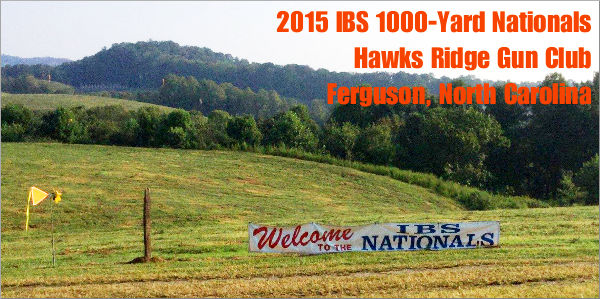
The 2015 IBS 1000-Yard National Championships were held September 4-5 at the Hawks Ridge Gun Club in Ferguson, North Carolina. Attendance was great, with 103 Registered Light Gun shooters and 89 Heavy Gun competitors. After a practice day, the competitors tried on Friday and Saturday to master the unpredictable conditions at Hawks Ridge. The 1000-Yard National Match for 2015 featured a three-target Aggregate for each Division (i.e. six targets total for both classes).
The Hawks Ridge range is quite unique — it’s a very wide-open, over-the-hills range. Conditions constantly change (and change very quickly according to several competitors). The management and membership of this range put on a great event this year. Several shooters said this was one of the best-run National-level matches they had ever attended.
Jim Bauer Won the IBS 2015 Nationals shooting a 6mm Dasher in both Light Gun and Heavy Gun Classes. Here’s his match-winning Heavy Gun. Smithed by Gordy Gritters, Bauer’s Heavy Gun featured a BAT action, Kreiger barrel (in barrel block), Shehane stock, and Nightforce scope.
Bauer Drives Dashers to Victory The Two-Gun Champion and Overall winner was Jim Bauer with 24 rank points. In second place was Robert McMichael with 36 rank points. Bauer shot great in both Light Gun (LG) and Heavy Gun (HG) matches, posting Top 10 finishes in both classes. Bauer ran 6mm Dashers in both Divisions (LG and HG) with Vapor Trail bullets. By contrast, McMichael shot big cartridges — a .284 Shehane in LG and a .300 WSM in HG, using Berger Bullets for both calibers. Top lady shooter was Donna Matthews while Amber Brewer won the Junior Division. John Stecik won a BenchSource Annealing machine for shooting the Best Light Gun Target (50 score with a 3.758″ group). Steve Knight shot the Best Heavy Gun Target (100 with 4.407″ group), to win a Douglas barrel.
PDF File — scroll to bottom of document for EQUIPMENT LIST.
The Hawks Ridge Gun Club Range and Facility
The 1000-yard shooting facility is a covered pavilion that has 15 shooting benches located in the rolling hills of Wilkes County North Carolina. The Club has a great Barbeque grill on site, which the McNeil family employed to perfection, delivering an outstanding Barbeque chicken meal on Friday night.
One veteran shooter commented that when you can take 103 of the best shooters in the country and hold a event that had very little to any issues you have accomplished something. Range officials were quick to point out that it took a lot of hard work from Hawks Ridge Club members as well as support from the IBS, the sponsors, and the competitors.
Outstanding Prize Table
Over $20,000 worth of prizes were awarded at this year’s IBS 1000-Yard Nationals. Prizes included: Nightforce scopes, Sightron Scopes, BAT Action, Defiance Action, Baity Action, Shehane stocks, rests, reloading tools, Sierra and Berger bullets, and more. Many thanks should go to Stanley Taylor from Douglas Barrels for his time and energy in acquiring prizes for the match.
Experience and Youth — HV Grand Agg Winner Harley Baker with Hart Trophy Winner Henry Miller.
Report by Ken Frehm
In early August, many of the nation’s best Benchrest shooters headed to New York for the N.Y. State IBS Championships and 16th Annual Pro-Am Group Shoot at the Camillus Sportsmen’s Club (located outside Syracuse, NY). For this IBS event, held August 1st and 2nd, shooters were graced with two beautiful sunny summer days. Forty sharpshooters tested their skills against each other as well as the challenging, and ever-changing winds at Camillus.
Many competitors arrived early on Friday to see if they could get a handle on the unique conditions at Camillus. Our benches, as well as our facilities, have been newly renovated and a new tree line pattern influenced the course in an entirely different way. The 100-yard matches on Saturday were quite difficult as winds gusted to 20+ miles per hour and 180-degree shifts in direction were commonplace. Getting five in one hole was difficult at best. Good-natured grumbling, head shaking and “Where did that come from?” comments were heard from some top shooters. Yet, many managed to Agg in the twos!
On Sunday, the second day, the 200-yard matches were blessed with less fickle winds, and some conditions that even remained constant for a very brief time. Improved groups and scores reflected the kinder conditions that Mother Nature shared with us.
Top Shooters at N.Y. State Group Benchrest Championships, August 1-2, 2015:
Two-Gun Aggregate
HV Grand Aggregate
LV Grand Aggregate
1. Brushingham, Bob 0.2762
2. Baker, Harley 0.2870
3. Dolinsky, Brian 0.3002
4. Auman, Al 0.3007
5. Reed, Tim 0.3023
1. Baker, Harley 0.2469
2. Auman, Al 0.2538
3. Reed, Tim 0.2602
4. Brushingham, Bob 0.2605
5. Peinhardt, Wyatt 0.2664
1. Brushingham, Bob 0.2919
2. Hamister, Bob 0.2941
3. Miller, Jim 0.2957
4. Mitchell, Paul 0.3063
5. Dolinsky, Brian 0.3121
On the line, we had three youngsters competing. 11-year-old Henry Miller (from Malden Bridge, NY) proved that you don’t have to have gray hair to have low Aggs! Henry won the Clyde Hart Trophy silver bowl. New shooters (amateurs) as well as top experts were intermingling, helping each other and sharing their experiences. Of course a lot of good-natured ribbing was overheard. Amazingly, I didn’t hear a serious complaint during the entire two-day event.
There were many tables set up for ammo-loading activity under the pavilions as well as in our clubhouse. A number of spouses were there to help their better halves in any way they could. Many campers were in evidence as well.
Interview with Shooters — Challenges and Great Friendships
I asked some of the competitors, “What is the hardest thing for you? … What is the most challenging? They told me: “Having the patience to wait until things are right… as well as the mental game of conditioning oneself to be strong and to be a champion.”
I also asked competitors: “What is the most pleasurable thing about this sport for you?” In every instance the folks I interviewed told me that the best aspect of benchrest competition was “the People”. Having relationships within the community of Benchrest folks is what is BEST — No doubt about it!
My job of roving photographer/event reporter gave me a unique opportunity to see things in a new way and to gain insights from a wide range of helpful marksmen. My most important take-away was that this group of sportsmen (and women) are friendly, helpful, and genuinely nice people. What are the secrets to winning? They will share them with you willingly! Need help? They are there!
Hardware Report — Top Guns
Harley Baker finished second overall in the Two-Gun and took the HV Grand. Baker’s rig featured a Tony Leonard Stock, Bat Action, Krieger barrel, and BixNAndy trigger. Harely shot Sta-Moly Bullets with 30 grains of Vihtavuori N133. The rifle was smithed by Jeff Peinhardt.
Jim Miller, who placed third in the Light Varmint Grand Agg, shot JW 65g bullets with 30.0 grains of N133 powder. Jim’s rifle featured a Roy Hunter Stock, March Scope, and BixNAndytrigger.
Bob Brushingham won the Two Gun Overall. Bob’s rifle, smithed by Don Beaver, featured a Panda action and Krieger barrel. Bob shot Berger 65g Bullets pushed by 28.6 grains of LT32.
Many Hands Make Light the Work — Praise for the Volunteers
Many volunteers helped make the weekend a great success. Four different groups manned the golf carts that put up and took down the targets between each relay and match. Event Chairman, Bob Hamister put it all together. Volunteers from the Syracuse Police Department, as well as our club members and some of their kids joined in the effort. Camillus Club members prepared all the targets, the target boards, the moving backers and all the paraphernalia that was needed. In the clubhouse, three ladies and our club president (Bill Parfitt) manned the scoring boards, and the computers. Three ladies took over the griddle, delivering delicious food and drinks for the shooters’ breakfasts and lunches.
Deep Creek 1000-yard line: 46°55’35.03” N 114°14’45.40” W, elevation 3355′.
The International Benchrest Shooters (IBS) welcomes the Montana NW 1000 Yard Benchrest Club as a newly-affiliated club hosting registered IBS matches. The Montana club’s origins go back to 1996 when the Whitefish (Montana) Rifle and Pistol Club affiliated with the Original Pennsylvania 1000-Yard Benchrest Club (Williamsport) to conduct 1000-yard matches. Early in 1998 the Northwest 1000-Yard Benchrest Association was formed to promote 1000-yard benchrest competition in affiliation with Williamsport. The Club now operates at the Deep Creek Range as the Montana NW 1000 Yard Benchrest Club (www.MT1000yd.com), an IBS-affilated organization.
2015 Championships at Deep Creek
The 2015 Championships were held this past weekend, August 7-9. The video below features the winners from this year’s championships, Tom Mousel (Two-Gun Overall), Leo Anderson (Heavy Gun Overall), and Bill Johnson (Light Gun Overall). The three winners describe their equipment. Tom shot a pair of 17-lb 6mm Dashers, running Vapor Trail Bullets pushed by CCI 400 primers and Hodgdon H4895 powder. The brass is Lapua 6mmBR hydro-formed to Dasher with lightly-turned necks.
Here is one of Tom Mousel’s match-winning rifles, and an impressive 100-3X, 10-shot target:
The Club holds 12 shoots per year over six weekends that count towards the 6- and 10-shot Aggregates for the year. The Championship Shoot held in August is match number 11 and 12 and does not count for Aggs. More than $20,000 worth of prizes were donated by major sponsors this year. The prize table featured scopes from Nightforce and Vortex, actions from DeFrance, Borden, BAT, Kelbly, and Stiller, plus barrels from Bartlein, Benchmark, Brux, Caliber, Krieger, and McGowen.
The Deep Creek Rifle Range is located near Missoula, Montana. Club members are continually upgrading the 1000-Yard Range, which has become one of the best long-distance benchrest shooting facilities in the country. The Deep Creek Rifle Range invites shooters to visit this scenic shooting facility. Participation in club matches continues to grow, and club members hold several 1000-yard World Records for group, score, and Aggregates of both. For more information on club shoots and joining the club, contact Alex Wheeler: zfast_malibu [at] yahoo.com.
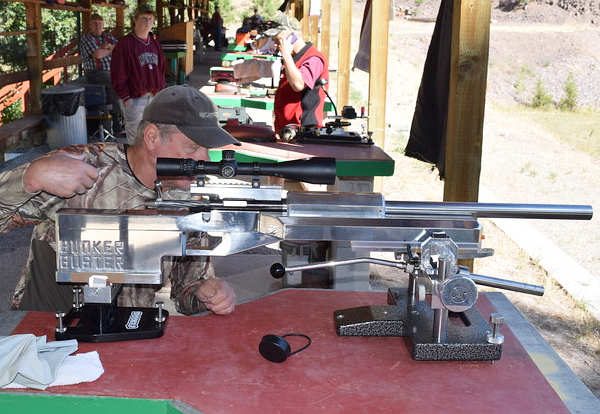
Here’s “Bunker Buster”, a metal-stocked Heavy Gun (HG):
At Deep Creek, competitors shoot three (3) classes: IBS Light Gun (LG), IBS Heavy Gun (HG), and a special 11-pound class. At registered matches, Light Gun shoots five shots per relay, Heavy Gun shoots 10 shots, while the 11-pound class shoots five shots. For more information on classes and courses of fire, visit MT1000yd.com or send email to: northwest1000ydbenchrest [at] gmail.com.
New World Records Set at July 2015 Match:
Important 1K records were set at the Club’s July 9-10 match earlier this summer. Tom Mousel broke the Light Gun 10-match score record and Heavy Gun 10-match group record. Jim Williams broke the HG 10-match score Agg record. In the video below, Tom Mousel talks about his record-breaking performances.
Missoula, Montana Travel Tips
The City of Missoula is nestled in the Northern Rockies of Montana, at the confluence of three rivers. Surrounded by seven wilderness areas, Missoula is an outdoor enthusiast’s dream. You can kayak, raft or tube through downtown, or take a relaxing hike in 60,000 acres of wilderness minutes from your hotel. Missoula is known for blue-ribbon trout fishing (made famous by the movie A River Runs Through It) and spectacular natural beauty.
Missoula is a popular destination for shopping and dining, featuring three shopping districts and an abundance of restaurants, cafes, and brew-pubs with something to fit all budgets and palates. Known for its eclectic culture, Missoula offers a wide variety of entertainment including theater, film festivals, college sports, ballet, and even roller derby.


 Yes old dogs can learn new tricks. Just five years ago Forum member Henry Pasquet (aka “HenryP”) got started in 1000-yard benchrest shooting. He was 66 at the time. Henry worked hard, learned fast, and pursued accuracy with a vengence. That all paid off when Henry won the 2013 IBS 1000-yard Nationals this summer, finishing as the Two-Gun Overall National Champion. Henry was kind enough to talk about his rifle, his reloading methods, and his strategy for success. In fact, Henry was eager to share “everything he knows, so that other guys can fast-track their learning process”. Henry told us: “I want to share every lesson I’ve learned, so that other guys can improve their game and enjoy the sport more.” Henry also wants to encourage other senior shooters: “If you pay attention to details (when reloading), and get a good rifle with a good barrel, age is not a handicap. With a good set-up, older guys can compete with anyone out there. This is one sport where you can be a champion in later life.”

 On top is a Nightforce 12-42x52mm Benchrest scope with CH-3 reticle. I used a Fulghum (Randolph Machine) front rest with an Edgewood bag made with the low-friction 3M material. In the rear I use a special-order Protekor rear “Doctor” bag with ears spaced 3 inches apart. The rear bag also has the new 3M material on contact surfaces (photo at right).
 To dispense powder, I use a RCBS ChargeMaster set 0.1 grain below my desired load and then weigh them on a Sartorius GD-503 magnetic force restoration scale to get identical charges. I use a K&M Arbor Press with seating force gauge when seating the bullets with a Wilson inline die. My “target” seating force on the K&M dial is 20-23 units for Dashers and 35-40 units for the .284 Shehane. I put any variables aside for sighters. I do not weigh brass, bullets, or primers. My bullets were so consistent that I did not sort by bearing surface. I did trim the Berger VLDs to the shortest bullet length with a Hoover Trimmer, and then pointed the meplats just enough to close them with a Whidden pointer. I sort my bullets to 0.005″ overall length, rejecting about five percent.
 Q: You go 60-80 rounds between cleaning and the results speak for themselves. What is your barrel cleaning procedure? Do you think some guys clean too often or too aggressively?


 More Mirage on Day Two
 The
The 


 All but one Light Gun was chambered as a 6mm, mostly 6BRs or Dashers. Even in the Heavy Gun division, 6mms ruled — 58 out of 61 Heavy Guns were chambered for 6mm cartridges, mostly Dashers.




 The Two-Gun Champion and Overall winner was Jim Bauer with 24 rank points. In second place was Robert McMichael with 36 rank points. Bauer shot great in both Light Gun (LG) and Heavy Gun (HG) matches, posting Top 10 finishes in both classes. Bauer ran 6mm Dashers in both Divisions (LG and HG) with Vapor Trail bullets. By contrast, McMichael shot big cartridges — a .284 Shehane in LG and a .300 WSM in HG, using Berger Bullets for both calibers. Top lady shooter was Donna Matthews while Amber Brewer won the Junior Division. John Stecik won a BenchSource Annealing machine for shooting the Best Light Gun Target (50 score with a 3.758″ group). Steve Knight shot the Best Heavy Gun Target (100 with 4.407″ group), to win a Douglas barrel.