|
|
March 30th, 2014
The 2014 ISSF World Cup at Fort Benning is underway, and some events have already finished, such as the 10m Air Rifle and 10m Air Pistol. The World Cup, which has attracted many of the world’s top rifle and pistol shooters, continues through April 3, 2014. Here are some photo highlights from the first three days of the Fort Benning World Cup. There were plenty of exotic, expensive rifles and pistols on display — plus a few small toy animals (favored by the lady shooters).

 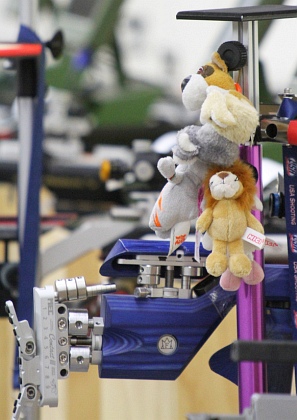
ISSF Fort Benning World Cup Photo Stream
Young Russian Wins First Gold of the Competition
Nazar Luginets, 24, from the Russian Federation, won the first medal match of the competition, the 10m Air Rifle Men event. With 209.4 points, the Russian athlete beat Serbian Milutin Stefanovic, who finished just one tenth behind Luginets. The 2013 Euro Champion, Sergey Richter from Israel, finished third.
10m Air Rifle Winner Nazar Luginets

 New Air Pistol Record Set New Air Pistol Record Set
Hoang Xuan Vinh, from Vietnam, won the 10m Air Pistol Men final, setting a new world record in the process. Currently ranked 8th in the world, The Vietnamese pistol shooter pocketed the Gold medal with a record score of 202.8 points in the final, breaking the previous 202.3-point record set by the 2008 Olympic Champion Pang Wei of China. Hoang beat Russians finalists Sergey Chervyakovskiy, and Vladimir Gontcharov, 36, who finished in second and third place with 202.3 and 181.3 points, respectively. This was an important comeback for Gontcharov, a 14-time ISSF World Cup medalist. Vladimir who started competing back in 1990, had been far from ISSF podiums since 2012.


Photos © International Shooting Sport Federation.
March 23rd, 2014
The International Shooting Sports Federation (ISSF) World Cup season kicks off right here in the USA, March 26 through April 3, 2014, in Fort Benning, Georgia. Many of the world’s best rifle and pistol shooters will be on hand — more than 400 competitors from 50 nations are expected to compete at the home of the U.S. Army Marksmanship Unit (USAMU).
ISSF World Cup (Fort Benning) 2013 50m Rifle Prone Winner Valerian Sauveplane of France.

At the last Rifle/Pistol World Cup USA back in May 2013, the USA earned two medals with Will Brown winning a gold medal in Men’s 10m Air Pistol and Dempster Christenson winning a silver medal in Men’s Air Rifle. Highlights from last year’s ISSF World Cup at Fort Benning are featured in the 24-minute video linked below. The video covers both rifle and pistol disciplines.
Here is last year’s women’s 50m 3P winner at the Fort Benning World Cup, Andrea Arsovic of Serbia.


Complete ISSF World Cup (Fort Benning) Match Schedule
If you want to watch the matches,or meet some of the shooters here is a schedule for the all the events, starting with training sessions on March 27th.
CLICK HERE for General Match INFO (PDF)
CLICK HERE for list of competitors, grouped by Nation (PDF).

Photos ©2014 ISSF | Competitor Photos: Marco Dalla Dea
January 5th, 2014
Free is good — especially when it’s a free digital magazine about precision shooting. The latest digital edition of the ISSF News Magazine is now offered for both iOS (Apple) and Android OS devices. The downloadable ISSF Magazine is packed with content about competition shooting worldwide. The most recent December 2013 edition includes 34 articles, over 500 photos, and several videos, plus exclusive reports from the ISSF World Cup Finals. Each ISSF eZine is “self-contained”. That means, once you download an issue, you read it start to finish, even without a live web connection.

The ISSF News Tablet Magazine can be downloaded for free, in English and German. Pick the version that suits your hardware — Apps are offered for both Android tablets and for iPads. Bimonthly issues are published in February, April, June, August, October and December.
DOWNLOAD Free ISSF News Magazine for Tablets:
Download Android App (Google Play) | Download Apple App (iTunes)
The ISSF News Tablet Magazine covers precision shooting around the globe. Each issue spotlights top shooters and the latest hardware — rifles, sights, accessories, ammo. You’ll find up-to-date coverage of top-level competitions, and these match reports feature videos, slide shows, and other interactive features made possible by modern, touch-screen tablet technology.
Preview iPad Version of ISSF Digital Magazine
July 2nd, 2013
 The International Shooting Sports Federation (ISSF) has a great new product for iPad users. The ISSF now offers a multi-media “eZine” optimized for Apple tablets. The free, downloadable ISSF Magazine covers competition shooting around the globe. You’ll find match reports, interviews with shooters, and coverage of the gear and ammo that win matches. Packed with plenty of photos and videos, ISSF’s iPad magazine is rich with interactive content. The latest issue features 15 videos, 35 articles, and over 400 photos. That’s quite a package… and it’s all FREE (just download from the App Store). Each magazine is “self-contained” when downloaded. That means, once you download an issue, you read it start to finish, even without a live web connection. The International Shooting Sports Federation (ISSF) has a great new product for iPad users. The ISSF now offers a multi-media “eZine” optimized for Apple tablets. The free, downloadable ISSF Magazine covers competition shooting around the globe. You’ll find match reports, interviews with shooters, and coverage of the gear and ammo that win matches. Packed with plenty of photos and videos, ISSF’s iPad magazine is rich with interactive content. The latest issue features 15 videos, 35 articles, and over 400 photos. That’s quite a package… and it’s all FREE (just download from the App Store). Each magazine is “self-contained” when downloaded. That means, once you download an issue, you read it start to finish, even without a live web connection.
The ISSF plans to release six (6) iPad magazines each year, covering the full range of ISSF shooting disciplines. The ISSF iPad magazine is now available to download for free from the Apple App Store. To get the ISSF Magazine App, click the App Store button on your iPad, then search for “ISSF News” in the App Store. To learn more about the ISSF’s eZine for iPad, watch this video from ISSF:
Preview Free ISSF Interactive Magazine
Gary Anderson Praises ISSF’s New Digital Magazine
ISSF Vice-President Gary Anderson states: “I’m from the old generation, but the App is perfectly easy for me to use. I encourage everyone to download the new App and use it. I think they’re going to find that this is the best new way to get information about ISSF competitions and ISSF activities. Everyone who is interested in shooting should take advantage of this.”

March 27th, 2013
Original story by Marco Dalla Dea for ISSF.
The ISSF has announced a new name and new competition for the ISSF Run & Shoot event. ISSF TARGET SPRINT will now be the official title for this action-filled ISSF “Sport for All” event. And the ISSF is organizing an international Target Sprint Grand Prix in Munich (GER) in May to promote the new sport. ISSF Target Sprint combines athletes’ precision shooting and running abilities. The new event mixes air rifle shooting and middle-distance running. It requires participants to be fast, accurate shooters and to possess outstanding physical fitness. LINK: ISSF-Sports.org.

You Provide the Running Shoes — ISSF Provides the Air Rifles
“A pair of running shoes is all you need. Everything is designed to keep costs down for the athletes. The ISSF will provide targets and single-shot air rifles,” explained ISSF Secretary General Franz Schreiber. “The game is as easy as it looks”, says Schreiber, “Competitors will run on a track or running path and then stop at the air gun range to shoot at falling targets on their assigned firing points. There are no complicated scoring systems — the first athlete to cross the finish line is the winner.”
ISSF President Olegario Vazquez Raña adds: “We are developing ISSF TARGET SPRINT under the rubric of Sport for All, a program now being strongly promoted by the IOC. We were looking for a new event that combines marksmanship and fitness, can be staged outdoors, and is accessible to everybody.”

How Does ISSF TARGET SPRINT Work?
ISSF Target Sprint participants begin each event with a mass start and a fixed distance run. At the end of the first run, normally 600 meters, they stop at a 10-meter air rifle range where they must pick up their rifles and shoot at and hit five knockdown targets from standing position. More than five shots are often required to hit all five targets, but that adds to the shooting time. There are no penalties, but the sooner you finish shooting, the sooner you can start running your next lap. At the end of the second run, participants must shoot another five targets before beginning the third and final running stage. The final rankings are clear and easy to understand. The athlete who completes the three running stages and two shooting stages and who is the first at the finish line is the winner.
 ISSF TARGET SPRINT Competition this May ISSF TARGET SPRINT Competition this May
at ISSF World Cup in Munich, Germany
The new event will have its official 2013 inauguration during the 2013 ISSF Rifle and Pistol World Cup Munich, set for 23-30 May at the Hochbrück Olympic Shooting Range. The ISSF TARGET SPRINT competition will be held on the 26th of May.
Participation is open and more than 40 athletes have already registered to compete. World Cup participants who are interested in trying TARGET SPRINT are invited to bring their running shoes and clothing to Munich and give it a try.
December 25th, 2012
The Arizona Desert Sharpshooters website offers a complete collection of competition plot sheets. These plot sheets were created by shooter Reid Perry. High Power and F-Class shooters can use these to mark their shot locations and record their wind calls. All the Plot Sheets are created in Adobe Acrobat (.pdf) format so they’ll print consistently from any computer. See sample plot sheet for 600 Yards.
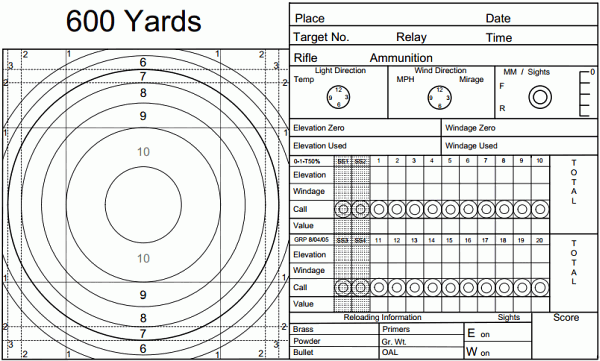
Right click and “save as” the links below to download full-size plot sheets. On the Desert Sharpshooters site you’ll find other free plot sheets, including ISSF (300m) and ICFRA Plot Sheets (300 to 1000 yards), plust sight-setting and score-keeping plot sheets.
|
|
DCRA (Canada) Plot Sheets
|
December 20th, 2012
 We live in a digital, electronic era. The very story you’re reading right now consists of digital data packets transmitted electronically around the globe. Because of cost factors, 99+% of shooting matches in the USA still rely on old-fashioned manual scoring methods. However, target scoring can be done faster and more precisely with electronic scoring systems. Olympic and international CISM shooting competitions now employ electronic target systems. And electronic scoring is widely used in Europe. Virtually all the rifle and pistol events at the recent ISSF World Championships in Munich featured electronic scoring — complete with large, overhead digital displays so the audience could track the action, shot for shot. We live in a digital, electronic era. The very story you’re reading right now consists of digital data packets transmitted electronically around the globe. Because of cost factors, 99+% of shooting matches in the USA still rely on old-fashioned manual scoring methods. However, target scoring can be done faster and more precisely with electronic scoring systems. Olympic and international CISM shooting competitions now employ electronic target systems. And electronic scoring is widely used in Europe. Virtually all the rifle and pistol events at the recent ISSF World Championships in Munich featured electronic scoring — complete with large, overhead digital displays so the audience could track the action, shot for shot.
Below is a video showing an electronic scoring system developed by Norway’s Kongsberg Mikroelektronikk AS. Watch as a prone shooter puts five rounds on a 300m target. You can see the group form on the video screen at his shooting station. He’s a good shooter (with an accurate rifle). The first three shots are touching.
As you can see from the video, viewing shots on the monitor is easier than using a spotting scope and waiting for targets to be marked. And, electronic targets eliminate the need for target pullers in the pits.
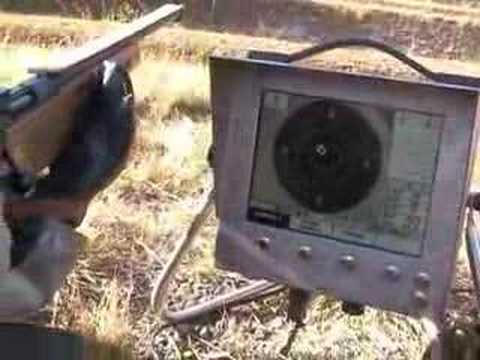
The Kongsberg target systems, like the electronic systems produced by Sius Ascor of Switzerland, do more than just display shot locations to the shooter. The target units automatically calculate scores, which are transmitted to a central computer. This can provide updated competitor rankings, and can even display the results to event spectators on large view screens.


CLICK HERE for a longer streaming Flash VIDEO showing how electronic target systems work. This video, produced by Sius Ascor, shows Olympic target systems in action.
December 7th, 2012
In November, the ISSF Administrative Council approved new ISSF rules calling for major changes in ISSF and Olympic Shooting Sports events. Starting in 2013, all Finalists will start with zero scores and there will be elimination rounds, ending with a final two-shooter duel for the Gold medal (the loser of the duel gets Silver). The new Finals procedure represents the ISSF’s first major format change since the introduction of finals in 1986. The new Finals format will be used in all 2013 ISSF Championships.
This rules were changed to make shooting events more “spectator-friendly”, attract media coverage, and engage a larger fan base. It is hoped that the new format, ending in a duel, is more appealing and easily understandable. The new ISSF rules contain new Finals formats for all Olympic shooting events mandating that ALL finalists start from zero. This means that qualification scores will not be carried into the Final anymore, making the scoring system immediately understandable for spectators. Furthermore, all Finals feature eliminations, and end with duels between the two best athletes to decide the gold and silver medals. The new 2013 Rules have been published on the ISSF website, ISSF-sports.org.
Other Shooting Rule Changes to Be Implemented
The new ISSF Rules also include the separation of sighting and match firing in 10m and 50m rifle and pistol events, a new position order for 50m Rifle 3-Position events, and a provisional test of decimal scoring for 10m Air Rifle and 50m Prone Rifle events. The Final for the 50m 3-P Rifle event will become a true 3-Positions Final, not a one-position Final like it used to be. And new time limits will require shooters to make more rapid position changes in future 3-position rifle Finals. Both 25m Pistol Finals will use hit-miss scoring to encourage more spontaneous spectator reactions.
ISSF Big Shots Praise Finals Format Changes
“The shooting sport has always been a leading sport in the Olympic movement. And with the new finals we made an important step forward to keep that leading position,” said ISSF President, Mr. Olegario Vazquez Raña.
ISSF Sec. Gen’l Franz Schreiber concurred: “It was time to change….The ISSF has always been open to innovation, and we are proving it once again. All sports must adapt to the digital era of technology and media. The time has come to adopt new [formats] which fulfill these objectives.”
Legendary USA Olympic marksman and ISSF Vice-President Gary Anderson observed that the rule changes will present challenges: “We will have to work hard to make this work. But our sport will benefit from this new, appealing format.”
November 1st, 2012
 Two new mixed team events will be part of the 2014 Youth Olympic Games Program, while the total number of quotas will remain unchanged. Two new mixed team events will be part of the 2014 Youth Olympic Games Program, while the total number of quotas will remain unchanged.
The International Olympic Committed (IOC) has approved the Shooting program for the 2014 Youth Olympic Games. The program includes the previously approved individual events, 10m Air Rifle Men, 10m Air Rifle Women, 10m Air Pistol Men and 10m Air Pistol Women plus two new events, 10m Air Rifle Mixed Teams and 10m Air Pistol Mixed Teams.
The number of participation quotas for the individual events remains the same (20 quotas per 4 events, for a total of 80 quotas). Athletes who compete in the individual events will also form two-person mixed teams (one male, one female) according to their place finishes in the individual events. No additional athlete quotas were allocated for those events.
 All teams will be composed of one male and one female athlete based on their final rankings in the individual Air Rifle and Air Pistol Men and Women events. All teams will be composed of one male and one female athlete based on their final rankings in the individual Air Rifle and Air Pistol Men and Women events.
Mixed Team events will take place over 2 days, following the 4 days of individual competitions. In the team duels, the two members of each team will fire one shot on command. The scores of the two team-members will be combined and compared with the combined score of the other team. The team with the higher total will score one point. The paired teams will continue to fire single shots on command until one team scores ten points to win that round of competition. Detailed technical rules for the YOG Mixed Team events will be provided after the ISSF Administrative Council meeting in November 2012.
Report by Marco Dalla Dea for ISSF-Sports.org.
October 27th, 2012
 Four-time USA Olympian SFC Jason Parker won the ISSF World Cup Final, finishing ahead of Han Jinseop of South Korea and Olympic finalist Ole Krsitian Bryhn of Norway. Parker, a soldier serving with the USAMU, claimed the International Shooting Sport Federation (ISSF) World Cup Final trophy in the Men’s Three-Position Rifle event Thursday in Bangkok, Thailand. Four-time USA Olympian SFC Jason Parker won the ISSF World Cup Final, finishing ahead of Han Jinseop of South Korea and Olympic finalist Ole Krsitian Bryhn of Norway. Parker, a soldier serving with the USAMU, claimed the International Shooting Sport Federation (ISSF) World Cup Final trophy in the Men’s Three-Position Rifle event Thursday in Bangkok, Thailand.
Ranked ninth in the world, Parker earned his invitation to Bangkok after winning the Milan World Cup earlier this season. The 38-year-old Parker, no stranger to the World Cup Finals after six previous visits, made it to the final round with a head-start of four points after shooting an 1,171. Scoring 95.5 points during the final stage, Parker won gold with an overall score of 1266.5 points. Parker added. “”I have been competing in World Cup Finals since 1998, and dreaming of a gold medal since then. It’s finally around my neck, and it feels great!”
Three points behind him, Korea’s Han Jinseop pocketed the silver medal with an overall score of 1263.5 points. Making it to the final with 1166, Han overtook Norway’s Ole Kristian Bryhn to finish on the second step of the podium with a final score of 97.5 points. Bryhn landed in third, securing the Bronze medal with a total score of 1263.0 (1167+96.0) points.
Parker’s Olympic and USAMU teammate SFC Eric Uptagrafft took fourth in the World Cup Final Wednesday in the Men’s Prone Rifle event. (He finished .6 points away from second place). In other ISSF World Cup events in Bangkok, USAMU shotgunners did well. Josh Richmond earned the gold medal in Men’s Double Trap while Vincent Hancock shot his way to a silver medal in Men’s Skeet.
 Elite Field for ISSF World Cup Elite Field for ISSF World Cup
Starting with the London World Cup in April and then passing through Milan and Munich, the 2012 ISSF World Cup Series finished in Bangkok. Only the sport’s top performers were invited to compete in the World Cup Finals. Ninety (90) shooters from 34 countries, including Olympic medalists and past World Cup title holders, competed at the Thailand ISSF World Cup Match this year. (Shown at right is SFC Parker competing at the Milan World Cup.)
|


