At the request of our readers, we provide select “Deals of the Week”. Every Monday morning we offer our Bargain selections. Here are some of the best deals on firearms, hardware, reloading components, and shooting accessories. Be aware that sale prices are subject to change, and once clearance inventory is sold, it’s gone for good. You snooze you lose.
1. MidwayUSA — Black Friday Sale Starts Monday, 11/21/2016
Black Friday starts today — at least at MidwayUSA. Starting Monday, November 21st, you’ll find super bargains at MidwayUSA all week. Prices have been slashed on dozens of popular products. Above are six Black Friday bargains that caught our eye — check out the major price cuts on Leupold VX-6 scopes, and save 15% on Sierra bullets. This is just the tip of the iceberg — dozens of other products are on sale. Loaded ammo is deeply discounted and you can even get an NRA Life Membership for just $600.00. You’ll find these and scores of other super-deals on MidwayUSA’s Black Friday Sale Page. These prices are good through 11/28/2016 at 11:59 pm.
2. Natchez — Hodgdon Varget 8-lb Jugs, $186.49
If you’ve been looking for Hodgdon Varget powder in the large eight-pound (8 lb.) jugs, Natchez has this in stock, as of Monday morning, November 21st. If you want this powder, you better jump on this. Supplies are limited. Sorry, no H4350 in the big jugs, but Natchez does have Varget in one-pound containers for $25.99 per pound.
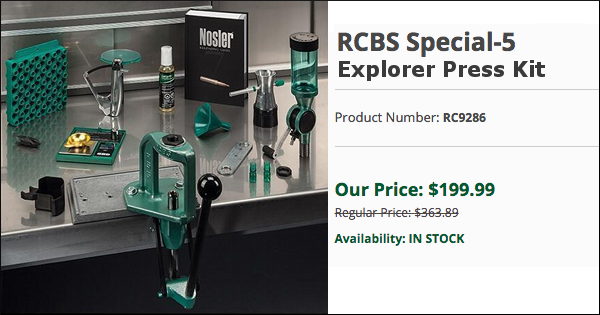
3. Natchez — Special 5 Reloading Press Kit, $199.99
Looking for a great holiday gift for a family member getting started in metallic cartridge reloading? This RCBS Kit has everything a new reloader needs: single-stage press, powder measure, scale, powder trickler, priming tool, cartridge tray, “rocket” chamfer tool, case lube and more. This is an excellent entry-level reloading kit, on sale for just $199.99 at Natchez Shooters Supplies. We like the relatively compact Special 5 press for most reloading duties. Eventually you may want to add an additional, large heavy press, but this will get the job done. For the combined package, with all the tools one needs to hand-load quality ammo — this is a stunningly good deal at $199.99.
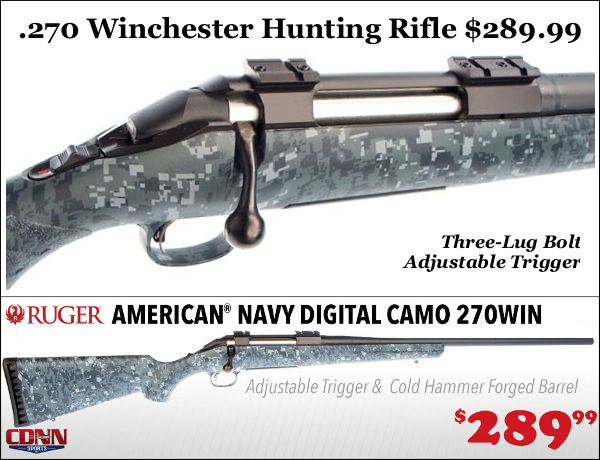
4. CDNN Sports — Ruger American .270 Win, $289.99
If you’re looking for a good deer-hunting rifle at a super-affordable price, check out this .270 Winchester Ruger American. It comes with a gray-blue digital camo finish that actually suits gray fall days pretty well. The long action sits in a integral bedding block, and features a three-lug bolt with 70° bolt lift. The 22″ hammer-forged barrel has a 1:10″-twist, so it’s capable of shooting the most popular .270-caliber hunting bullets. Ammo is held in a flush-fit rotary magazine. The Ruger American is a good, solid rifle — and this is a steal at $289.99. If you don’t like the finish, buy a $5.00 can of spray paint.
5. Brownells — GET $10 Off $75.00+ Orders plus Free Shipping
Brownells is the “go-to” source for firearms parts and accessories, and Brownells also offers a full range of reloading and gunsmithing tools. Now, with PROMO CODE L6G, you can save $10 off any order over $75.00, plus get FREE Shipping. That could easily save you twenty bucks or more on your next order. Note, this deal applies to online orders only, and you can only use one promo code per order. To qualify, insert CODE “L6G” during checkout.
6. J&G Sales — Eley Target .22 LR Ammo, $59.90 for 500 Rounds
Yellow Box Eley Target is excellent .22 LR ammunition that is plenty accurate for all but the most demanding rimfire disciplines. This is way more accurate than bulk ammo which might sell for $4.00-$5.00 per box at stores. With this special deal at J&G Sales you can get a 500-round brick (ten 50-rd boxes) for just $59.90. That’s a steal when you consider this ammo sells elsewhere (MidwayUSA) for $7.99 for a 50-rd box. So you can save two bucks a box with this deal. That’s a 25% savings.
7. Amazon — Frankford Quick-N-EZ Case Tumbler, $34.99
Look no further for a great deal on a reliable tumbler. We’ve used this very same machine to tumble both pistol brass and rifle cases. We like the see-through, transparent top and the large capacity — this will hold up to 350 .223 Rem cases. With 1000+ customer reviews on Amazon.com, this Frankford Quick-N-Easy Case Tumbler has earned a 4.5-star rating. If you need a tumbler, you might want to order soon — this is the best price we’ve seen in a while.
8. Midsouth — 17 HMR V-Max Ammo, $10.45 for 50 rounds
Need 17 HMR ammo for your varmint safaris? Then grab this Hornady V-Max ammo while you can at $10.45 for a 50-round box. This is a great price. Other vendors are selling the same Hornady ammo for as much as $15.00 per box. We’ve used this ammo and it was very accurate out of both semi-auto (Savage A17) and bolt-action (CZ 455) 17 HMR rifles.
9. Amazon — Leight MAX NRR33 Earplugs, $7.58 for 50 Pairs.
These Howard Leight NRR33 Max plugs are your Editor’s favorite foam earplugs. Between shooting, motorcycling and mowing lawns, I probably have Max plugs in my ears 2-3 days a week. This is a very good price for a bulk pack of 50 pairs. And if you act soon, you can get free shipping to boot.
Trimming and chamfering brass are tasks hand-loaders grow to hate. Those chores are time-consuming and tiresome. Thankfully there are faster, better alternatives to manual trimming/chamfering. In this article, Forum member Erik Cortina shows how to use the Giraud tool which trims and chamfers in one operation. Erik has his own YouTube Channel dedicated to precision reloading and accurizing. Here we feature Erik’s video about the “mother of all brass trimmers”, the Giraud powered case trimmer. Erik says: “If you do volume reloading… this is the only trimmer to get. It not only trims to length but it also chamfers your case mouth inside and out.” In his video, Erik offers some very clever and useful tips that will help you get the most from your Giraud.
This is a manufacturer’s photo showing an older model.
The Giraud trimmer is very precise. When set up correctly, it can trim brass with amazing consistency. In the video, Erik trims five pieces of brass in 15 seconds (6:32 mark). He then measures all five with precision calipers (7:00-8:08). All lengths are exact within .0005 (half a thousandth). Erik notes that the Giraud trimmer indexes off the case shoulder. As long as you have fire-formed brass with consistent base-to-shoulder dimensions, you should get very consistent trim lengths.
The secret to the system is a 3-way cutting head. This cutter can be swapped in and out in a couple minutes with wrenches provided with the kit. Erik has three different heads; one each for 6.5mm, 7mm, and .30 caliber. The video shows how to adjust the cutting heads to match caliber diameter (and to get the desired amount of inside/outside chamfer).
To trim and chamfer cases, you simply insert them nose-first into the cartridge-specific case-holder. Erik offers a smart tip — He uses a die locking ring to position the cartridge holder (3:15). This can be locked in place. Erik says die locking rings work much better than the hex-nuts provided by Giraud (with the hex-nut, one must re-set cut length each time you change case-holders.)
The Giraud can be used in either horizontal or vertical modes. Erik prefers to have the trimmer aligned vertically, allowing him to push cases down on the trimmer head. But the trimming unit has twin sets of rubber feet, allowing horizontal or vertical orientation.
Improved Case-Holder Made with Chamber Reamer:
For his .284 Shehane, Erik had to create his own case-holder (Giraud does not make one for that wildcat cartridge). Erik used his chamber reamer. To his surprise, Erik found that the brass was easier to trim in the custom case holder (compared to the Giraud-made spring-loaded holders). With a perfect fit, trimming and case extraction went more smoothly and the process was easier on his hands. (See 9:00-10:00). Based on Erik’s experience, you may want to create your own custom case-holder.
Trim Bullet Meplats Also
With a special bullet-holder fitting and meplat cutter head, the Giraud power trimmer can be used to trim bullet meplats. Trimming meplats can help make the Ballistic Coefficents of a batch of bullets more consistent. Uniforming meplats is also often done as a first step in the process of “tipping” bullets to improve BC.
Report by Des Parr
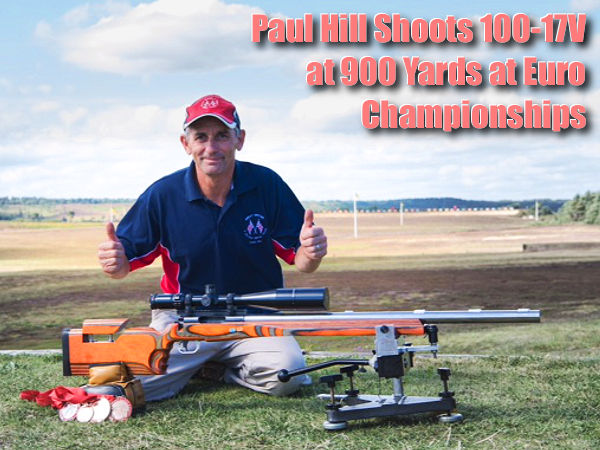
With every new season, standards in the F-Class game are climbing ever higher. Shooter are improving their skills set while equipment and loading techniques are improving (thanks in part to websites such as this). Evidence of the level of improvement in F-Class shooting comes from the UK, where a talented shooter drilled a new GBFCA record score. One of our rising stars on this side of the pond is F-Open shooter Paul Hill. He hails from England’s wide-open flat lands where the wind blows strongly in from the North Sea and where a shooter must soon learn to read the wind.
At the European Championships held in September at the Bisley ranges, Paul set a new record score at 900 yards — a 100-17V! That’s 17 shots placed in a five-inch circle the size of a CD (compact disc) at over half a mile. [NOTE: At Bisley, the maximum score is FIVE points, not ten points. So the maximum score for 20 shots is 100. Also what Americans call an “X” is called a “V” at Bisley.]
Record Set with Slower Pair Firing Method
Bear in mind the style of shooting here in Great Britain is pair-firing. Under this procedure, each of two competitors shoots alternately, taking turns from shot to shot. Each shooter has 45 seconds to get his shot off. Allowing for the target pullers to do their jobs, this means that each shot can take up to one minute. As Paul was pair firing, he had to concentrate for up to 40 minutes to get all 20 shots off! You can imagine how many times the wind changed course in those 40 minutes — pick-ups, let-offs, changes of angle and direction. Paul had to counter each change and still managed to keep 17 shots in that 5-inch circle!
Paul Hill Sets Record with His First-Ever DIY-Chambered Barrel
What makes this new GBFCA record all the more significant is that Paul did it by barreling his own rifle — and for the first time! By simply taking great care and attention he has chambered and fitted a barrel himself to the very highest standards. Paul chambered the Krieger 1:9″-twist barrel for the .284 Winchester cartridge. His action was a Barnard. The stock is by Joe West.
Record Shot with Lapua 180gr Scenars and Russian Primers
We should note that Paul Hill is a very keen fan of Lapua’s 180gr Scenar-L bullet. It has to be said that this bullet doesn’t have the highest BC, yet whatever it lacks in that department it more than makes up for by being remarkably consistent — and consistency counts for a lot. Paul is also a fan of the Russian KVB-7 primers. His achievement is proof that Lapua Scenars and KVB-7 primers are every bit as good as the premium-priced alternatives. The powder was Vihtavuori N160. [Editor: For its 180gr Scenar-L, Lapua lists a 0.661 G1 BC, and a 0.332 G7 BC. Those numbers may not top the charts, but they are still very impressive.]
Records are made to be broken, but we think it will be quite a while before Paul’s 200-17X is surpassed in European competition. If you feel up to that challenge, consider competing in next year’s European Championships in late September 2017.
When we first ran this story a while back, it generated great interest among readers. By popular request, we’re reprinting this story, in case you missed it the first time around. — Editor
Precision shooters favor premium brass from Lapua, Norma, or RWS. (Lake City also makes quality brass in military calibers.) Premium brass delivers better accuracy, more consistent velocities, and longer life. Shooters understand the importance of good brass, but many of us have no idea how cartridge cases are actually made. Here’s how it’s done.
The process starts with a brass disk stamped from strips of metal. Then, through a series of stages, the brass is extruded or drawn into a cylindrical shape. In the extrusion process the brass is squeezed through a die under tremendous pressure. This is repeated two or three times typically. In the more traditional “draw” process, the case is progressively stretched longer, in 3 to 5 stages, using a series of high-pressure rams forcing the brass into a form die. While extrusion may be more common today, RWS, which makes some of the most uniform brass in the world, still uses the draw process: “It starts with cup drawing after the bands have been punched out. RWS cases are drawn in three ‘stages’ and after each draw they are annealed, pickled, rinsed and subjected to further quality improvement measures. This achieves specific hardening of the brass cases and increases their resistance to extraordinary stresses.” FYI, Lapua also uses a traditional draw process to manufacture most of its cartridge brass (although Lapua employs some proprietary steps that are different from RWS’s methods).
After the cases are extruded or drawn to max length, the cases are trimmed and the neck/shoulder are formed. Then the extractor groove (on rimless cases) is formed or machined, and the primer pocket is created in the base. One way to form the primer pocket is to use a hardened steel plug called a “bunter”. In the photos below you see the stages for forming a 20mm cannon case (courtesy OldAmmo.com), along with bunters used for Lake City rifle brass. This illustrates the draw process (as opposed to extrusion). The process of draw-forming rifle brass is that same as for this 20mm shell, just on a smaller scale.
River Valley Ordnance explains: “When a case is being made, it is drawn to its final draw length, with the diameter being slightly smaller than needed. At this point in its life, the head of the draw is slightly rounded, and there are no provisions for a primer. So the final drawn cases are trimmed to length, then run into the head bunter. A punch, ground to the intended contours for the inside of the case, pushes the draw into a cylindrical die and holds it in place while another punch rams into the case from the other end, mashing the bottom flat. That secondary ram holds the headstamp bunter punch.
The headstamp bunter punch has a protrusion on the end to make the primer pocket, and has raised lettering around the face to form the headstamp writing. This is, of course, all a mirror image of the finished case head. Small cases, such as 5.56×45, can be headed with a single strike. Larger cases, like 7.62×51 and 50 BMG, need to be struck once to form a dent for the primer pocket, then a second strike to finish the pocket, flatten the head, and imprint the writing. This second strike works the brass to harden it so it will support the pressure of firing.”
Thanks to Guy Hildebrand, of the Cartridge Collectors’ Exchange, OldAmmo.com, for providing this 20mm Draw Set photo. Bunter photo from River Valley Ordnance.
The Nammo Group, parent of Lapua and Vihtavuori, has announced the acquisition of Berger Bullets, one of the USA’s leading bullet makers. With Berger Bullets joining the Nammo Group, this teams America’s ultra-premium bullet-maker with what is arguably the world’s most respected cartridge brass and ammunition-maker. This is huge news. For competition shooters this may be a “marriage made in heaven”. Many top shooters, including champions like Bryan Litz and John Whidden, are already shooting Berger bullets in Lapua brass. This merger will make it easier for the two companies (Berger and Lapua) to optimize the performance of factory ammo, as well as to optimize brass for use with Berger match projectiles.
A spokesman for Lapua said that Lapua will continue to make bullets in Europe while Berger will conduct its regular operations in the USA: “Lapua will still make bullets, and it will be ‘business as usual’ for Berger at this time. There are no plans to change production sites to consolidate product lines. Berger will continue to operate as an independent business, just under the Nammo umbrella.” NOTE: This acquisition will be subject to regulatory approvals by U.S. governmental authorities.
On firearm industry analyst believes this merger is a “win-win” for both Berger and Nammo: “This will help Berger export more product to the European market while it will give Nammo a stronger connection to the huge U.S. firearms market, expanding Nammo’s North American customer base”. Nammo president/CEO Morten Brandtzæg concurred, stating: “Having Berger Bullets on board is the perfect match for Nammo. Their products, which are complementary to our other premium brands, will strengthen our group’s strategic position in the U.S. commercial ammunition market.” This acquistion WILL include Berger’s ABM Ammunition and J-4 Jackets product lines.
Here is the press release issued by the Nammo Group, which is headquartered in Norway and has 2,100 employees in 12 countries:
On the heels of the announcement that Berger Bullets will join the Nammo group, the following information was posted on the Long Range Hunting Forum by Doc Beech of Applied Ballistics:
I would like to emphasize a couple of things before you read on. The [acquisition of Berger Bullets by Nammo] CHANGES NOTHING. Production will remain in the same facility, by the same people, to the same quality. Berger Bullets will remain the highest-quality bullets on the market. What this merger does, is it gives these companies [the opportunity] to work together, to provide the highest-quality ammunition.
Lapua is well known for its high-quality brass, VihtaVuori makes high-quality powder, and Berger makes high-quality bullets. When you put the three together, you have the possibility of unmatched, premium … factory ammunition. To be clear, this will not affect the quality or way that Berger bullets are produced.
Q & A about Berger Bullets Joining Nammo Group
Q. What are Nammo’s plans concerning Berger Bullets?
A. Nammo plans on operating Berger Bullets as a stand-alone brand with support from the Nammo Group in a number of areas. First, they would like to help Berger improve the availability of many of their bullets that are in high demand.
Q. Are you going to eliminate any specific bullets? In other words, do they need to stock up!
A. We have no immediate plans to discontinue any of our bullets. We will continue as a part of our normal business practice to discontinue bullets that have been replaced by a superior product or those that do not have a demand sufficient to warrant allocating time in our production schedule. This is just what we have always done as part of our process.
Q. Is Bryan Litz still going to be the ballistician for Berger Bullets?
A. Yes. Bryan is an important part of the Berger Bullet team and our plans definitely include keeping Bryan on as our lead ballistician.
Q. Is Eric Stecker going to remain in charge of Berger Bullets?
A. Eric Stecker will continue as President of Berger Bullets
Q. Are the same dealers going to carry Berger Bullets?
A. Yes, we have no plans to change the way we distribute Berger Bullets to the shooting community.
Q. Does this mean ABM Ammo will have direct access to components like powder and brass?
A. Yes.
__________________
Doc Beech – Applied Ballistics
doc.beech@appliedballisticsllc.com
www.abmediaresources.com – www.appliedballisticsllc.com
Vihtavuori has updated and enhanced its reloading information, adding VV powder load recipes for many more cartridge types. Data is now online for 64 rifle cartridge types and 26 pistol cartridge types. You’ll find the updated reloading data on the Vihtavuori Website. Bookmark this link: www.vihtavuori.com/en/reloading-data/about-reloading.html.
The updated online information supplements the Vihtavuori Reloading Guide (2016 Edition) available in PDF format. The online Reloading Database has dedicated sections for Rifle Cartridges, Pistol Cartridges, and Cowboy Action. There is also a handy, FREE Reload Mobile App for iOS and Android.
Vihtavuori’s Rifle Reloading Database is now very comprehensive. Many of the popular modern match cartridges such as the 6.5×47 Lapua and 6.5 Creedmoor are now included, and of course you’ll find the 6mm PPC, 6mmBR, and 6XC. (There is no .284 Win or 7mm RSAUM data unfortunately.) You will find recommended load recipes for all the following cartridges:
.204 Ruger
.221 Remington Fireball
.222 Remington
.22 Hornet
.22 PPC-USA
.223 Remington
.22-250 Remington
.223 WSSM
.243 Winchester
.243 WSSM
6mm PPC-USA
6mmBR Norma
6 XC
6mm Remington
.240 Weatherby Magnum
6.5 Grendel
6.5 x 47 Lapua
6.5 Creedmoor
6,5 x 55 Swedish Mauser
6,5 x 55 Swedish Mauser/ SKAN
6.5-284 Norma
.25-06 Remington
.260 Remington
.270 Winchester
.270 WSM
.270 Weatherby Magnum
7 mm-08 Remington
7 x 57
7 x 64
7 mm Remington Magnum
7 mm WSM
7 mm RUM
7 x 57R
7 mm Weatherby Magnum
7,5 x 55 Swiss GP31
.30 Carbine
.30-30 Winchester
.300 AAC Blackout
7,62 x 39
.300 Savage
7,62 x 53R (7,62 Russian)
.308 Winchester
.30-06 Springfield
.300 Lapua Magnum
.300 Remington Ultra Magnum
.300 Winchester Magnum
.300 Weatherby Magnum
.30-.378 Weatherby Magnum
.300 H&H Magnum
.300 WSM
.303 British
8 x 57 IRS
8 x 57 IS (8 mm Mauser)
.338 Winchester Magnum
.338 Lapua Magnum
9,3 x 62
9,3 x 66 Sako
9,3 x 74R
.375 H&H Magnum
.416 Rigby
.444 Marlin
.45-70 Government
.458 Winchester Magnum
.50 Browning
.32 S&W Long N.P.
.32 S&W Long Wadcutter
.357 Remington Maximum
.357 Magnum
.357 SIG
.38 Super Lapua
.38 Super Auto
.38 Special
7 mm GJW
7 mm TCU
7 mm BR Remington
7,62 x 25 Tokarev
9 mm Luger
9 x 21
9 x 23 Winchester
.40 S&W
10 mm AUTO
.41 Remington Magnum
.44 S&W Special
.44 Remington Magnum
.45 ACP
.45 Colt
.45 Winchester Magnum
.454 Casull
.500 S&W Magnum
.50 AE
Story Tip by EdLongrange. We welcome reader submissions.
Our friend Kirsten Joy Weiss is a modern-day Annie Oakley. A very successful competitive shooter in the collegiate ranks, Kirsten now produces a popular YouTube Channel focusing on the “Joy of Shooting”. In her videos, Kirsten offers shooting tips and performs a variety of trick shots — such as splitting cards with a .22 LR rimfire. This young lady can shoot, that’s for sure.
In this video, Kirsten shoots at some tiny reactive targets — “Pop-Its”. These pea-sized targets “pop” audibly when hit. They make a very challenging target, even when bunched together. Kirsten secured three (3) Pop-Its with a clothespin, and then placed the clothespin in the ground.
It took a couple tries, but Kirsten did manage to light off a Pop-It or two. Kirsten reports: “Basically a small exploding target, Pop-Its, also known as ‘Bang Snaps’, snaps, snappers, party snaps, etc., are a fun firework trick noisemaker — but will they make a good target? Let’s put it to the test to see if these poppers are gun range-worthy targets. These little Pop-Its make for some challenging shots with reactive targets.” Enjoy the video:
Equipment Report: For this video, Kirsten shot Lapua .22 LR ammo in a Volquartsen Ultra-lite semi-auto .22 LR rimfire rifle, fitted with a C-More Red-Dot sight. She was using Oakley eye protection.
Chuck’s Pair of Pennsylvania Dashers
There’s been a lot of interest in the 6mm Dasher cartridge lately, so we thought we’d showcase a matched pair of Dasher rifles belonging to a Forum member. The 6mm Dasher began as a wildcat improved version of the 6mmBR Norma cartridge. The 6mm Dasher has been very successful in competition, and now factory Norma-made Dasher cartridge brass is available from Bullets.com.
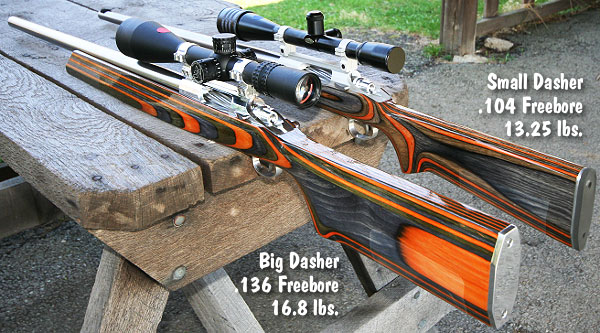
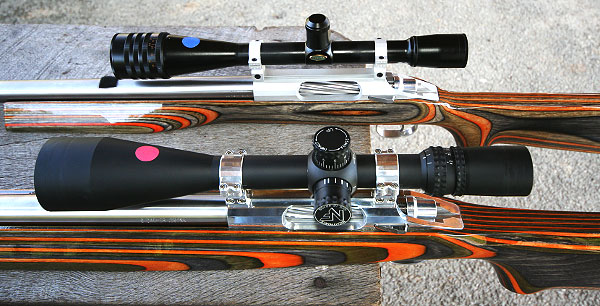
Forum Member Chuck L. (aka “Ridgeway”) has created a handsome duo of 6mm Dashers for competitive benchrest and varmint matches in Pennsylvania. Both guns are built on Kelbly Panda RBLP actions, with Bartlein 8-twist barrels, and Shehane Laminated Tracker Stocks. However, the two rifles are not exact twins, as you can see. One, which we’ll call the Big Dasher, is built on a Shehane ST1000 Tracker stock. The other gun, the Small Dasher, sports Shehane’s “Baby Tracker” stock — a design used with great success by Richard Schatz. The Big Dasher, optimized for 1000-yard competition, also has a slightly longer freebore — 0.136″ vs. 0.104″ for the Small Dasher.
Specifications for the Dasher Duo:
Small Dasher (13.5-pounder): Chambered for 6mm Dasher with approximately .104 freebore and a .264 NK. (No way of knowing exactly since it freebore was done in a separate operation by Kelbly.) Components are: Shehane Baby Tracker stock, Kelbly Panda RPLB action, Bartlein 1:8″ LV barrel at 26 ¾”, Kelbly Rings, Weaver T36, Jewell trigger. The barrel was chambered by Kelblys and the stock was bedded, glued and balanced by a shooting buddy (Forum Member johara1). I clear-coated the stock with auto urethane. Total weight is 13 lbs., 4 ounces.
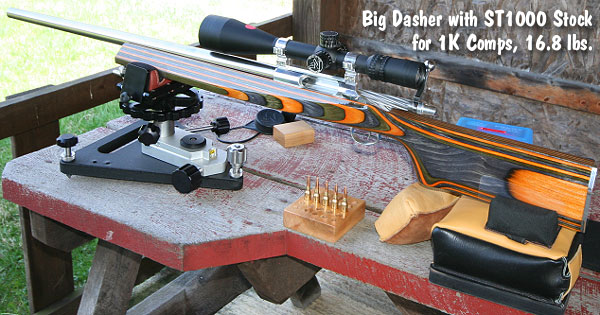
Big Dasher (1K Light Gun, 17-pounder): Chambered for 6mm Dasher with a .136 freebore and .264 neck (PTG Reamer). Components are: Shehane ST-1000 stock, Kelbly Panda RPLB action, Bartlein 1:8″ HV 5R barrel at 28″, Shehane +20-MOA rings, Nightforce NXS 12-42x56mm, Jewell trigger. The barrel work, pillar installation, and bedding was done by Dave Bruno. The stock was clear-coated by Chuck with auto urethane. Chuck also made the rear butt plate and balanced the rifle. Total weight: 16 lbs., 13 ounces.
Chuck tells us: “I don’t get out shooting competition as much as I want due to time and family, but when I do compete, I shoot a Groundhog match at Southfork Rifle Club in Beaverdale, PA. Info on Southfork Club events can be found at Southforkrifleclub.com. The Southfork match is basically a 100-, 300- and 500-yard match with one sighter the entire match and 5 shots at each yardage for score. The Small Dasher, with the shorter ‘Baby Tracker’ stock, was set up for the Southfork Rifle Club’s ‘Light Unlimited’ class which has a 13.5-lb max weight.” (Editor: ‘unlimited’ is a misnomer for a weight-limited category.)
Chuck adds: “The Big Dasher with the heavy ST-1000 stock is set up for 1000-yard benchrest matches in Light Gun class. I hope to shoot a couple 1K matches with it at Reade Range in southwest Pennsylvania. I am still in load development for this rifle since it was just finished in January. One ironic thing is, it shoots the same load I’m shooting out of the lighter gun rather well. The only difference between the two chambers is the freebore is roughly thirty thousandths longer on the 1K gun (Large Dasher). I will also shoot this at Southfork in the ‘Heavy Unlimited’ class.”
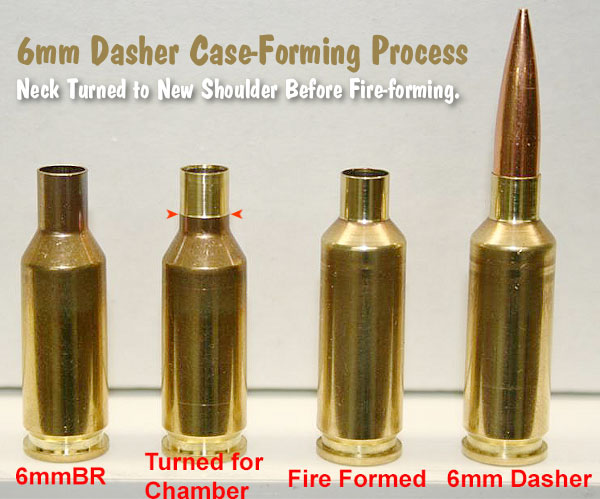
Dasher Case-Forming: Neck-Turn then Fire-form with Bullets Hard in Lands
To fireform, I turn my cases down to fit the chamber and stop where the false shoulder makes snug contact with the chamber. Fire-forming rounds are loaded up with a 29-grain charge of H4895 or Varget and a 108gr Berger bullet seated hard into the lands about 0.020″ past initial contact with the rifling. It takes about three firings to make a nice clean Dasher case with a sharp shoulder. I anneal about every 3-4 firings. I have many cases that have about 10+ firings on them and they are still shooting well. The primer pockets are a little looser, but still hold a primer.
Both Dashers Group in the Ones at 100 Yards
My main bullet for both rifles is the 107gr Sierra MK, loaded with Reloder 15 powder, Lapua cases and CCI 450 primers. My main load for the Small Dasher is 33.0 grains of Reloder 15. This load shoots in the ones at 100 yards. For the Big Dasher, I’m still working on a load, although the same 33.0 grain load shoots in the ones in the heavier gun as well. I’m still looking for more velocity and my ‘max’ node. So far, I’ve gone well above 33.0 grains of RL 15 without pressure signs, but that load produces vertical at 100 yards, so I’m going to tinker with the load until I see pressure or it starts to shoot.
Derek Rodgers, the only shooter to win both the F-Open and F-TR National Championships, has done it again. While shooting the Santa Fe Trail LR Regional match in Raton, New Mexico, it looks like Derek set a new 1000-yard record. Derek nailed his 1000-yard target, recording a 200-14X score — that’s twenty (20) shots for record, all tens with 14 in the X-Ring. Derek told us: “Yesterday at Raton New Mexico’s Whittington Center, I shot a 200-14X, which should be a new pending F-TR National Record at 1000 yards.” Derek took special pride in this accomplishment, as he held the F-TR record before: “I’m happy to have the record back. I have had three of the last four records”. Well done Derek!
Derek Rodgers .308 Win F-TR Rifle Equipment List:
McMillan Xit stock, Kelbly Panda LBLP action, Bartlein .308 Win barrel (32″, 1:11.25″ twist), Nightforce NXS 8-32x56mm scope. Note that Derek shoots right-handed, but with a LEFT BOLT. This allows him to stay in position better while cycling the bolt with his LEFT hand.
This impressive performance by Derek shows that the best F-TR rifles can rival the big F-Open rigs for pure accuracy, even though the favored F-Open chamberings, such as .284 Win and .300 WSM, are still ballistically superior to the venerable .308 Winchester used by nearly all F-TR competitors. For his record-breaking load, Derek used Berger 200gr Hybrid Target bullets in Lapua .308 Win (small primer pocket) brass, pushed by Hodgdon Varget powder.







 Precision shooters favor premium brass from