Leica just introduced its latest pocket-sized laser rangefinder, the CRF 1600-B Rangemaster. This unit features built-in angle compensation plus a ballistics solver that can give you either hold-over (in inches or cm) or clicks (from your zero) to put the shot on target at the ranged distance. At the heart of the CRF 1600-B is Leica’s Advanced Ballistic Compensation(ABC™) system, a precision integrated ballistics calculator that combines stored data with analysis of current ballistics parameters. To calculate projectile trajectory, the ABC™ system processes multiple ballistics variables, including measured distance, angle of incline, temperature, and absolute air pressure. The new 1600-B should be available in June, 2012. The “street price” should be the same as the current CRF 1600, $799.00.
There’s a lot of marketing mumbo-jumbo in the product release info, but what you need to know is that the new CRF 1600-B offers three important functions, in addition to ranging distance to target. These functions are: Angle Compensation, Display of Hold-Over, and Click-Value Display.
1. Built-in Angle Compensation
If you are taking an angled shot (whether up-hill or downhill), the 1600-B tells you the true horizontal component distance to the target. Use this number (as opposed to the line-of-sight distance to the target) to set your elevation. The 1600-B figures out the angle through a built-in inclinometer. This is a handy feature for hunters and tactical shooters, but it’s not really that innovative — other rangefinders have have offered angle compensation for quite some time. Still this is a nice feature that allows hunters to dispense with an angle indicator on their rifles, and you won’t have to work out math equations in the field.
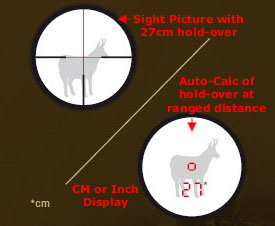
2. Hold-Over Values (Inches or CM)
When you range a target, the 1600-B can display the actual hold-over you need (at the ranged distance), either in inches or centimeters. Then you simply place your cross-hairs higher on the target, according to the hold-over value displayed in cm or inches. This works well — so long as you have some idea of the actual size of the target. If you don’t know if your prey is 4-feet tall or 6-feet tall then you can make mistakes. The hold-over display can read in either inches or cm. Holdover values, based on 12 pre-programmed ballistics curves, are given from 100 yards to 880 yards (compared to only 500 yards on the CRF 1600).
3. Elevation Click Values to Correct POI
One very handy feature of the new Leica 1600-B is that it automatically calculates the elevation clicks you need to correct your point of impact (POI) for the target range. First, you must select a matching ballistics curve (based on your muzzle velocity, bullet BC etc.). Then the 1600-B uses its built-in ballistics solver to calculate drop at the target distance, figuring in temperature and barometric pressure automatically. With a click of a button the 1600-B will displays the number of up-clicks you need to have the correct POI at the ranged distance. Available click values are: 1 MOA, 1/3 MOA, 1/4 MOA, 10 mm/100 m, 5 mm/100 m.
CRF 1600-B Rangemaster Specs (and Real-World Ranging Performance)
The new Leica 1600-B features a 7X monocular optic with 24mm objective and 3.4mm exit pupil. The external lenses have AquaDura® coatings. Though it’s packed with computing power, the 1600-B weighs just 8.1 ounces and, measuring 3″ x 1.63″ x 1.25″, it really does fit in a shirt pocket. Along with target distance, hold-over, and calculated clicks, the auto-adjusting red LED display can show Angle of Incline, Temperature, and Air Pressure.
Leica claims the 1600-B will range out to “approximately 1,600 yards”. Yes, in ideal conditions, the unit can nail a large, reflective object (such as a barn) at that distance, but you’ll find real-world performance on deer-sized targets to be quite different.
It is hard to hand-hold the tiny CRF 1600-B with sufficient stability to range small objects at extreme long distance. When testing the current CRF 1600 model we’ve found the practical max range for hand-holding on a deer to be about 800 yards, and even to do that you need very steady hands and a bit of practice. For long-distance ranging, we actually prefer a larger, flat-body design, such as the Zeiss Victory PRF, which can be rested more easily on a pack or sandbag. For the new 1600-B model, Leica claims measuring accuracy of +/- 1.1 yards to 400 yards, +/- 2.2 yards to 800 yards, and +/- 0.5% over 800 yards.
Last year we reported on the Bushnell Fusion 1600 ARC rangefinding binoculars. As first introduced, the Fusion 1600 was sold as a 10×42 binocular with ten-power magnification. Now Bushnell has introduced a larger, more powerful 12×50 Fusion ARC model. This has larger, 50mm objective lenses, plus 12X magnification. With a “street price” under $900.00, the new 12×50 Fusion 1600 is less than half the price of the less powerful 10×42 Leica Geovids ($2349.00) or Zeiss Victory RF Binoculars (10×45, $2,799.00). That huge price advantage makes the Fusion very tempting — but can Bushnell’s 1600 ARC binos perform as advertised?
Don’t Expect to Range a WhiteTail at 1600 yards
There is BIG difference between ranging a water tower, and ranging a deer-sized animal. Bushnell lists three different effective ranging distances for the Fusion 1600, and Bushnell claims only 500-yard effectiveness on deer-sized objects (vs. 1000 yards on trees). This is fairly consistent with our LRF comparison tests.
You can see the features of Bushnell’s new 12×50 Fusion 1600 ARC rangefinding binoculars in the video below. This also shows the smaller 10×42 Bushnell Fusion for comparison. The video does a good job explaining the functional differences between the 12X and 10X units, helping you decide which one best fits your needs. Surprisingly, the bigger Fusion is only about one ounce heavier. If you have any interest in a combo bino/rangefinder you should watch this video. The reviewer concludes the Fusions represent good value for the money.
Fusion 1600 ARC Features
The 12×50 roof prism binoculars feature built-in battery life indicator, twist-up eye pieces, and multi-coated optics with RainGuard. The Fusion 1600 is fully waterproof and submersible, meeting IPX7 “waterproof” specification. Owners have reported that the Fusion 1600 has good glass, and the red readouts are easy to see. Bushnell employs Vivid Display Technology™ (with four display brightness settings) to enhance display readability in all lighting conditions.
The built-in laser rangefinder features ARC (Angle Range Compensating) technology, which calculates the angle to the target (-90 to +90 degrees). ARC also and gives the hold-over range for the rifle shooter, and true horizontal distance for bow hunters. We like the fact that you can choose between Inches and MOA for holdover. There is a brush mode for measuring distances in heavy cover and a bullseye mode for ranging in open areas. The brush mode can filter out false returns from closer objects. This IS a useful feature that actually does work. The Fusion 1600 ARC laser rangefinder binoculars come with battery, neck-strap, and carrying case. Typical retail price for th 12×50 Fusion is around $900.00. For more info, visit www.bushnell.com or call 800-423-3537 for consumer inquiries.
Carl Zeiss Sports Optics has announced attractive consumer promotions that can save you hundreds of dollars. From May 1 through December 31, 2011, you can get a $50 mail-in-rebate on all Conquest Riflescopes with Rapid-Z® Ballistic Reticle. Zeiss will also offer a $100 mail-in-rebate on all Victory Riflescopes with Rapid-Z reticle. “Even though the economic outlook is improving, we know there are many people out there who are mindful of every dollar spent,” said Erik Schumacher, president of Carl Zeiss Sports Optics. “This is our way of helping hunters’ dollars go further.”
Zeiss Rangefinder Price Cut $100.00
Zeiss is also lowering the price of its Victory Laser RF binoculars by $200 and Victory 8×26 T* PRF laser rangefinder (LRF) by $100. NOTE: AccurateShooter.com recently conducted a comparison field test with the Zeiss Victory Laser PRF, Leica 1200, and the much more expensive Swarovski Laser Guide. The Zeiss Victory LRF ranged as well as the Leica and the Swaro out to 1000 yards, and we found the Zeiss to be easier to hold and aim than both the Leica and Swaro. Even before the price drop, we considered the Zeiss Victory LRF a “best buy”. The Zeiss LRF was the favorite of all three of our testers and it was the unit we eventually purchased with our own money.
Carl Zeiss is also offering special Victory DiaScope Spotting Scope kits at participating dealers. These kits include a DiaScope Spotting Scope (65mm or 85mm, straight or angled), with 15-56x / 20-75x Vario eyepiece and new Zeiss Carbon Fiber Tripod set. Purchasing these items as a kit yields a $300 savings to customers.
The innovative Zeiss 2.5-10x50mm Diarange riflescope with built-in Laser Rangefinder is now on sale at EuroOptic.com for $2400.00. That’s an amazing price — the Zeiss Victory Diarange 2.5-10x50mm normally sells for $3949.00. This represents a $1549.00 savings over the regular price — almost 40% off. (EuroOptic.com also has the Zeiss Victory Diarange 3-12×56 T* demo models for $3,200.00 marked down from $3,999.00.)
EuroOptic.com has about 40 units at this price. They are offered with either Rapid Z 800 or Rapid Z 600 reticles (both illuminated). The Zeiss Diarange is a unique products that combines a very high-grade riflescope with an integrated laser rangefinder. Measuring range for the laser is from 10-999 yards, with a measuring accuracy of ± 1 yard up to 600 yards and ± 0.5 % of reading at ranges beyond 600 yards. Ranging is fast and the scope offers outstanding low-light performance.
For a hunter looking to simplify his load-out, the Diarange allows you to sight your prey and range it with one device. You can keep both hands on the rifle at all times and you can keep your muzzle on target while you’re ranging. Eurooptics’ $2400.00 price is a lot of money, to be sure, but consider that the discounted Diarange gives you a high-end scope AND a rangefinder for about the same price as a Zeiss Diavari scope by itself.
Today at the SHOT Show’s “Media Day at the Range”, Burris gave us a glimpse of the future in hunting optics. The new Burris Eliminator scope will range your target, calculate your trajectory, and illuminate a spot on the reticle that becomes your aimpoint at extended range. We could write a treatise on the Eliminator’s breakthrough technology, but all you really need to know is that after you range your target with the scope, a red dot appears on the vertical crosshair that is the correct aiming point for your ranged distance. The ballistics “hold-over” is already calculated. Just put the calculated red dot on the target, and pull the trigger. It’s that simple.
The new “Eliminator” scope is being introduced as a 4-12x42mm optic, for an expected $850.00 street price. The laser is activated with a simple push-button on the left side of the scope, and also comes with a remote switch that you can attach to the rifle in a more convenient position allowing the laser to be activated while maintaining the aim of the rifle. In the above photo you can see the remote switch on the objective end of the scope.
Once the target range is acquired, the range displays for about 10 seconds and the illuminated aiming dot remains illuminated for 70 seconds. The illumination clock allows plenty of time to pull off a good shot, yet saves battery life.
So how does the Burris LaserScope calculate the appropriate trajectory of your load? The software in the scope contains a database of hundreds of factory-loaded cartridges and even calculates handload trajectories using two (2) user-provided data points. The user inputs the zero range (100 or 200 yards) along with the inches of drop at 500 yards. The 500-yard drop is best found by real world shooting, not by using a calculated trajectory approximation from a ballistic program. The scope’s software then uses the zero-distance and the 500-yard drop figure to extrapolate the entire trajectory.
While shooting this scope on a Tikka 7mm-08, we successfully engaged targets from 350-570 yards that were approximately the size of a whitetail deer’s vitals area. Seeing how the conditions were not very conducive to accurate shooting with rain and a 5-15 mph switchy wind, we were impressed with the results.
For those that hunt or shoot out to about 600 yards or so, this scope will definitely speed up the process of pulling off an accurate long range shot. In a matter of seconds, you can locate a target, range it, and engage it. There is no time wasted fumbling with a separate laser rangefinder, no time wasted looking at a drop chart, and no time wasted clicking in the appropriate amount of elevation. As long as you can get a range on your target, the only thing left to worry about is the wind! This scope is obviously not for everyone, but we are confident that many hunters can benefit from this remarkable new technology.
Burris Eliminator Specs:
Click value 1/4″ at 100 yards
Weight 26 ounces; length 13″
Eye Relief 3-3.5″
Elevation Travel 50″
Laser range 550-800 yards based on reflectivity
Newcon Optik, based in Toronto, Ontario, Canada, produces many optics products for the Canadian military including laser rangefinders, image stabilizers, and night-vision gear. Newcon Optik also sells a line of laser rangefinders for consumers. Newcon claims that its rangefinders offer performance comparable to Leica, but at a much lower cost. The Newcon Optik LRM2000 Pro is designed to function out to 2000 meters, with a “reliable, all-conditions range” of at least 1500 yards. The LRM2000 Pro sells for $499.95 at SWFA.com, making it considerably cheaper than comparable models from Leica and Swarovski.
AccurateShooter.com has not been able to field test the LRM2000 Pro ourselves. For that reason it was not included in our Review of Laser Rangefinders done in 2007. However, we’ve handled the unit at SHOT Show and there are many features we like. First, it has a selectable reticle, offering a choice between a small rectangle and a cross-hair. By contrast, the $890.00 Swarovski Laser-Guide only offers a rather large aiming circle. Some hunters have complained the Swaro’s reticle is just too big for deer-sized animals out past 600 yards or so.
FEATURES
1 – Measurement result
2 – Units of measurement (Yards, Meters, Mils, Degrees)
3 – Low battery indicator
4 – Over 100m indicator (LRM 2500, LRM 2500CI Models only)
5 – Laser active indicator
6 – Target quality indicator (optional)
7 – Reticle (cross or rectangular selectable)
We also like the Newcon Optik’s shape and ergonomics. Sized 4.72″ x 4.8″ x 2.36″, the Newcon is flat and easy to hold, with non-slip rubber grip sections on both left and right sides. You can hold the brick shape securely with two hands, horizontally, like using binoculars.
By contrast, Leica went to an ultra-compact, vertical design for its latest CRF1200 rangefinder. The CRF’s small size makes the Leica easy to carry, but it is more difficult to hold the Leica stable when precise aiming is needed. With the Newcon Optik, you can set it flat on top of a case or rucksack and it’s easier to maintain a solid grip. The LRM2000 Pro also offers a built-in digital compass, a nice feature for anyone in the outdoors.
In the video below, Alex Rudi of Newcon Optik explains the features of the LRM2000 Pro model:
How do the Newcon Optik rangefinders perform in the field? Do they live up to the claims of Leica-class performance? We invite our readers who own or use Newcon Optik rangefinders to add their comments.


 1. Built-in Angle Compensation
 2. Hold-Over Values (Inches or CM)
 3. Elevation Click Values to Correct POI


 EuroOptic.com has about 40 units at this price. They are offered with either Rapid Z 800 or Rapid Z 600 reticles (both illuminated). The Zeiss Diarange is a unique products that combines a very high-grade riflescope with an integrated laser rangefinder. Measuring range for the laser is from 10-999 yards, with a measuring accuracy of ± 1 yard up to 600 yards and ± 0.5 % of reading at ranges beyond 600 yards. Ranging is fast and the scope offers outstanding low-light performance.




 By contrast, Leica went to an ultra-compact, vertical design for its latest CRF1200 rangefinder. The CRF’s small size makes the Leica easy to carry, but it is more difficult to hold the Leica stable when precise aiming is needed. With the Newcon Optik, you can set it flat on top of a case or rucksack and it’s easier to maintain a solid grip. The LRM2000 Pro also offers a built-in digital compass, a nice feature for anyone in the outdoors.


