|
|
May 25th, 2017
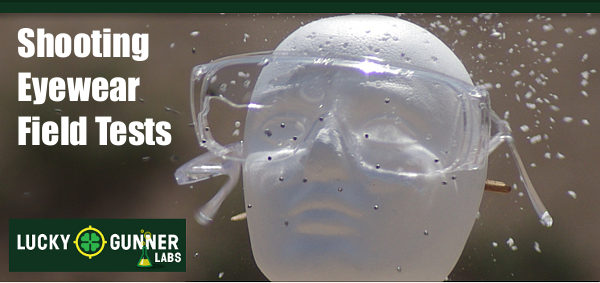
If you’re one of those folks who doesn’t wear eye protection, you need to check out the LuckyGunner Labs Eye Protection Test. For those who DO wear safety glasses — don’t assume that everything is OK. Just because you purchased name-brand “safety glasses” doesn’t mean that you are getting truly effective protection. In fact, many forms of protective eyewear sold today are flimsy, or poorly made. Consequently, they won’t stop even low-energy, slow-velocity fragments.
CLICK HERE to Read Complete Eyewear Test Report by LuckyGunner Labs.
 Two years ago, LuckyGunner Labs conducted very extensive field tests of 28 types of eyewear, ranging in price from $7 to $220. Remarkably, some of the most expensive safety eyewear performed no better than $10 items. Many of the products failed shockingly — with the lenses coming right out of the frames when hit with pellets. LuckyGunner recorded these kind of failures even with ANSI Z87-“approved” eyewear. The reason is that the Z87 test is not tough enough: “The basic ANSI standard is referred to as Z87, and you’ll see this marked in a number of locations on most eye protection marketed to shooters. However, the Z87 impact standard involves a .25″ steel ball traveling at 150 fps — this is fine for protecting eyes from debris that might fall or be thrown, but is not extremely relevant to shooters, who are dealing with objects traveling at much higher velocities.” Two years ago, LuckyGunner Labs conducted very extensive field tests of 28 types of eyewear, ranging in price from $7 to $220. Remarkably, some of the most expensive safety eyewear performed no better than $10 items. Many of the products failed shockingly — with the lenses coming right out of the frames when hit with pellets. LuckyGunner recorded these kind of failures even with ANSI Z87-“approved” eyewear. The reason is that the Z87 test is not tough enough: “The basic ANSI standard is referred to as Z87, and you’ll see this marked in a number of locations on most eye protection marketed to shooters. However, the Z87 impact standard involves a .25″ steel ball traveling at 150 fps — this is fine for protecting eyes from debris that might fall or be thrown, but is not extremely relevant to shooters, who are dealing with objects traveling at much higher velocities.”
| Standard |
Impact speed |
Caliber/Size |
ANSI Z87.1-2003
High Velocity |
150 feet/second
45 meters/second |
0.25″ diameter steel ball
(25 caliber) |
Mil-PRF-31013
Vo ballistic test |
640-660 feet/second
195 meters/second |
0.15 inch diameter steel projectile (15 caliber) |
The testers recommend you select eyewear that meets military specification (above and beyond ANSI Z87). The MIL-PRF-31013 Standard covers projectiles up to 650 feet per second. This is much more stringent. Additionally, you want to replace often-used protective eyewear every year or so. Long-term exposure to UV radiation can weaken polycarbonate and lessen its ability to withstand impacts.
SUMMARY — What to Look for in Protective Eyewear
THE GOOD — Eyewear Protects Against Direct Hit with .22 Short Bullet
APEL Revision Sawfly eyewear was shot with a .22 Short, pushing a 29 grain bullet at 710 fps. That’s not powerful by modern firearm standards, but this might be fairly representative of a ricochet bullet fragment. The Sawfly lens stopped this 29gr bullet with minimal damage to the cheek area.

THE BAD — Remington Eyewear Lenses Separate. Right Lens Enters Eye Socket
The most gruesome example was the cheap Remington eyewear which shed both lenses back towards the eyes, one of which embedded itself into the eye socket. The real-world implications of this action are disturbing to say the least.

THE UGLY — Prescription Glasses Failed Miserably
Many ranges don’t see any need for protective eyewear beyond prescription glasses. However, most prescription lenses offer little if any protection. If the prescription lenses are glass, this can create more problems. As shown below, these prescription glasses offered no ballistic protection, and, in fact, proved more dangerous to the eyes due to the flying glass shards.

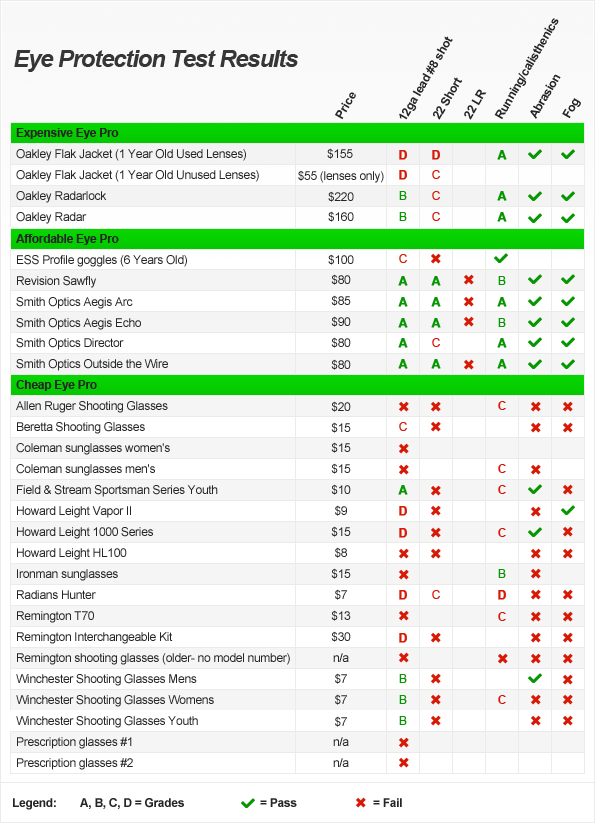
Results Chart, Video Clips, and Photos copyright Luckygunner.com.
Summary and Conclusions:
For faster-moving projectiles such as ricochet fragments, you need high quality, tested eye protection. LuckyGunner recommends eyewear with a single (one-piece) lens for any activity where your face might be struck by small, fast-moving objects. Individual lenses detach from the frames once a certain level of force is reached, and they are driven back into the eye sockets, where considerable damage may be done. There are good examples of protective eyewear with two separate lenses, but a broad, one-piece lens distributes force much better.
 A wide, comfortable, and preferably soft rubber nosepiece is critical. Along with good “arms”, this will serve to keep the eye protection in place and will also reduce the chances of the lens being driven down or back into the face with enough force to damage the orbital bones. A wide, comfortable, and preferably soft rubber nosepiece is critical. Along with good “arms”, this will serve to keep the eye protection in place and will also reduce the chances of the lens being driven down or back into the face with enough force to damage the orbital bones.
A frame that connects across the top of the lens, not individual arms which attach to the outside corners of the lens, is recommended. This will reduce the chances of the lens detaching from the frame under impact (it’s still possible, just less likely). Some types of eye protection actually use the frame to absorb impact and distribute force.
NOTE: Andrew, the author of the LuckyGunner Eyewear report, was a former Navy Corpsman. Accordingly, he is familiar with health and safety matters.
February 6th, 2017

 When shopping for a new riflescope or spotting scope it’s easy to get confused by all the technical terminology. Do you wish you had a better way to compare scopes — beyond just size, weight, and price? Well Swarovski Optik can help. The Swarovski Hunting Blog offers a helpful guide to technical terms used when comparing scope specifications. Here are some important definitions, expressed in layman’s language: When shopping for a new riflescope or spotting scope it’s easy to get confused by all the technical terminology. Do you wish you had a better way to compare scopes — beyond just size, weight, and price? Well Swarovski Optik can help. The Swarovski Hunting Blog offers a helpful guide to technical terms used when comparing scope specifications. Here are some important definitions, expressed in layman’s language:
Objective Lens Diameter
The objective lens diameter determines the size of the optical system’s entrance pupil. The bigger the objective lens diameter, the more light the system can capture. However, the size of the objective lens does not determine the size of the field of view.
Exit Pupil
The size of the Exit Pupil is determined by the objective lens diameter and the magnification. If you look at the eyepiece from a distance of around 30 cm (11.8 in), the Exit Pupil appears as a bright disc.
For calculating the Exit Pupil the formula is:
Exit Pupil = objective lens diameter ÷ magnification (expressed in power number).
The larger the Exit Pupil, the more light will reach the eye.

Field of View
The Field of View is the size of the circular section of the area which can be observed when you look through a long-range optical device. In the case of rifle scopes, it is specified at a distance of 100 meters or 100 yards. For example, 42.5 m at 100 m or 127.5″ at 100 yards. As an alternative, the Field of View can also be stated in degrees (e.g. 6.6°).
NOTE: The technically-feasible size for the Field of View is essentially determined by the magnification. The higher the magnification the smaller the Field of View.
Twilight Factor
The Twilight Factor defines the optical system’s performance in poor light. The statement “the greater the twilight factor, the better the suitability for twilight” only applies if the exit pupil is larger than or at least as big as the eye’s pupil. The pupil in the human eye can only open to around 8 mm. As we get older, our eyes become less flexible, which limits our ability to see things in twilight or at night. Therefore [an optic’s] exit pupil cannot always be fully utilized.
For calculating the Twilight Factor the formula is:
Twilight Factor = root of ( magnification x objective lens diameter ).
NOTE: Spotting scopes have extremely high twilight factors because of their high magnification and large objective lens diameter. But [when used at high magnification] their small exit pupil can make them [somewhat difficult] to use in twilight.
CLICK HERE to Read Full Article (with more illustrations).
Photos copyright Swarovski Optik Blog, all rights reserved.
Story Tip by EdLongrange. We welcome reader submissions.
July 26th, 2016

 What is the most-used piece of equipment on this editor’s reloading bench? No it’s not my Rock-Chucker press, or even my calipers. The one item in near-constant use is a small, folding magnifying glass. Mine folds into a square case and offers 4X viewing with an 8X bifocal insert. With this handy tool I can inspect case mouths for burrs, check primer pockets, inspect meplats, and look for flaws on bullet jackets. I also use the magnifier to see rifling marks on bullets seated into the rifling, or check my bolt for galling. The number of uses is nearly endless. I keep one magnifier at my reloading bench and another in my range kit. What is the most-used piece of equipment on this editor’s reloading bench? No it’s not my Rock-Chucker press, or even my calipers. The one item in near-constant use is a small, folding magnifying glass. Mine folds into a square case and offers 4X viewing with an 8X bifocal insert. With this handy tool I can inspect case mouths for burrs, check primer pockets, inspect meplats, and look for flaws on bullet jackets. I also use the magnifier to see rifling marks on bullets seated into the rifling, or check my bolt for galling. The number of uses is nearly endless. I keep one magnifier at my reloading bench and another in my range kit.
Folding magnifiers are so handy yet inexpensive that you should own a couple spares (including one in the range box). I bought my magnifier in a book-store, but you can also find them on the web at FoldingMagnifier.com and WidgetSupply.com starting at just $1.95. To see the finest details, Widget Supply offers a powerful 9X/18X slide-out magnifier with a built-in, battery-powered LED light. With that gadget, you can easily see any minute flaws in your barrel crowns. That’s important because crown damage can cause hard-to-diagnose accuracy issues. We’ve known guys who spend weeks tinkering with loads, when the real problem was a worn-out or damaged crown.
July 3rd, 2016

There is one subject as to which we should all be in agreement — the need to wear quality, protective eyewear whenever one uses a firearm. Sadly, it’s not uncommon, at the range, to see shooters wearing no eye protection, or wearing cheap, “dime-store” glasses that can shatter on impact.
This video from Luckygunner Labs shows what can happen with low-quality eyewear. When hit with pellets, the left lens came out and the right lens entered the eye socket!
Read Our Guide to Protective Eyewear
We’ve created a comprehensive Guide to Protective Eyewear. Forum member ChuckW2 told us: “That was the most important article that has ever been posted on this site. I am amazed how many people do not wear glasses while shooting or hunting. Great read….” If you haven’t done so already, read the story. We guarantee you’ll learn something new.
The Eyewear Guide explains the safety standards that apply to protective eyewear and reviews the best lens materials currently available including Polycarbonate, Trivex™, and SR-91. You may not have heard of Trivex, but it is probably the best material out there right now — it’s tough, lightweight, and has better optical properties than Polycarbonate. SR-91 is a good choice for those who need a polarized lens. Our Eyewear Guide also includes a section by Danny Reever on Prescription Shooting Glasses. Danny discusses the available options in lens materials and has many helpful recommendations.
Along with our reviews of lens materials, tint properties, and frame design, we highlight a study done by the NRA’s American Hunter magazine. 10 popular brands of eyewear were tested, with some very interesting results. The testers observed that price does not necessarily assure quality. Relatively inexpensive Bollé VX and Pyramex eyewear both worked better than some expensive brands.
On the other hand, don’t select eyewear simply because it’s cheap or easy to find. American Hunter editor Jeff Johnston observed: “It’s a mistake to assume that any plastic-lens sunglasses off the rack at the local 7-11 are made of polycarbonate and therefore are effective as shooting glasses—cheap plastics are not polycarbonates; in fact, wearing them could be worse than wearing nothing, as they can introduce sharp shards of plastic to your eyes in addition to the projectile(s) that caused them to break.”
September 3rd, 2015

Based on its external appearance, a modern riflescope may seem simple. It’s just a tube with two or three knobs on the outside right? Well, looks can be deceiving. Modern variable focal-length optics are complex systems with lots of internal parts. Modern scopes, even ‘budget’ optics, use multiple lens elements to allow variable magnification levels and parallax adjustment. We had a chance to look inside a riflescope thanks to a product display from ATK, parent of Alliant Powder, CCI, Federal, RCBS, Speer, Weaver Optics. ATK sliced open a Weaver Super Slam scope so you can see the internal lens elements plus the elevation and windage controls. We thought readers would like to see the “inner workings” of a typical modern rifle scope, so we snapped some pictures. The sectioned Super Slam scope was mounted inside a Plexiglas case, making it a bit hard to get super-sharp images, but you can still see the multiple lenses and the complex windage and elevation controls.


February 11th, 2015
Editor’s comment: The new lens technology described here is a big deal. The “flexible” polymer lens is nothing short of revolutionary — there’s never been anything like it on a riflescope (though our own human eyes have flexible lenses). In the world of optics, this is as noteworthy a development as the touch-screen was for personal computing. Flexible, “adaptive” lenses can potentially be employed for a wide variety of products, from cameras to spotting scopes. Think about the benefits of “instantaneous zoom” for security cameras.

Sandia’s RAZAR Scope Features Flexible Lenses That Can Change Focal Length Instantly
Sandia National Laboratories has developed a truly game-changing piece of optical technology at the direct request of the Department of Defense: the RAZAR (Rapid Adaptive Zoom for Assault Rifles). Fundamentally different than every other riflescope ever made, the RAZAR represents a revolution in lens design and function. Until now, all riflescopes used a set of rigid, hard lenses (usually glass). The new RAZAR utilizes an advanced set of flexible polymer lenses that allow the user to toggle between high and low magnification with the press of a button. The RAZAR can literally zoom in and out in the blink of an eye (250 milliseconds).
The RAZAR works in conjunction with a tactical-style optic, such the Leupold HAMR (top photo). This tandem (two-part) sighting system combines the conventional scope’s eyepiece and illuminated reticle with the RAZAR’s ultra-fast zooming capability. Unlike traditional eyepiece (ocular) magnifiers, the RAZAR sits in front of the primary optic.
See RAZAR Demonstrated in Sandia Labs Video
Game-Changing Technology
The RAZAR’s instant, push-button zoom capability gives soldiers the ability to change field of view and magnification without re-positioning their grip on the rifle, unlike traditional variable-power riflescopes. This capability can be invaluable to a soldier in combat.
Michael Squire, a former SFC with Special Operations Research Support Element, said the ability to zoom between near and far targets within seconds, without taking his hand off the weapon, is “game-changing.” Squire added: “The difference that can make, especially with somebody shooting back, could mean life or death…”
The secret to the RAZAR’s high performance lies within the development of the advanced technologies within the scope. A hermetically sealed, flexible polymer lens core encapsulates a proprietary polymer liquid, and this core then works in tandem with glass lenses to form the basis of the optical design.

Rapid changes in magnification are accomplished via a piezoelectric motor that changes the curvature of the lenses, achieving the correct positioning within 250 milliseconds within an accuracy level of 100 nanometers. When zooming, these electronically-controlled actuators act much like the tiny muscles that allow the human eye to change focus from near to far. Human eyes have flexible lenses controlled with muscles*. The RAZAR has flexible lenses controlled by tiny electric motors.


It’s important to highlight the reliability that Sandia was able to build into the RAZAR. The system requires very little mechanical power to operate, and can undergo up to 10,000 zoom actuations on a single set of two standard AA batteries. The ultrasonic motor draws no power unless it’s being used to bend the soft lenses, which makes the RAZAR very reliable. If the batteries do go flat, the RAZAR remains fully usable — the system simply stays at the last magnification level until the batteries are replaced.

Sandia’s RAZAR design provides a large, clear viewing aperture, without sacrificing any of the optical quality found in traditional riflescopes. The RAZAR is also shock-proof, vibration-proof and capable of operating in a very wide temperature range.

The Future of “Instant Zoom” Adaptive Lenses
Sandia Labs is developing other specialty lenses in the near-infrared, short wave-infrared and mid-wave infrared spectrum, primarily for DOD use. However, Sandia has suggested that its flexible polymer-lens technology could be adapted for other imaging applications where rapid zoom is needed, such as binoculars, spotting scopes, and even security cameras. For more information, visit the Sandia Labs website.

*Changing the curvature of the human eye lens is carried out by the ciliary muscles surrounding the lens. They narrow the diameter of the ciliary body, relax the fibers of the suspensory ligament, and allow the lens to relax into a more convex shape. A more convex lens focuses divergent light rays onto the retina allowing for closer objects to be brought into focus.
About the Author
Kip Staton is a freelance gun writer based in North Texas, and loves to blog about news within the firearms industry and his perceptions on marksmanship. Kip is a content marketer, copywriter and digital strategist for an award-winning Dallas marketing agency. To read more by Kip, visit KipStaton.com.
December 14th, 2014
 With the price of some premium scopes approaching $3000.00 (and beyond), it’s more important than ever to provide extra protection for your expensive optics. ScopeCoat produces covers that shield scopes with a layer of neoprene rubber (wetsuit material) sandwiched between nylon. In addition to its basic covers, sold in a variety of sizes and colors, ScopeCoat has a line of heavy-duty 6mm products that provide added security. With the price of some premium scopes approaching $3000.00 (and beyond), it’s more important than ever to provide extra protection for your expensive optics. ScopeCoat produces covers that shield scopes with a layer of neoprene rubber (wetsuit material) sandwiched between nylon. In addition to its basic covers, sold in a variety of sizes and colors, ScopeCoat has a line of heavy-duty 6mm products that provide added security.
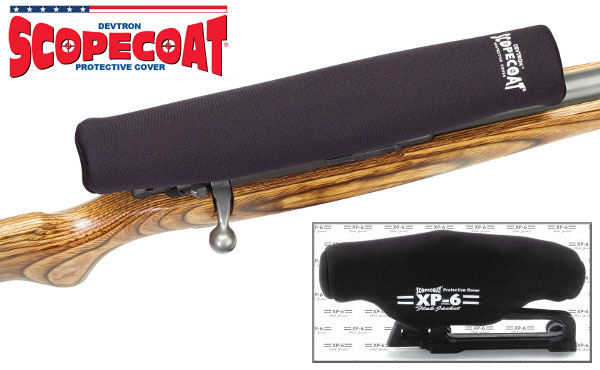
Triple-Thickness XP-6 Model for Added Protection
The XP-6 Flak Jacket™ is specifically designed for extra protection and special applications. The 6mm-thick layer of neoprene is three times thicker than the standard ScopeCoat. XP-6 Flak Jackets are designed for tall turrets, with sizes that accommodate either two or three adjustment knobs (for both side-focus and front-focus parallax models). To shield an expensive NightForce, March, or Schmidt & Bender scope, this a good choice. XP-6 covers come in black color only, and are available for both rifle-scopes and spotting scopes.
 The heavily padded XP-6 Flak Jacket is also offered in a Zippered version, shown at right. This is designed for removable optics that need protection when in storage. The full-length, zippered closure goes on quick-and-easy and provides more complete protection against dust, shock, and moisture. MSRP is $30.00. The heavily padded XP-6 Flak Jacket is also offered in a Zippered version, shown at right. This is designed for removable optics that need protection when in storage. The full-length, zippered closure goes on quick-and-easy and provides more complete protection against dust, shock, and moisture. MSRP is $30.00.
Special Covers for Binos and Red-Dots
ScopeCoat offers many specialized products, including oversize covers for spotting scopes, protective “Bino-Bibs” for binoculars, rangefinder covers, even sleeves for small pistol scopes and red-dot optics. There are also custom-designed covers for the popular Eotech and Trijicon tactical optics. Watch the Shooting USA video below to see some of ScopeCoat’s latest specialty covers.
September 23rd, 2013
What is the most-used piece of equipment on this editor’s reloading bench? No it’s not my Rock-Chucker press, or even my calipers. The one item in near-constant use is a small, folding magnifying glass. Mine folds into a square case and offers 4X viewing with an 8X bifocal insert. With this handy tool I can inspect case mouths for burrs, check primer pockets, inspect meplats, and look for flaws on bullet jackets. I also use the magnifier to see rifling marks on bullets seated into the rifling, or check my bolt for galling. The number of uses is nearly endless. I keep one magnifier at my reloading bench and another in my range kit.
Folding magnifiers are so handy yet inexpensive that you should own a couple spares (including one in the range box). I bought my magnifier in a book-store, but you can also find them on the web at FoldingMagnifier.com and WidgetSupply.com starting at just $1.95. To see the finest details, Widget Supply offers a powerful 17X/50X slide-out magnifier with a built-in, battery-powered LED light. With that gadget, you can easily see any minute flaws in your barrel crowns. That’s important because crown damage can cause hard-to-diagnose accuracy issues. We’ve known guys who spend weeks tinkering with loads, when the real problem was a worn-out or damaged crown.

July 3rd, 2012
Those of us over-40 types can use some help when shooting iron sights. As one gets older, your eyes lose the ability to rapidly adjust to different points of focus. In practice, when shooting a rifle, this means the target image may be sharp but the sights are blurry, or vice-versa. Or you may be able to see the target and front sight reasonably well, but the rear sight is a complete blurr. (That is this Editor’s problem when shooting a rifle, such as a Swedish Mauser, with a notched blade rear sight.) Even if you are using a rear peep sight, you may see a blurry rear circle (or two circles if you have astigmatism). Placing a diopter on your shooting glasses can help many people see open sights better, when shooting both handguns and rifles.

 Merit Corp. in Schenectady, NY, offers an adjustable metal diopter that attaches to shooting glasses with a rubber cup. Though primarily intended for pistol shooters, the Merit diopter can also be helpful when shooting rifles with open sights, such as military bolt actions. Priced at $65.00, the Merit device features a shutter-style adjustable aperture iris. Merit Corp. in Schenectady, NY, offers an adjustable metal diopter that attaches to shooting glasses with a rubber cup. Though primarily intended for pistol shooters, the Merit diopter can also be helpful when shooting rifles with open sights, such as military bolt actions. Priced at $65.00, the Merit device features a shutter-style adjustable aperture iris.
 Merit explains: “The human eye, whether or not prescription glasses are required, cannot focus on both sights and the target at the same time. The eye will constantly shift focus from the sights to the target trying to ensure proper alignment. Unfortunately, as we age, the eye loses the flexibility which allows it to do this; thus, sights and target begin to grow fuzzy. There is a simple way to combat this by increasing your eyes’ depth of field (range of focus). If you look through an aperture or pinhole of the correct size, you will be able to see both sights clearly, and the target will be clearly defined as well.” Merit explains: “The human eye, whether or not prescription glasses are required, cannot focus on both sights and the target at the same time. The eye will constantly shift focus from the sights to the target trying to ensure proper alignment. Unfortunately, as we age, the eye loses the flexibility which allows it to do this; thus, sights and target begin to grow fuzzy. There is a simple way to combat this by increasing your eyes’ depth of field (range of focus). If you look through an aperture or pinhole of the correct size, you will be able to see both sights clearly, and the target will be clearly defined as well.”
In addition to diopters for eyeglasses, Merit produces a variety of adjustable iris sight products for rifles, including the Variable Iris Aperature for AR15s. Visit MeritCorporation.com or call (518) 346-1420.
Cheaper Diopter from Lyman
If you can’t afford a Merit adjustable diopter, Lyman offers a similar all-plastic device for under $20.00. The Lyman Hawkeye Shooting Aid mounts directly to your eyeglass lens with a rubber suction cup. The diopter section is made of plastic, and aperture diameter is non-adjustable.

Though it is simple and inexpensive, the Lyman Hawkeye works for many shooters, if positioned properly. (Don’t think this is anything close to the Merit Diopter in quality though!) Currently, Cabelas.com has the Lyman Hawkeye on sale for just $12.88, item # IK-229094. MidwayUSA sells the Lyman Hawkeye for $18.99, item # 936878. One MidwayUSA customer reports:
“This thing really works! I have it on my shooting glasses, and it has made a significant improvement in my ability to keep the front sight and target in focus at the same time. If you are older and find that you are having a hard time keeping the target in focus over ‘iron sights’, then this may be the answer to your problem. Mine works equally well for both pistol and rifle, although I do have to change the device’s position on my shooting glasses when changing weapon types.”
November 30th, 2011
Nikon has raised the bar in Spotting Scope technology. It has introduced the first-ever spotters with built-in Vibration Reduction. This may be a significant breakthrough. Image stabilization has revolutionized hand-held photography, and it could definitely improve the practical functioning of spotting scopes. If you have ever used a big, heavy spotting scope, you know that it is easy to induce vibration and shaking — merely with a heavy hand on the focus knob. And when the wind blows, a big scope acts like a sail, so it can wobble and vibrate in gusts. Just a small amount of shake or vibration can make it difficult to see your target, slowing down your target acquisition time considerably.

Nikon’s new 85mm EDG Fieldscopes are the first spotting scopes on the planet with lens-adjusting image stabilization. The EDGs employ a lens-shift type VR (Vibration Reduction) system that counters vibration and shaking. According to Nikon, the EDG VR system greatly reduces external vibrations caused by wind and the operational vibrations occurring during focusing, panning and tilting. Nikon claims its VR system reduces vibration to 1/8th the level of a conventional spotting scope.
HOW IT WORKS — This system uses two independent Angular Velocity sensors to detect pitching (vertical movement) and yawing (horizontal movement). Both sensors then detect diagonal movements. Upon the detection of movement, the sensors provide instructions to the two Voice Coil Motors (VCM) that command and control the Vibration Reduction-optical system to eliminate the shake or blurring. These sensors can detect movement every 1/1000 second. The system can effectively reduce vibrations by roughly 88% (compared to a conventional spotting scope), providing the equivalent of a shutter speed approximately two stops faster.

So how much does this new VR technology cost? Hold on to your hat — MSRP for the 85mm EDG VRs (either body style) is a shocking $5,499.95! At least that includes eyepiece and protective case. We can only hope that, as this technology matures, it will be implemented at much lower cost. Consider that $200.00 point-and-shoot cameras now offer image stabilization. Given time, we can expect the vibration reduction systems to go down in price, and to become commonplace in premium spotting scopes.
Available in a straight or angled body, the all-new EDG VR Fieldscopes come standard with a 20-60x Zoom Eyepiece, ED (Low-Dispersion) glass, and multi-coated lenses. The 85mm EDGs feature a five-meter close focus distance and waterproof, fogproof construction. Weighing in at just over 84 ounces (w/o batteries), the straight-body EDG is 14.9″ long, while the angled version is 15.7″ long. Nikon’s VR system takes four AA batteries which provide roughly 17 hours of battery life with alkaline batteries and up to 32 hours with lithium. While the VR function can be manually activated, an auto power-off function helps conserve battery life. Seven optional EDG eyepieces are available. Three tripod mount screw holes permit flexible mounting.

|


