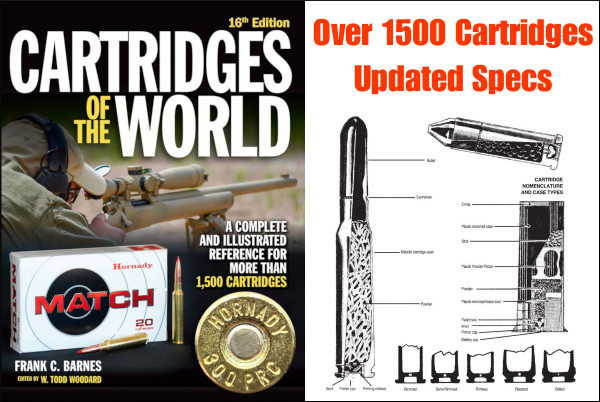
Cartridges of the World (16th Edition), belongs in every serious gun guy’s library. This massive 688-page reference contains illustrations and load data for over 1500 cartridge types. If you shoot a wide variety of cartridges, or are a cartridge collector, this book is a “must-have” resource. The latest edition (release date 7/23/2019) includes 50 new cartridge types and 1500+ photos. This print version can be ordered for $26.49 at Amazon.com (plus shipping and tax), while a Kindle eBook version costs $14.99.
Updated 16th Edition with Feature Articles
The 16th Edition of Cartridges of the World includes cartridge specs, plus tech articles on Cartridge identification, SAAMI guidelines, wildcatting, and new cartridge design trends. Cartridges of the World, the most complete cartridge reference guide in print, now includes a lengthy full-color section with feature articles such as 7mm Rem Magnum, .44 Special History, and “P.O. Ackley’s Best Improved Cartridges”.
Cartridges of the World 16th Ed. CHAPTERS:
Chapter 1: Current American Sporting Cartridges
Chapter 2: Obsolete American Rifle Cartridges
Chapter 3: Wildcat Cartridges
Chapter 4: Proprietary Cartridges
Chapter 5: Handgun Cartridges of the World
Chapter 6: Military Rifle Cartridges of the World
Chapter 7: British Sporting Rifle Cartridges
Chapter 8: European Sporting Rifle Cartridges
Chapter 9: American Rimfire Cartridges
Chapter 10: Shotgun Shells
Chapter 11: U.S. Military Ammunition
Chapter 12: Cartridge ID by Measurement
Cartridges of the World by author Frank C. Barnes was first published in 1965. The 16th Edition is edited by W. Todd Woodard, Editor of Gun Tests magazine and author of several firearms reference books. Frank Barnes (1918-1992) began collecting information on handgun cartridges at the early age of 12, thanks to his father, a police officer. Frank Barnes was an innovative cartridge designer, who invented the original 308 x 1.5″ Barnes, predecessor of the 30BR case.
Before Frank began a law enforcement career, he was a college professor. Frank was also a pilot, and a race-car driver. Learn more about Cartridges of the World (15th Ed.) at www.gundigest.com.
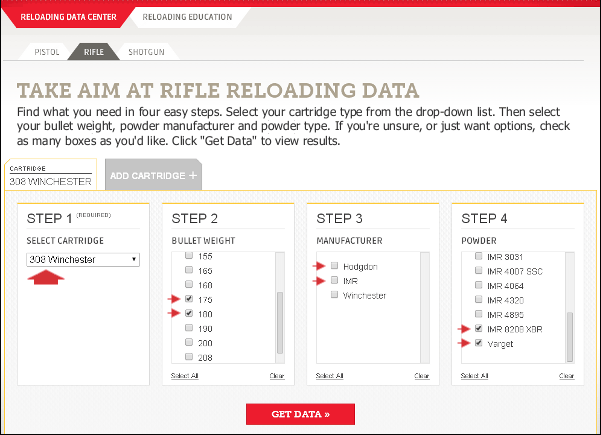
Looking for a good load for a new rifle? Or perhaps you want to try a new powder and bullet combo for an existing rig. One of the best places to start for load data is Hodgdon’s online Reloading Data Center for pistol, rifle, and shotgun reloaders. Check out the Reloading Data Center at www.HodgdonReloading.com.
In the Data Center, you’ll find thousands of load recipes for pistol, rifle, and shotgun. Rifle shooters will find dozens of loads for their favorite Hodgdon, IMR, and Winchester powders such as H4198, H4895, Varget, H4350, and IMR 8208 XBR. And Hodgdon’s Reloading Center is “mobile-friendly” so it works well with smartphones and tables. Navigation is easy, and you can set the search criteria easily choosing your favorite powder or bullets. After choosing a cartridge, you can pre-select specific bullet weights and powder types. That quickly delivers just the information you want and need. You won’t have to scroll through scores of entries for bullets or powders you don’t use.
Mobile users will notice that the current Hodgdon Reloading Center is much more “user-friendly” for smart-phone and tablet users. Controls have been optimized for touch-screens, and buttons are large and easy to use. Likewise the results are displayed in a large, easy-to read format.
How to Get Started with Handloading
Getting started in Reloading? Ultimate Reloader offers a helpful introductory video that covers the basics. In addition, a recent Ultimate Reloader article reviews the types of reloading presses, plus the other gear you’ll need, from dies to powder dispensers.
Here is a very interesting test for the 6 BRA (6mmBR Ackley) cartridge. Forum member James Phillips, a talented long-range benchrest shooter, tested SIX different primer types from three different manufacturers. To help determine vertical dispersion, James set his target out at 500 yards. He then proceeded to shoot 4-shot groups, in order, with each primer type. Velocities were recorded with a chrono. The photo above shows the results. James says: “I’ll retest the best two for accuracy and consistency with 10 shots each”. CLICK HERE for full-screen target photo.
As you can see, ALL the groups are pretty impressive. The smallest groups, 1.253″, was shot with CCI 400 primers. Next best (and very close) was CCI BR4, at 1.275″ for four shots. The “flat line” winner was the Remington 7.5, at upper left. There was almost no vertical. If you are intrigued by this interesting primer test, you can ask join the discussion in this Primer Test FORUM THREAD.
Primer Brand
Group Size
Velocity
Extreme Spread
Std Deviation
Remington 7.5
1.985″ 4 shot
2955 FPS
8 FPS
4.0 FPS
Federal 205M
2.200″ 4 shot
2951 FPS
11 FPS
4.8 FPS
Sellier Bellot SR
1.673″ 4 shot
2950 FPS
14 FPS
5.9 FPS
CCI 450M
2.341″ 4 shot
2947 FPS
14 FPS
6.6 FPS
CCI 400
1.253″ 4 shot
2950 FPS
3 FPS
1.3 FPS
CCI BR4
1.275″ 4 shot
2949 FPS
15 FPS
6.9 FPS
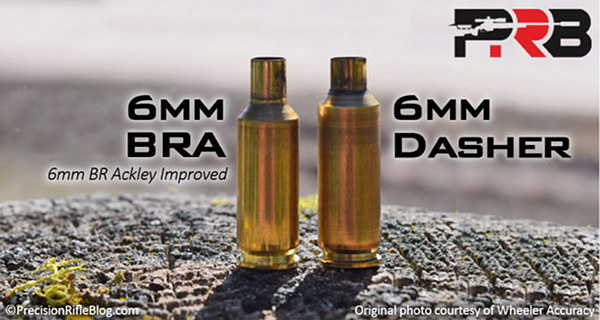
CARTRIDGE: 6mmBR Ackley, aka 6 BRA. Parent case is 6mmBR Norma. The 6 BRA is fire-formed to create a 40-degree shoulder and less body taper. Capacity is increased, but the neck is longer than a 6mm Dasher. The capacity is enough to get to the 2950+ FPS accuracy node. Some shooters say the 6 BRA is more forgiving than the 6mm Dasher. The 6 BRA is certainly easier to fire-form.
TEST REPORT — Conditions, Shooting Method, Loading Method
Tester James Phillips posted this report in ourShooters’ Forum:
Conditions: The testing was done in the morning over flags. The flags never moved or even twitched. I had as perfect conditions as I could have asked for. It was overcast so no mirage and no wind. There were no other shooters, just me.
Test Procedure: Each shot was precisely shot at my pace and centered the best possible using my Nightforce 15-55X scope. I did not use the round-robin method. Each four-shot group with the same was shot at one time. Then I moved onto the next primer. Everything felt right for each and every shot fired today. Of course I could repeat the test tomorrow and it could be exact opposite of today’s test. We can chase this forever. But [soon] I’m going to test the BR4 and 400 primer… for best accuracy and consistency for 10 shots each.
How Rounds Were Loaded: Each load was weighed to one (1) kernel of powder. So I know that’s as good as I can weigh them. Each bullet seating force was within 1# on my 21st Century hydraulic arbor press.
Previous Initial Load Testing: All groups were shot with 31.1 grains of H4895. During initial load testing I settled in on the Sellier & Bellot primer to finalize everything as it showed more promise over the CCI 450 Magnum I also tried. I was actually surprised to have seen the higher ES and SD from that primer today along with the vertical shown. [Editor: Look carefully — one shot from the CCI 450 is right in the center black diamond, stretching the vertical. By contrast the Rem 7.5 had almost no vertical.]
Velocity and NODE Considerations: I was about 5-6 FPS above what appeared to been my optimum velocity of 2943-2945 FPS, so I’ll test 5 shots of 31.0 and 5 of 31.1 and see what happens from there. I can only assume my velocities where higher due to the higher humidity and of course temps were 5 degrees warmer this morning as well. It wasn’t far off but I noticed it.
Western Powders has released its NEW Handloading Guide, Edition 7.0. This $2.99 print resource contains the latest load data for Western’s propellants including Accurate, Ramshot, and Blackhorn powders. Edition 7.0 features the most current data available for Ramshot and Accurate powders, including popular LT30 and LT32, and new Accurate TCM, Accurate 11FS and Ramshot LRT propellants. This latest load guide also has load data for the new 224 Valkyrie, 300 Norma, and 30 Nosler cartridges. Along with reloading recipes, this resource features helpful articles on handloading methods and rifle maintenance/cleaning with X-Treme products.
In the new Handloading Guide 7.0 , you’ll find load data for over 100 rifle cartridges. The cartridge listings are up to date — you’ll find the popular new mid-sized competition cartridges, such as the 6.5 Creedmoor and 6.5×47 Lapua, along with many popular wildcat varmint cartridges, such as the 20 Vartarg, 20 Tactical, and 20 BR. Benchresters will also find recipes for the new LT 30 and LT 32 powders which have proven very accurate in the 30BR and 6PPC respectively.
Download FREE Version 6.0 Guide:
If you can live without the very latest info, you can still get Version 6.0 of Western’s Reloading Guide for FREE. That’s right Version 6.0 is a FREE downloadable PDF. This FREE Reloading & Load Data Guide (Edition 6.0) contains thousands of recipes for handgun and rifle cartridges (plus shotshell and muzzle-loading info).
Looking for a good load for a new rifle? Or perhaps you want to try a new powder and bullet combo for an existing rig. One of the best places to start for load data is Hodgdon’s online Reloading Data Center for pistol, rifle, and shotgun reloaders. Check out the enhanced Data Center at www.HodgdonReloading.com.
In the Data Center, you’ll find thousands of load recipes for pistol, rifle, and shotgun. Rifle shooters will find dozens of loads for their favorite Hodgdon, IMR, and Winchester powders such as H4198, Varget, H4350, and IMR 8208 XBR. And Hodgdon’s Reloading Center is “mobile-friendly” so it works well with smartphones and tables. Navigation is easy, and you can set the search criteria easily choosing your favorite powder or bullets. After choosing a cartridge, you can pre-select specific bullet weights and powder types. That quickly delivers just the information you want and need. You won’t have to scroll through scores of entries for bullets or powders you don’t use.
Mobile users will notice that the updated/enhanced Reloading Center is much more “user-friendly” for smart-phone and tablet users. Controls have been optimized for touch-screens, and buttons are large and easy to use. Likewise the results are displayed in a large, easy-to read format.
Hodgdon tip from EdLongrange. We welcome reader submissions.
Speer Ammunition has just released the latest edition of its reloading handbook: The Speer Handloading Manual No. 15. Shipments of this new book are being delivered to dealers now. It will be available on Amazon next week. The MSRP for the new Speer Manual is $34.95. We think the new book is worth the price — it is well-organized and quite complete. But if you are not a fan of conventional books, be aware that you can get a significant portion of Speer’s rifle and pistol load data for FREE on Speer’s website.
Why Buy the Book?
» New DATA for 6.5 Creedmoor and 12 More New Cartridge Types
» Complete Instructions for Handloading Rifle and Pistol Cartridges
» Updates for More Than 120 Cartridge Types
This new edition is Speer’s largest volume yet, featuring updated recipes with the latest propellants for more than 120 legacy cartridges. In addition, the new 15th Edition includes load data for 13 popular new cartridges, including 6.5 Creedmoor, .204 Ruger, and 300 Blackout. The 15th Speer Handloading Manual also features authoritative articles by expert shooters.
FREE Online INFO and DATA from Speer
On its website, Speer-Ammo.com, Speer also offers Rifle and Pistol Reloading Data, Reloading Safety Page, Step-by-Step Handloading Guide, and helpful Glossary of Reloading Terms.
Vihtavuori markets a full line of quality, European-made powders for rifles and pistols. Finland-based Vihtavuori is operated by the same parent company, Nammo, that owns Lapua and Berger Bullets. If you haven’t tried Vihtavuori powders yet, you may be pleasantly surprised. For loading .45 ACP, our favorite powder is VV N320 — it burns clean and is very accurate. Likewise, VV makes excellent powders for rifle applications — from small varmint cartridges to large magnums.
New Reloading Data Released Vihtavuori offers free reloading data on its website, and through a free Mobile App. And now those resources are even more complete…
Last week, Vihtavuori added new reloading data for ten different cartridge types, including some of the most popular pistol and rifle cartridges. You’ll find new pistol data for 9mm Luger and .45 ACP, and extensive new load data for .223 Rem, .260 Rem, .308 Win, and .30-06 Springfield (among others). Overall the 2018 data update features over 20 new bullets, with more than 140 new lines! All new data is also available in FREE Vihtavuori Reload App for iOS and Android. The updated online information supplements Vihtavuori’s Reloading Databases, which have dedicated sections for Rifle Cartridges, Pistol Cartridges, and Cowboy Action.
New Reloading Data is available for these TEN cartridge types:
If you own an AR, you’ve probably heard of the hot, new .224 Valkyrie cartridge. Basically a 6.8 SPC necked down to .22, the Valkyrie has a shorter case than the .223 Remington (and 5.56×45 NATO). This allows you to load the longest, heaviest .224-caliber bullets and still feed reliably from an AR15-type magazine. With Sierra’s remarkable new 95-grain MatchKing, this gives the little Valkyrie long-range performance that can rival some much larger cartridge types. Sierra Bullets states: “The [Valkyrie] case length is shorter than the 223 Remington affording the use of heavier match-grade bullets with very long ogives and high ballistic coefficients. This offers … super-sonic velocities at ranges greater than the .223 Remington and the 6.5 Grendel can achieve at magazine length”.
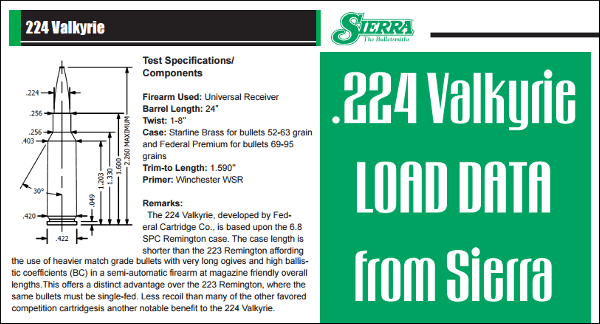
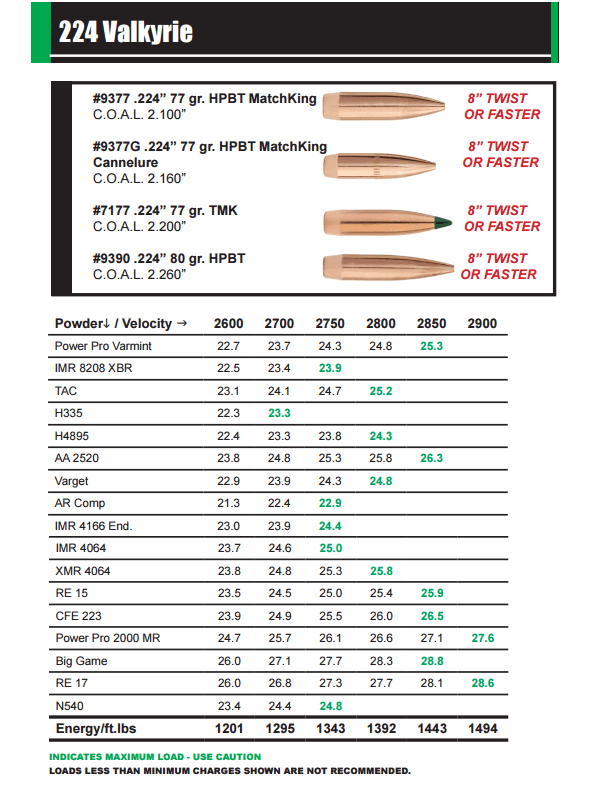
If you’re considering a .224 Valkyrie, you’re in luck — Sierra Bullets has just released comprehensive LOAD DATA for this new cartridge. Sierra has published loads for a broad range of bullet weights from 52 grains all the way up to 95 grains. Loads for 20 bullet types and 22 powders* are listed.
Shown below is Sierra’s load data for bullet weights from 77 grains to 90 grains. Values in green indicate MAXIMUM loads — use CAUTION. NOTE: This is only a partial sample, less than a third of the data Sierra has published. Download Sierra’s Full 4-page PDF to view all the data, including load information for Sierra’s new 95gr .224-caliber MatchKing with claimed 0.600 G1 BC.
The new .224 Valkyrie was introduced late last year as a Hot Rod cartridge that will work in AR15s. Designed to rival the .22 Nosler while still running well in ARs, the new .224 Valkyrie offers excellent long-range performance when loaded with modern, high-BC bullets. We expect some bolt-action PRS shooters might adopt the .224 Valkyrie. Why? Reduced recoil. With the 90gr SMK, the .224 Valkyrie offers ballistics similar to the 6.5 Creedmoor but with significantly less felt recoil. Check out this chart from Federal showing comparative recoil levels:
* All the following powders were tested, but not all for each bullet weight: Accurate 2520, Accurate XMR 2495, Accurate 4064, Hodgdon AR Comp, Hodgdon Benchmark, Hodgdon CFE 223, Hodgdon H335, Hodgdon H380, Hodgdon H4895, Hodgdon Varget, IMR 4064, IMR 4166, IMR 8208 XBR, Power Pro 2000 MR, Power Pro Varmint, Ramshot Big Game, Ramshot TAC, Reloder 10X, Reloder 15, Reloder 17, Vihtavuori N540, Winchester 760.
Written by Sierra Bullets Ballistic Technician Duane Siercks
One of the first things new reloaders notice is that load data varies between reloading manuals. The Sierra Bullets Technicians frequently get inquiries asking us to explain why the load data appears to be inconsistent. This article explains five key factors that can influence published load data.
Example of load data variances for two 168 grain bullets:
Here are five reasons why the load data varies:
The Bullet
Basically, the similarities in the .30 caliber 168 grain Match bullets (for example) end with weight and diameter. The bullets likely have dimensional differences such as bearing surface length. Bearing surface has a large effect on pressure and velocity. There are also differences in boat tail, flat base, ogive and over-all lengths, which each help determine the cartridge over-all-length (COAL). With different COAL’s, we can expect changes in pressure and velocity also. In some calibers there are differences in bullet diameter with different bullet manufacturers.
It is also worth noting that bullet manufacturers do not all use the same copper alloy for their jackets. This produces more or less friction that results in load pressures and velocities. The solid copper bullets also vary quite a bit in comparison to a lead core and copper jacketed bullet.
The Gun
Each gun is unique, even if you are using the same make, model, and caliber. Special consideration should be used to consider that not all firearm chambers are the same either, creating more variables that need consideration. There can be drastic differences in the throat length. This controls the amount of “jump” that a bullet experiences when the cartridge is fired.
The Powder
Within normal manufacturing tolerances, you can see some variation in a given powders burn rate between different lots of the same powder. So naturally when two different Manuals are produced, it would be doubtful that the same lots would be tested.
The Cartridge Cases
New cases are almost always near minimum specs in dimension. A load fired in a new case would likely have slightly more pressure that when fired in a re-sized case. This would certainly be true if we were loading into fire-formed cases that have had minimal re-sizing done. Fired cases that are full length resized most of the time be slightly larger than the new unfired cases. This gives you differences in case capacity. The same powder charge placed within a new case and a full length resized case will produce different pressure levels and probably different velocities.
Conditions
Temperature can cause pressure increases or decreases. Hot temperatures tend to cause pressures to increase, while cold temperatures will usually do the opposite. Humidity and altitude can impact pressures and velocities likewise.
Conclusion
As you can see, an amazing number of variables effect any load combination. With the differences in the manuals, you’re just seeing firsthand examples of what took place when the data was collected with that particular set of components and firearm. Think of a reloading manual as a report. In essence, a reloading manual says, “We tried this particular component combination, and these are the results we obtained.”
Remember that you may or may not reach the same maximum load safely. There is no “one load fits all bullets.” The minimum load data offers a safe place to start. The maximum load data listed should always be regarded as a safety guideline and not necessarily a goal! Your gun should shoot accurately without breaching the maximum load data. The best advice is: always start low and work your load up!
If you have questions about variances in load data or other reloading questions, please call our ballistic technicians at 1-800-223-8799 or send us an email at sierra [at] sierrabullets.com.
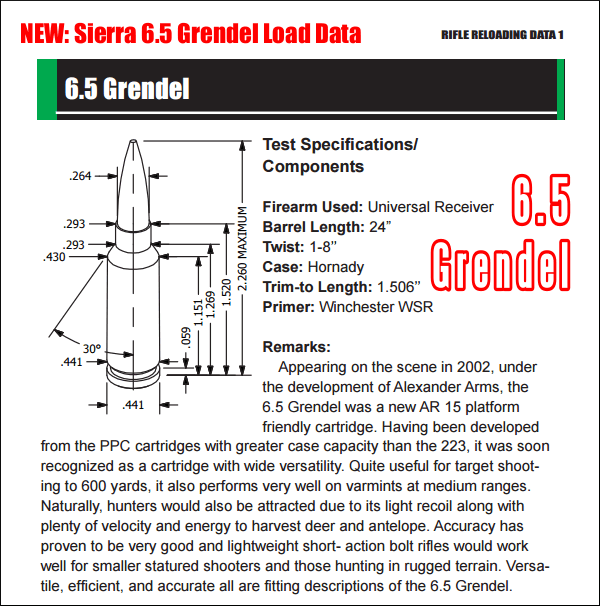
Sierra Bullets has just released load data for the 6.5 Grendel, a popular cartridge that works equally well in bolt guns and AR15-platform gas guns. Sierra published comprehensive 6.5 Grendel load data, covering 19 powders and eight (8) different bullets from 85 to 130 grains. NOTE: Hornady-brand brass (see below) was used for Sierra’s 6.5 Grendel tests, not the stronger Lapua 6.5 Grendel brass. Hand-loaders using Lapua 6.5 Grendel brass may need to adjust their loads. Also Winchester WSR primers were used. We imagine most precision hand-loaders will prefer CCI or Federal primers.
Sierra Bullets Tested for 6.5 Grendel Load Data
85gr HP (#1700)
100gr HP (#1710)
107gr HPBT (#1715)
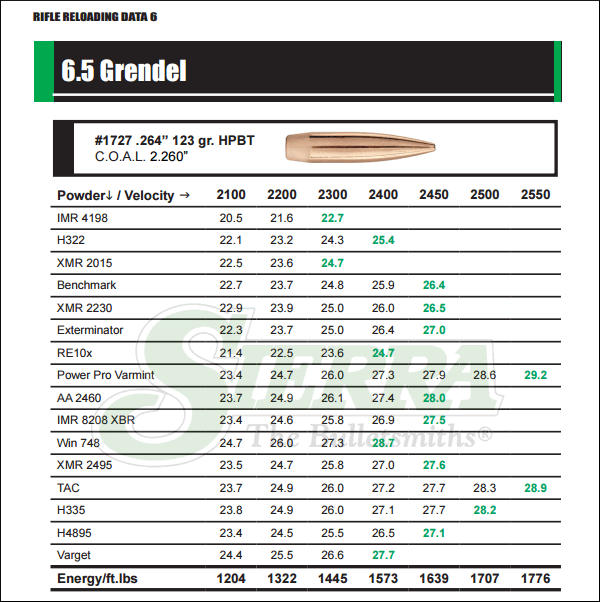
In developing its 6.5 Grendel load data, Sierra tested a very wide selection of propellants, 19 in all. For the 85gr to 100gr varmint bullets, modern powders such as XMR 2230, Power Pro Varmint, and Ramshot TAC offered the best velocity in the 24″ test barrel. For the heavier 120gr to 130gr match bullets, Sierra tested a selection of powders. Highest velocities came with Power Pro Varmint and TAC. If you’re looking for best accuracy, consider the slower burn-rate powders such as IMR 8208 XBR and Varget — but you’ll sacrifice some speed. Overall, Sierra’s latest 6.5 Grendel load data is an excellent addition to the 6.5 Grendel knowledge base. Thanks Sierra!
Here are Sierra’s 6.5 Grendel Load Data Charts for Sierra’s 123gr HPBT, 130gr HPBT, and 130gr TMK. There are a five other tables for lighter-weight Sierra bullets.
History of the 6.5 Grendel Cartridge
The 6.5 Grendel originated as a 6mm PPC necked up to 6.5 mm. After Alexander Arms relinquished the “6.5 Grendel” Trademark, the 6.5 Grendel was standardized as an official SAAMI cartridge. It has become popular with target shooters and hunters alike because it is accurate, efficient, and offers modest recoil. Good for small to medium game, the 6.5 Grendel is becoming a popular chambering in lightweight hunting rifles, such as the Howa Mini Action Model. It is one of the most accurate cartridges you can shoot in the AR-15 platform.