John Whidden of Whidden Gunworks used the .243 Winchester cartridge to win the 2016 NRA Long Range Championship, his fourth LR title at Camp Perry. John selected the .243 Win because it offers excellent ballistics with manageable recoil. John says that, at least for a sling shooter, the .243 Win is hard to beat at long range. Yes, John says, you can get somewhat better ballistics with a .284 Win or .300 WSM, but you’ll pay a heavy price in increased recoil.
.243 Winchester — The Forgotten 6mm Cartridge for Long Range
by John Whidden, 2016 National Long Range Champion
My experience with the .243 cartridge for use as a Long Range High Power cartridge dates back about 10 years or so. After building a .300 WSM, I realized that the recoil was hurting the quality of my shots. The WSM shot great, but I couldn’t always execute good shots when shooting it. From here I built a 6.5-284, and it shot well. I also had a very accurate 6mmBR at the time, and my logic in going to the .243 Win was to get wind performance equal to the 6.5-284 with recoil similar to the 6mmBR. The experiment has worked out well indeed!
Championship-Winning Load: Berger Bullets, Lapua Brass, and Vihtavuori N160
For a load, currently I’m shooting Lapua brass, PMC primers (Russian, similar to Wolf), VihtaVuori N160 single-base powder, and Berger 105 grain Hybrid bullets. I switched to the Hybrid bullets fairly recently at the beginning of the 2015 season. Previously I shot the 105gr Berger hunting VLDs, and in testing I found that the Hybrids were just as accurate without having to seat the bullet into the lands. The velocity of this combination when shot through the excellent Bartlein 5R barrels (32” length) is around 3275 FPS.
For my match ammo, I seat the Berger 105 Hybrids well off the lands — my bullets are “jumping” from .035″-.060″. I only use one seating depth for ammunition for multiple guns (I know some benchrest shooters will stop reading right here!) and the bullets jump further in the worn barrels than in the fresh barrels. The bullets are pointed up in our Bullet Pointing Die System and are moly-coated. The moly (molybdenum disulfide) does extend the cleaning interval a little bit, probably 20% or so. The Lapua .243 Win brass is all neck-turned to .0125″ thickness.
Whidden’s .243 Win Ammo is Loaded on a Dillon
My loading process is different than many people expect. I load my ammo on a Dillon 650 progressive press using our own Whidden Gunworks dies. However powder charges are individually weighed with a stand-alone automated scale/trickler system from AutoTrickler.com (see below). Employing a high-end force restoration scale, this micro-processor controlled system offers single-kernel precision. The weighed charges are then dropped into the cases with a funnel mounted to the Dillon head.
The Lapua .243 Win brass is full-length sized every time, and I run one of our custom-sized expanders in my sizer die. The expander measures .243″ which yields the desired .001″ neck tension. In my experience, the best way to get consistent neck tension is to run an expander in the case neck at some point. When sizing the case neck by a minimal amount such as is the case here, I don’t find any negative points in using an expander in the sizer die.
In my experience, the keys to accurate long range ammo are top quality bullets and the most consistent neck tension you can produce. From these starting points, the use of quality components and accurate powder measurement will finish out the magic.
Great Ballistics with 6mm 105s at 3275 FPS
Running at an impressive 3275 FPS, Berger 6mm 105 grain Hybrids deliver ballistics that are hard to beat, according to John Whidden:
“My .243 Win shoots inside a 6.5-284 with 142-grainers. Nothing out there is really ahead of [the .243], in 1000-yard ballistics unless you get into the short magnums or .284s and those carry a very significant recoil penalty. In the past I did shoot the 6.5-284. I went to the .243 Win because it had similar ballistics but had much less recoil. It doesn’t beat me up as much and is not as fatiguing.
With the .243 Win, there’s no tensing-up, no anticipating. With the reduced recoil (compared to a 7mm or big .308), I can break and shoot very good quality shots. I find I just shoot better shots with the .243 than I ever did with the 6.5-284.”
John Whidden of Whidden Gunworks won his fourth Long Range National Championship at Camp Perry this month. In this article, the first of a three-part series on Long Range competition, John shares his thoughts on wind strategies and keeping one’s composure in pressure situations. John tells us Camp Perry was very challenging this year: “The 2016 Long Range Championship will go down in my memory as one with quick wind changes that made it very easy to shoot a 9.”
How to Win at Long Range Shooting
(Or at least what worked at the 2016 National Championships)
by John Whidden, 2016 National Long Range Champion
The NRA Long Range National Championships at Camp Perry Ohio are now in the history books and the competitors are home and reflecting on what they could have done to improve their score. I think anyone who has ever competed always knows they could have done even better if they had changed this detail or that aspect. This is the case regardless of where a shooter places in the standings, even for the winners.
This year the winds were reasonably tough. We mostly have either headwinds or winds from the 2-3 O’clock positions with speeds often in the 9-11 mph range. The changes came quickly and we had to be on our toes. Fortunately the course of fire allows the shooters some options. For the 1000-yard matches, we typically have 33 minutes for preparation, an unlimited number of sighter shots, and then 20 shots for record. Many shooters will shoot about 3-5 sighters and complete the task in about 15 minutes.
The 2016 Long Range Championship was definitely a match where you had to fight for every point during the whole event.
In preparation for shooting by watching the wind, I realized that the quick changes were going to add to the difficulty. Given the conditions, I chose a strategy of choosing only one condition to shoot in and waiting during any changes away from my desired condition. This plan meant that I would have to be very patient and plan to use all of my 33 minutes allotted time if needed.
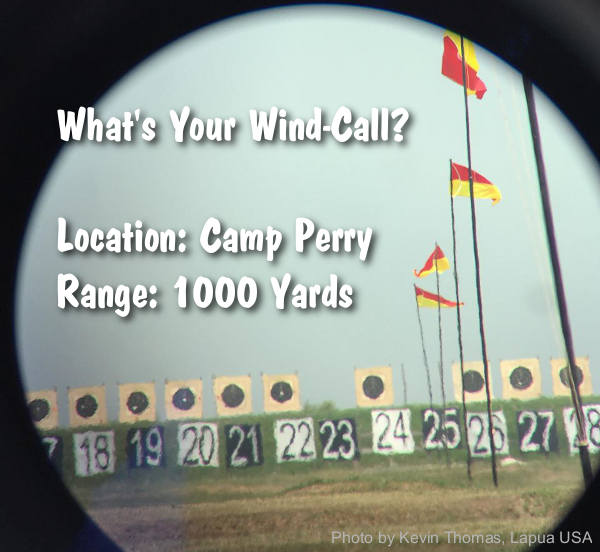
The sun was shining for most of the matches so we had mirage to look at. There are plenty of flags at Camp Perry and I was glad for them!
As the wind speeds get higher I think a shooter should study the appearance of the flags. Some people look at the flag, and some really LOOK at the flags. The difference is observing things like how many ripples are in the flag, how far the flag stands off the pole, the angle of the flag in a headwind or tailwind, and how high the tip of the flag is relative to where the flag is attached to the pole. These details make all of the difference.
Time Management and Patience
Patience in wind reading can be a virtue. Choosing a condition and being patient has probably yielded more success in my long range wind reading than any other method. It’s not the only way to go, but on a day when you have time available and patience on your side it can yield a win! It should be obvious now that keeping a timer and managing the available time along with the number of shots remaining is an important part of this.
Amazing. Spectacular. Stunning. Awe-inspiring. You choose the superlatives — but this is one team shooting performance that will long be celebrated. Competing in the Herrick Trophy 1000-yard Team Match at the Long Range National Championships, the USAMU Praslick 4-member squad turned in a performance for the ages, posting a record-breaking 800-57X score. That means that every one of the four soldiers shot a perfect 200 at 1000 yards. And the X-count was impressive as well. Recently-crowned 2013 National High Power Champion SSG Brandon Green nailed 15 Xs, as did his USAMU team-mate SGT Amanda Elsenboss. Nearly as good, SSG Ty Cooper had 14 Xs to go with his 200 score, while SSG Shane Barnhart notched 13 Xs.
The team’s combined 800-57X score is a new National Record. We commend all four shooters and their wind coach SFC Emil Praslick III. Well-done Lady and Gentlemen. This was a truly superior display of long-range marksmanship! As one fellow shooter observed at Camp Perry: “This is one record that will likely stand for a long, long time.”
Story based on report by Lars Dalseide for NRABlog.
The second day of NRA’s National Long Range High Power Rifle Championships ended with members of the U.S. Army Marksmanship Unit (USAMU) at the top of the standings. But they’re not alone. A mere point or two behind are Nancy Tompkins and her daughter Michelle Gallagher. These civilian ladies have, in the past, captured a few National Long Range High Power Rifle titles of their own. The mother and daughter team are strongly positioned to challenge the Marksmanship Unit soldiers for the lead.
Two more days remain in the Long Range Championship. As the cool conditions continue, with a hint of rain on tomorrow’s forecast, the challenge will continue. Anything can happen (such as a cross-fire) that could completely re-shuffle the standings. Here is the “Leader Board” at the End of Day Two:
Long Range Nationals – Day 2 Range Report by Kelly Bachand
Today started with a lower velocity wind coming out of the south east. We shot 20 shots at 1000 yards as individuals then teamed up for a four man team match, again with 20 shots for each shooter. I shot fine in the morning getting a 198-5X; the winning score on my relay was a 198-10X I think. It was very hard to see the target first thing in the morning. The south eastern wind was only worth 30″-45″ of bullet drift (that’s about half of yesterday’s wind). In general the scores were a little lower today because the wind was a little trickier. While it was relatively constant in velocity, it changed direction quickly and subtly. That’s enough to give even the best shooters a 9 here and there. I don’t think there were any 200s shot with Palma rifles in the individual portion of the match today.
Right before the start of the team match the wind switched around and started coming from the north east with roughly the same velocity. I’m coaching a team made up of shooters from the United States Army Reserve team. Some of them are US Rifle Team members, and past Palma team members, really a bunch of great shooters. In a team match the coach is responsible to call the wind for each shot. Comparing this to a sniper/spotter setup the coach is the spotter and makes all the adjustments on the sights before giving the shooter the command to shoot. I did pretty good for the most part and kept my shooters in the middle the best I could. I was particularly excited to have coached one of the shooters to a perfect 200 — man that’s a great feeling!
Tomorrow (Monday) is a repeat of today with another 20 shots at 1000 for individual and then a four-man team match. After that the Palma match is up next. To read more of Kelly’s Reports from Camp Perry, visit KellysGunSales.com.
After two years away I’ve returned to the NRA Long Range Nationals at Camp Perry hoping to have lots of fun and shoot well. When I saw the wind coming from the East I was initially a little worried that it could be a wild day as from my memory of Camp Perry a relatively consistent wind from the West is the norm. The Eastern wind was actually pretty consistent today and some very good scores were shot.
A little background is in order you can follow the rest of this range report. When shooting at long range, the biggest variable the shooter must correctly account for is typically wind. Knowing this it makes sense that someone shooting in less severe wind could end up with a higher score than perhaps even a much better shooter who shoots in more severe wind conditions. Because of this, in order to win a trophy match at the NRA Long Range Nationals you have to win twice — you must first win your relay by having the highest score when compared to those who shot at the same time as you, then you must win the Shoot Off where you shoot against the top shooters from the other relays. This prevents someone from winning simply because they shot in an easier condition.
I shot my first 20-shot string at 1000 yards and scored a 198-9X out of a possible 200-20X. That means I had 9 shots inside a the 10″ X-Ring, 9 shots in the 20″ Ten-Ring, and 2 shots in the 30″ Nine-Ring. The wind was a little tricky, but as it turned out I had tied another shooter for the high score on our relay. I originally was not listed for the Shoot Off and I asked what tie break was used because I was simply curious. A few minutes later the referee came by and told me I was in the Shoot Off after all because I had the high score on the relay, the tie didn’t matter. I shot my second string next and the wind was trickier still starting with about 75” of drift and decreasing to about 50” at the end. I lost track of the wind at one point and shot an 8 making my total for the second string a 198-11X. That wasn’t good enough for the second Shoot Off.
Kelly Wins A Shoot Off in Palma Class with 100-5X
The Shoot Off consists of 3 practice shots and 10 shots for score. The Shoot Offs are made more spectator-friendly and many competitors gather around and watch as the trophies are won and lost. I reminded myself I was here to have fun, said a quick prayer, and got ready to shoot. I was focused. I only looked at my own target and I was very careful on my wind calls and on my shot execution. I finished and got off the line to see my score keeper giving me a thumbs up! I had shot a 100-5X and everyone else had already dropped at least one point so I had won! This first match was sponsored by Remington I believe and I’ll get a plaque and my picture taken with the trophy. (Note to Remington — I’ve always wanted a Remington 700).
This was a fun first day of the competition, I’m very glad to be able to shoot for Team Sinclair and I can’t help but smile when God’s blessed me with such a fun talent as shooting!
Story by Kerrin Brinkman for The NRA Blog.
The 2011 United States Long Range Rifle Team is in Brisbane, Australia and starts competing today in the World Long Range Rifle Championships for the prestigious Palma Trophy. Taking place at the Belmont Shooting Complex near Brisbane from October 8-22, 2011, the competition is 135 years old and only takes place every three to four years, with the last competition held in 2007. The United States has won 13 of the 28 Palma Matches, and Team USA is hoping to clinch another win this year.
The course of fire is comprised of three slow fire stages fired from the prone position. The first stage is 15 shots at 800 yards, the second stage is 15 shots at 900 yards, and the third stage is 15 shots at 1,000 yards. Targets are six feet square with a 20-inch black bullseye (10-ring), and an aiming circle of 44 inches that includes a 9-ring and an 8-ring. A perfect score for each stage is 150 points. Rifles are single-shot bolt actions equipped with iron sights, and ammunition is 7.62×51/.308 Winchester caliber using a bullet weighing 155 grains. CLICK HERE for Current Match Results (Updated Daily)
United States 2011 Long Range Rifle National Team Members and Advisors
Shooting Members: Bob Mead, Bryan Litz, David Littlefield, Gary Rasmussen, John Whidden, Justin Skaret, Kelly Bachand, Lane Buxton, Nancy Tompkins, Noma Mayo, Norm Anderson, Robert Gustin, Sherri Gallagher, Steve Cunico, Steve Hardin, Trevor Hengehold, Trevor Massey, Trudie Fay, Ty Cooper, and Wayne Forshee.
Team Captain: Dennis Flaharty
Vice Team Captain/Adjutant: Dan Simpson
Vice Team Captain: Dr. Tom Whitaker
Armorer: Robert Gamboa
Head Team Coach: Emil Praslick III
NRA Advisor: Middleton Tompkins
Belmont Shooting Complex — World-Class!
The Belmont Range near Brisbane, Queensland is a beautiful facility. Firing mounds are maintained like golf greens and there are over 25 flags. With great facilities (and no pit duty!), it’s truly the lap of luxury for Fullbore shooting. Belmont is the largest shooting complex in the southern hemisphere and most target shooting sports are conducted there. Coordinates: 27°30 ’40″S 153°7’50″E. It is the home of the Queensland Rifle Association (QRA). (Editor’s Note: Click the tab below the photo to see larger image — it’s even more impressive.)
David Tubb Won the Long-Range National Championship today, shoting a perfect 45 for 45 inside the 10-Ring during today’s Individual Palma Trophy Match. Tubb’s impressive performance secured David the 2011 Long Range High Power Rifle Championship, edging out 2010 LR Champion John Whidden. We believe this is David’s seventh individual long-range title. Tubb last won the Long-Range Championship in 2004, when he shot an “perfect” 1450-101X Aggregate, not dropping a point. Tubb has also won the NRA High Power National Championship 11 times.
Tubb Wins Title, Not Yielding to Whidden’s Strong Challenge
As he took his spot in the final round of the Palma Match, Tubb was stationed to the right of last year’s Long Range champ and 2011 runner-up John Whidden. Whidden, donning his favorite red cap, started with two well-placed sighting shots at 1,000 yards before jumping into the scoring phrase of the match. Tubb, waiting for the wind and that instinctive feeling that’s developed over time, took his first sighter after Whidden started scoring tens.
“Ten” shouted Whidden’s spotter. “X” rang out next. The race was on.
Tubb’s spotter echoed his counterpart’s calls with Tens and Xs of his own. But Whidden had the advantage … he was two shots ahead and two points behind. Scoring ten after ten after X, Whidden was applying the pressure to Tubb as he mounted a final charge. There was even a moment when The Pit mistakenly pulled Tubb’s target as he was about to fire. If there was ever an opportunity for a man to feel the pressure — this was it. I don’t know about the shooters, when when Whidden hit his 13th shot inside the ten ring, my heard started to pump a little bit faster.
The spotter’s calls grew louder and louder as the shooters kept firing and firing. Waiting for one to drop a point, slip outside the ten, make that fatal mistake that would allow the other a path to the championship. Ten, Ten, X, Ten … they just kept coming.
After Whidden Cleaned his Target, the Pressure Was On
Whidden finished clean. Tubb still had two shots to go. Whidden and his spotter silently shifted their scope and glasses to Tubb’s target. I inched a little closer. Hearing a noise, I turned to find an RSO peering over my shoulder to check on Tubb’s progress. The 14th shoot was an X. One shot left. A nine or ten meant Tubb would earn his first Long Range title in seven years. An eight meant we’d go to the X count and a seven or less would give the title to Whidden.
Whidden rose when the spotter cried out ten. The match and the championship was over. “Congratulations David. That’s some great shooting.”
Tubb accepted Whidden’s hand, allowed a smile and returned the admiration. Two shooters with almost a decade’s worth of Championships between them. But this one was for David Tubb. The end of a long road back to the title.
David Discusses his Championship-Winning Tubb 2000 Rifle
In the video below, David Tubb discusses his Tubb 2000 Rifle and the many records it has set. Over the past 11 years, Tubb 2000s have been used by 30 of the 33 “Top Three” finishers in the NRA High Power Championships — that’s a remarkable winning record:




 Amazing. Spectacular. Stunning. Awe-inspiring. You choose the superlatives — but this is one team shooting performance that will long be celebrated. Competing in the Herrick Trophy 1000-yard Team Match at the Long Range National Championships, the USAMU Praslick 4-member squad turned in a performance for the ages, posting a record-breaking 800-57X score. That means that every one of the four soldiers shot a perfect 200 at 1000 yards. And the X-count was impressive as well. Recently-crowned 2013 National High Power Champion SSG Brandon Green nailed 15 Xs, as did his USAMU team-mate SGT Amanda Elsenboss. Nearly as good, SSG Ty Cooper had 14 Xs to go with his 200 score, while SSG Shane Barnhart notched 13 Xs.


 After two years away I’ve returned to the NRA Long Range Nationals at Camp Perry hoping to have lots of fun and shoot well. When I saw the wind coming from the East I was initially a little worried that it could be a wild day as from my memory of Camp Perry a relatively consistent wind from the West is the norm. The Eastern wind was actually pretty consistent today and some very good scores were shot.


 Belmont Shooting Complex — World-Class!


