Are you interested in long range shooting … really long-range shooting, i.e. well beyond a mile? Will you be at SHOT Show in ten days? Then consider attending the start-up meeting of the Unlimited Range Shooters Association (URSA), a new organization dedicated to the ultra-long-range game. URSA’s initial, organizational meeting will be held on Tuesday, January 14 during the 2014 SHOT Show in Las Vegas, NV. Visit Unlimitedrange.org to learn more about this new organization.
The goal of the meeting will be to lay the groundwork for an organization that will serve the needs of shooters interested in “unlimited range” shooting (i.e. 2000 yards and beyond). The meeting is open to all interested parties, SHOT Show attendees and non-attendees alike. Especially encouraged to attend are those interested in helping to form the Association and further its objectives. The meeting will be in the Marcello Room (#4402), 4th level of the Venetian/Palazzo Congress Center. Doors open at 2:30 pm and the meeting begins at 3:00 pm (room reserved by URSA through 6:00 pm).
Anyone wishing to provide assistance, or to provide constructive suggestions, is requested to e-mail webmaster [at] unlimitedrange.org. Corporate supporters are encouraged to provide their logo(s) for inclusion on the Association’s Supporters page. Visit Unlimitedrange.org for the URSA start-up meeting agenda and more information about the proposed association. (Click the “About” link for details).
Oscar Leckliter
URSA Facilitator and Interim Webmaster
webmaster [at] unlimitedrange.org
URSA thanks Desert Tech (formerly Desert Tactical Arms) for its support and generosity. The meeting will be held in Desert Tech’s meeting space.
Earlier this month, Forum Member Steven Blair won the California Long-Range Championship (F-Open Class) shooting a .300 WSM. Here Steve explains the advantages of the .300 WSM cartridge in long-range competition. Steve also discusses the learning process required to shoot the stout-recoiling .300 WSM successfully. Steve cautions: “It took me months to learn how to shoot my .300 WSM rifle well”.
The Argument for the .300 WSM as an F-Open Cartridge by Steven Blair
There has been much interest lately regarding .300 WSM (Winchester Short Magnum) in F-Open competition. The cartridge is already well-established in 1000-yard benchrest and has been used successfully in F-Open, notably by Derek Rodgers to win the 2010 National Championship. Derek used, as do most .300 WSM BR shooters, a 210-grain bullet.
The .300 WSM is a modern design, short and fat with a 35° shoulder. It is a slightly rebated and beltless magnum, capable of approaching .300 Winchester Magnum performance with notably less powder. It has an excellent accuracy reputation and I’ve found it very easy to tune.
Berger introduced the outstanding .30-caliber, 230-grain Hybrid bullet in 2011. This bullet ballistically eclipses all others, caliber .30 and under. Berger rates it as G7 .380 and G1 .743. Trimmed and pointed, the B.C., estimated from elevation adjustments at 300, 600, and 1000 yards, increases to G7 .410. It is also an exceptionally accurate bullet.
The combination of these two items, .300 WSM cases and Berger 230gr Hybrid bullets, and their application to long range F-Class, is what I will discuss in this article.
VOICE FILE: Click Button to hear Steven Blair Explain How to Master the .300 WSM.
.300 WSM Brass — Choices are largely limited to Norma, Winchester and Remington (Lapua, are you listening?). Since I have only used Winchester and Norma brass, I won’t discuss Remington brass, which may also be a viable choice. I found Norma brass to be exceptionally good and have seen no evidence of short life that I’ve heard elsewhere. Winchester brass can produce results equal to Norma, if first sorted, culled, and prepped. There is a significant price difference between the two brands. It is worth noting that Norma manufactures both .270 WSM and .300 WSM brass. Either can be used. Winchester makes .270 WSM, 7mm WSM, .300 WSM, and .325 WSM brass. Again, any can be used but 7mm WSM requires pushing the shoulder back. The other three have the same shoulder dimension.
Bullet Selection — My approach is to use the highest B.C. bullet available that is accurate. As mentioned above, the hands-down, .30-caliber winner is Berger’s 230gr Hybrid. My loads using 230gr Hybrids produce approximately 2865 fps from 34″ barrels. In order to equal the 1000-yard, 10 mph wind deflection, 215 Hybrids must be run at 3030 fps, a fairly stiff load. By contrast, 7mm 180gr Hybrids must start at 3100 fps, not reliably achievable in most conditions. Lapua now makes a 220gr Scenar-L that Erik Cortina has shot a fair bit and reports that it is very accurate. It has a similar profile to the Sierra 220gr MatchKing, another possible candidate, albeit with much lower B.C. than Berger’s mighty 230gr Hybrid.
Barrel Life — After 1126 and 936 rounds shot at F-Class cadence in two barrels, my best guess is at least 2000 rounds accurate barrel life. The barrels look better than any of my .284 Shehane barrels at this point.
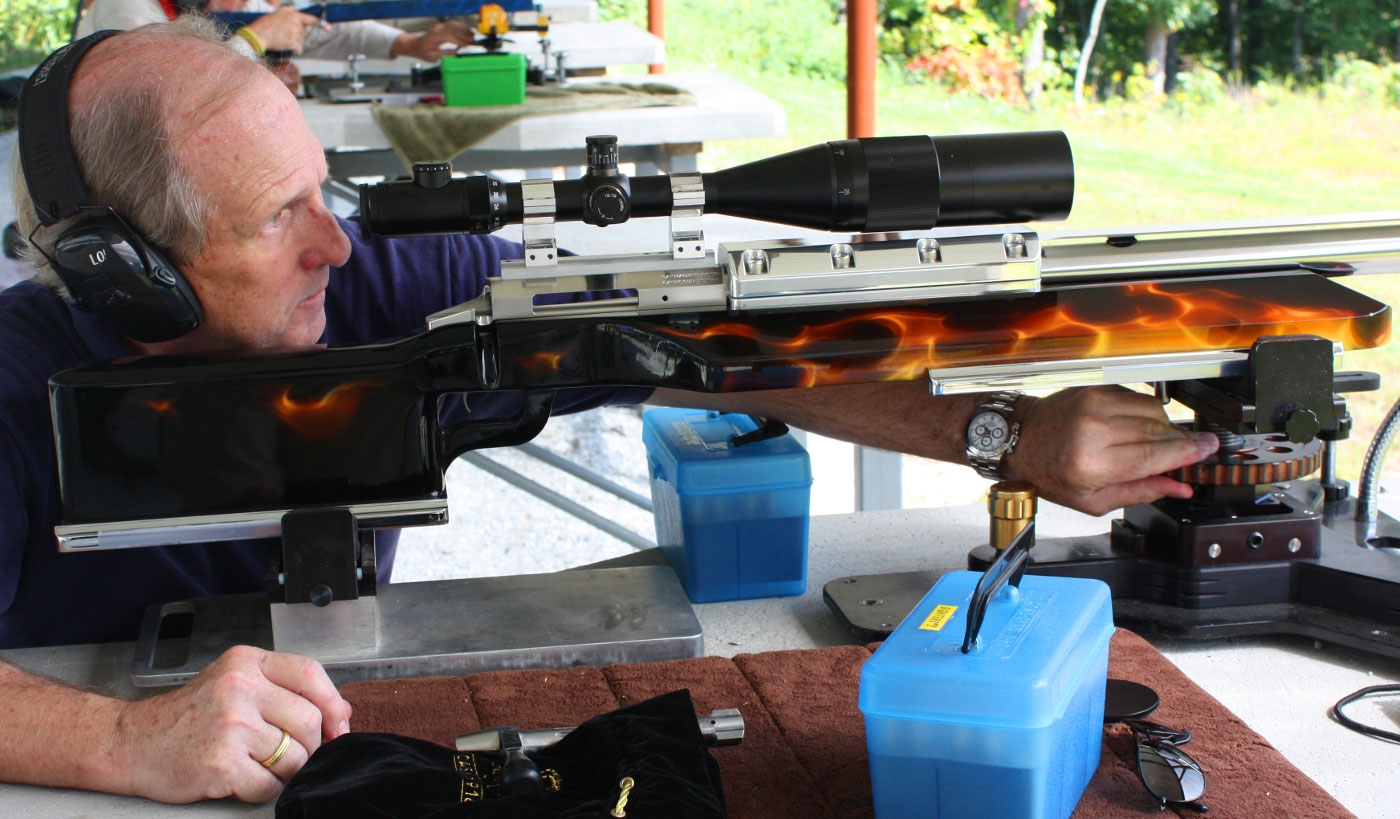
F-Open Rig with Tuner
Steve’s .300 WSM rifle features a BAT 3-lug action (with integral recoil lug and +20 MOA rail), in a Manners F-Class stock. The barrel is a 34″, 1.25″-straight contour Krieger or Brux fitted with an Erik Cortina 1.25″-diameter tuner (shown at right — note Index Marks). Other hardware includes a Bix ‘n Andy trigger, and Nightforce 12-42x56mm NXS scope (NP-R1 reticle). Some of these components were chosen to aid tracking (given the additional recoil). The rifle weighs 21 pounds, 13.5 ounces — just under the 22-pound F-Open limit.
Accuracy and Tuning Ease — The .300 WSM tunes more easily and is more tolerant than any of the four 6mmBR barrels I’ve shot. It is the most accurate large-caliber cartridge I know. A number of 1000-yard benchrest records were set with the cartridge and my experience reinforces that. During my .300 WSM load development, several 100-yard, five-shot groups were in the “ones”, no mean feat for a rifle pushing 230 grains at nearly 3000 fps. The load tolerance window, the powder charge spread where velocity, ES and accuracy are relatively constant, is 0.8 grains in my loading. That means the same load can be fired confidently in many conditions.
Exterior Ballistics — The extent to which the big bullet reduces wind deflection and vertical movement must be experienced to appreciate. I shoot against 7mm cartridges ranging from .284 Win to 7mm WSM, no slouches among them. When they are blown into the 9 Ring, I stay in the 10 Ring. When range vertical pushes them up or down to lose a point, I see it, too, but don’t drop points. However, there is nothing magic about it. The shooter still must point the gun at the right place. The mistakes just cost less and, since F-Class is an Aggregate game, the point spread will accumulate.
Recoil — This is the big downside of the .300 WSM + 230gr Hybrid combination. My rifle weighs 2½ ounces shy of 22 pounds and still pushes me around. My early testing was done with a load that produced 2950 fps. I still cannot shoot it well. The load is very accurate but I cannot manage the recoil consistently. At 2865 fps, it is manageable but always requires careful attention to body position, shoulder pressure, front rest setup, rear bag characteristics and other ergonomic factors. I have learned that shooting a rig with this much recoil places more emphasis on the factors our sling brothers and sisters have managed for many years. It took me months to learn how to shoot the rifle well. I fired over 1000 rounds before I began to feel comfortable. Persist, the results are worth it.
Summary — If you are willing to put the effort into learning how to shoot the cartridge and have a reasonable recoil tolerance, the investment will pay dividends. My scores have increased and become more consistent. My confidence in the rifle has also increased, no small matter in a game with many mental aspects. Be prepared for what could be a long learning curve. If all that sounds like too much, one of the 7mm cartridges is pretty close and certainly competitive in the right hands. My choice, given all the factors listed above, is .300 WSM.
Left to Right: RCBS Chargemaster, Hoover meplat trimmer, Omega trickler, Sartorius GD-503 scale.
Steven Blair has competed in F-Class competition since December of 2010 and F-Open since November of 2011. He placed fifth in the F-Class National Championship this year and is the two-time winner of both the California Long Range F-Class Championship and Twentynine Palms Long Range Regional. Steve shoots on Team Lapua.
Steve says the .300 WSM may offer an advantage at long range: “The weekend of 2-3 November, I won my second straight California Long Range F-Class Championship. Last year, my .284 Shehane performed well against strong competition. This year, the .300 WSM provided a ballistic edge that certainly gained a few additional points. My final 991-50X was at least partly due to the excellent ballistics and accuracy the big cartridge provided.”
As you may know already, Bryan Litz of Applied Ballistics LLC has produced an excellent 3-Disc DVD set entitled Putting Rounds on Target. When one views the end result one can forget the hard work and tribulations that go into making such a production. Sometimes Mother Nature doesn’t cooperate when the crew is out at the range.
Bryan tells us:
“Filming for ‘Putting Rounds on Target’ proved to be a bit more challenging then we had expected. For this segment in the third disk, we packed up and set up everything over half a dozen times to keep the camera and shooting equipment dry as the sun played Peek-a-boo behind rain clouds. The chilled temperatures, required a lot of hot coffee, but the lack of restrooms made for a long day. In the end, it was totally worth it!
Watch Trailer Video of Putting Rounds on Target DVD Set
When we first ran this story 18 months ago, it proved immensely popular with our readers. In case you missed it the first time around, check out what can be done with a factory Savage 110 BA at extreme long range — 1760 yards. Shooter Mark Dalzell did a great job with the video, which features multiple camera views so you can see the shooter and the target at the same time. Enjoy!
This video by Mark Dalzell demonstrates the long-range capabilities of the Savage 110 BA chambered in .338 Lapua Magnum. Mark took his “BadAss” rig out to the southwest Nevada desert just north of Jean Dry Lakes. He placed a 2’x3′ target way, way out there — a full mile (1760 yards) away. At that range, flight time to target was 3.75 seconds! Sighting with a Nightforce 5-22x50mm NXS scope, Mark needed a few shots to get on target, but eventually made multiple hits, using 67 MOA of elevation and 2.25 MOA left windage. You can view the hits starting at 1:56 time-mark on the video. (Mark had a second camera set up closer to the target — this displays frame in frame in the video, and if you watch carefully you can see the strikes.) The ammo was HSM 250gr HPBT match with a 3.600″ COAL. The shooting was done at 8:13 in the morning, with clear conditions, very light winds. Temp was 57°, humidity 24.5, Density Altitude 3666. Video soundtrack is La Grange by ZZ Top.
PLAY BUTTON
LISTEN TO MARK TALK about One Mile Shooting:
CLICK Play Button to hear Mark Dalzell TALK about his .338 LM Savage 110 BA and how he scored hits at 1760 yards.
Good Shooting Mark. That’s darn good for a factory rifle. You also had the elevation dialed in real close before the firing started! That shows a good knowledge of your ammo’s long-range ballistics. We also noticed how effective that muzzle brake was. Recoil looked about the same as an un-braked .308 Win.
Report for International Benchrest Shooters (IBS) On August 30-31, 2013, Robert and Chrissy Ross hosted this year’s 2013 IBS 1000-Yard National Championships at their Midwest Benchrest range in Yukon, Missouri.
This year’s format was run with all the Light Gun (LG) relays shot on Friday, followed by all the Heavy Gun (HG) relays on Saturday. The competition was very tight as the Two Gun Overall Champion, Henry Pasquet from Elsinore, Missouri, didn’t even realize he had won until his name was called out at the award ceremony. Henry, an active AccurateShooter Forum member, secured a well-deserved National Championship with strong performances in both classes. Henry registered a fifth place in LG Group along with tenth place in LG Score. Henry then finished first in HG Score along with eleventh in HG Group to earn the 2013 Two-Gun Overall Title.
Matthew Kline traveled from Pennsylvania to take second place in the Two Gun competition. He garnered that honor with an eighth Place in LG Group and a fourth place in LG Score. Matthew followed up these with a ninth place in HG Group and eleventh place in HG Score.
Kansas’ Jim Bauer came in a close third in the Two Gun rankings, by finishing first in LG Score and 21st in HG Group, then adding a second place in HG Group and 16th place in HG Score. Jim’s wife Sally, last year’s IBS long-range Shooter of the Year winner, was the Top Female Shooter. Rory Jacobs, from Vapor Trail Valley Shooting Club in Spickard, MO was the Top Junior Shooter.
Hot Temperatures and Fickle Winds Challenge Shooters
The Midwest Benchrest range is literally in the Ross’ back yard and is cut right out of the middle of a Missouri forest, which gave the shooters new to the range a false sense of confidence, thinking the trees would block the winds. The shooters had to deal with temperatures in the upper 90s (and the shade trees offered little relief). With the incredible humidity present, it felt it was even hotter. Although the winds weren’t very high, they weren’t very cooperative either, as they were never consistent throughout both days. One minute it was directly behind the shooters and the next it was quartering to the right. A moment later it was to the left.
The early relay winners seemed to favor the end benches, while later in the day, they seemed to favor the middle benches. There was was nothing but bright sunshine for the two-day event. Cloud cover and cooler temps, which were earlier forecast for the shoot, finally showed up the day after the tournament. Needless to say, the “heat monkeys” were making small groups difficult at this year’s shoot. Most small groups that were shot, were followed up with larger groups, in both the LG and HG events.
All in all, everyone still had a great time competing, seeing friends and fellow shooters from other parts of the country, and enjoying the Ross’ hospitality. It wasn’t long after the shoot was over before everyone started talking about where the 2014 Nationals would be. Perhaps, Robert Ross said it best: “Ultimately, the competition yields to the resulting friendships, which are fostered as part of a common goal: Raising the bar in long range precision shooting.”
The two-day competition was run as smoothly as any monthly shoot is run. The weekend’s shoot really started off on Thursday night though. Jim and Sally Bauer, Hornady, and Midwest Benchrest, sponsored a fantastic fish fry for all the competitors and their spouses. This provided some neutral ground to meet up and catch up with both new and old friends alike before the actual shooting began. If possible we will add equipment lists and individual relay results to this story on Accurate Shooter.com.
Featured Hardware at the 1K Nationals (Click Photos to Zoom)
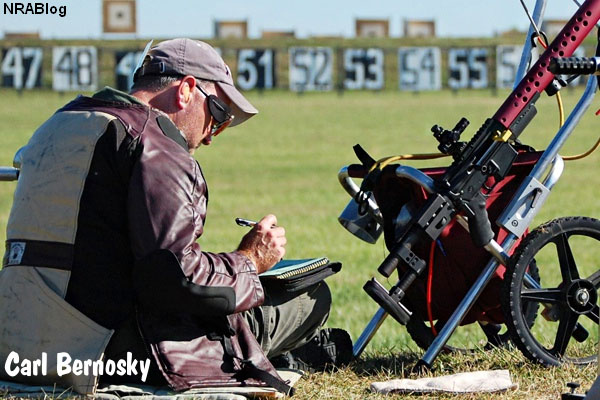
SSG Ty (Tyrel) Cooper of the USAMU won the 2013 NRA National High Power Rifle Long Range Championships with a final score of 1243-71X. Ty grabbed the lead from fellow USAMU shooter Shane Barnhart on the final day of competition, shooting superbly to take the Long Range title. Also moving up in the standings today was SSG Brandon Green, who won the NRA High Power Championships last week. Green was a close second. Though both soldiers finished with a total score of 1243 points, Cooper’s X count topped Green’s by seven (71 to 64). On his Facebook page, Green praised his USAMU team-mate: “Congrats to Ty Cooper, he is the 2013 Long Range National Champion! And I’m the first loser! … Stupid Xs.” (Photo courtesy NRA Blog.)
Below is a file photo of SSG Ty Cooper at 2012 High Power Championship. In the Long Range Championships, Cooper used a Nesika-actioned bolt gun with long barrel chambered in 7mm SAUM.
NRA Blog editor Lars Dalseide interviewed Ty Cooper shortly after he won the 2013 Long Range title. “It’s a long time coming,” said Cooper with a smile. “Years of shooting and now here it is. It’s overdue — that much is true.”
Cooper edged out USAMU teammate Brandon Keith Green for the win by seven Xs, after four days of long-range competition. “You don’t get much closer than that,” said Russ, a competitor from Georgia. “Winning by an X count. Boy that is something.”
Rounding out the top five in the overall Long Range Championships are Bob Gustin with 1239-76X, Shirley Mcgee with a 1238-65X, and Eric Smith with a 1236-55X.
Complete Results from the Long Range Championships will be posted on the NRA Competitive Shooting Championships Results Webpage later today.
Shooting a 50 BMG, off-hand, at 1000 yards may seem absolutely nuts, but read on — this story should make you smile. At the Texas Triggers Ranch (Sonora, TX), former Army Ranger and Sniper Team Leader Ryan Cleckner, shooting OFF-HAND, hit a torso-sized steel silhouette target at 1000 yards with a 50-caliber Barrett M107. That would be impressive enough, but consider this — Ryan hit the target on his first shot. And yes he was shooting standing (on his hind legs), holding the 37-pound rifle with his arms (no support).
Watch VIDEO of Ryan Cleckner Shooting Barrett M107 Off-Hand at 1000 Yards
Jumbo-Sized Ammo, and Jumbo-Sized Recoil
The ammo Ryan used in his 50 BMG Barrett pushes a 661-grain bullet at 2900 fps muzzle velocity. This load (fired from this 37-pound rifle), has 12,357 ft-lbs of energy at the muzzle, and 81.88 ft-lbs of recoil energy. To put things in perspective, an 18-pound, .308 Win F-TR rifle, shooting a 168gr bullet at 2750 fps, has 7.99 ft-lbs of recoil energy. So, Ryan was shouldering a weapon that delivered more than Ten Times the recoil energy of a .308 Win. (Energy numbers calculated with Point Blank software). And he made it look easy. Kudos to Ryan for proving what a properly-trained marksman can do. Rangers Lead the Way….
Credit Steve Johnson of The Firearm Blog for finding this video.
If you plan to compete at the 2013 NRA National Rifle and Pistol Championships, you can now register online. To sign up, visit www.NMEntry.com. Returning shooters should enter their Camp Perry Competition ID (from a previous year). New shooters should enter NRA member ID, if available. Choose one (or more) of the five championship events: Pistol Championship, Smallbore Rifle Championship, High Power Rifle Championship, Mid-Range Rifle Championship, Long Range Championship.
Competing at Perry is special: “For over 100 years, shooters in the United States have made the pilgrimage to Camp Perry for the NRA National Matches, and the honor to shoot shoulder-to-shoulder with the best.” (NRABlog)
Watch Slide Show from 2012 NRA Long Range Championship
Story by Lars Dalseide for NRABlog Bloemfontein, South Africa — The South African Rifle Team jumped out to an early lead in yesterday’s America Match at the General de Wet Range. Gaining ground in each of the four relays, the South Africans’ final tally reached 2362.251 before teams from the U.S. and England fired their final shot. By then, South Africa was in the clubhouse with a 13 point win.
The America Match is a four-round team competition shot at 300, 600, 800 and 900 meters. Made up of eight-man teams, each has the opportunity to score up to 600 points per round. Shot last year during the NRA Long Range High Power Rifle Championships in Camp Perry, this is the first America Match win for South Africa.
Having Long Range High Power Rifle Fun in the African Sun
Though one may try, it is truly impossible to simulate game day situations in practice. All the preparation in the world will never prepare you for the tension or adrenaline spike that accompanies real life. The distractions are even greater when competing in South Africa.
Not only is there the incredibly long plane ride, a new culture to embrace and new cuisines to devour, there’s also the local wildlife to consider. Don’t believe me? Then listen to what Alex Williams had to say on the England Rifle Team website:
Aside from keeping a beady eye on the targets, there were several opportunities to cop a look at the local wildlife – dawn is heralded by the cooing of pigeons and the squeaking of hundreds of small starlings. Zebras and elegant giraffes festoon the grasslands on the drive from the hotel to the range. Springbok prance through the fawn coloured savannah startled by the passing minibuses. Dinner also provides an opportunity to sample some of the local wildlife, which generally appears medium-rare.”
Redemption via the Rifle Awaits
Though the American Match holds a special significance to those of us here in The States, American shooters have to toss those results aside. Same goes for the the English, the Welsh and the Irish. After all, they are only three days into ten day of competition. There are plenty of victories left to be had.
Having the home field advantage has played well into the South African’s hands so far. The heat, the elevation (4,500 feet above sea level) and familiarity with the surroundings makes aiming that rifle all the more favorable for the locals. But it doesn’t have to stay that way. Things can change.
Yesterday’s match saw Team USA finish second. Under the leadership of Head Coach Norm Anderson, along with coaches Emil Praslic and Steve Harding, Team USA’s shooters (including Lane Buxton, Brandon Green, Michael Storer, Ty Cooper, Bob Gill, Nate Guernsey, Anette Wachter and Dave Crandell) are sure to find their mark soon enough.
Thanks to Anette Wachter and James Watson for contributing to this post … both with pictures (Anette’s) and information. Follow Anette’s coverage of her long range high power shooting saga at www.30calgal.com.
Here’s great news for IBS members. The IBS has announced its affiliation with AccurateShooter.com, the premier website dealing with all types of rifle accuracy. The IBS and this website will work together to provide prominent media coverage of IBS events. IBS President Jeff Stover explains: “The IBS leadership was faced with an unexpected dilemma in late 2012 with the loss of our print media outlet. We think the partnership with Accurateshooter.com will present the IBS (and the sport of benchrest) front and center before a large, global audience of shooters interested in small groups and high scores from 100 to 1000 yards.”
Building its internet presence will benefit the IBS and its members says Stover: “Benchrest shooting has earned a highly respected position among the shooting disciplines. Most, if not all, innovations in rifle accuracy technology have been derived from benchrest. Nevertheless, it has been a ‘niche’ shooting sport. We in the IBS feel that AccurateShooter.com will help us achieve two major goals. The first is to give our members (and the matches they shoot) increased exposure. AccurateShooter.com has a worldwide audience with over 130,000 visitors every week. Secondly, we hope this website will present benchrest shooting as approachable and a mature discipline that is ready to welcome new shooters.”
IBS President Jeff Stover Talks About IBS Match Coverage on AccurateShooter.com
[haiku url=”http://accurateshooter.net/Video/jeffstovertalks.mp3″ title=”Jeff Stover Talks about IBS”]Click “Play” to Hear Audio
Beyond the major match coverage at AccurateShooter.com, the IBS website (Internationalbenchrest.com) will remain the IBS’s primary online resource for schedules and match results for every registered IBS match, be it short range or longrange.
Looking Ahead — What the IBS Plans
In the future, the IBS envisions further synergies with AccurateShooter.com. Together we are exploring ways to enhance the way benchrest matches are scored and reported. AccurateShooter.com provides a new media platform that will allow both the match results and the human side of the competitions to be brought to life. There will be a dedicated area on this website for important IBS match reports (and special IBS features). We foresee a system being developed that will standardize the match scoring software that would be used at the range and then quickly be made available on the web. Match reports will evolve from a simple set of scores and equipment reports to rich content with lots of photos, audio reports, and even video clips.
Watch IBS Slide Show
AccurateShooter Teams up with IBS for Event Coverage
At AccurateShooter.com, we’re delighted to team up with the IBS. We plan to provide enhanced IBS match coverage in the months ahead. With luck, we’ll kick off our IBS coverage with three upcoming matches: the 1000-yard Match at Whitehorse WV (April 20), the Pennsylvania State Score Championships in York, PA (April 27), and the Boop/Altemus Memorial Shoot at Weikert, PA (May 11-12, group match). And of course, we’ll be covering the major IBS National events later in 2013.
We want to provide the “full story” of matches with photos, equipment features, and interviews with top shooters. Where possible, we hope to include audio interviews with the “Top Guns” and some videos of the matches. Our IBS Match Reports will feature the latest benchrest hardware, including some of the most accurate rifles ever made….
Our IBS Reports will show the ranges where benchrest dreams are chased, and world records are set.
And our Match Reports will feature the great people (of all ages) who make IBS Benchrest shooting such a great sport and rewarding pastime.


 Are you interested in long range shooting … really long-range shooting, i.e. well beyond a mile? Will you be at SHOT Show in ten days? Then consider attending the start-up meeting of the Unlimited Range Shooters Association (URSA), a new organization dedicated to the ultra-long-range game. URSA’s initial, organizational meeting will be held on Tuesday, January 14 during the 2014 SHOT Show in Las Vegas, NV. Visit Unlimitedrange.org to learn more about this new organization.
 The .300 WSM is a modern design, short and fat with a 35° shoulder. It is a slightly rebated and beltless magnum, capable of approaching .300 Winchester Magnum performance with notably less powder. It has an excellent accuracy reputation and I’ve found it very easy to tune.


 F-Open Rig with Tuner


 As you may know already, Bryan Litz of


 On August 30-31, 2013, Robert and Chrissy Ross hosted this year’s 2013 IBS 1000-Yard National Championships at their




 SSG Ty (Tyrel) Cooper of the USAMU won the 2013 NRA National High Power Rifle Long Range Championships with a final score of 1243-71X. Ty grabbed the lead from fellow USAMU shooter Shane Barnhart on the final day of competition, shooting superbly to take the Long Range title. Also moving up in the standings today was SSG Brandon Green, who won the NRA High Power Championships last week. Green was a close second. Though both soldiers finished with a total score of 1243 points, Cooper’s X count topped Green’s by seven (71 to 64). On his Facebook page, Green praised his USAMU team-mate: “Congrats to Ty Cooper, he is the 2013 Long Range National Champion! And I’m the first loser! … Stupid Xs.” (Photo courtesy
 Shooting a 50 BMG, off-hand, at 1000 yards may seem absolutely nuts, but read on — this story should make you smile. At the




 Here’s great news for IBS members. The IBS has announced its affiliation with


