|
|
August 17th, 2010
The 2010 NRA National Long Range Rifle Champion is John Whidden of Whidden Gunworks. Whidden, a soft-spoken shooter from Georgia, amassed an overall score of 1243-75x, topping the USAMU’s Brandon Green (1240-60X) by three points. John was way ahead of Green in X-Count. We’re proud to see John, who provided match reports for AccurateShooter.com, back on top of the podium. As great a shooter as he is, John is one of the most humble champions you’ll ever meet. Bravo John!

This is Whidden’s third NRA Long-Range National Championship, following his Long-Range Championship wins in 2007 and 2008. Sherri Gallagher took the Long-Range Championship in 2009, but this year she must content herself with a record-breaking performance in the High Power Championship. After notching an impressive third Long-Range victory, John no doubt has his sights set on #4 and #5 in the years ahead. John would need five (5) long-range titles to tie the legendary David Tubb.
See John Whidden in action over the past four days at Camp Perry in this slide-show from the NRA:
July 26th, 2010
Shooting at the Original Pennsylvania 1000-Yard Benchrest Club (Williamsport), Frank Weber, set a new Light Gun Williamsport Record Score and World Record Score this past weekend, a 100-6X (4.237″) for ten (10) shots. Our Assistant Editor Jason Baney witnessed the new record while working the pits. Jason reports: “Frank’s 100-6X beats my Williamsport Record and Andy Murtaugh’s World Record. It was an incredible group. Frank almost got a group record as well — nine of Frank’s ten shots measured about 3.4″, all falling well inside the 4″x4″ white square. This was a great achievement for Frank. He has been shooting at Williamsport since 1968, and this is his first-ever Light Gun group under 7 inches.”

Weber’s Record-Setting Light Gun
Frank Weber set his 1K record with a BAT-actioned 6mm Dasher smithed by Mark King. The Broughton 1:8″ twist, 28″ barrel has a 0.266″-necked Dasher chamber, with 0.155″ freebore. The Broughton barrel is nearly new — it had roughly 100 rounds through it when the record was shot. For optics, Weber used a Nightforce 8-32x56mm NXS scope.

Record Recipe: Varget, BR4s, and Custom 105gr Bullets Jumped .010″
Weber’s record-setting load was fairly typical for a Dasher, except for the projectile. Frank loaded 33.5 grains of Hodgdon Varget and CCI BR4 primers behind a custom 105gr bullet, seated 0.010″ OFF the lands (i.e. he was jumping the bullets ten thousandths). Ironically, Frank was using this relay to test seating depths. It certainly seems that he found a load that worked! Later, in the shoot-off, Frank tried IMR 8208 XBR powder.
March 20th, 2010
From April 30 – May 2, the Original Pennsylvania 1000 Yard Club will host a multi-day, long-range benchrest school at its Williamsport range. For $250, up to 36 students will enjoy 1 night and 2 days of intensive training under the tutelage of some of the nations’ top 1000-yard shooters. There are still some spots available for the class, which is designed for novice to intermediate shooters. The sign-up deadline is April 25th.

On Friday night (April 30), students will meet their mentors, including school director Frank Grappone. Saturday (May 1), the class moves to the range for a full day of hands-on technical training. Topics will include precision reloading, load development, gun handling, use of chronograph, analysis of shooting results, gun cleaning, and target analysis. The Williamsport Club will provide the rifles and all reloading components. Saturday’s sessions are followed by a steak dinner, included in the $250 seminar price.

On Sunday (May 2), after an early training session covering bench set-up and match strategies, students will participate in a 1000-yard match, spending time both behind the trigger and in the pits. Instructors will explain how to read conditions, and will demonstrate target measuring and analysis after the relays. The program wraps up before 4:00 pm on Sunday.
The 1000-yard Benchrest School is limited to 36 students (with less than 3 students per advisor). Intructors include Gunsmiths Bruce Baer and Mark King, our Asst. Editor Jason Baney, and many Williamsport Hall of Fame shooters. For more info, email School Director Frank Grappone, frankgrappone [at] sbcglobal.net.

February 14th, 2010
 Bryan Litz, Ballistician for Berger Bullets, is the author of the book Applied Ballistics for Long-Range Shooting. Before joining Berger, Bryan was a missile design engineer working with the U.S. Air Force. An NRA High Master, Bryan also happens to be one of the country’s top long-range shooters. Bryan (aka “bsl135″ in our Forum) has written many ballistics programs and technical papers dealing with long-range flight dynamics of projectiles. Bryan has recorded some very impressive match performances recently. At the 2008 NRA National Championships at Camp Perry, Bryan beat 258 other competitors to win the Palma Individual Trophy Match. Bryan shot a remarkable 450/26x, not dropping a single point. Bryan Litz, Ballistician for Berger Bullets, is the author of the book Applied Ballistics for Long-Range Shooting. Before joining Berger, Bryan was a missile design engineer working with the U.S. Air Force. An NRA High Master, Bryan also happens to be one of the country’s top long-range shooters. Bryan (aka “bsl135″ in our Forum) has written many ballistics programs and technical papers dealing with long-range flight dynamics of projectiles. Bryan has recorded some very impressive match performances recently. At the 2008 NRA National Championships at Camp Perry, Bryan beat 258 other competitors to win the Palma Individual Trophy Match. Bryan shot a remarkable 450/26x, not dropping a single point.
Palma Match — Caught on Video
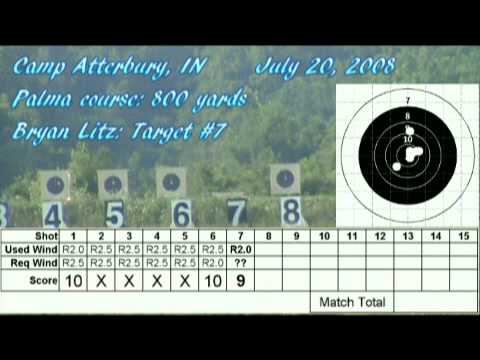
Bryan has crafted a cool video that puts the viewer “in the driver’s seat” as Bryan shoots an 800-yard match with his .308 Winchester, iron-sights Palma rifle. Watch as each shot is marked and scored. Bryan explains: “The inset target at upper right displays each shot location in sequence. The score card shows the windage used for each shot, as well as the windage that was ‘Required’ for that shot to be centered. Wind wasn’t very challenging in this string, only requiring between 2 and 3 MOA right. This particular match is the 800-yard phase of a Palma course fired in the summer of 2008 at Camp Atterbury, IN. NOTE: I’ve had to cut out some ‘pauses’, and speed up the film in order to meet YouTube’s size requirements, so that’s why we sound like chipmunks.”
CLICK SCREEN to WATCH VIDEO. Click Menu Button for High Quality (HQ) Option
Bryan also has his own website with a number of authoritative articles. Topics include: Bullet Design, Meplat Trimming, Gyroscopic and Coreolis Drift, Palma Bullet Analysis, How Ballistics Programs Work, and Ballistic Coefficient Testing. CLICK HERE to visit BRYAN LITZ Website.
February 4th, 2010
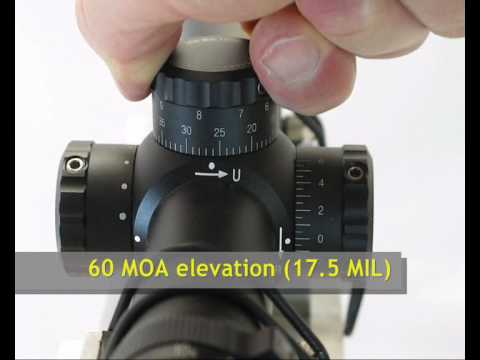
Forum member Thomas Haugland (aka “Roe”) from Norway has created an excellent video comparing the features on four long-range scopes: Schmidt & Bender PMII 3-12x50mm, Schmidt & Bender PMII 12-50x56mm, Leupold MK IV, and Zeiss Diavari Victory 6-24x56mm. Thomas shows how the adjustments function, he records the available vertical elevation, and he takes apart the turrets to show how the weather seals work. While the Leupold MK IV has MOA clicks, the three Euro scopes tested by Thomas have mil-based or mil/cm adjustments. These mil-based clicks work well with first focal plane reticles that have mil or half-mil hash marks.
Thomas explains:
These films emphasize the shooter’s Point of View (POV) and ‘user friendliness’. ALL these scopes get the job done, but they have some similarities and differences in the details and your own personal preferences would decide what scope can be labeled ‘best’. The perfect scope doesn’t exist, you’ll have a compromise somewhere — be that economy, magnification, reticle, turret, optical quality, sturdiness…
In these films I’ve set the Schmidt & Bender PMII 3-12×50 as the benchmark for comparison. Not because it is ‘best’ (it isn’t!) but because S&B is one of the manufacturers which first recognized the needs of professional Long Range shooters and put together products [optimized to work well] in high stress environments. The features that are important are: First focal plane, MIL reticles and MIL turrets, plenty of adjustment and suitable magnification.
Note that S&B and Zeiss scopes are also available in the USA with MOA-based turrets and/or second focal plane (SFP) reticles, for those shooters who prefer the MOA system, and SFP. A first focal plane reticle is best for ranging, but a target shooter working at known distances will probably prefer a second focal plane reticle that doesn’t change in size with magnification.
January 31st, 2010
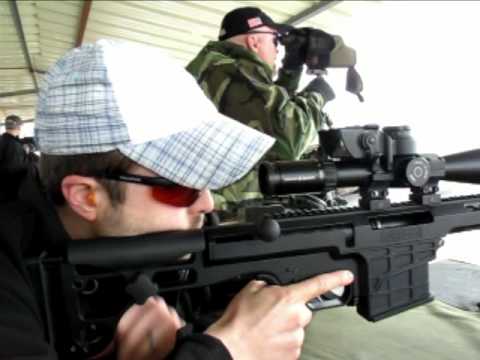
On Media Day, just prior to SHOT Show 2010, our Assistant Editor Jason Baney headed straight to the biggest, baddest rifles he could find — a pair of serious-looking tactical rigs from Barrett Rifles. First off was the mighty semi-auto Barrett 82A1, chambered in .416 Barrett. a “beast of a cartridge” according to Jason. The .416 is a very powerful chambering, and you can see the recoil pushed Jason pretty hard. That’s serious energy — Jason’s a big boy, and the Barrett 82A1 weighs nearly 31 pounds. Want one? You may have to liquidate some investments. MSRP on the Barrett 82A1 is a whopping $9345.00.


Ninety-Eight Bravo in .338 Lapua Magnum
Next up was Barrett’s bolt-action model 98B (“Ninety-Eight Bravo”), chambered in .338 Lapua Magnum. At less than half the weight of the Barrett 82A1, the 98B was much easier to steer on the bench and the ergonomics were generally better according to Jason.
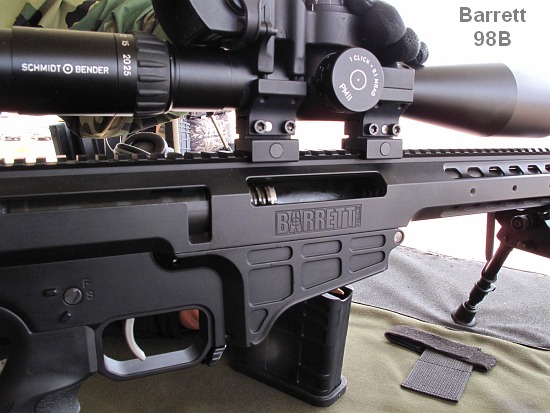
While recoil from the .338 Lapua Mag was stout, you can see in the video that the .338 LM kicked much less than the .416 Barrett, even in a gun with less than half the mass. The 98B gives you a good solid thump to the shoulder when firing. By contrast, the .416 Barrett in the 82A1 shakes your whole body. The 98B weighs 12.4-13.5 pounds (depending on configuration) and starts at $5039.99 without optics. Speaking of optics, the hooded display on top of the 98B is a Barrett Optical Ranging System (BORS). This $1500.00 gadget provides a digital read-out of your actual ballistics settings. It doesn’t control windage and elevation — that is still done manually with the scope knobs. BORS is an integrated electronic ballistic computer that mounts directly on the riflescope and couples to the elevation knob. Just turn the elevation knob until the LCD displays the target’s actual range (which must be pre-determined). The BORS’ three internal sensors automatically calculate a ballistic solution, compensating for up/down angle, temperature, and barometric pressure changes. It even tells you if the rifle is canted. It’s a handy device that eliminates the possibility that you loose track of your turret settings.

January 25th, 2010
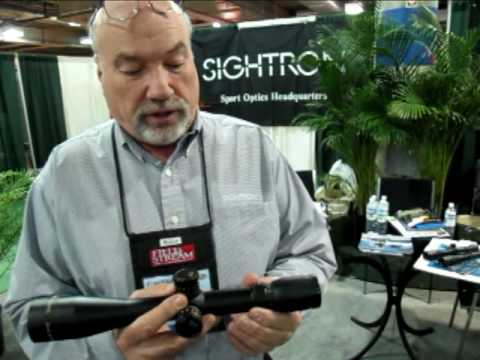
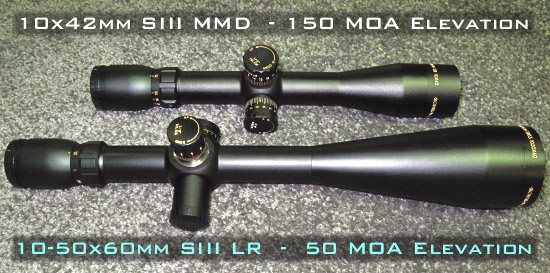
At SHOT Show, Sightron rolled out its much-awaited 10-50x60mm, and it looks good. Currently available in either a Fine-Cross-Hair (FCH) reticle, or FCH with target dot, the new unit has 1/8 MOA clicks and 50 MOA of windage and elevation. Priced under $1000.00, this is a good value compared to other premium optics with similar max magnification.
Affordable High-Magnification Long-Range Optic
With a “street price” under $995.00, the Sightron 10-50 could become hugely popular in 600/1000-yard benchrest and F-Class shooting. The big new zoom features a jumbo 60mm objective, 30mm maintube, and 1/8 MOA clicks. Nearly 17″ long and weighing 28.9 ounces, make no mistake, this is a BIG piece of glass. If the new 10-50×60mm SIII Sightron is as good as the 8-32×50mm LR SIII we tested in 2009, this should be a fantastic scope for the money.

New Tactical Scopes with Rear Parallax Control
Sightron had another much smaller, but equally impressive, scope on hand. It was the 10X model from the new SIII Tactical series which includes 16X and 20X versions also. The new SIII fixed-power Tactical Sightrons feature a modified mildot (MMD) reticle with 1/4 MOA clicks. These scopes (10X, 16X, and 20X) all boast an amazing 150 MOA of total elevation (and windage). We repeat: 150 MOA of total up/down travel. That allows you to shoot well past 1000 yards without needed an angled scope base. The parallax control is at the back, where you’d normally find a zoom ring. The position is actually very handy. With the parallax (focus) control near the rear eyepiece, you can easily set the parallax with your firing hand without moving out of position. These new fixed-power Tactical Scopes will retail for about $550.00.
September 30th, 2009
 The 7th Long-Range World Muzzle-Loading Championships were held September 24-27 at Camp Butner, North Carolina. Shooters from seven nations competed at distances between 300 and 1,000 yards. Competitors employed percussion target rifles of 19th-century design (though many were modern reproductions). Typically between .40 and .50 caliber and weighing around fifteen pounds, these rifles represent the apogee of mid-1800s firearm technology. The 7th Long-Range World Muzzle-Loading Championships were held September 24-27 at Camp Butner, North Carolina. Shooters from seven nations competed at distances between 300 and 1,000 yards. Competitors employed percussion target rifles of 19th-century design (though many were modern reproductions). Typically between .40 and .50 caliber and weighing around fifteen pounds, these rifles represent the apogee of mid-1800s firearm technology.
The World Muzzle-Loading Championships, held since 1972, is the highest level of target shooting with muzzle-loading arms. Guns used range from Japanese matchlock muskets, through the flintlocks of the American Revolution, to the percussion arms of the Civil War era. Individual competitions are held in eight rifle, four pistol, and two shotgun events. Original antique arms and modern replicas compete in separate classes.

CLICK HERE for complete match results. American competitors excelled in the original-arms division of the matches. Firing 150-year-old antiques, Karl Kuehn took gold in the 1,000-yard match and silver in the 900-yard match, carrying him to triumph in the overall long-range aggregate and earning a bronze medal in the Grand Aggregate. Nor was Kuehn the only medalist. Al Roberts won the original division of the 600-yard match, while Mon Yee took bronze at 300 and 500 yards — scores which earned him bronze in the mid-range Agg as well.
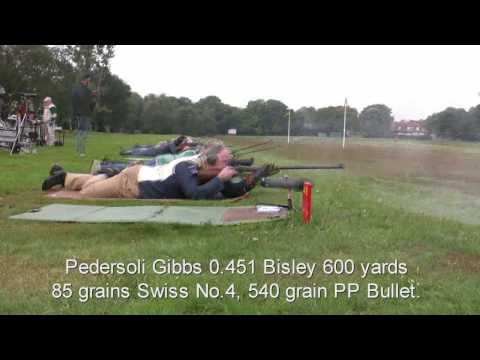
The Long-Range Muzzle-Loading World Championship was held under the auspices of the Muzzle-Loading Associations International Committee (MLAIC), the world governing body for black powder competition. The 8th World Long-Range Championship will be held in 2011, at the famed Bisley range in Great Britain. Shown below is a Pedersoli Gibbs target rifle at Bisley during the UK National Championships. Repro rifles like this won 10 gold medals at the 2007 World LR muzzle loading championships in South Africa.
More information on long-range muzzle-loading is available at www.lrml.org and www.usimlt.org (USA Team website).
August 19th, 2009
SPC Sherri Gallagher (of the USAMU) triumphed in the Tompkins Trophy Match, earning the title of 2009 NRA Long Range Champion. Gallagher shot a 1245-62X score, a new National Record, topping former champion John Whidden (1239-61X) by six points. Fellow USAMU shooter SFC Lance Dement finished third, with 1238-67X. Proving that accuracy runs in the family, Sherri’s sister Michelle Gallagher finished in fourth place with a 1238-65X, and Sherri’s step-father Mid Tompkins was the High Grand Senior with a 1230-58X.

L to R: John Whidden, SPC Sherri Gallagher, SFC Lance Dement. Photo courtesy NRABlog.com.
Miller Edges Litz on X-Count in Palma Match
The Palma Individual Trophy Match was hotly contested, going right down to the wire. Larry Miller (448-25X) eventually emerged the winner, edging Bryan Litz (448-23X) by two Xs. Bryan has written articles for this website and he is the author of the important new book, Applied Balllistics for Long Range Shooting.
In Team Competition, John Whidden’s Southeast Rifle Club won the Herrick Trophy Team Match, beating the USAMU Praslick Team by just one point, 791-30X to 790-41X. Sherri Gallagher also shot with the Praslick USAMU team, which was the winner of the Roumanian Trophy Match with a 793-42X Team score.
August 16th, 2009
The folks at the NRABlog have done a superb job covering the NRA National Rifle Championships at Camp Perry, Ohio. Now that the National High Power Championship has been decided (congrats to 2009 Champion Norm Houle!), attention shifts to the long-range events, including the Leech Cup, Mustin Trophy, Porter Trophy, and Andrus Trophy competitions, along with the Roumanian Trophy Team Match.

The NRA Blog has talented photographers on scene who’ve done a great job capturing the matches from a shooter’s perspective on the firing line. Go to the NRA Blog to view some excellent slide shows from the long-range events. This will also click to web galleries where you can view all the photos at your own pace. Below is a collection of some of our favorite photos from the NRABlog’s recent slide shows.
All photos are © 2009 NRABlog.com, All Rights Reserved, used with permission.
|


