|
|
August 6th, 2009
Sinclair Int’l has introduced two important new reloading products. Both are items that reloaders have requested for quite some time. Sinclair listened and now offers: 1) a precision large (.081″) flash hole reamer; and 2) a neck-turning tool for large cartridges such as the 50 BMG.
Large Flash-Hole Reamer
Sinclair has released a new, .081″-spec “outside-in” Flash Hole Reamer (item 07-3081) designed to designed to uniform standard flash holes to exactly .081 inch. This 3-piece tool features all stainless steel construction, a double-ended reamer guide for both large and small primer pockets, a knurled handle for easy turning, and a straight-fluted .081 inch reamer. With this tool you can remove burrs or obstructions in the flash hole and ensure that all your flash holes are the same size. NOTE — this tool works for both small primer pockets AND large primer pockets, for cartridges with .080″ nominal diameter flash holes. The new 07-3081 tool costs $37.50.

For quite some time, Sinclair Int’l has sold a similar device for small (PPC and BR-size) flash holes. Like the new 07-3081 unit for large flash holes, the 07-3000 Reamer for small flash holes works from the outside, so it can index off the primer pocket. It reams to .0625″, and also costs $37.50. The standard dimension for Lapua 220 Russian and 6mmBR flash holes is 1.5mm or .0590″. This tool will permit standard-size decapping rods with .0625″ tips to work without binding. However, note that both Forster and Redding normally supply .057″ decapping pins with their PPC and BR dies. So, it is NOT necessary to ream your Lapua BR/PPC flashholes, unless you prefer to do so for uniformity. It IS, however, a good idea to check BR/PPC flash holes for burrs before loading the first time.
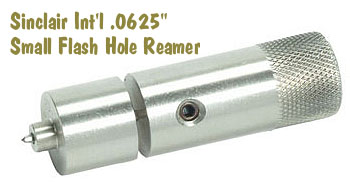
NOTE: If you purchase either the 07-3081 or 07-3000 Sinclair Flash Hole Reamer tools, we recommend you mic the cutter tip before you process a bunch of cases. Sometimes a tip comes through that is oversize. This will ream the flash holes larger than you may intend.
Large Caliber (35-50) Neck Turning Tool
Jumbo rifle cartridges, such as the 408 Chey Tac and 50 BMG, are becoming more popular with precision shooters, and Sinclair’s customers have asked for a neck-turning tool which will handle the large calibers. Sinclair’s new NT-5000 Neck Turning Tool will work for cartridges from 35 caliber all the way up to 50 cal, including the 50 BMG. This new tool uses the same smooth, cutter adjustment system as Sinclair’s NT-1000 Neck Turner, but a special oversize case-holder is furnished with each NT-5000 tool. Special large-caliber Expander Dies, and large-caliber turning and expander mandrels are available individually or as part of a Large Caliber Neck Turning Tool Kit.

July 21st, 2009
Grant, one of our Forum members from New Zealand, asked if there was a universal shell-holder that could hold cartridges securely for neck-turning, trimming, and case prep. He complained that the screwdriver-type case holder he was using didn’t center easily, was hard to tighten, and the case sometimes came loose during rotation. Another forum member agreed that he has experienced the same problems using a screwdriver-type case-holder.
This editor has found that a K&M screwdriver-type case holder CAN work securely if you tighten the locking mechanism tightly with the supplied wrench. But then you need the wrench again to get the case OUT. We were interested to see if there was a better solution that held the case securely, yet was easy to lock and unlock without tools.
Forum member Gunamonth provided a solution: “I use a Lee Zip Trim three-jaw case holder. With a little practice it centers the case quite nicely and holds just about anything. Chuck it in a cordless drill and have at it. It is much better than either the K&M or Sinclair [case-holder] in my opinion and the Zip Trim jaw is a lot cheaper (about $12.00). To use with power, you also need the Zip Trim three-jaw spindle, which is another $2.00.”

June 18th, 2009
 The full line of K&M reloading tools and accessories is now offered by PrecisionReloading.com. The popular K&M Arbor press (with optional seating force measurement gauge) is in stock. The K&M arbor costs $78.00, or $115.00 with the force measurement system. This clever design uses a Belleville washer stack and linkage to show the force required to seat your bullet on a standard dial indicator mounted on the top (dial indicator is $22 extra.) In addition, Precision Reloading offers K&M neck-turning tools, primer seaters, expanders, neck reamers, and flash-hole uniformers. The full line of K&M reloading tools and accessories is now offered by PrecisionReloading.com. The popular K&M Arbor press (with optional seating force measurement gauge) is in stock. The K&M arbor costs $78.00, or $115.00 with the force measurement system. This clever design uses a Belleville washer stack and linkage to show the force required to seat your bullet on a standard dial indicator mounted on the top (dial indicator is $22 extra.) In addition, Precision Reloading offers K&M neck-turning tools, primer seaters, expanders, neck reamers, and flash-hole uniformers.
This editor has tried out many different arbor presses. The K&M is my favorite. For me, the force measurement system acts like a warning light, telling me if something is way off in the bullet seating process. If you see the dial indicator needle jumping around wildly, or spiking too soon, you know that case has excessive neck tension, or perhaps the bullet is oversize in diameter (it happens). Currently, the K&M is the only arbor press with a seating-force gauge. The only down-side to the K&M arbor is that you must adjust multiple bolts to set the ram height. By contrast, the Sinclair Int’l Arbor and some other arbors feature a quick-release lever that lets you adjust ram height quickly and easily.

Based in Mitchell, South Dakota, Precision Reloading is run by active, knowledgeable shooters. In addition to centerfire reloading supplies and tools, Precision Reloading offers a full line of shotshell components and shotgun reloading equipment, plus optics, cleaning supplies, gun cases, and hunting gear. This month Precision Reloading is running an optics sale on Bushnell, Sightron, and Vortex scopes, binoculars, and spotting scopes.
February 3rd, 2009
 If you’re using a body die or a full-length sizing die, try using Ballistol (in the aerosol can) as a lube. It works GREAT without the tacky or gooey residue left by most case lubes. It will also clean off carbon residues on the neck as you lube the case. Just spray a little on a cotton patch (or your fingertips) and wipe each case before you run it up into the die. If you are using a steel neck bushing, be sure to wipe the neck as well. You can usually do a 6-10 BR-sized cases before you need to re-apply Ballistol on the patch. Ballistol is non-toxic, non-petroleum based, and will not harm your skin. It is very slippery, but can easily be removed with a rag or paper towel. Try it–you may retire your One-Shot. Derived from Pine Oil, Ballistol can also be used to protect wood stocks. If you’re using a body die or a full-length sizing die, try using Ballistol (in the aerosol can) as a lube. It works GREAT without the tacky or gooey residue left by most case lubes. It will also clean off carbon residues on the neck as you lube the case. Just spray a little on a cotton patch (or your fingertips) and wipe each case before you run it up into the die. If you are using a steel neck bushing, be sure to wipe the neck as well. You can usually do a 6-10 BR-sized cases before you need to re-apply Ballistol on the patch. Ballistol is non-toxic, non-petroleum based, and will not harm your skin. It is very slippery, but can easily be removed with a rag or paper towel. Try it–you may retire your One-Shot. Derived from Pine Oil, Ballistol can also be used to protect wood stocks.
Use Heavier Lube for Case-Forming
Note, for heavy case-forming or necking up case necks, we still recommend a thicker lubricant, such as Imperial die wax. But for normal case sizing, after your neck has been expanded, Ballistol will do the job, and you won’t need to tumble the brass afterwards. All you need is a very thin layer of Ballistol, and this easily wipes off with a paper towel.
 Neck-Turning Lubes Neck-Turning Lubes
For lubing the neck-turning tool mandrel while turning case necks, many folks use a blend of STP® Oil Treatment and Mobil 1 lube. Chuckw2 reports: “Try STP and Mobile 1 Synthetic oil in a 50/50 mixture. Very slick, but it sticks so you will need to tumble your cases after turning.” STP is a very thick lubricant, that flows and clings almost like honey. Jason reports the STP blend comes off easily in an ultra-sound bath, using a bit of detergent. STP is also now available in a convenient 7-ounce tube, so you don’t have to buy a large bottle. Another even cheaper option is assembly lubricant. For turning his case necks, RStreich uses assembly lube from an auto parts store. He notes: “The brand I have is reddish in color and kind of sticky like honey. It’s far better than the Imperial die wax I was using before.”
|


