Today is the first day of August, the beginning of National Shooting Sports Month (NSSM). Each August, throughout the month, America’s shooters come together to celebrate our sport and get newcomers involved. To help grow the ranks of shooters, the National Shooting Sports Foundation (NSSF) asks you to bring a new shooter to the range in August. That’s a good mission — adding to the ranks of shooters is the best way to preserve our Second Amendment rights.
This month, newcomers can take their first shots, and experienced shooters can invite someone new to the range or help an older shooter rediscover the fun of target shooting. This month-long event involves all the shooting sports — rifle, pistol, and shotgun.
Find Shooting Sports Events Near You
The NSSF’s ShootingSportsMonth.org website offers a comprehensive, searchable database. This lets you search by state, to find ranges, events, and sales promotions near you. Visit the NSSF online database of NSSM shooting events to find matches, clinics, training sessions, special sales — and much more.
Find Shooting Ranges Throughout the USA
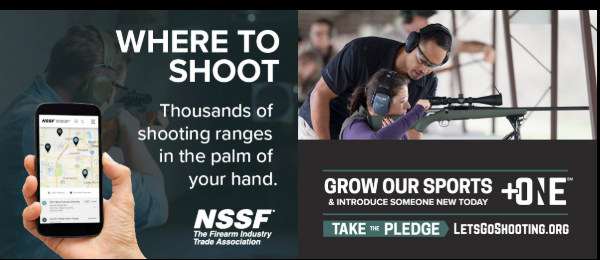
The NSSF offers a directory of shooting ranges online. Visit Wheretoshoot.org to get info on thousands of shooting ranges and facilities around the country. In addition, there is a FREE WheretoShoot Mobile App you can install on your phone. Versions are available for both Android and iOS (Apple) users.
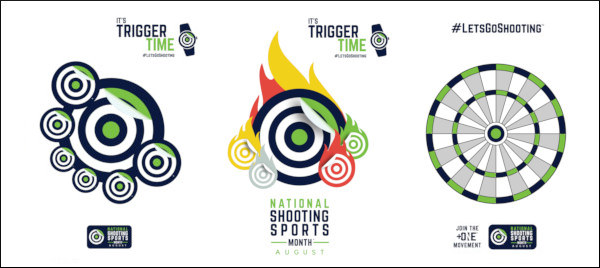
To promote National Shooting Sports Month, the NSSF offers 17 FREE Downloadable Targets. There are regular bullseyes, as well as Darts, Golf, and more. We really like the Billiards target and kids love the Water Balloons target. You can download all 17 targets for free, and then print them out, ideally with a color printer. Below are six of our favorite targets. Click HERE to download these six targets (3.5 mb ZIP).
What Shooters Can Do to Promote National Shooting Sports Month:
The NSSF says: “As shooters, you serve a critical role in the continued growth of gun ownership and shooting sports participation. We urge you to join us this August for National Shooting Sports Month.” There are a variety of ways you can help this August:
— Introduce a family member, friend, or group of friends to the shooting sports by taking them to a local range that’s hosting an event.
— Spread the word to family/friends and encourage them to get out to the range in August.
— Encourage the ranges and retailers near you to host an event this August and add them to the official events calendar at www.ShootingSportsMonth.org.
We’re in the middle of summer now, with the 4th of July holiday just last Friday. Most public ranges and private shooting facilities are now open for business — so there are plenty of places to have fun shooting. Now’s a great opportunity to get out of the house, enjoy some fresh air, and dust off those skills. To help you have fun on your range trips, here are 12 FREE printable targets.
FREE FUN Targets from NSSF
The Billiards Table Target above offers 15 brightly-colored numbered balls with the cue ball at the bottom. Aim for the numbers, shooting 1-15 in sequence, or alternate between stripes and solids. You can also draw an “X” on the white cue ball (or attach a paster), and use that to set your zero. This target is fun for shooting outdoors with rifles at 50 or 100 yards or indoors with pistols. This billiards target is part of a set of 12 Fun Targets from the NSSF. These were issued a couple seasons back for National Shooting Sports Month, held in August of each year.
FREE NSSF Fun Targets — Dartboard, Golf, Billiards, Bowling, Baseball and More…
HERE are a dozen FREE Targets. Along with Bullseye targets, there are some very cool specialty targets here, including a Golf Course Target, Baseball Diamond Target, Billiards Target, Light Bulb Target, Bowling Pin Target, and even a Windmill Target. Enjoy the myriad possibilities with these 12 fun targets.
With schools closed for the summer and kids spending more time at home, firearms safety is more important than ever. Given that fact, the NSSF reminds gun owners to keep their guns locked up so they cannot be accessed by children. The National Shooting Sports Foundation (NSSF) and its partners urge gun owners to keep firearm safety a top priority and are making safety resources widely available as gun and ammunition sales increase, especially among first-time firearm purchasers.
For anyone considering buying a gun, Project ChildSafe’s Road To Responsible Firearm OwnershipMany Paths to Firearm Safety video series helps gun owners determine the best safe storage device for their home/lifestyle. You also view the Safe Storage Options chart.
NSSF encourages gun owners and non-gun owners to use the firearm safety resources available on its Project ChildSafe website. These include the McGruff Gun Safety videos for young children and this educational video explaining how to discuss gun safety with children:
“More parents are assuming the role of educators in their homes, so it’s a good to time have a talk with your kids about gun safety, even if you don’t own a gun”, states Joe Bartozzi, NSSF President and CEO. “If you do own a firearm, be sure your family understands the safety rules regarding firearms in your home, and always store guns responsibly when not in use.”
The U.S. Supreme Court has issued a unanimous 9-0 decision holding that the Protection of Lawful Commerce in Arms Act (PCLAA) bars Mexico’s claims that firearm manufacturers “aided and abetted” illegal firearms trafficking to narco-terrorist drug cartels in Mexico. In the case of Smith & Wesson Brands, Inc. v. Estados Unidos Mexicanos, Mexico sought $10 billion in damages against several U.S. firearm manufacturers and distributors.
In its unanimous decision the Supreme Court stated: “Recall that Congress enacted the [PCLAA] statute to halt a flurry of lawsuits attempting to make gun manufacturers pay for the downstream harms resulting from misuse of their products. In a ‘findings’ and ‘purposes’ section, Congress explained that PLCAA was meant to stop those suits — to prevent manufacturers (and sellers) from being held ‘liable for the harm caused by those who criminally or unlawfully misuse firearm[s].’ Mexico’s suit closely resembles the ones Congress had in mind: It seeks to recover from American firearms manufacturers for the downstream damage Mexican cartel members wreak with their guns.”
Smith & Wesson Pres./CEO Mark Smith posted: “Today’s unanimous Supreme Court decision… represents not only a big win for Smith & Wesson, but our industry, American sovereignty and, most importantly, every American who wishes to exercise his or her Second Amendment rights. This suit, brought by Mexico in collaboration with U.S.-based anti-Second Amendment activist groups, was an affront to our nation’s sovereignty and a direct attack on the Constitutional rights of law-abiding Americans. It [was] a blatant abuse of our legal system to advance their anti-Constitutional agenda.”
NSSF filed an amicus brief supporting Smith & Wesson in its petition to dismiss Mexico’s claim for $10 billion in damages. NSSF’s Lawrence G. Keane, Senior V.P. and General Counsel stated: “This is a tremendous victory for the firearm industry and the rule of law. For too long, gun control activists have attempted to twist basic tort law to malign the highly-regulated U.S. firearm industry with the criminal actions of violent organized crime, both here in the United States and abroad. The firearm industry is sympathetic to plight of those in Mexico who are victims of rampant and uncontrolled violence at the hands of narco-terrorist drug cartels. The firearm industry works closely with the Bureau of Alcohol, Tobacco, Firearms and Explosives (ATF) to prevent the illegal straw purchasing of firearms and the illegal transnational smuggling of firearms. This unequivocal decision by the Supreme Court that PLCAA applies and there is no evidence whatsoever that U.S. manufacturers are in any way responsible is verification of commitment to responsible firearm ownership.”
The NRA also filed an amicus brief urging the Court to take the case and then filed a subsequent brief arguing for the outcome decided by the Court. Doug Hamlin, NRA Executive V.P. and CEO, stated: “The U.S. Supreme Court correctly renounced the tactics Mexico and its American collaborators used to try to extort and impoverish America’s firearms industry. The Protection of Lawful Commerce in Arms Act is clear – firearm manufacturers are not liable for the criminal misuse of their products, and this doesn’t change just because gun control activists disapprove of their lawful business practices and products. PLCAA is the law of the land today due to the work of NRA-ILA and NRA members in the early 2000s.”
Mexico filed its claim in a U.S. District Court in Boston in 2021, which was dismissed by that district court based on the bipartisan PLCAA that prohibits frivolous lawsuits against the firearm industry for the criminal misuse by remote third parties.
Mexico appealed to the U.S. Court of Appeals for the First Circuit, which revived the lawsuit holding that Mexico’s “aiding and abetting” theory fit within one of the PLCAA’s narrow exceptions. Smith & Wesson Brands, Inc., et al., successfully petitioned the Supreme Court last year. The case was argued before the Supreme Court in March of this year.
Gun Storage Check Week is the time to ensure your firearms are stored safely and securely. NSSF, the Firearm Industry Trade Association, is promoting Gun Storage Check Week, June 1-7, 2025, to remind gun owners to review their storage practices to prevent accidents, suicides and thefts. During this week, check your gun safe(s), and ensure your firearms are stored correctly and locked down properly. Also use secure gun cases when transporting firearms to the range. When traveling by air, use proper TSA-approved gun cases and comply with transport rules.
“Securely storing guns when they’re not in use can save lives. It’s really that simple,” said Joe Bartozzi, President and CEO of NSSF. “No one wants their gun in the hands of an unsupervised child, a person in crisis, someone who does not understand how to safely operate firearms, or a thief. If something bad happens because your gun isn’t stored securely, you’ll regret it, probably forever.”
This video covers gun safety rules and secure storage of firearms.
Gun Storage Check Week’s safety resources highlight many options to store firearms securely so that guns are off limits to unauthorized persons. Secure gun storage devices include:
Cable Locks — Available free of charge through NSSF’s Project ChildSafe® program Lock Boxes — Secure storage solution for guns kept for home security and in vehicles Lockable Gun Cases — for security, portability, and travel Full-size Gun Safes — For owners with multiple firearms to protect against fire and theft.
Enter to Win Product Prizes in June
Each week in June 2025, you can enter to win firearm storage units and other safety equipment thanks to Regal Products, Vault Pro, and ShotLock. Storage equipment prize packages are valued up to $499 and change weekly. Shown below is the first set of prizes. Go to GunStorageCheck.org to register. One winner per week will be chosen. The contest restarts each week, so you can enter up to four times in June.
Team Smith & Wesson shooter Julie Golob has a message for Mother’s Day (Sunday, May 12th). Julie writes: “While some are using Mother’s Day week to push a gun control agenda, I’d like to encourage moms to ‘Take a Moment’. Talk to your kids about firearms safety. Help them learn what to do around firearms and have an open, honest discussion about guns and gun safety.
I truly believe that, no matter if you are pro-gun or anti-gun, everyone should know and understand the basic rules of firearm safety. It is equally important for parents to have the discussion about guns and what to do if your child finds one. Both the NSSF’s Project ChildSafe and the NRA’s Eddie Eagle GunSafe® Program are excellent. They offer resources for parents, educators, and child care providers to help ensure kids stay safe.
In this video, Julie encourages parents to have “the talk” about firearm safety with their kids sooner rather than later, and provides tips for how to have a helpful discussion. Sherra Scott, a mom and a certified NRA instructor, agrees with Julie: “Whether you have firearms in your home or not, if you have children in your life, please watch this video and talk WITH them about firearm safety and what to do if they come into contact with a firearm.”
Pistol shooting is fun — that’s reason enough to head to an indoor range. In addition, all CCW permit holders should definitely practice regularly. For many people, indoor shooting can be done in the evening, after work, relatively close to home. Indoor ranges are most convenient for those who live near urban centers, where the biggest threats to public safety currently exist. This article talks about indoor firearms training and the proper procedures you should follow at indoor ranges.
This Video Covers Basic Gun Range Safety Rules and Etiquette
FIVE IMPORTANT SAFETY PROCEDURES for Indoor Ranges
1. Follow the Three Fundamental Rules for Safe Gun Handling
ALWAYS keep the gun pointed in a safe direction. ALWAYS keep your finger off the trigger until ready to shoot. ALWAYS keep the gun unloaded until ready to use.
2. Follow ALL Range Officer Instructions
ROs are the first and final authority on any range and their decisions are generally final. Arguing with a Range Officer may just get you thrown out.
3. Don’t Bother Others or Touch Their Guns
Respect other shooters’ privacy unless a safety issue arises. Do NOT engage other shooters to correct a perceived safety violation unless absolutely necessary – inform the RO instead. NEVER handle or touch another shooter’s firearm without their permission!
4. Know Your Range’s Rules
Review and understand any and all range rules and requirements/expectations. For example, what is the range’s maximum rate of fire? Are you allowed to collect your brass?
5. Know What To Do During a Cease Fire
IMMEDIATELY set down your firearm, pointed downrange, and STEP AWAY from the shooting booth (or bench). Range Officers do not want shooters trying to “secure/unload” their firearms in a cease fire situation — they want the shooters separated from their guns instantly.
BAD RANGE BEHAVIOR — Five Things NOT to Do at the Range
Here are the five worst behaviors we’ve seen at indoor ranges. These behaviors are both dangerous and inconsiderate. Any one of these behaviors can get you permanently banned from an indoor range.
1. Sweeping other individuals after loading a weapon behind the firing line is very bad. All your weapons should be empty until you reach your shooting station.
2. Turning the handgun sideways while trying to clear a malfunction or insert/remove a magazine. This will point the muzzle at a fellow shooter. Or, after shooting a gun, the shooter fails to clear the weapon and then places the gun somewhere near the shooting station with the muzzle in an unsafe position.
3. Reacting unpredictably when firing a high recoil handgun. We’ve seen people take a second shot by accident with the muzzle way off target.
4. Not obeying range commands — in particular continuing to shoot during called cease-fires.
5. Poorly aimed shooting that hits target frames or carriers, causing ricochets.
Double-Up on Hearing Protection When Shooting Indoors
When shooting indoors we recommend quality muffs with earplugs underneath, offering double protection. When inside an enclosed range, with other shooters blasting away right next to you, you really need effective hearing protection. But you also need to hear range commands and be able to communicate. That’s why we recommend electronic muffs with plugs underneath.
For indoor pistol shooting, we like the Howard Leight Impact Pro Muffs. These offer an impressive 30 dB Noise Reduction Rating (NRR). In addition, the electronic functionality allows you to hear all range commands clearly. These muffs are a good value. These are available for $76.99 at Palmetto SA. Howard Leight also makes good protective safety eyewear with ANSI Z87.1-2010 (High Impact) rating. These milspec, wrap-around Genesis safety glasses can be purchased for $16.63 on Amazon (#ad).
The National Shooting Sports Foundation (NSSF) has prepared tips for gun owners transporting firearms in their vehicles. Whenever you are driving with guns (of any kind), the firearms should be transported securely. In some states, the firearms must be in locked cases inside the vehicle. And, with the rise of break-ins on parked vehicles, it’s important to keep gun cases out of sight if possible. This article has tips on safe and secure gun transport.
HERE Are Key Guidelines for Safe, Secure Handling of Firearms in Vehicles:
• Take note of and safely control the muzzle direction of firearms in vehicles. This is one of the main rules of gun safety and applies to the inside of vehicles as well as any other location.
• When finished using your firearm outside your vehicle, unload it before you re-enter your vehicle.
• Even after a long hunt or a day in the sun at the range, always check, and then double check, that guns are unloaded before placing them in a car or truck.
• Be very careful if you must unload a firearm in the confined space of a vehicle so as not to have an accidental discharge. If your location allows, it is safer and easier to unload the firearm outside the vehicle.
• Never leave firearms in parts of the vehicle accessible to children or pets.
• Keep firearms and ammunition out of sight to avoid tempting thieves.
• Use secure temporary storage for firearms in vehicles.
• A lockable gun case or a lock box may be the most practical choice to securely store a gun in a vehicle. These come in a range of prices and models.
• If you’re concerned about quick access to your firearm, many types of lockable safes allow for extremely fast access of your gun while at the same time helping to prevent unauthorized access.
• Secure the lock box to the vehicle, if possible. Some companies make custom concealed compartments for specific model vehicles.
Storing Firearms in Vehicles to Prevent Theft and Misuse
We travel with our firearms all the time, taking them to the range, on hunting trips or carrying them on our person, as permitted by law. When you are transporting guns, the last thing you want is to have your gun stolen and potentially misused by a criminal. In some states, you could even be subject under the law to serious penalties and fines for failure to properly secure a firearm. Unfortunately, thefts of firearms from vehicles are on the rise. Thieves commonly steal cars and trucks even when they don’t obviously contain firearms — a reminder that vehicle door locks are not totally secure.
When you are not in your vehicle, all firearms should be placed in locked storage and out of sight. Locking the doors on your vehicle does not constitute secure firearm storage. As one writer put it: As one writer put it: “Cars and trucks aren’t safes. And they’re not holsters. They’re not storage containers.”
The glove compartment or console of your vehicle, even if lockable, should not be considered a secure storage device either, as it can be pried open quickly and is the first place a thief might look. If you need to leave a handgun in a vehicle, we recommend putting the guns in secure case, preferably out of sight. Many vehicles have a compartment, above the spare tire storage recess, which can be secured.
Virginia Governor Glenn Youngkin has vetoed two dozen anti-gun bills passed by the Democrat-controlled Virginia General Assembly. These bills would have curtailed individual gun rights and attacked gun dealers/manufacturers throughout the Commonwealth. The NRA and NSSF (National Shooting Sports Foundation) praised Governor Youngkin for standing up to those who want to destroy gun rights in Virginia.
The NRA praised Gov. Youngkin for his actions to preserve Second Amendment rights: “[We] thank Governor Youngkin for standing strong in his support for the Second Amendment by vetoing the litany of gun control bills pushed through the General Assembly this year,” said John Commerford, Exec. Director of the NRA Institute for Legislative Action (NRA-ILA). “For the second year in a row, [Virginia] gun control activists tried to enact dozens of radical, California-style laws that would have severely restricted the Second Amendment rights of gun owners in the Commonwealth. The NRA applauds Governor Youngkin for upholding his promise to protect our Constitutional freedoms.”
The bills vetoed by Governor Youngkin came from the long wish list of radical gun control activists. This included attempts to restrict the Constitutional rights of 18- to 20-year-old adults, dramatically expand gun-free zones that would have left law-abiding Virginians defenseless and enact a mandatory waiting period to take possession of a legally-purchased firearm. In addition, the vetoed legislation would have banned a wide range of common firearms used for hunting, competition, and self-defense
Notable anti-gun bills vetoed by Gov. Youngkin this year include:
SB 848 — Remove the right of anybody under 21 years of age to purchase certain semiautomatic rifles mislabeled as “assault weapons.”
SB 891 — Mandates 5-day waiting period of five days for the purchase and transfer of firearms.
SB 1181 and HB 1607 — Bans the sale of many semiautomatic firearms and bans magazines having a capacity of more than 10 rounds.
SB 1329 — Imposes restrictions on concealed carry and storage in vehicles.
SB 1450 and HB 1608 — Creates new civil liabilities for companies engaged in the sale, manufacturing, distribution, or marketing of firearm-related products.
CLICK HERE for the official list of Virginia legislation vetoed by Gov. Youngkin so far this year. This includes the two dozen anti-Second Amendment bills he recently vetoed.
The NSSF notes that the defense of Second Amendment rights by Governor Youngkin proves that Elections DO matter. All gun owners should register and VOTE to ensure that your rights are preserved. Take time to research candidates and support those who will protect your Second Amendment rights.
What did you really want for Christmas? A new rifle? Maybe a new reloading press? A poll of sportsmen and firearm owners by Southwick Associates’ HunterSurvey.com / ShooterSurvey.com asked, “What hunting or target shooting gear are you most hoping to receive this holiday season?” Respondents could select three items from a long list of products.
The most-wished-for items were in the Hunting Apparel category, with 22.3 % of respondents asking Santa for new hunting duds. A new Handgun was second-highest on the list, followed by a Trail Camera at #3, Ammunition at #4, and a Laser Rangefinder at #5.
How do your choices stack up against the survey responses?
Note, the totals of all selections exceeds 100% because survey participants could elect three total choices. Also, since this older survey was specifically directed at hunters (rather than just firearm owners), a number of responses relate to bows and archery equipment.
This NSSF video explains key legal considerations when gifting a firearm.






 Team Smith & Wesson shooter


 What did you really want for Christmas? A new rifle? Maybe a new reloading press? A poll of sportsmen and firearm owners by Southwick Associates’ HunterSurvey.com / ShooterSurvey.com asked, “What hunting or target shooting gear are you most hoping to receive this holiday season?” Respondents could select three items from a long list of products.


