On January 10, the National Shooting Sports Foundation (NSSF) and the Sporting Arms and Ammunition Manufacturers’ Institute (SAAMI) filed a lawsuit on behalf of their members against the State of California in Fresno Superior Court challenging the state’s microstamping law. NSSF and SAAMI seek to invalidate and enjoin enforcement of provisions of California state law enacted in 2007, but not made effective until May 2013. These newly “activated” provisions of California law will effectively require that ALL future models of semi-auto pistols be microstamp-capable. Note — semi-auto handguns that are currently on California’s “approved” handgun roster will not be banned from sale. But guns introduced in the future cannot be sold in California unless they have microstamping technology. If gun makers cannot include such features in their future designs, the next generation of handguns will effectively be banned from sale in California.
Under California law, firearms manufacturers would have to micro laser-engrave a gun’s make, model and serial number on two distinct parts of each gun, including the firing pin so that, in theory, this information would be imprinted on the cartridge casing when the pistol is fired. “There is no existing microstamping technology that will reliably, consistently and legibly imprint the required identifying information by a semiautomatic handgun on the ammunition it fires. The holder of the patent for this technology himself has written that there are problems with it and that further study is warranted before it is mandated. A National Academy of Science review, forensic firearms examiners and a University of California at Davis study reached the same conclusion and the technical experts in the firearms industry agree,” said Lawrence G. Keane, NSSF senior vice president and general counsel. “Manufacturers can not comply with a law the provisions of which are invalid, that cannot be enforced and that will not contribute to improving public safety. As a result, we are seeking both declaratory and injunctive relief against this back-door attempt to prevent the sale of new semiautomatic handguns to law-abiding citizens in California.”
In 2007, California Assembly Bill 1471 was passed and signed into law requiring microstamping on internal parts of new semiautomatic pistols. The legislation provided that this requirement would only became effective if the California Department of Justice certified that the microstamping technology is available to more than one manufacturer unencumbered by patent restrictions. On May 17, 2013, Attorney General Kamala D. Harris provided such certification. The DOJ’s certification notice has been attacked on the grounds that it is scientifically unsound, founded on little more than “wishful thinking”.
Earlier this week, the U.S. District Court in Illinois declared the City of Chicago’s ban on the sale of firearms to be “unconstitutional under the Second Amendment”. The ruling was issued in a court case filed by Illinois firearms dealers and gun owners, challenging Chicago ordinances that ban virtually all sales and transfers of firearms inside Chicago city limits.
U.S. District Court Judge Edmond Chang held that the Second Amendment includes “the right to acquire a firearm, although that acquisition right is far from absolute[.] But Chicago’s ordinance goes too far in outright banning legal buyers and legal dealers from engaging in lawful acquisitions and lawful sales of firearms[.]”
[Chicago] Municipal Code § 8-20-100 and the City’s zoning ordinance (MCC § 17-16-0201), which ban gun sales and transfers other than inheritance, are declared unconstitutional under the Second Amendment. The Court will enter judgment for Plaintiffs [Illinois Assn. of Firearms Retailers]. — Order by U.S. District Judge Hon. Edmond E. Chang.
Lawrence G. Keane, NSSF senior vice president and general counsel commented: “This is an important decision because the Court recognized that the lawful commerce in firearms, in which NSSF members are engaged, is protected by the Second Amendment.”
What covers an area greater than the Great Pyramid at Giza, attracts visitors from 100 countries, and has over 1600 exhibitor booths distributed along 12.5 MILES of Aisles? The SHOT Show in Vegas is the correct answer. The annual trade show for the $6 billion per year fireams/hunting industry, SHOT Show is the ultimate gathering for all things gun-related. Just how big is SHOT Show? This NSSF Infographic reveals some amazing facts:
The NFL has refused to run a self-protection-themed TV commercial from Daniel Defense during the 2014 Super Bowl game. Apparently it’s fine to display half-naked ladies, or sell alcohol products on national television, but anything related to the Second Amendment is off-limits. In refusing to air the Daniel Defense commercial, the NFL cited its League policy against promoting firearms. According to the NSSF, “It is league regulation and not federal law that prohibits the advertising of firearms or ammunition on NFL broadcasts.”
Watch Daniel Defense Commercial Banned from the Super Bowl by the NFL
If you watch the minute-long video above, you will see that it is pretty tame. It is all about a man taking individual responsibility for protecting his family. You won’t see guns being fired, in fact you won’t see any actual guns at all*. The message is subtle — if you care about your family’s security, you may wish to exercise your Constitutional right to own a firearm. That doesn’t seem extreme at all, but NFL decision-makers decided that this commercial was too controversial, and violated its ‘no guns’ rules.
Larry Keane, Senior Vice President and General Counsel for the National Shooting Sports Foundation, criticized the action of the NFL: “It would have been interesting to see if the television ad that Daniel Defense wanted to run during the 2014 Super Bowl would have caused the hubbub in elite liberal circles that the National Football League clearly feared it would. It may well have, but we’ll never know, for sure, since the NFL decided that its ‘no firearms’ on its airtime ruling would stand after the video review.
While we are disappointed that the nicely-produced Daniel Defense commercial will not run on national television during the Super Bowl, we are very pleased to see the attention being paid to the decision of a major sport’s management that seems so out of touch with the pro-Second Amendment sentiments of so many football fans across the country. Conservative commentators have been busy scoring points. Nationally-syndicated Columnist Michelle Malkin, for example, wrote ‘The National Football League’s hypocrisy and selective decency standards reek like a post-game locker room’.” Here is a Fox News commentary about the NFL’s refusal to air the Daniel Defense commercial:
* The video does show the Daniel Defense logo with the silhouette of a rifle. Daniel Defense agreed to remove that rifle graphic, but the NFL still said “no”. As a Fox commentator explains: “This is really not about guns at all but [rather] the idea of guns, and how distasteful they are… to people in the media.”
Believe it or not, NSSF’s 2014 SHOT Show is only a month and a half away. As the entire industry prepares, enthusiasm is already building for the January 14-17 event in Las Vegas, Nevada.
If you haven’t already done so, register today at ShotShow.org. At the same time you can also sign up for special sessions, such as retailer and law enforcement seminars, SHOT Show University, evening events, and more. Stay up to date on show news through the SHOT Show Blog and connect with the show via Facebook and Twitter.
Looking for a shooting range? There’s an App for that. The National Shooting Sports Foundation (NSSF) has released free Where-To-Shoot mobile Apps that locate shooting ranges. This App is offered for Android devices as well as Apple iPhones and iPads.
Available for free in the Apple App Store and Google’s Android App Store, the Where-To-Shoot Apps puts a comprehensive directory of shooting ranges in the palm of your hand. These Apps also include tips for shooters, news, and firearm-safety information.
Users can search by current location or zip code and find specifics about each range, including activities offered, directions, and contact info. The App Databases are updated regularly.
A poll conducted for the National Shooting Sports Foundation has found Americans are highly skeptical of the reliability of user authorized technology for firearms. They also say overwhelmingly that they would not be likely to buy a so-called “smart gun” and overwhelmingly oppose any government mandate requiring the use of this technology should it become available.
Asked “How familiar are you with efforts to develop a firearm that will only fire for a specific authorized person(s)?”, only 20 percent of respondents said they were very or somewhat familiar with the concept of “smart gun” technology. When told that such firearms would incorporate biometric or radio frequency identification (RFID) with an activation system that would rely on battery power, 74 percent of respondents said that these firearms would not be reliable at all or very reliable. Gun owners overwhelmingly (84%) believed a smart gun would not be reliable, while a clear majority (60%) of non-gun owners also believed they would not be reliable.
An overwhelming 74 percent of respondents overall said that they would not buy or would not very likely buy such a smart gun. Some 70 percent of the survey sample said that they did not believe that government should mandate that all firearms produced incorporate smart gun technology should it become commercially available.
Can Technology Be Trusted? Watch this Video for a Chilling Vision of Future Gun Control:
These findings were among the results of a national scientific poll of more than 1,200 Americans conducted in October by McKeon & Associates and released by the NSSF. Although attempts to develop and market firearms equipped with authorized user recognition technology have been discussed for many years, the topic has been revived in recent months by some gun control advocates, remarks by President Obama and by the depiction of a smart gun in the latest James Bond movie. Read the NSSF press release for more details.
Planning to buy a gun soon, and worried about the effect of the Federal government shutdown? Many government services have been temporarily terminated (and Federal facilities closed). However, the background check system for firearms purchases is still up and running. The NSSF reports that The FBI’s National Instant Criminal Background Check System (NICS) Section is remaining fully operational and maintaining normal business hours. Accordingly, if you go to a gun store to purchase a firearm, the shop should be able to run a NICS background check in normal fashion.
However, some other firearms-related services of the Bureau of Alcohol, Tobacco, Firearms and Explosives (ATF) have been halted for the time being. The ATF’s Office of Enforcement Programs and Services (EPS), which includes the imports, firearms technology, NFA branches, and the licensing center and firearms industry programs branch now processing marking variances, is effectively shut down, operating only with minimal staff.
Are target shooters a dying breed? Apparently not according to a new NSSF study. Remarkably, 20% of all target shooters began participating in the past five years. That’s great news. The next generation of target shooters is more diverse and more urban than ever before — and there are more females getting involved in target shooting — a lot more. 37% of new target shooters are female, a big number compared to older generations. The NSSF’s newly-commissioned study shows that, in years ahead, our shooting ranges will see more lady shooters and more participants who come from urban/suburban areas (as opposed to rural communities).
The NSSF report shows that one-fifth of target shooters in America first started participating in the shooting sports between 2008 and 2012. That means 20 percent of all target shooters began participating in the past five years. That’s promising news.
Here Are Some Key Findings:
Younger: 66 percent of new shooters fall into the 18-to-34-year-old category compared to 31 percent in the same age category for established shooters.
Female: 37 percent of new target shooters are female compared to 22 percent of established target shooters.
Urban: 47 percent of new target shooters live in urban/suburban settings versus 34 percent of established target shooters.
Introducing New Shooters to the Sport — Tips from a Champion
In this video, Champion pistol shooter Doug Koenig offers advice on how to introduce newcomers to the shooting sports. With new shooters, Doug says you need to keep the experience safe and fun. Start with low-recoil firearms and use reactive targets to increase the “fun factor”.
Koenig’s Tips for Successful Range Sessions with New Shooters
1. Start off a new shooter with an airgun or a .22 LR. “You don’t want to start them out with the biggest, loudest firearm you have in your collection.”
2. Make sure the shooting is fun. “Use [reactive] targets — steel targets, knock-down targets, clay pigeons sitting on the bank — anything reactive, something they can see happen.” You want to keep people interested, keep them excited.
3. Remember the reason we go to the range — to have a good time. Don’t overload newcomers with stress. “Keep it fun, keep it safe, and keep everything in perspective.” Remember that [newcomers] “are the future of the shooting sports for all of us.”
A lead-free “utopia” where bullets are banned and hunting is, for all practical purposes, eliminated — that’s apparently what some legislators want California to become. California Assembly Bill AB 711 would completely ban the use of traditional lead ammunition for hunting anywhere in the state. What’s more, many legislators acknowledge that this ban could, in the near future, be applied to all shooting sports in the Golden State. If you can’t buy bullets, you can’t shoot — and that seems to be the real agenda.
NSSF has purchased billboards in the Sacramento area to urge opposition to AB 711 and has been airing radio commercials that reveal the role of the anti-hunting groups behind this ill-conceived legislation. This week, the opposition to AB 711 was joined by a major state labor organization. NSSF urges all California hunters, target shooters and gun owners to contact their state legislators to oppose AB 711.
To understand more about the issue, read a well-reasoned editorial published in the Outdoor Wire. Even non-Californians should be concerned, because other states might follow California’s lead in the future. And AB 711 is not the only serious anti-gun measure on the table. In addition to AB 711, several other highly restrictive measures are in the works. Proposed legislation would place ALL semi-automatic rifles with detachable magazines on California’s list of banned “assault weapons”. Another bill would block Californians from purchasing long guns unless purchasers pass a state-mandated written test.


 On January 10, the National Shooting Sports Foundation (NSSF) and the Sporting Arms and Ammunition Manufacturers’ Institute (SAAMI) filed a lawsuit on behalf of their members against the State of California in Fresno Superior Court challenging the state’s microstamping law. NSSF and SAAMI seek to invalidate and enjoin enforcement of provisions of California state law enacted in 2007, but not made effective until May 2013. These newly “activated” provisions of California law will effectively require that ALL future models of semi-auto pistols be microstamp-capable. Note — semi-auto handguns that are currently on California’s “approved” handgun roster will not be banned from sale. But guns introduced in the future cannot be sold in California unless they have microstamping technology. If gun makers cannot include such features in their future designs, the next generation of handguns will effectively be banned from sale in California.
 Earlier this week, the U.S. District Court in Illinois declared the City of Chicago’s ban on the sale of firearms to be “unconstitutional under the Second Amendment”. The ruling was issued in a court case filed by Illinois firearms dealers and gun owners, challenging Chicago ordinances that ban virtually all sales and transfers of firearms inside Chicago city limits.

 The NFL has refused to run a self-protection-themed TV commercial from Daniel Defense during the 2014 Super Bowl game. Apparently it’s fine to display half-naked ladies, or sell alcohol products on national television, but anything related to the Second Amendment is off-limits. In refusing to air the Daniel Defense commercial, the NFL cited its League policy against promoting firearms. According to the NSSF, “It is league regulation and not federal law that prohibits the advertising of firearms or ammunition on NFL broadcasts.”
 Believe it or not, NSSF’s 2014 SHOT Show is only a month and a half away. As the entire industry prepares, enthusiasm is already building for the January 14-17 event in Las Vegas, Nevada.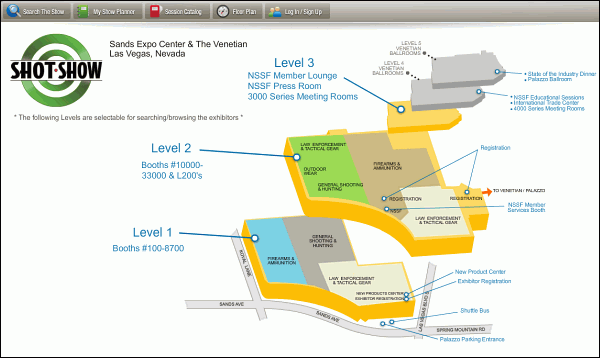
 Looking for a shooting range? There’s an App for that. The National Shooting Sports Foundation (NSSF) has released free Where-To-Shoot mobile Apps that locate shooting ranges. This App is offered for Android devices as well as Apple iPhones and iPads.
 Planning to buy a gun soon, and worried about the effect of the Federal government shutdown? Many government services have been temporarily terminated (and Federal facilities closed). However, the background check system for firearms purchases is still up and running. The NSSF reports that The FBI’s National Instant Criminal Background Check System (NICS) Section is remaining fully operational and maintaining normal business hours. Accordingly, if you go to a gun store to purchase a firearm, the shop should be able to run a NICS background check in normal fashion.
 Are target shooters a dying breed? Apparently not according to a new NSSF study. Remarkably, 20% of all target shooters began participating in the past five years. That’s great news. The next generation of target shooters is more diverse and more urban than ever before — and there are more females getting involved in target shooting — a lot more. 37% of new target shooters are female, a big number compared to older generations. The NSSF’s newly-commissioned study shows that, in years ahead, our shooting ranges will see more lady shooters and more participants who come from urban/suburban areas (as opposed to rural communities).
 A lead-free “utopia” where bullets are banned and hunting is, for all practical purposes, eliminated — that’s apparently what some legislators want California to become. California Assembly Bill AB 711 would completely ban the use of traditional lead ammunition for hunting anywhere in the state. What’s more, many legislators acknowledge that this ban could, in the near future, be applied to all shooting sports in the Golden State. If you can’t buy bullets, you can’t shoot — and that seems to be the real agenda.


