|
|
May 3rd, 2011
In a few more weeks, many readers will hit the road for a summer holiday. Would you like to find a convenient shooting range near your destination? Perhaps you’ve recently relocated and want to join a shooting club near your new residence. Or maybe you’re just looking for a facility close to home that offers instruction or specialized programs for women or juniors. You can quickly find exactly what you want at the WhereToShoot.org website.

A service of the NSSF (Nat’l Shooting Sports Foundation), WhereToShoot.org offers a Searchable Database of pistol, rifle, and shotgun ranges around the country. You can search by state, or select a particular distance from any zip code. The database is very complete. The individual range pages also include web addresses, phone numbers, and map links. The example below shows the results of a search for rifle-specific ranges in Arizona:

Five-Star Ranges
Your search results may reveal ranges identified with up to five stars. This is a rating system developed by the National Association of Shooting Ranges (NASR) that distinguishes these ranges as the best at providing quality-level recreational experiences.
May 3rd, 2011
All gun owners, hunters, and target shooters are invited to participate in the National Shooting Sports Foundation’s 50th Anniversary Photo Contest. Here’s your chance to win a $50 Cabela’s Gift Card and have your photos showcased on the NSSF website. Each month, from May through December 2011, NSSF will announce a contest theme*. This month’s theme is “Spring Hunts”, so post a photo of your spring hunt — whether turkey, game birds or small game.”

How To Enter NSSF Contest
To enter the photo contest, click the Contest Tab on NSSF’s Facebook page. Photos may be posted during the first three weeks of each month. (To post a photo, you must first “Like” the NSSF Facebook page.) At the end of the month, the ten photos with the most votes will be declared winners, and the top voter-getter each month will receive a $50 Cabela’s Gift Card. Click HERE for Contest RULES.
* Other monthly themes will focus on target shooting, youth participation, family and friends, hunter orange, wildlife conservation, AR-style modern sporting rifles and handguns.
March 10th, 2011
 Do you want to boost membership at your local shooting range? Then check this out. To help public and private shooting facilities jump-start their recruitment and retention efforts, the National Shooting Sports Foundation (NSSF) will award up to $500,000 in grants this year to ranges around the country. This is the fourth year that the NSSF has distributed funding to qualifying ranges through its Range Partnership Grant Program. Do you want to boost membership at your local shooting range? Then check this out. To help public and private shooting facilities jump-start their recruitment and retention efforts, the National Shooting Sports Foundation (NSSF) will award up to $500,000 in grants this year to ranges around the country. This is the fourth year that the NSSF has distributed funding to qualifying ranges through its Range Partnership Grant Program.
“Having purchased firearms in record amounts in the last few years, people are excited about target shooting,” said Chris Dolnack, NSSF senior VP. “We want ranges to tap into that enthusiasm and these grants will help shooting range managers test new strategies to attract customers.” Private shooting ranges must have a public-participation option to qualify. “The best way to increase participation is to enhance and promote shooting opportunities at the local level,” said Melissa Schilling, NSSF recruitment and retention manager. “We’re looking for unique proposals that motivate people of all ages to enjoy target shooting.”
CLICK HERE to learn more about NSSF’s Range Partnership Grant Program.
Deadline: Applications must be received by NSSF no later than 5:00 pm (EST) on April 19, 2011.
Who May Apply? Only project proposals submitted by and in the name of public shooting facilities, private facilities that offer the public shooting opportunities, or educational institutions with either public shooting facilities of their own or hunting and shooting sports curricula shall be eligible for funding under the Grant Program. Separate proposals must be submitted for each project to be funded. A group of ranges may band together and submit one proposal. IMPORTANT — This grant program is NOT intended for land purchases, for building or improving structures (such as club-houses), or for acquisition of range equipment and supplies.
How to Apply: Download the Grant Application Form (PDF) and submit according to guidelines.
February 22nd, 2011
According to the latest Firearm Manufacturing and Export Report from the Bureau of Alcohol, Tobacco, Firearms, and Explosives (ATF), U.S. firearm manufacturers produced more than 5.4 million firearms in 2009. That’s a big increase compared to the start of the decade in 2001, when less than 3,000,000 firearms were manufactured by U.S. companies. In recent years, production of both handguns and long guns has grown significantly, as show in the graph below, prepared by the National Shooting Sports Foundation (NSSF) based on ATF records from 1984-2009.

The ATF data (from 1984-2009) reveals some interesting trends:
- Total firearms produced in 2009 topped 5.4 million, exceeding the previous high total in 1994.
- Over 3,000,000 long guns were produced in 2009, the highest quantity in the past 25 years.
- The total number of firearms sold in 2009 works out to one gun for every 57 citizens, based on the 2009 U.S. population of 305,529,237.
- After a decade-long decline, handgun production rose dramatically from 2004-2009. If trends continue, in a few more years, pistol sales could out-number long gun sales.
NSSF research has updated its 14-page Industry Intelligence Report, titled Firearms Production in the United States, with the most recent data on U.S. production of pistols, revolvers, rifles and shotguns. Additional updated data found in this report include: Annual Survey of Manufacturers figures and U.S. International Trade Commission firearm import and export figures. The report is available for free to NSSF members by logging into the members section of the NSSF website, clicking “NSSF Industry Research” and then clicking “Industry Intelligence Reports.” For more information, log on to www.nssf.org.
December 27th, 2010
Story by Larry Keane, NSSF
 Since the early 1970s, ammunition being shipped in the United States has been classified under “Other Regulated Materials” — class D (ORM-D) regulations. This precludes the need for hazardous material (HazMat) shipping charges and other expensive handling requirements. The savings to the industry has been estimated at more than $300 million per year. Since the early 1970s, ammunition being shipped in the United States has been classified under “Other Regulated Materials” — class D (ORM-D) regulations. This precludes the need for hazardous material (HazMat) shipping charges and other expensive handling requirements. The savings to the industry has been estimated at more than $300 million per year.
The Sporting Arms and Ammunition Manufacturers Institute (SAAMI) recognized a potential risk of losing ORM-D status due to the emerging “global harmonization” of shipping regulations. Simply put, the U.S. was likely to adopt United Nations (UN) regulations in an attempt to help ease the global shipping process by adhering to one uniform policy. The problem with shifting to UN regulations is that there is no “ORM-D” status, so if/when this happened, ammunition would have to be shipped under the UN 1.4s category — a category that includes HazMat fees.
 SAAMI petitioned the world body to change its shipping regulations to allow for a Limited Quantity (LQ) exemption for class 1.4s products that meet certain testing criteria. Then, SAAMI proved that ammunition meets these criteria. The LQ exemption for loaded ammunition would allow countries to adopt regulations very similar to the current U.S. Department of Transportation (DOT) ORM-D classification, yet still be in alignment with global shipping regulations. SAAMI petitioned the world body to change its shipping regulations to allow for a Limited Quantity (LQ) exemption for class 1.4s products that meet certain testing criteria. Then, SAAMI proved that ammunition meets these criteria. The LQ exemption for loaded ammunition would allow countries to adopt regulations very similar to the current U.S. Department of Transportation (DOT) ORM-D classification, yet still be in alignment with global shipping regulations.
‘LQ’ Ammo Shipping Class Will Replace ‘ORM-D’
The UN has adopted SAAMI’s petition and the new international regulation have become final. In the meantime, the U.S. Dept. of Transportation (DOT) has announced sweeping changes to U.S. regulations that will harmonize them with the international regulations. Included in these upcoming changes are the elimination of ORM-D status and the addition of the LQ exemption for ammunition . The net result is that while the regulations will change, shipment of ammunition in the U.S will continue without additional fees and handling requirements. So you will still be able to ship loaded ammo with NO Haz-Mat Fees, but in the future, the ORM-D status will change to LQ exempt status.
July 30th, 2010
 The National Shooting Sports Foundation (NSSF) recently completed a six-month effort to expand and update the www.wheretoshoot.org web database of shooting venues. Hundreds of new places to shoot have been added and thousands of listing updates have been made. WhereToShoot.org is a free online resource that lists range locations, along with descriptions of facilities and types of shooting offered. The site is particularly helpful to new participants to the shooting sports as well as active participants who have moved to a new location. Visitors simply enter their state, area code or zip code and a list of places to shoot is created. Searches can be further narrowed by selecting which shooting discipline you are interested in. If you own or operate a shooting range that is not listed yet, NSSF encourages you update your range information free of charge. The National Shooting Sports Foundation (NSSF) recently completed a six-month effort to expand and update the www.wheretoshoot.org web database of shooting venues. Hundreds of new places to shoot have been added and thousands of listing updates have been made. WhereToShoot.org is a free online resource that lists range locations, along with descriptions of facilities and types of shooting offered. The site is particularly helpful to new participants to the shooting sports as well as active participants who have moved to a new location. Visitors simply enter their state, area code or zip code and a list of places to shoot is created. Searches can be further narrowed by selecting which shooting discipline you are interested in. If you own or operate a shooting range that is not listed yet, NSSF encourages you update your range information free of charge.
July 20th, 2010
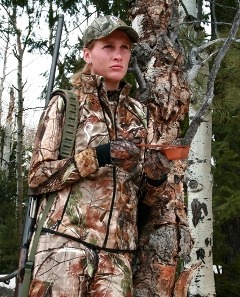 Last year saw a significant 5.4% increase in the number of female hunters in the United States — that means 163,000 new ladies hunting with firearms and/or bows. In fact, in 2009 the rate of increase in hunting participation is higher for women than for men, according to new figures from the National Sporting Goods Association (NSGA). Last year saw a significant 5.4% increase in the number of female hunters in the United States — that means 163,000 new ladies hunting with firearms and/or bows. In fact, in 2009 the rate of increase in hunting participation is higher for women than for men, according to new figures from the National Sporting Goods Association (NSGA).
Data also show that women outpaced men among newcomers to target shooting. Female participation in rifle target shooting grew by 4.1%. That’s a big change in a single year. The number of women involved in Muzzle-loading activites showed a remarkable 134.6% annual increase.
The growth in new participation among women, perhaps counter-intuitive to traditionalists, is no surprise to Steve Sanetti, president of the National Shooting Sports Foundation (NSSF). Steve explained, “Over the past several years [we have] encouraged existing hunters and shooters to introduce their spouses, daughters and other newcomers to shooting sports and outdoor lifestyles. I believe these efforts are paying off.”
Photo courtesy Próis hunting clothing for women.
May 10th, 2010
The National Shooting Sports Foundation (NSSF) now offers FREE educational video DVDs about firearm safety and wildlife conservation to teachers and school administrators. Already, more than 4,500 DVDs have been ordered by educators. Teachers can order the DVDs (and download related PDF brochures) via the NSSF website. In addition to the videos, each DVD contains guides and activity planners to assist teachers. For more information, visit the NSSF Education Videos webpage.

The Firearms Safety DVD contains three video segments, two designed for viewing by students and one for a general audience. These videos show students how to make correct decisions when encountering a firearm in an unsupervised situation at school, at home or at a friend’s home. The Wildlife Conservation DVD features three videos that teach students about America’s wildlife management system and explain how hunters contribute funding for conservation. Teachers can preview both the Firearms Safety Videos and the Conservation Videos on the NSSF Website.
“We believe teachers and school administrators should teach students how to correctly respond if they encounter an unattended firearm. Students who understand what to do in such situations can potentially save lives,” said Steve Sanetti, NSSF President. Regarding conservation education, Sanetti said, “We have a generation of children who spend less time outdoors and who see more wildlife on television than in the wild. It’s important that students today understand how once-endangered species such as white-tailed deer and wild turkey have been brought back to abundance through efforts funded by hunters.”
May 4th, 2010
Are you looking to boost membership at your local shooting range? Then check this out. To help public and private shooting facilities jump-start their recruitment and retention efforts, the National Shooting Sports Foundation (NSSF) will award up to $500,000 in grants this year to ranges around the country. This is the third year that the NSSF has distributed funding to qualifying ranges through its Range Partnership Grant Program.
“These grants will help shooting range managers create new strategies to drive traffic to their facilities”, said Chris Dolnack, NSSF senior vice president. The projects funded by the grants will also serve as pilot programs, which, if successful, can be used by other facilities. “The best way to increase participation is to enhance and promote shooting opportunities at the local level,” said Melissa Schilling, NSSF recruitment and retention manager. “We’re looking for unique proposals that move the needle on recruiting new shooters, attracting lapsed shooters back to the range and increasing opportunities for active shooters.”
CLICK HERE to learn more about NSSF’s Range Partnership Grant Program.
Who May Apply? Only project proposals submitted by and in the name of public shooting facilities, private facilities that offer the public shooting opportunities, or educational institutions with either public shooting facilities of their own or hunting and shooting sports curriculums shall be eligible for funding under the Grant Program. Separate proposals must be submitted for each project to be funded. A group of ranges may band together and submit one proposal. IMPORTANT — This grant program is NOT intended for land purchases, for building or improving structures (such as club-houses), or for acquisition of range equipment and supplies.
How to Apply: Download the Grant Application Form (PDF) and submit according to guidelines.
Deadline: Grant applications must be received by NSSF no later than 5:00 pm (ET) on June 17, 2010.
|


