Schmidt & Bender revealed some impressive optics at SHOT Show. Perhaps the “star” of the S&B line-up was the 3-27x56mm PMII. This optic boasts the first-ever 9 times zoom range. Originally custom-designed to U.S. SOCOM specs, this impressive optic won a contract for use in SOCOM sniper platforms. S&B’s representative said this scope, when employed with steep-angled bases, may be used to engage targets at distances exceeding 2 kilometers.
Unrivaled Brightness — T96 Polar Offers 96% Total Light Transmission
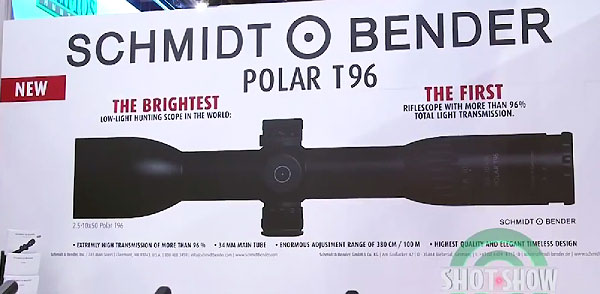
Schmidt & Bender also unveiled its all-new 2.5-10x50mm Polar T96 scope, which S&B claims is “the brightest low-light hunting scope in the world” Designed for hunting, the new Polar boasts extremely high 96% light transmission levels, the most ever in a 10-power scope. In addition, transmission of “night-relevant wavelengths” has been improved dramatically, offering 5% more light in the evening than other hunting scopes. This means the scope will be brighter at dusk than other optics, effectively extending a hunter’s usable time in the field, allowing the hunter to use “the last light of the day.” S&B is considering expanding the T96 scope line to include 3-12X or 4-16X models.
Schmidt & Bender had scores of scopes on display, worth well over $100,000 in retail value.
Our friends Ed and Steve, aka the 6.5 Guys, were prolific last week in Las Vegas, visiting dozens of vendors at SHOT Show. Here are Ed and Steve’s video reports for Ashbury Precision Ordnance (APO), Vortex Optics, and Thunderbeast Arms. (If you’re thinking about buying a suppressor definitely check out the new Ultra series from Thunderbeast, featured in the third video below). You can see more SHOT Show videos by Ed and Steve at 6.5Guys.com.
Ashbury Precision Ordnance
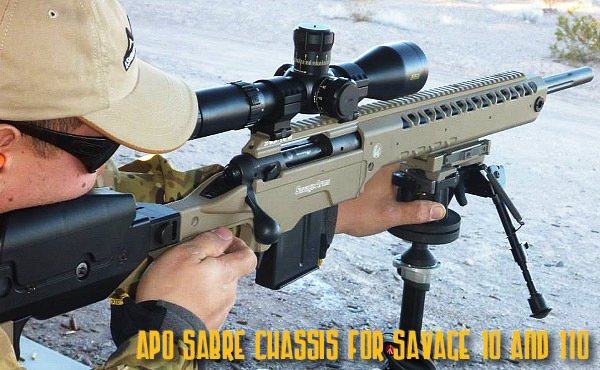
Here Precision Rifle Series (PRS) Competitor Melissa Gilliland talks about the modular chassis systems offered by Ashbury Precision Ordnance (APO). With adjustable buttplate, cheekpiece, and grip, these systems can be adapted for a variety of shooting disciplines. APO even offers a modular chassis for Savage barreled actions. Melissa shoots a tricked-out 6.5 Creedmoor rig with a Titanium APO action.
New Precision Rifle from APO
SABRE Chassis System for Savage Actions
Vortex Optics
Vortex continues to grab a larger share of the tactical and long-range hunting markets. This video features the Vortex Razor HD Gen II 4.5-27x56mm and 3-18x50mm scopes. These Gen II Razors feature apochromatic objective lenses, rugged 34mm single-piece aluminum main tubes, and versatile 6X zoom range. Both MOA-based and Milrad-based reticles are offered. Vortex scopes have large, user-friendly controls, and a good feature set for the price.
Thunder Beast Arms
Thunder Beast Arms’s suppressors, built by shooters for shooters, are tough yet light. Thunder Beast developed a strong following for its titanium cans that offered excellent performance with light weight. In this video, Thunder Beast unveils its new “Ultra” series of suppressors. Compared to Thunder Beast’s previous CB-series suppressors (of like size), these Ultras are 4 to 5 ounces lighter, yet provide 4 to 5 decibels of additional noise reduction. That represents a major gain in suppressor performance.
With the price of some premium scopes approaching $3000.00 (and beyond), it’s more important than ever to provide extra protection for your expensive optics. ScopeCoat produces covers that shield scopes with a layer of neoprene rubber (wetsuit material) sandwiched between nylon. In addition to its basic covers, sold in a variety of sizes and colors, ScopeCoat has a line of heavy-duty 6mm products that provide added security.
Triple-Thickness XP-6 Model for Added Protection
The XP-6 Flak Jacket™ is specifically designed for extra protection and special applications. The 6mm-thick layer of neoprene is three times thicker than the standard ScopeCoat. XP-6 Flak Jackets are designed for tall turrets, with sizes that accommodate either two or three adjustment knobs (for both side-focus and front-focus parallax models). To shield an expensive NightForce, March, or Schmidt & Bender scope, this a good choice. XP-6 covers come in black color only, and are available for both rifle-scopes and spotting scopes.
The heavily padded XP-6 Flak Jacket is also offered in a Zippered version, shown at right. This is designed for removable optics that need protection when in storage. The full-length, zippered closure goes on quick-and-easy and provides more complete protection against dust, shock, and moisture. MSRP is $30.00.
Special Covers for Binos and Red-Dots
ScopeCoat offers many specialized products, including oversize covers for spotting scopes, protective “Bino-Bibs” for binoculars, rangefinder covers, even sleeves for small pistol scopes and red-dot optics. There are also custom-designed covers for the popular Eotech and Trijicon tactical optics. Watch the Shooting USA video below to see some of ScopeCoat’s latest specialty covers.
Every rifle shooter should have access to a borescope. These devices reveal the condition of the inside of your barrel. Do you have a carbon ring problem? Is there jacket fouling near the muzzle? Are the edges of your lands worn away? All these common conditions can be revealed by a quality borescope.
UPDATE: MSRP will be under $300.00 and the unit should be available in March. Lyman told us: “We expect to have these available in March 2015. The price is expected to be $299.95. We will have this available for pre-order via our website in early 2015.”
And now new digital/optical technology makes the borescope easier than ever to use. For 2015, Lyman will introduce a new, affordable borescope that employs digital imaging (with a micro-camera). You no longer have to peer into an old-fashioned eyepiece. With the new Lyman borescope you can view the inside of your barrel via a small portable display screen. That’s handy. In addition, the borescope images can be displayed on your laptop or mobile device. Lyman provides a USB cable and software that allows you to view the borescope’s image output on your computer (plus you can record images for future reference). The unit fits bores .20 caliber and larger.
Sorry, we don’t have an exact price yet, but we’ve been told that this new product will be less expensive than current, conventional precision borescopes with glass-lens eyepieces. Here’s what Lyman says about it’s new product:
Lyman’s new Borescope provides active shooters with the means to carefully inspect the bores of their firearms for wear, throat erosion, tool marks, and other rifling or chamber damage, as well as for checking for fouling. The scope will fit 20 caliber and larger barrels and works with miniature camera technology. The display will show a clear image of the inside of the barrel and also allows you to take a photo of the bore. The image will storage on a standard SD card and can later be viewed on a computer or lap top. A separate cable (with USB connection) and CD are also available so that the Borescope rod can be connected directly to your computer or lap top. If you prefer to view only on your computer or lap-top, the Borescope rod is available separately (without the display unit) and plugs into the computer with a USB connection.
New product tip from EdLongrange. We welcome reader submissions.
Last year, PrecisionRifleBlog.com published results from the most comprehensive field test of rangefinder binoculars ever conducted. The comparison test included virtually every product then available in the USA. If you are thinking about getting a set of binoculars with range-finding capability, you should definitely read this test. Here we summarize key findings of the test, but you’ll want to read theFULL STORY.
Six range-finding binocular optics (and two monocular rangefinders) were field-tested in a variety scenarios to see which had the best performance in terms of both optical clarity and ranging capabilities. The results are based on over 10,000 data points collected from the field over 3 months of testing. Cal Zant, author of PrecisionRifleBlog.com, published a series of posts with exhaustive details about his optical and ranging tests and results, but we’ll hit the highlights here.
VOICE FILE: Click Button to Hear Cal Zant TALK about Rangefinder Binocular Test
Six of the models tested were binoculars, and the other two were monoculars. The Leupold monocular was included for reference, because many shooters have a 1,000-yard rangefinder similar to the RX-1000. The Vectronix Terrapin model was included as the control for ranging performance, because it is known to be an extremely accurate rangefinder (spoiler alert: it is). Cal provides a very detailed side-by-side spec comparison for these models in one of his posts.
Ranging Test Results
Each model was used to range 500+ times in a variety of scenarios from 25 to over 30,000 yards. The tests showed these models had similar performance at close and mid-range targets, but at 600 yards their performance started to diverge … so that is where most of the testing was focused.
The chart below summarizes the ranging performance found on the test targets in ideal conditions, which was from a sturdy tripod, at sunset, with 10+ mile visibility. The exact target shape and surroundings varied, but the targets were all approximately 2 MOA wide, highly reflective, and perpendicular to the rangefinder. Specifics on target dimensions, view from the ranging position, and target surroundings are given in the detailed ranging performance results post.
Vectronix is the leader of the rangefinder world, and that was proved once again in these tests. The new Leica Geovid HD-B wasn’t far behind them, with accurate ranging beyond 1 mile. The Zeiss Victory RF also had surgical precision off a tripod, although it had a reduced range compared to the Vectronix and Leica. The Bushnell Fusion 1 Mile also proved to be able to range targets out to their claimed max range of 1,760 yards.
PrecisionRifleBlog.com also tested the ranging performance of each model in bright lighting conditions, and offhand as well. The data from those tests also contained a few surprises. To determine how accurate each model really was, Cal Zant carefully analyzed the results from each model when aimed at precisely positioned, “known distance” targets. To see how those tests turned out, or learn more details about specific models, GO TO full results.
Optical Test Results
For the optics tests, Cal’s goal was to find an objective, data-driven approach to testing optical performance. What he came up with was placing eye exam charts from 600 to 1,400 yards with different size letters, and then recording what two different people could accurately read with each model. The data for each unit was summed into a single score so they could be ranked relative to how much detail the testers could make out. More specifics are provided regarding how the test was conducted and how scores were calculated in the optical performance results post. Here are the results from Cal’s data-driven approach:
The Leica Geovid HD-B edged out the other models for the top spot, with its completely new, Perger-Porro prism design. The original Leica Geovid HD, and Zeiss Victory RF also showed great optical clarity.
The Rest of the Story
Cal’s full series of posts is very informative. He’s done tons of analysis on the data, and summarizes it in several charts that provide a lot of insight. Cal is also in the process of publishing detailed reviews on each model, including notes he and the other testers compiled for each unit. They used them all — a lot, so they have a unique perspective on what’s good or bad about each. Find out more at the link below:
MIL or MOA — which angular measuring system is better for target ranging (and hold-offs)? In a recent article on his PrecisionRifleBlog.com website, Cal Zant tackles that question. Analyzing the pros and cons of each, Zant concludes that both systems work well, provided you have compatible click values on your scope. Zant does note that a 1/4 MOA division is “slightly more precise” than 1/10th mil, but that’s really not a big deal: “Technically, 1/4 MOA clicks provide a little finer adjustments than 1/10 MIL. This difference is very slight… it only equates to 0.1″ difference in adjustments at 100 yards or 1″ at 1,000 yards[.]” Zant adds that, in practical terms, both 1/4-MOA clicks and 1/10th-MIL clicks work well in the field: “Most shooters agree that 1/4 MOA or 1/10 MIL are both right around that sweet spot.”
Zant does note that a whopping 94% of shooters in the Precision Rifle Series (PRS) used a mil-based reticle. However, Zant says: “This does NOT mean MIL is better. It just means MIL-based scopes are more popular.” Zant agrees with Bryan Litz’s take on the subject: “You can’t really go wrong with either (MIL or MOA). They’re both equally effective, it comes down to how well you know the system. If you’re comfortable with MOA, I wouldn’t recommend switching to MIL. I have a few MIL scopes but primarily because they’re on rifles used for military evaluation projects, and that community is now mostly converted to MILS, so when in Rome….”
We recommend you read Zant’s complete article which is very thorough and is illustrated with helpful graphics. Here are the key points Zant makes in his MIL vs. MOA analysis:
MIL vs. MOA — Key Points
There are a handful of minor differences/trade-offs between MIL & MOA, but there are no inherent advantage to either system. Most people blow the small differences WAY out of proportion….Here are the biggest differences and things to keep in mind:
Whatever you decide, go with matching turret/reticle (i.e. MIL/MIL or MOA/MOA)
1/4 MOA adjustments are slightly more precise than 1/10 MIL.
MIL values are slightly easier to communicate.
If you think in yards/inches the math for range estimation is easier with MOA. If you think in meters/cm the math is easier with MIL.
When your shooting partners are using one system, there can be some advantage to having the same system.
Around 90% of the PRS competitors use MIL.
There are more product options (with ranging reticles) in MIL.
Range Card Print-Outs
Zant makes an interesting practical point regarding range card print-outs. He suggests the MIL System may be easier to read: “You can see in the range card examples below, 1/4 MOA adjustments take up more room and are a little harder to read than 1/10 MIL adjustments.”
Here’s a nice combo offer if you’re thinking about buying a laser rangefinder for the fall hunting season. Right now, if you purchase a Leica CRF 1000-R or 1600-B Laser Rangefinder you can receive a Surefire G2x-Pro flashlight worth $85.00. The rugged, dual-power G2x-Pro should last a lifetime.
This is a limited-time offer works. When you purchase a new Leica CRF Rangemaster 1000-R or 1600-B Compact Laser Rangefinder from any authorized North America Leica Dealer you can receive a Surefire G2X-Pro flashlight and lanyard ($85 value). Send in your mail-in Rebate Form, plus your CRF proof of purchase, to Leica between Sept. 15 and Dec. 31, 2014, to receive your Surefire G2X-Pro flashlight.
Leica’s CRF 1000-R Rangemaster is an easy-to-use laser rangefinder than can fit in your pocket. The wide field of view makes target identification fast and easy. The CRF 1000-R features built-in angle correction. This provides automatic point-of-aim correction for uphill or downhill shots. That’s a very valuable feature for hunters.
Leica’s CRF 1600-B Compact Laser Rangefinder boasts an integrated precision ABC (Advanced Ballistic Compensation) system. This instantly measures distance, incline, temperature, and air pressure and then calculates hold-over based on selected bullet BC. The 1600-B’s LED display has ambient-light-controlled brightness — a nice feature when you’re in the field. For more info, visit LeicaSportOptics.com
Need a hunting scope or a good pair of compact binoculars? With Steiner’s Big Game Fall Optics Promotion, you can get 10% off retail price through the end of September on Steiner GS3 Riflescopes and Predator Binoculars. The savings are automatic — there are no rebate forms, no waiting — just instant savings. And the GS3 scopes are very nice. We’ve tried them in the field. They are sharp and clear, with nice controls. The 5X magnification range is definitely a plus for hunters.
Hunters Will Enjoy This Video. It’s Definitely Worth Watching for the Outdoor Photography.
The new Steiner GS3 scopes utilize exclusive CAT (color adjusted transmission) lens coatings to amplify contrast in the peak human vision sensitivity range. The optimized contrast helps separate game from leafy or shadow-dappled backgrounds. The GS3’s 5x zoom range gives hunters great flexibility. Zoom to low magnification for a wider field of view, then zoom in at five times higher power when you spot your prey. The GS3 series scopes provide excellent low light performance, and mount on most rifles with standard-height rings.
Steiner Predator Binoculars also utilize the game-revealing CAT lens coating to help hunters detect game in heavy cover and leafy environments. They feature a roof prism design in a tough Makrolon® housing. The high definition lenses deliver very good low light performance. At approximately 10 ounces in weight, the 8×22 and 10×26 compact models are small enough to fit in a pocket. The larger 8×42 and 10×42 models (below) offer greater low-light performance. We wish these binocs had captive lens covers, however. We try to keep ocular and objective lenses always covered except when glassing.
It’s “rebate season” for rifle scopes. Leica recently announced a $200.00 trade-in rebate offer, and now Leupold is joining in on the fun with a $50.00 rebate on VX-2 scopes.
Here’s how you can save fifty bucks on a Leupold VX-2.
From August 1 to September 1, 2014, hunters and shooters can receive a $50 rebate on the purchase of select Leupold® VX®-2 riflescopes. To receive the rebate, submit a rebate form with a valid receipt and the original UPC bar code cut from the product packaging. Forms can be obtained at Point of Purchase. The VX-2 rebate forms must be postmarked no later than October 1, 2014.
Alternatively, you can fill out Leupold’s Online Rebate Form. After filling in your personal info, then upload a photo of the sales receipt, plus a photo (or scan) of the product UPC code. If you have a smart-phone, that should be easy, and you don’t even need a stamp or envelope.
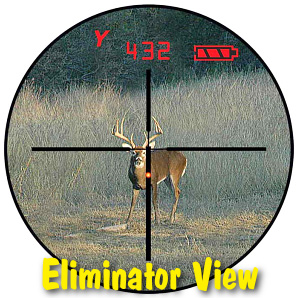
Burris Optics is currently offering significant rebates on three lines of scopes. You can get up to $100.00 in rebates on Burris Tactical and Fullfield II scopes. For the innovative Eliminator optics with built-in laser rangefinders, the savings are even bigger — you can get up to $200.00 in rebates with your purchase. We like the Eliminator scopes for Varmint hunting. The built-in rangefinder instantly calculates the needed hold-over, based on the target distance. Then the scope displays the corrected aim point as a red dot on the vertical cross-hair. Just put the red dot on your target and pull the trigger. The Eliminator does all the work for you — no turret clicking needed.
Rebate Instructions
These Burris products are available now at Grafs.com. Rebates available for purchases made between July 1, 2014 and December 31, 2014. Mail-in form must be signed, dated, and post-marked by January 31, 2015. View Full Offer Details.






 With the price of some premium scopes approaching $3000.00 (and beyond), it’s more important than ever to provide extra protection for your expensive optics.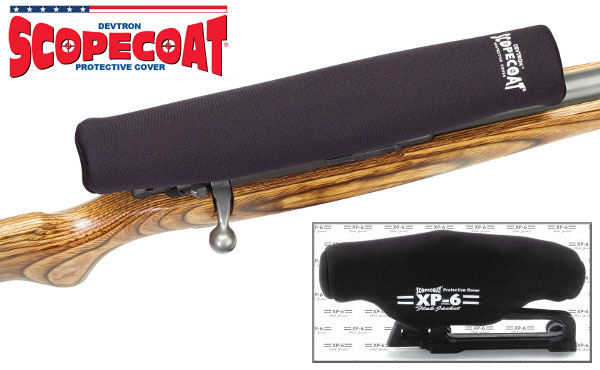
 The heavily padded XP-6 Flak Jacket is also offered in a Zippered version, shown at right. This is designed for removable optics that need protection when in storage. The full-length, zippered closure goes on quick-and-easy and provides more complete protection against dust, shock, and moisture. MSRP is $30.00.