Now this is smart — ZEISS has just introduced a series of precision scope rings with integral bubble levels. These new ZEISS Ultralight 1913 Mil-Spec Rings for Picatinny Rails are beautifully made, making them a smart choice for mounting all brands of quality riflescopes. The rings are currently offered in 30mm diameter (low, med, high) and 36mm diameter (med, high), with 34mm versions coming out in the very near future.
We like the craftsmanship on these Precision Rings — they are “micro-radiused” on the machined leading edges to ensure a non-marring design. That special design feature helps prevent annoying marks on your expensive scope. Along with the built-in anti-cant levels, these rings feature an integral bottom recoil lug. That helps ensure the rings align perfectly and hold securely even with the high recoil forces generated by big caliber, magnum rifles.
Though these Precision Rings are very strong, they are also relatively light-weight. Crafted from Mil-Spec 7075-T6 aluminum (Type III) these rings weigh just 4.4 ounces with screws for a 30mm low set. For durability, ZEISS UltraLight Rings feature a 30-micron hard, matte black, anodized finish. The ring sets ship with a nice hard case, which includes both T15 and T25 Torx driver bits. The Zeiss Ultralight 30mm Rings cost $179.99 while the larger-diameter 36mm rings cost $199.99
NOTE: These rings are designed for correct, Mil-Spec Picatinny rails (aka MIL-STD-1913 rail or STANAG 2324 rail). Some lower-cost “Weaver-type” rails may not be ideal. ZEISS states: “For optimum performance and flawless mounting, we strongly advise that you mount [these rings] on a high-quality 1913 Mil-Std specification rail[.]”
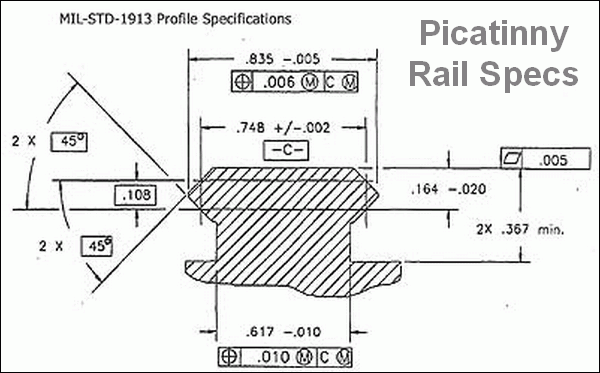
Looking for authentic U.S. Military Specification Standards (MIL-STD) for gun parts, safety products, or other hardware? Log on to EverySpec.com. This website provides FREE access to the complete archive of U.S. Government spec sheets and technical manuals. You can quickly access and download thousands of public domain U.S. Government documents. For example, we searched for “Picatinny” and came up with MIL-STD-1913 “Dimensioning of Accessory Mounting Rail for Small Arms Weapons”. With one click we downloaded the file as a PDF. Then a search for “M118″ yielded the engineering drawing for 7.62×51 M118 LR Match ammo. Pretty cool.
Using EverySpec.com is fast and easy. And everything you find and save is FREE. Search as often as you like — there are no limits on search requests or downloads. You can either search by keyword, or Federal Supply Class Code (FSC). CLICK HERE for a complete list of FSCs for all products.
Here are FSCs for a few common product types. Keep in mind that there are hundreds of other FSCs — for everything from Office Supplies (FSC 7510) to Nuclear Projectiles (FSC 1110).
1095 — Miscellaneous Weapons (incl. Knives) 1240 — Optical Sighting and Ranging Equipment 1395 — Miscellaneous Ammunition (incl. Small Arms) 3455 — Cutting Tools for Machine Tools 6140 — Batteries, Rechargeable 6230 — Electric Portable Lighting Equipment 7640 — Maps, Atlases, Charts and Globes 8340 — Tents and Tarpaulins 8405 — Outerwear, Mens
Credit Gunsmith Thomas ‘Speedy’ Gonzales for finding this resource. Thanks Speedy!
Red Dot (aka “Reflex”) sights help pistol shooters hit their targets quickly. With these sights you simply place the dot on the target. Head alignment is not critical. These sights offer an open field of view, virtually no parallax, and eye relief is basically unlimited. You don’t have to worry about aligning front and rear sights — as long as you can see the red dot you’re good to go. The only real negative is that the red dot can be hard to see in very bright sunlight, and users with strong astigmatism may see a blurry or fuzzy image instead of a sharp dot.
As quoted in Outdoor Life, pistol champion Doug Koenig explains: “Red-dot sights are fast, superior in low light, and allow the shooter to simply focus on the target.” For those reasons competitive action pistol shooters can shoot faster with red dot sights. They definitely offer a “competitive advantage”, and that’s why iron sights guns run in a different class in most pistol matches.
The NRA Blog recently reviewed five (5) red dot sight systems for handguns. Red dots give let shooters focus on the target rather worry about sight alignment. In addition, red dots aid older shooters who often have trouble with close focusing. TIP: If you need reading glasses — a red dot can help.
SIG SAUER Romeo 1 SIG SAUER’s Romeo 1 open reflex sight is built with SIG’s twin adjustment springs that provide a “lock-less” zeroing system while maintaining zero. The sight body is CNC-machined from solid billet magnesium to be lightweight and strong, and its molded aspherical lens is bright and distortion-free. The Motion Activated Illumination (MOTAC) system recalls the last brightness setting used, so you don’t have to remember those adjustments on your own.
Vortex Venom Vortex’s Venom reflex sight can be mounted on pistols with Picatinny rails, as well as tactical rifles and shotguns. The 3 MOA dot is easy to see in nearly any lighting conditions and allows users to shooting accurately at long ranges. Ultra-clear multi-coated lenses provide a wide field of view with sharp image quality, and brightness controls are easy to find and use, located on the left side of the unit. The Venom features 14-hour auto-shutdown to extend battery life, and the unit is built shockproof and waterproof to withstand harsh operational demands.
Burris Fastfire III
Burris’ Fastfire III is one of the most versatile red dots on the market. In addition to the unlimited eye relief awarded by red dots, the Fastfire III features windage and elevation adjustments that don’t require the use of a proprietary or special tool – just a small flathead screwdriver is needed to make adjustments, and comes bundled. Battery access on the top of the sight makes it easier to change batteries, and the Fastfire III includes a battery warning indicator and eight-hour auto-shutoff to prolong battery service life.
Bushnell First Strike
Known for quality sights at great prices, Bushnell delivers again with the First Strike, one of the most affordable red dot sights available. Despite its affordability, the First Strike is well made, and an ideal candidate for use with smaller-caliber firearms, such as rimfire pistols. Like many other reflex sights, the First Strike mounts using the Picatinny rail system, so you’ll need to ensure your pistol either has a rail included or can facilitate a small mounting rail section. The First Strike is waterproof, shock-proof and fog-proof, and coated lenses ensure excellent light transmission, allowing easy target acquisition up to 100 yards — well beyond normal pistol range.
Trijicon RMR
Trijicon’s RMR (Ruggedized Miniature Reflex) sight is one of the most durable mini red dots available today. Produced from 7075-T6 aluminum to military specifications, the RMR is lightweight but strong, using a patented shape that absorbs impact and diverts stress away from the lens. The RMR is available in dual-illuminated, LED, and adjustable LED models with dot sizes from 1 to 13 MOA. The RMR is waterproof to 20 meters (66 feet), and boasts easy adjustment for windage and elevation.
Readers often ask “What’s the difference between a Weaver scope rail and a Picatinny Rail?” The answer is not as simple as it seems. The dimensions of a Picatinny Rail should be consistent (from one rail-maker to another), since there IS a government spec. Conversely, there is some variance in “Weaver-style” rails. The width of the groove is the most important difference between Picatinny Rails and weaver rails. “Mil-spec” Picatinny rails will have a grove width of 0.206″ while Weaver rails typically have a narrower, 0.180″ groove width.
Brownell’s has a helpful GunTech™ Article that discusses the Picatinny Rail vs. Weaver Rail. That article explains:
“What are the differences between the ‘Picatinny’ and the ‘Weaver’ systems? The profile of the two systems is virtually identical. Depending on the quality of the machining done by the manufacturer, the two systems should be indistinguishable from the profile. The key difference lies in the placement of the recoil grooves and with width of the grooves. MIL-STD-1913 (Picatinny) grooves are .206″ wide and have a center-to-center width of .394”. The placement of these grooves has to be consistent in order for it to be a true ‘Picatinny’MIL-STD system. Weaver systems have a .180” width of recoil groove and are not necessarily consistent in a center-to-center measurement from one groove to the next.
In many instances, a Weaver system has a specific application that it is machined for, so interchangeability is not necessarily an issue. A MIL-STD-1913 system must adhere to the specifications listed above in order for it to be considered MIL-STD, since the military desires uniformity in the recoil grooves to allow for different systems to be mounted on the weapon with no concern for compatibility.
Now, what does this mean to you? Boiled down, it means that accessories designed for a Weaver system will, in most cases, fit on a ‘Picatinny’ system. The reverse, however, is probably not the case. Due to the larger recoil groove, ‘Picatinny’ accessories will not fit a Weaver system. There are, of course, exceptions to every rule, but for a good rule-of-thumb, [full-width] ‘Picatinny’ won’t fit Weaver, but Weaver will fit ‘Picatinny’.”
Looking for authentic U.S. Military Specification Standards (MIL-STD) for gun parts, safety products, or other hardware? Log on to EverySpec.com. This website provides FREE access to the complete archive of U.S. Government spec sheets and technical manuals. You can quickly access and download thousands of public domain U.S. Government documents. For example, we searched for “Picatinny” and came up with MIL-STD-1913 “Dimensioning of Accessory Mounting Rail for Small Arms Weapons”. With one click we downloaded the file as a PDF. Then a search for “M118″ yielded the engineering drawing for 7.62×51 M118 LR Match ammo. Pretty cool.
Using EverySpec.com is fast and easy. And everything you find and save is FREE. Search as often as you like — there are no limits on search requests or downloads. You can either search by keyword, or Federal Supply Class Code (FSC). CLICK HERE for a complete list of FSCs for all products.
Here are FSCs for a few common product types. Keep in mind that there are hundreds of other FSCs — for everything from Office Supplies (FSC 7510) to Nuclear Projectiles (FSC 1110).
1095 — Miscellaneous Weapons (incl. Knives) 1240 — Optical Sighting and Ranging Equipment 1395 — Miscellaneous Ammunition (incl. Small Arms) 3455 — Cutting Tools for Machine Tools 6140 — Batteries, Rechargeable 6230 — Electric Portable Lighting Equipment 7640 — Maps, Atlases, Charts and Globes 8340 — Tents and Tarpaulins 8405 — Outerwear, Mens
Credit Gunsmith Thomas ‘Speedy’ Gonzales for finding this resource. Thanks Speedy!
In the video below, Forum Member Thomas Haugland (from Norway) shows how to install a Picatinny-type rail on a Sako action. Every stage of the process is illustrated — removing the barrel from the action, drilling/tapping the action, aligning/attaching the rail, and finally mounting the scope and test-firing the rifle. Note that the action is removed using a large adjustable-end wrench with brass disks to protect the finish. This is possible because this particular Sako action has a flat bottom and top. With a different action you’ll want to use a custom action wrench.
In the video, Thomas and his assistant actually fabricate the rail from scratch. That’s probably beyond the ability of most do-it-yourselfers. You can purchase precisely machined Picatinnny rails from Seekins Precision and other sources instead. Still, it is interesting to see the milling of the rail. Note that, before screwing the rail to the top of the action, Thomas applies a marine epoxy (timeline 3:18). This effectively beds the rail to the top of the action and provides a more secure installation.
You can find more interesting gunsmithing, hunting, and long-range shooting videos on Thomas Haugland’s YouTube Channel.
You can find big, bulky, heavy rings from many sources, but what if you need svelt, light-weight rings for a weight-restricted benchrest rifle, or need light-weight offset rings or benchrest-grade .22 RF rings? Well now there’s a source for these specialized rings — Morr Accuracy.
Beautifully crafted by John Morrison, these ring-sets offer many nice features you won’t find elsewhere. Chose from various heights and 2-fastener or 4-fastener models. You can even get a combo set (one 4-screw and one 2-screw). Got a dove-tailed rimfire action? Check this out — Morr Accuracy has rimfire rings designed for factory 11mm dovetails. But these will also fit aftermarket 3/8″ rails, so if you later decide to mount a rail, you won’t need a new set of rings. That’s clever. For more information, email john [at] morraccuracy.com or call (201) 537-5374.
VOICE FILE: Click Button to hear John Morrison TALK about his Rings and Bases.
Offset Rings — Unique Design
These offset rings allow shooters to get slightly away from the stock so as not to disturb the rifle in the rest during shooting. These are a beautiful design, unique in their simplicity. They are offered in a silver-tone finish as well as the Gold Anodized finish shown below. Morrison says: “There are other offset rings using multiple components, but we decided to integrate the offset into the rings themselves and eliminate some complexity. We also took advantage of finite element analysis to eliminate extra weight in the new Edge offset rings without sacrificing strength.” Weighing just 1.5 oz. per pair, these offset rings are offered for 1″ or 30mm scope tubes and for 11mm or 3/8″ rails. Price is $75.00 per set ($78.00 with Gold Anodizing).
World’s Lightest Rings — Magnesium Air Weight Rings — Just 0.6 Ounces Per Set!
The Air Weight rings were designed specifically for the .22 Sporter Class shooter where every ounce counts. These Morr Accuracy Air Weights may well be the lightest commercially available rings you can buy. They weigh just over 0.6 oz. for a pair of two rings, including all the fasteners. John Morrison says: “We couldn’t quite make our goal of lightest ever with any of the aluminum alloys, so we went to magnesium, which is the lightest, commonly available alloy. Magnesium presents some specific machining challenges, but we felt that the added care needed was worth it for the result.” The .22 Air Weight Rings are available for both 1″ and 30mm scope tubes at $98.00 per pair.
Scope Rails and Bases — Both Davidson Style and Picatinny
Morr Accuracy offers a variety of high-grade scope rails and precision bases. Morrison tells us: “Originally we developed stainless steel Picatinny rails for the tactical market, feeling that there was a demand for rails that were stronger than aluminum offerings, but would never rust like standard steel alloy. We have offerings for several popular actions in both 0 and +20 MOA, and have the ability to do special angles relatively quickly. We also offer the advantage of the one-piece rail to target shooters in the 3/8 style. For a slight penalty in weight, the shooter has the advantage of knowing that the ring bases are in alignment and that the rings will require minimal to no lapping. The one-piece target rails are also available in 0 and +20 MOA.”
Morr Accuracy Does Tactical Too
John Morrison served in the U.S. Marines Corps as a marksmanship instructor, so he understands the requirements of tactical shooting. Along with these lightweight rings and rails designed for target shooters, Morr Accuracy also offers sturdy Tactical Rings and Rails. Priced at $125.00 per set, Morr Accuracy’s Tactical Rings are made from 7075 aluminum alloy, with 17-4 stainless steel cross bolts, nuts and clamps. These are offered for 30mm tubes in 1″, 1.25″, and 1.5″ heights. This is very nice ring set for the price.
Angled Weaver-style or Picatinny-style scope rails elevation “pre-load” are commonplace these days. But most angled scope rails are non-adjustable. Cold Shot LLC offers a more sophisticated solution — an adjustable scope base that allows the shooter to “dial in” up to +150 MOA of vertical. The M.O.A.B. system works via a horizontal rotary adjuster with 1/4-MOA clicks, positioned on the rear of the unit. The M.O.A.B. 150 can be mounted on any rifle fitted with a full-length Picatinny Rail, chambered for any cartridge from .22 LR all the way up to .50 BMG. The M.O.A.B. system works well on AR rifles — when installed on any flat-top AR, the M.O.A.B. eliminates the need for extra-high rings or riser blocks.
With the M.O.A.B. 150, a shooter has more than 150 minutes of angle (i.e. vertical adjustment) calibrated in 1/4-MOA clicks, with a handy zero-stop. This allows you to stay centered in the vertical elevation range of your scope. In addition, the amount of elevation travel is sufficient to adjust for drop at extreme long ranges — a mile or more.
Some users will employ the dial-in adjustment just to set an elevation pre-load for a shooting session (more preload for longer range). However, because the M.O.A.B. offers precise 1/4-MOA clicks, you can actually use the M.O.A.B.’s click-wheel to fine-tune elevation settings, just as you might use the elevation turret on your scope. This saves wear and tear on your scope’s internals.
The price for the M.O.A.B. 150 is $399.95. Note: a +300 MOA version is also available for the same price — but we don’t know why anyone would need that much elevation. Made in the USA, the M.O.A.B. 150 (and 300 MOA version) come with a lifetime warranty on materials and craftsmanship.
Editor’s Comment: We are intrigued by this system. We like the idea of external elevation adjustment with 1/4-MOA clicks. However, the precision of such a system is dependent on the fit of the front hinge cross-bolt and the tolerances of the rear rotary riser. With a design like this, if there is any “slop” in the system, you could see a POI change from shot-to-shot. We have NOT tested the M.O.A.B. 150 so we cannot evaluate if the tolerances are up to snuff — this is just something you should consider before shelling out your hard-earned cash.
Bolt-On Version for M1A and M14 Rifles
Cold Shot also offers an adjustable scope base for M1A and M14-platform rifles. This unit has front and rear attachment points for a “no-gunsmithing” installation. Like the standard M.0.A.B. 150 scope base, the M1A/M14 version offers up to +150 MOA elevation travel in 1/4-MOA clicks.
Product Tip from EdLongrange. We welcome reader submissions.
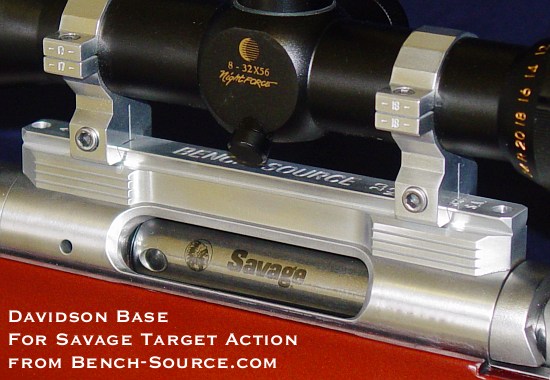
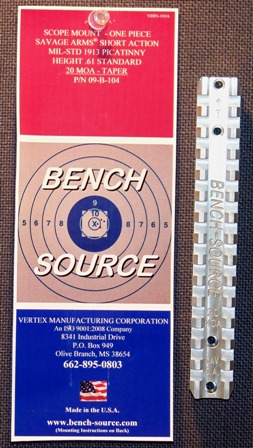
Bench-Source, founded by David Dorris, President of Vertex Mfg. Corp., and benchrest shooter Darrell Jones, is now producing precision scope-mounting bases for the Savage round-top Target Action. CNC-machined to exact tolerances from 7075-T6 aircraft aluminum, these bases are extremely light (under two ounces) yet strong. Both Picatinny-style bases and Davidson dovetail bases are offered with either zero taper (flat) or with +20 MOA of built-in elevation. Bench-Source rails also feature precision-cut reliefs to match the loading ports on the Savage Target Actions.
The Picatinny (Weaver) base costs $84.95 (either flat or +20 MOA) while the Davidson dovetail base is just $69.95 (either flat or +20 MOA). This is a good price considering the quality of the materials and machining. (The 7075-T6 aircraft grade aluminum is three times as expensive as the aluminum alloy used by some other rail-makers.) Either style base is available with either a “luster” or polished finish. The price includes a Torx wrench and mounting screws.
Technical Specifications
The Picatinny M1913-A Mounting Rail features 14 symmetrically spaced cross-slots. The base is long enough to mount any popular scope. The Picatinny base is approximately .610″ tall. Parallelism deviates less than .002″ between the dovetail clamping area and top of the receiver after mounting. The screws used are #6-48 x 3/8″ long and holes are drilled and counter-bored to the correct depths. This ensures that users will not damage their barrel threads or encounter interference with the locking lugs when closing the bolt.
The Davidson 1/2″ x 60º Mounting Rail dovetail is parallel over its entire length. The rail is held to very tight tolerances to minimize windage correction (at different ring positions). The Davidson rail should self-center on your action when installed per the included instructions. Both ends of the mount are chamfered slightly on a 30° angle to let the sharp corners of the mating rings align themselves without binding. The 60º dovetails are machined +/- .001″ and measured over two optimum-diameter pins to minimize over-clamping of your rings.
For more information, visit Bench-Source.com or phone: (662) 895-0803.
Pierce Engineering has just introduced its new Tactical Multi-flat action. This handsome design, crafted from chrome-moly steel, features a built-in 20-MOA rail and an integral recoil lug. The action was designed from the get-go to fit the Accuracy International chassis with no modification. With a 1/2″ flat on the bottom and 45° angled sides, the new Pierce Multi-flat short action drops right into the AI stock. Just bolt it in and shoot. The actions will cost $1295.00 and John Pierce is taking orders right now for delivery in two months.
John Pierce reports: “Our new Tactical Multi-flat action features a low-profile, 20-minute integral Picatinny rail and integral recoil lug. We made the action to drop into the Accuracy International modular stock utilizing AI’s magazines as well. Though this is a short action for .308 Win and similar-sized cartridges, the loading port is much longer than usual for better access and ejection. The current price is $1295.00, and that price includes a 30° coned bolt and/or spiral fluting if the customer desires those options.” John noted that the coned bolt option works well in Tac Comps: “I have a coned bolt on my own tactical rifle that I used at ASC. I found it picks up the rounds more smoothly from the magazine. At ASC, quite a few guys had feeding issues, but my action ran perfectly. The coned bolt works slick.” Actions will come finished with NIC CeraKote in customer’s choice of colors including: Matte Black, Titanium, OD, Sand, Brown, Gray, and Forest Green. (CLICK HERE for CeraKote color options).
Short Actions Will Be Followed By Long Actions Later This Year
Currently the new action will be available only in a short-action design. OAL is 8.050″, about the same as a Rem 700 short action if you include the thickness of the Rem’s recoil lug. The new actions will be made to order with a two-month lead time. After placing your order, you should get your new multi-flat action within about eight (8) weeks. Later this year, Pierce plans to release a larger Tactical Multi-flat action. This long action will work for cartridges such as the .30-06, .300 Win Mag, and 7mm Magnums.
For more information, or to place an order, call Pierce Engineering at (517) 321-5051, or visit www.PierceEngineeringltd.com.


 Red Dot (aka “Reflex”) sights help pistol shooters hit their targets quickly. With these sights you simply place the dot on the target. Head alignment is not critical. These sights offer an open field of view, virtually no parallax, and eye relief is basically unlimited. You don’t have to worry about aligning front and rear sights — as long as you can see the red dot you’re good to go. The only real negative is that the red dot can be hard to see in very bright sunlight, and users with strong astigmatism may see a blurry or fuzzy image instead of a sharp dot.




 Morr Accuracy Does Tactical Too
 Angled Weaver-style or Picatinny-style scope rails elevation “pre-load” are commonplace these days. But most angled scope rails are non-adjustable.




 Technical Specifications
 John Pierce reports: “Our new Tactical Multi-flat action features a low-profile, 20-minute integral Picatinny rail and integral recoil lug. We made the action to drop into the Accuracy International modular stock utilizing AI’s magazines as well. Though this is a short action for .308 Win and similar-sized cartridges, the loading port is much longer than usual for better access and ejection. The current price is $1295.00, and that price includes a 30° coned bolt and/or spiral fluting if the customer desires those options.” John noted that the coned bolt option works well in Tac Comps: “I have a coned bolt on my own tactical rifle that I used at ASC. I found it picks up the rounds more smoothly from the magazine. At ASC, quite a few guys had feeding issues, but my action ran perfectly. The coned bolt works slick.” Actions will come finished with


