Federal Ammunition is releasing a new line of range ammunition with polymer-encased projectiles. American Eagle Syntech is the first range-specific factory-loaded ammunition designed to reduce fouling and extend barrel life with a high-tech polymer bullet coating plus specially-formulated clean-burning powders. The potential for reduced wear and fouling is real — when tested against conventional FMJ ammunition, Federal claims Syntech produced an average of 12% less barrel friction and 14% less heat. Also, since Syntech bullets lack a metal jacket, there is less chance of ricochets on steel targets. Initially, three (3) types of Syntech ammo will be offered: 9mm Luger (115 grain); 40 S&W (165 grain); and .45 ACP (230 grain).
For years this Editor has loaded his .45 ACP and .44 Mag handguns with polymer/moly matrix-coated bullets from Precision Bullets in Texas. Those poly/moly-encased lead bullets shot VERY accurately and I found that my barrels fouled much less than with conventional lead bullets. Likewise, there was much less cylinder fouling on my revolvers. If the American Syntech bullets work as well as those Precision bullets, I think the Syntech line will be a winner. Syntech bullets should benefit any shooter who frequents a range where lead ammo is not allowed.
Features & Benefits
• Polymer-encapsulated Syntech bullet prevents metal-on-metal contact in the bore, eliminating copper and lead fouling, while extending barrel life.
• Exclusive primer formulation provides reliable, consistent ignition.
• Clean-burning propellants minimize residue and fouling.
• Significantly reduces the required frequency of cleaning.
• Absence of a copper jacket minimizes splash-back on steel targets.
At the request of our readers, we provide select “Deals of the Week”. Every Monday morning we offer our Bargain selections. Here are some of the best deals on firearms, hardware, reloading components, and shooting accessories. Be aware that sale prices are subject to change, and once clearance inventory is sold, it’s gone for good. You snooze you lose.
1. Midsouth — Lyman BoreCam Digital Borescope, $222.46
The Lyman BoreCam is an electro-optical borescope with a digital display. You can record “stills” on a SD card. This is one of the hottest products on the market right now — so hot that it has been back-ordered at most vencdore. But we found some in stock at a great price. Midsouth Shooters Supply now has the BoreCam for $222.46. Grab it while you can at that price. Other online vendors are charging a LOT more (e.g. MidwayUSA price is $259.99).
The system really works. A few of our Forum members have the system and they say it functions very well and is “very easy to set up and use”. Here’s what an Optics Planet BoreCam buyer wrote: “I have used Hawkeye borescopes and know their quality. The Lyman worked as advertised and is a great tool for checking for leading, cleanliness of bore, and bore wear. The compact size, ability to take pictures, and store them are a big plus.”
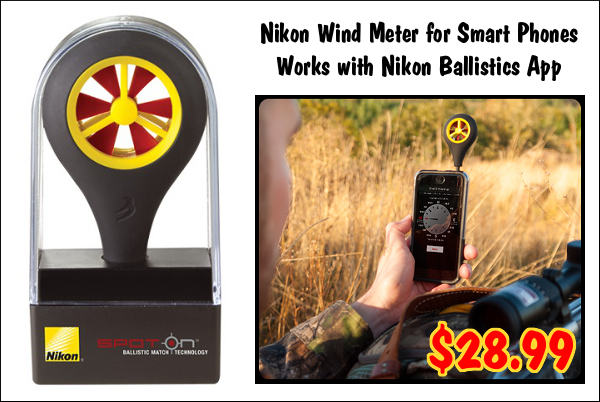
2. Grafs.com — NEW Nikon Wind Meter for SmartPhones, $28.99
Here’s a great new gadget for under $30.00. Nikon’s new Spot On™ Ballistic Wind Meter plugs directly into the headphone port on most popular smart phones. The Spot On Wind Meter reads both wind speed and direction and inputs the data directly into Nikon’s free Spot On Ballistics Mobile App (available for iOS and Android). This allows you to quickly determine and calculate wind drift corrections without needing a separate, dedicated wind meter. When not in use, the Nikon device easily fits in a pocket.
Video shows use of Nikon Spot On Wind Meter starting at 2:35 time mark:
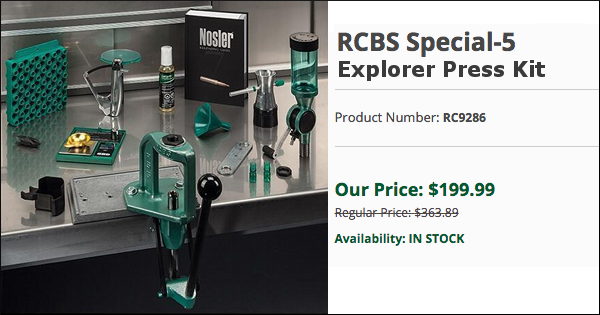
3. Natchez — Special 5 Reloading Press Kit, $199.99
This is an excellent entry-level reloading kit, which is on sale for $199.99 at Natchez Shooters Supply. We like the relatively compact Special 5 press for most reloading duties. Eventually you many want to add an additional large heavy press, but this will get the job done. This kit includes an RCBS Powder Measure, Digital Scale, Powder Trickler, Hand Priming Tool, Load Manual, Loading Tray, and more. It’s hard to beat this combination of tools for under $200.00.
4. CDNN Sports — Remington 597 for $149.99
Looking for a “first rifle” for a family member? Consider this semi-auto Remington 597. It currently retails for just $149.99. That’s right, for under $150 you can get a reliable, self-feeding rimfire rifle that will provide years of fun for a young shooter. The 597 has a stock that’s sized right for both youngsters and adults. Receivers are dovetailed for standard rimfire rings and are also drilled and tapped to allow mounting of Weaver-style bases.
5. Walmart — 14-gun Stack-on Gun Safe
If you need a smaller, secondary safe that can fit in a closet, here’s a 14-gun Stack-On Safe that is a great bargain right now. The safe is on sale at Walmart for $399.00 — nearly $200 off the regular price. And Walmart offers FREE shipping or FREE Pickup. Don’t expect this to hold anywhere near 14 scoped rifles — 8 or so long-guns will probably be the most you can fit comfortably. But that’s fine for a secondary “closet” safe that will also articles such as cameras, jewelry, and important documents. One verified safe purchaser states: “This safe is 300 pounds, not too hard to move around, took it home in my truck.”
6. Amazon — Neiko Digital Calipers, $17.16
Even if you have a good set of calipers, you may want to get one of these Neiko 01407A Digital Calipers. The #1 best-selling digital caliper on Amazon.com, this Neiko tool features a large LCD Screen and measures up to 6.0 inches. With over 1500 customer reviews, this product has earned an overall rating of 4.4 out of 5 stars. It’s hard to go wrong for $17.16, even if you just use these as a spare set for measuring group sizes and case trim lengths.
7. Amazon — 34 NRR Top-Selling Ear Muffs
If you want serious hearing protection, and can tolerate large muffs, these Clear Armor earmuffs are hard to beat for the price. They seal very well and carry an unsurpassed 34db Noise Reduction Rating (NRR). These are the #1 Best Selling Safety Muffs on Amazon. Yes they are big and bulky — but you only have one set of ears. These are a good choice for loud magnum rifles and noisy indoor ranges.
A new statute passed in California will bar state employees (as well as teachers, police personnel, and health care workers) from using a variety of firearms terms in official communications. California Assembly Bill 2243, authored by Assemblyman Tony Fulenzo (D. Los Angeles), defines over 30 gun-related words as “hate speech”. Under existing California law, any words/phrases defined as “hate speech” are proscribed (forbidden) in official publications, school textbooks, and all public-sector communications (including email). By effect of AB 2243 then, dozens of gun-related nouns, verbs, and adjectives will be banned, and “shall no longer be uttered or used in the State of California by any public agent or employee”.
Assemblyman Fulenzo said his intent in sponsoring AB 2243 was to alter public attitudes toward firearms, and in particular, to convince school children that firearms are bad. “We want to prevent young kids from perceiving firearms as ‘cool’ or ‘exciting’. The best way to do that is to bury the subject altogether. We need to dismantle the ‘gun culture’. That begins with banning the words themselves.”
Fulenzo said AB 2243 was inspired by existing bans on racist “hate speech”: “We don’t want children to read about guns or talk about guns. The first step, therefore, is to remove firearms-related words from textbooks, classroom presentations, and state documents. This is not something new. California has done the same thing with hateful words directed at minority groups. In California, by law, we have banned the use of the ‘N’ word (and other racist terms) in official state publications and school textbooks. Now we are just following that practice and banning the ‘G’ word (i.e. ‘gun’) and similar firearms-related hate speech”.
Ban on Gun Words in Arizona Next?
Meanwhile, in neighboring Arizona, anti-gun groups have called for the passage of similar legislation banning the use of firearms-related terminology.
Permitted Word Equivalencies for Banned Firearm Terms
When enacted into law, AB 2243 will ban more than 30 firearm-related words, including “gun”, “pistol”, “rifle”, “bullet” and other commonly-used words. Where it is necessary to reference a firearm, as in a police report, AB 2243 provides for substitute words or phrases. AB 2243 recognizes that, in some instances, it will be necessary to mention firearms-related facts in official documents. By using these officially-designated substitute words, firearms-related facts can be logged without resort to banned “hate speech”.
Gun = “Gunk”
Pistol = “Piddle”
Rifle = “Ripple”
Shoot = “Suit”
Bullet = “Mullet”
Cartridge = “Partridge”
How to Use CA-Approved Substitute Words:
Under AB 2243, if an official report requires description of a hate speech item, then the approved replacement words shall be used instead of the prohibited terms. For example, if a state-funded hospital treats a pistol wound, this shall be listed as a “piddle wound” in the medical report. Likewise the recovery of cartridges at a crime scene by police shall be recorded as a “partridge recovery” in the incident report.
New Law Does Not Restrict Speech by Non-Governmental Entities
This new law only applies to “public sector” entities (schools, police/sheriff agencies, hospitals/health clinics, state and municipal agencies). Private businesses, including newspapers and web sites, will still be allowed to use firearms-related words without the threat of prosecution. Likewise, private citizens will still be allowed to say “gun”, “pistol”, or “rifle” etc. in their own private communications. However internet posting of hate speech involving forbidden firearm words will be monitored by a new California State Agency. This new Agency, the California Office of Firearms Hate Speech (COFHS) will be funded by a new 5% sales tax on firearms ammunition and components.
Do you know someone who wants to get started in pistol shooting? Here’s a new opportunity. The NRA now offers its Basics of Pistol Shooting Course in an online format. That makes it easy to cover the “classroom” part of the course on your own time. The $60.00 online course includes 11 step-by-step lessons (to be followed by live range training). CLICK HERE to enroll in online Pistol Training Course.
Train Online, Then Register for a Range Session
For the NRA Basics of Pistol Shooting course, Phase 1 is conducted in an online environment, completed on your own time (cost is $60.00, non-refundable). After successfully completing the online exam, students can register for Phase 2, the instructor-led training session. Phase 2 is conducted at your local range with an NRA Certified Instructor. You must successfully complete Phase 1 and Phase 2 in order to receive your NRA Basics of Pistol Shooting course certificate.
Designed and developed by experts to accommodate busy schedules, the web-based course takes a blended learning approach to firearms training with both online and physical components. Students have 90 days to work through 11 online lessons before registering for Phase 2, the NRA Certified Instructor-led phase at a local range. “America has more first time gun owners than ever and the NRA remains dedicated to being the number one provider of firearm training,” said Executive Director of NRA General Operations, Kyle Weaver. “Thanks to our online courses and network of more than 125,000 NRA Certified Instructors, it has never been easier to learn basic firearm skills.” The NRA offers other online training courses at Onlinetraining.nra.org. These offerings include a Range Safety Office (RSO) course, and a Range Development and Operations course.
Jay Christopherson is AccurateShooter.com’s systems administrator — he keeps the servers up and running. Jay is also a very talented rifle shooter who holds a carry permit. Recently, Jay acquired a Walther PPS M2, a compact, defensive carry pistol. Here Jay reviews that pistol, which is now his “go-to” handgun when he chooses to carry a firearm pursuant to his CCW permit.
The Walther PPS M2, Single-stack 9mm is a Comfortable, Reliable Everyday Carry Pistol.
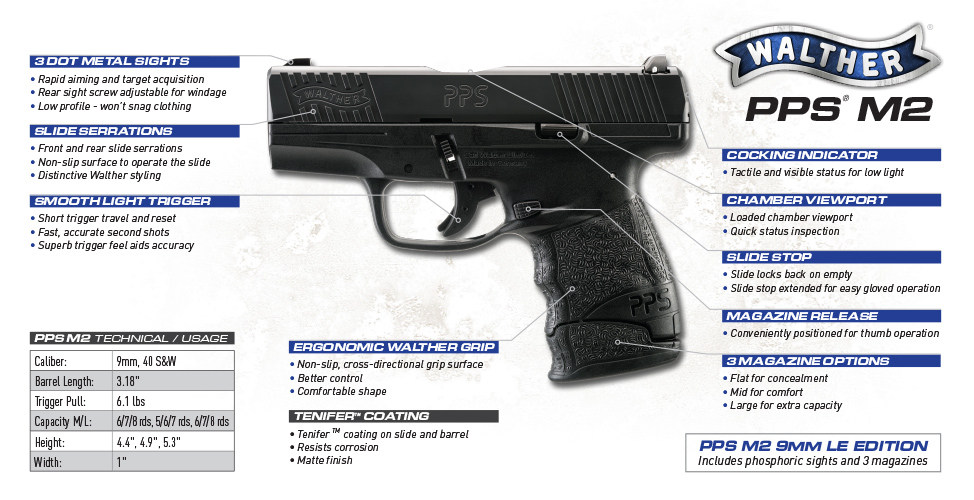
Looking for a new carry pistol in a single-stack, 9mm configuration, I tested out the slim (1″-wide) Walther PPS M2, with three different magazine capacities. For someone who has carried a 5″-barreled, .45 ACP model 1911 for the last few years, the switch to a single-stack 9mm was a big change — but a welcome one in terms of weight and comfort. I like my big 1911, but the PPS M2 gives me the feeling that if it’s needed, it’ll be a safe, effective, and reliable option. I still love my 1911, but when it comes to carry, the 1911 will stay in the safe while I “pack” the smaller, lighter PPS.
Click Image for Large View of Pistol Specifications Sheet
Like many of AccurateShooter.com’s readers, I have a permit to carry a concealed firearm and I use the privilege regularly. I’m no great shakes with a pistol, having focused most of my efforts on long-range rifle shooting, but I do spend enough time at the pistol range to ensure that I am familiar with my weapon and comfortable shooting it out to ranges where I might encounter a situation requiring its use.
Part of being responsible is selecting a carry weapon that you can be comfortable with, both using and carrying. Now, I’ll admit that I’ve focused a lot on the former, but not as much on the latter. I’m an unabashed fan of John M. Browning’s crowning (in my opinion) achievement, the Colt .45 ACP M1911. My current 1911, with a 5” barrel, is not the easiest pistol in the world to carry comfortably. While I love shooting it, carrying it is another situation altogether. I’ve tried many different configurations, but found myself carrying it less and less.
And so, I decided that I needed to enter the world of the 9mm single stack for a carry weapon. There are a lot of reasons why I chose to go that direction, but it’s a highly subjective and personal subject (some of the arguments out there are pretty heated), so I won’t bore you with mine. Suffice it to say, there’s plenty of available information for you to make an informed decision. To help with testing, Walther Arms was kind enough to provide a new Walther PPS M2, in 9mm, for evaluation.
Three Magazine Options
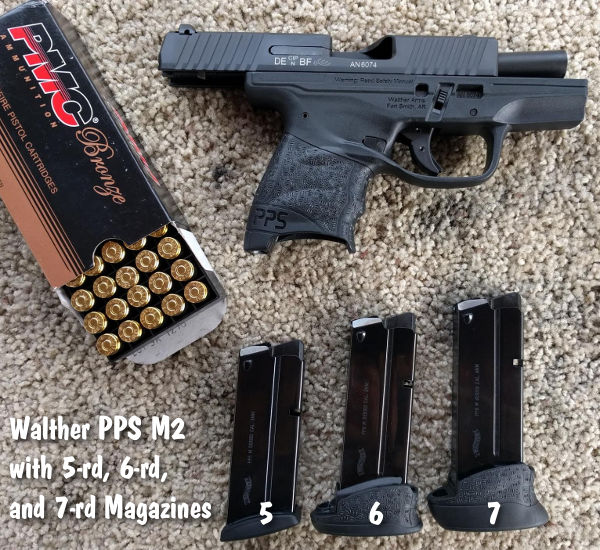
Along with the PPS M2, Walther provided three magazines — the 5-round standard mag plus 6-round and 7-round extended magazines. I tried all three magazines, both for carry/fit, and at the range to see if they would affect my ability to shoot the pistol. For reference my hands are roughly 9.25″ wide — according to the Internet, the average hand size for a male is 7.44″, so I guess I’ve got larger than average hands. The shortest magazine was a bit too short for me to grip comfortably — my pinky finger had zero engagement and my two-hand grip suffered for it. The middle magazine let my pinky engage the grip partially, but was still not ideal. The longest magazine fit perfectly. My guess is that if your hand is in the average range, the middle magazine will work for you. For women, I think the smallest grip will work nicely. My wife has an average hand span for females and thought that the smallest grip felt pretty natural for her.
The trigger is fair — the takeup is smooth, the trigger breaks relatively cleanly and predictably, but a rough spot on the Glock-style trigger safety lever wore against my finger, leaving it feeling a bit raw. It’s fairly minor and something that can easily be resolved. And even with my larger fingers, I still had no problem with trigger guard clearance. Disassembly is fairly easy, though the take-down lever takes some effort to work. [Editor — on the PPS M2 I tried at SHOT Show, the small slide-stop lever was hard to manipulate.]
After having carried my 1911 around quite a bit, I found the Walther PPS M2 to be much lighter and easier to carry (I use a Clinger holster). I rarely notice it, even when getting into and out of a car. With the PPS M2 it’s easy to carry without “printing”, at least with the appendix carry method I prefer.
General Function and Accuracy Testing
I took the pistol down to the range to test it out and get a feel for it. I bought a variety of 115 grain FMJ ammunition to test including PMC and Blazer brass-cased 9mm. I ran about 400 rounds through the little Walther. None of the ammo experienced any sort of issue and the pistol never failed to perform flawlessly. With 400 rounds through the PPS M2 cleanly, I am confident to carry the PPS M2 when I feel the need to carry.
I set up targets at 15 feet and 30 feet — remembering that I’m looking for a personal defense/carry pistol and that I don’t practice for competition! At both ranges, shooting all three magazines, I had no problems putting together groups that are more than accurate enough for “center mass”.
During a second testing session, I shot the pistol for accuracy with my forearms rested on sandbags. The results were impressive. Above is a seven-shot (7-shot) group at 10 yards (30 feet) with the CCI Blazer Brass ammo. At right is a group shot at 5 yards (15 feet), forearms rested, with the PMC ammo. The one shot that went up outside the group was probably me, the shooter. Remember this is a very small, light-weight pistol that does have some muzzle flip. I’ve seen other tests done with the Walther PPS M2, at longer ranges in the hands of skilled shooters and producing much cleaner groups.
Summary — Walther PPS M2 is a Keeper
Overall, I really like the 9mm single stack Walther PPS M2. It’s a very handy, manageable pistol. After testing the gun for AccurateShooter.com I decided to purchase the pistol and keep it. That’s the ultimate vote of confidence. This gun shoots comfortably, accurately and reliably, and most of all, the PPS M2 is comfortable to carry. When I choose to carry, should I ever need a firearm, I have every confidence in the Walther PPS M2.
Here’s a handy product for pistol shooters and 3-Gun competitors. The NRA Handgunner Backpack provides a convenient transport solution for your pistols, magazines, and assorted range gear. This product offers all the carrying capacity of a large range bag, in a design that, when worn on your back, leaves your hands free to haul long-gun cases, target frames, spotting scopes, or other bulky hardware. Measuring 17″ wide, 22″ high and 9″ deep, the pack has plenty of room for your gear.
Quad-Pistol Gear Hauler
The cleverly-designed Handgunner Backpack carries up to four pistols. Undo the zipper, slide out the compartment, place your pistols in one of the four foam gun cradles. Store your magazines in a zip-up side pocket with six (6) individual mag sleeves. There are also specially designed compartments for ammo boxes, muffs, protective eyewear, target stapler, and more. You’ll find handy embroidered patches showing the right spot for each gear item.
Lars Dalseide, editor of the NRAblog, tells us this pack is comfortable and sturdy. The shoulder straps and the rear back panel feature moisture-wicking padding and the pack comes with a waterproof cover. And the pack won’t collapse when you set it on a bench — it stands up on its own.
We’re impressed with the design and features of this pack. A lot of smart thinking went into its design. As you might expect though, because the Handgunner Backpack has so many features, it’s not cheap. This specialized backpack sells for $119.95 at the the NRA Online Store. We don’t think that’s too much, considering what this pack can do. This could be a sweet Xmas gift for the pistolero or 3-Gun shooter in the family. If you are running a shooting match, the Handgunner Backpack would make a great prize — way more useful than a walnut plaque.
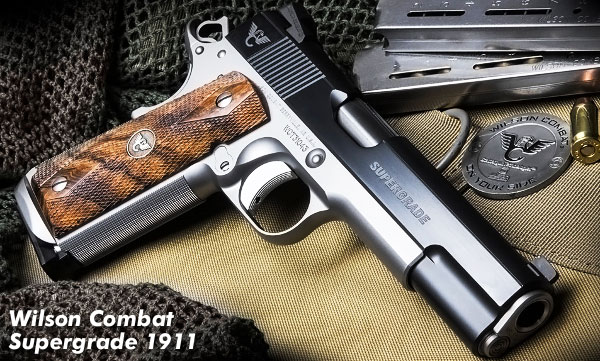
While AccurateShooter.com focuses on rifles, we know that a large percentage of our readers own handguns, with 1911-style pistols being particular favorites. For you 1911 owners, here are four short videos from Brownells showing how to fieldstrip, clean, lubricate, and re-assemble a 1911-style pistol.
FBI Photo shows a Glock Model 22, .40 S&W caliber. This will be replaced by new, striker-fired 9mm Luger pistols in both compact and full-size formats.
The Federal Government loves to spend your tax dollars, and the FBI wants its share of the action. The Federal Bureau of Investigation recently issued a Request for Proposal (RFP) for the next generation of 9mm FBI pistols. At stake is $85,000,000 in Federal dollars for handguns, parts, and accessories. CLICK HERE to Download FBI RFP.
The FBI is actually seeking two 9x19mm pistols, one “Compact” and the other “Full-Size”. The pistols must be striker-fired, and capable of a “20,000 round endurance firing cycle”. Trigger pull weight shall be “no less than 4.5 pounds nor exceed 6 pounds”, with NO mag disconnect/safety. There will also be no manual external safety, no grip safety, and no de-cocking lever. Here are the RFP basic descriptions of the pistols:
Class I Compact Pistol: One (1) Class I Pistol with a barrel length of no less than 3.75” and no greater than 4.25”, minimum magazine capacity of 14 rounds, night sights, six (6) magazines, FBI approved gun lock. Firing pin/Striker fired only.
Class II Full Size Pistol: One (1) Class II Pistol with a barrel length of no less than 4.26” and no greater than 5.20”, minimum magazine capacity of 16 rounds, night sights, six (6) magazines, FBI approved gun lock. Firing pin/Striker fired only.
Why Change from .40 SW back to 9x19mm?
Last time we checked the FBI had more than enough firepower. The FBI’s stated need for $85 million dollars worth of 9mm pistols* certainly raises questions, while re-igniting the “great caliber debate”. In May 1997, the FBI officially adopted the Glock .40 S&W pistol for general agent use. Now it is going back to the 9mm Luger (aka 9x19mm), which it had used in Sig P226/228 pistols from 1988 to 1997.
Why make the change? Some people think advancements in propellants and 9mm bullets allow the smaller cartridge to rival the .40 SW for penetration and stopping power. Possibly the FBI learned that many of its agents couldn’t shoot the snappy, harder-recoiling .40 SW very well. So this change to a more user-friendly round may be all about compensating for lawmen who can’t shoot straight.
A report originating at the FBI Training Academy in Quantico, VA may explain why the FBI wants to dump the .40 SW in favor of the 9mm. Here are highlights from the Report’s Executive Summary:
LEOs miss between 70 – 80 percent of the shots fired during a shooting incident.
9mm Luger now offers select projectiles which are, under identical testing conditions, outperforming most of the premium line .40 S&W and .45 Auto projectiles tested by the FBI.
9mm Luger offers higher magazine capacities, less recoil, lower cost (both in ammunition and wear on the weapons) and higher functional reliability rates (in FBI weapons).
The majority of FBI shooters are both FASTER in shot strings fired and more ACCURATE with shooting a 9mm Luger vs shooting a .40 S&W (in similar sized weapons).
There is little to no noticeable difference in the wound tracks between premium line law Auto enforcement projectiles from 9mm Luger through the .45 Auto.
Source: FBI Training Division, FBI Academy (Quantico, VA) Report quoted in LooseRounds.com.
* In addition to the Compact and Full-Size duty pistols, the FBI plans to acquire training pistols and spare parts: “Class I Inert Training Pistol (a.k.a. Red Handle); Class I Man Marker Training Pistol (a.k.a. SIMUNITION); Class I & Class II Pistol Replacement Parts”. The $85,000,000 contract price would include these additional items.
This photo shows some of the handguns actually found by the TSA in carry-ons last year.
Here’s an important reminder to our readers who have concealed-weapon carry permits — don’t overlook your carry gun when traveling through airports. Many travelers with carry permits are forgetting weapons stashed in carry-on luggage. The TSA is encountering more firearms than ever, and those weapons are normally confiscated with their owners subject to penalties.
In 2014, according to TSA.gov, 2,212 firearms were discovered in carry-on bags at checkpoints across the country (that’s a 22% increase over 2013). Of those, 1,835 (83 percent) were loaded. Firearms were intercepted at a total of 224 airports.
Another problem is that Carry Permit holders may enter an airport with their guns still on their person. Here are actual examples:
A 94-year-old man attempted to enter the checkpoint at LaGuardia Airport with a loaded .38 caliber revolver clipped to his belt.
A loaded .380 caliber firearm was discovered strapped to the ankle of a passenger who walked through a metal detector at Cincinnati/Northern Kentucky International Airport.
A loaded .380 caliber firearm was discovered in the rear pocket of a San Antonio International Airport passenger during advanced imaging technology screening.
If you are traveling by air, make sure you remove all firearms from your person (or carry-on luggage), unload the firearm(s), place any weapon in a locked, hard-sided container, and declare them as checked baggage. Anything else can land you in jail.
Here are the TSA guidelines for transporting firearms as checked baggage:
Comply with regulations on carrying firearms where you are traveling from and to, as laws vary by local, state and international governments.
Declare all firearms, ammunition and parts to the airline during the check-in process. Ask about limitations or fees that may apply.
Firearms must be unloaded and locked in a hard-sided container and transported as checked baggage only. Firearm parts, including firearms frames and receivers, must also be placed in checked baggage and are prohibited in carry-on baggage.
Replica firearms may be transported in checked baggage only.
Rifle scopes are permitted in carry-on and checked bags.
All firearms, ammunition and firearm parts, including firearm frames, receivers, clips and magazines are prohibited in carry-on baggage.
It’s official… the U.S. Army is replacing the M9 Pistol made by Beretta. On August 28, 2015, the Army released the official solicitation for the XM17 MHS Pistol, a modular design that will replace the M9, the Army’s version of Beretta’s model 92. This is a big contract — the Army intends to acquire at least 300,000 pistols, all from one manufacturer.
According to Military.com: “One of the major goals of the MHS [Modular Handgun System] effort is to adopt a pistol chambered for a more potent round than the current 9mm[.] The U.S. military replaced the .45 caliber 1911 pistol with the M9 in 1985 and began using the 9mm NATO round at that time.” It is unclear what chambering the U.S. Army wants instead of the 9x19mm. Some pundits suggest the Army wants a larger-diameter bullet, while others think the Army is looking for a higher velocity projectile that can penetrate body armor. While the Army has not specified a particular cartridge, the XM17 spec requires that the pistol’s projectile penetrate at least 14″ of ballistics gel at 50 meters. The Army also hopes that the new pistol will be more durable and easier to maintain than the M9.
This XM17 solicitation document, a whopping 351 pages long, contains detailed specs for the pistol, accessories, along with performance standards. Guns.com says the specification includes accuracy standards as well as modular design requirements: “The Army said the handgun should be able to hit a 4-inch target at a 50-meter range at least 90 percent of the time throughout the gun’s lifespan. To compete in the Modular Handgun System, and the XM17 designation, the pistol needs modifiable grips, varied magazine options, ambidextrous controls, and rails for accessories.”




 Fulenzo said AB 2243 was inspired by existing bans on racist “hate speech”: “We don’t want children to read about guns or talk about guns. The first step, therefore, is to remove firearms-related words from textbooks, classroom presentations, and state documents. This is not something new. California has done the same thing with hateful words directed at minority groups. In California, by law, we have banned the use of the ‘N’ word (and other racist terms) in official state publications and school textbooks. Now we are just following that practice and banning the ‘G’ word (i.e. ‘gun’) and similar firearms-related hate speech”.



 During a second testing session, I shot the pistol for accuracy with my forearms rested on sandbags. The results were impressive. Above is a seven-shot (7-shot) group at 10 yards (30 feet) with the CCI Blazer Brass ammo. At right is a group shot at 5 yards (15 feet), forearms rested, with the PMC ammo. The one shot that went up outside the group was probably me, the shooter. Remember this is a very small, light-weight pistol that does have some muzzle flip. I’ve seen other tests done with the Walther PPS M2, at longer ranges in the hands of skilled shooters and producing much cleaner groups.
 Quad-Pistol Gear Hauler
 FBI Photo shows a Glock Model 22, .40 S&W caliber. This will be replaced by new, striker-fired 9mm Luger pistols in both compact and full-size formats.


