|
|
May 30th, 2013
 For those of use who have sweated through fire-forming and load development, it’s nice to see things coming together right out of the gate. With the 6mmBR improved wildcats such as the BRX, BRDX, and Dasher, it’s not unusual to see outstanding accuracy even while blowing out cases. In fact the accuracy is usually good enough that you might as well do your fire-forming during competition (once you’ve confirmed that everything is working with a 10-round function test). We’ve seen Dashers shoot in the low twos and even ones during fire-forming — so long as you load carefully and use good bullets, powder, and primers. Here’s a report from Forum member Chris W. (aka “baydawg”) on his new 6mm BRX tube gun: For those of use who have sweated through fire-forming and load development, it’s nice to see things coming together right out of the gate. With the 6mmBR improved wildcats such as the BRX, BRDX, and Dasher, it’s not unusual to see outstanding accuracy even while blowing out cases. In fact the accuracy is usually good enough that you might as well do your fire-forming during competition (once you’ve confirmed that everything is working with a 10-round function test). We’ve seen Dashers shoot in the low twos and even ones during fire-forming — so long as you load carefully and use good bullets, powder, and primers. Here’s a report from Forum member Chris W. (aka “baydawg”) on his new 6mm BRX tube gun:
Shot my 6 BRX last night for the first time at 600 yards last night. The result was a 199-11X. Not bad for fire-forming brass with thrown loads… LOL. Thanks Gary Eliseo and Competition Machine for a kick-ass chassis!”

Gun Specs: Competition Machine R1 in Granny Smith green. Pierce repeater tube gun action. 32″ Bartlien 6mm barrel, chambered in 6mm BRX. Smithed by Pierce Engineering in Lansing, Michigan.
March 3rd, 2013
The MidwayUSA Pro Series Competition Shooting Mat is now on sale for just $49.99, through the end of March, 2013. That’s 51% off the regular $102.99 price. This mat is bigger and better than MidwayUSA’s original shooting mat, with many enhancements. The Pro Series mat measures a full 73.5″ x 35.5″ and the padding is thicker. There is a zippered pocket on the front extension flap to hold ammo or log book. The rubberized contact areas are tan now (rather than black) so they don’t get so hot in the sun. And the designers added webbing “pockets” for bipod feet so you can pre-load the ‘pod with forward pressure. MidwayUSA has done a good job improving a mat that was already a good deal for the money. At $49.99 on sale (through 3/31/2013), this Pro Series mat is a great deal.


MidwayUSA Buyer Reviews:
Five Stars: Great upgrades to the original. It’s bigger in every direction, and the padding is twice as thick. The new knee and elbow pads won’t get as hot as the black material on the old one did, and the new material is “grippier” than the old stuff too. The bi-pod stop is a nice touch if you shoot F-T/R. — Bob M., Missouri, 10/6/2010.
Five Stars: As a competitive shooter my mat is important. The mat I replaced had been with me for about twenty years. It had been with me through the famous weather at Camp Perry, the winds and sand of Grayling 1000 yard matches. My Midway mat arrived shiny and new, full of stuffing, stiff and green. At my next match I found I liked the feel of the mat, it has handles! The rocks and sand on the firing line were not as sharp. The rubber is well-placed. It has proven to be rugged and quite up to the task. I am seeing more Midway mats at matches. A good thing. — Tom, Michigan, 12/26/2012.
Four Stars: I purchased this mat for a 2-day Appleseed event this fall. Good overall quality and more than wide and long enough for my frame. The only drawback and reason for me giving it 4 stars instead of 5 is that the padding is insufficient when placed on top of a rocky surface. I wasn’t looking for a sleeping mat mind you, but you feel every single rock underneath the mat when shooting prone (especially on the elbows), kneeling and when transitioning between positions. Best to use another pad underneath if you are using it on a rocky surface. Most of the other mats out there have the same drawbacks so this is still a great choice at a very decent price. — Chris S., Illinois, 1/6/2013.
Five Stars: This is a great mat for the money. It’s larger, thicker, and stickier than my old one. I could use larger knee area friction pads, but that’s the only complaint. The elbow area is huge and that’s what’s best. Much cooler in the sun, too. Rolls up and rolls out easy. The double-adjustable carry strap has built in loops I use for carrying a rolled up foul weather cover. The fold-out front fly is large and useful. This is a good looking, hard working mat. — Steve R., Illinois, 10/11/2010
This product has 4.3 star average with 53 user reviews.
February 8th, 2013
Report by Monte Milanuk
With the proliferation of wide bipods for competitive F-TR shooting, we’ve seen a lot of cool gear hitting the market. Whatever you can imagine, someone is either building now, or working on prototype plans. One new design that seems to have stayed under the radar thus far is the FLEX bipod by Dan Pohlabel.

The FLEX bipod’s designer, Dan Pohlabel, offers these instructions:
The bipod feet are shipped loose. Note there is a left foot and a right foot. Mount them as shown in the diagram above. Determine the balance point of your rifle and mount the bipod approximately two inches forward of that point. You may want to move it further forward after shooting. Experiment with its placement to minimize movement of the bipod. When setting up, first grab each foot and ‘dig’ them in to the shooting surface, dirt, gravel, grass, carpet — it doesn’t matter. After making sure each foot has a hold, raise or lower the bipod to your target and use the cant adjustment to level your rifle. Loading the bipod with your shoulder is the preferred method of position. Contact me with any FLEX bipod questions you may have: danielp123 [at] earthlink.net.
The FLEX bipod is a very simple design — no Mariner’s wheel for vertical adjustment, no joystick head, no changing width as it goes up and down. And the FLEX bipod is very light (as are most, these days), but also very durable. I haven’t actively tried to destructively test it, but so far it’s held up to being tossed in the back of the truck, hauled around to the range and everywhere else in between. It definitely has not been ‘babied’ in any way, and it’s not noticeably any worse for wear. An added bonus is that it breaks down very flat for airline travel. Once I take the feet off, remove the ratchet lever (with screw), the whole bipod nestles very nicely in the bottom layer of foam in my gun case (with cuts for the head etc. in the foam). I’m definitely not worried about it in there. If someone bashes the case hard enough to damage what is essentially a plate of spring steel, then I’ve got bigger worries.

This view (below) shows a bit of the adjustment controls. Each leg has independent control for height, and there is a ratcheting locking lever that controls the cant. Instead of being directly centered like most other designs I’ve seen, this one is off-set a little, allowing a fair amount of movement without allowing it to completely ‘flop’ over to one side. (By contrast, using other bipod designs, I’ve had guns literally flip over as they tipped over too far.) Also having the tilt control relatively close/tight to the bore of the gun helps with the stability as well.

Inventor Dan Pohlebel developed the FLEX bipod for use in his native Ohio, where apparently grassy firing lines are the norm. Here in the Pacific Northwest, I seem to encounter concrete or gravel more often, which is why I usually place a mat under the bipod to keep it from sinking in too far. On Dan’s newest models, the “feet” have teeth to give better traction on hard surfaces such as the hard-pack clay/dirt (beneath a skim layer of gravel) that you’ll find at Raton, NM.
Why would you want more traction? Well, not everyone wants a bipod that slides around like a hog on ice. Some people manage to get things tracking straight back and forth, almost like it was constrained by a front rest. Personally, I have a hard time doing that in a repeatable fashion. While the FLEX Bipod shoots quite well with a [loose] hold, it was designed for those of us who like to ‘lean’ into the gun a bit. Quite literally, the idea is that you get the feet to dig in slightly, and push against the rifle butt with your shoulder and the bipod will ‘flex’ or bow forward slightly. It is one of those things that sounds wonky until you try it. It may take a few times to get a feel for it, but once you do, it is surprisingly repeatable.

The system does have a few quirks to it. Personally, I wish the rail attachment had a ratchet lever like the pivot control. Currently you need a separate tool to take the bipod on/off the gun. Also, the FLEX bipod seems to work better mounted somewhat further back than other designs. Some experimenting may be necessary to find what works best. Then again, we all need more trigger time….
October 8th, 2012

This 2010 story is reprinted at readers’ request.
In the past few years, tubeguns have really taken over in high power circles. At many matches you’ll see more tubeguns than conventional prone rifles, and a high percentage of those tubeguns will have been built using an Eliseo (Competition Machine) CSS chassis kit.
Step-By-Step Guide to Stock Set-Up
If you are a new tubegun shooter, or if you are planning a tubegun build this winter, German Salazar has prepared a comprehensive set-up guide for Eliseo tubeguns. Eliseo’s CSS chassis system affords a myriad of adjustments. Initially, one can be overwhelmed by all the variables: Length of Pull, Length to Sights, Length to Handstop, Cheekpad Height, Buttstock Offset, Buttstock Cant Angle, Handstop Angle, and Forearm Rotation.
 In his Guide to Configuring the Eliseo Tubegun, Salazar shows how to adjust the Tubegun so that a shooter’s prone position is stable, repeatable, and comfortable. Salazar covers each adjustment, step by step. If you follow his instructions, starting with setting Length of Pull, you should find that your hold becomes more stable, the gun moves less from shot to shot, and your eye position relative to the sights is improved. In his Guide to Configuring the Eliseo Tubegun, Salazar shows how to adjust the Tubegun so that a shooter’s prone position is stable, repeatable, and comfortable. Salazar covers each adjustment, step by step. If you follow his instructions, starting with setting Length of Pull, you should find that your hold becomes more stable, the gun moves less from shot to shot, and your eye position relative to the sights is improved.
German explains the set-up process: “Adjusting the stock is a process that you must work at and it builds on itself. As you get one adjustment right, the others begin to fall into place. Our hope is that you take from this article a system for adjusting the stock, not an exact set of dimensions; and that you understand that it will take continuous work over a period of time to really refine the adjustments. Your goal is not to obtain a ‘perfect set of dimensions’ but rather a perfect feel that accomplishes the three objectives of stability, durability and comfort and the knowledge of how to change the adjustments to achieve those objectives under varying conditions such as sloped firing lines or other terrain features.”
Read More at RiflemansJournal.com
German Salazar runs the excellent Rifleman’s Journal website, where you will find dozens of informative articles like this story.
July 31st, 2012
Report based on story by Kyle Jillson for the NRA Blog
CPT Christopher Abalo of the USAMU won the NRA Smallbore Rifle Prone Championship at Camp Perry, claiming the prestigious Critchfield Trophy with a score of 4792-352X. Reya Kempley came in second, just two points back (4790-363X). Rounding out the top three was Michael Anti who shot 4787-350X
The “third time was a charm” for Abalo, who secured the title in his third appearance at the Camp Perry smallbore prone event. He was close to the top in the past two years. In 2010 Abalo finished second behind teammate SSG Shane Barnhardt, while in 2011 Abalo took third, behind teammate SSG Michael McPhail and Mark Delcotto. “It feels great,” Abalo said of his first win. “After coming in second and third the last two years, it feels great to be at the top of the podium this time.”
 CPT Abalo shown during “Any Sights” stage of Smallbore Prone Event. CPT Abalo shown during “Any Sights” stage of Smallbore Prone Event.
Comprised of a Metallic Sight Championship and Any Sight Championship, the Prone Championship saw improved weather from the previous week’s Position Championships. Conditions stayed dry for the most part, but the wind coming off Lake Erie was still a force to contend with and often made life difficult for the almost 300 shooters taking part in the matches.
Photo courtesy the NRA Blog
June 16th, 2012
The rifle shooters who will represent the United States at the 2012 London Olympics are currently profiled on the RifleShooter magazine website. Log on to RifleShooterMag.com to read about Team USA’s Olympians who will be competing in Air Rifle and Smallbore (.22LR Rimfire) events in London next month. The Olympic selection process recently concluded, and we now know the talented men and women who made the cut. CLICK HERE to read bios of individual athletes.

| Men’s Rifle Team |

Matt Emmons, 50m 3P
10m Air Rifle |

Jonathan Hall, 10m Air Rifle |

Michael McPhail, 50m Prone |

Josh Olson, Paralympic R3, R6 |

Jason Parker, 50m 3P |

Eric Uptagrafft, 50m prone |
| Women’s Rifle Team |

Jamie Beyerle Gray, 50m 3P
10m Air Rifle |

Amanda Furrer, 50m 3P |

Sara Scherer, 10m Air Rifle |
Story find by EdLongrange. We welcome reader submissions.
June 3rd, 2012
Gary Elesio of Competition Machine has come up with a new product for smallbore shooters. Gary has a new H1 Tubegun Chassis for the Hall custom rimfire action, a very high-quality, single-shot action that can be fitted with a Jewell trigger. The new H1 Chassis, like other Elesio tubegun kits, features a fully-adjustable skeleton-style stock, and a tubular forearm. The forearm can be rotated so a sling-shooter can “dial in” the best angle for his hand-stop. We think this new H1 action should be popular with rimfire prone and position shooters who are looking for an affordable, all-American alternative to expensive European match rifles. Below is a “sneak peek” at Elesio’s new H1. This shows the H1 receiver housing fitted with a Picatinny-style rail. MSRP for the H1 has yet to be announced.

About the Hall Action
The $1075.00 Hall action is a high-quality, custom-crafted design built to benchrest standards. The action is 1 3/8″ diameter by 7 ” long and is made of 416 stainless steel, with heat-treated, tool steel locking lugs. The action features an Anschutz-type feed ramp, and it comes with a trigger housing which uses 40X Remington-type triggers (Jewell Remington triggers will work). The Hall action is currently available with either right or left port, but only right bolt.

Product Tip from EdLongrange. We welcome reader submissions.
February 28th, 2012
German Salazar, a top prone shooter and “head honcho” of the fine RifllemansJournal.com website, has crafted an excellent new article on stock design. Writing for Precision Shooting magazine, German compares traditional stocks, such as the MasterClass Prone, with more modern, modular designs, such as the Eliseo TubeGun and Ross Precision stock. German, who shoots match rifles built with each type of stock, explains the pros and cons of the different designs, and explains how to optimize the stocks’ adjustments for best fit and function. German also explains the best methods to attach and bed an action to each of the designs.
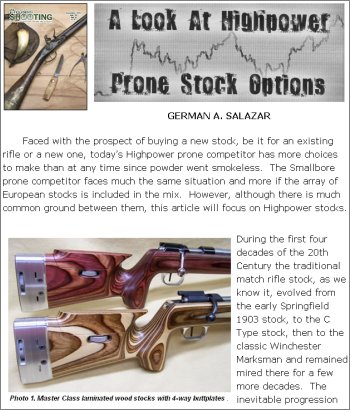

For a limited time, German’s excellent article is available online, courtesy of Precision Shooting Magazine. If you’re a High Power shooter, or you are interested in the design, construction, and engineering of modern competition stocks, this article is a “must-read”.
CLICK HERE to read FULL STORY

October 15th, 2011
Our friend John Whidden accomplished another milestone in his storied shooting career. This time John topped an extremely competitive field of Palma shooters at the World Rifle Championships in Australia. Earlier today Whidden nailed a 100-13V on the final day of the Queen’s Prize Match to win the three-day event with a 399-46V Aggregate. (A “V” is equivalent to the “X” in American matches). John’s Day 1 score of 150-012V and Day 2 tally of 149-21V were enough to overtake early Palma Teammate Norman Anderson, and hold off the strong-finishing SGT Sherri Gallagher on Day 3.
When the dust had settled, John took the Queen’s Prize Match by a single point over runner-up Sherri Gallagher. In fact, Sherri and the 3rd, 4th, 5th and 6th-place finishers all had identical 398 scores, so V-counts were used as tie-breakers. Yes this match was that close.

By tradition, fellow competitors carried Whidden and his green John Deere-sashed rifle to the awards in a ceremonial sedan-chair. John seems to be enjoying the ride. The above photo was taken by fellow Palma Teammate Dave Cloft. Overall, Americans did very well in the Queen’s Prize Match, taking four of the Top 10 places. South Africa, a strong force at the last World Championship, had three shooters in the Top 10. Here’s how the Top 10 finished in the Queens Match:
 1. John Whidden, USA: 399-046V 1. John Whidden, USA: 399-046V
2. Sherri Gallagher, USA: 398-054V
3. Jim Bailey, Australia: 398-044V
4. Petrus Haasbroek, South Africa: 398-043V
5. Norm Anderson, USA: 398-043V
6. Colin Cole, North Arm: 398-039V
7. Andre Du Toit, South Africa: 397-048V
8. Johannes Du Toit, South Africa: 397-048V
9. Geoffrey Grenfell, Bendigo: 397-048V
10. Tom Whitaker, USA: 397-047V
It looks like the Yanks are picking up steam in the World Rifle Championships, which continue with both individual and team events through October 22nd. (We’ll have a report on the hot-shooting USA Young Eagles team tomorrow.)
Story by Lars Dalseide for The NRA Blog.
October 11th, 2011
105gr Hybrid Tests Demonstrate Excellent Accuracy and Consistency
By Robert Whitley
After the initial Daily Bulletin Report on the new Berger 6mm 105gr Hybrids, I did some accuracy and consistency field testing with these new bullets. They shot so well, I thought an update was in order. My 100-yard testing has revealed much about these new bullets — all of it good so far. The test rifle was a MAK Tube Gun with a trued Rem 700 action (glued in), with a 6mm Brux 30″, 1:8″-twist barrel chambered with a no-neck-turn 6mm BRX chamber (1.563″ max case and .120″ free bore). The 6mm 105gr Hybrids fit and work well in this 6 BRX chamber configuration. (CLICK HERE to view a print of the reamer I used for the 6 BRX chamber.)

Hybrids Show Excellent Accuracy in Prone Tests (with Sling)
As some may know, I am predominantly a prone shooter and do most of my load testing prone with a sling. I chose to do the same with these Hybrids, to see how they would perform when fired as they would be in a prone match. In this case, shooting prone with sling, I shot four 10-shot groups (two 10-shot groups in each of two range session). All four groups were right around .5 MOA (i.e. each group about .750″ edge-to-edge, minus a bullet diameter of .243″ = .507″). The new Berger 6mm 105gr Hybrid bullets had no problems doing this. The groups shot were also consistent with the best groups I have been able to shoot in the past with the Berger 108gr BT bullets and the Berger 105gr VLD bullets, and I consider both of those bullets to be excellent and accurate. There is no question in my mind that these new Hybrid bullets are accurate, and the consistency is there! Check out my test targets below.

The two 10-shot targets above were shot at 100 yards on September 30th, prone with sling. The 6 BRX load was: Berger 6mm 105gr Hybrids, Lapua brass, 32.0 grains N140, Federal 205M-AR primers, .020″ jump. Note: If you put the targets over each other the groups line up perfectly.

These two 10-shot targets (above) were shot at 100 yards on September 23, prone with sling. The 6 BRX load was: Berger 6mm 105gr Hybrids, Lapua brass, 31.0 grains H4895, Federal 205M-AR primers, .020″ jump. When I can shoot 20 Xs in a row (as I did with these two targets) the rifle is really shooting well.

Accuracy needs to be coupled with consistency, especially when running longer strings of fire or in matches demanding a larger number of hits on the target. I am pleased to report that I have found the Berger 105gr Hybrid bullets to be consistently accurate bullets (i.e. there were no anomalies or fliers, they just keep going where you pointed the rifle). At each of the last two range sessions I shot back to back 10-shot groups with no break between the two (i.e. 20 shots in a row and only switching to the next target after 10 shots). Not only did the individual 10-shot groups stay tight, but if you hold each first target over the second target, the groups are right on top of one another. This is what I look for in terms of consistency — that I can keep shooting, and the bullets keep going right into the group, with no odd fliers.
105gr Hybrid Bearing Surface and Optimum Free Bore
Shooters may wonder how the new 6mm 105gr Hybrids function with the existing freebores on chambers set up for current Berger 105gr VLDs and Berger 108gr BT bullets. Based on the investigation and measuring of various chambers, here are some general guidelines:
1. For a chamber with a 1.5° throat angle, and the bullets touching the lands, the Berger 105gr Hybrid bullets sit up in the neck a little further than both the current production Berger 105 VLD Target bullets and the Berger 108gr BT bullets.
2. Based on basic measuring and testing, for the junction of the boat tail and bearing surface of a 6mm 105gr Hybrid bullet to be in the same spot as other bullets, the 105 Hybrid (Lot #3079) would need about .020″ – .025″ less freebore than recent production Berger 105gr Target VLD bullets (Lot #3220) and about .030″ – .035″ less freebore than recent Berger 108gr Target BT bullets (lot #2791).
3. Since the Hybrids are designed to work both in the lands and jumped away from the lands, some extra freebore may not be a bad thing. In truth, the 105 Hybrid bullets should work well and fit well in various 6mm chamberings (such as 6 BRX, 6 Dasher, 6mmAR etc.) which have been optimized for the previous generation, non-Hybrid 6mm Berger 105s and 108s.
|


