Eurooptic vortex burris nightforce sale


teslong borescope digital camera barrel monitor


As an Amazon Associate, this site earns a commission from Amazon sales.


December 22nd, 2025

Loading Precision Centerfire Pistol Ammunition

USAMU Service Pistol Handgun Tip Advice Reloading

If you want to compete in top handgun competitions such as the CMP matches at Camp Perry, you’ll need good ammo that has low ES, consistent powder charge, uniform cartridge OAL, and consistent crimp. Every with action pistol matches you’ll want ammo that is very uniform. One miss on steel can mean losing a match. The following USAMU article provides rock-solid pistol reloading advice, explaining how to load accurate, reliable handgun ammo.

USAMU Service Pistol Handgun Tip Advice Reloading

The U.S. Army Marksmanship Unit (USAMU) fields pistol teams as well as rifle and shotgun competition squads. Consequently the USAMU’s Reloading Shop loads tens of thousands of pistol rounds every year. In this article, the USAMU’s handgun experts talk about reloading for handguns — with smart tips on how to achieve superior accuracy with 100% reliability. This article, which offers important insights on COAL, primers, crimps and more.

USAMU Service Pistol Handgun Tip Advice Reloading

Precision Pistol Reloading — Recommended Methods

Optimize the Taper Crimp
One often-overlooked aspect of handloading highly-accurate pistol ammunition is the amount of crimp and its effect on accuracy. Different amounts of taper crimp are used with various handloads to obtain best accuracy. The amount is based on bullet weight, powder burn rate and charge, plus other factors. It is not unusual for our Shop to vary a load’s crimp in degrees of 0.001″ and re-test for finest accuracy.

USAMU Service Pistol Handgun Tip Advice ReloadingUse Consistent Brass
Brass is also important to pistol accuracy. While accurate ammunition can be loaded using brass of mixed parentage, that is not conducive to finest results, particularly at 50 yards. It is important for the serious competitor/handloader to use brass of the same headstamp and ideally one lot number, to maximize uniformity. Given the volumes of ammunition consumed by active pistol competitors, using inexpensive, mixed surplus brass for practice, particularly at the “short line” (25 yards), is understandable. However, for the “long line” (50 yards), purchasing and segregating a lot of high-quality brass to be used strictly for slow-fire is a wise idea.

Importance of Uniform COAL
Uniformity of the Case Overall Length (COAL) as it comes from the factory is also important to achieving utmost accuracy. More uniform case lengths (best measured after sizing) contribute to greater consistency of crimp, neck tension, ignition/burn of powder charge, and so on. Cartridge case-length consistency varies from lot to lot, as well as by maker. Some manufacturers are more consistent in this dimension than others. [Editor’s note: It is easy to trim pistol brass to uniform length. Doing this will make your taper crimps much more consistent.]

Primers and Powders — Comparison Test for Accuracy
Pay attention to primer brands, powder types and charges. Evaluating accuracy with a Ransom or other machine rest at 50 yards can quickly reveal the effect of changes made to handload recipes.

Bullet Selection — FMJ vs. JHP
Bullets are another vital issue. First, there is the question of FMJ vs. JHP. A friend of this writer spent decades making and accuracy-testing rifle and pistol bullets during QC for a major bullet manufacturer. In his experience, making highly-accurate FMJ bullets is much more difficult than making highly-accurate JHPs, in large part due to the way the jackets are formed. Small die changes could affect accuracy of FMJ lots dramatically.

The CMP now allows “safe, jacketed ammunition” in Excellence-in-Competition (EIC) Service Pistol matches, although wadcutter ammunition is prohibited. Thus, the option to use very accurate JHP designs simplifies the life of CMP Service Pistol shooters in pursuit of the Distinguished Pistol Shot badge.
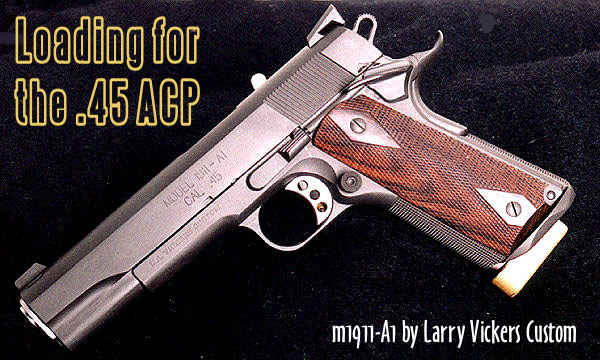

reloading .45 acp pistol

Hopefully, these tips will be helpful to any pistol shooters interested in accurate handloads, not just “Bullseye” shooters. Small tweaks to one’s normal routine can pay big dividends in improved accuracy and make practice and competition more rewarding. Stay safe, and good shooting!

Permalink Bullets, Brass, Ammo, Reloading, Tech Tip No Comments »
June 11th, 2015

Precision Handloading for Pistols — Tips from the USAMU

USAMU Service Pistol Handgun Tip Advice Reloading

This week, the U.S. Army Marksmanship Unit is pleased to host pistol teams from the various U.S. Armed Services in the 56th Annual Interservice Pistol Championship. Our Handloading Shop members have enjoyed discussing pistol accuracy and enjoying the camaraderie of competitive shooters from all over. In that spirit, this week’s topic will focus on handloading for best pistol accuracy, rather than our usual rifle-oriented information.

Optimize the Taper Crimp
One often-overlooked aspect of handloading highly-accurate pistol ammunition is the amount of crimp and its effect on accuracy. Different amounts of taper crimp are used with various handloads to obtain best accuracy. The amount is based on bullet weight, powder burn rate and charge, plus other factors. It is not unusual for our Shop to vary a load’s crimp in degrees of 0.001″ and re-test for finest accuracy.

(more…)

Permalink Handguns, Reloading No Comments »
March 4th, 2011

Ransom Rifle Master ‘SL Mega Rest’ — Review Part One

Ransom recently introduced the Ransom Rifle Master ‘SL Mega Rest’, a large, modular rest system for FSCA, NBRSA, and IBS shooters and other shooting disciplines that allow a rest system. We persuaded accomplished NBRSA point blank and long range shooter John Crawford to check out this system and share his experiences. This article is Part One of a two-part series.

Ransom’s SL Mega Rest: Part One (First Impressions) by John Crawford

Ransom SL Mega Rest

Upon receiving the Ransom SL Mega Rest, the first thing I noticed was how well the rest was packaged. There were two boxes, a large box holding the two base plates and a small box holding all of the small parts for the rest. The large box is double-walled, cardboard construction. It held up well to the rigors of shipping, keeping the two rest halves, each in their own inner box, in perfect shape.

Unpacking the Ransom SL Mega Rest one could not help but notice the weight of each half and their very attractive, black, Rhino coating. [Rhino coating is a heavy, extremely durable and tough, textured polyurethane coating commonly sprayed in the bed area of pickup trucks to protect the bed from damage.] Unpacking the small parts, which were all packaged separately for protection, gave me a good chance to note their excellent fit and finish. The small parts are made of steel and have a black oxide finish, including the ½:20-threaded legs which have nicely knurled knobs and lock rings. The black oxide finish compliments the bases.

Ransom SL Mega Rest

Front Section
The front base and post, used exclusively for elevation adjustment, are well built and have some very nice features. The post, which is 1.25″ in diameter, has a keyway and key in the front to keep it from turning, and the lockdown bolt has a carbide ball in the end to lock the post in place. The mariner’s wheel has a cogged rubber belt on the outside (fits into a groove) and makes adjusting height easy and comfortable without hand slippage. The post assembly can be located, front-to-rear, in one inch increments, to provide a center-of-front-rest-base-to-center-of-rear-rest-base distance of from 24″ to 32″, thus accommodating an 8″ difference in stock length.

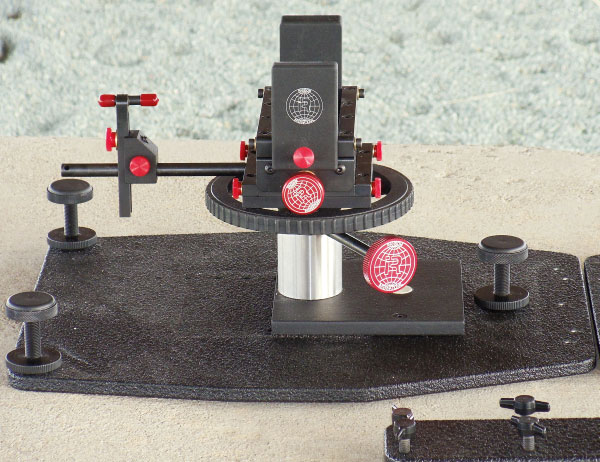
The Ransom SL Mega Rest’s elevation rest top is a modular system. The base for the rest top broke tradition and has two bolts, side by side, to hold it to the post, a welcome change from having a single bolt to hold the top on. With two bolts you reduce the stress when putting a heavy rifle on the rest. The front post is mounted to a plate that bolts down to the rest base. The rest base has a series of tapped holes that allows one to adjust the front rest location, front-to-rear, to fit different stock lengths.

Ransom SL Mega RestRear Section
The rear rest, used exclusively for windage adjustment, has the rest top holder bolted in place. As a modular system, you can put the elevation rest top bag holder or windage top bag holder in either the front or rear rest as needed. You could also have a few different elevation rest tops or windage tops for different rifles. Both front and rear rests have a bubble level.

The Ransom SL Mega Rest’s windage top and bag holder are also modular. You can put the windage top and bag holder, or just the bag holder, in either the front or rear rest by removing four thumb screws and changing the tops. You can buy different width rest tops and swap them out in a few minutes, a nice feature for different stock length and width configurations. The windage top has a dovetail fit with a center bolt to hold the top in place and has no perceivable side play or movement, nice and tight and the windage adjusts easily.

The forearm stop is well thought out and fully adjustable for height and length to accommodate different front bag heights and stock lengths/positions. It can be adjusted forward about 4″ and, in height, from 1-1/2″ to 3-1/2″. It easily adjusts with two thumb screws.

83 pounds of Steel Solidity
The bridge plate between the front and rear rests is also black Rhino-coated, matching the bases. There are four dowel pins in the bridge plate for alignment and six 5/16-18 bolts that securely hold the bridge plate in place. The rest can be shot with the bridge plate in place, as a one-piece rest system, or the bridge plate can be removed, making it a two-piece rest system.

Ransom SL Mega Rest

The rear rest with windage top weighs 38 pounds and the front rest weighs 45 pounds, for a total weight of 83 pounds. This is without sand bags or sand. Overall the all-steel-construction, Ransom SL Mega Rest is well thought out, nicely finished, and made to the standards and quality you would expect from the Ransom Company. The MSRP for the whole unit (everything except sand bags) is $1,330.00. This includes front heavy bag plate, and rear windage-adjustable bag plate. Additional plates (for different sized bags) start at about $90.00. Next step is to fill my sand bags and do some field testing. We’ll cover that in Part Two of this review, later this spring.

Test Arranged by Edlongrange.
Permalink Gear Review, New Product 2 Comments »