Readers who have just recently discovered the Daily Bulletin may not realize that AccurateShooter.com has hundreds of reference articles in our archives. These authoritative articles are divided into mutiple categories, so you can easily view stories by topic (such as competition, tactical, rimfire, optics, shooting skills etc.). One of the most popular categories is our Technical Articles Collection. On a handy index page (with thumbnails for every story), you’ll find over 120 articles covering technical and gunsmithing topics. These articles can help you with major projects (such as stock painting), and they can also help you build more accurate ammo. Here are five popular selections from our Technical Articles archive.
Stress-Free Pillar Bedding. Richard Franklin explains how to do a top-quality bedding job, start to finish.
OnTarget Software Review. Our Editors test free software that measures shot groups with great precision. We explain how to use the program and configure advanced features.
Savage Action Tuning. Top F-TR shooter Stan Pate explains how to enhance the performance of your Savage rifle by optimizing the torque settings of the action screws.
Complete Precision Case Prep. Jake Gottfredson covers the complete case prep process, including brass weight sorting, case trimming, primer pocket uniforming, neck-sizing, and, case-neck turning.
Stock Painting Instructions. Step-by-step guide for stock painting by expert Mike Ricklefs. Mike shows both simple coverage and fancy effects.
There has been a hue and cry on some internet sites about changes in smokeless powder classifications by the Federal Bureau of Alcohol, Tobacco, Firearms and Explosives (ATF). Writers have been concerned that recent interpretations by the ATF would make it much more difficult to store and transport reloading powders, which in turn could lead to price increases and/or powder shortages. Concern arose over the potential re-classification of “wetted” Nitrocellulose as a “high explosive”. Since “high explosives” are subject to more stringent rules, such re-classification would alter the way common smokeless propellants could be lawfully stored and transported.
Thankfully, there is good news. On August 31st the ATF issued an Addendum to its June 16 ATF Explosives Industry Newsletter saying that its policies regarding smokeless powders containing Nitrocellulose will not change… at least for now:
Based on this “Addendum”, it seems the ATF has tabled its proposal to classify Nitrocellulose-based smokeless powders as “high explosives”.
The NRA Institute for Legislative Action (NRA ILA) confirms that the ATF has backed off, so that current practices for powder storage and transport can continue unchanged. Thus hand-loaders should NOT face an impending powder shortage and/or price hikes. Here is the NRA ILA’s report:
ATF Delays Any Changes to Nitrocellulose Regulation
Earlier this summer, ATF released an Explosives Industry Newsletter that changed the agency’s treatment of nitrocellulose, the primary component in smokeless powders used in modern ammunition. This change had the potential to seriously disrupt ammunition supply in the United States because it changed a long-standing ATF policy that exempted properly “wetted” nitrocellulose from treatment as an explosive under federal law.
NRA and [shooting industry representatives] raised these concerns to ATF and any change in ATF’s treatment of nitrocellulose is now officially delayed. In an addendum to the earlier newsletter, ATF announced that it “will conduct further industry outreach concerning wetted Nitrocellulose. In the interim, previously authorized industry practices concerning wetted Nitrocellulose will NOT be affected.”
While the addendum doesn’t indicate that ATF has permanently abandoned this change to nitrocellulose regulation, smokeless powder manufacturers will be permitted to continue normal operation, at least for the time being. NRA will continue to work to ensure that any future change to nitrocellulose regulation will not affect ammunition supply.
ATF Industry Newsletter Caused Concern
The cause for firearms industry concern was the ATF’s statement about Nitrocellulose published in the June 2016 ATF Explosives Industry Newsletter. The key language is shown in the right column below. According to the NRA ILA, the ATF has, at least for the time being, decided NOT to change its policies regarding the storage and transport of “wetted” Nitrocellulose. Accordingly, “smokeless powder manufacturers will be permitted to continue normal operation”.
At the request of our readers, we provide select “Deals of the Week”. Every Monday morning we offer our Bargain selections. Here are some of the best deals on firearms, hardware, reloading components, and shooting accessories. Be aware that sale prices are subject to change, and once clearance inventory is sold, it’s gone for good. You snooze you lose.
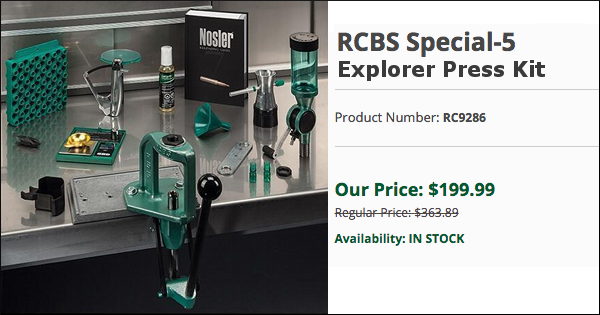
1. Natchez — Special 5 Reloading Press Kit, $199.99
This is an excellent entry-level reloading kit, which is on sale for $199.99 at Natchez Shooters Supplies. We like the relatively compact Special 5 press for most reloading duties. Eventually you may want to add an additional, large heavy press, but this will get the job done. This kit includes an RCBS Powder Measure, Digital Scale, Powder Trickler, Hand Priming Tool, Load Manual, Loading Tray, and more. It’s hard to beat this combination of tools for under $200.00.
Walker’s new Razor-X and Razor-XV operate like electronic muffs — allowing you to hear commands and conversations while still blocking loud noises. The Razor-X combines a collar unit (containing the electronics) with retractable, foam-tipped ear buds. Unlike conventional earmuffs, the Razor-X system doesn’t interfere with your cheek weld. The patent-pending earbuds provide an impressive 31dB of noise reduction, with the ability to hear commands. To ensure a good fit (for best noise reduction), the Razor-X and Razor-VX come with two styles of noise-reducing foam tips. An AC wall adapter with USB port and a one-meter micro USB cord is provided. READ Razor-X User Reviews.
We like reactive targets. It’s fun to “ring steel” and see a target move instantly when hit. For just twenty bucks (including shipping), it’s hard to go wrong with this 8″ AR500 Steel Gong. The 8″-diameter size is big enough for zeroing at 200 yards, yet offers a nice challenge at 500 yards and beyond. There is also a 6″-diameter model for $16.00.
4. Cabelas — Big Ammo Sale Plus FREE Shipping
Right now, Cabela’s is running a big sale on all types of ammunition from major manufacturers. Save as much as 20% off regular pricing. For example, Winchester 9mm pistol ammo is marked down from $13.99 to $11.99 for 50 rounds. And PMC X-Tac 5.56×45 ammo is reduced from $9.99 to $8.49 for 20 rounds. Plus, you can get FREE SHIPPING on all orders of $99.00 or more. Use Code 86BUY during checkout (code valid through 8/31/2016).
5. Kelbly.com — 15% Off Discount on All Products
Looking for a Panda or Atlas Action, or a complete match rifle? Here’s a great promotion from our friends at Kelbly’s. Now through Tuesday, August 23, 2016 you can get 15% of ANYthing on the Kelblys.com website. That includes rifles, actions, stocks, barrels, scope rings, muzzle brakes, Berger bullets, accessories and more. To save big, use code 15ALL at checkout. Don’t delay — this offer expires at 11:59 pm on September 1, 2016.
6. Midsouth — Complete Case Tumbling Kit, $73.70
This brass tumbling system contains everything you need to clean your cartridge brass: Vibratory Case Tumbler, Rotary Media Separator, 6 lbs. of Corn Cob Media, and 8 oz. of Brass Polish. Right now this whole system is on sale at Midsouth for just $73.70. The case tumbler, which holds 450 .223 Rem cases or 1000 9mm cases, has a three-year motor warranty. This is a good deal for the package. You could pay $65.00 for a good vibratory Tumbler by itself.
7. Natchez Shooters Supply — 325 Rounds .22 LR Ammo, $22.99
This Federal .22 LR ammo is just 7 cents per round — the kind of pricing on bulk rimfire ammo we used to see in the “good old days”. Act quickly, this $22.99 Federal .22 LR Ammo deal won’t last long. Each box contains 325 rounds — enough ammo for many sessions at the range. The bullets are 40 grains, solid lead.
8. CDNN — Browning A-Bolt with Nikon Scope, $639.99 w/Rebate
Right now you can get a nice, wood-stocked Browning A-Bolt III Hunting rifle in .308 Winchester for just $689.99. And, to sweeten that deal, the current “Browning Benjamins” Rebate program knocks $50.00 off, so the price (with rebate) is just $639.99. This package includes a Nikon Buckmaster II 4-12x40mm BDC scope. This same Browning/Nikon special is available in many other chamberings for the same price: .243 Win, .270 Win, .270 WSM, 7mm-08, .30-06 Spr, .300 Win Mag.
9. Browning — Save Up to $100 on Browning Firearms (Rebates)
Now through the end of September, 2016, Browning is offering substantial cash rebates on rifles, pistols, and shotguns. Save $100.00 on a shotgun, $50.00 on a rifle, or $25.00 with this rebate offer, good on firearms purchases made by September 30th. Browning makes some pretty darn good firearms. This Editor owns a Browning Citori Shotgun and it’s a gem. CLICK HERE for details and Rebate Form.
What is the most-used piece of equipment on this editor’s reloading bench? No it’s not my Rock-Chucker press, or even my calipers. The one item in near-constant use is a small, folding magnifying glass. Mine folds into a square case and offers 4X viewing with an 8X bifocal insert. With this handy tool I can inspect case mouths for burrs, check primer pockets, inspect meplats, and look for flaws on bullet jackets. I also use the magnifier to see rifling marks on bullets seated into the rifling, or check my bolt for galling. The number of uses is nearly endless. I keep one magnifier at my reloading bench and another in my range kit.
Folding magnifiers are so handy yet inexpensive that you should own a couple spares (including one in the range box). I bought my magnifier in a book-store, but you can also find them on the web at FoldingMagnifier.com and WidgetSupply.com starting at just $1.95. To see the finest details, Widget Supply offers a powerful 9X/18X slide-out magnifier with a built-in, battery-powered LED light. With that gadget, you can easily see any minute flaws in your barrel crowns. That’s important because crown damage can cause hard-to-diagnose accuracy issues. We’ve known guys who spend weeks tinkering with loads, when the real problem was a worn-out or damaged crown.
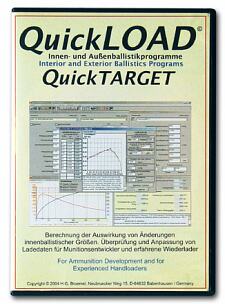
In our Shooters’ Forum, many questions are asked about QuickLOAD software — how to get best results, how to use the advanced features, how to adjust for temperature and so on. To help answer those questions, here’s a short feature we first ran during SHOT Show 2012. You can also CLICK HERE for a very detailed explanation of QuickLOAD in our main site.
At SHOT Show, we had the chance to meet with German software engineer Hartmut Broemel, creator of QuickLOAD software. This software program, while not a substitute for conventional load manuals, allows shooters to evaluate a wide range of powders and bullets, comparing potential loads on the basis of predicted pressures, velocities, load density and projectile in-barrel time.
We took the opportunity, in the video below, to explain some of the fine points of QuickLOAD for our members. QuickLOAD, sold by Neconos.com, helps reloaders understand how changing variables can affect pressures and velocities. It can predict the effect of changes in ambient temperature, bullet seating depth, and barrel length.
In the video below we explain how to adjust the program for true case capacity, bullet seating into the lands, and other important factors. If you are a new QuickLOAD user, or are contemplating buying the $152.95 program, you should watch the video. The program isn’t perfect, but it can accelerate the load development process, and it can save you money by narrowing down the list of appropriate powders for your cartridge.
No other product currently available to serious reloaders offers as much predictive power as QuickLOAD, and you’ll find your money well spent just for the vast collection of data on bullets and cartridges. With a couple mouse-clicks you can instantly get the specifications of hundreds of bullets and cartridges. Likewise, in a matter of seconds, you can compare load density for a half-dozen powders, or compare the projected velocities of one cartridge versus another.
IMR® Legendary Powders now offers four (4) Enduron powders: IMR 4166, IMR 4451, IMR 4955, and IMR 7977. Shooters looking for readily-available alternatives to hard-to-find extruded powders should definitely check out the Enduron line-up. Precision shooters will find an Enduron option well-suited to most of the popular precision cartridge types. For example, IMR 4166 is a good replacement for Hodgdon Varget (commonly used in the .223 Rem, 6mmBR and .308 Win), while IMR 4955 is a fine substitute for H4831 (favored by F-Open shooters for the .284 Win and 7mm WSM cartridges).
Modern Powder Technology for Enhanced Performance
The technology in IMR’s Enduron line of powders provides four very important qualities that enhance both in-gun and downrange performance.
Copper fouling reduction – these powders contain an additive that drastically reduces copper fouling in the gun barrel. Copper fouling should be minimal, allowing shooters to spend more time shooting and less time cleaning a rifle to retain accuracy.
Temperature change stability – the Enduron line is insensitive to temperature changes. Whether a rifle is sighted in during the heat of summer, hunted in a November snowstorm or hunting multiple locations with drastic temperature swings, point of impact with ammunition loaded with Enduron technology will be very consistent.
Optimal load density - Enduron powders provide optimal load density, assisting in maintaining low standard deviations in velocity and pressure, a key feature for top accuracy.
Environmentally friendly - Enduron technology is environmentally friendly, crafted using raw materials that are not harmful to the environment.
The Enduron Line-Up of Four Powders
IMR now offers four Enduron powders that cover a broad range of burn rates. They are suitable for a wide variety of cartridges, from small varmint cartridges all the way up to the .338 Lapua Magnum.
IMR 4166 possesses the fastest burn rate in the Enduron lineup. It is the perfect burn speed for cartridges such as .308 Win, 7.62mm NATO, 22-250 Rem and 257 Roberts. A versatile, match-grade propellant, IMR 4166 is comparable to Hodgdon® Varget.
IMR 4451 is a mid-range burn speed powder, ideally suited for cartridges such as .270 Winchester, .30-06 and 300 Winchester Short Magnum. This powder is comparable to Hodgdon H4350.
IMR 4955 is a medium burn speed powder, falling in between IMR 4451 and IMR 7977 in burn speed. It provides top performance in big game cartridges such as 25-06, 280 Remington and 300 Winchester Magnum. This powder is comparable to Hodgdon H4831.
IMR 7977 has the slowest burn rate among the Enduron Technology powders. Its loading density is perfect for magnum cartridges and contributes to superb uniformity, yielding outstanding performance in 300 Winchester Magnum, 7MM Remington Magnum and .338 Lapua Magnum. IMR 7977 is comparable to Hodgdon H1000.
The Enduron Technology powders are available in one-pound (1 lb) and eight-pound (8-lb) containers from quality reloading retailers. Learn more about Enduron powders at www.enduronimr.com. For info on other IMR powders, visit www.imrpowder.com.
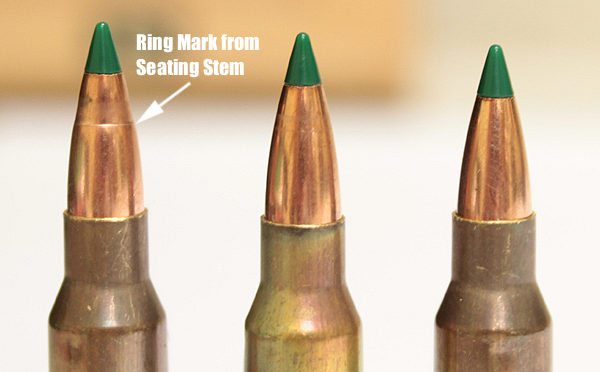
Here’s a helpful hint for hand-loaders from Sierra Bullets. While this article focuses on Sierra’s new Tipped Match-King bullets, the recommended solutions apply to other bullet types as well. The article explains how sharp edges on a seating stem can cause a ring to be pressed into the bullet jacket — especially with compressed loads that resist downward bullet movement. Here Sierra technician Rich Machholz diagnoses the problem and provides a solution.
Solutions for Ring Marks Caused by Seating Stems
by Sierra Bullets Ballistic Technician Rich Machholz
Now that the new Tipped MatchKing® (TMK) bullets are being shipped and shooters are putting them to use I have received several calls regarding marking on the bullet ogive from the seating stem.
The cause can be traced to one of several things.
In the .223 and especially with the long, 77 grain TMK seated at 2.250” or even 2.260” most loads of Varget® and Reloder® 15 are compressed loads, sometimes heavily compressed. This puts a great deal of pressure on the bullet through the seating stem. The result of all this pressure is a mark of varying depth and appearance on the ogive of the bullet. [Editor: We have seen this issue with a variety of other bullet types/shapes as well, including non-tipped VLDs. The solution is profiling the internal cone of the seating stem to match your bullet shape.]
Some older seating stems might even bear against the tip of the bullet which can make a slight bulge in the jacket just below the junction of the resin tip and the copper jacket in a compressed load. If this is the case there is not a ready fix other than calling the die manufacturer and requesting a new deeper seating stem.
Polish Your Seating Stem to Remove Sharp Internal Edges
If the seating stem is of proper depth the culprit most generally is a thin sharp edge on the inside taper of the seating stem. This is an easy fix that can be accomplished by chucking a spare 77 grain bullet in your drill, coating it with valve grinding compound or even rubbing compound or in a pinch even tooth paste.* Remove the seating stem assembly from the seating die. Turn the drill on and put the seating stem recess over the spinning bullet with the polishing compound to break or smooth the sharp edge that is making the offending mark. This might take more than one application to get the proper polish depending upon what you use, but the more you polish the better the blend of angles which will [ensure the stem matches the bullet contours, not leaving a sharp ring].
If the above is a little more than you care to tackle you might try very fine emery cloth twisted to a point that can be inserted into the mouth to the seating stem and rotated to polish the inside to eliminate any sharp edges that might be present.
Load Advice for 77gr TMKs in the .223 Rem
And last but certainly not least. Actually, even though we don’t say you need additional data for the TMKs, remember you are dealing with heavily-compressed loads in some cases because of the additional bullet length. Due to the additional length of these new bullets and in the interest of gaining some room in the case you might consider trying a slightly faster extruded powder like BenchMark or the 4895s or an even more dense powder like the spherical H335®, CFE223 or TAC. The extra room will allow for trouble free bullet seating also.
Good luck and remember we are no further away than your telephone: 1-800-223-8799.
The 50th Edition of the Lyman Reloading Handbook is here — and it’s bigger and better than ever. This 50th Anniversary Edition, the first to be produced in full color, includes more load data, and covers more cartridge and bullet types than ever before. This handbook has a strong heritage, starting with the Ideal reloading manuals from the early 20th Century. For more than a century the Ideal Handbook (and later) Lyman Handbooks have been popular and reliable data sources for hand-loaders. (In 1925, Lyman purchased Ideal Reloading Products, which produced the Ideal reloading handbooks.)
View Lyman 50th Anniversary Handbook at the NRA Annual Meeting in Louisville
The full-color Lyman 50th Edition will be available for the first time at the upcoming NRA Annual Meeting in Louisville, Kentucky on May 19-22, 2016. The Hardcover Edition (item #9816050) is priced at $39.98, while the Softcover Edition (item #9816051) retails for $29.98. Notably, Lyman will donate $1.00 to the NRA for every Lyman 50th Edition Reloading Handbook sold during the first year of its publication.
Lyman 50th Edition Handbook Features and Highlights:
There’s an all-new book from Applied Ballistics. Modern Advancements in Long Range Shooting – Volume II, is now available for pre-order from the Applied Ballistics eStore. This 356-page hardcover resource is chock full of information, much of it derived through sophisticated field testing. The pre-order price is $34.95, $5.00 off the regular $39.95 price. The books are expected to ship in July, 2016.
AUDIO FILE: Bryan Litz Talks about Modern Advancements in Long Range Shooting, Volume 2. (Sound file loads when you click button).
Volume II of Modern Advancements in Long Range Shooting contains all-new content derived from research by Applied Ballistics. Author Bryan Litz along with contributing authors Nick Vitalbo and Cal Zant use the scientific method and careful testing to answer important questions faced by long range shooters. In particular, this volume explores the subject of bullet dispersion including group convergence. Advanced hand-loading subjects are covered such as: bullet pointing and trimming, powder measurement, flash hole deburring, neck tension, and fill ratio. Each topic is explored with extensive live fire testing, and the resulting information helps to guide hand loaders in a deliberate path to success. The current bullet library of measured G1 and G7 ballistic coefficients is included as an appendix. This library currently has data on 533 bullets in common use by long range shooters.
Bryan tells us that one purpose of this book is to dispel myths and correct commonly-held misconceptions: “Modern Advancements in Long Range Shooting aims to end the misinformation which is so prevalent in long range shooting. By applying the scientific method and taking a Myth Buster approach, the state of the art is advanced….”
Bullet Dispersion and Group Convergence
Part 1 of this Volume is focused on the details of rifle bullet dispersion. Chapter 1 builds a discussion of dispersion and precision that every shooter will benefit from in terms of understanding how it impacts their particular shooting application. How many shots should you shoot in a group? What kind of 5-shot 100 yard groups correlate to average or winning precision levels in 1000 yard F-Class shooting?
Chapter 2 presents a very detailed investigation of the mysterious concept of group convergence, which is the common idea that some guns can shoot smaller (MOA) groups at longer ranges. This concept is thoroughly tested with extensive live fire, and the results answer a very important question that has baffled shooters for many generations.
Part 2 of this Volume is focused on various aspects of advanced hand-loading. Modern Advancements (Vol. II) employs live fire testing to answer the important questions that precision hand loaders are asking. What are the best ways to achieve MVs with low ES and SD? Do flash hole deburring, neck tension, primer selection, and fill ratio and powder scales sensitivity make a difference and how much? All of these questions are explored in detail with a clear explanation of test results.
One of the important chapters of Part 2 examines bullet pointing and trimming. Applied Ballistics tested 39 different bullet types from .224 through .338 caliber. Ten samples of each bullet were tested for BC in each of the following configurations: original out of the box, pointed, trimmed, pointed and trimmed. The effect on the average BC as well as the uniformity in BC was measured and tabulated, revealing what works best.
Part 3 covers a variety of general research topics. Contributing author Nick Vitalbo, a laser technology expert, tested 22 different laser rangefinders. Nick’s material on rangefinder performance is a landmark piece of work. Nick shows how shooters can determine the performance of a rangefinder under various lighting conditions, target sizes, and reflectivities.
Chapter 9 is a thorough analysis of rimfire ammunition. Ballistic Performance of Rifle Bullets, 2nd Edition presented live fire data on 95 different types of .22 rimfire ammunition, each tested in five different barrels having various lengths and twist rates. Where that book just presented the data, Chapter 9 of this book offers detailed analysis of all the test results and shows what properties of rimfire ammunition are favorable, and how the BCs, muzzle velocities and consistency of the ammo are affected by the different barrels.
Chapter 10 is a discussion of aerodynamic drag as it relates to ballistic trajectory modeling. You will learn from the ground up: what an aerodynamic drag model is, how it’s measure and used to predict trajectories. Analysis is presented which shows how the best trajectory models compare to actual measured drop in the real world.
Finally, contributing author Cal Zant of the Precision Rifle Blog presents a study of modern carbon fiber-wrapped barrels in Chapter 11. The science and technology of these modern rifle barrels is discussed, and then everything from point of impact shift to group sizes are compared for several samples of each type of barrel including standard steel barrels.
The last half-inch or so of your barrel is absolutely critical. Any damage (or abnormal wear) near the crown will cause a significant drop-off in accuracy. Here are ways you can check the end of your barrel, using a common Q-Tip.
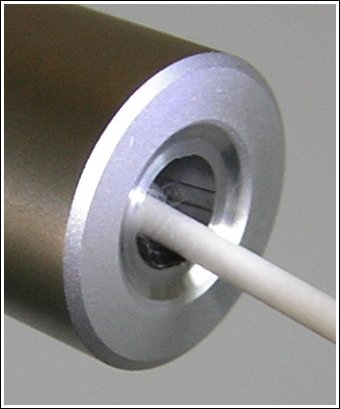
Use Q-Tip for Barrel Inspection To find out if you have a burr or damage to your crown, you can use an ordinary Q-tip cotton swab. Check the edges of the crown by pulling the Q-tip gently out past the edge of the crown. If you have a burr, it will “grab” the cotton and leave strands behind.
Larry Willis has another way to use a Q-Tip: “Here’s a neat trick that will surprise you with how well it works.” Just insert a Q-Tip into your barrel (like the picture below), and it will reflect enough light so that you can get a real good look at the last half inch of rifling and the crown of your barrel. In most cases you’ll find that this works much better than a flashlight. Larry tells us: “I’ve used this method about a jillion times. Q-Tips are handy to keep in your cleaning supplies anyway. This is a good way to judge approximately how well you are cleaning your barrel when you’re at the range. It’s also the best way to examine your barrel when you’re in the field.”


 Readers who have just recently discovered the Daily Bulletin may not realize that AccurateShooter.com has hundreds of reference articles in our archives. These authoritative articles are divided into mutiple categories, so you can easily view stories by topic (such as competition, tactical, rimfire, optics, shooting skills etc.). One of the most popular categories is our Technical Articles Collection. On a handy index page (with thumbnails for every story), you’ll find over 120 articles covering technical and gunsmithing topics. These articles can help you with major projects (such as stock painting), and they can also help you build more accurate ammo. Here are five popular selections from our Technical Articles archive.










 What is the most-used piece of equipment on this editor’s reloading bench? No it’s not my Rock-Chucker press, or even my calipers. The one item in near-constant use is a small, folding magnifying glass. Mine folds into a square case and offers 4X viewing with an 8X bifocal insert. With this handy tool I can inspect case mouths for burrs, check primer pockets, inspect meplats, and look for flaws on bullet jackets. I also use the magnifier to see rifling marks on bullets seated into the rifling, or check my bolt for galling. The number of uses is nearly endless. I keep one magnifier at my reloading bench and another in my range kit.
 At SHOT Show, we had the chance to meet with German software engineer Hartmut Broemel, creator of QuickLOAD software. This software program, while not a substitute for conventional load manuals, allows shooters to evaluate a wide range of powders and bullets, comparing potential loads on the basis of predicted pressures, velocities, load density and projectile in-barrel time.







 Part 2 of this Volume is focused on various aspects of advanced hand-loading. Modern Advancements (Vol. II) employs live fire testing to answer the important questions that precision hand loaders are asking. What are the best ways to achieve MVs with low ES and SD? Do flash hole deburring, neck tension, primer selection, and fill ratio and powder scales sensitivity make a difference and how much? All of these questions are explored in detail with a clear explanation of test results.
 To find out if you have a burr or damage to your crown, you can use an ordinary Q-tip cotton swab. Check the edges of the crown by pulling the Q-tip gently out past the edge of the crown. If you have a burr, it will “grab” the cotton and leave strands behind.


