Two New England gun-making facilities will soon close their doors. The operations of both Bushmaster (Maine) and Thompson/Center Arms (New Hampshire) are being relocated to other facilities owned by their respective corporate parents.
Bushmaster Plant in Maine to Close
First, the Freedom Group, which owns Remington, Bushmaster, Marlin and other companies, announced that it will close Bushmaster’s Windham, ME facility, “effective March 31, 2011″. According to an official press release: “The Company will relocate manufacturing of all Bushmaster products currently produced at Windham to other, existing Freedom Group Facilities. The move will have no impact on customers or the existing supply base.” John B. Blystone, Chairman of the Freedom Group’s Board of Directors, commented: “We are continuing to adjust our operations in order to remain competitive…. Given increasing costs and pricing pressures affecting the entire firearms industry, this action is clearly necessary[.]”
T/C New Hampshire Facility To Be Phased Out
Smith & Wesson, parent of Thompson/Center Arms (T/C), is pulling the plug on T/C’s Rochester, New Hampshire operation. The Rochester factory will be phased out starting in January 2011, and finishing before the end of next year (2011). T/C production will be switched to Smith & Wesson’s Springfield, MA facility. Some workers may be relocated, but most will lose their jobs. According to S&W Mktg. Service Director Paul Pluff: “We needed to streamline in order to make our company more efficient and profitable.” S&W Human Resources VP Bill Lachenmeyer explained that the plant closure was due to a big decline in T/C sales over the last three years. S&W invested heavily in the new line of T/C Icon hunting rifles but the Icons didn’t sell well. Likewise sales of T/C’s signature Encore and Contender tilt-breech hunting pistols declined in the economic downturn.
Jonathan Ocab, a High Power shooter from California, had gunsmith Doan Trevor install a Sako-style extractor in the Rem 700 bolt in Ocab’s 6mmBR Eliseo R5 tubegun. Jonathan produced an excellent video showing how the Sako extractor improves the ejection of the short, fat 6mmBR cartridges in his rifle. Jonathan’s video demonstrates 6mmBR case ejection with an unmodified Rem 700 factory bolt versus a factory bolt fitted with a Sako-style extractor.
Johnathan explains: “Note how even when slowly operating the bolt, the bolt with the Sako extractor easily ‘kicks’ out the brass on ejection with minimal chance of operator error resulting in a failure to extract. While the unmodified bolt has issues ejecting brass on slow operation, it will eject if the operator pulls the bolt back quickly (fast and with some force).
While a Sako-style extractor isn’t an absolute necessity, this video shows the definite improvement this modification provides. For short cartridges like the 6mmBR, this is very useful. This modification is highly recommended for competition shooters, especially High Power competitors who seek improved function in rapid-fire stages. This modification is fairly inexpensive and any competent gunsmith should be able to perform the work (usually under $100 with parts and labor).”
EDITOR’s NOTE: In his video, Jonathan deliberately worked the unmodified Remington bolt slowly to show how the standard Rem extractor can struggle with short fat cases like the 6mmBR. In fact, when you work a standard, unmodified bolt more quickly, the extraction can be much more positive. Cycling the bolt with more “snap” provides more energy to eject the cases. We have run an R5 Tubegun chambered in 6mmBR with an unmodified Rem 700 bolt (no SAKO extractor), and the extraction was reliable, provided the bolt was worked quickly.
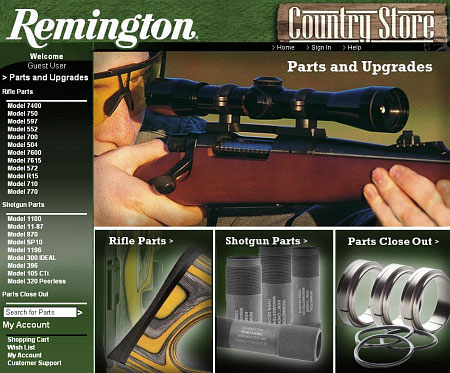
Need parts for your Remington rifle or shotgun? You can spend hours searching around the web for a few hard-to-find parts… OR you can simply go straight to the source, Remington’s online Parts Store. Remington now operates a modern, searchable online store selling parts for Rem 700 rifles and actions, plus parts for other Remington rifles and shotguns.
Prices are pretty good too. An ejector spring is just $3.20. Likewise a stainless, hex front guard screw is just $3.20. Bigger components are offered as well. Stainless Long Action BDL bottom metal is $82.00, and you can purchase a complete Rem 700 firing pin assembly for $52.00. All cataloged parts can be orderd quickly and easily with a secure shopping cart system. If you have questions about the parts you need, just call Remington’s toll-free customer service line, (800) 243-9700.
On October 20th, CNBC plans to air a television “exposé” about Remington Arms. The hour-long show argues that there may be a safety issue associated with the Remington 700 series of rifles. We haven’t viewed the show yet, but Jim Shepherd of The Shooting Wire is familiar with its contents. Jim, a veteran journalist, recently wrote a cogent commentary on CNBC’s “investigation” of Remington. Given the important insights Jim reveals, his commentary is well worth reading.
Yesterday morning, I received a promotional piece from CNBC, touting an hour-long investigation into America’s largest firearms company. The promo piece teases “Remington Under Fire: A CNBC Investigation” a story that CNBC says will “take viewers inside a 10-month investigation of the world’s most popular hunting rifle and examines whether a company has gone too far in protecting their signature product.” That product being the Model 700 bolt-action rifle. With more than five million sold, it is hard to argue its domination of the bolt-action rifle market.
It’s hard to argue with the idea that a serious safety defect — especially if it was deliberately downplayed-could cause serious repercussions.
Having spent nearly three decades in journalism, when someone says their exclusive “examines” rather than “exposes” — my first impression is always that the story didn’t come to the conclusion they’d presumed, so they’re leaving plenty of wiggle room in the story by “examining the question” rather than “answering it”. That doesn’t say it’s not interesting, whatever the conclusion.
According to the release, CNBC Senior Correspondent Scott Cohn traveled from Florida to Alaska, uncovering numerous complaints about Remington’s 700 model rifle. The most intriguing fact is Cohn’s having “tracked down” 98-year-old Mike Walker, the Remington engineer who designed the trigger for the Remington 700. The report purports to have an interview — and internal memorandums from Walker — that indicate he had repeated safety concerns about the trigger system — even after he left the company.
Video teasers for the program, however, don’t show Walker. Instead, they show Jack Belk “gunsmith, former cop” and expert witness in a variety of lawsuits against Remington. In the soundbite — admittedly designed to titillate, not answer questions — Belk says “no gun should fire unless the trigger is pulled.”
Not exactly the building of a rock-solid case. But in many cases — especially those tried in the fickle court of public opinion — emotion will trump logic.
I’ve not spoken to anyone at Remington regarding the reports — and CNBC says Remington only responded to their interview requests in writing.
For Remington, that’s prudent business practice. From CNBC, it’s couched as to leave the impression that a lack of willingness to go on camera and talk about six decades of business practices indicates there’s something to hide.
That’s not the case — it is impossible for current management to have first-hand knowledge of anything that happened nearly six decades ago. Consequently, when you don’t know what to say, the best thing to say — especially in a television interview — is nothing.
Remington Under Fire is scheduled to air on October 20. We’ll be watching and at that time, Remington officials will be offered the opportunity to respond to the program.
A while back, Forum member Andy (aka GrayMist) did an interesting test, with five (5) different types of .243 Winchester Brass. He collected Federal, Lapua, Remington, and two different lots of Winchester-brand brass. Then he selected ten (10) cases at random from each brand and measured their weights. To ascertain case capacity, three (3) cases from each brand/lot that were closest to the average weight for that brand/lot were selected. The results were surprising: there was less than one (1) grain capacity difference between all the cases, even with a 14.7 grain maximum difference in case weight!
Measuring Procedures
The cases were sized in a Redding body die then primed with a spent primer. All were weighed before and after filling them with distilled water. The capacity shown is an average of all three (3) cases from that lot and represents grains of water. Note, I tested two lots of Winchester brass. Lot A was purchased in 1999. Lot B was from factory .243 ammo. There is a rather large disparity in case weight between the two lots.
Brand
Federal
Lapua
Remington
Winchester A
Winchester B
Capacity
53.9
54.4
53.7
54.8
54.8
Aver. Weight
173.28
173.13
165.34
158.58
166.44
SD¹
0.46
0.39
0.17
0.58
0.42
Range²
1.70
1.10
0.40
1.80
1.40
% of Avg.³
0.98%
0.64%
0.24%
1.14%
0.84%
1) Standard Deviation in grains.
2) Range is the difference in weight between the heaviest and lightest cases in the test.
3) Case range weight divided by the average weight.
What the Numbers Mean … And Some Speculations
Andy observes: “It certainly seems there is a huge difference in case weight between Winchester lot A and any other brand of 243 tested. What is also surprising is that there was less than one (1) grain capacity difference between all the cases, even with a 14.7 grain difference in case weight!
Should one be wary of trying the same loads that were initially tested in the light weight Winchester brass even though the capacity difference is small? I have had some interesting results with one brand brass that I cannot pass on yet, except to say I sent that company a sample of the lot I have been using. The Remington brass weight range was very low. These were taken from a box of once-fired factory ammo. I will have to acquire some more and measure it.”
Results of Larger Lapua Sample
In a previous session Andy weighed all 100 Lapua cases he had on hand. His measurements showed a total variation of 2.1 grains, with the weight range being 172.5 to 174.6 grains. That is a 1.2 percent spread. The most that came in at the same weight were 11 cases at 173.5 grains.
In Saturday’s Remington Band of Brothers (BOB) match and Mustin Trophy match, class winners from each relay go into a shoot-off. Each relay’s top shooter from the Any Sight, Palma Rifle, and Service Rifle categories then lines up against the other relay winners in their class. The course of fire for the shoot-off was ten shots in thirteen minutes.
Gallagher vs. Whidden in “Sudden-Death” Shoot-out
A major drama unfolded at the end of the regular shoot-off in the Remington BOB match, as “Any Sights” competitors Michelle Gallagher and John Whidden were locked in a tie. Michelle and John had both shot 100-8x. Now, to decide the winner, a “sudden death” shot-for-shot rifle duel took place to determine the class winner. The crowd tensed as both shooters went to the line.
Both Michelle and John proceeded to hit 10s (or Xs) for the first twelve (12) shots. Then it was unlucky #13 for John. Whidden’s 13th shot was a nine, against Michelle’s ten. That gave Michelle the Remington Band of Brothers match Any Sight Class victory, but onlookers congratulated both shooters.
John Whidden redeemed himself later in the day, winning his “Any Sight” Class in the Mustin Trophy shoot-off. John posted a “best-in-class” 100-8x, making him the “Any Sight” winner. We talked to John after the match and he told us: “That was an exhausting day. Rain was forecast for the afternoon and some of the relays got heavy rain which increased the difficulty. Michelle shot great in the Band of Brothers Match, but I was pleased to come back and shoot steady for a Class win in the Mustin Match. Now we’ve got a lot of shooting ahead of us and I’ll try to stay up near the top.” John is shooting a .243 Winchester with moly 105gr Berger bullets.
In related news from Camp Perry, here are the preliminary scores for the three long range matches shot Sunday morning (August 15th). The course of fire was 20 shots, slow-fire prone at 1000 yards. The high-scoring competitor from each relay of each match will compete in the shoot-off held immediately after the the completion of the Herrick Trophy Team Match.
OutdoorDealHound.com is a new website offering special discounts and “bundled” outdoor gear bargains from popular manufacturers including Browning, Boyt Harness Co., Leupold, Mossberg, Remington, Weatherby, Sarge Knives, Thermacell and many more. If you’re looking for a good deal on scopes, firearms, gun cases, hunting gear, boots, tents, and more, check out OutdoorDealHound.com when it launches August 10, 2010.
OutdoorDealHound.com will offer more than 1,200 outdoor products. The site will also provide instant rebates, individually-tailored discounts, and bundled pricing based on the number and type of items a customer purchases and his/her demographic profile. Shoppers can identify discount opportunities by watching for icons, like dog bones, paws and padlocks. For example, the more dog bones displayed on an item’s page, the bigger the discount.
Looking to expand its share of the burgeoning market for tactical rifles, Remington has released a new Hogue-stocked Rem 700 variant with a 20″ barrel threaded for sound moderators (suppressors). Remington calls the new rifle the Model 700™ SPS™ Tactical AAC®-SD. (Somebody at Remington got carried away with the acronyms.) There’s nothing new or remarkable to be found in the gun’s internals. It’s pretty much a standard short-action Rem 700 with a 1:10″-twist heavy barrel chambered in .308 Winchester. The rifle does feature a Hogue® Overmolded Ghillie Green™ pillar-bedded stock, an upgrade over the inexpensive synthetic stocks on entry-level Rem 700s.
We generally like the build quality of the Hogue stocks, but some of our tactical testers have complained that the over-molded design is a bit flexy compared to a McMillan or Manners tactical stock. If you’re planning to use the rifle for mostly prone work, you’ll also want to add some sort of buttpad spacer system to allow length-of-pull adjustment. MSRP for the SPS Tactical AAC-SD is $757.00.
With the Cerberus-owned Freedom Group family of companies preparing for an IPO later this year, industry experts wondered: “Will Cerberus purchase a handgun manufacturer, or launch a line of Remington handguns?” With the announcement of the new Remington 1911 R1 pistol, Cerberus has showed its hand. The new 1911 R1 is the first pistol Remington has produced in decades, and the first 1911-design in 91 years.
Remington’s 1911 R1 is featured in the current issue of Shooting Times (left). A blued-steel retro design, the Remington 1911 R1 is faithful to the 1911 A1 with some modern upgrades. Like the original 1911, Remington’s R1 has a flat mainspring housing, internal extractor, short trigger and double diamond grips. Modern enhancements include a flared ejection port, beveled magazine well, loaded chamber indicator, tall single-dot front and two-dot rear sights, and a black-oxided stainless barrel. The 1911 R1 also has a Series 80-style firing pin block safety.
Classic Lines with Some Modern Features
From a subjective standpoint, this Editor likes the looks of Remington’s 1911 R1 and I favor some of its design features. I personally can shoot 1911s better with the short trigger, and I prefer the clean look of a slide without forward serrations. However, I question the decision, based on styling, to use an internal extractor, and the tall blocky sights look somewhat out of place on a retro-styled 1911. However, the big sights will unquestionably help the gun’s shootability.
Remington’s 1911 R1 will be officially launched at the NRA Annual Meeting in NC in May. The gun, which is made in Remington’s Ilion, NY facility, should be available in June, 2010, and dealers are already taking advance orders. The Remington 1911 R1 will be shipped in a custom carry case with two 7-round magazines and a barrel bushing wrench (see photo below). Suggested retail price is $699.00.
Do We Need Yet Another 1911?
It’s easy to be cynical about Remington’s entry into the 21st-century handgun market. Rather than give us something new and really remarkable, Remington merely recycled the tried and trued 1911, a design that is already produced by dozens of companies. Do we really need yet another 1911? One clever gun writer joked: “‘1911′ is supposed to be the model name, not the number of companies building versions of it.” Does Remington bring anything to the marketplace that one can’t buy elsewhere? Well, 1911 fans like the pricing of Remington’s 1911, predicting it will sell very well at the $700.00 mark. And Remington does have a history of producing 1911 handguns for the U.S. Military — Remington-UMC built 21,677 1911s for the U.S. Ordnance Dept. in 1918.
But still, one wonders how much market share Remington will grab from Kimber, Springfield Armory, Smith & Wesson, Les Baer, STI, Wilson Combat, USFA and other proven 1911-makers. Is Remington too late to the party with its retro-styled 1911 R1? Would it have been better for Remington to launch an all-new pistol design that creates a whole new market segment, as did Glock and Keltec? If Remington wants to become a major player in the pistol market, wouldn’t it have been better to engineer a more modern pistol that could compete for lucrative LEO and military pistol markets? Perhaps the answer to these questions is that Remington simply took the cheap and easy route — producing a pistol that required minimal engineering and testing. As ToddG writes on the Pistol-training.com Blog: “Building a 1911 is just a lazy way to enter the handgun market. There is little design and testing needed compared to making something new from scratch. Pick a design, build some prototypes, do a little testing to make sure the CNC machines are set right, and start pumping out guns.”
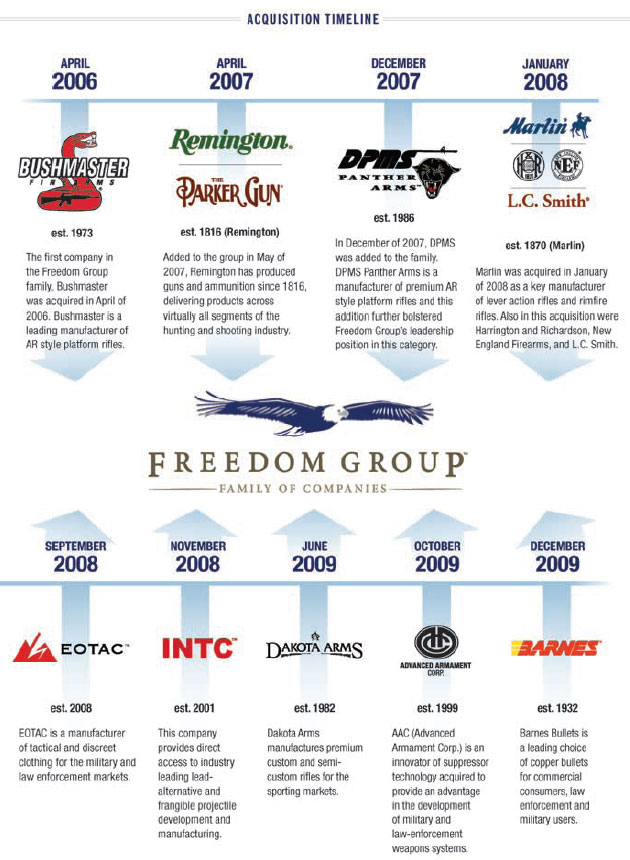
Want to own a piece of Remington? And throw in Bushmaster, Marlin, DPMS, H&R and EOTAC for good measure? Well you may have your chance later this year. The Freedom Group, a holding company owned by Cerberus Capital Management, is planning to “go public”. Last fall, the Freedom Group filed a preliminary S-1 prospectus with the SEC. This launched the process of regulatory approvals needed for a Freedom Group public offering. Three weeks ago, the Freedom Group filed an amended S-1 in preparation for an IPO in the second half of 2010.
We’ve all been watching the Freedom Group gobble up one firearms-maker after another over the past few years, building the colossus of the gun industry. (See Acquisition Timeline.) Now the Freedom Group claims to be “the largest manufacturer of commercial firearms and ammunition” in the world. The Freedom Group conglomerate includes more than a dozen leading brands: Advanced Armament, Barnes Bullets, Bushmaster Firearms, Dakota Arms (including Miller Arms and Nesika), DPMS/Panther Arms, EOTAC, INTC, Marlin (including H&R, New England Firearms and L.C. Smith), and Remington Arms. With its series of acquisitions (most recently Advanced Armament and Barnes), the Freedom Group has become a dominant player in the Shooting Sports and Security Industries. In its SEC Filings, the Freedom group declared $54.5 million in net income on $848.7 million in net sales.
When will the Freedom Group launch its IPO and how much will shares cost? That information has not yet been revealed, but documents filed so far definitely point to a public offering sometime this year. Will buying shares in the Freedom Group prove a good investment? Well if you had bought gun company stocks immediately after the November 2008 election you could have tripled your money. However, some experts say Cerberus’ decision to take the Freedom Group public indicates that the “blush is off the rose” and the gun industry may be facing lean times ahead, with reduced profit potential and slower growth. For cynics, the IPO announcement confirms that Cerberus plans to “take the money and run” — disposing of the Freedom Group before its profitability declines.


 Bushmaster Plant in Maine to Close
 T/C New Hampshire Facility To Be Phased Out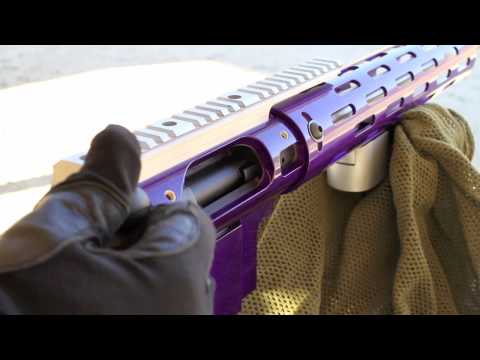



 It’s hard to argue with the idea that a serious safety defect — especially if it was deliberately downplayed-could cause serious repercussions.
 What the Numbers Mean
 In Saturday’s Remington Band of Brothers (BOB) match and Mustin Trophy match, class winners from each relay go into a shoot-off. Each relay’s top shooter from the Any Sight, Palma Rifle, and Service Rifle categories then lines up against the other relay winners in their class. The course of fire for the shoot-off was ten shots in thirteen minutes.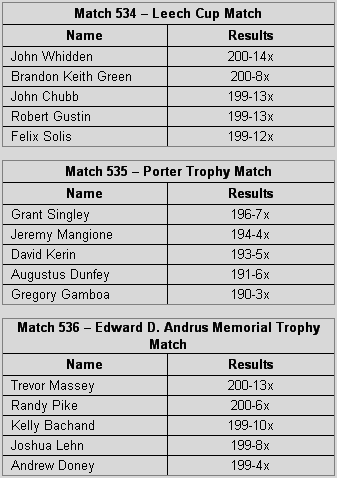


 With the Cerberus-owned
  Classic Lines with Some Modern Features
 Want to own a piece of Remington? And throw in Bushmaster, Marlin, DPMS, H&R and EOTAC for good measure? Well you may have your chance later this year. The