|
|
July 13th, 2009
Powder Valley Inc. (PVI) reports that it is scheduled to receive twenty thousand (20,000), 1000-count boxes of Wolf primers this Wednesday, July 15th. PVI staffers don’t know the exact distribution of primer types, but the large shipment should include small rifle, small rifle magnum (recommended for 6BR and 6-6.5×47), large rifle, and large rifle magnum, as well as pistol primers.
You may want to call Powder Valley, 1- 800-227-4299, and place your orders right away. We can’t predict how long Wolf primer supplies will last. Just last week Powder Valley received a shipment of CCI primers and they were gone in two days.

July 12th, 2009
 The 2009 NRA National Championships at Camp Perry, Ohio kick off tomorrow, July 13th.13th with the First Shot Ceremony. This week, pistol competitors vie for top honors, and then smallbore matches begin on July 22. Our Daily Bulletin will report on highlights of the rifle matches. In addition, the NRA Blog has sent reporters to Ohio to provide regular, day-by-day Blog coverage of the National Matches, from start to finish. Here is a schedule of major events: The 2009 NRA National Championships at Camp Perry, Ohio kick off tomorrow, July 13th.13th with the First Shot Ceremony. This week, pistol competitors vie for top honors, and then smallbore matches begin on July 22. Our Daily Bulletin will report on highlights of the rifle matches. In addition, the NRA Blog has sent reporters to Ohio to provide regular, day-by-day Blog coverage of the National Matches, from start to finish. Here is a schedule of major events:
- July 13: First Shot Ceremony
- July 14-18: NRA Pistol Matches
- July 22-25: NRA Smallbore 3-Position Matches
- July 26-30: NRA Prone Smallbore Matches
- August 9: Whistler Boy High Power Rifle Match & NRA/Springfield M1A Match
- August 10-14: NRA National High Power Rifle Matches
- August 15-19: NRA Long Range Matches
The National Matches, considered America’s “World Series of the Shooting Sports”, have been a tradition at Camp Perry, Ohio since 1907. Each summer, the nation’s finest civilian and military marksmen and women square off for five weeks of rifle and handgun competition in a variety of formats and events. For complete match results, visit the NRA National Championships webpage. You’ll also find lots of helpful information on the CMP National Match Index Page. This includes a detailed calendar, Match Rules, and Online Event Registration.
June 18th, 2009
 DATELINE: June 18, 10:40 am Pacific Time DATELINE: June 18, 10:40 am Pacific Time
Here is an important product update. Sinclair International received a shipment of Sellier & Bellot rifle primers on June 15. These are good non-corrosive boxer primers made by a respected Czech munitions-maker. As of June 18, 10:30 am Pacific time, Sinclair has the following quantities of Sellier & Bellot rifle primers in stock:
S&B Sm Rifle Primers (item 25-8000): $33.60 per 1,000-ct box — 165 boxes in stock.
6/22/09 UPDATE: Sm Rifle SOLD OUT
S&B Lg Rifle Primers (item 25-8100): $36.40 per 1,000-ct box — 455 boxes in stock.
6/22/09 UPDATE: 150 boxes Lg Rifle remaining
Sinclair tells us: “The primers are leaving fast so if you need large or small rifle primers or know someone who does we have some at the moment. Visit our website at Sinclairintl.com to check availability or call 1-800-717-8211. We have more large rifle primers than small rifle primers. Please limit yourself to 5,000 primers since many of your fellow shooters are without any primers at the present time.”

June 17th, 2009
Victoria Croft, the national manager of Collegiate & School Programs for the NRA, has announced a new program that could make its debut as early as next year: the NRA Intercollegiate Rifle Club Championship.

This new championship would be geared toward ALL collegiate rifle shooters, encompassing NRA College Rifle Clubs, Varsity Rifle Teams, NCAA Rifle Teams, ROTC and independent shooters. Currently there is no championship for NRA College Club participants, Varsity Rifle Team participants, or independent college-age rifle competitors. Croft said this would give them the chance to be represented.
New Rifle Championship Triples Participation Levels
Presently, the NCAA Championship invites only 48 NCAA rifle shooters to participate each year. The proposed NRA championship will triple championship participation and help foster collegiate rifle programs across the nation. Qualification for the Championship would be determined through NRA Collegiate Sectionals.
 Funding for this championship would come from the NRA Foundation, the same program that funds the NRA Intercollegiate Pistol Championships and the ACUI Clay Target Championships. The proposed Intercollegiate Championship would include a training summit similar to the one offered at the NRA Junior Air Gun Championship. Funding for this championship would come from the NRA Foundation, the same program that funds the NRA Intercollegiate Pistol Championships and the ACUI Clay Target Championships. The proposed Intercollegiate Championship would include a training summit similar to the one offered at the NRA Junior Air Gun Championship.
The NRA Intercollegiate Rifle Championship will also teach college shooters about various NRA programs and let shooters demonstrate their skills in front of peers, families, coaches, and university administrators. “This program has been a long time coming,” said Victoria Croft. “So much of the rifle community is already excited, and we have only just started planning for it.”
Story and photo courtesy the NRA Blog.
December 29th, 2008
Free Recent Sample Issues to Review
Wolfe Publishing offers FREE downloadable partial samples of recent issues of Rifle Magazine. Click the links below to view the Jan/Feb 2009, and Nov/Dec 2008 issues. (Note: these are fairly large, 4-5 megabyte .pdf files that will take some time to download.) The Nov/Dec ’08 issue has a nice article on a Kimber model 8400 “tactical” rifle in .308 Winchester. This gun, fitted with a McMillan stock, delivered true half-MOA accuracy with Federal Gold Match ammo.

CLICK HERE for Jan/Feb 2009 (partial issue) | CLICK HERE for Nov/Dec 2008 (partial issue)
July 28th, 2008
Bill Shehane has a new version of his MBR Tracker stock. This features a longer, deeper, and wider fore-end for added stability and more resistance to torque with the heavy calibers. Called the MBR ‘Big Dawg’, this stock is cut 4″ longer than a standard Shehane ST-1000 Tracker. This provides a “longer wheelbase” for better balance with very long (30″+) barrels. (The ST-1000 itself is 3″ longer than most benchrest stocks.) The Big Dawg is available with a 4″-wide or 5″-wide forearm, and will handle barrels up to 40″ in length and 1.5″ in diameter. In the top photo, taken by Forum member Preacher, you see a 4″-wide Big Dawg next to a normal ST-1000 Tracker. (Both stocks are symmetrical; there is distortion caused by wide-angle lens.)


This color pattern is what Bill calls “Prairie Dog Camo”, a Rutland laminate in orange and dark gray, with olive ‘accent’ layers. The price for a ‘Big Dawg’ in Rutland laminate is $525. In African Obeche wood (any color choice), the price is $725.00. For more info, contact Bill Shehane at (704) 824-7511, or visit his website, www.ScopeUsOut.com.
July 24th, 2008
 Up-to-date results of the NRA National Rifle & Pistol Championships are available online at the NRA website. The Pistol events are concluded, the Smallbore (rimfire) 3-position matches finished on July 18, and the Smallbore prone events will wrap up today, July 24. The High Power Rifle Championships commence August 4th. Up-to-date results of the NRA National Rifle & Pistol Championships are available online at the NRA website. The Pistol events are concluded, the Smallbore (rimfire) 3-position matches finished on July 18, and the Smallbore prone events will wrap up today, July 24. The High Power Rifle Championships commence August 4th.
CLICK HERE for current Camp Perry Results
Daily updates, complete with interviews with shooters, are being published on the new NRA BLOG. This blog, with daily entries from two correspondents at Camp Perry, features plenty of photos, late-breaking news, a full schedule of events, and links of special interest. You should check it out.

July 20th, 2008
Last week, the third annual Southern California Precision Rifle Competition (SCPRC) was held. This match takes place each year in July at the West End Gun Club, 20 minutes west of San Bernadino, CA. Match director Mark Archuleta, aka “Spaniard”, ran a great match, with a diverse and challenging course of fire. Mark reports: “This was our third SCPRC, and we had 34 shooters from all over the US.” Mark posted a match report in our FORUM with lots of photos. CLICK HERE to read Mark’s full report. Below are some pictorial highlights from the Match, with Mark’s commentary:
Vu Pham from Nor-Cal, shown below, hit both his cold bore shots on day 1 & 2. This year’s Day Two cold bore shot (CBS) reprised our 2006 CBS. There was a 3.5″ Clay pigeon set at about 325 yards, with roughly a 10° down angle. In 2006, 7 out of 22 shooters made the hit, this year 12 out of 34 shooters made the hit. Some folks don’t think that the 10°-15° slope makes a difference, but it does.

Below Phil demonstrates textbook bipod shooting: working the bolt, maintaining a solid cheek weld and keeping an eye on the next target. Good job Phil. [Editor’s Note: the “pucks” on the bipod legs are “PodPaws” from Zephyr Dynamics]

One of the stages was shot from a squatting position with rifle supported by saw-horses. This stage obviously favored the shorter guys.

The match included timed stages. The challenge was how to record times for multiple shooters. I purchased a timing system and did some modifications to it so each shooter had his own stop button. It worked great and I could shoot whole teams all at once. This made the lines move very fast. It’s will be a part of all my future matches, local and not so local. Below, just like on Jeopardy, Scott Cochran stops the clock.

At the request of Kurt Stone (LV Steel Targets), a standing stage was added. It’s not easy to shot a heavy tactical rifle off-hand! Here, representing the United States Marine Corp., is SSgt. Tony Palzkill — a real professional and a nice guy too.

May 9th, 2008
Eight years into the 21st century, it’s easy for us to assume that our “latest and greatest” gun stock designs truly represent the cutting edge of technology and innovation. We forget that some of the founding fathers of benchrest devised some pretty interesting designs decades ago.


 An intriguing piece of Benchrest history came up for sale on Gunbroker.com recently. This 25-lb “unlimited” benchrest rifle, chambered in .222 Remington, showcases many features that were ahead of their time. The action says “Al Weber of Lodi, Calif”, but it’s not clear whether Al built the unusual wood stock, or whether that was the brainchild of someone else. The action looks like it might be an early custom action. Perhaps our readers know more…. An intriguing piece of Benchrest history came up for sale on Gunbroker.com recently. This 25-lb “unlimited” benchrest rifle, chambered in .222 Remington, showcases many features that were ahead of their time. The action says “Al Weber of Lodi, Calif”, but it’s not clear whether Al built the unusual wood stock, or whether that was the brainchild of someone else. The action looks like it might be an early custom action. Perhaps our readers know more….
Forum member Dan Conzo notes: “View page 17 of the Ultimate in Rifle Precision (1958), by Whelen. Ralph Pride, a barrel-maker and competitor, is using a rifle that is a twin of this rifle. Pride also wrote highly of the Weber action. The round bottom action has heavy lugs, a wall thickness greater than any conventional action at that time, and an integral recoil lug, It has three guard screws (1/4 ” socket head type), and the one-piece trigger guard extends past the front guard screw. The top of action is what they called a strong back with the port held to a minimum and it has the squared off rear tang. This action seems to have spawned the older Hart actions and even the more modern actions by other makers of today.”

In the front is a metal sled with twin Delrin rails for improved tracking. Front rails have been used on 1K Heavy Guns for quite some time, but when rails like this were added to the underside of F-Class rifles that innovation was considered fairly radical.

In the rear is another tracking rail. Interestingly, the rear rail is a wide, “Twin Keel” or “catamaran” design. Presumably this twin keel design enhances stability while reducing friction. That’s a design we’ve just started to see on short-range BR rifles, and it has been hailed as “highly innovative”.
We wanted to showcase this Vintage BR rifle, to give credit to the early innovators. Our current high-tech stocks and actions borrow from many of their design ideas.
CLICK HERE to View Gun Auction
March 25th, 2008
The last half-inch or so of your barrel is absolutely critical. Any damage (or abnormal wear) near the crown will cause a significant drop-off in accuracy. Here are ways you can check the end of your barrel, using a common Q-Tip.
Use Q-Tip for Barrel Inspection
To find out if you have a burr or damage to your crown, you can use an ordinary Q-tip cotton swab. Check the edges of the crown by pulling the Q-tip gently out past the edge of the crown. If you have a burr, it will “grab” the cotton and leave strands behind.
Larry Willis has another way to use a Q-Tip: “Here’s a neat trick that will surprise you with how well it works…
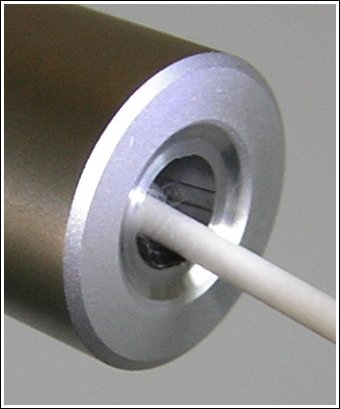
Just insert a Q-Tip into your barrel (like the picture below), and it will reflect enough light so that you can get a real good look at the last half inch of rifling and the crown of your barrel. In most cases you’ll find that this works much better than a flashlight. Since then, I’ve used this method about a jillion times. Q-Tips are handy to keep in your cleaning supplies anyway. This is a good way to judge approximately how well you are cleaning your barrel when you’re at the range. It’s also the best way to examine your barrel when you’re in the field.”
Larry Willis is the inventor of the unique Innovative Technologies Belted Magnum Collet Resizing Die. Larry explains how this die works, and offers many other useful reloading tips on his website, LarryWillis.com.
|


