|
|
July 2nd, 2010
 On June 19, the 4R Rifle Club in Alex, Oklahoma hosted its Spring Balloon Shoot. This challenging “fun shoot” drew nearly 50 competitors from five states. In this multi-yardage event, shooters try to break four balloons, one each at 100, 250, 400, and 500 yards. A total of 18 rounds were allowed. The balloons were worth 10, 20, 30, and 45 points respectively. Shooters attacked the balloons in 12 relays. Even with challenging winds, some impressive scores were fired. When the smoke cleared and all the competitors had tried their luck, only two had perfect scores of 420. Jim Fowler turned in a pair of 410s to win the Two-Gun award, youth winner Dalton Ernst shot a 390, and factory gun champ Don Johnson managed a 365 with his Savage 6BR. On June 19, the 4R Rifle Club in Alex, Oklahoma hosted its Spring Balloon Shoot. This challenging “fun shoot” drew nearly 50 competitors from five states. In this multi-yardage event, shooters try to break four balloons, one each at 100, 250, 400, and 500 yards. A total of 18 rounds were allowed. The balloons were worth 10, 20, 30, and 45 points respectively. Shooters attacked the balloons in 12 relays. Even with challenging winds, some impressive scores were fired. When the smoke cleared and all the competitors had tried their luck, only two had perfect scores of 420. Jim Fowler turned in a pair of 410s to win the Two-Gun award, youth winner Dalton Ernst shot a 390, and factory gun champ Don Johnson managed a 365 with his Savage 6BR.
Exciting Shoot-off Decides Match Winner
The top six shooters of the day returned to the bench with clean scorecards for the Shoot-off. They would repeat the same course as earlier in the day — one balloon each at 100, 250, 400, and 500 yards, with 18 rounds. Two competitors, Don Johnson and Rick Jensen, emerged from the Shoot-off tied, having both shot clean scores of 420. The balloons were set up again, only this time, Don and Rick were allowed just 8 rounds. Hard choices had to be made. Both men elected to start at 400 yards, breaking all four balloons before moving to 500, where both Don and Rick broke three. As a final tie-breaker, each man fired a single shot at a distance of 300 yards. When the targets were retrieved, Don Johnson prevailed as the Overall Champion, with Rick Jensen in second. Don was shooting a .243 Win, while Rick had a .284 Win; both guns featured Surgeon actions. Finishing 3rd, 4th, and 5th respectively were: Shane Herman, Jim Fowler (2-Gun Champ), and Arthur McMeans.

Top Ten Shooters’ Equipment List (in alphabetical order)

Match organizers offer special thanks to the many match sponsors who filled a rich prize table, and thanks to the Reeves family for hosting yet another great match at the 4R Rifle Club.
May 8th, 2010
Thanks to Savage’s signature barrel nut system, it’s easy for Savage rifle owners to swap barrels without gunsmith assistance. With a pre-fit barrel from Pac-Nor or Shilen you can easily re-barrel your rifle and set the headspace with go/no-go gauges. In addition to a barrel vise, you’ll need a specialized barrel nut wrench to swap Savage barrels. Now through 5/31/2010, MidwayUSA has the Wheeler Engineering Savage Barrel Nut Wrench on sale for just $22.99, marked down from $38.49 (a $15.50 savings — roughly 40%). For comparison, Brownell’s charges $47.90 for the Sharp Shooter Supply Savage barrel nut wrench.

The double-ended Wheeler Savage Barrel Nut Wrench (item #288765) allows easy removal of the barrel nut on Savage model 10, model 110, and model 12 series rifles. Made from 3/16″ steel, the Wheeler tool features two 1/2″ square drive holes for a swing bar or torque wrench.
April 12th, 2010
Last month we profiled the new, affordable Savage Edge hunting rifle. Though starting MSRP is just $329.00, this new Savage has many nice features, including a detachable box magazine, free-floated barrel, and handy thumb safety on the tang. The bolt copies the Savage 10/110 floating-head design and the Edge uses the familiar Savage barrel nut to secure the barrel and set headspace.

Jeff Quinn of Gunblast.com got his hands on the new Savage Edge. He was impressed with the gun, which he called “an excellent rifle at an amazing price.” Despite its low cost, Quinn’s test gun delivered sub-MOA accuracy with a variety of .243 Winchester factory loads: “Several [three-shot] groups were fired that measured under one-half inch, but the five-eighths inch group shown was typical for the day. No groups measured in excess of the magical one-inch mark.”
CLICK HERE to read complete Gunblast.com Review (many photos).
Overall, writer Jeff Quinn praised the Edge as a good, solid hunting rifle that offers great value: “There were no surprises in the handing of the Edge; it balances and handles very well. There were no surprises in the accuracy of the Edge; it shoots where you point it. There were no surprises in the reliability of the Edge; it fed, fired, and ejected perfectly. The surprise is in the price. As of this writing, the Edge has an MSRP of only $329 US. For only fifty bucks more, you can get the Edge with a 3 to 9 power scope already mounted and bore-sighted.”
March 31st, 2010
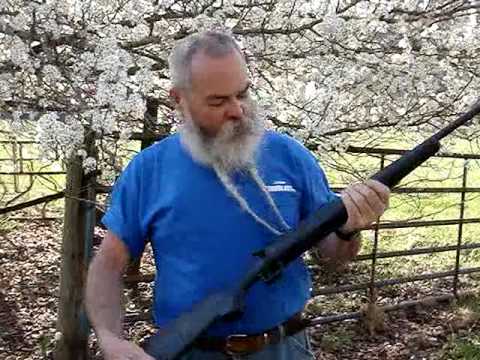
Savage Arms has released a new line of Savage EDGE centerfire rifles. This new platform was built from the ground up as an affordable entry-level rifle. The EDGE features a new modern look, and while it shares key features with its older brother the Model 110, it has a different receiver design.

Though the basic model has a low, $329.00 MSRP, the EDGE includes some nice features: detachable box magazine, pillar bedding, and 2-position safety. For $379.00, you can get the EDGE XP, which includes a 3-9×40 scope (mounted and bore-sighted). Factory camo versions are also offered in both basic and XP configurations.
The EDGE action is apparently long enough to handle both short and long cartridges. This “one size fits all” approach has been used on some recent European rifles as well. We were pleased to see that Savage is offering a wide variety of chamberings: 223 Rem, 22-250, 243 Win, 25-06, 270 Win, 7mm-08, 308 Win, 30-06 Springfield.
An Affordable Gun for a Tough Economy
The EDGE was conceived in January of 2009. At the time, Savage observed heavy activity at the entry level pricepoint from consumers as well as manufacturers. The poor economy created more interest in pricepoint hunting guns and key manufacturers were cutting already low prices even lower.
“We wanted to not only maintain our market share, but to grow it,” Savage VP of Sales & Marketing Brian Herrick said. “We felt the only way to accomplish this was to develop a new rifle designed for this segment, rather than discount current models. We wanted a rifle that not only had a lower price, but one that had better features and was more aesthetically appealing than what was out there at the time.”
January 28th, 2010
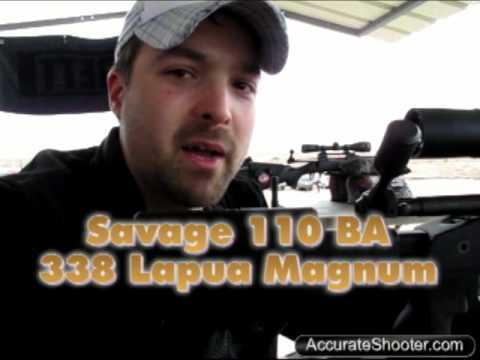
Savage Arms caused quite a stir at Media Day when it unveiled its new 110 BA big-bore tactical rifle. The 110 BA is initially available in two chamberings: 300 Win Mag, and .338 Lapua Magnum. The .338 version of this rifle is Savage’s first-ever .338 Lapua Magnum, and it is VERY affordable compared to .338 LM tactical rifles from other manufacturers. We predict this gun will be a big hit with shooters who want the long-range capability of the .338 Lapua Magnum cartridge but who don’t want to sell the farm to acquire a capable rifle. Once the initial demand settles down, you should be able to find a 110 BA for around $2000 (not including optics).

NOTE: Jason removed his eye protection for this photo. We recommend that shooters ALWAYS wear ANSI-certified eye protection.
The 110 BA gun comes complete with a detachable box magazine (DBM), target grip with base, a +20 MOA scope rail, and Picatinny accessory rails ahead of the action and on the side of the chassis. The stock has a comfortable cheekpiece that adjusts for height using a handy rotary knob. A similar knob controls the buttpad position, allowing you to “dial in” length of pull. As you’d expect, the 110 BA features a Savage Accutrigger.
CLICK HERE for large photo of Savage 110 BA (shows buttstock details)
On the gun we tested, the AccuTrigger broke clean and crisp under 2.5 pounds, with little overtravel. Fitted with an oversize bolt handle from the factory, the action was smooth in operation and effortlessly fed and extracted the big .338 LM cartridges. The gun demonstrated good accuracy with Hornady .338 Lapua Mag factory ammo, allowing Jason to make a first-round hit at about 800 yards. Jason liked the gun, telling us it “feels solid and well-balanced”. Jason did note that the large muzzle brake creates quite a side-blast. When this Editor was taking video, Jason warned me to get out of the way of the blast. I moved back behind the shooter, but even there, the brake’s blast could be felt.
Quality Big-Bore Tactical for under Two Grand
The 110 BA establishes a new, affordable price point for a true big-bore tactical rifle. Both the 300 Win Mag and the 338 Lapua Mag versions have an MSRP of just $2267.00. We expect to see the “street price” on these rifles peg below $2000.00. That makes the .338 LM version of the 110 BA one of the most affordable .338 Lapua magnum tactical rifles yet offered to the public.

January 19th, 2010
Savage Arms was well represented today at the SHOT Show’s “Media Day as the Range.” We saw and shot several new offerings from Savage (including a tactical rifle in 338 Lapua Magnum and a hunting weight 6.5-284). We’ll cover these centerfire Savages later this week. One of the new Savages we really liked was the model 93R17 TR, a slick little 17 HMR. It looks and feels like a full-sized centerfire tactical bolt-gun, it comes with an excellent stock and nice trigger, and it is both affordable and very accurate. (NOTE:v Savage is also offering 22LRs rimfires in the same stock, the MK II TR and TRR.)

 This rifle features an all-new, texture-painted wood stock with a very sound “tactical” design. It is well thought out, with good ergonomics, and offers options and design details that most rimfires do not. The stock features a moderate beavertail fore-end, a fairly vertical grip and a shallow butt-hook at the rear for support using the non-shooting hand. The black textured paint is very similar to the black painted finish on McMillan stocks (notice the texture in the photo). This rifle features an all-new, texture-painted wood stock with a very sound “tactical” design. It is well thought out, with good ergonomics, and offers options and design details that most rimfires do not. The stock features a moderate beavertail fore-end, a fairly vertical grip and a shallow butt-hook at the rear for support using the non-shooting hand. The black textured paint is very similar to the black painted finish on McMillan stocks (notice the texture in the photo).
The “look and feel” of the model 93 TR is similar to the popular Rem 700 PSS, and that’s good news for tactical shooters. With the new m93 TR, you feel like you are shooting a full-size tactical rifle. It feels solid and comfortable. And this rifle features with an optional factory-installed picatinny rail — a very nice feature on a rimfire rifle. You can easily move your scope back and forth between the model 93 and a Picatinny equipped centerfire bolt-gun. The model 93 should prove very popular with shooters who want to train with an economical rimfire that has very similar ergonomics to a centerfire bolt gun. For training duties only you may prefer the 22LR version. But the 17 HMR would be our pick for a “working” varmint rifle.

With CCI hollowpoint 17 HMR ammo, the m93 proved very accurate — we hit everything we shot at with ease, even in rainy, gusty conditions. Targets were mostly clay pigeons at 50-100 yards; we could break a clay, then easily hit the smaller pieces. Clearly this gun can be a very effective short-range varminter.
Overall, we really liked the feel and ergonomics of this rifle. It is a good choice for those seeking a rimfire trainer that handles like an “adult-sized” centerfire rifle. We are confident this will make a great varmint rifle as well as a economical tactical trainer. Your Editor expects that this rifle will be a hot seller for Savage.

Savage m93 17 TR Specs: Cal 17HMR; barrel 21″; overall-length 40″; weight about 7.5 lbs.
January 18th, 2010
Eat your hearts out readers. Today while you’re working hard at “real jobs”, Jason Baney and I will be in Boulder City, Nevada testing the latest and greatest new firearms from Savage, Browning, Sig Sauer and other makers. Jason and I will be exercising our trigger fingers as part of the SHOT Show Media Day at the Range. At this annual event, over 50 leading manufacturers will showcase their new products for 2010.

We’ll have a chance to put a variety of rifles and pistols through their paces. Sig Sauer has promised some exciting new rifles, and Beretta, Glock, Ruger, and Taurus should all have some new pistols.
We will provide a complete report, with many photos and video, on Tuesday. But if you can’t wait, check out our Twitter Page Monday afternoon and evening for Media day updates. We hope to provide “instant updates” on Twitter.com, offering quick highlights of the new firearms on display.
CLICK HERE for Media Day Instant Field Reports on Twitter.com
September 24th, 2009
North Carolina-based gunsmith Nat Lambeth is one of the gurus of the Savage world. He has built many highly competitive match rifles using Savage actions, employing his special accurizing methods. Nat recently built up a 6 BRX prone rifle using Gary Eliseo’s new S1 Savage Chassis. The 6 BRX, a 6BR improved with 30° shoulder, can be a very accurate cartridge, as demonstrated by Nat’s new rifle. Right out of the gate, this gun shot an 0.290 five-shot group during barrel break-in.

The rifle features a Savage Target action, factory Accutrigger, and a very accurate 32.5″, 8-twist Broughton 5C™ barrel. The load was Lapua 6BR brass hydraulically formed to 6 BRX, 32.5 grains of Hodgdon Varget, Wolf (Russian) SRM primers, and a Berger 105gr VLD bullet.
Nat really likes the 6 BRX chambering in a long-range prone rifle: “The 6mm BRX is like a 6mmBR on steroids. The whole purpose of the 6mm BRX and 6mm Dasher is to make the 6mmBR a better round for 600-1000 yard shooting. The have the advantages of the 6mmBR with a little more velocity. Most folks who shoot a 6mm BRX fire-form their 6mmBR brass by seating the bullets in the rifling and loading the 6mmBR case with a 90% load. The case expands into the larger chamber making a 6mmBR case now a 6mm BRX. [For this gun] I used my new Hornady Hydraulic Forming Die. [Editor: the hydraulic die will form the cases to about 95% of final shape using just the die, a water-filled case, and a mallet.] As you can see, the hydraulic die allowed me to start off with a standard 6mm BRX load from the get go. For optimum accuracy, barrel life, and case life the 6mm BRX seems to have an accuracy node between 3000 fps and 3080 fps.
Another factor is that the Broughton barrels seem to give about 100-150 fps more velocity. Almost every Broughton barrel that I have chambered seem to gain a little velocity after the first 200 rounds. I have chambered the 6mm BRX with most other barrel manufacturers and they all have shot well. This is a very sweet round.”

If you want to check out this rifle, head to the 2009 F-Class Nationals at Camp Butner, Sept. 30 – October 4. Nat explains: “This rifle will be at Butner for the F-Class Nationals and future matches and practices. I will have it and ammo available for those who would like to shoot it during the practice sessions both as a 6mm BRX and .308 Win.” For more info, call Nat Lambeth at (919) 556-0554 (Home/shop — evenings and weekends), (919) 662-6848 (cell), or email NLambeth [at] embarqmail.com.
September 6th, 2009
The 2009 F-Class National Championships will be held September 30 through October 4 at Camp Butner, North Carolina. This year the host North State Shooting Club has amassed a treasure trove of prize awards, worth over $15,000.00. If you’ve been debating whether to attend the Nationals, the lure of big money prizes should motivate you to load up and head to Butner.

 Rifles, Actions, Stocks, Scopes and More Will Be Awarded Rifles, Actions, Stocks, Scopes and More Will Be Awarded
2008 F-Class National Champion (and North State Club member) Charles Ballard reports that: “This years prize table is huge, with over $15,000 worth of prizes donated by our sponsors. Kelbly’s is donating an F-Class action to the top junior, and Precision Rifle & Tool is donating an F-Class stock. Remington Arms will give the top F-TR shooter a new Model 700™ XCR™ .308 Tactical Long Range rifle. All F-TR shooters will be entered in a drawing to win a new Savage F-TR Rifle. Nightforce Optics “will make two shooters very happy.”
F-Class Nationals Sponsor List
Bartlein Barrels
Berger Bullets
Broughton Barrels
Brux Barrels
D&B Supply
Ear East
Kelbly’s Inc.
King Canopy
Manson Precision Reamers
Nightforce Optics
Pacific Tool & Gauge
Precision Rifle and Tool
Pro-Shot
Redding Reloading Equipment
Remington Arms
Savage Arms
Sierra Bullets
CLICK HERE for a complete list of F-Class Nationals Prizes
CLICK HERE for F-Class Nationals Program, Schedule, and Application Form
Note: The entry application (page 4 of program above) must be filled out and mailed to: Jane Green, 6147 Hebron Road, Oxford, NC 27565
The Nationals commence with a Practice Day on September 30. On Thursday, October 1, the match begins with the 600-yard Stage (both individual and 4-man team match). The first 1000-yard Stage will be held on October 2 (individual and team), while the final 1000-yard stage is set for October 3. October 4 is reserved as a make-up day in case of bad weather.
September 3rd, 2009
When developing a load for a new rifle, one can easily get consumed by all the potential variables — load weight, seating depth, neck tension, primer options, neck lube, and so on. When you’re fully focused on loading variables, and the results on the target are disappointing, you may quickly assume you need to change your load. But we learned that sometimes the load is just fine — the problem is the trigger puller, or the set-up on the bench.

Here’s an example. We were recently testing two new Savage F-Class rifles, both chambered in 6mmBR. Initial results were promising, but not great — one gun’s owner was getting round groups with shots distributed at 10 o’clock, 2 o’clock, 5 o’clock, 8 o’clock, and none were touching. We could have concluded that load was no good. But then, another shooter sat down behind the rifle and put the next two shots, identical load, through the same hole. Shooter #2 had his own issues with the bag and rest and eventually produced a 6-shot group that was a vertical line, with 2 shots in each hole but at three different points of impact. OK, now we can conclude the load needs to be tuned to get rid of the vertical. Right? Wrong. Shooter #3 sat down behind the gun and produced a group that was pretty much a horizontal line with almost no vertical. Hmmm… what gives?

Well each of the three shooters had a different way of holding the gun and adjusting the rear bag. Shooter #1, the gun’s owner, used a wrap-around hold with hand and cheek pressure, and he was squeezing the bag. All that contact was moving the shot up, down, left and right. Shooter #2 was using no cheek pressure, and very slight thumb pressure behind the tang, but he was experimenting with different bag positions. His hold eliminated the side push, but variances in bag position and down pressure caused the vertical string. When he kept things constant, the gun put successive shots through the same hole. Shooter #3 was using fairly heavy cheek pressure. This settled the gun down vertically, but it also side-loaded the rifle. The result was almost no vertical, but a lot of horizontal.
A “Second Opinion” Is Useful
Conclusion? Before you spend all day fiddling with a load, you might want to adjust your shooting style and see if that affects the group size and shape on the target. Additionally, it is nearly always useful to have another experienced shooter try your rifle. In our test session, each time we changed “drivers”, the way the shots grouped on the target changed significantly. We went from a big round group, to vertical string, to horizontal string. Interestingly, all three shooters were able to diagnose problems in their shooting styles, and then refine their gun-handling. As a result, in a second session, we all shot that gun better, and the average group size dropped from 0.5-0.6 inches into the threes.
That’s right, we cut group size in half, and we didn’t alter the load one bit. Switching shooters demonstrated that the load was good and the gun was good. The skill of the trigger-puller(s) proved to be the limiting factor in terms of group size.
|


