Camera Land has announced a remarkable Combo Optics Sale on Minox Optics products. If you purchase a qualifying Minox rifle scope from Camera Land, you can get a Minox Binocular or Minox Monocular for just one penny more. Yes, that’s correct, add your choice of four Minox BF Binocular models or the MD 8×42 CWP Monocular for just $.01. That’s an awesome deal — consider that the Minox BF 10×42 binocular (by itself) sells for $150.00-$199.00 elsewhere. Note: Purchasers are limited to a single $0.01 Binocular or Monocular per new riflescope ordered.
New ZA 3 and ZA 5 Minox Scopes Are Good Buys
These are current production, quality scopes. The new Minox line of riflescopes is impressive, with German Schott glass, strong monotube construction, and a no-fault, lifetime warranty. Just last week we reviewed the new Minox ZA 5 6-30x56mm scope and concluded it offers an impressive set of features for the price. Retailing for $799.00 to $829.99 (depending on reticle) the 6-30X ZA 5 is an outstanding value for a high-magnification, side-focus, 30mm-tube scope with premium glass. The 6-30X ZA 5 is more than two hundred bucks cheaper than a Leupold VXIII 8-25x50mm LRT, yet the Minox offers more magnification, plus a true diopter eyepiece not found on the Leupold. The Minox scopes from Camera Land even come with a Scopecoat cover at no extra cost.
Camera Land reports very positive buyer feedback on the new Minox ZA-3 and ZA-5 riflescopes: “We’ve sold a ton of these. Buyers tell us they are impressed with the glass and the overall quality. These scopes hold zero, the controls are positive, the warranty is great. The Minox rifle scopes are an excellent value right now.”
How to Purchase Minox Scope with Companion Optic
NOTE: Not all binocular/monocular options for this promo are displayed on the Camera Land web site. To secure the companion binocular/monocular you want with your Minox rifle scope: 1) Call 212-753-5128 and speak with Doug or Neil, or 2) Purchase the scope you want, select the one binocular shown to be offered, and in the note area of the order type in “Minox Promotion” and list the binocular/monocular you prefer. To keep it simple, we recommend you just call Doug at 212-753-5128 and ask about the Minox “Penny Promo”. Please mention AccurateShooter.com. Doug can take your order or he can send you a Paypal invoice listing the Minox rifle scope the Binocular/Minocular of your choice.
Open Box Bargains on Minox Rifle Scopes
In addition to the 1 cent combo sale, Camera Land has some great “open box” bargains on Minox rifle scopes. Open Box #66030 ZA-5 4-20×50 Plex (#66030) have been discounted from $699.00 to only $449.99. Likewise Open Box ZA-5 3-15×42 Plex (#66020) have been discounted from $499.00 to $319.99. NOTE: All open box items may not be listed on the Camera Land website. Call 212-753-5128 and speak with Doug or Neil about these special discounted items.
Promo Tip by EdLongrange. We welcome reader submissions.
We know that many readers, particularly target shooters and long-range varmint hunters, are looking for a fairly high-magnification optic that is also affordable. A common question in our Shooters Forum is: “I can’t afford a Nightforce. Is there a quality scope with more than 25X magnification that costs under $900.00.” Fitting that bill are two scopes that have been on the market for a while — the Bushnell Elite 6500 4.5-30x50mm, and Sightron SIII 8-32x56mm. Now there’s a new optic from MINOX to add to the list of quality, high-magnification scopes that can be purchased for well under $1000.00.
Great Glass in 6-30x56mm MINOX
There is a new 6-30 power scope from Minox that offers impressive features at an affordable under-$900.00 price point. The Minox ZA 5 6-30x56mm SF riflescope offers a wide 500% zoom range, 30mm main tube, and outstanding Schott glass from Germany. These scopes are engineered in Germany and assembled in the USA. The Minox 6-30×56 offers a handy side-focus parallax control. What’s more, the Minox has a European-style diopter eyepiece, with a -2 to +1.5 range. That’s great for shooters who would otherwise require corrective lenses. Leupold and Bushnell don’t provide a diopter eyepiece — that’s something you normally find on high-end European scopes (such as Schmidt & Bender).
The Minox 6-30x56mm riflescope is offered with three reticle choices: MinoPlex (Medium Plex), BDC (bullet drop compensating), and XR-BDC which has finer lines in the central zone, with both vertical and horizontal stadia (hash-marks). We favor the XR-BDC for target use.
Minox offers a strong “no-fault” lifetime warranty on its scopes. The MINOX Lifetime Total Coverage Warranty “provides protection against manufacturing defects, functional failures, or any accidental damages to the covered product, including breakage, water damage, or any accident”. Put simply, “MINOX will repair or replace any damaged MINOX Riflescope with no questions asked.”
Features of Minox ZA 5/30 6-30×56 SF Riflescopes:
Side Focus Parallax Adjustment
Ample 4″ plus Eye Relief
Premium lenses by SCHOTT AG of Germany
Zero resettable 1/4 MOA Windage and elevation knobs
Fast-focus European-style diopter eyepiece (-2 to +1.5)
Minox M* multi-coated lenses for improved contrast, detail, and brightness
Leupold is now offering an $80.00 rebate on select VX-3 rifle scopes. The qualifying optics are: Leupold VX-3 3.5-10x40mm (SKUs 59260, 66090, 66110) and Leupold VX-3 4.5-14x40mm (SKUs 59270, 66215, 66220, 66225). This offer is limited in time. The scope(s) must be purchased from August 2nd through September 30, 2012.
To get your $80 rebate, complete and return the Leupold Rebate Form with the original on-line or store sales receipt, plus original UPC bar code cut from the product packaging (originals only, copies not accepted). Mail these materials to: Leupold VX-3 Riflescope Promotion, Dept. # LS12-8710, P.O. Box 472, Scottsdale, AZ 85252-0472. CLICK HERE to download Leupold Rebate Form.
Bushnell is now offering rebates on popular rifle scopes and spotting scope. Through this “Bushnell Bonanza” promo, you can save up to $75.00 on Elite, Legend Ultra HD, or Trophy XLT Riflescopes and Spotting Scopes. An Elite would be a choice for an affordable optic for your hunting or varminting rifle. Bushnell’s Elite series of scopes are pretty darn good for the price, and Bushnell offers a ‘Bullet-Proof’ money-back gaurantee — if you don’t like the scope, send it back, and Bushnell will refund 100% of the purchase price. Can’t argue with that.
To get your rebate, you must purchase a qualifying product before the end of October. Then you must complete a REBATE FORM and mail it (along with Sales Receipt, and Package Barcode tag) back to Bushnell before 11/15/2012.
Promo Tip from EdLongrange. We welcome reader submissions.
Hey Burris, Leupold, Sightron and Weaver — are you reading this? If you want to dominate the market for varmint scopes, give us a large elevation knob offering at least 20 MOA in a single revolution. IOR and U.S. Optics already offer this “one-rev” option on tactical scopes and it is clearly superior when moving back and forth between multiple yardages. Schmidt & Bender offers a single-turn option on some S&B PMII Tactical scopes, along with a color-coded, double-turn elevation turret option.
IOR’s big 9-36×56 scope offers 25 MOA of elevation in ONE ROTATION (and about 75 MOA overall). If you use the zero stop, that one rotation (25 MOA) will get most rifles to 850 yards with ease (and very few varmint shots are made beyond that). That means you should never loose track of your elevation setting. Right in front of your nose is a large visible number that corresponds to your actual come-up: “7” for 7 moa, “12” for 12 moa, and so on. Wow–this is so easy compared to other systems that require multiple revolutions and leave you staring at unlabeled hash marks wondering how many clicks you just dialed in or out.
When this Editor first tried a one-rotation elevation knob I had the same reaction I did years ago when I watched a ultra-high-grade flat screen TV for the first time. Then I thought… “wow, this flat screen is just better in every respect and, eventually, will change everything.” Scopes aren’t TV sets, but I think the large one-rotation knob IS a huge advancement — a breakthrough in scope design. When used with a come-up table showing the elevation needed for various yardages (50-1000 yards), the one-rev system makes it really hard to be “way off” in your elevation. With conventional elevation knobs it is very easy to lose track of clicks (and whole revolutions) as you move up and down to different yardages.
The IOR and U.S. Optics products offering 20+ MOA in one-revolution are large, heavy, expensive scopes. The big elevation knob on the IOR Ultra Long Range scope has about 125 MOA total elevation (25 MOA per turn) with 1/4-MOA clicks. The large flat EREK (Erector Repositioning Elevation Knob) on the U.S. Optics scopes offers 22.5 MOA per revolution, with a total of about 62 MOA in a 5-25 SN-3 model with 1/4-MOA clicks.
Scope-Makers Should Adapt Technology to Varmint Scopes
It’s time for the mainstream scope makers to bring this techology to the market. Adding a one-revolution elevation knob (with 25 moa of travel) to a $600.00 varmint scope would make a huge difference in practical functionality in the field. You could reliably click back and forth between yardages all day long and never lose track of your elevation setting. This is almost as easy as a yardage-calibrated elevation knob (but not limited to a single load.) So, you scope makers out there… How about giving us a one-revolution elevation knob on an affordable hunting scope?
Do you have a nice scope mounted to a “safe queen” rifle that never gets used? Or maybe you have a set of premium binoculars you bought for that Alaskan hunting trip you never got to take?
Now you can convert those valuable optics into cash with the SWFA Trade-In Program. You can either sell your gear outright to SWFA, or trade your items in on new products. Just fill out an online appraisal form, upload a photo, and SWFA will evaluate your submitted product. You can designate whether you want to sell your item outright, or trade it in on new gear.
Trade Your Pre-Owned Optics or Firearms
While SWFA specializes in optics, you can also trade-in firearms, or even barter hunting holidays. SWFA says: “We gladly accept trades on just about anything of value (firearms of any type, scopes, binoculars, spotting scopes, hunts). You never know unless you ask!”
Note, you must submit an Online Appraisal Form for all items submitted for trade-in. In addition, SWFA needs a digital JPEG photo of each item, 400 pixels wide and 300 pixels high.
Forum member Roy Bertalotto did a real nice off-set scope installation on a bolt gun to help a sight-challenged shooter. Roy explains: “A friend of mine shoots left-handed and has lost the sight in his left eye. I built him a scope mount so he can still shoot left-handed, but now use his right eye.” Roy’s fabrication work is impressive and we praise his efforts to help a fellow shooter stay in the game.
Roy bolted a plate to the existing scope rail on the top centerline of the Rem 700 action. This plate extends a few inches to the right. On the outboard end of the plate, Roy fitted a second scope rail, aligned with the bore. Weaver-based rings are then clamped to the outboard (right side) auxiliary rail.
Be Careful of Canting Issues with Offset Scope Installations
We’re pleased to see that Roy developed a solution for a shooter with an optical disability, but we want to stress that this is a specialized installation that can create some problems with point of impact shift if the gun is not maintained perfectly level. With the amount of horizontal offset (between the scope’s optical axis and the bore axis) built into this rig, if the rifle is canted, point of impact can shift rather dramatically. For a southpaw who is willing to adapt his/her shooting style, it may be better, in the long run, to learn to shoot right-handed if his/her right eye is the only good eye. Likewise, if a right-handed shooter can only see well through his left eye, he may benefit from learning how to hold the stock and work the trigger with his left hand. The shooter could still work the bolt with his non-trigger hand. Changing from right-hand to left-hand shooting (or vice-versa) may require a stock swap if the stock is not ambidextrous.
The June Digital Edition of GUNS Magazine is now available for free online. Just click this link to view the June Edition. NOTE: When the log-in screen appears, simply click the “CONTINUE” button. You do NOT have to fill in your name or email address. You can also read previous monthly editions by clicking on the Archive Tab. The last three (3) years of GUNS Magazine can be accessed for FREE online.
Articles by Jake Gottfredson in June Edition
The June Edition of GUNS Magazine contains two interesting articles by our friend (and AccurateShooter contributing writer) Jacob (“Jake”) Gottfredson. In the first article, Some Basic Riflescope Theory, Gottfredson identifies key principles of optics and shows how they apply to riflescope design and construction. He explains the term “Modulation Transfer Function” (MTF), and how this can be used to quantify both contrast and resolution. The author also explores the topics of color correction, chromatic aberration, and color fringing. Jake notes how color correction and focus precision are directly related. Jake also explains the difference between “clarity” and “resolution”. You can have a scope with good clarity but poor resolution or vice-versa. If a scope shows cloudiness it lacks clarity. If the scope can’t show a test grid in sharp focus, it lacks resolution. There are many other important insights Jake provides in this well-written article. We recommend you read the article and perhaps event print it out for future reference. If you are shopping for an expensive scope, Jake provides specific criteria by which you can judge a scope’s quality and repeatability.
600-Yard Playing Card Shoot — Tiny Target, Far Away
The second offering by Gottfredson in the June issue of GUNS Magazine, is an entertaining report about a 600-yard fun shoot using playing cards. Regular-sized 2.5″ x 3.5″ playing cards with a 3/4″ red dot are placed in the center of an 8.5″ x 11″ target sheet. To help aiming, the target sheets have a black ring about 5″ in diameter. After a sighter session, shooters are allowed 10 shots in 7 minutes from 600 yards. That’s a pretty tough challenge, but with a very accurate rifle, multiple card hits are possible. Jake reports that, at his “card shoot”, the two top competitors, Gary Chaney and Andrew Smith, each hit the card six (6) times, with Gary breaking the tie by hitting the 3/4″ red dot. If this sounds like fun, read the full story, and perhaps you can set up a similar match at your shooting club. Gottfredson even includes “10 Tips for Success” such as: “7. Shoot fast, trying to get all rounds downrange in the same wind. Stop when it changes and wait for it to return or hold off if it does not….”
In addition to two Gottfredson articles, the June Edition of GUNS Magazine has a helpful feature on the .243 Winchester by John Barsness. This provides a short history of the cartridge and Barsness discusses 6mm bullet options for hunters using the .243 to harvest game.
In this NSSF Video, Ryan Cleckner, a former Sniper Instructor for the 1st Ranger Battalion, defines the term “MilliRadian” (Milrad) and explains how you can use a mildot-type scope to range the distance to your target. It’s pretty simple, once you understand the angular subtension for the reticle stadia dots/lines. Cleckner also explains how you can use the milrad-based reticle markings in your scope for elevation hold-overs and windage hold-offs.
Even if you normally shoot at known distances, the hold-off capability of milrad-reticle scopes can help you shoot more accurately in rapidly-changing wind conditions. And, when you must engage multiple targets quickly, you can use the reticle’s mil markings to move quickly from one target distance to another without having to spin your elevation turrets up and down.
GOOD RESOURCE: If you want to learn more about using Milliradians and Mildot scopes, we suggest the excellent article The Truth about Mil Dots by Michael Haugen. This article explains, in considerable detail, the use of U.S. Army and U.S.M.C. Mildot scopes. Haugen begins with basic definitions: 1 radian = 2 PI; 1 Milliradian (Milrad or ‘Mil’) = 1/1000th of a radian; 1 Milliradian = .0573 degrees.
Carl Zeiss Sports Optics has introduced a “No-Fault Policy” to supplement its current limited lifetime transferrable warranty. This “No-Fault Policy” is being initially offered to customers who purchase new Conquest HD Binoculars or Conquest Duralyt Riflescopes from Zeiss dealers in the USA or Canada. Under this new No-Fault Policy, Zeiss will repair or replace any of these new models for free for the first five years of ownership if they are damaged during normal and intended use. NOTE: The new policy is for original owners only and is not transferrable.
“This policy is being introduced at a time when customer service expectations are at their highest level in history. Asking consumers to pay for a repair soon after they have just invested a considerable amount of money for a high quality product is simply no longer acceptable,” said Michael A. Jensen, President of Carl Zeiss Sports Optics. “Anybody who purchases equipment at this quality level always takes great care of it. However … serious hunters and birders are hard on our optics, and accidents happen. This new policy simply allows those who purchase Conquest HD or Conquest Duralyt products to pursue their passion with extra peace of mind.”
Product Registration Required for “No-Fault” Coverage
Customers must register all new Conquest HD Binoculars and Conquest Duralyt Riflescopes with Zeiss within 60 days of purchase to qualify for the No-Fault Policy. Scope owners will then be covered for five (5) years from the initial date of purchase. Visit www.zeiss.com/register to register these products online. This No-Fault Policy is in addition to the limited lifetime transferrable warranty. To learn more about the No-Fault Policy for Conquest HD Binoculars and Duralyt riflescopes, visit www.zeiss.com/sports or call 1-800-441-3005.


 Camera Land has announced a remarkable Combo Optics Sale on Minox Optics products. If you purchase a qualifying Minox rifle scope from Camera Land, you can get a Minox Binocular or Minox Monocular for just one penny more. Yes, that’s correct, add your choice of four Minox BF Binocular models or the MD 8×42 CWP Monocular for just $.01. That’s an awesome deal — consider that the Minox BF 10×42 binocular (by itself) sells for $150.00-$199.00 elsewhere. Note: Purchasers are limited to a single $0.01 Binocular or Monocular per new riflescope ordered.
 Great Glass in 6-30x56mm MINOX
 Minox offers a strong “no-fault” lifetime warranty on its scopes. The MINOX Lifetime Total Coverage Warranty “provides protection against manufacturing defects, functional failures, or any accidental damages to the covered product, including breakage, water damage, or any accident”. Put simply, “MINOX will repair or replace any damaged MINOX Riflescope with no questions asked.”
 Leupold is now offering an $80.00 rebate on select VX-3 rifle scopes. The qualifying optics are: Leupold VX-3 3.5-10x40mm (SKUs 59260, 66090, 66110) and Leupold VX-3 4.5-14x40mm (SKUs 59270, 66215, 66220, 66225). This offer is limited in time. The scope(s) must be purchased from August 2nd through September 30, 2012.
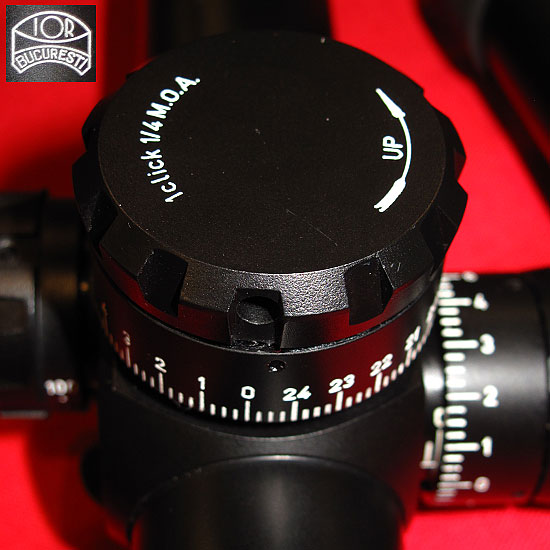

 The IOR and U.S. Optics products offering 20+ MOA in one-revolution are large, heavy, expensive scopes. The big elevation knob on the IOR Ultra Long Range scope has about 125 MOA total elevation (25 MOA per turn) with 1/4-MOA clicks. The large flat EREK (Erector Repositioning Elevation Knob) on the U.S. Optics scopes offers 22.5 MOA per revolution, with a total of about 62 MOA in a 5-25 SN-3 model with 1/4-MOA clicks.
 Forum member Roy Bertalotto did a real nice off-set scope installation on a bolt gun to help a sight-challenged shooter. Roy explains: “A friend of mine shoots left-handed and has lost the sight in his left eye. I built him a scope mount so he can still shoot left-handed, but now use his right eye.” Roy’s fabrication work is impressive and we praise his efforts to help a fellow shooter stay in the game.


 The
The 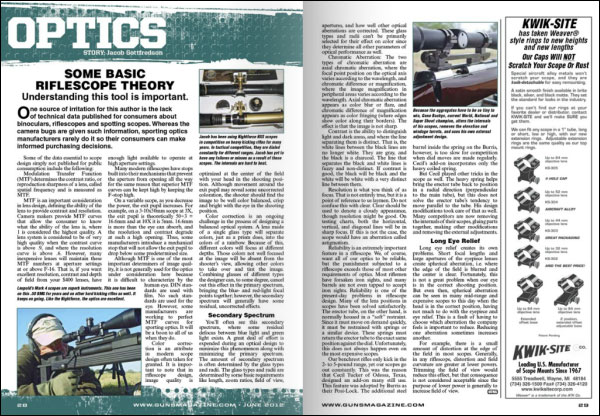

 In this NSSF Video, Ryan Cleckner, a former Sniper Instructor for the 1st Ranger Battalion, defines the term “MilliRadian” (Milrad) and explains how you can use a mildot-type scope to range the distance to your target. It’s pretty simple, once you understand the angular subtension for the reticle stadia dots/lines. Cleckner also explains how you can use the milrad-based reticle markings in your scope for elevation hold-overs and windage hold-offs.


