|
|
August 14th, 2017

At the request of our readers, we provide select “Deals of the Week”. Every Monday morning we offer our Best Bargain selections. Here are some of the best deals on firearms, hardware, reloading components, optics, and shooting accessories. Be aware that sale prices are subject to change, and once clearance inventory is sold, it’s gone for good. You snooze you lose.
1. Bullets.com — Huge Reloading Powder Sale — Great Prices

Got powder? If you need smokeless propellants for your rifles and pistols, head over to Bullets.com which has slashed prices on its powder inventory. There are great savings to be had here, honest. We compared Bullets.com’s inventory reduction sale pricing with some other online powder vendors. With Bullets.com’s current price cuts, you can SAVE $4-$7 per pound for even high-demand powders such as Varget. Bullets.com’s powder sale is scheduled to run through 8/23/2017; however, prices are subject to change. Here are examples of current Sale Prices.
|
Hodgdon CFE Pistol, $17.99/lb
Hodgdon Varget, $21.99/lb
Alliant Reloder 17, $22.95/lb
IMR 4064, $22.95/lb
Hodgdon H1000, $22.99/lb |
Hodgdon CF3 223, $149.99/8 lbs.
IMR 8208 XBR, $159.99/8 lbs.
Hodgdon H4198, $169.95/8 lbs.
Hodgdon H4831sc, $175.00/8 lbs.
Accurate LT-32, $189.95/8 lbs. |
|
2. CDNN — Winchester XPR Hunting Rifle, $279.99 After Rebate

Looking for a good hunting rifle at a great price? Check out this promotion for the Winchester XPR. This is a fine-handling rig with a smooth bolt and many chambering options. Right now at CDNN Sports the basic gray-stocked Winchester XPR is on sale for $379.99. But here’s the kicker, Winchester is offering a $100.00 Mail-In Rebate. That drops your net cost to just $279.99. That’s an insanely good deal. You can also get the XPR in Vias Camo for $299.99 after rebate.
3. Stocky’s — LR Stocks with Aluminum Bedding Block, $179.99

Here’s a good deal on a versatile Stocky’s Long Range Stock with aluminum V-block bedding system. For just $179.99, order this for Rem/Rem Clone long actions or short actions, with either narrow or wide (varmint/tactical) barrel channel. This would be a good choice for a varmint rifle. This is also offered with handsome hydrographic or web-pattern baked-on textured finishes for $199.99.
4. Amazon — Frankford Complete Master Tumbler Kit, $48.05

This Master Tumbler Kit contains everything you need to tumble rifle or pistol brass. Now on sale for $48.05 with free Prime shipping, this Kit contains: Vibratory Tumbler, Rotary Media Separator, Plastic Bucket, 3 lbs. Cleaning Media, and 4 oz. Brass Polish. NOTE: We considered this an excellent deal when it was priced around seventy bucks. At $48.05 it is a total steal — you could easily pay more than that for a decent vibratory tumbler alone.
5. Champions Choice — Deluxe 58″-Long Rifle Case, $68.00

Many of our readers shoot Palma, F-Class, and ELR rifles with long barrels (up to 35″). It’s difficult to find high-quality, well-padded cases that fit very long rifles. Champion’s Choice offers just such a product, the 58″ Deluxe Soft Rifle Case. With thick 1″ padding on each side, big pockets, and backpack straps, this black/blue/white gun case has earned rave reviews from our Forum members. There’s plenty of room for big scopes, and it even comes with an internal tube to hold your cleaning rod.
6. Natchez — Leupold VX-6 Scopes Closeout, Save Hundreds

Natchez Shooters Supplies is running a big sale on Leupold VX-6 scopes. You can save hundreds of dollars on a wide variety of VX-6 optics, from 1-6x24mm up to 3-18x50mm models. If you are looking for a high-quality hunting optic at a great price check out these deals. For example, Leupold’s 2-12x42mm FireDot (Illum.) Duplex VX-6 scope is marked down from $1199.99 to just $749.99 — a $450.00 savings! Shown above are four hot deals, but a dozen Leupold VX-6 models on are sale now.
7. Precision Reloading — Sierra Bullets Sale, Big Discounts

Now through 8/25/2017 Precision Reloading is running a BIG SALE on Sierra bullets. These projectiles, including MatchKing (MK) and Tipped Match-King, are being offered at deep discounts. Listed below are some of the many types of Sierra Bullets on sale. In many cases you can choose either 100-ct or 500-ct packages. Along with match projectiles, Sierra hunting and varmint bullets are on sale.
Sierra 30 Cal, 195gr Tipped MK, 100 for $41.39 (marked down from $45.99)
Sierra 30 Cal, 155gr HPBT MK, 100 for $34.64 (marked down from $38.49)
Sierra 7mm, 183gr HPBT MK, 100 for $41.84 (marked down from $46.49) (Great new bullet)
Sierra 6.5mm, 142gr HPBT MK, 100 for $36.44 (marked down from $40.49)
Sierra 6.5mm, 123gr HPBT MK, 100 for $35.09 (marked down from $38.99)
Sierra 6mm, 107gr HPBT MK, 100 for $28.34 (marked down from $31.49)
Sierra 6mm, 95gr Tipped MK, 100 for $30.59 (marked down from $33.99)
Sierra 22 Cal, 80gr HPBT MK, 50 for $15.29 (marked down from $16.99)
Sierra 22 Cal 77gr Tipped MK, 100 for $27.44 (marked down from $30.49)
8. Midsouth — CCI Std Velocity .22 LR Ammo, $3.75 for 50ct Box

Here’s a great low-price on quality, CCI .22 LR rimfire ammo. The sale price of $3.75 per 50-ct box works out to just 7.5 cents a round for this 40gr CCI 1070 fps rimfire ammo. At that price you can enjoy rimfire plinking without worrying about cost — just like the “good old days”.
9. Amazon — Discovery Scope Level, $13-$16 (1″, 30mm)

If you shoot long range, you need a scope level. This Discovery scope level is fully CNC-machined to close tolerances for a good fit. It is available with inner diameters to fit scopes with either 1″ or 30mm main tubes. The 1″ version is just $12.99 while the 30mm model is $13.95. You could easily pay $35.00 or more for a 30mm scope level. Purchasers have praised this product: 89% of verified buyers rated this five stars.
August 10th, 2017

Game image courtesy OutdoorNebraska.gov/deer.
Written by Sierra Bullets Ballistic Technician Paul Box
Judging by the calls I’ve had through the years, I think some shooters might be placing too much importance on Ballistic Coefficient (B.C.). The best example of this comes from a call I had one day. This shooter called wanting the ballistic coefficient of one of our Sierra bullets. After I told him he seemed a little disappointed, so I ask him what his application was. Long range target, deer hunting in the woods? Talk to me.
As it turned out, he hunted deer in open timber. He very rarely shot beyond 100 yards. I pointed out to him that, under 200 yards, B.C. has little impact. Let’s compare a couple of bullets.
Let’s look at the trajectory of a couple of bullets and see how they compare. The .30 caliber 180 grain Round Nose #2170 RN and the 180 grain Spitzer Boat Tail #2160 SBT. The round nose has a B.C. of .240, while the SBT is .501. Starting both bullets out of the muzzle at 2700 FPS [with a 100-yard ZERO], at 200 yards the #2170 RN impacts 4.46″ low while the #2160 SBT impacts 3.88″ low. That’s a difference of only 0.58″ in spite of a huge difference in Ballistic Coefficient. If we compare out at 500 yards, then we have a [significant drop variance] of 14.27″ between these two bullets. [Editor: That difference could mean a miss at 500 yards.]
Distance to Your Prey is the Key Consideration
In a hunting situation, under 200 yards, having a difference of only .58” isn’t going to make or break us. But when elk hunting in wide open spaces it could mean everything.
The next time you’re choosing a bullet, give some thought about the distances you will be shooting. Sometimes B.C. isn’t everything. If you have any questions, please give the Sierra Bullets technicians a call at 800-233-8799.

May 21st, 2017

 A unique, comprehensive Cartridge Comparison Guide is available as a 340-page, spiral-bound book. Covering over 250 cartridges, the updated Second Edition of the Cartridge Comparision Guide is the product of many years of labor by Andrew Chamberlain, a Utah-based hunter. Andrew says his $36.95 Guide “compares every factory available cartridge from the 17 calibers up to the 50 caliber cartridges”. (Sorry, most wildcat cartridges are not covered.) Chamberlain’s Guide also compiles cartridge data from major ammunition manufacturers such as Barnes, Federal, Hornady, Norma, Nosler, Remington, Sierra, Swift, Weatherby, and Winchester. It shows the optimal velocity achieved for each bullet weight and calculates bullet energy, recoil, and powder efficiency. Large color photos illustrate handgun and rifle cartridges. A unique, comprehensive Cartridge Comparison Guide is available as a 340-page, spiral-bound book. Covering over 250 cartridges, the updated Second Edition of the Cartridge Comparision Guide is the product of many years of labor by Andrew Chamberlain, a Utah-based hunter. Andrew says his $36.95 Guide “compares every factory available cartridge from the 17 calibers up to the 50 caliber cartridges”. (Sorry, most wildcat cartridges are not covered.) Chamberlain’s Guide also compiles cartridge data from major ammunition manufacturers such as Barnes, Federal, Hornady, Norma, Nosler, Remington, Sierra, Swift, Weatherby, and Winchester. It shows the optimal velocity achieved for each bullet weight and calculates bullet energy, recoil, and powder efficiency. Large color photos illustrate handgun and rifle cartridges.
The Cartridge Comparison Guide provides data for thousands of cartridge/bullet/velocity combos. Quick reference data sheets and ballistics charts cover Trajectory, Velocity, and Energy out to 500 yards. The Cartridge Comparison Guide also offers a firearms lexicon, plus Appendices covering Cartridge Selection for Game Animals, Bullet Selection/Design, Bullet Expansion, Wound Channel Characteristics and more.
New Content in Second Edition of Cartridge Comparison Guide
The Cartridge Comparison Guide (Second Edition) costs $36.95 plus shipping and tax. CLICK HERE to visit the Online Store where you can order the 340-page book. Here’s what’s new in the Second Edition:
- Addition of Shotgun Ammunition (Both Slug and Shot loads).
- Momentum Calculation for all Rifle, Shotgun and Handgun loads.
- Integration of Shotgun Slug Ammunition with Center Fire Rifle Data Tables.
- Factory Load Summary Added (Shows manufacturers and loads produced).
- One factory load and one hand load for every bullet weight available in each cartridge.
- Over 90 pages of additional ballistics content (roughly 35% more than in First Edition).
April 26th, 2017

All 10s and Xs for record — that’s a very impressive 200-10X score card for young Lynzie Graham.
Here’s a “feel-good” story about a talented young shooter. We like to acknowledge the accomplishments of the “rising stars” in our sport. Lynzie Graham, a member of the U.S. F-Class Under-25 Team recently shot a perfect 200-10X at 600 yards, not dropping a point. That’s particularly impressive when you consider Lynzie shot her 600-yard “clean” using a factory rifle — a Savage Arms .308 Win F-TR rig.
Congratulations Lynzie Graham on your first 600-yard “clean” at the Texas State Qualifier in February 2017. Lynzie was shooting the Sierra 180gr MatchKing® #2220 with her Savage F-TR .308 Win. This August, Lynzie and other U.S. F-Class U-25 Team members will be competing at the F-Class World Championships (FCWC) hosted at the Connaught Ranges near Ottawa, Canada. Click image below for more information about the 2017 FCWC.

March 31st, 2017

For load development, some guys shoot 3-shot groups. Other guys shoot 5-shot groups, or even 10-shot strings. But for testing its projectiles, Sierra Bullets takes it to another level entirely. A while back Sierra was testing its .30-Caliber 175gr HPBT MatchKing in the Sierra uynderground tunnel. The results are show above — a FIVE HUNDRED Round group!
The tunnel testers sent five full boxes of bullets down-range. Here are 500 Shots shot in a 300 meter tunnel. The group size is 2.82 inches (that’s edge to edge of the farthest shots, less the bullet diameter). This was a pressure/velocity test for a commercial customer. The Cartridge was .308 Win, loaded at 2.800″.The powder was Reloder 15. A 26″ barrel was shot from a return to battery rest. The gun was cleaned every 125 rounds and two foulers shot.
What do you think — could you beat this group from a bench for 500 rounds?
One Facebook poster joked: “500-round group? Everyone knows anything less than 1000-round groups are a waste of time and statistically irrelevant.”

Sierra’s 300 Meter Testing Tunnel
Ever wonder how (and where) Sierra tests its bullets? The answer is underground, in a 300-meter test tunnel located under Sierra’s factory in Sedalia, Missouri. The photo above shows the construction of the tunnel back in May, 1990. Like most bullet manufacturers, Sierra does live-fire bullet testing of its projectiles. Sierra’s 300-meter test range is the longest, manufacturer-owned underground bullet test facility in the world. Sierra offers free tours of the test tunnel as part of Sierra’s Factory Tour Program.
March 3rd, 2017

Ever wondered what caused a particular bulge or marking on a case? And more importantly, does the issue make the case unsafe for further use? Sierra Bullets Ballistic Technician Duane Siercks offers some insight into various issues and their causes in this article from the Sierra Blog.
Incipient Case-Head Separation
This is a Winchester .308 Win case that has a real issue. This case has a very obvious incipient case head separation in the process of becoming a complete failure.

This is most commonly caused by over-sizing the case causing there to be excess headspace on the case. After a few firings and subsequent re-sizing, this case is just about ready to come completely apart. Proper die adjustment is certainly a requirement here. Of course this case is not safe to reuse.
Excessive Pressure (Load Too Hot)
If you will notice in the picture of the case rim, there are two pressure signs to notice. First, look at the primer. It is basically flattened to about the max of what could be considered safe. If this was the only pressure sign noted, I would probably be fine with this load, but would constantly keep an eye on it especially if I was going to use this load in warmer temperatures. This load could easily cross into the “excess pressure” realm very quickly.
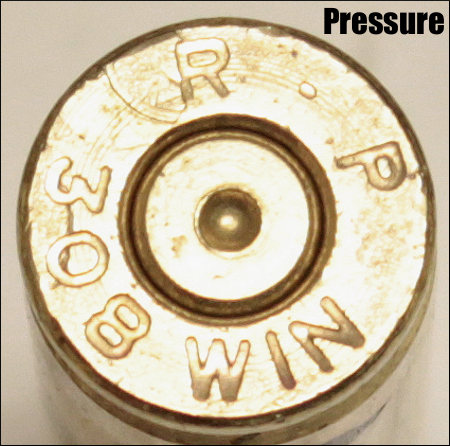
There is another sign of pressure that we cannot ignore. If you’ll notice, there is an ejector mark apparent that is located over the “R” of the R-P headstamp. This absolutely tells us that this load would not have been in the safe pressure range. If there were any of these rounds loaded, they should not be fired and should be dis-assembled. This case should not be reloaded.
Split Case-Neck
Here we have an R-P .22-250 case that has died the death. Everything looks fine with this case except the neck is split. This case must be tossed.
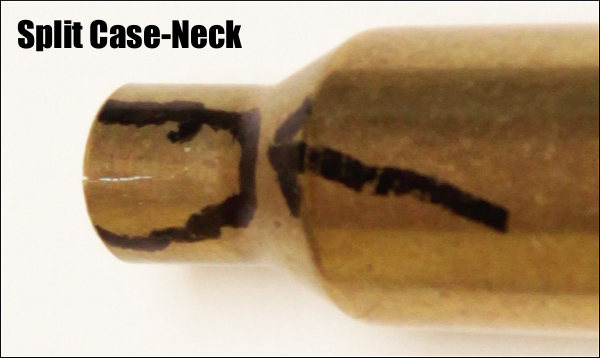
A split neck is a normal occurrence that you must watch for. It is caused by work-hardening of the brass. Brass cases get harder with age and use. Brand new cases that are stored for a period of time can become hard enough that they will split like this case within one to two firings. I have had new factory loads do the same thing. Then as we resize and fire these cases repeatedly, they tend to get harder and harder. Eventually they will split. The life of the case can be extended by careful annealing practices. This is an issue that would need to be addressed in an article by itself. Of course this case is no longer usable.
In the classes that I teach, I try to use examples like this to let the students see what they should be looking for. As always, if we can assist you, whether you are new to reloading or very experienced, contact us here at Sierra Bullets by phone at 1-800-223-8799 or by email at sierra@sierrabullets.com.
Dented Case Body
Here we have a Lake City 7.62×51 (.308 Win.) case with two heavy marks/dents in the case body.

This one may be a bit of a mystery. It appears as if this case may have been caught in the action of a semi-auto rifle when the firearm jammed or the case failed to clear during the cycling process. I probably would not reload this case just to prevent any feeding problems. This also appeared to be a factory loaded round and I don’t really see any pressure issues or damage to the case.
It is very important to observe and inspect your cases before each reloading. After awhile it becomes second nature to notice the little things. Never get complacent as you become more familiar with the reloading process. If ever in doubt, call Sierra’s Techs at 1-800-223-8799.

January 17th, 2017

Sierra Bullets has just released very complete load data for the popular 6.5 Creedmoor cartridge. This medium-sized cartridge has become one of the most popular chamberings for tactical and PRS shooters. The 6.5 Creedmoor combines excellent accuracy, good mag-feeding, good barrel life, moderate recoil, and reasonable component cost. That’s why this cartridge has caught on quickly.
 Developed in 2007 by Dennis DeMille and Dave Emary, the 6.5 Creedmoor is a shortened and improved 30 TC cartridge case that was inspired by the .308 Winchester design. This short action design was created to maximize case capacity and a wide range of loading lengths, while still fitting in standard short action magazines. With the correct twist barrel, the versatile 6.5 Creedmoor can take advantage of the wide range of bullet weights available in 6.5 mm (i.e. .264 caliber). Reloaders should keep in mind that the 6.5 Creedmoor works best with medium to medium-slow powders such as H4350, Varget, Win 760, and RE-17. The light recoil and adaptability of the efficient 6.5 Creedmoor cartridge has already proven itself in high power, precision rifle series and benchrest competitions. Couple that with respectable barrel life and its intrinsic accuracy potential and you have a recipe for success which should insure its legacy for decades to come. Developed in 2007 by Dennis DeMille and Dave Emary, the 6.5 Creedmoor is a shortened and improved 30 TC cartridge case that was inspired by the .308 Winchester design. This short action design was created to maximize case capacity and a wide range of loading lengths, while still fitting in standard short action magazines. With the correct twist barrel, the versatile 6.5 Creedmoor can take advantage of the wide range of bullet weights available in 6.5 mm (i.e. .264 caliber). Reloaders should keep in mind that the 6.5 Creedmoor works best with medium to medium-slow powders such as H4350, Varget, Win 760, and RE-17. The light recoil and adaptability of the efficient 6.5 Creedmoor cartridge has already proven itself in high power, precision rifle series and benchrest competitions. Couple that with respectable barrel life and its intrinsic accuracy potential and you have a recipe for success which should insure its legacy for decades to come.

Here are three tables from the Sierra Bullets Reloading Manual (5th Edition). IMPORTANT — This is just a sample!! Sierra has load data for many other 6.5mm bullet types, including FB, Spitzer, SBT, HPBT, and Tipped MK from 85 grains to 142 grains. To view ALL 6.5 Creedmoor DATA, CLICK HERE.

INDICATES MAXIMUM LOAD – USE CAUTION
LOADS LESS THAN MINIMUM CHARGES SHOWN ARE NOT RECOMMENDED.

INDICATES MAXIMUM LOAD – USE CAUTION
LOADS LESS THAN MINIMUM CHARGES SHOWN ARE NOT RECOMMENDED.

INDICATES MAXIMUM LOAD – USE CAUTION
LOADS LESS THAN MINIMUM CHARGES SHOWN ARE NOT RECOMMENDED.
January 9th, 2017
At the request of our readers, we provide select “Deals of the Week”. Every Monday morning we offer our Best Bargain selections. Here are some of the best deals on firearms, hardware, reloading components, and shooting accessories. Be aware that sale prices are subject to change, and once clearance inventory is sold, it’s gone for good. You snooze you lose.
1. Precision Reloading — Sierra Bullets Sale, Big Discounts

Right now Precision Reloading is running a BIG SALE on Sierra MatchKing (MK) and Tipped MatchKing (TMK) bullets. These projecticle are being offered at deep discounts, with very low prices (some close to wholesale). Here are a few examples of the dozens of types of Sierra Bullets on sale. In most cases you can choose either 100-ct or 500-ct packages.
Sierra 30 Cal, 195gr Tipped MK, 100 for $36.02 (marked down from $41.79)
Sierra 30 Cal, 155gr HPBT MK, 100 for $31.21 (marked down from $35.29)
Sierra 7mm, 183gr HPBT MK, 100 for $38.37 (marked down from $43.39) (Great new bullet)
Sierra 6.5mm, 142gr HPBT MK, 100 for $34.21 (marked down from $187.69)
Sierra 6.5mm, 130gr Tipped MK, 100 for $30.58 (marked down from $38.69)
Sierra 6mm, 107gr HPBT MK, 100 for $27.68 (marked down from $31.29)
Sierra 6mm, 95gr Tipped MK, 100 for $28.25 (marked down from $31.99)
Sierra 22 Cal, 80gr HPBT MK, 500 for $117.08 (marked down from $132.39)
Sierra 22 Cal 77gr TMK, 100 for $26.19 (marked down from $29.69)
NOTE: This Sierra Bullets Sale runs through January 11, 2017, so order soon!
2. EuroOptic — Vortex Viper PST 4-16×50 EBR-1 Scope, $499.99

Here’s an awesome deal from EuroOptic.com. Save $200 on a very popular Vortex Precision Shooting Tactical (PST) optic. On sale for just $499.99, this 4-16x50mm EBR-1 Scope offers tactical turrets with Milradian adjustments, an illuminated second focal plane EBR-1 reticle, 30mm main tube, side-focus parallax, plus a large, bright objective. What’s more, this scope weighs just 22 ounces — making it an ideal optic for a tactical or precision rifle, varmint blaster, or hunting rifle.
3. Amazon — Plano Double Rifle Case with Wheels, $106.37

This Plano Double Scoped Rifle Case is an Amazon Best Seller for good reason. It offers the functionality and durability of an SKB-type hard case for HALF the money. This is under $110.00, while the equivalent SKB is around $240.00, so you can buy two Planos for the price of one SKB. The 51.5″ interior will fit most scoped competition rifles up to about 29″ barrels (measure your own rifle to make sure). The handles are convenient and beefy and the wheels make this case easy to move through airports and parking lots. This is a very tough, roomy case for the money.
4. Grafs.com — Hornady Reloading Kit with Sonic Cleaner, $299.99

This Hornady Reloading Kit is a great deal at $299.99 (30% off Graf’s regular price). This kit comes with everything you need: Lock-N-Load single stage press, L-N-L Powder Measure, Digital Scale, Powder Trickler, Funnel, 9th Ed. Handbook of Cartridge Reloading, 3 L-N-L die bushings, handheld priming tool, universal reloading block, chamfering and deburring tool, primer turning plate and One Shot Case Lube. Plus this Kit includes a bonus FREE Lock-N-Load Sonic Case Cleaner, a $90.00 value. NOTE: This reloading Kit also qualifies for Hornady’s Get Loaded Free Bullets promotion.
5. Amazon — Leight MAX NRR33 Earplugs, $7.45 for 50 Pairs.

These Howard Leight NRR33 Max plugs are your Editor’s favorite foam earplugs. They seal out noise better than any others I’ve tried. Between shooting, motorcycling and mowing lawns, I probably have Max plugs in my ears 2-3 days a week. This is a very good price for a bulk pack of 50 pairs (100 plugs). And if you act soon, you can get free shipping to boot.
6. Amazon — MTM Shooting Range Box, $32.99 Shipped

| |
The versatile MTM Shooting Range Box includes cradles so you can do gun maintenance while at the range. A lift-out tray holds small items such as patches and jags. This durable, Made-in-USA product can hold ammo, windmeter, LRF, cleaning supplies, and other gear. The $32.99 Sale Price includes free shipping for Prime members.
|
7. Amazon — Tipton 12-pc Ultra-Jag Set, $16.99

Brass jags work well — with one hitch. Strong copper solvents can leech metal from the jag itself, leaving a tell-tale blue tint on your patches. This “false positive” can lead shooters to over-clean their barrels. No such problem with these nickel-plated Ultra Jags. For just $16.99 you can get 12 jags in a handy, clear-top fitted caddy. All Tipton nickel-plated jags have 8-32 thread, except for the .17 caliber jag which has a 5-40 thread.
8. Midsouth — 17 HMR V-Max Ammo, $10.45 for 50 rounds

Need 17 HMR ammo for your planned 2017 varmint safaris? Then grab this Hornady V-Max ammo while you can at $10.45 for a 50-round box. This is a great price. Other vendors are selling the same Hornady ammo for as much as $15.00 per box. We’ve used this ammo and it was very accurate out of both semi-auto (Savage A17) and bolt-action (CZ 455) 17 HMR rifles.
January 8th, 2017

This article comes from the Sierra Bullets Blog. Visit Sierra’s Blog for a variety of interesting articles about reloading, ballistics, hunting, and competitive shooting.
Shooting F-Class as a Team
by Sierra Bullets Product Development Manager Mark Walker
Last [year] I attended the Southwest Nationals for my third straight year. However this was the first year that I had the opportunity to participate in the team shooting events. At the previous matches I was strictly shooting to try and post the best individual scores that I could. This was challenging in its own right and I pushed myself to become a better shooter. During this time I became friends with some other shooters and started to become exposed to the team events. A good friend of mine, Bret Solomon, approached me about shooting with the Spindle Shooters team and I jumped at the chance.
F-Class teams consist of four shooters and a wind coach. As a shooter, you are responsible for the vertical up and down component of each shot. You want to have a rifle that shoots with very little vertical dispersion from shot to shot to give the wind coach as much of the width of the scoring ring to use as possible. The wind coach is responsible for the horizontal component of each shot. The wind will move the bullet from side to side on the target and it is the wind coach’s job to tell the shooter where to aim so each bullet will land in the highest scoring rings in the middle of the target. Everyone has a job and for the team to succeed, everyone must be at the top of their game.

For some people, the stress of having four other people depending on you is a bit daunting. However, that is what makes the team events so fun! Not every string you shoot will be a clean. But there is nothing more exhilarating than when the wind is blowing and you and your coach are having to pick your way through the conditions, and that final shot comes up an X.
Now when I attend matches, I shoot the individual targets to help determine how my rifles are shooting and pick the best one to shoot in the team events. And I have to admit that even my individual scores are improving due to the extra attention that I give the rifles to try and have the best equipment for the team. If you have never tried team shooting, I encourage you to give it a try. At most large matches, there are “pick-up” teams that are looking for shooters. This makes a perfect opportunity to meet new people and get [started]. Once you give it a try, you will be hooked!”
Team Shooters Work Together for a Common Goal.

USA F-TR Team member Matt Schwartzkopf excels at F-TR team shooting despite lacking two lower legs. He works as a range manager at Ben Avery. In recognition of his character and determination, at the 2016 SWN, Matt was awarded one of the first Accurateshooter Corinthian Awards. (2015 Photo.)
December 12th, 2016
At the request of our readers, we provide select “Deals of the Week”. Every Monday morning we offer our Bargain selections. Here are some of the best deals on firearms, hardware, reloading components, and shooting accessories. Be aware that sale prices are subject to change, and once clearance inventory is sold, it’s gone for good. You snooze you lose.
1. CDNN Sports — Ruger American Ranch Rifle (Tan), $349.99

Here’s a nice little varmint rifle from Ruger with good features and performance at a killer price: $349.99. You could pay that much just for a barrel. This .223 Rem rifle features a 16.5″ hammer-forged barrel barrel threaded 1/2″-28 at the muzzle for brake or suppressor. The action, which features a 70° three-lug bolt, and Picatinny-style scope rail, sits in an aluminum bedding block. The crisp trigger adjusts down to 3 pounds. With a weight (before optics) of 6.1 pounds, this is a handy carry-around varminter. We like this rifle. For $349.99 it’s a steal.
2. Precision Reloading — NEW High-BC Sierra 6mm 110gr SMKs

Here’s the new King of the 6mm Hill. Sierra’s new 110gr 6mm MatchKing, optimized for a 1:7″-twist barrel, promises class-leading ballistics. The listed G1 Ballistic Coefficient (BC) is an impressive 0.617. That’s 12.8% higher than the 0.547 G1 BC Sierra claims for its older 107gr MatchKing. That’s a very significant improvement. We attribute the reduced drag of the new 110-grainer to an improved hybrid-ogive bullet shape along with smaller meplats and (we believe) pointed tips.
If you want to try out Sierra’s impressive new 6mm (0.243) MatchKings, visit Precision Reloading, which got some of the very first production run from Sierra. You may want to pick up powder and primers too. Now through the end of the year, Precision Reloading is offering a low $15 HazMat fee on any powder and primer order.
3. Midsouth — Lock ‘N Load Complete Reloading Kit, $259.99

The Hornady Lock-N-Load Classic Reloading Kit comes with everything you need to turn out high-quality handloads. The $259.99 Kit includes: Hornady Lock-N-Load Classic single-stage press, Hornady Powder Measure, Digital Scale, Two-Volume Hornady Reloading Manual, Three Lock-N-Load Die Bushings, Reloading Block, Chamfer/Debur Tool, Hand Priming Tool, and One Shot™ Case Lube. We’ve used this press and it is excellent. The L-N-L bushings allow fast die changes.
4. Bruno’s — 46x48mm Weaver T-Series XR Scope, $739.95

Need a reliable, high-magnification scope for your benchrest rifle, but on a tight budget? Then look no further. Here’s a great deal. Weaver’s latest T-Series XR scopes are now just $739.95 at Brunos Shooters Supply. These Weaver scopes are renown for their repeatability and precise clicks. This new model features 1/8 MOA clicks and side-focus parallax adjustment. The XR series are offered with Fine Cross Hair or Target Dot reticles. Even with a 48mm front objective, these XR scopes weigh just 24 ounces. Save big bucks — these Weaver XRs sell elsewhere for $899.00.
5. Cabela’s — Lyman TurboSonic Cleaning Machine, $49.99

If you have brass or small parts to clean an ultrasonic cleaning machine really comes in handy. This Lyman machine was a good deal at $69.99 before. Now it is an awesome deal at $49.99 from Cabela’s. Plus, for a limited time, you can also get FREE Shipping. At check-out, use Code 6JOLLY for free shipping on orders of $49.00 or more.
6. Natchez — Hornady 22-Cal Varmint Bullets, $9.99 Per 100

Headed out for a varmint safari next spring? Need inexpensive bullets to load up this winter for your .223 Rem or 22-250? Then check out this deal on Hornady 55-grainers from Natchez. Get 100 Soft Point .224-Caliber FB bullets for just $9.99. At that price, it doesn’t hurt so much when you shoot 1000+ rounds over a weekend. With good expansion, these bullets work great on prairie dogs and other small critters. Note: These sale bullets ship in a bag, not the box as shown.
7. Natchez — 1k Rounds Blazer 9mm (Brass Cased), $199.99

This is quality, CCI made-in-USA ammo with reloadable, brass casings. We have used this CCI-made Blazer 9mm ammo in Sig, HK, and Glock pistols and it performed very well. This stuff won’t last long at this price (less than $0.20 per round). If you need 9mm practice ammo, order soon — this very same 1000-round case of Blazer 9mm ammo costs $60.00 more at MidwayUSA. Blazer Brass is loaded in boxer-primed, reloadable brass cases for added value.
8. Cabelas.com — Catch-All Gear Bag $9.99

This versatile bag holds lots of gear, and you can’t beat the price — just $9.99. At 16″x10″x6″ it’s big enough to hold rifle ammo, muffs, a Kestrel, and other accessories. It can also serve as a general utiling bag for car camping trips. Six exterior pockets, including zippered mesh pockets on top and side, provide multiple storage options. This Catch-All Gear Bag is available in Forest Green/Black and Dark Green/Camo. This a real bargain — the original price was $24.99.
9. RCBS — Buy Green, Get Green Rebate

RCBS is running a very attractive Rebate Program currently. If you spend $300.00 on qualifying products you get a $75.00 rebate. Spend $50 and get a $10.00 Rebate. This program is limited to one (1) rebate redemption per calendar year, with a maximum of $75.00. CLICK HERE for more information. NOTE: To qualify, you must supply completed RCBS rebate coupon, original UPC barcodes from package, and original cash register receipt and/or dated, itemized sales invoice.
|


