This article comes from the Sierra Bullets Blog. Visit Sierra’s Blog for a variety of interesting articles about reloading, ballistics, hunting, and competitive shooting.
Shooting F-Class as a Team by Sierra Bullets Product Development Manager Mark Walker
Last [year] I attended the Southwest Nationals for my third straight year. However this was the first year that I had the opportunity to participate in the team shooting events. At the previous matches I was strictly shooting to try and post the best individual scores that I could. This was challenging in its own right and I pushed myself to become a better shooter. During this time I became friends with some other shooters and started to become exposed to the team events. A good friend of mine, Bret Solomon, approached me about shooting with the Spindle Shooters team and I jumped at the chance.
F-Class teams consist of four shooters and a wind coach. As a shooter, you are responsible for the vertical up and down component of each shot. You want to have a rifle that shoots with very little vertical dispersion from shot to shot to give the wind coach as much of the width of the scoring ring to use as possible. The wind coach is responsible for the horizontal component of each shot. The wind will move the bullet from side to side on the target and it is the wind coach’s job to tell the shooter where to aim so each bullet will land in the highest scoring rings in the middle of the target. Everyone has a job and for the team to succeed, everyone must be at the top of their game.
For some people, the stress of having four other people depending on you is a bit daunting. However, that is what makes the team events so fun! Not every string you shoot will be a clean. But there is nothing more exhilarating than when the wind is blowing and you and your coach are having to pick your way through the conditions, and that final shot comes up an X.
Now when I attend matches, I shoot the individual targets to help determine how my rifles are shooting and pick the best one to shoot in the team events. And I have to admit that even my individual scores are improving due to the extra attention that I give the rifles to try and have the best equipment for the team. If you have never tried team shooting, I encourage you to give it a try. At most large matches, there are “pick-up” teams that are looking for shooters. This makes a perfect opportunity to meet new people and get [started]. Once you give it a try, you will be hooked!”
Team Shooters Work Together for a Common Goal. USA F-TR Team member Matt Schwartzkopf excels at F-TR team shooting despite lacking two lower legs. He works as a range manager at Ben Avery. In recognition of his character and determination, at the 2016 SWN, Matt was awarded one of the first Accurateshooter Corinthian Awards. (2015 Photo.)
At the request of our readers, we provide select “Deals of the Week”. Every Monday morning we offer our Bargain selections. Here are some of the best deals on firearms, hardware, reloading components, and shooting accessories. Be aware that sale prices are subject to change, and once clearance inventory is sold, it’s gone for good. You snooze you lose.
1. CDNN Sports — Ruger American Ranch Rifle (Tan), $349.99
Here’s a nice little varmint rifle from Ruger with good features and performance at a killer price: $349.99. You could pay that much just for a barrel. This .223 Rem rifle features a 16.5″ hammer-forged barrel barrel threaded 1/2″-28 at the muzzle for brake or suppressor. The action, which features a 70° three-lug bolt, and Picatinny-style scope rail, sits in an aluminum bedding block. The crisp trigger adjusts down to 3 pounds. With a weight (before optics) of 6.1 pounds, this is a handy carry-around varminter. We like this rifle. For $349.99 it’s a steal.
2. Precision Reloading — NEW High-BC Sierra 6mm 110gr SMKs
Here’s the new King of the 6mm Hill. Sierra’s new 110gr 6mm MatchKing, optimized for a 1:7″-twist barrel, promises class-leading ballistics. The listed G1 Ballistic Coefficient (BC) is an impressive 0.617. That’s 12.8% higher than the 0.547 G1 BC Sierra claims for its older 107gr MatchKing. That’s a very significant improvement. We attribute the reduced drag of the new 110-grainer to an improved hybrid-ogive bullet shape along with smaller meplats and (we believe) pointed tips.
Manufacturer-listed G1 Ballistic Coefficients of 6mm Match Bullets
If you want to try out Sierra’s impressive new 6mm (0.243) MatchKings, visit Precision Reloading, which got some of the very first production run from Sierra. You may want to pick up powder and primers too. Now through the end of the year, Precision Reloading is offering a low $15 HazMat fee on any powder and primer order.
3. Midsouth — Lock ‘N Load Complete Reloading Kit, $259.99
The Hornady Lock-N-Load Classic Reloading Kit comes with everything you need to turn out high-quality handloads. The $259.99 Kit includes: Hornady Lock-N-Load Classic single-stage press, Hornady Powder Measure, Digital Scale, Two-Volume Hornady Reloading Manual, Three Lock-N-Load Die Bushings, Reloading Block, Chamfer/Debur Tool, Hand Priming Tool, and One Shot™ Case Lube. We’ve used this press and it is excellent. The L-N-L bushings allow fast die changes.
Need a reliable, high-magnification scope for your benchrest rifle, but on a tight budget? Then look no further. Here’s a great deal. Weaver’s latest T-Series XR scopes are now just $739.95 at Brunos Shooters Supply. These Weaver scopes are renown for their repeatability and precise clicks. This new model features 1/8 MOA clicks and side-focus parallax adjustment. The XR series are offered with Fine Cross Hair or Target Dot reticles. Even with a 48mm front objective, these XR scopes weigh just 24 ounces. Save big bucks — these Weaver XRs sell elsewhere for $899.00.
If you have brass or small parts to clean an ultrasonic cleaning machine really comes in handy. This Lyman machine was a good deal at $69.99 before. Now it is an awesome deal at $49.99 from Cabela’s. Plus, for a limited time, you can also get FREE Shipping. At check-out, use Code 6JOLLY for free shipping on orders of $49.00 or more.
6. Natchez — Hornady 22-Cal Varmint Bullets, $9.99 Per 100
Headed out for a varmint safari next spring? Need inexpensive bullets to load up this winter for your .223 Rem or 22-250? Then check out this deal on Hornady 55-grainers from Natchez. Get 100 Soft Point .224-Caliber FB bullets for just $9.99. At that price, it doesn’t hurt so much when you shoot 1000+ rounds over a weekend. With good expansion, these bullets work great on prairie dogs and other small critters. Note: These sale bullets ship in a bag, not the box as shown.
This is quality, CCI made-in-USA ammo with reloadable, brass casings. We have used this CCI-made Blazer 9mm ammo in Sig, HK, and Glock pistols and it performed very well. This stuff won’t last long at this price (less than $0.20 per round). If you need 9mm practice ammo, order soon — this very same 1000-round case of Blazer 9mm ammo costs $60.00 more at MidwayUSA. Blazer Brass is loaded in boxer-primed, reloadable brass cases for added value.
8. Cabelas.com — Catch-All Gear Bag $9.99
This versatile bag holds lots of gear, and you can’t beat the price — just $9.99. At 16″x10″x6″ it’s big enough to hold rifle ammo, muffs, a Kestrel, and other accessories. It can also serve as a general utiling bag for car camping trips. Six exterior pockets, including zippered mesh pockets on top and side, provide multiple storage options. This Catch-All Gear Bag is available in Forest Green/Black and Dark Green/Camo. This a real bargain — the original price was $24.99.
9. RCBS — Buy Green, Get Green Rebate
RCBS is running a very attractive Rebate Program currently. If you spend $300.00 on qualifying products you get a $75.00 rebate. Spend $50 and get a $10.00 Rebate. This program is limited to one (1) rebate redemption per calendar year, with a maximum of $75.00. CLICK HERE for more information. NOTE: To qualify, you must supply completed RCBS rebate coupon, original UPC barcodes from package, and original cash register receipt and/or dated, itemized sales invoice.
Sierra has just announced a new, high-BC .30-caliber projectile. This provides a very interesting new option for F-TR competitors and long-range benchrest shooters. The new 195-grain Tipped MatchKing (TMK) boasts an impressive 0.610 G1 Ballistic Coefficient. That compares well with any conventional bullet in this caliber and weight range. The key to the high BC is the green acetal resin tip that lowers drag while making the BC more consistent for every bullet in the box. NOTE: This .30-caliber 195 grain TMK requires a twist rate of 1:10” or faster to stabilize.
The new 30 cal. 195 grain Tipped MatchKing® bullets will be available in 500-ct boxes (product #7795C) with a $243.84 MSRP as well as 100-ct boxes (product #7795) with MSRP of $51.19 per box. Note, this new 195gr TMK is designed for competition use — primarily as a paper-puncher. Sierra says: “Tipped MatchKing® bullets are not recommended for most hunting applications.”
New Product Tip from EdLongrange. We welcome reader submissions.
The folks at Sierra Bullets asked a few staff bulletsmiths a classic question about guns: “If you could own only one firearm which one would you choose?” There were many interesting answers including a “cheater” response — the drilling — which is really two guns in one. The most-often mentioned chambering was the venerable .30-06. Respondents cited its versatility, hunting prowess, and ready availability of ammo. The popular .308 Winchester, as expected, got mentions as did its cousins the .243 Win and 7mm-08. There were quite a few votes for classic lever guns, as well as 12-gauge shotguns. Two bulletsmiths cited the .22 LR, and we can certainly see the logic in that answer. The little rimfire cartridge is versatile, quiet, and inexpensive.
We ask our readers the same question — if you could only have one long gun, what type of firearm would it be? List the gun type and chambering in the comments section.
If You Could Have Just One Long-Gun — ANSWERS:
Media Relations Manager Carroll Pilant answered: “I would NEVER own only one gun. If I HAD to pick one, it would be a drilling in 12 gauge over .30-06.”
Ballistic Technician Rich Machholz answered: “The early tang safety Ruger M77s pretty much have all you could want in a bolt gun, but I do like the Winchester lever guns and the combination guns, particularly the drillings. Since I have the first two, I’m going for a Doug Turnbull 1886 or a side by side 20 gauge over .223 drilling.”
Ballistic Technician Philip Mahin answered: “More than likely it would have to be a bolt action .30-06. The reliability is legendary on a wide range of game animals and factory ammunition has still been available at my local stores even in these tough times.”
Ballistic Technician Duane Siercks answered: “If I had to boil it all down to one gun, it would probably be a .30-06. I have a Remington 700C (custom shop gun) that has worked very well for anything and everything I have ever wanted to do with it.”
Ballistic Technician Paul Box answered: “A .22 Rimfire.”
Chief Ballistician Tommy Todd answered: “Remington 700 in .308 Winchester.”
VP – Sales & Marketing Matt Reams answered: “A light weight Kimber in 25-06.”
Production Toolsetter Brad Vansell answered: “Savage weather warrior 7mm-08 is my rifle of choice.”
Production Toolsetter Dan Mahnken answered: “The .308 Winchester rifle — [based on the] wide range of bullets made and the wide range of things that one can hunt with it.”
Process Engineer David Palm answered: “Savage action 243 Winchester.”
Ballistic Technician Gary Prisendorf answered: “Probably a .22 LR. It may not be the best choice, but you could use it for about anything if you really had to.”
Production Manager Chris Hatfield answered: “Beretta A300 Outlander 12 gauge.”
We asked a few Sierra Bullets bulletsmiths “What is your favorite ‘don’t know how you ever lived without it’ piece of reloading equipment?” Along with the not-so-surprising “reloading press” responses, there are some interesting answers, including a reloading room, an annealing machine, a comparator, and a home-made tool for detecting incipient case head separation. Check out all the answers below. We would love to hear from you too, please share your response in the comments below.
What Is Your Favorite Piece of Reloading Equipment?
Ballistic Technician Carroll Pilant answered: “Dillon 550 and 650 presses.”
Ballistic Technician Rich Machholz answered: “My universal decapping die is as handy as a pocket on a shirt.”
Ballistic Technician Philip Mahin answered: “A comparator gauge to measure from the base of a case to the ogive of the bullet. This bypasses the tip of the bullet, so I can repeat the same seating depth the next time I visit a specific combination.”
Ballistic Technician Duane Siercks answered: “I don’t know that you would actually call this equipment, but the item that comes to mind would be my reloading room. I had always had to squeeze everything into a corner or even an unheated shed. After we bought our current house, I built a garage and placed it so that I had a window looking down a 250-yard range. I built a dedicated room with heat and A/C. It contains my reloading bench and a shooting bench. The shooting bench lets me slide open the window and shoot down the range. It is very handy to not have to load everything up to go to the range. It also makes load development a lot simpler and efficient. I don’t know how I ever got along without it.”
Ballistic Technician Paul Box answered: “The Lee hand priming tool.”
Former Ballistic Technician Robert Treece answered “My homemade dental pick. I use it to check incipient case-head separations. We all see the ‘bright ring’ down close to the case head, that’s natural, but after several firings could be starting to split apart. You could start by just straightening out a paper clip; flattening one end; sharpening and turning it 90 degrees, then bend if about 1/8″ long will even fit all the way down into .204″ cases. On the other end, bend about 3/4″ to 90 degrees also, in the same direction as the pick. That will give you a handle and also ‘points’” in the direction of the pick as you scrape along the side wall from down inside at the bottom upward along the side wall. If the pick hooks into a crevice — DON’T TRY TO SIZE THE CASE. It will pull apart in your die.”
Dan Blake answered: “My Annealing Made Perfect (AMP) annealer. With consistent neck tension being one of the largest contributions to small Extreme Spread on muzzle velocities, I believe this induction annealer is truly the best on the market.”
This manufacturer-produced video shows how the AMP annealing machine operates:
Production Toolsetter Brad Vansell answered: “Redding Ultramag single-stage reloading press for my rifle and my Dillon 650 for my pistol loading.”
Process Engineer David Palm answered: “Homemade case lube.”
Plant Engineer Darren Leskiw answered: “Beyond the normal equipment, I’d say my electronic scale. Using the beam balance for the past 9 years was ok, but nowhere as easy as using an electronic scale.”
There were many votes for the classic RCBS Rock Chucker single-stage press:
Ballistician Gary Prisendorf answered “RCBS Rockchucker Press, it’s built like a tank, and it will last me a lifetime.”
Production Manager Chris Hatfield answered: “RCBS single stage reloading press.”
Maintenance & Machine Shop Lead Craig Westermier answered: “RCBS Rock Chucker.”
Production Resource Manager Dan Mahnken answered “RCBS Rock Chucker! Buy one and it lasts a lifetime.”
Right now Precision Reloading is running a BIG SALE on Sierra MatchKing (MK) and Tipped MatchKing (TMK) Bullets. These bullets are being offered at deep discounts, with very low prices (some close to wholesale). Precision Reloading says you can save up to $37.00 on 500-ct boxes. Here are just a few examples of the dozens of types of Sierra Bullets on Sale.
Sierra 30 Cal, 200gr HPBT MK, 100 for $35.57 (marked down from $40.29)
Sierra 7mm, 183gr HPBT MK, 100 for $38.37 (marked down from $43.39) (Great new bullet)
Sierra 6.5mm, 142gr HPBT MK, 500 for $167.74 (marked down from $187.69)
Sierra 6.5 mm, 130gr TMK, 100 for $30.58 (marked down from $34.59)
Sierra 6mm, 95gr TMK, 500 for $138.75 (marked down from $156.89)
Sierra 22 Cal, 80gr HPBT MK, 500 for $117.08 (marked down from $132.39)
Sierra 22 Cal 77gr TMK, 100 for $26.19 (marked down from $29.69)
NOTE: This Sierra Bullets Sale runs through October 31, 2016, so you’ll want to place your order before the end of the month.
Sierra offers the widest selection of .30-Caliber match bullets in the world today, producing bullets suited to nearly every form of long-range competition. Along with classic HPBT and HP MatchKings, Sierra now offers the new Tipped MatchKing (TMK) line, which feature an acetal resin tip. The major advantage of adding a tip to the bullet is the reduction of drag, producing a more favorable ballistic coefficient. Another benefit is improved feeding in magazine-fed firearms.
Ever wondered what caused a particular bulge or marking on a case? And more importantly, does the issue make the case unsafe for further use? Sierra Bullets Ballistic Technician Duane Siercks offers some insight into various issues and their causes in this article from the Sierra Blog.
Diagnosing Problems with Cartridge Brass
by Duane Siercks, Sierra Bullets
I was handed a small sample of .223 Rem cases the other day and was asked if I could comment on some marks and appearances that had been noticed as they were sorting through the cases. I will share what was observed and give you what would seem to be a cause for them. These were from an unknown source, so I have no way of knowing what type of firearm they were fired in or if they were factory loaded or reloaded ammunition.
Example ONE: Lake City 5.56, Unknown Year
Case #1 was seen to have a very rounded shoulder and split. Upon first look it was obvious that this round had been a victim of excess pressure. The firearm (perhaps an AR?) was apparently not in full battery, or there was possibly a headspace issue also. While taking a closer look, the primer was very flat and the outside radius of the primer cup had been lost. High pressure! Then I also noticed that there was an ejector mark on the case rim. This is most certainly an incident of excessive pressure. This case is ruined and should be discarded. See photo below.
Example TWO: Lake City Match 1993
Case #2 appears very normal. There was some question about marks seen on the primer. The primer is not overly flattened and is typical for a safe maximum load. There is a small amount of cratering seen here. This can be caused by a couple of situations.
Cratering is often referred to as a sign of excess pressure. With safety in mind, this is probably something that should make one stop and really assess the situation. Being as there are no other signs of pressure seen with this case, I doubt that pressure was unsafe. That leads us to the next possibility. This can also be caused by the firing-pin hole in the bolt-face being a bit larger than the firing-pin, and allowing the primer to flow back into the firing-pin hole causing the crater seen here. This can happen even with less-than-max pressures, in fact it has been noted even at starting loads. Always question whether pressure is involved when you see a crater. In this situation, I lean toward a large firing-pin hole. This case should be safe to reload.
Example THREE: R-P .223 Remington
Case #3 appears normal with one exception. There are two rings seen about one half inch below the base of the shoulder. These rings are around the circumference of the case, one being quite pronounced, and the other being noticeably less.
As we do not know the origin of the firearm in which this case was fired, it does seem apparent that the chamber of the firearm possibly had a slight defect. It could have been that the reamer was damaged during the cutting of this chamber. I would suggest that the chamber did have a couple of grooves that imprinted onto the case upon firing. This firearm, while maybe not dangerous should be looked at by a competent gunsmith. In all likelihood, this case is still safe to use.
Example FOUR: R-P .223 Remington
Case #4 has no signs of excess pressure. There is a bulge in the case just ahead of the case head that some might be alarmed by. This bulge is more than likely caused by this case being fired in a firearm that had a chamber on the maximum side of S.A.A.M.I. specifications. There is actually no real issue with the case. Note that the primer would indicate this load was relatively mild on pressure.
If this case was reloaded and used in the same firearm numerous times there might be a concern about case head separation. If you were going to use this case to load in an AR, be sure to completely full-length re-size to avoid chambering difficulties. This case would be safe to reload.
It is very important to observe and inspect your cases before each reloading. After awhile it becomes second nature to notice the little things. Never get complacent as you become more familiar with the reloading process. If ever in doubt, call Sierra’s Techs at 1-800-223-8799.
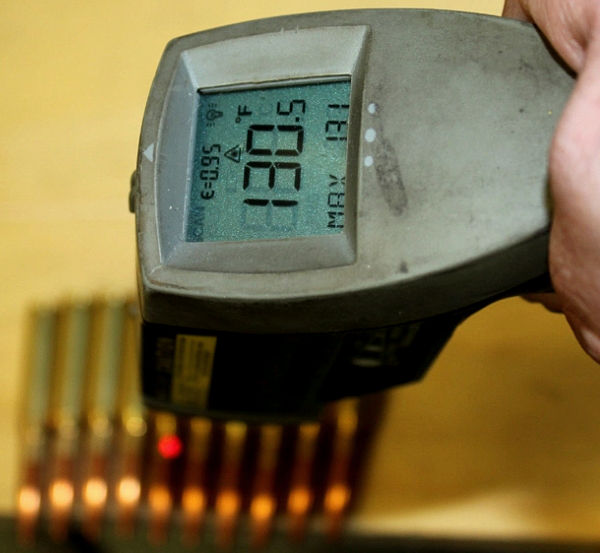
In this .308 Win test, 70° F ammo shot 96 FPS slower than ammo heated to 130.5° F. And the 130.5° ammo was 145 fps faster than ammo right out of the freezer (at 25.5° F). That’s a huge difference…
EDITOR’s NOTE: The Sierra tester does not reveal the brand of powder tested here. Some powders are much more temp sensitive than others. Accordingly, you cannot extrapolate test results from one propellant to another. Nonetheless, it is interesting to see the actual recorded velocity shift with ammo temperature variations in a .308 Win.
Written by Sierra Chief Ballistician Tommy Todd This story originally appeared in theSierra Bullets Blog
A few weeks ago I was attending the Missouri State F-Class Match. This was a two-day event during the summer and temperatures were hot one day and hotter the next. I shot next to a gentleman who was relatively new to the sport. He was shooting a basically factory rifle and was enjoying himself with the exception that his scores were not as good as he hoped they would be and he was experiencing pressure issues with his ammunition. I noticed that he was having to force the bolt open on a couple of rounds. During a break, I visited with him and offered a couple of suggestions which helped his situation somewhat and he was able to finish the match without major issues.
He was shooting factory ammunition, which is normally loaded to upper levels of allowable pressures. While this ammunition showed no problems during “normal” testing, it was definitely showing issues during a 20-round string of fire in the temperatures we were competing in. My first suggestion was that he keep his ammunition out of the direct sun and shade it as much as possible. My second suggestion was to not close the bolt on a cartridge until he was ready to fire. He had his ammo in the direct sunlight and was chambering a round while waiting on the target to be pulled and scored which can take from a few seconds to almost a minute sometimes.
This time frame allowed the bullet and powder to absorb chamber [heat] and build pressure/velocity above normal conditions. Making my recommended changes lowered the pressures enough for the rifle and cartridge to function normally.
Testing Effects of Ammunition Temperature on Velocity and POI
After thinking about this situation, I decided to perform a test in the Sierra Bullets underground range to see what temperature changes will do to a rifle/cartridge combination. I acquired thirty consecutive .30 caliber 175 grain MatchKing bullets #2275 right off one of our bullet assembly presses and loaded them into .308 Winchester ammunition. I utilized an unnamed powder manufacturer’s product that is appropriate for the .308 Winchester cartridge. This load is not at the maximum for this cartridge, but it gives consistent velocities and accuracy for testing.
I took ten of the cartridges and placed them in a freezer to condition.
I set ten of them on my loading bench, and since it was cool and cloudy the day I performed this test I utilized a floodlight and stand to simulate ammunition being heated in the sun.
I kept track of the temperatures of the three ammunition samples with a non-contact laser thermometer.
The rifle was fired at room temperature (70 degrees) with all three sets of ammunition. I fired this test at 200 yards out of a return-to-battery machine rest. The aiming point was a leveled line drawn on a sheet of paper. I fired one group with the scope aimed at the line and then moved the aiming point across the paper from left to right for the subsequent groups.
NOTE that the velocity increased as the temperature of the ammunition did.
The ammunition from the freezer shot at 2451 fps.
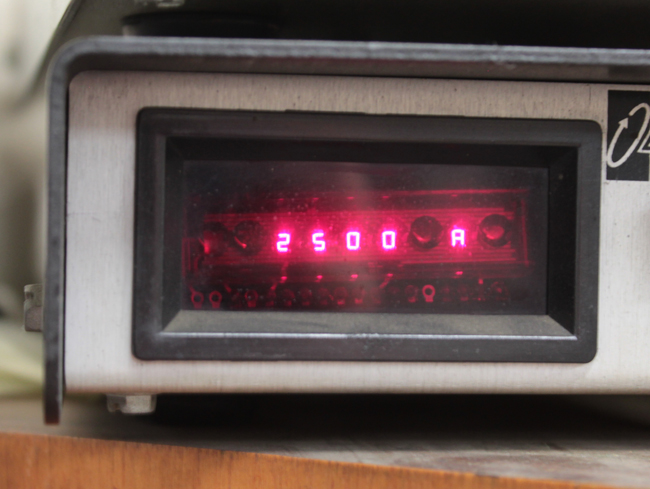
The room temperature ammunition shot at 2500 fps.
The heated ammunition shot at 2596 fps.
The tune window of the particular rifle is fairly wide as is shown by the accuracy of the three pressure/velocity levels and good accuracy was achieved across the board. However, notice the point of impact shift with the third group? There is enough shift at 200 yards to cause a miss if you were shooting a target or animal at longer ranges. While the pressure and velocities changed this load was far enough from maximum that perceived over pressure issues such as flattened primer, ejector marks on the case head, or sticky extraction did not appear. If you load to maximum and then subject your ammunition to this test your results will probably be magnified in comparison.
This test showed that pressures, velocities, and point-of-impact can be affected by temperatures of your ammunition at the time of firing. It’s really not a bad idea to test in the conditions that you plan on utilizing the ammo/firearm in if at all possible. It wouldn’t be a bad idea to also test to see what condition changes do to your particular gun and ammunition combination so that you can make allowances as needed. Any personal testing along these lines should be done with caution as some powder and cartridge combination could become unsafe with relatively small changes in conditions.
David Tubb has come out with a new, improved version of his heavyweight 6mm match bullet. David’s new DTAC 115gr 6mm projectile is very slippery — the tested G1 1000-yard BC is 0.620. The DTAC 115 features a Rebated Boat Tail (RBT) design and a factory-pointed tip (what David calls a “closed nose”). This bullet is in production now, priced at $145.00 for 500 bullets. David tell us “the new DTAC 115 has arrived” and his company is currently filling backorders. New orders will be taken at DavidTubb.com starting Monday, August 15th. You can also call 806-323-9488 (8:30 am-4:30 pm CT) to order.
David explained the two main reasons why the Rebated Boat Tail (RBT) design was chosen for the new DTAC 115 bullet:
1. It is easier to precisely hold tolerances when manufacturing the 7 degree boat tail angle. Most conventional boat tails have 9 degree angles (or greater).
2. The RBT more efficiently obturates to the bore of the rifle barrel when fired. (It mimics a flat base bullet design). This will allow the RBT design to extend your accurate barrel life by reducing gas leakage around the bullet when fired in a worn 6mm throat.
NOTE: David does NOT claim the RBT offers a higher BC compared to a conventional boattail design.
DESIGN FEATURES: DTAC 115 Bullet with Rebated Boat Tail
Commentary by David Tubb
In the 1980s we shot 107 grain weight-range 6mm bullets for Silhouette and High Power competitions. Lower recoil and good wind drift were paramount in coming to the 6mm bullet diameter.
After I developed the 6XC case around 2003 I approached Sierra about making me a 6mm bullet in the 115 grain range. Sierra ran prototypes in 112, 115, and 120 grain configurations. I thoroughly tested these and decided on the 115 grain. In 2004 I used these at Camp Perry and the result was a Long Range National Championship Aggregate with a perfect 1450×101 score. Enough said….
In 2007 Sierra had just introduced its plastic-tipped bullets. I had them run a test batch of plastic-tipped 117 grain weights. These didn’t pass my criteria.
We then ran another test batch of 111 grain plastic tip 6mm bullets and they looked great in the Sierra tunnel tests. However when shot them over an Oehler 43 at 1000 yards the results indicated the plastic tips were deformed or nonexistent at the target. These didn’t pass my criteria.
FYI — that plastic tip deformation testing information preceded the Hornady “Plastic tips Are Bad” advertising campaign by more than seven years.
When using a .308 early in my High Power rifle career we shot 190 grain Sierras at the 600-yard stage. When 600-yard accuracy began to fall off a switch to a 185gr Lapua rebated boat tail brought the accuracy back. I remember shooting some very high X-Count scores with 185gr Lapuas. The reason the Lapua worked in a worn barrel is because the rebated boat tail allows the bullet to obturate to fit the worn throat and prevent less gas leakage around the bullet when fired.
I had a bullet-maker friend reform some 6mm 115s with a rebated boat tail (RBT) in 2015 and had excellent results. So it was a natural move to redesign the current DTAC 115 6mm with a RBT and a 7 degree boat tail.
Ballistic Coefficent and Stabilization
High BC Confirmed
David says, “The new DTAC 115 RBT testing is complete and [we] can claim a G1 1000-yard BC of 0.620″.
Required Twist Rate for Stability
David reports: “This bullet stabilized out of true 1:8″ twist or faster barrel at velocities approaching 3000 fps at sea level”.
Based on the questions we get on a daily basis on our 800 (Customer Support) line, twist is one of the most misunderstood subjects in the gun field. So let’s look deeper into this mystery and get a better understanding of what twist really means.
When you see the term 1:14″ (1-14) or 1:9″ twist, just exactly what does this mean? A rifle having a 1:14″ twist means the bullet will rotate one complete revolution every fourteen inches of the barrel. Naturally a 1:9″ turns one time every nine inches that it travels down the barrel. Now, here’s something that some people have trouble with. I’ve had calls from shooters thinking that a 1:14″ twist was faster than a 1:9″ because the number was higher with the 1:14″. The easiest way to remember this is the higher the number, the slower the twist rate is.
Now, the biggest misconception is that if a shooter has a .223 with a 1:8″ twist, his rifle won’t stabilize a 55gr bullet or anything lighter. So let’s look at what is required. The longer a bullet is for its diameter, the faster the twist has to be to stabilize it. In the case of the .223 with a 1:8″ twist, this was designed to stabilize 80gr bullets in this diameter. In truth the opposite is true. A 1:8″ will spin a 55gr faster than what is required in order to stabilize that length of bullet. If you have a bullet with good concentricity in its jacket, over-spinning it will not [normally] hurt its accuracy potential. [Editor’s Note: In addition, the faster twist rate will not, normally, decrease velocity significantly. That’s been confirmed by testing done by Bryan Litz’s Applied Ballistics Labs. There may be some minor speed loss.]
Many barrel-makers mark the twist rate and bore dimensions on their barrel blanks.
Think of it like tires on your truck. If you have a new set of tires put on your truck, and they balance them proper at the tire shop, you can drive down a street in town at 35 MPH and they spin perfect. You can get out on the highway and drive 65 MPH and they still spin perfect. A bullet acts the same way.
Once I loaded some 35gr HP bullets in a 22-250 Ackley with a 1:8″ twist. After putting three shots down range, the average velocity was 4584 FPS with an RPM level of 412,560. The group measured .750″ at 100 yards. This is a clear example that it is hard to over-stabilize a good bullet.
Twist-rate illustration by Erik Dahlberg courtesy FireArmsID.com. Krieger barrel photo courtesy GS Arizona.


 Plant Engineer Darren Leskiw answered: “Beyond the normal equipment, I’d say my electronic scale. Using the beam balance for the past 9 years was ok, but nowhere as easy as using an electronic scale.”





 After I developed the 6XC case around 2003 I approached Sierra about making me a 6mm bullet in the 115 grain range. Sierra ran prototypes in 112, 115, and 120 grain configurations. I thoroughly tested these and decided on the 115 grain. In 2004 I used these at Camp Perry and the result was a Long Range National Championship Aggregate with a perfect 1450×101 score. Enough said….


