Here’s something you don’t see every day — a reloading press that has loaded over 1,000,000 rounds of ammo. At the NRA Convention in Dallas in 2018, Redding showcased an old Redding T-7 Turret Press delivered to Sierra Bullets decades ago. 0ne of the very first T-7s made by Redding, this “old warrior” was used by Sierra Bullets to load over 1,000,000 rounds of ammunition in Sierra’s ballistics lab.
Redding T-7 Still Within Spec
After all that loading, Redding tested the press and, remarkably, found that it still remained “within spec”. Redding notes: “This press was subjected to real world reloading wear and stress yet remains within ‘new’ spec after this historic test”. When showcased in Dallas, this Redding turret press was fitted with indicators to show “just how good American steel and craftsmanship remains after what, in a normal situation, would represent numerous lifetimes of use.”
About Redding Reloading
Redding Reloading Equipment has crafted quality, American-made products for the precision handloading market since 1946. Along with single-stage and turret presses, Redding makes great dies. And Redding’s line of tools/accessories includes concentricity gauges, scales, trimmers, powder measures, powder tricklers, cleaning tools, deburring tools, bushings, and many other quality items.
by Sierra Bullets Ballistic Technician Philip Mahin for Sierra Bullets Blog
A lot of calls that come into the Sierra Customer Service Center are made by shooters [of retirement age]. Most of the time the shooter used to reload back when they were [younger] and stopped in order to raise a family, pursue a career, or both. Maybe their father or grandfather taught them back in the day and they are looking for an answer to the new whatchamacallit they found on the internet. The point is they are coming back to it because it was fun.
Reloading Can Provide Stress Relief
As a father of three, a husband, a brother, a son and son-in-law, and a friend and neighbor, I get pulled in a lot of directions. In all honesty, reloading and shooting has become a stress relief for me even though I work in the shooting industry.
Sometimes, the shooting gets put on hold for other more important things but there will always be another project or repair to accomplish. There are a lot out there that have found a way to balance the work life, the family life, and the play life. I would like to applaud you on your efforts because it is a hard thing to accomplish.
Remember to take time and relieve that stress. Do something fun, especially if it is shooting that special hand-load you just made.
AccurateShooter Comment — Hand-Loading and the Creative Process
Reloading your own precise ammo can be rewarding in many ways. First it allows you a temporary escape from work pressures, “Honey-Dos”, filing your taxes — whatever. It’s just you and Mr. Rockchucker spending quality time in the loading room. Second, hand-loading is a creative process that engages the mind. During load development, you are like an inventor, selecting a powder charge, choosing the bushing size, experimenting with seating depths, working to perfect your load.
Lastly, the process of hand-loading is rewarding because you are building something start to finish. You begin with components — bullets, brass, and powder, and end up with a finished product that (hopefully) is better than the best factory ammo you could buy. It is enormously satisfying to start with piles of bullets and brass and end up with beautiful hand-loads that can deliver great accuracy.
Sierra Bullets has released very complete load data for the popular 6.5 Creedmoor cartridge. This medium-sized cartridge has become one of the most popular chamberings for tactical and PRS shooters. The 6.5 Creedmoor combines excellent accuracy, good mag-feeding, good barrel life, moderate recoil, and reasonable component cost. That’s why this cartridge has caught on quickly.
Developed in 2007 by Dennis DeMille and Dave Emary, the 6.5 Creedmoor is a shortened and improved 30 TC cartridge case that was inspired by the .308 Winchester design. This short action design was created to maximize case capacity and a wide range of loading lengths, while still fitting in standard short action magazines. With the correct twist barrel, the versatile 6.5 Creedmoor can take advantage of the wide range of bullet weights available in 6.5 mm (i.e. .264 caliber). Reloaders should keep in mind that the 6.5 Creedmoor works best with medium to medium-slow powders such as H4350, Varget, Win 760, and RE-17. The light recoil and adaptability of the efficient 6.5 Creedmoor cartridge has already proven itself in high power, precision rifle series and benchrest competitions. Couple that with respectable barrel life and its intrinsic accuracy potential and you have a recipe for success which should insure its legacy for decades to come.
Here are three tables from the Sierra Bullets Reloading Manual (5th Edition). IMPORTANT — This is just a sample!! Sierra has load data for many other 6.5mm bullet types, including FB, Spitzer, SBT, HPBT, and Tipped MK from 85 grains to 142 grains. To view ALL 6.5 Creedmoor DATA, CLICK HERE.
INDICATES MAXIMUM LOAD – USE CAUTION
LOADS LESS THAN MINIMUM CHARGES SHOWN ARE NOT RECOMMENDED.
INDICATES MAXIMUM LOAD – USE CAUTION
LOADS LESS THAN MINIMUM CHARGES SHOWN ARE NOT RECOMMENDED.
INDICATES MAXIMUM LOAD – USE CAUTION
LOADS LESS THAN MINIMUM CHARGES SHOWN ARE NOT RECOMMENDED.
Two More Great 6.5 Creedmoor Reloading Resouces
Want More 6.5 Creedmoor Load Info? View Starline’s 6.5 Creedmoor Guide by Gavin Gear:
PRB 6mm Creedmoor and 6.5 Creedmoor Load Survey
The Precision Rifle Blog compiled Load Data from PRS Competitors, for both 6mm Creedmoor and 6.5 Creedmoor. This is a good place to start. PRB surveyed the match loads for “173 of the top-ranked precision rifle shooters in the country”. CLICK HERE.
At the request of our readers, we provide select “Deals of the Week”. Every Sunday afternoon or Monday morning we offer our Best Bargain selections. Here are some of the best deals on firearms, hardware, reloading components, optics, and shooting accessories. Be aware that sale prices are subject to change, and once clearance inventory is sold, it’s gone for good. You snooze you lose.
⏺ Great price for nice hunting rifle; many calibers, coated action + barrel
In today’s market, getting a quality hunting rig for under $450.00 is a very good deal. Add in a Permacote protective finish on both action and barrel and you have a true bargain. Right now Sportsman’s Warehouse is offering the Winchester XPR rifle in a variety of regular and magnum chamberings for just $449.99. Choose from 6.5 Creedmoor, .270 Win, 7mm Rem Magnum, .308 Win, .30-06 Springfield, .300 Win Magnum. These guns have smooth feeding and good warranties. Notable features include:
Flat Dark Earth (FDE) Permacote Receiver Finish
Free-floating Button-rifled Barrel with FDE Permacote Finish
M.O.A. Trigger System with 2-Position Thumb Safety
Mossy Oak Elements Terra Bayou Camouflage Finish
2. Midsouth — Bullets IN STOCK from All Major Brands
⏺ Berger, Sierra, Hornady, Nosler, Barnes, Speer in stock
Reloading components are getting harder to find. Thankfully, Midsouth has a HUGE inventory of rifle bullets IN STOCK, from many makers, in a wide selection of calibers and weights. And many of these bullets are on sale right now. Choose your favorite projectiles from Berger, Sierra, Hornady, Nosler, Speer, and Barnes. You’ll find good prices on rifle match bullets as well as hunting bullets, with both tipped and conventional designs, as well as solids (from Barnes). Hornady A-Tips are on sale. CLICK HERE for Bullets.
⏺ Very high quality brass for popular mid-size accuracy cartridges
After Lapua and Peterson, USA-based Alpha Munitions makes some of the best cartridge brass available today. In stock now at Precision Reloading is Alpha brass for these popular cartridges: 6mm Creedmoor, 6.5 Creedmoor, 6XC, and .308 Win. Notably, Alpha also makes 6mm Dasher brass, saving you a fire-forming step, and Alpha also produces the new 6GT case popular with PRS shooters. BIG NEWS: Alpha recently started producing 6mm BRA (6BR Ackley) brass. Alpha 6mm BRA and 6 Dasher brass are available directly from Alpha Munitions, but act soon — this will quickly sell out. Click links below:
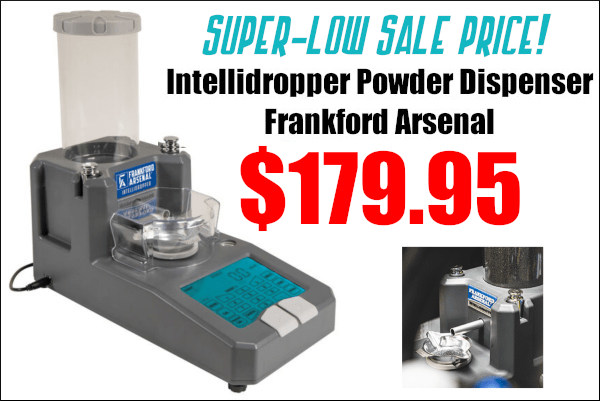
⏺ Fast, programmable, accurate dispenser at great price
The Frankford Arsenal Intellidropper is a high-quality powder scale dispenser. It’s accurate to +/- one-tenth of a grain, dispenses in seconds, and can be controlled by a handy mobile App that can store various charges weights for different cartridges. This unit has a 7000-grain capacity with both Auto and manual trickle capability. IMPORTANT: This super-low Amazon price won’t last long. Act quickly to secure the Intellidropper for $179.95 on Sale.
5. All Dealers — Zeiss Conquest V4 $100 Instant Rebate
⏺ Instant $100 savings on outstanding Zeiss Conquest V4 Scopes
Calling all holiday shoppers! Looking for that perfect gift for the hunter or shooter on your list? Through December 31, 2020, ZEISS is offering a great deal through participating ZEISS authorized retailers. Customers looking to buy Conquest V4 riflescopes and Terra ED 42 mm objective binoculars will receive $100 off instantly at time of purchase. No Rebate forms to fill out, no waiting periods — you just save $100 instantly. CLICK HERE for ZEISS SALE INFO.
6. MidwayUSA — BOG Death Grip Tripod, $124.99
⏺ Versatile — use in all positions (even prone), secure top clamp
BOG makes very popular “long reach” shooting sticks/bipods for hunters. And now BOG has developed a clamp-style tripod that is great for hunters and PRS/NRL competitors. The BOG Death Grip Tripod has a rectangular-style padded clamp that will fit a wide variety of rifle fore-end styles (and widths).
Watch the video above to see this tripod’s versatility and why it has earned rave reviews. Non-marring rubber jaw insert protect your rifle’s finish. The 3-position leg angle lock allows for secure shooting in standing, kneeling and prone positions. Tilt adjustment lever controls up to 25 degrees of cant forwards and back and the head pans 360 degrees. Right now the BOG Death Grip Tripod Aluminum version is on sale at MidwayUSA for $124.99, $25.00 off. NOTE: You need to place the product in MidwayUSA’s shopping cart to see this special price.
7. Focus Camera — Fujinon Scope Plus Binoculars, $149.00
⏺ Killer combo deal — great gift for someone getting started in hunting
Here is a killer deal on a hunting optics combo. Fujinon does make high quality optics but the company is not well known among American consumers so Fujinon optics have been deeply discounted. Right now you can get a good, light-weight 1.75-5x32mm hunting scope AND 10x32mm binoculars for just $149.00! The original MSRP on this combo was $499.99 so you’re saving over $350! The magnification level is ideal for a deer rifle scope. We think this would be a great gift item for a hunter in your family.
8. Midsouth — Great End-of-Year Target Sale
⏺ Dozens of Hi-Viz and Specialty Targets at Great Prices
Need targets for your range days next year? Midsouth Shooters has a huge selection of shooting targets at attractive prices. Choose from stick-on targets, target dots, splatter targets, grid targets, bullseye targets, and even Zombie fun targets, in various sizes and colors.
Midsouth also has a unique stick-on white benchrest target that comes on a handy roll. The 250 target roll is $12.49. This self-adhesive target is great for practicing for benchrest matches and load development. We use it because it has a nice grid and precise aim point.
9. MidwayUSA — Dual Gong Target System, 50% Off, $44.99
⏺ Great Price for twin AR500 system — just add wood beam and have fun
Who doesn’t like shooting steel? The “clang” of hitting a steel target at long range provides instant gratification. This Viking Solutions Gong Target System features two AR500 Steel Gongs (6″ and 8″) suspended by chains. All the hardware is supplied including chains, leg stands, and nuts and bolts — all you need is a length of 2×4 lumber. Setup time is less than two minutes. The gongs are manufactured from 3/8″-thick AR500 steel for long lasting durability! NOTE: User must supply lumber beam. This unit once sold for $89.99 so you save $45.00!
10. Amazon — Cleaning Kit with 1000 Patches, Swabs, Boresnake
⏺ Great bargain cleaning kit with swabs, 1000 patches, bottles and boresnake
This handy Gun Cleaning Kit is worth the $15.95 price for the 1000 cotton patches alone. But in addition to that you get a handy boresnake for barrel cleaning, 100 cotton, tipped swabs, two empty solvent bottles (needle-nose), along with a handy kit to carry all this gear. Buyer selects the boresnake size. Chose from: .223, .270/7mm, .308, .40, .45, and 12 gauge.
Sierra Bullets has published load data for the 6mm Creedmoor cartridge, a necked-down version of the popular 6.5 Creedmoor. Sierra has released very comprehensive 6mm Creedmoor load data, covering fifteen (15) different bullets from 55 to 110 grains. NOTE: Hornady-brand brass was used for Sierra’s 6mm Creedmoor load tests, not the newer, stronger Lapua 6.5 CM brass with small primer pockets. Hand-loaders using Lapua 6.5 Creedmoor brass necked to 6mm may have to adjust their loads.
Sierra writes: “As soon as the 6.5 Creedmoor was released in 2007, a 6mm version was being envisioned. After the 6mm Creedmoor demonstrated its worth at 1000 yards it began to catch the attention of Precision Rifle Series (PRS) competitors. The 6mm Creedmoor is a great fit for those looking for an AR platform-friendly cartridge. It delivers velocities very similar to the .243 Win and yet fits the AR10 magazine length[.] The 30-degree shoulder makes this a very efficient case and helps prolong case life as well. The 6mm Creedmoor works well with powders such as H4350, [RE-16], RE-17, and Ramshot Hunter for heavier long-range bullet weights. Slightly faster powders such as RE-15, Win 760, and Vihtavuori N540 work well with lighter weight bullets.”
Sierra Bullets Tested for 6mm Creedmoor Load Data
55gr BlitzKing (#1502)
60gr HP (#1500)
70gr HPBT (#1505)
70gr BlitzKing (#1507)
75gr HP (#1510)
In developing its 6mm Creedmoor load data, Sierra tested a very wide selection of propellants, two dozen overall. For the smaller bullets, fast-burning powders such as Benchmark, H4895, and CFE223 were tested. For the heavier 100+ grain bullets, Sierra tested a selection of medium-burn-rate powders including H4350, Reloder 16, Reloder 17, Varget, and Superformance. Sierra did a very thorough job. We know this information will be welcomed by 6mm Creedmoor shooters.
Don’t know what powder to try first? For the 107-110 grain bullets, if you want best accuracy and low ES/SD, our Forum members recommend Alliant Reloder 16 and Hodgdon H4350. If you are seeking max velocity with the 110-grainer, look at Hodgdon Superformance and Reloder 19.
Here are Sierra’s 6mm Creedmoor Load Data Charts for 90-95 grain bullets plus the 107gr MK and 110gr MK. There are five other tables for other bullet types.
BONUS: PRB 6mm Creedmoor and 6.5 Creedmoor Load Survey
The Precision Rifle Blog compiled Load Data from PRS Competitors, for both 6mm Creedmoor and 6.5 Creedmoor. This is a good place to start. PRB surveyed the match loads for “173 of the top-ranked precision rifle shooters in the country”. One cautionary note: These PRS guys may be loading fairly hot, so work up gradually, 0.3 grains at a time. CLICK HERE.
Written by Sierra Bullets Ballistic Technician Duane Siercks
One of the first things new reloaders notice is that load data varies between reloading manuals. The Sierra Bullets Technicians frequently get inquiries asking us to explain why the load data appears to be inconsistent. This article explains five key factors that can influence published load data.
Example of load data variances for two 168 grain bullets:
Here are five reasons why the load data varies:
The Bullet
Basically, the similarities in the .30 caliber 168 grain Match bullets (for example) end with weight and diameter. The bullets likely have dimensional differences such as bearing surface length. Bearing surface has a large effect on pressure and velocity. There are also differences in boat tail, flat base, ogive and over-all lengths, which each help determine the cartridge over-all-length (COAL). With different COAL’s, we can expect changes in pressure and velocity also. In some calibers there are differences in bullet diameter with different bullet manufacturers.
It is also worth noting that bullet manufacturers do not all use the same copper alloy for their jackets. This produces more or less friction that results in load pressures and velocities. The solid copper bullets also vary quite a bit in comparison to a lead core and copper jacketed bullet.
The Gun
Each gun is unique, even if you are using the same make, model, and caliber. Special consideration should be used to consider that not all firearm chambers are the same either, creating more variables that need consideration. There can be drastic differences in the throat length. This controls the amount of “jump” that a bullet experiences when the cartridge is fired.
The Powder
Within normal manufacturing tolerances, you can see some variation in a given powders burn rate between different lots of the same powder. So naturally when two different Manuals are produced, it would be doubtful that the same lots would be tested.
The Cartridge Cases
New cases are almost always near minimum specs in dimension. A load fired in a new case would likely have slightly more pressure that when fired in a re-sized case. This would certainly be true if we were loading into fire-formed cases that have had minimal re-sizing done. Fired cases that are full length resized most of the time be slightly larger than the new unfired cases. This gives you differences in case capacity. The same powder charge placed within a new case and a full length resized case will produce different pressure levels and probably different velocities.
Conditions
Temperature can cause pressure increases or decreases. Hot temperatures tend to cause pressures to increase, while cold temperatures will usually do the opposite. Humidity and altitude can impact pressures and velocities likewise.
Conclusion
As you can see, an amazing number of variables effect any load combination. With the differences in the manuals, you’re just seeing firsthand examples of what took place when the data was collected with that particular set of components and firearm. Think of a reloading manual as a report. In essence, a reloading manual says, “We tried this particular component combination, and these are the results we obtained.”
Remember that you may or may not reach the same maximum load safely. There is no “one load fits all bullets.” The minimum load data offers a safe place to start. The maximum load data listed should always be regarded as a safety guideline and not necessarily a goal! Your gun should shoot accurately without breaching the maximum load data. The best advice is: always start low and work your load up!
If you have questions about variances in load data or other reloading questions, please call our ballistic technicians at 1-800-223-8799 or send us an email at sierra [at] sierrabullets.com.
This is a sad story. Remington, America’s oldest continuously-operated gunmaker, has collapsed due to debts and litigation. Through a bankruptcy proceeding, Remington’s product lines and other assets are being acquired by a variety of companies, including Ruger, Vista Outdoor, Sierra, and other large shooting/outdoor industry enterprises. Notably, Ruger will pay $30 million to get the Marlin brand, and Sierra will take over Barnes bullets/ammo business, paying $30.5 million.
The sell-off of Remington assets, specifically product brands, will be going forward through Federal Bankruptcy court, with an order expected Tuesday September 29, 2020. The Shooting Wire reported on 9/28/2020:
Although it won’t be formalized until approved at a hearing scheduled tomorrow (Tuesday, September 29, 2020) in the United States Bankruptcy Court for the Northern District of Alabama, the breakup plan for Remington was filed yesterday. Barring something unforeseen, Remington and its associated companies will be divided among Ruger, Vista Outdoor, Roundhill Group, LLC, Sierra Bullets, Sportsman’s Warehouse, Franklin Armory, and JJE Capital [Palmetto State Armory]. Remington’s Lonoke, Arkansas, ammunition business will go to Vista Outdoor (with SIG Sauer as a backup bid), Sierra Bullets will acquire the Barnes Ammunition interests, Ruger will acquire Marlin, Franklin Armory will assume the Bushmaster brand (and related assets), JJE Capital Holdings will assume DPMS, H&R, Stormlake, AAC, and Parker brands, and Sportsman’s Warehouse will acquire the Tapco brand.
Remington assets will be divided among: Franklin Armory, JJE Capital, Ruger, Roundhill Group, Sierra Bullets, Sportsman’s Warehouse, Vista Outdoor. Roundhill will take over production of Remington firearms which will continue in Ilion, New York.
Remington-owned brands displayed at Remington booth at SHOT Show. Photo by Remington.
Even with surging firearms sales in 2020, Remington Arms Company (Remington) found itself in financial trouble — with overwhelming obligations to creditors and investors. Accordingly, on July 27, 2020, Remington filed for Chapter 11 Bankruptcy — the second time in recent years.
Remington, based in Madison, North Carolina, previously filed for Chapter 11 in March 2018. With major loan reorganizations, Remington “emerged nearly two months later, having converted more than $775 million in debt into equity for its lenders.” (Source: Syracuse.com.) However, despite this debt-restructuring, the company struggled with high interest costs and litigation related to the 2012 Sandy Hook school shooting. The perpetrator had a Bushmaster XM15-E2S rifle sold by Remington.
Ever wondered what caused a particular bulge or marking on a case? And more importantly, does the issue make the case unsafe for further use? Sierra Bullets Ballistic Technician Duane Siercks offers some insight into various issues and their causes in two Case Diagnostic articles from the Sierra Blog.
Incipient Case-Head Separation
This is a Winchester .308 Win case that has a real issue. This case has a very obvious incipient case head separation in the process of becoming a complete failure.
This is most commonly caused by over-sizing the case causing there to be excess headspace on the case. After a few firings and subsequent re-sizing, this case is just about ready to come completely apart. Proper die adjustment is certainly a requirement here. Of course this case is not safe to reuse.
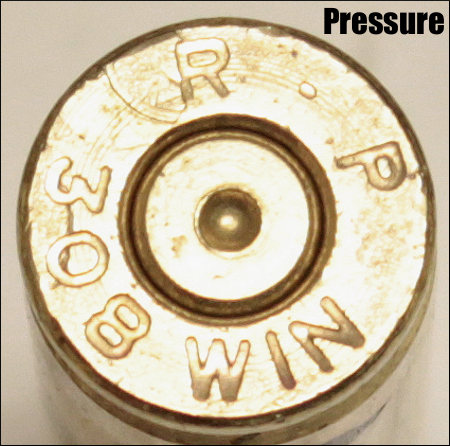
Excessive Pressure (Load Too Hot)
If you will notice in the picture of the case rim, there are two pressure signs to notice. First, look at the primer. It is basically flattened to about the max of what could be considered safe. If this was the only pressure sign noted, I would probably be fine with this load, but would constantly keep an eye on it especially if I was going to use this load in warmer temperatures. This load could easily cross into the “excess pressure” realm very quickly.
There is another sign of pressure that we cannot ignore. If you’ll notice, there is an ejector mark apparent that is located over the “R” of the R-P headstamp. This absolutely tells us that this load would not have been in the safe pressure range. If there were any of these rounds loaded, they should not be fired and should be dis-assembled. This case should not be reloaded.
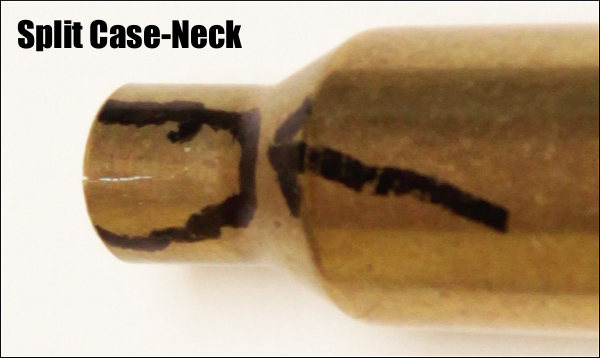
Split Case-Neck
Here we have an R-P .22-250 case that has died the death. Everything looks fine with this case except the neck is split. This case must be tossed.
A split neck is a normal occurrence that you must watch for. It is caused by work-hardening of the brass. Brass cases get harder with age and use. Brand new cases that are stored for a period of time can become hard enough that they will split like this case within one to two firings. I have had new factory loads do the same thing. Then as we resize and fire these cases repeatedly, they tend to get harder and harder. Eventually they will split. The life of the case can be extended by careful annealing practices. This is an issue that would need to be addressed in an article by itself. Of course this case is no longer usable.
In the classes that I teach, I try to use examples like this to let the students see what they should be looking for. As always, if we can assist you, whether you are new to reloading or very experienced, contact us here at Sierra Bullets by phone at 1-800-223-8799 or by email at sierra@sierrabullets.com.
Dented Case Body
Here we have a Lake City 7.62×51 (.308 Win.) case with two heavy marks/dents in the case body.
This one may be a bit of a mystery. It appears as if this case may have been caught in the action of a semi-auto rifle when the firearm jammed or the case failed to clear during the cycling process. I probably would not reload this case just to prevent any feeding problems. This also appeared to be a factory loaded round and I don’t really see any pressure issues or damage to the case.
Multiple Problems — Lake City 5.56×45 unknown year.
This case has suffered multiple failures and cannot be re-used. First its has have a very rounded shoulder that is split. Upon first look it was obvious that this round had been a victim of excess pressure. The firearm (perhaps an AR?) was apparently not in full battery, or there was possibly a headspace issue also. While taking a closer look, the primer was very flat and the outside radius of the primer cup had been lost. High pressure! Then I also noticed that there was an ejector mark on the case rim. This is most certainly an incident of excessive pressure. This case is ruined and should be discarded.
It is very important to observe and inspect your cases before each reloading. After awhile it becomes second nature to notice the little things. Never get complacent as you become more familiar with the reloading process. If ever in doubt, call Sierra’s Techs at 1-800-223-8799.
Sierra BulletsBallistic Technician Gary Prisendorf has written a nice essay about how reloading can become a life-time hobby, a rewarding pastime that can bring together a father and son…
Memories of My Father — Reloading As a Life-Time Hobby
by Gary Prisendorf
For as long as I can remember I have been around reloading. I have tons of childhood memories of my father reloading and shooting. I remember how he would let me help him load his ammunition, by letting me clean primer pockets or wipe the sizing lube off of his cases. I really thought I was doing something. Well, I guess I was, I was spending quality time with my father doing something that would become a great hobby and eventually land me a great job working for Sierra Bullets.
If you are a reloader, teach someone. You may just give them a hobby for the rest of their life and who knows, you could help them find an enjoyable career, doing something that they love.
— Gary Prisendorf
I remember watching my father sizing cases on his Herters press, dropping his powder charges with a Belding & Mull powder measure and weighing powder charges with his Texan scales. Heck, I can even remember when he would buy powder at a local pawn shop, and they would weigh it out and put it in a paper sack. He would save his empty powder cans, wrap them with masking tape and write what the powder was on them with a black magic marker.
When I was in Junior High, I got my first shotgun, a 20 gauge Mossberg 500 and within a couple of weeks my father came home with a 20 gauge Lee Load-All and a pound of Blue Dot. He gave me a crash course on how to use it, and got me up and running with a couple of safe loads. I put a lot of shells through that old 20 gauge.
From that day forward I was hooked. If I got a new gun, I was loading ammunition for it. I don’t buy factory ammunition unless I just want to shoot it up so I can get some once fired brass. I reload everything that I shoot, except for rimfire stuff, and if I could figure out how to do that safely, I would probably load that too.
Through the years I have learned to appreciate things — such as once-fired military .30-06 cases that can be converted to obscure cartridge types. And I know the value of a five-gallon bucket of lead wheel weights that will be melted down and cast into bullets.
I remember finding 19 once-fired Norma 7.7×58 Arisaka cases laying on the ground at a public shooting range, and it was like Christmas came early. I must have looked for that 20th case for about thirty minutes, but I never did find it.
I can’t thank my father enough for getting me started in reloading, he gave me a great hobby, many wonderful memories and taught me the skills that gave me a career doing something that I love.
Summer’s here, so many folks will head to the hinterlands on prairie dog safaris. On a good P-Dog adventure, you may shoot hundreds of rounds over a long weekend. So you’ll need plenty of ammo. With these ammo volume requirements, you probably won’t have time to load to benchrest standards, and you may not have the budget for match-grade bullets. To save time you may throw (rather than weigh) your charges, or even load on a progressive press. This all raises the question of ammo accuracy — how good is “good enough”? A Sierra Bullets expert answers that question here — explaining how to efficiently load ammo for varmint work.
Ammunition Accuracy Requirements 101 — Varmint Ammo
This story based on article by Sierra Bullets Chief Ballistician Tommy Todd
I load and shoot ammunition for a living. In my duties here at Sierra I constantly test bullet accuracy for our production needs. Because of this, I shoot a variety of different calibers and cartridges on a daily basis and a large demand of this shooting is keeping the guns and loads tuned for optimum accuracy. I have a very narrow window of tolerances to maintain in order to provide our customers (you) with the most accurate bullets on the market.
I have learned many tricks and techniques over the years to tuning a load, prepping brass, and cleaning barrels to keep a gun shooting. I often utilize the things I have learned and take them to extreme levels when competing in a shooting event. I also often ignore most of these things (other than safety) and simplify the process if the shooting I will be doing does not warrant.
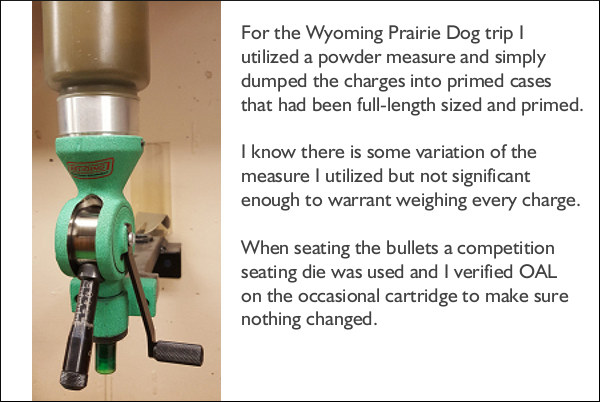
Recently I went on a prairie dog shoot in Wyoming with some good friends. The targets cooperated as did the weather with the exception of some challenging winds we experienced. We had a great time and make a lot of hits on those small rodents. When loading for the .223 Remington rifles and the TC Contender, I cut a few corners in the ammunition-loading process due to both time constraints and accuracy needed. When shooting at a prairie dog a miss is simply that, but when shooting at say the X-Ring at 1000-yard competition, a poorly-placed shot [harms your] placing in the match. Because of this, I can afford to miss an occasional shot at a varmint due to ammunition capability without worry but will not allow the same tolerances in my match ammo. For the Wyoming trip I utilized a powder measure and simply dumped the charges into primed cases that had been full-length sized and primed.
I had measured enough for length to know that while there was some variance all were under maximum length. I know there is some variation of the measure I utilized but not significant enough to warrant weighing every charge. When seating the bullets a competition seating die was used and I verified OAL on the occasional cartridge to make sure nothing changed.
This varmint ammo, with thrown charges, put TEN shots inside ONE inch at 200 yards. That’s half MOA. Good Enough? Absolutely!
The ammo produced shot under one inch at 200 yards in one of the guns I planned on taking on to Wyoming with me. [Editor: That was for TEN Shots — see above.] I knew I had loaded ammunition that was quite suitable for the task at hand which was evidenced by the number of hits I was able to make at fairly long range.
NOTE: The author, Tommy Todd, explains that, when loading ammo for F-Class matches, he uses more exacting methods. He weighs every charge and seats his bullets carefully with an arbor press. Todd adapts his methodology for his particular application. The lesson here is to load to the level of precision demanded by your discipline. READ Full Story HERE.


 Redding T-7 Still Within Spec
About Redding Reloading


 Developed in 2007 by Dennis DeMille and Dave Emary, the 6.5 Creedmoor is a shortened and improved 30 TC cartridge case that was inspired by the .308 Winchester design. This short action design was created to maximize case capacity and a wide range of loading lengths, while still fitting in standard short action magazines. With the correct twist barrel, the versatile 6.5 Creedmoor can take advantage of the wide range of bullet weights available in 6.5 mm (i.e. .264 caliber). Reloaders should keep in mind that the 6.5 Creedmoor works best with medium to medium-slow powders such as H4350, Varget, Win 760, and RE-17. The light recoil and adaptability of the efficient 6.5 Creedmoor cartridge has already proven itself in high power, precision rifle series and benchrest competitions. Couple that with respectable barrel life and its intrinsic accuracy potential and you have a recipe for success which should insure its legacy for decades to come.




 ⏺ Dozens of Hi-Viz and Specialty Targets at Great Prices