by Sierra Bullets Ballistic Technician Paul Box This cartridge was introduced by Winchester in 1935 in their model 54 rifle. A year later, it was added as a standard cartridge in the model 70. What might not be common knowledge to some reloaders is that the prototype for the Swift was developed in 1934-35 by Grosvenor Wotkyns by necking down the 250 Savage case, but in the end, Winchester chose the 6mm Lee Navy case for the foundation for this cartridge.
This cartridge was far ahead of its time and for that reason it received a lot of bad press. We’ve all read the horror stories through the years. Many of those stories were just simply repeated from previous articles even the wording was just slightly different. So how bad was the Swift? Let’s take a deeper look.
Some of the early Swifts had soft barrel steel and some of the rare ones even had barrels that were .223 in bore size. This stemmed from the fact that the .22 Hornets prior to the end of World War II were .223 in bore size and some of these barrels were chambered in the Swift. It was rumored that the Swift peaked in pressure far too quick. I’ll bet they did with a turkey extra full choke barrel.
Burn rates of powders were limited at that time as well, so the Swift was limited in its true ability due to that. It was almost like building a funny car for drag racing when only kerosene was available.
One of the longest lasting black eyes was that it shot barrels out so fast. If you get the barrel branding iron hot and fail to clean it often this can happen. Common sense will go a long ways here. Keep the barrel as cool as you can and properly clean it every fifteen rounds or less will go a long way to improving accuracy life of a Swift.
So what is the real truth about this cartridge? I’m glad you ask. I’ve been shooting the .220 Swift for over 43 years now. It is one of the best varmint cartridges I’ve ever owned. It is not hard to load for, it doesn’t suddenly peak in pressure and it isn’t the barrel burner that you’ve heard. Hodgdon powders once reported a Remington 40-X with over 3,000 rounds of full power loads averaged .344” for five, 5-shot groups. My findings have been the same. It isn’t as hard on barrels as it has been made out to be.
I’ve also read that down loading it slightly will help in barrel life. This is true, but if you buy a thoroughbred you want him to run. Barrels are threaded on the end for a reason. If you have enough fun to shoot out a Swift barrel, just rebarrel it.
The bottom line is enjoy the .220 Swift for what it was meant to be. The popularity of the Swift has slipped in the last twenty years and few factory rifles are now available in this caliber. There is no reason for this and I know the Swift will always have a strong and loyal following.
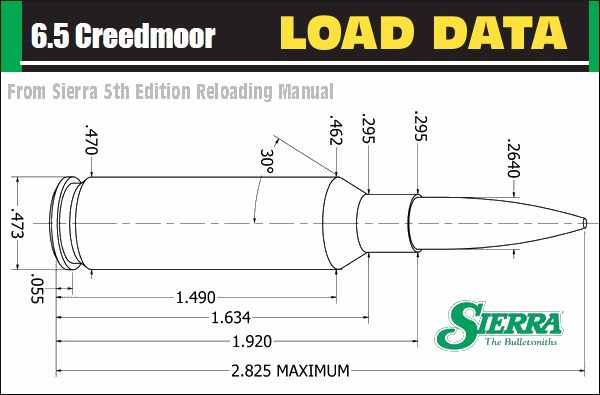
Sierra Bullets has released extensive load data for the popular 6.5 Creedmoor cartridge. This medium-sized cartridge has become one of the most popular chamberings for tactical and PRS shooters. The 6.5 Creedmoor combines excellent accuracy, good mag-feeding, good barrel life, moderate recoil, and reasonable component cost. That’s why this cartridge has caught on quickly, and is now one of the most popular chamberings in factory rifles.
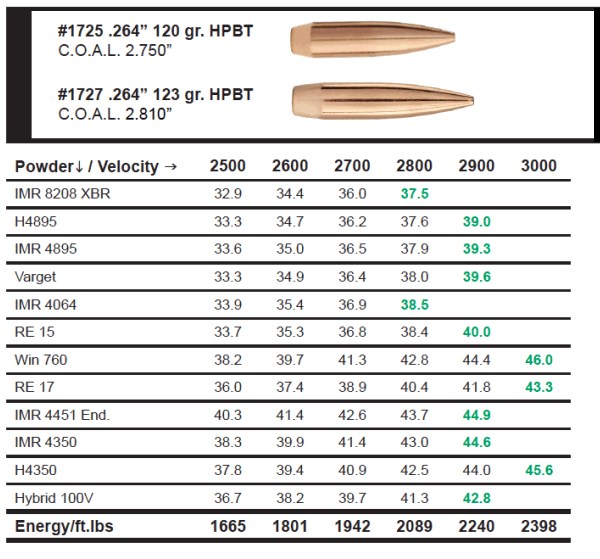
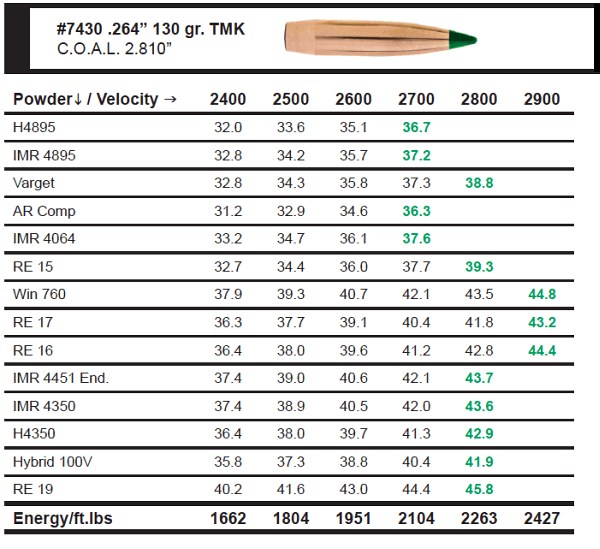
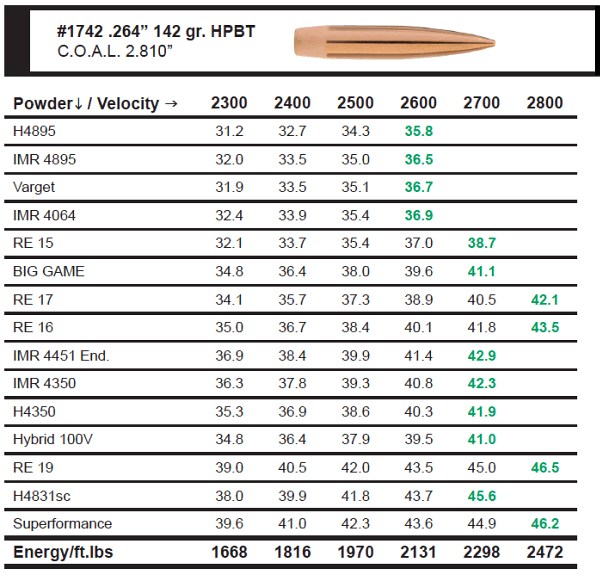
Developed in 2007 by Dennis DeMille and Dave Emary, the 6.5 Creedmoor is a shortened and improved 30 TC cartridge case that was inspired by the .308 Winchester design. This short action design was created to maximize case capacity and a wide range of loading lengths, while still fitting in standard short action magazines. With the correct twist barrel, the versatile 6.5 Creedmoor can take advantage of the wide range of bullet weights available in 6.5 mm (i.e. .264 caliber). Reloaders should keep in mind that the 6.5 Creedmoor works best with medium to medium-slow powders such as H4350, Varget, Win 760, and RE-17. The light recoil and adaptability of the efficient 6.5 Creedmoor cartridge has already proven itself in high power, precision rifle series and benchrest competitions. Couple that with respectable barrel life and its intrinsic accuracy potential and you have a recipe for success which should insure its legacy for decades to come.
Here are three tables from the Sierra Bullets Reloading Manual (5th Edition). IMPORTANT — This is just a sample!! Sierra has load data for many other 6.5mm bullet types, including FB, Spitzer, SBT, HPBT, and Tipped MK from 85 grains to 142 grains. To view ALL 6.5 Creedmoor DATA, CLICK HERE.
INDICATES MAXIMUM LOAD – USE CAUTION
LOADS LESS THAN MINIMUM CHARGES SHOWN ARE NOT RECOMMENDED.
INDICATES MAXIMUM LOAD – USE CAUTION
LOADS LESS THAN MINIMUM CHARGES SHOWN ARE NOT RECOMMENDED.
INDICATES MAXIMUM LOAD – USE CAUTION
LOADS LESS THAN MINIMUM CHARGES SHOWN ARE NOT RECOMMENDED.
Two More Great 6.5 Creedmoor Reloading Resources
Want More 6.5 Creedmoor Load Info? View Starline’s 6.5 Creedmoor Guide by Gavin Gear:
PRB 6mm Creedmoor and 6.5 Creedmoor Load Survey
The Precision Rifle Blog compiled Load Data from PRS Competitors, for both 6mm Creedmoor and 6.5 Creedmoor. This is a good place to start. PRB surveyed the match loads for “173 of the top-ranked precision rifle shooters in the country”. CLICK HERE.
Here are some really smart tips for hand-loaders compiled by Sierra Bullets. These suggestions were submitted by Sierra’s Facebook fans — and some are very valuable indeed. Some of these tips will help you load more accurate ammo. Other selections will help you stay SAFE — which should always be your #1 priority. For example, we concur with the advice to “Check and Double Check. Everything. Every Time”. Also definitely keep “One powder on the bench at a time” — that could be a life-saver. You may want to print these “words of wisdom” and place them on a wall in your loading room.
Reloading Safety Tips — Sound Advice
ALWAYS START LOW: “Just because a load manual says X grains of X powder with X bullet is max, your rifle could reach max pressure a grain or two before what the book says. Start low and work up.” — Walter Coats
BE SAFE and CAREFUL: “Check and double check. Everything. Every time. Only one type of powder on the bench at a time.” — Glen Lundgren
DON’T RUSH: “Be patient, don’t be in a hurry, have fun and find your rhythm. Just tell your family you’re putting yourself in ‘time-out’. They will understand.” — Erik Dyal
POWDER RULE #1: “One powder on the bench at one time, it might save your life.” — James A. Kimery
STAY FOCUSED: “Relaxed but concentrated attention. Have fun enjoying a great hobby and pastime but stay focused.” — Jim Caldwell
POLICE LOADING AREA: “Keep your reloading bench area clean and put items away ASAP.” — Eric J. Ford
BE PATIENT: “Focus, Focus, Focus — be patient — it AIN’T a race.” — William Stanley
RECORD YOUR LOADS: “Write down on a small card what you’re loading – bullet weight, powder weight, type of powder, and primer. And put it in the powder hopper. I am unloading .45 FMJ because I forgot what type powder was in the hopper.” — Michael Conniff
HAVE a PROCEDURE for INTERRUPTIONS: “If, for any reason, you have to leave the bench while in the process of dropping powder charges, turn the next case to be charged upside down in the loading block so you know where you left off.” — Bill Tinsley
LABEL EVERYTHING: “OCD is a good habit to have with your loading bench. CLEARLY label everything!” — Andy Pynckel
HAVE a GOAL: “Never start reloading or developing a load without a specific goal in mind. Second keep meticulous records.” — Peter Eick
RESEARCH THE JOB: “Read all you can about it before you start!” — Keith Shively
KEEP TRACK of the Brass: “I put all my primed brass upside down (primer up) and as I charge the casing, I (of course) flip it primer down.” — Mark Ewing
Need some informative reading material for winter days? Here’s a vast resource available free from Sierra Bullets. Here are links to over 60 articles with information on bullets, ballistic coefficients, wind drift, up/down angles, temperature effects, tailwind effects and much more. Most of these resources come from the respected Sierra Reloading Manuals, 4th and 5th Editions. There are enough articles to read one per week for a year!
Sierra Bullets has released extensive load data for the popular 6.5 Creedmoor cartridge. This medium-sized cartridge has become one of the most popular chamberings for tactical and PRS shooters. The 6.5 Creedmoor combines excellent accuracy, good mag-feeding, good barrel life, moderate recoil, and reasonable component cost. That’s why this cartridge has caught on quickly, and is now one of the most popular chamberings in factory rifles.
Developed in 2007 by Dennis DeMille and Dave Emary, the 6.5 Creedmoor is a shortened and improved 30 TC cartridge case that was inspired by the .308 Winchester design. This short action design was created to maximize case capacity and a wide range of loading lengths, while still fitting in standard short action magazines. With the correct twist barrel, the versatile 6.5 Creedmoor can take advantage of the wide range of bullet weights available in 6.5 mm (i.e. .264 caliber). Reloaders should keep in mind that the 6.5 Creedmoor works best with medium to medium-slow powders such as H4350, Varget, Win 760, and RE-17. The light recoil and adaptability of the efficient 6.5 Creedmoor cartridge has already proven itself in high power, precision rifle series and benchrest competitions. Couple that with respectable barrel life and its intrinsic accuracy potential and you have a recipe for success which should insure its legacy for decades to come.
Here are three tables from the Sierra Bullets Reloading Manual (5th Edition). IMPORTANT — This is just a sample!! Sierra has load data for many other 6.5mm bullet types, including FB, Spitzer, SBT, HPBT, and Tipped MK from 85 grains to 142 grains. To view ALL 6.5 Creedmoor DATA, CLICK HERE.
INDICATES MAXIMUM LOAD – USE CAUTION
LOADS LESS THAN MINIMUM CHARGES SHOWN ARE NOT RECOMMENDED.
INDICATES MAXIMUM LOAD – USE CAUTION
LOADS LESS THAN MINIMUM CHARGES SHOWN ARE NOT RECOMMENDED.
INDICATES MAXIMUM LOAD – USE CAUTION
LOADS LESS THAN MINIMUM CHARGES SHOWN ARE NOT RECOMMENDED.
Two More Great 6.5 Creedmoor Reloading Resouces
Want More 6.5 Creedmoor Load Info? View Starline’s 6.5 Creedmoor Guide by Gavin Gear:
PRB 6mm Creedmoor and 6.5 Creedmoor Load Survey
The Precision Rifle Blog compiled Load Data from PRS Competitors, for both 6mm Creedmoor and 6.5 Creedmoor. This is a good place to start. PRB surveyed the match loads for “173 of the top-ranked precision rifle shooters in the country”. CLICK HERE.
For load development, some guys shoot 3-shot groups. Other guys shoot 5-shot groups, or even 10-shot strings. But for testing its projectiles, Sierra Bullets takes it to another level entirely. A while back Sierra was testing its .30-Caliber 175gr HPBT MatchKing in the Sierra underground tunnel. The results appear above — a FIVE HUNDRED Round group!
500 Shots Form 0.82 MOA Group at 300m (328 yards)
Sierra’s trigger-pullers sent five full boxes of bullets down-range at a single target. The photo above shows the result of 500 shots taken in a 300 meter test tunnel. The raw group size, edge to edge of the farthest shots, is about 3.13 inches, as shown on the calipers’ metal linear scale. Subtract a .308″ nominal bullet diameter* to get the 2.823″ on the digital readout. So you’re seeing a 2.823″ group at 300 meters (328 yards). One MOA at this distance is 3.435″ so this 500-round group is 2.823 divided by 3.435 or 0.82 MOA (0.8218 MOA to be precise).
This 500-round group was shoot as part of a pressure/velocity test for a commercial customer. The cartridge was .308 Winchester, loaded at 2.800″. The powder was Reloder 15. A 26″ barrel was shot from a return to battery rest. The gun was cleaned every 125 rounds and two foulers shot.
What do you think — could you beat this group from a bench for 500 rounds?
One Facebook poster joked: “500-round group? Everyone knows anything less than 1000-round groups are a waste of time and statistically irrelevant.”
Sierra’s 300 Meter Testing Tunnel
Ever wonder how (and where) Sierra tests its bullets? The answer is underground, in a 300-meter test tunnel located under Sierra’s factory in Sedalia, Missouri. The photo above shows the construction of the tunnel back in May, 1990. Like most bullet manufacturers, Sierra does live-fire bullet testing of its projectiles. Sierra’s 300-meter test range is the longest, manufacturer-owned underground bullet test facility in the world. In years past, Sierra offered free visits to the test tunnel as part of a factory tour.
* Normally, to get an exact group size, you should subtract the TRUE bullet hole size, which is usually smaller than the nominal bullet diameter. E.g. a .308 bullet hole may show on paper as .298 or so. But here, for simplicity, we are subtracting .308″ because we do not have the original target to measure.
NOTE: There are ten (10) shots in the group, but for simplicity we are only displaying five (5) shot circles. Adding more circles won’t change the measurement because the two most distant shots, which determine group size, ARE included.
What kind of 200-yard accuracy can you get in an enclosed, underground test range? Would you believe 0.162 MOA at 200 yards with a .338? Have a look at these test targets from Sierra Bullets. Like most bullet manufacturers, Sierra does live-fire bullet testing to ensure that Sierra projectiles perform as promised, with repeatable accuracy. Sierra tests bullets in its own underground test complex. Sierra’s 300-meter test range is the longest, privately-owned underground bullet test facility in the Western Hemisphere.*
Day in and day out, various bullet types are tested using a big collection of barreled actions. These barreled actions are clamped in stout, return-to-battery test fixtures. These big, heavy test fixtures provide near-perfect repeatability (with no human-induced holding or aiming errors).
Sierra Bullets 10-Shot Groups at 200 yards
Check out these 10-shot test groups shot at the Sierra Test Range at 200 yards. Note that the numbers listed on each sample are actual measurements in inches. To convert to MOA, cut those numbers in half (to be more precise, divide by 2.094, which is 1 MOA at 200 yards). For example, the 0.340″ middle group works out to 0.162 MOA at 200 yards.
Scan-Verified 0.162 MOA Accuracy at 200 Yards
To verify the accuracy of Sierra’s measurements, we measured the middle (.338 caliber) 10-shot group with our On-Target Group Measurement software. We registered a group size reading of 0.339″ — within one-thousandth of the Sierra measurement. The calculated group size in MOA (Minute of Angle) is 0.162.
That’s amazingly good for ten rounds of big .338 caliber bullets. A FIVE-shot 0.162 MOA group at 200 would be considered excellent at any benchrest match. But remember this target has TEN shots. The current, one-target IBS world record for ten shots at 200 yards is 0.245″, set by Ed Watson in 1999.
Bevy of Barreled Actions for Bullet Testing
Sierra Bullets uses dozens of barreled actions for testing bullets in its enclosed, 200-yard test range. Each barrel has its own logbook to track the barrel’s usage.
Click Photo to Zoom
*Even Longer Test Tunnels Exist in Europe: At Stadeln in Germany, RWS (now part of RUAG) owns a 500 meter tunnel (above ground level) which has existed for decades. In Thun, Switzerland, RUAG has a fully-instrumented 500 meter underground tunnel. Near Ulm, Germany, there is a 5-lane 300 meter underground shooting range that is open to the public.
by Sierra Bullets Ballistic Technician Paul Box This cartridge was introduced by Winchester in 1935 in their model 54 rifle. A year later, it was added as a standard cartridge in the model 70. What might not be common knowledge to some reloaders is that the prototype for the Swift was developed in 1934-35 by Grosvenor Wotkyns by necking down the 250 Savage case, but in the end, Winchester chose the 6mm Lee Navy case for the foundation for this cartridge.
This cartridge was far ahead of its time and for that reason it received a lot of bad press. We’ve all read the horror stories through the years. Many of those stories were just simply repeated from previous articles even the wording was just slightly different. So how bad was the Swift? Let’s take a deeper look.
Some of the early Swifts had soft barrel steel and some of the rare ones even had barrels that were .223 in bore size. This stemmed from the fact that the .22 Hornets prior to the end of World War II were .223 in bore size and some of these barrels were chambered in the Swift. It was rumored that the Swift peaked in pressure far too quick. I’ll bet they did with a turkey extra full choke barrel.
Burn rates of powders were limited at that time as well, so the Swift was limited in its true ability due to that. It was almost like building a funny car for drag racing when only kerosene was available.
One of the longest lasting black eyes was that it shot barrels out so fast. If you get the barrel branding iron hot and fail to clean it often this can happen. Common sense will go a long ways here. Keep the barrel as cool as you can and properly clean it every fifteen rounds or less will go a long way to improving accuracy life of a Swift.
So what is the real truth about this cartridge? I’m glad you ask. I’ve been shooting the .220 Swift for over 43 years now. It is one of the best varmint cartridges I’ve ever owned. It is not hard to load for, it doesn’t suddenly peak in pressure and it isn’t the barrel burner that you’ve heard. Hodgdon powders once reported a Remington 40-X with over 3,000 rounds of full power loads averaged .344” for five, 5-shot groups. My findings have been the same. It isn’t as hard on barrels as it has been made out to be.
I’ve also read that down loading it slightly will help in barrel life. This is true, but if you buy a thoroughbred you want him to run. Barrels are threaded on the end for a reason. If you have enough fun to shoot out a Swift barrel, just rebarrel it.
The bottom line is enjoy the .220 Swift for what it was meant to be. The popularity of the Swift has slipped in the last twenty years and few factory rifles are now available in this caliber. There is no reason for this and I know the Swift will always have a strong and loyal following.
by Sierra Bullets Ballistic Technician Paul Box
One thing that plays a major role in building an accuracy load is neck tension [one of the factors that controls the “grip” on a bullet]. I think a lot of reloaders pretty much take this for granted and don’t give that enough thought.
So, how much neck tension is enough?
Through the years and shooting both a wide variety of calibers and burn rates of powder, I’ve had the best accuracy overall with .002″ of neck tension. Naturally you will run into a rifle now and then that will do its best with something different like .001″ or even .003″, but .002″ has worked very well for me. So how do we control the neck tension? Let’s take a look at that.
First of all, if you’re running a standard sizing die with an expander ball, just pull your decapping rod assembly out of your die and measure the expander ball. What I prefer [for starters] is to have an expander ball that is .003″ smaller than bullet diameter. So for example in a .224 caliber, run an expander ball of .221″. If you want to take the expander ball down in diameter, just chuck up your decapping rod assembly in a drill and turn it down with some emery cloth. When you have the diameter you need, polish it with three ought or four ought steel wool. This will give it a mirror finish and less drag coming through your case neck after sizing.
Tips for Dies With Interchangeable Neck Bushings
If you’re using a bushing die, I measure across the neck of eight or ten loaded rounds, then take an average on these and go .003″ under that measurement. There are other methods to determine bushing size, but this system has worked well for me.
Proper Annealing Can Deliver More Uniform Neck Tension
Another thing I want to mention is annealing. When brass is the correct softness, it will take a “set” coming out of the sizing die far better than brass that has become too hard. When brass has been work hardened to a point, it will be more springy when it comes out of a sizing die and neck tension will vary. Have you ever noticed how some bullets seated harder than others? That is why.
Paying closer attention to neck tension will give you both better accuracy and more consistent groups.
We’ve been hearing that top-name bullets are in short supply right now, particularly in popular .224, 6mm and .308 calibers. Here’s a new option for HPBT bullets that can serve for practice and local club matches. Creedmoor Sports now offers American Bullet Company bullets. These are “seconds” from a major bullet-maker, but they can be a good choice for competitors who want to spend more time on the range perfecting their position, trigger pull, and wind-reading skills.
Creedmoor Sports states: “American Bullet Company bullets technically are factory seconds, and are priced accordingly to provide more range time without breaking the bank. But, since Distinguished Rifleman Scott Young recently shot scores of 597 and 600 out of 600, with very high X counts, it’s easy to see they do not sacrifice on performance.” You can buy these bullets and save up to 50% compared to first-run offerings. Then you may want to sort the bullets by weight and/or base-to ogive measurement.
We think these are a good choice for service rifle shooters as well as M1 Garand, M1A, and 1903 Springfield shooters running .30-06 or .308 Win chamberings. And, at just $22.95 per 100 and $104.95 per 500, the 52gr and 55gr .224 bullets will also work well for high-volume varmint shooters.
These bullets are available in a .224, .243 (6mm), and .308 calibers in a variety of bullet weights. Choose 100-ct, 250-ct, or 500-ct boxes.


 This cartridge was introduced by Winchester in 1935 in their model 54 rifle. A year later, it was added as a standard cartridge in the model 70. What might not be common knowledge to some reloaders is that the prototype for the Swift was developed in 1934-35 by Grosvenor Wotkyns by necking down the 250 Savage case, but in the end, Winchester chose the 6mm Lee Navy case for the foundation for this cartridge.


 Developed in 2007 by Dennis DeMille and Dave Emary, the 6.5 Creedmoor is a shortened and improved 30 TC cartridge case that was inspired by the .308 Winchester design. This short action design was created to maximize case capacity and a wide range of loading lengths, while still fitting in standard short action magazines. With the correct twist barrel, the versatile 6.5 Creedmoor can take advantage of the wide range of bullet weights available in 6.5 mm (i.e. .264 caliber). Reloaders should keep in mind that the 6.5 Creedmoor works best with medium to medium-slow powders such as H4350, Varget, Win 760, and RE-17. The light recoil and adaptability of the efficient 6.5 Creedmoor cartridge has already proven itself in high power, precision rifle series and benchrest competitions. Couple that with respectable barrel life and its intrinsic accuracy potential and you have a recipe for success which should insure its legacy for decades to come.




 Scan-Verified 0.162 MOA Accuracy at 200 Yards


