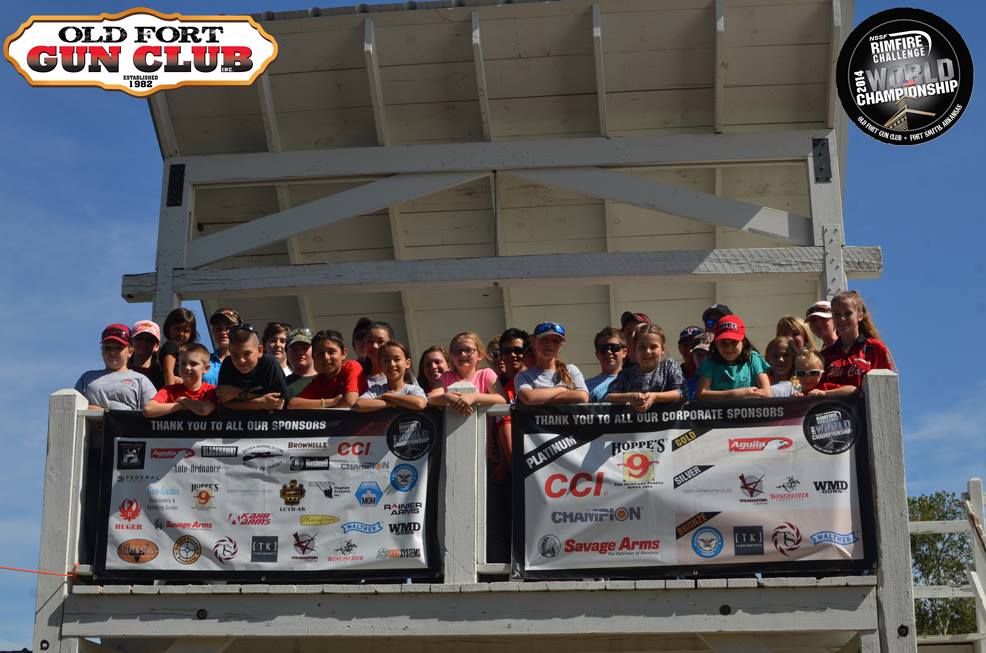
This is the kind of shooting match we like to see — with competitors of all ages having fun without having to shell out gobs of hard-earned money. More than 170 shooters competed at the NSSF Rimfire Challenge World Championship, held this past weekend (October 3-5) at the Old Fort Gun Club in Fort Smith, Arkansas. (Notably, that is ten more competitors than attended the much-ballyhooed Trijicon World Shooting Championships last month.) And, for many competitors, the Rimfire Challenge was very much a family affair — with mom, dad, and the kids all joining in the fun.
Kids Having Fun — Youth Competitors at NSSF Rimfire Challenge World Championship.
Rimfire Challenge attendance was up 60 percent this year compared to 2013. Shooters ranged in age from seven years to 83 years, with a big turn-out of junior (age 13-17) and youth (12 and under) shooters. “We are extremely pleased at the caliber of sportsmanship and camaraderie shown at Old Fort Gun Club this weekend,” said Zach Snow, NSSF Manager of Shooting Promotions. “Entire families traveled from all across the country to be here. It’s exactly this kind of supportive and family-friendly atmosphere that makes the Rimfire Challenge what it is: fun for everyone.”
B.J. Norris walked away with the top prize of World Champion. Shooting in the Open Division, Norris’ total time over the more than a dozen stages was 161.11 seconds. In second place overall was young Caleb Partch of Missouri. Caleb also won the Junior Open Division. Wayne Seale was the top Limited Division Shooter. Top Lady Shooters were Cassie Beahr of Iowa (Open) and Cheyenne Dalton (Limited and Junior). CLICK HERE for complete match results.
In the “good old days”, if you needed rimfire ammo for fun shooting, you could just head over to Walmart (or a local sporting goods store) and find a wide variety of offerings, including low-cost bulk packs from Federal, CCI, and Remington. These days, there are “slim pickings”, even at Wally World. You need to “cast a bigger net” to find rimfire ammo these days.
One of the most efficient ways to locate rimfire ammunition nationwide is to use Ammoseek.com, a specialized search engine. On its home page, Ammoseek has a handy 22LR PAGE link. With just one click you can search dozens of ammo vendors.
If you click the 22LR Page link, Ammoseek instantly calls up current ammo inventories located by Ammoseek’s automated search bots. Then Ammoseek plots ALL the available rimfire ammo, sorted from least expensive to most expensive. Here are search results from this morning, October 6, 2014. We found some CCI Blazer at $4.99 per 50-rd box (40gr LRN). That’s just want we needed for a plinking session at the range.
Story based on report by Lars Dalseide forNRABlog.com
Kevin Nevius is the 2014 NRA smallbore prone National Champion. It’s not the first time Nevius has won the NRA Smallbore Prone Rifle crown. A phenomenal prone shooter, Nevius has now secured multiple National Titles. That may be surprising notion given Kevin’s relatively late start in the sport of competitive shooting.
“My brother got me into long range varmint hunting and I started building my own guns very early,” Nevius told Dan Holmes in an earlier Pronematch.com interview. “I had a hunting friend who shot indoor smallbore who started me in three position and I was hooked.”
With a practically perfect score of 4799-390X, Nevius beat out second and third place shooters by two points … on the final day of the Conventional Championships. The 2014 NRA National Smallbore Rifle Championships wrap up this weekend with Metric Prone. Will we have another new 2014 smallbore champion or will there finally be a repeat? Stay Tuned.
Kevin Nevius, 2014 Smallbore Prone National Champion
“He showed his steel,” said Assistant Match Director Victoria Croft. “On the last day, the final relay, when it really counted, he didn’t miss a shot.”
Jamie Gray, London 2012 Gold Medalist in Women’s 3 X 20, has retired from professional shooting this year. However, Jamie plans to stay involved in the shooting sports as a Public Relations/Marketing representative for ELEY, a leading maker of rimfire ammunition. Joining the ELEY team this month, Jamie will work with shooting clubs and educational institutions to promote smallbore target shooting.
Jamie’s role in the USA will be wide ranging. Her job description includes working with state associations, governing bodies, schools, colleges and retail partners, giving educational seminars, and meeting “grass roots” shooters across the USA. Jamie has always been an icon within the USA shooting community.
Those who have met Jamie know that she is passionate about her sport and that she’s always willing to help others. Jamie’s extensive knowledge, international experience, and engaging personality makes her a great choice for ELEY’s new PR & Marketing Executive for the USA. As an Olympian who competed in Beijing 2008 and then went on to win the Gold medal at the 2012 London Olympics, she is well qualified to “inform and inspire” the next Olympic hopefuls in the shooting sports.
Rifle events concluded June 28th at the USA Shooting National Championships for Rifle/Pistol. These National Championships were Part Two of an intensive qualification process for the World Championship. USA junior team members were chosen through a selection process that included two qualifiers and a final at the National Junior Olympic Shooting Championships (NJOSC) and another two qualifiers and two finals at the National Championships held at Fort Benning, Georgia this week.
Not only were USA titles on the line, but for Junior shooters, the chance to represent the USA at the ISSF World Championship in Granada, Spain was also up for grabs.
Garrett Spurgeon claimed yet another National Title today by winning the Junior Men’s Air Rifle event. At this National Championships, Spurgeon also won the Junior Men’s 3P Rifle title. The gold medalist for Junior Women’s Three-Position Rifle, was Lauren Phillips.
In the Open division, Ryan Anderson claimed top honors in Men’s Air Rifle, narrowly edging out defending National Champion Connor Davis. The Women’s Open Division Three-Position title went to Amy Sowash. Winning silver was 2012 Olympian Amanda Furrer and winning bronze was Sarah Beard. Beard also won the prone rifle National Championship title. Beard has now won five National titles throughout her career (four in the Open division, one in Junior).
Paralympic Competition at Fort Benning
Along with the regular competition for able-bodied shooters, these Championships included Paralympic Air Rifle Prone, Free And Sport Pistol events for injured/disabled athletes. Some of these competitors shot from wheelchairs, while others shot from a bench with support for the rifles.
Report based on story by Kyle Jillson forNRA Blog The 2014 Remington and NRA National Rifle & Pistol Championships at Camp Perry, Ohio are just a couple weeks away. You can still register for one or more of the matches. Just click the orange “Register” button (below) to register online.
Many of the finest civilian and military marksmen in the United States will square off for weeks of rifle and handgun competition while vying for the NRA’s historic and prestigious trophies. From pistol, to smallbore rifle, high power rifle, and long-range high power rifle, the National Matches have something for just about everybody.
Smallbore Matches Will Be in Indiana This Year
If you’re a smallbore shooter, these next two years will be a little different. In 2014 and 2015, the NRA National Smallbore Position Championships and the NRA National Smallbore Prone Championships will be held at Chief Wa-Ke-De Range in Bristol, Indiana. This change of venue for the Smallbore Championship Events was made to accommodate the 2015 World Palma Rifle Championships at Camp Perry. (The change was made in 2014 because the World Palma teams will be practicing at Camp Perry this summer, a year before the big event.) The Chief Wa-Ke-De Range is an excellent location that has hosted the NRA National Metric Championships for the past few years.
The NRA National Rifle & Pistol Championships are the pinnacle of target shooting in the USA. If you’re itching to try out some new equipment or are looking for an excuse to buy some more accessories, the National Matches are the perfect excuse. Use the links below to register for the National Matches, or to view the 2014 program brochures (in PDF format) for the High Power, Fullbore, and Pistol disciplines.
Based on Report by Lars Dalseide for NRABlog.com
I first read about Lauren Phillips in 2012. Back then she part of a spitfire quartet known as the West Seattle/Vashon Thunderbirds. Fresh off her team’s NRA National Junior Sectional victory, she decided to start taking a more serious approach her shooting career.
Since then, she hit the road for matches in Fort Benning, Georgia, Anniston, Alabama, Camp Perry, Ohio, and Colorado Springs, Colorado. What did that travel catalog get her? How about a scholarship to the University of Nebraska and a spot in the National Junior Olympic Shooting Championships. Once she earned that Junior Olympics spot, well, let’s just say she’s been difficult to stop. So much so that she walked away with the overall Women’s Three-Position Rifle title yesterday.
To get a full breakdown of Phillip’s performance at the National Junior Olympic Shooting Championships, take a look at the press release from USA Shooting:
Phillips Dominates Women’s Three-Position Rifle at NJOSC
No one could catch Lauren Phillips. Before she even stepped on the line for the Women’s Three-Position Rifle Final at the National Junior Olympic Shooting Championships (NJOSC), Phillips (Seabeck, Wash.) already had the title in the bag.
Phillips, a freshman at the University of Nebraska, built a dominating eight-point lead over the closest competitor in the 66-shooter field. Champions at this year’s NJOSC are determined through a modified selection format similar to that of USA Shooting’s National Championships: Points are awarded points earned in each day of competition with Nebraska freshman Lauren Phillips takes a moment at the National Junior Olympic Shooting Championships additional points awarded for performance in the Final – Eight for first, seven for second and so on. Phillips finished fifth in the Final, but it didn’t really matter.
“The Qualification was just like I was planning for – build an early lead so it takes the pressure of the Final,” Phillips said. “That’s just what I did. Went in Day One with a personal best and Day Two two points lower, but stayed consistent…I went in gunning for a record Final but it didn’t happen today. There were some excellent performances by my fellow collegiates.”
The International Shooting Sports Federation (ISSF) World Cup season kicks off right here in the USA, March 26 through April 3, 2014, in Fort Benning, Georgia. Many of the world’s best rifle and pistol shooters will be on hand — more than 400 competitors from 50 nations are expected to compete at the home of the U.S. Army Marksmanship Unit (USAMU).
ISSF World Cup (Fort Benning) 2013 50m Rifle Prone Winner Valerian Sauveplane of France.
At the last Rifle/Pistol World Cup USA back in May 2013, the USA earned two medals with Will Brown winning a gold medal in Men’s 10m Air Pistol and Dempster Christenson winning a silver medal in Men’s Air Rifle. Highlights from last year’s ISSF World Cup at Fort Benning are featured in the 24-minute video linked below. The video covers both rifle and pistol disciplines.
Here is last year’s women’s 50m 3P winner at the Fort Benning World Cup, Andrea Arsovic of Serbia.
Complete ISSF World Cup (Fort Benning) Match Schedule
If you want to watch the matches,or meet some of the shooters here is a schedule for the all the events, starting with training sessions on March 27th.
Shoot like a girl? That’s a source of pride at the University of Nebraska-Lincoln. The Nebraska Huskers womens’ shooting team, Nebraska Rifle, has a strong tradition of excellence. Led by Coach Stacy Underwood, the Huskers are ranked among the top teams in the country. In the past 10 years, the Huskers have earned four Top-5 finishes in the NCAA Championships, and Nebraska has had over 30 All-American selections, as well as individual national champions.
This video spotlights some of the current members of 2013-14 Nebraska Rifle Team: Alexandrea Lorentz, ReAnn Wilson, Magdalena Mical, Lauren Phillips, Rachel Martin, Denise Martin, Sunny Russell, Marissa Major, Jaycee Carter, and Kelsey Hansen.
Nebraska Rifle Team Member Kelsey Hansen
The 2014 season is going well for the Nebraska Team. Just this past weekend the No. 8-ranked Huskers completed a sweep of two matches against Air Force, scoring a 4,679-4,671 win over the Falcons. Follow the team via the Nebraska Rifle News Page
Here is a more detailed video that shows the Nebraska Training Range, complete with electronic targets. This is one of the most advanced collegiate shooting facilities in the nation.
Getting to Know Coach Stacy Underwood
Q: What is your coaching philosophy?
A: Rifle is the only NCAA sport where you compete against yourself without awareness of how your fellow competitors are doing, until you’re finished. Only then are scores compared. So my athletes have to be totally self-contained — in motivation, discipline, and focus.
Even more, my athletes have to be supremely calm. A minute waver of even hundredths of a millimeter at the rifle barrel end can throw a shot way off a center target that’s the size of a pin head at 10 meters away. Very slight differences in breathing, heart rate, pulse strength, and muscle twitch amplify that waver.
Finally, rifle is a sport of slight differences. A perfect individual match score is 1200 points. A perfect team score is 4800 points. Perform at 96 percent of perfection and you’ll be marginally competitive. Perform at 98 percent of perfection and you’ll be setting NCAA records. It’s in that two percentage point spread that you find greatness in rifle.
So, given these rigors, I’ve organized my coaching philosophy around the idea of “just 1 percent more”. I’m asking each team member to give just 1 percent more in all areas- academics, personal development and performance.
Sounds simple, but think about what’s involved. Every team member has to deliver. To deliver, they’ll have to organize all the areas of their lives so they’re always ready mentally and physically. Any issues that come up can be referenced by “what will get us just 1 percent more”. They can learn from each other what works. Their lives – mind and body – will be in sync and at peace. That will give them calm. So my efforts will focus on helping each one achieve their goal. I expect great individual surprises, and from that, a great team result.
by Tony Chow
In recent years, the use of electronic trainer systems has revolutionized training in all disciplines of position shooting. By capturing (and illustrating) key performance variables like the steadiness of a shooter’s hold, accuracy of aiming, and the timeliness of trigger release, these devices can offer tremendous insights into the strengths and weakness of a shooter’s position and technique, making high-level marksmanship training less voodoo and more of a science.
Until now, electronic trainers all suffered from one critical limitation: the inability to be used outdoors in live fire training. Now, however, SCATT has introduced the next-generation MX-02 electronic trainer, a product that can finally support outdoor live firing in broad daylight, as well as dry firing indoors. In addition, the MX-02 is the first electronic trainer to support centerfire rifles. It goes without saying that, when we at AccurateShooter.com were offered an MX-02 test unit to review, we jumped at the opportunity.
How the SCATT MX-02 Works
The SCATT sensor mounted on the end of the barrel has a digital camera that “sees” the black bullseye in the target, even in broad daylight outdoors. Using the bullseye as a reference, the SCATT software tracks the movement of the muzzle relative to the center of the target. The unit can plot these movements as a continuous trace, which appears on a monitor as a squiggly, colored line. Data points from the trace are also available in a tabular spreadsheet format. This allows the shooter to “crunch the numbers”, revealing strengths and weaknesses in his gun-handling and aiming technique.
In our testing, we confirmed that, like SCATT’s earlier indoor-only WS-01, the MX-02 offers excellent support for indoor dry-fire training, which will continue to be the primary means through which position shooters sharpen their fundamental skills. Since the new SCATT uses the same familiar Windows software for data capture and analysis as its predecessors, shooters and coaches upgrading to MX-02 will have no learning curve to overcome, and newcomers to the SCATT platform can tap into the wealth of institutional knowledge accumulated over the years by the shooting community on how to interpret shot data.
It’s in the support for outdoor live firing, however, that SCATT MX-02 distinguishes itself from its predecessors and the competition. Shot trace data captured by MX-02 during live firing turned out to be every bit as valuable (and revealing) as we had hoped. The ability to correlate SCATT tracing with real shots on target gave us a better understanding of the shooting process, and helped the reviewer, already a high-level smallbore prone shooter, uncover a significant problem in his shooting. SCATT MX-02’s outdoor capability is therefore an invaluable feature, particularly for experienced shooters aspiring to world-class performance.
In summary, SCATT MX-02 is an outstanding product that delivers on its promises. We heartily recommend it, both for first-time users of electronic training aids, and also for those shooters who may wish to upgrade their current electronic training system. The MSRP for SCATT MX-02 is $1,799, $500 more than its predecessor, the SCATT WS-01, which is still available. In my view, the $500 premium for the MX-02 is justified by the MX-02’s enhanced capabilities, making it a better long-term investment.
Our complete, 3600-word MX-02 review of the SCATT MX-02 can be accessed through the link below. This full review contains many more photos plus detailed field test results. For the time being, the review only covers our experience with the product in smallbore shooting. An upcoming addendum to the review will include test results from centerfire shooting. Those attending SHOT Show in Las Vegas next week can examine SCATT MX-02 in person. SCATT will have the MX-02 on display at Booth 111.




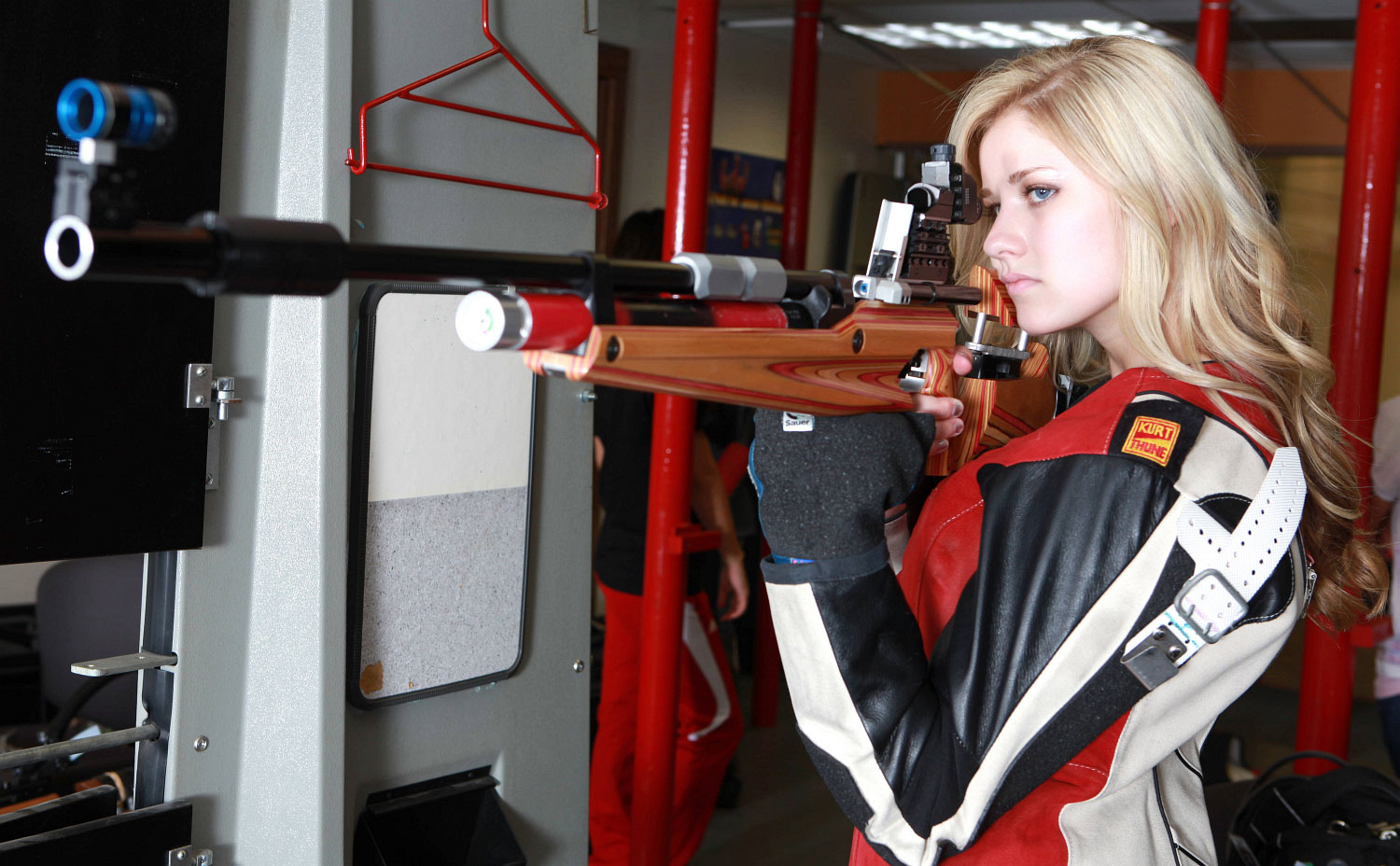
 Jamie Gray, London 2012 Gold Medalist in Women’s 3 X 20, has retired from professional shooting this year. However, Jamie plans to stay involved in the shooting sports as a Public Relations/Marketing representative for ELEY, a leading maker of rimfire ammunition. Joining the ELEY team this month, Jamie will work with shooting clubs and educational institutions to promote smallbore target shooting.




 A: Rifle is the only NCAA sport where you compete against yourself without awareness of how your fellow competitors are doing, until you’re finished. Only then are scores compared. So my athletes have to be totally self-contained — in motivation, discipline, and focus.


