Shoot like a girl? That’s a source of pride at the University of Nebraska-Lincoln. The Nebraska Huskers womens’ shooting team, Nebraska Rifle, has a strong tradition of excellence. Led by Coach Stacy Underwood, the Huskers are ranked among the top teams in the country. In the past 10 years, the Huskers have earned four Top-5 finishes in the NCAA Championships, and Nebraska has had over 30 All-American selections, as well as individual national champions.
This video spotlights some of the current members of 2013-14 Nebraska Rifle Team: Alexandrea Lorentz, ReAnn Wilson, Magdalena Mical, Lauren Phillips, Rachel Martin, Denise Martin, Sunny Russell, Marissa Major, Jaycee Carter, and Kelsey Hansen.
Nebraska Rifle Team Member Kelsey Hansen
The 2014 season is going well for the Nebraska Team. Just this past weekend the No. 8-ranked Huskers completed a sweep of two matches against Air Force, scoring a 4,679-4,671 win over the Falcons. Follow the team via the Nebraska Rifle News Page
Here is a more detailed video that shows the Nebraska Training Range, complete with electronic targets. This is one of the most advanced collegiate shooting facilities in the nation.
Getting to Know Coach Stacy Underwood
Q: What is your coaching philosophy?
A: Rifle is the only NCAA sport where you compete against yourself without awareness of how your fellow competitors are doing, until you’re finished. Only then are scores compared. So my athletes have to be totally self-contained — in motivation, discipline, and focus.
Even more, my athletes have to be supremely calm. A minute waver of even hundredths of a millimeter at the rifle barrel end can throw a shot way off a center target that’s the size of a pin head at 10 meters away. Very slight differences in breathing, heart rate, pulse strength, and muscle twitch amplify that waver.
Finally, rifle is a sport of slight differences. A perfect individual match score is 1200 points. A perfect team score is 4800 points. Perform at 96 percent of perfection and you’ll be marginally competitive. Perform at 98 percent of perfection and you’ll be setting NCAA records. It’s in that two percentage point spread that you find greatness in rifle.
So, given these rigors, I’ve organized my coaching philosophy around the idea of “just 1 percent more”. I’m asking each team member to give just 1 percent more in all areas- academics, personal development and performance.
Sounds simple, but think about what’s involved. Every team member has to deliver. To deliver, they’ll have to organize all the areas of their lives so they’re always ready mentally and physically. Any issues that come up can be referenced by “what will get us just 1 percent more”. They can learn from each other what works. Their lives – mind and body – will be in sync and at peace. That will give them calm. So my efforts will focus on helping each one achieve their goal. I expect great individual surprises, and from that, a great team result.
by Tony Chow
In recent years, the use of electronic trainer systems has revolutionized training in all disciplines of position shooting. By capturing (and illustrating) key performance variables like the steadiness of a shooter’s hold, accuracy of aiming, and the timeliness of trigger release, these devices can offer tremendous insights into the strengths and weakness of a shooter’s position and technique, making high-level marksmanship training less voodoo and more of a science.
Until now, electronic trainers all suffered from one critical limitation: the inability to be used outdoors in live fire training. Now, however, SCATT has introduced the next-generation MX-02 electronic trainer, a product that can finally support outdoor live firing in broad daylight, as well as dry firing indoors. In addition, the MX-02 is the first electronic trainer to support centerfire rifles. It goes without saying that, when we at AccurateShooter.com were offered an MX-02 test unit to review, we jumped at the opportunity.
How the SCATT MX-02 Works
The SCATT sensor mounted on the end of the barrel has a digital camera that “sees” the black bullseye in the target, even in broad daylight outdoors. Using the bullseye as a reference, the SCATT software tracks the movement of the muzzle relative to the center of the target. The unit can plot these movements as a continuous trace, which appears on a monitor as a squiggly, colored line. Data points from the trace are also available in a tabular spreadsheet format. This allows the shooter to “crunch the numbers”, revealing strengths and weaknesses in his gun-handling and aiming technique.
In our testing, we confirmed that, like SCATT’s earlier indoor-only WS-01, the MX-02 offers excellent support for indoor dry-fire training, which will continue to be the primary means through which position shooters sharpen their fundamental skills. Since the new SCATT uses the same familiar Windows software for data capture and analysis as its predecessors, shooters and coaches upgrading to MX-02 will have no learning curve to overcome, and newcomers to the SCATT platform can tap into the wealth of institutional knowledge accumulated over the years by the shooting community on how to interpret shot data.
It’s in the support for outdoor live firing, however, that SCATT MX-02 distinguishes itself from its predecessors and the competition. Shot trace data captured by MX-02 during live firing turned out to be every bit as valuable (and revealing) as we had hoped. The ability to correlate SCATT tracing with real shots on target gave us a better understanding of the shooting process, and helped the reviewer, already a high-level smallbore prone shooter, uncover a significant problem in his shooting. SCATT MX-02’s outdoor capability is therefore an invaluable feature, particularly for experienced shooters aspiring to world-class performance.
In summary, SCATT MX-02 is an outstanding product that delivers on its promises. We heartily recommend it, both for first-time users of electronic training aids, and also for those shooters who may wish to upgrade their current electronic training system. The MSRP for SCATT MX-02 is $1,799, $500 more than its predecessor, the SCATT WS-01, which is still available. In my view, the $500 premium for the MX-02 is justified by the MX-02’s enhanced capabilities, making it a better long-term investment.
Our complete, 3600-word MX-02 review of the SCATT MX-02 can be accessed through the link below. This full review contains many more photos plus detailed field test results. For the time being, the review only covers our experience with the product in smallbore shooting. An upcoming addendum to the review will include test results from centerfire shooting. Those attending SHOT Show in Las Vegas next week can examine SCATT MX-02 in person. SCATT will have the MX-02 on display at Booth 111.
Massachusetts smallbore shooter Dan Holmes, well-known match shooter and gun writer Hap Rocketto, and Erik Hoskins have developed a great dedicated website for competitive small-bore and air rifle shooters. Over the past few years, Pronematch.com has delivered quality content, including match reports, shooting tips, rule changes/updates, tech reports, and a calendar of events.
Pronematch.com also has a “human interest” feature, called the “Shooter Spotlights”. Holmes and his staff have interviewed dozens of shooters. Each marksman answers a few questions about his/her background in shooting, shooting techniques, match strategies, and personal items (such as “What is your favorite pre-match meal?).
The “Shooter Spotlights” let you “tap into” the wisdom of some of the county’s best shooters. Many of those interviewed offer some great tips, or they share fascinating anecdotes about the shooting sports.
We recommend you visit Pronematch.com, if nothing else to peruse the profiles, check the upcoming matches and read the popular “Hap’s Corner” stories. Hap is a talented writer who has provided plenty of content to ProneMatch.com. As just one example, Hap has written a fascinating Short History of Camp Perry and The National Championships.
If you watched the position and prone shooters at the 2012 London Olympic Games, you couldn’t help but notice the exotic rifles competitors were shooting. There were wood stocks, metal stocks, off the shelf rifles and customized specials. Why are there are so many different design features and stock types? To answer this question, the NRAblog’s editors called on Jessie McClain of the NRA Competitive Shooting Division.
“The customized rifles, like the Anschütz you showed me, can make a real difference in a shooter’s performance,” explained McClain. “I went from a decent shooter to making the varsity shooting team my freshman year because of the rifle.” As Jessie explained, one new feature out there is the adjustable stock, which she called the Porsche of the shooting world. Fully adjustable from the butt plate to the check piece to the hand stop and risers and bolt knobs, this component is fully customizable to the athlete … which can be a huge advantage. “Every person is different … a customizable rifle fits anyone. A rifle team can purchase four of these and field a shooting team for years.”
Not for Novices
The one warning she did have is that these are not for the novice shooter. Get a couple of years of shooting under your belt and then think about moving on to a customized rifle. That way, you can learn the basics before investing in the high dollar equipment. “You wouldn’t give your 16 year old a Ferrari for his first car, would you?”
The Modern Anschütz Position Rifle
Smallbore match rifle makers are using modern materials in response to the need for greater adjustability (and enhanced accuracy). One of the popular new designs is the Anschütz model 1913 position rifle with a “1918 ALU Precise” brushed aluminum stock. This looks like it has been crafted in an aircraft plant.
Kirsten Joy Weiss is one of America’s top smallbore shooters. Her many titles include the 2012 NRA National Women’s Smallbore 3P Championship. Using her Anschütz target rifle and Lapua ammunition, she has competed at top-level national and international events. To help demonstrate the fun of shooting, Kirsten has started her own YouTube Channel, Facebook Page, and her own website, www.KirstenJoyWeiss.com. There you’ll find shooting tips, gear reviews, and videos. Each week Kirsten does a new trick shot video. Here are three of our favorites.
Here Kirsten Drills the Center of Two Apples with One Shot:
In this Video, Kirsten Shoots from Pilates Position with Rifle Held Upside-Down (Wow!):
For this Trick Shot, Kirsten Shoots the Lead Tip off a Pencil without Breaking the Wood:
Kirsten Joy Weiss Competition Highlights
Kirsten is from Pennsylvania. A 3-time All-American in smallbore, Kirsten led the Univ. of Nebraska Cornhuskers to a 4th-place finish at the NCAA Championships. Weiss was an NRA Second-Team All-American and was named to the CRCA All-Collegiate Team twice. In 2012, Kirsten was the top USA athlete-shooter at the Munich World Cup. She won the 2012 NRA Three-Position Women’s Smallbore Championship and also won the Standing Position, while finishing as the National Overall Woman Champion.
Need .22 LR rimfire ammo? As of noon on November 4, 2013, Creedmoor Sports has 1100 boxes of SK 40-grain High Velocity HP ammunition (item #SK-HVHP) in stock. This is available in 50-count boxes or 500-count bricks, at a sale price of $8.95 per 50-round box or $83.95 per 500-round case. This is good ammo, suitable for club-level match shooting or general plinking use. If you have been searching high and low for rimfire ammo, you may want to jump on this before it’s all gone.
Technical Information
Caliber: .22 Long Rifle | Bullet Weight: 40 Grains | Bullet: Lead Hollow Point | MV: 1265 FPS
Here’s a feel-good story about a talented young shooter.
Article based on report by Lars Dalseide, forNRA Blog.
Finding the X-Ring while taking part in NRA’s National Rifle and Pistol Championships can be challenging enough. Finding the X-Ring from three positions during the smallbore rifle phase of the championships can be even more trying. But Amy Fister, winner of this year’s NRA 3-Position Rifle High Woman title, found it with no trouble at all. A surprising result given her wry self-description.
“I’m a nerd,” she said with a laugh. “I’m very dedicated to my studies.”
Based out of Kutztown, Pennsylvania, Fister walked away from the 3-Position Awards Ceremony with three titles: High Woman with Metallic Sights, High Civilian with Metallic Sights, and High Woman Overall. Fister finished with a score of 2374 – 140X (good for 7th overall). “Last year I was close but not close enough,” said Fister. “I guess this year it was my time.” Seeing her on stage, winning award after award, it’s hard to believe that it almost didn’t happen — she nearly fell victim to the summer heat at Camp Perry.
Fighting Dehydration at Camp Perry
About halfway through the National Championship match, Fister was setting up targets when she realized something was wrong: “I was delusional, seeing things,” Fister explained. “After setting up my target, it wasn’t there. I started chasing down the target guy for another one. It was an interesting and a little bit scary of an experience.”
She was dehydrated. Heartbeat rapid, extremely lethargic, unsteady on her feet — she recognized the signs and started back for the line. Pulling a bottle of Gatorade out of her bag, she gulped until it emptied. Feeling a touch steadier, she made for the water coolers behind the line. A few cups later and she was ready to proceed. “Luckily it happened during prone,” she said with a laugh. “Standing would have been a different story.”
How a Nerd Became a World-Class Rifle Shooter
Starting as far back as she can remember, Fister was out shooting with her dad. First as the official gear porter, then as a huntress. “Deer and goose, that’s what we went for,” she said. “I go out deer hunting whenever I can, but it cuts into my shooting time. You’ve got to find a happy medium.”
Though it was dad who first put a rifle in her hand, it was her sister Valerie who started her down the competitive trail. Like most stories of sibling rivalry, big sister joined the rifle team so little sister (Amy) wanted to also. A little practice, a little patience, and it all came together — so well in fact that Amy has earned a shooting scholarship to the University of Memphis. But her ambitions don’t stop there. They reach as far as Rio de Janeiro, site of the 2016 Olympics.
“I missed a spot on the U.S. Team by two points. Now the goal is to be part of the Olympic Rifle Team in 2016. Problem is that I don’t want my scores to drop and I don’t want my grades to drop.
“My goal is to become a pediatrician and an Olympian. Guess I’ll just find a way.”
To learn more about the NRA’s Competitive Shooting Programs, visit compete.nra.org.
Get Official Targets, Target Centers, Pasters, Pit Supplies, and Training Targets
Looking for training targets, competition targets, or fun targets? Well Creedmoor Sports has what you need for NRA smallbore and centerfire competition (including target pasters). Creedmoor has the official targets for most popular NRA disciplines along with the “Target Repair Centers” (Bullseye overlays that save money compared to full-size targets). In stock now are official F-Class targets, High Power rifle targets, smallbore targets, pistol targets, and air rifle targets. Creedmoor also now carries Birchwood Casey Shoot-N-C targets and Hi-Viz Orange Target Spots®. When practicing with scoped rifles, we use the 1″ Target Spots at 200 yards, and the 3″ Target Spots at 600.
Ruger recently announced the new Ruger American Rimfire™ series of bolt-action rimfire rifles, chambered in .22LR or .22 Magnum. These rifles feature an interesting convertible polymer stock and the .22LR versions can run 10/22 magazines. You could say the new rifles borrow features from the centerfire Ruger American Rifle® series, while offering mag interchangeability with 10/22 rimfire rifle. Ruger offers both full-sized (22″ barrel/13.75″ length of pull) and compact (18″ barrel/12.5″ length of pull) models, both of which are available in either .22 LR or .22 Magnum. All models have a suggested retail price of $329.00.
Comb Height Adjusts with Interchangeable Stock Modules
Ruger’s new rimfires feature interchangeable stock modules that provide variable comb heights. Standard models come with long length of pull modules, while compact models come with short length of pull modules. By simply removing the rear sling swivel stud, stock modules can be changed in seconds.
.22LR Models Can Use All 10/22 Magazines
Models chambered in .22LR feature the detachable, flush-mounted 10/22® BX1 10-round rotary magazine and accept all 10/22® magazines. Models chambered in .22 Magnum use the detachable, flush-mounted JMX1 9-round rotary magazine.
Dove-Tailed Action and Bolt with 60° Bolt Throw
Standard 3/8″ dovetails for rimfire rings are milled into the actions, which are also drilled and tapped for mounting Weaver-style bases. The 60-degree bolt can be removed with an easy-to-use, receiver-mounted bolt release that does NOT require a pull of the trigger.
Integral Bedding Block for Action
The new rimfire rifles also feature a patent-pending Power Bedding® integral bedding block system that positively locates the receiver and free floats the barrel. Additional features include a blued, hammer-forged barrel with fiber optic front sight and adjustable, folding leaf rear sight.
New Product Tip from EdLongrange. We welcome reader submissions.
Months ago, we reported on the new, .17 Winchester Super Magnum (Win Super Mag or WSM) rimfire cartridge. Able to drive a 20gr bullet over 3000 fps, this new .17 Win Super Mag raises the bar for rimfire cartridges. The .17 WSM shoots faster, flies flatter, and bucks the wind better than a .17 HMR.
Sounds good right? Well the only problem is that .17 Win Super Mag cartridges (and a rifle that could shoot them) have been virtually impossible to obtain. In January, Savage unveiled its new B-Mag rifle chambered for the .17 Win Super Mag, but there were delays getting the gun into production.
GunsAmerica Tests .17 Win Super Mag
At last, after many months, the B-mag rifle is ready, and .17 Win Super Mag rimfire ammo is starting to hit dealer’s shelves. GunsAmerica managed to score some .17 WSM rimfire ammo, borrow a B-Mag rifle, and test the new cartridge at the range. GunsAmerica has published its findings in a detailed review on the GunsAmerica Blog.
GunsAmerica Says New 17-Cal Rimfire Cartridge Is Promising:
“Savage sent us this test rifle over two months ago, but we had no ammo, so like everyone else, we waited. Finally, as you can see from these tests, the ammo has started to trickle out. Several of our dealers have reported that they have gotten 40 box orders in (and quickly out) the door, and this ammo you see here was purchased retail at Bass Pro in Hollywood, Florida. We were only able to get the 2600 fps 25 grain load, but it is still a rip-roaring monster for a rimfire, and the accuracy is acceptable, (though not fabulous for a Savage).
The Savage “B-Mag” rifle is currently the only gun for the cartridge, and it carries an MSRP of $349.00. As a first effort on a new and revolutionary rimfire, the B-Mag performed well, and the cartridge looks to have great potential.
The .17WSM is not just a hotter .17HMR. It is a different, and much larger case entirely. Winchester based it on a .27 caliber blank made for industrial nail guns used for cement nails…. They beefed up the case by doubling the wall thickness and added extra meat to the top.”


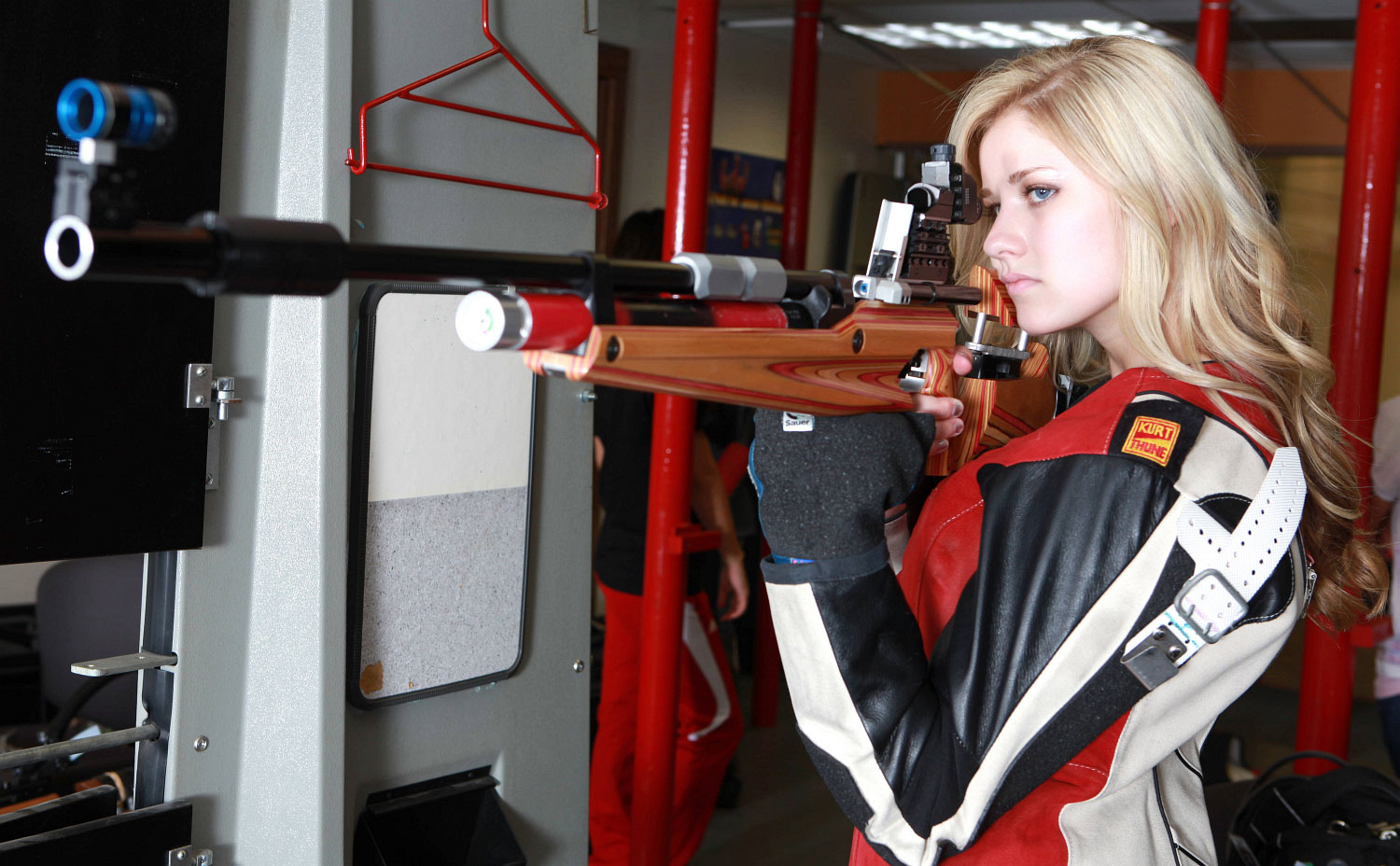


A: Rifle is the only NCAA sport where you compete against yourself without awareness of how your fellow competitors are doing, until you’re finished. Only then are scores compared. So my athletes have to be totally self-contained — in motivation, discipline, and focus.


 Pronematch.com also has a “human interest” feature, called the “Shooter Spotlights”. Holmes and his staff have interviewed dozens of shooters. Each marksman answers a few questions about his/her background in shooting, shooting techniques, match strategies, and personal items (such as “What is your favorite pre-match meal?).
 If you watched the position and prone shooters at the 2012 London Olympic Games, you couldn’t help but notice the exotic rifles competitors were shooting. There were wood stocks, metal stocks, off the shelf rifles and customized specials. Why are there are so many different design features and stock types? To answer this question, the NRAblog’s editors called on Jessie McClain of the NRA Competitive Shooting Division.


 Kirsten Joy Weiss Competition Highlights

 Though it was dad who first put a rifle in her hand, it was her sister Valerie who started her down the competitive trail. Like most stories of sibling rivalry, big sister joined the rifle team so little sister (Amy) wanted to also. A little practice, a little patience, and it all came together — so well in fact that Amy has earned a shooting scholarship to the University of Memphis. But her ambitions don’t stop there. They reach as far as Rio de Janeiro, site of the 2016 Olympics.
 Get Official Targets, Target Centers, Pasters, Pit Supplies, and Training Targets


