The National Shooting Sports Foundation and Cavern Cove Rimfire welcomes everyone to join us October 14 – 16, 2016 for the 2016 NSSF Rimfire Challenge World Championship! The event will be hosted at the Cavern Cove Rimfire facility in Woodville, Alabama.
Competitors will be challenged with both rimfire pistol and rifle stages. As with all NSSF Rimfire Challenge events, both novice and experienced shooters are encouraged to participate. This event is designed to be fun and enjoyable for all skill levels. For many shooters, a Rimfire Challenge represents their first competitive shooting experience.
Rimfire Challenge events are intended to be entertaining for the entire family. Whether you’re coming as a spectator or a competitor, side shooting activities are in the works so that everyone in attendance will have the opportunity to enjoy some trigger time. Come one come all to what will be a very exciting and fun weekend!
Today is an important day for Team USA shooters at the Rio Olympics. American rifle marksmen SFC Michael McPhail and David Higgins will be competing in the smallbore 50m prone event. In addition, 25m Pistol shooters will compete, and the Women’s Skeet Finals will be held this afternoon.
Schedule for the Remaining 2016 Olympic Shooting Events:
Friday, August 12
8:00 am – 50m Rifle Prone Men
8:00 am – Skeet Women
9:30 am – Skeet Men Day 1
10:00 am – Finals 50m Rifle Prone Men
11:15 am – 25m Rapid Fire Pistol Men Stage 1
2:00 pm – Finals Skeet Women
Saturday, August 13
8:00 am – 25m Rapid Fire Pistol Men Stage 2
8:30 am – Skeet Men Day 2
11:30 am – Finals 25m Rapid Fire Pistol Men
2:00 pm – Finals Skeet Men
Sunday, August 14
8:00 am – 50m Rifle 3-Position Men
12:00 pm – Finals 50m Rifle 3-Position Men
SFC Michael McPhail
Hopes are high for McPhail, one of the favorites to win a shooting Gold Medal in Rio. McPhail, ranked number one in the world in men’s 50-meter rifle prone, won the ISSF World Cup Finals in Munich this September. McPhail also won back-to-back gold medals at the ISSF World Cup events at Fort Benning, GA and Munich, Germany, held in May and early June of 2015. This is McPhail’s second Olympic appearance, so he understands what’s at stake: “The Olympics are unlike any other match you’ll ever shoot, the magnitude of it….”
SFC Michael McPhail, shown above, is currently ranked #1 in the world in the smallbore 50m prone rifle discipline. He’s one of the favorites to win Gold today in Rio.
David Higgins
Air Force Academy graduate David Higgins has been a competitive shooter since his early teens. “I was 13 when I first began shooting Rifle competitively, and I immediately knew that I wanted to pursue Rifle as my primary sport,” said Higgins.
Higgins recently graduated from the Air Force Academy and enjoys rock climbing, sailing and surfing in his free time. He now moves on to the next phase of his military career, having cross-commissioned into the Marine Corps upon graduation to become an infantry officer.
Virginia “Ginny” Thrasher, who will compete in the Rio Olympics this summer, showed continued dominance of her sport by winning the women’s national Air Rifle title last week at Fort Benning, Georgia, home of the USAMU. Mindy has been on fire in recent months. In April she won the 2016 U.S. Olympic Team Trials in Smallbore Rifle, securing a spot at the Rio Olympics. Prior to that, Ginny won individual NCAA titles in both air rifle and smallbore — as a freshman! This girl is a genuine phenom…
Thrasher, a member of the West Virginia University Mountaineers, has been on a tear of late. After winning the the Olympic Trials in Three-Position Rifle in April, she then earned two finals appearances at the Munich World Cup in May. Prior to that, Ginny’s sharpshooting earned her individual NCAA titles in air rifle and smallbore. With those performances, the talented freshman led West Virginia University to the collegiate team title and was named Top Performer of the 2016 NCAA Shooting Championship.
Her WVU coach, Jon Hammond, said Ginny has had an amazing run to Rio: “It’s an unbelievable freshman year to win NCAA championships and qualify for the Olympics. I would hazard she’s probably going to be one of the youngest members of the U.S. shooting team at the Olympics.”
Thrasher earned her way onto the national team with a stellar performance at the 2015 U.S. championships, where she won five medals, three in junior competition and two in open competition. That performance propelled her into her freshman season at West Virginia University.
This year’s USA Shooting National Championships includes more than 300 athletes vying for National Team selections and the upcoming Olympic and Paralympic Games in Rio De Janeiro, Brazil. Other shooters attending this year’s Nationals are looking ahead to the next Olympic Games — Tokyo 2020.
Mindy Miles (Weatherford, Texas) finished second at Nationals behind Thrasher in the women’s Air Rifle Event. Thrasher’s Team USA teammate at the Rio Olympics, Sarah Scherer (Woburn, Massachusetts), won the Final to finish third overall.
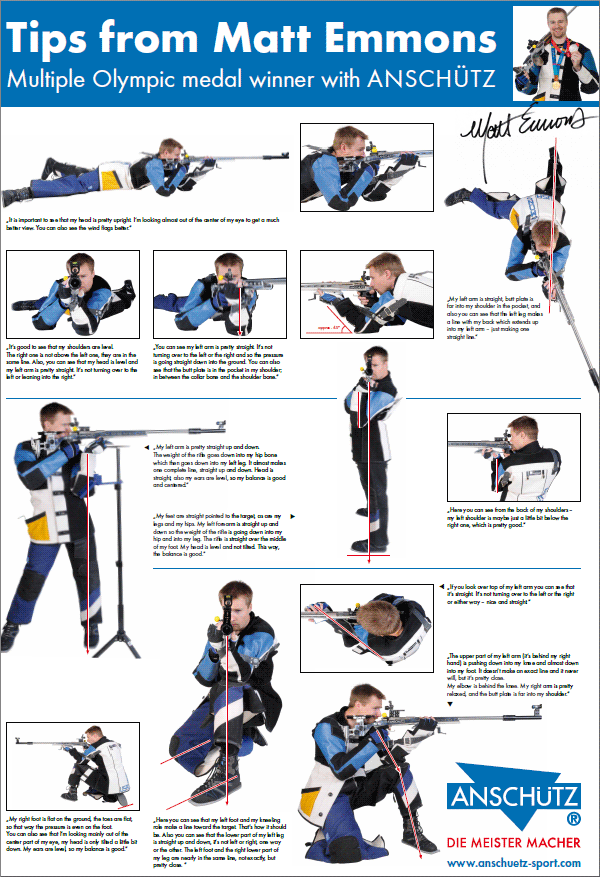
The 2016 Summer Olympics in Rio de Janeiro, Brazil are coming up soon. The Rio Olympic Games will include rifle, pistol, and shotgun competitions. Shooting events will be held in Brazil’s ultra-modern Olympic Shooting Center, originally created for the 2007 Pan-American Games at a cost of $53.5 million. Perhaps the most challenging Olympic rifle discipline is the 50m three-position (3P) smallbore match. In this article, American Olympian Matt Emmons provides expert tips on three-position shooting.
Here Matt Shows the Kneeling Position. The other two positions are Standing and Prone.
Matt Emmons will compete in the Three-Position Event at the Rio Olympics, seeking his fourth Olympic medal. Rio marks Matt’s fourth Olympic appearance — he has competed on the U.S. National Team since 1997, medaling in three Olympic games: Gold in 2004 in Men’s 50m Prone; Silver in 2008 in Men’s 50m Prone; and Bronze in 2012 in Men’s 50m 3X40. Although his specialty is Men’s 3-Position rifle, Emmons’ World Championship and Olympic Gold are in Men’s 50m Prone. He usually shoots an Anschütz or Bleiker .22LR rifle, with Eley Tenex ammo.
Here are shooting tips from Matt, courtesy Anschütz. Click image below to launch a large PDF file. Right-click the image and “save as” to download the poster-sized PDF.
CLICK Photo to Load Large PDF File
Three Sets of Hardware for Three Positions
You may be surprised to find that Matt often totes three complete sets of rifle parts to important matches — three buttplates, three cheekpieces, and three Centra sights with adjustable irises. Matt told Shooting Sports USA that he travels with “three sets for three positions. Our final is so fast that I need three sets of everything to allow a fast change-over between positions.” Matt carries his gear in an an Anschütz sport bag: “It’s similar to the big Ogio duffels with wheels, but lighter. I’ve worked with AHG/Anschütz for many years and I like their bag because all of my junk fits in it.”
Emmons, who will be competing in Rio this upcoming August, also carries something for good luck: “My wife Katy gave me a little figurine of a Czech fairytale character a long time ago for good luck and I always have it with me when I shoot.”
Story based on article by Ashley Brugnone, CMP Writer
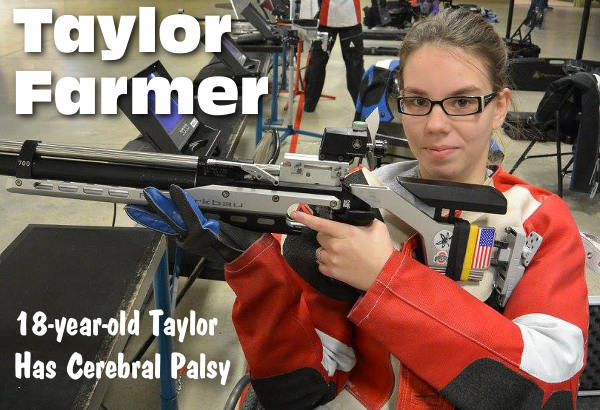
This story is about two shooters who have shown dedication, courage, and the ability to overcome physical limitations. 18-year-old Taylor Farmer has cerebral palsy. Her mentor and shooting coach, Greg Drown, has multiple sclerosis. But working together, Taylor has shown amazing abilities in competitive shooting. Taylor hopes someday to compete for the USA as a paralympic shooter in the Olympics.
Taylor Farmer was born to persevere. Her entire life, cerebral palsy (a neurological condition that limits muscle coordination) has forced her to work harder than others to achieve her goals. The effects of the disease on her body cause her to walk with crutches and to use a wheelchair for longer distances — but that hasn’t slowed her down.
As a teenager, Taylor began shooting rifle with her dad and her older brother. She never let the cerebral palsy get in the way of her desire to shoot. “I didn’t really think of it as being a challenge. I just wanted to do it…” she said.
Taylor built her marksmanship skills shooting rimfire rifles with a junior 4-H club. Her 4-H coach, Mary Ann Miller, recognized Taylor’s talent and introduced her to Greg Drown, a past State Champion shooter. That was the beginning of a great partnership…
Shooting Champion Doesn’t Let Multiple Sclerosis Stop Him
Greg Drown, 56, was a member of the Ohio State University Rifle team from 1980-1984, serving as team captain and earning numerous shooting honors. He competed in the 1984 Olympic Team Tryouts in Los Angeles and has been a State Champion in Three Position Air Rifle and Smallbore Prone. But a greater challenge lay ahead…
From 1995-2000, Greg gradually developed multiple sclerosis, a disabling condition of the central nervous system. His disease placed him in a wheelchair, but his determination kept him moving further into his shooting career (and winning a slew of gold medals and championships).
“It was a daunting task to re-learn the positions, not to mention shooting out of a chair with an attached table,” he said. “I had my trials and tribulations, but it took three or four years to become competitive again.” With determination, Greg reached the pinnacle of his career by winning the 2009 3P Any Sight Para National Championship at Camp Perry. He also made it to a Para World Cup in 2011.
Greg and Taylor Work Together
In September 2015, Greg and Taylor connected for the first time during the Ohio Day at the Range at Camp Perry. This event, held annually at the Gary Anderson CMP Competition Center, is conducted for children and adults with disabilities and their families.
“I grabbed a sporter rifle off the rack and Taylor began shooting off the foam rests,” Greg said. “She consistently put 20 or so shots in the 10 ring.”
Taylor then asked Greg if she could get rid of the rest and shoot out of the adapted standing position while seated in her wheelchair. To Greg’s amazement, she continued to put shot after shot in the 9 and 10 ring — all without a coat and glove.
The NRA has released new, updated versions of Competition Rules, with changes that have been adopted for 2016. There are quite a few minor changes affecting rifle competitors in High Power, Service Rifle, Prone AR Platform Rifle, F-Class, and Smallbore Disciplines. There are also new rules for matches with Electronic Targets.
You can download the updated rules, discipline by discipline, on the NRA Rulebook Page: http://rulebooks.nra.org. Bound copies of NRA Rule Books may be ordered online from the NRA Store: http://materials.nrahq.org.
by Tony Chow
In recent years, the use of electronic trainer systems has revolutionized training in all disciplines of position shooting. By capturing (and illustrating) key performance variables like the steadiness of a shooter’s hold, accuracy of aiming, and the timeliness of trigger release, these devices can offer tremendous insights into the strengths and weakness of a shooter’s position and technique, making high-level marksmanship training less voodoo and more of a science.
Until now, electronic trainers all suffered from one critical limitation: the inability to be used outdoors in live fire training. Now, however, SCATT has introduced the next-generation MX-02 electronic trainer, a product that can finally support outdoor live firing in broad daylight, as well as dry firing indoors. In addition, the MX-02 is the first electronic trainer to support centerfire rifles. It goes without saying that, when we at AccurateShooter.com were offered an MX-02 test unit to review, we jumped at the opportunity.
How the SCATT MX-02 Works
The SCATT sensor mounted on the end of the barrel has a digital camera that “sees” the black bullseye in the target, even in broad daylight outdoors. Using the bullseye as a reference, the SCATT software tracks the movement of the muzzle relative to the center of the target. The unit can plot these movements as a continuous trace, which appears on a monitor as a squiggly, colored line. Data points from the trace are also available in a tabular spreadsheet format. This allows the shooter to “crunch the numbers”, revealing strengths and weaknesses in his gun-handling and aiming technique.
In our testing, we confirmed that, like SCATT’s earlier indoor-only WS-01, the MX-02 offers excellent support for indoor dry-fire training, which will continue to be the primary means through which position shooters sharpen their fundamental skills. Since the new SCATT uses the same familiar Windows software for data capture and analysis as its predecessors, shooters and coaches upgrading to MX-02 will have no learning curve to overcome, and newcomers to the SCATT platform can tap into the wealth of institutional knowledge accumulated over the years by the shooting community on how to interpret shot data.
It’s in the support for outdoor live firing, however, that SCATT MX-02 distinguishes itself from its predecessors and the competition. Shot trace data captured by MX-02 during live firing turned out to be every bit as valuable (and revealing) as we had hoped. The ability to correlate SCATT tracing with real shots on target gave us a better understanding of the shooting process, and helped the reviewer, already a high-level smallbore prone shooter, uncover a significant problem in his shooting. SCATT MX-02’s outdoor capability is therefore an invaluable feature, particularly for experienced shooters aspiring to world-class performance.
In summary, SCATT MX-02 is an outstanding product that delivers on its promises. We heartily recommend it, both for first-time users of electronic training aids, and also for those shooters who may wish to upgrade their current electronic training system. The MSRP for SCATT MX-02 is $1,799, $500 more than its predecessor, the SCATT WS-01, which is still available. In my view, the $500 premium for the MX-02 is justified by the MX-02’s enhanced capabilities, making it a better long-term investment.
Our complete, 3600-word MX-02 review of the SCATT MX-02 can be accessed through the link below. This full review contains many more photos plus detailed field test results. For the time being, the review only covers our experience with the product in smallbore shooting. An upcoming addendum to the review will include test results from centerfire shooting. Those attending SHOT Show in Las Vegas next week can examine SCATT MX-02 in person. SCATT will have the MX-02 on display at Booth 111.
The 2016 IWA Outdoor Classics trade show (aka “Euro SHOT Show”) is now history. The IWA event increases in popularity each year. In 2016 there were 1457 exhibitors with nearly 5000 products on display. The final 2016 attendance count is not complete but there were probably close to 44,000 visitors at the IWA show in Nuremberg, Germany. Last year, in 2015, there were 41,748 trade visitors from 122 countries. The video below shows highlights of the 2015 IWA Outdoor Classic event:
IWA Outdoor Classics 2016 Wrap-Up Video
Many interesting new products were showcased at IWA this year. Here are some of the more innovative or noteworthy guns and shooting accessories on display in Nuremberg:
Anschutz 54.30 Smallbore Action and Rifle
The new Anschutz 54.30 smallbore target barreled action features a threaded receiver and barrel — a change from the past (when barrels were pressed and pinned). The new 54.30 action has many other important design improvements. The loading port was moved 30mm rewards and was reduced in size by 18%, resulting in a more rigid receiver. The closer location of the loading port is more ergonomic, allowing less movement when in position. The weight of the firing pin was reduced, resulting in a velocity increase of the firing pin and a shorter lock-time. Anschutz also claims that a newly-designed barrel chamber improves overall accuracy. The new 54.30 match action can be installed into all available stocks which fit Anschutz round match actions such as the 1907 or 1913.
Dentler Basis Vario — Modular Rifle Scope Mounting System
Dentler has introduced an interesting modular scope mounting system that allows you to quickly switch optics while retaining zero. The system offers many variations for scope height, optic type, and fore-aft position. Dentler claims this system offers 100% repeatable zeroes. Watch the video to see how the BASIS VARIO mounting system works.
CK Technology — Granular Rubber Bullet Trap
This is a smart use of recycled rubber materials. CK Technology of Belgium has created a new bullet trap that uses small rubber beads to capture bullets. The granular bullet trap is made of rubber granulates placed on an inclined galvanized steel plate. It offers many advantages compared to traditional steel bullet traps– most importantly there is less pollution, reduced noise, and most importantly, bullets are captured intact so there are no ricochets. This system works for up to .50 caliber bullets, and can be installed indoors or outdoors. The CK bullet trap takes up less space than a conventional steel bullet trap — an advantage for indoor ranges.
SIUS AG — Color Touch-Screen Electronic Scoring Display
SIUS AG is a leader in electronic scoring technology, and the new SA951 control/display unit represents the state of the art. The latest generation SA951 is designed for all types of pistols and rifles, centerfire, rimfire, and airguns. SIUS states the the SA951 is currently the only unit with ISSF Phase III approval for all types of firearms and airguns. The SA951 features a sharp 10.5-inch color touchscreen that permits the competitor to see his/her targets and easily navigate a variety of functions — all with the touch of a finger. Using the control menu and selecting programms and screens is easy, quick and intuitive. The control unit can also be operated via the remote control or the proven barcode scanner. This allows users the same kind of operation as with predecessor models SA931/SA941.
Korth Super Sport Revolver
This is one serious wheelgun. The new Korth Super Sport Revolver is big and beefy with Picatinny-type rails on top and on both sides of the barrel. Chambered for .357 Magnum, this gun was designed for used in action matches such as the Bianchi Cup. Weighing a hefty 3.64 pounds (1.652 kg), the Korth Super Sport is over 11 inches long, without compensator. This gun has many innovative features, including: externally adjustable hammer spring, externally adjustable double-action cycle (with pressure point wheel), adjustable iron sights, and quick-change cylinder (for caliber change to .38 Special or 9mm Para). Here’s video of the gun being shot at the SHOT Show Media Day event in January.
Svensk Jaktvision PhoneCam Holder
Svensk Jaktvision of Sweden offers a handy product that mounts a smartphone above your rifle-scope. This product is designed for hunters who want to record their experience in the wild. But the system is also useful for marksmanship training. The top-mounted smartphone screen allows a coach/instructor to see how the rifle moves in the hands of the trainee. Watch the video to see how the Jaktvision PhoneCam holder can be employed in the field.
Online registration is officially open for the 2016 NRA National Rifle and Pistol Championships at Camp Perry, Ohio. Held July 11 through August 9, 2016, the National Matches attract the nation’s finest civilian and military marksmen who will participate in a month of competitive shooting on the shores of Lake Erie. From pistol, to smallbore rifle, high power rifle, and long range high power rifle (including F-Class), the national matches have something for just about every serious shooter.
Shooters may now register to compete in this summer’s 2016 NRA National Rifle and Pistol Championships at Camp Perry, Ohio. Championship will be held in NRA’s Pistol, High Power, Mid-Range, and Long Range disciplines. Click the links below for the 2016 NM Calendar and NM Registration Form:
Smallbore Championships Will Be Held in Bristol, Indiana
As usual, the pistol, High Power, and High Power Long Range Championships will be held at Camp Perry, Ohio, on the shores of Lake Erie. However, the NRA National Smallbore Position Championships and Smallbore Prone Championships will be held at the Chief Wa-Ke-De Range in Bristol, Indiana. This year’s Smallbore Championships are scheduled for July 10 through July 18th.
Report based on story byNRABlog.com
Starting this summer, the NRA National Smallbore Rifle Championships will no longer feature a separate “High Women” award. From now on, men and women will compete shoulder to shoulder in the same category — every shooter will be scored in a single group regardless of gender. (There will still be age-based categories; also men and women have always been eligible to win match top honors regardless of gender).
The reason for this change is, quite simply, that ladies can shoot as well as men (or better in many cases). Consequently, there is no need for a separate class for women: “There is a high degree of parity between men and women shooters in the smallbore championships,” said H.Q. Moody, national manager of NRA’s Rifle Department. Moody explained: “Women are rightly viewed as equals in today’s America. Shouldn’t our championships reflect that attitude as well? Our smallbore committee has discussed making the championships gender equitable for many years now and finally felt it was the right time to implement the change.”
Men and women will now compete on equal terms at the National Smallbore Championship, competing for the same honors in “gender-neutral” classifications. Photo courtesy Shooting Sports USA.
This change was officially adopted this past January at the NRA Board of Directors winter meetings. It only affects the NRA National Smallbore Rifle Championships for now, but a positive reception could see “gender-neutrality” spread to regional matches and below, and maybe even other NRA disciplines.
History of Women’s Classfication in Smallbore Competition
The women’s category was first introduced to the smallbore championships nearly 70 years ago. Back then, military shooters were dominating the field so convincingly that several new categories were created to recognize the accomplishments of civilian shooters. This move saw the creation of not just the Woman category, but also Junior and Senior. The latter two have since expanded even further (e.g. Grand Senior, Intermediate Junior) to accommodate the skill discrepancies within levels and they make perfect sense to have; junior shooters are generally more inexperienced and many seniors are affected by physical limitations.
But the same can no longer be said of the women’s category. While military shooters still do very well nowadays, the proliferation of female service members has seen quite a few woman match winners. There are also a number of extraordinary female civilian shooters who finish near the top of each year’s overall standings. For instance, women shooters placed first in each of the two aggregate matches that determined last year’s Conventional 3-Position Champion.


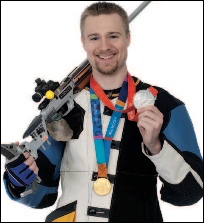 Matt Emmons will compete in the Three-Position Event at the Rio Olympics, seeking his fourth Olympic medal. Rio marks Matt’s fourth Olympic appearance — he has competed on the U.S. National Team since 1997, medaling in three Olympic games: Gold in 2004 in Men’s 50m Prone; Silver in 2008 in Men’s 50m Prone; and Bronze in 2012 in Men’s 50m 3X40. Although his specialty is Men’s 3-Position rifle, Emmons’ World Championship and Olympic Gold are in Men’s 50m Prone. He usually shoots an Anschütz or Bleiker .22LR rifle, with Eley Tenex ammo.