by Steven Blair, 2012 California State Long Range F-Open Champion
Assess the Terrain and How the Wind Will Interact with It
Before you begin a match, take a few minutes to look around the range at the terrain, any obstructions, range topography (berms and backstop), and trees, buildings or structures that could affect wind flow over the range. Imagine what might happen if the wind was from the left or right, headwind or tailwind. Depending upon the direction, significant effects may be seen on range. A head or tail wind may ripple across the berms, causing elevation changes, both high and low. A tall side berm, like the east side berm at Ben Avery, may cause turbulence when the wind comes from that direction. Blocking features might shield most of the wind but a break along the range can funnel strong gusts through the gap with no other indications. Take a few notes about the effects of different wind directions and refer to them if the prevailing direction changes. (Tip courtesy Tony Robertson.)
Use a Spotting Scope, Even When Shooting a Scoped Rifle
A good spotting scope can “see” mirage much more clearly than even an expensive rifle scope. Take your spotting scope to the line and position it as sling shooters do, close enough to use without much movement. Focus the scope approximately 1/3 of the way down range or where the most significant wind effects are likely to occur. Take a quick look while waiting for pit service, glance at the flags and compare to your scope sight picture. I often see ambiguous indications at the target through the rifle scope, but see a clear indication of wind direction and speed through the spotting scope at the shorter distance. When shooting the Arizona Palma Championship at Ben Avery last weekend, I was scoring while the wind was coming from the east. Shooters up and down the line were out to the left, losing points. Mirage at the target looked moderate and the flags weren’t indicating strong wind. As I focused the spotting scope back, the mirage suddenly looked like it was flowing twice as fast around 500 yards than it was closer or farther. It wasn’t until I realized that the access road cut through the berm there that I understood what was happening. (Tip courtesy Gary Eliseo.)
Don’t Over-React to Something That May Be an Anomaly
On ranges with sizable berms, a headwind or tailwind can cause significant elevation problems. It is generally not possible to see or predict when this will occur. When the conditions exist that cause elevation changes and other competitors are experiencing the same problem, the best strategy is to ignore it. Certainly, avoid shooting when the head or tail wind is gusting, the same as you would in a crosswind. But, if you react to random, range-induced elevation changes, the only likely result is to make it worse. Whether the problem is caused by range or ammunition, maintain your waterline hold until you have evidence that something has fundamentally changed.
My .284 Shehane will usually require a click or two down during a string as the barrel warms. That is normal and manageable. But, if your shots are just bouncing up and down in the 10 ring, leave it alone. The same is also true of an occasional gust pushing a shot into the 9 ring. If the conditions have not changed and one shot just went out, it may be the result of a random occurrence that was not predictable. (Tip courtesy “School of Hard Knocks”.)
Adjust Spotting Scope Focus and Magnification as Needed to View Mirage vs. Target Details
In F-Class we only need to see mirage, spotters, and scoring disks. That does not take a lot of magnification. My scope is a Nikon 25-75x82mm ED. It is a superb scope for the money and makes it trivial to see minor variations in mirage. It is good to have the high magnification available, and it can always be reduced if necessary. I use different power settings for different situations.
Setting Magnification Levels
During a match, in very good viewing conditions, I set my spotting scope at 75X, full power. The mirage is more subtle in the morning and greater magnification is needed.
During a match with heavy mirage I set my spotting scope at about 40X. I have no problem seeing mirage, even at this magnification.
When practicing at 300 yards or closer I set my spotting scope at max power (75X) so I can see the little 6mm holes from my 6BR rifle. I usually need to focus back and forth between shots to see both bullet holes and mirage.
Steven Blair, 2012 California State Long Range F-Open Champion, has been shooting since childhood and competing for over 30 years. Before retiring, Steve spent 16 years in Engineering and IT with General Atomics. He has held Engineering and Marketing positions with several firearms companies and worked on projects from pistols to 155mm howitzers.
Meopta USA now offers additional versions of its award-winning MeoPix® iScoping Adapter to fit Swarovski, Leica and Zeiss spotting scopes and binoculars, as well as most popular mid-level optics brands. With this iScoping Adapter, you can use your iPhone to record still images or video of the view through your spotting scope. This is great for capturing views of your target, or to record mirage conditions and flag positions for later study.
Available in several eyecup diameters, the MeoPix® iScoping adapter correctly positions an iPhone® 4/4S to a spotting scope or binocular eyepiece. Proprietary technology provides a secure fit to the iPhone and precise alignment to the spotting scope or binocular eyepiece. Priced at $59.99, the iScoping Adapter is sold by Cabelas.com and major optics dealers. “The overwhelming responses and feedback about the MeoPix iScoping Adapter convinced us to make versions to fit most popular brands of optics” said Meopta USA GM Reinhard Seipp.
Bushnell is now offering rebates on popular rifle scopes and spotting scope. Through this “Bushnell Bonanza” promo, you can save up to $75.00 on Elite, Legend Ultra HD, or Trophy XLT Riflescopes and Spotting Scopes. An Elite would be a choice for an affordable optic for your hunting or varminting rifle. Bushnell’s Elite series of scopes are pretty darn good for the price, and Bushnell offers a ‘Bullet-Proof’ money-back gaurantee — if you don’t like the scope, send it back, and Bushnell will refund 100% of the purchase price. Can’t argue with that.
To get your rebate, you must purchase a qualifying product before the end of October. Then you must complete a REBATE FORM and mail it (along with Sales Receipt, and Package Barcode tag) back to Bushnell before 11/15/2012.
Promo Tip from EdLongrange. We welcome reader submissions.
Swarovski has just announced a truly revolutionary spotting scope system. Imagine a “normal” spotting scope sliced in half, with separate objective (front) units and separate eyepiece (rear) units. This way you can have both straight and angled viewing options, and you can select from three (3) different objectives (65mm, 85mm, 95mm), depending on the light-gathering and max magnification you need for the job (and the weight you’re willing to carry).
The new Swarovski Optik ATX/STX Modular Spotting Scope combines a straight (#49902) or angled (#49901) rear eyepiece module with any one of three front objective sections, the largest of which is a whopping 95mm. All three available objectives have coated HD lenses for high contrast, low chromatic aberration, and optimal light transmission. These lenses are bright, with excellent color fidelity.
Both eyepiece modules have extended-eye-relief ocular lenses, with a “field-flattener” lens design that provides high contrast and correct geometry all the way out to the edge of the image. The eyepiece modules deliver either 25-60X or 30-70X power depending on front module. NOTE: The eyepieces are built into the rear modules — they are non-removable and you can’t swap in a third-party eyepiece. However, digiscoping adapter can also be fitted in the rear.
Watch Video to See Product Features and Lens Modules Changed in Field
With front and rear modules joined, the zooming and focusing rings are located right next to each other. This allows you to zoom quickly, and then easily fine-tune the focus without moving your hand. Centralizing both controls is smart because you don’t have to take your head away from the eyepiece to look for one control or the other. Your hand can stay in one position. We’ve always liked the large-diameter focus rings on Swarovski spotting scopes. Now, with the new modular Swarovski system, you get the advantage of a large-diameter, centralized zoom control as well.
Big Money for Complete System
As you might expect, the Swarovski ATX/STX system commands a premium price. Either angled or straight eyepiece module is $2179.00 at EuroOptic.com. The 65mm front objective module is $879.00, but you’ll pay $1599.00 for the 85mm objective module. The biggest 95mm objective module costs $1899.00. So, for an angled rear module plus the jumbo 95mm objective, you’re looking at $4078.00 total. If you want BOTH rear modules AND the 95mm objective, you’ll need to pony up $6257.00! That’s got to be some kind of record for consumer spotting scopes. The minimum you can spend (for one rear module and 65mm objective), will be $3058.00, which is still pretty pricey. There are some significant advantages to this modular system though. For example, transport and storage is simplified, and we like the ability to choose the objective size based on the “mission”. You don’t need a 95mm objective to see bullet holes at 100 yards. But at long range, a bigger objective can be very useful.
Carl Zeiss Sports Optics has made its top-end spotting scopes much more affordable. From August 1, 2012 through the end of the year, Zeiss is offering a whopping $500 rebate on its 65mm and 85mm Victory DiaScope spotting scopes. Those who purchase a DiaScope during this time will also receive a free portable tripod to enhance their viewing pleasure. This rebate offer is part of the Carl Zeiss 2012 Field Days Promotion. Visit Zeiss.com on August 1st for full details of the DiaScope promotion and other Field Days special offers.
The current Zeiss DiaScope models were launched in 2010 and won Field & Stream’s Best of the Best award, Outdoor Life’s Editor’s Choice award, Petersen’s Hunting’s Editor’s Choice award and the prestigious international Red Dot Design Award. It has many impressive features, including one-piece construction, full armor, and an innovative Dual Speed Focus System (DSF). For those seeking extreme magnification, the DiaScope has an edge over other premium spotting scopes — MORE POWER. The DiaScope’s 20-75x eyepiece remains the most powerful on the market today.
AccurateShooter.com Field Tests: Zeiss vs. Other Premium Spotting Scopes
We have tested the latest Zeiss 85mm DiaScope against high-end scopes from Swarovski, Nikon, and Pentax. Viewed at equivalent 60 power, the Zeiss glass was sharper, brighter, and clearer than both the Nikon and Pentax (showing less chromatic aberration). Contrast and sharpness was very, very close to the Swarovski, with possibly a tiny edge to the Swaro in contrast. Some of our testers prefered the DiaScope’s Dual Speed Focus. It is definitely fast. Others preferred the simplicity of the big, full-diameter ring on the Swarovski. But when we wanted max magnification, the DiaScope offered significantly more power than the Swaro: 75X for the Zeiss vs. 60X for the Swaro. Advantage Zeiss.
How about price? A Swarovski ATM-80 HD (Angled) with 20-60X eyepiece currently costs about $3059.00. The Zeiss Victory DiaScope 85T FL (Angled) with 20-75x eyepiece retails for about $3150.00 before rebate. If you knock $500.00 off the Zeiss with the rebate, you can get the 85mm Zeiss DiaScope for $409.00 less than the 80mm Swarovski. That should secure more buyers for the Zeiss. But anyone looking at ultra-premium spotting scopes should also consider the 88mm Kowa TSN-883/884 Prominar with Fluorite Glass. The Kowa is superb — perhaps the new benchmark for 80+ mm class spotters. The 88mm Angled version is $2450.00 for body only. CLICK HERE for Kowa TSN-880 Series Gear Review.
Camera Land’s One-Penny Tripod Promo Camera Land is offering a Vortex $129.99 Ball-head Tripod for just one penny ($0.01) if you purchase a Vortex spotting scope from the product list below. Cameraland’s marketing team states: “We thought it would be a nice thing to offer a special deal to all those forum members who support us so we came up with a wonderful offer. If you buy any new Vortex Viper Spotter from the list below, for an extra $.01 we’ll include a Vortex Dakota Tripod (PN#-DKA) with a Ball Head.”
Get a Tripod for a Penny More
If you purchase a Vortex Viper or Vortex Razor Spotting scope from the about list, Camera Land will include a Vortex Dakota Tripod (PN#-DKA) with a Ball Head for just one penny more. The Dakota ball-head tripod currently sells for $129.99.
Sale tip from EdLongrange. We welcome reader submissions.
Nikon has raised the bar in Spotting Scope technology. It has introduced the first-ever spotters with built-in Vibration Reduction. This may be a significant breakthrough. Image stabilization has revolutionized hand-held photography, and it could definitely improve the practical functioning of spotting scopes. If you have ever used a big, heavy spotting scope, you know that it is easy to induce vibration and shaking — merely with a heavy hand on the focus knob. And when the wind blows, a big scope acts like a sail, so it can wobble and vibrate in gusts. Just a small amount of shake or vibration can make it difficult to see your target, slowing down your target acquisition time considerably.
Nikon’s new 85mm EDG Fieldscopes are the first spotting scopes on the planet with lens-adjusting image stabilization. The EDGs employ a lens-shift type VR (Vibration Reduction) system that counters vibration and shaking. According to Nikon, the EDG VR system greatly reduces external vibrations caused by wind and the operational vibrations occurring during focusing, panning and tilting. Nikon claims its VR system reduces vibration to 1/8th the level of a conventional spotting scope.
HOW IT WORKS — This system uses two independent Angular Velocity sensors to detect pitching (vertical movement) and yawing (horizontal movement). Both sensors then detect diagonal movements. Upon the detection of movement, the sensors provide instructions to the two Voice Coil Motors (VCM) that command and control the Vibration Reduction-optical system to eliminate the shake or blurring. These sensors can detect movement every 1/1000 second. The system can effectively reduce vibrations by roughly 88% (compared to a conventional spotting scope), providing the equivalent of a shutter speed approximately two stops faster.
So how much does this new VR technology cost? Hold on to your hat — MSRP for the 85mm EDG VRs (either body style) is a shocking $5,499.95! At least that includes eyepiece and protective case. We can only hope that, as this technology matures, it will be implemented at much lower cost. Consider that $200.00 point-and-shoot cameras now offer image stabilization. Given time, we can expect the vibration reduction systems to go down in price, and to become commonplace in premium spotting scopes.
Available in a straight or angled body, the all-new EDG VR Fieldscopes come standard with a 20-60x Zoom Eyepiece, ED (Low-Dispersion) glass, and multi-coated lenses. The 85mm EDGs feature a five-meter close focus distance and waterproof, fogproof construction. Weighing in at just over 84 ounces (w/o batteries), the straight-body EDG is 14.9″ long, while the angled version is 15.7″ long. Nikon’s VR system takes four AA batteries which provide roughly 17 hours of battery life with alkaline batteries and up to 32 hours with lithium. While the VR function can be manually activated, an auto power-off function helps conserve battery life. Seven optional EDG eyepieces are available. Three tripod mount screw holes permit flexible mounting.
Amazon.com just listed 15 more Pentax PF-80ED Angled spotting scopes at $684.95 with FREE Shipping. While this price does NOT include eyepiece (20-60X zoom costs another $320.00 or so), this is a great deal on a high-quality 80mm spotting scope with great glass. You need to spend $2000.00 or more for a spotting scope that will significantly out-perform the Pentax PF-80ED. Also the Pentax eyepieces (purchase separately) are outstanding. READ MORE here.
Disclosure: AccurateShooter.com has an affiliate relationship with Amazon.com.
Kowa TSN-884 Spotting Scope Review by Danny Reever
It has been a couple of years since I wrote the review of high-end spotting scopes for AccurateShooter.com. In that time there have been some advances in technology and unfortunately some hefty price hikes to go along with that technology. Not too long ago, few top-end scopes exceeded $2300.00 with eyepiece. Now some premium spotting scopes top the $4000.00 mark with eyepiece! My Pentax PF100-ED, once a top-of-the-line product (but now discontinued by Pentax) would now be considered a mid-price spotting scope, given the current pricing of premium spotting scopes from Kowa, Leica, Zeiss, Swarovski and other top brands. “Street Price” for the Kowa TSN-884 reviewed here, is roughly $2800.00 with eyepiece. That’s a serious investment by any standards.
“The Kowa Prominar (TSN 88X series) is quite simply the best spotting scope I’ve ever looked through. In all instances the Kowa out-performed everything I was able to compare it to. The Kowa had unrivaled clarity, and I could resolve 6mm bullet holes at 500m with it better than with my 100mm Pentax. After testing the Kowa, I sold my Pentax PF100-ED, and I’m planning to purchase a Kowa TSN-884.”
Being like many shooters out there I’m always looking for that better mousetrap in regard to seeing 6mm bullet holes at extended yardages. That’s how I ended up with the Pentax PF100-ED. Recently I had been hearing rumblings here and there from other shooters and on various websites raving about the Kowa TSN 883/884 spotting scopes. In fact right here on AccurateShooter.com’s Daily Bulletin it was reported that the Kowa Prominar was rated number one by the Cornell Ornithology lab in their 2008 Scope Quest — a detailed review of 36 spotting scopes. However, they did not compare all spotting scopes that were available at that time. The super expensive Leica 82mm Televid APO HD was missing, along with my Pentax PF100-ED. The Cornell test also was geared more toward birders than shooters, but it was enough to pique my interest in regard to the Kowa, which features an 88mm objective with Pure Flourite Crystal (PFC) main lens elements.
I had to find a Kowa 883/884 to review and compare to what shooters were currently using out there. I contacted Kowa USA, which graciously agreed to furnish me one to review for Accurate Shooter. I requested the Kowa TSN-884 straight body along with the 20-60X zoom eyepiece that Kowa had redesigned for the 77-88mm spotting scopes. I chose the straight body over the TSN-883 angled version. With a straight spotter you can easily monitor flags and conditions downrange without moving your head very much. I admit the TSN-883 angled model may be more user-friendly for some applications, such as prone and F-Class shooting. With an angled body you can also set the scope slightly lower on your tripod. Straight or Angled — you need to choose what works best for you in your particular application.
Kowa TSN-884 Highlights
Even though the Kowa has a large 88mm objective I was struck by the compactness of this scope. With a length of a little over thirteen inches without eyepiece it is compact indeed. Weight (without eyepiece) is a trim 53.6 ounces due to the use of Magnesium alloy for the scope body. With the 20-60X eyepiece installed, length is 16 3/8 inches, and weight is 65.1 ounces. Compare this to my monster-sized Pentax PF100-ED which is 23 ¾ inches long and weighs 111.1 ounces (6.94 pounds!) with eyepiece. The Kowa is 7 3/8″ shorter overall, and the Kowa is an amazing three and a half pounds (56 ounces) lighter in weight! The smaller size and weight of the Kowa allows you to use a much lighter and more compact tripod for this scope if you so desire. (Note: You might think the Pentax’s weight might actually stabilize the unit. However, the problem is that much of the weight of the Pentax is way out front, where it is cantilevered far forward of the mounting bracket. We’ve found that just a light touch on the front end of the Pentax will cause it to shake and wobble. Because so much weight is cantilevered way out front, the Pentax can wobble easily even on a massive tripod.)
The most impressive quality of the Kowa 883/884 is its bright, ultra-sharp image. This super-sharp, distortion-free image comes from superior glass. The objective lens of the TSN 884 incorporates Pure Fluorite Crystal (PFC). Kowa claims 99% or higher light transmission and after looking through the scope I have no reason to doubt that claim. One focuses the Kowa via a system of two focus controls along one axis. The larger-diameter knob provides course adjustment to rapidly bring the subject into focus. The smaller-diameter control fine-tunes the focus for the sharpest image. This system works well in practice and one adapts quickly to the dual controls.
Like most high-end spotting scopes, the Kowa 883/884 is designed to function in all weather conditions. The nitrogen-purged body is fully sealed, and Kowa claims the “housing” is waterproof — but no you don’t want to dunk your scope in a river. Note: Even though this scope is robustly constructed, I must point out that the Kowa does not have any rubber armor coating. This does keep the weight down, but if you are tough on scopes, you may prefer a different design, such as the new Zeiss Diascope which boasts full rubber armor over the entire scope body. Kowa does offer a padded cover for an additional $125.00 which would help protect the scope. Given the high cost of the TSN 883/884, the padded cover is probably a smart investment.
Kowa TSN-884 Field Test Results
Initially I set up the Kowa and my Pentax PF100-ED on separate tripods side by side on my front deck. I was immediately impressed with the optical clarity of the Kowa, especially at the lower powers. I aimed both scopes at my neighbor’s log house, perhaps 150 yards away, focusing on a particular log end cut. With both scopes set at 60-power I could easily count the growth rings on the log with both scopes. However, the Kowa, without question, was clearer. How much clearer? I can best describe it this way. Imagine looking through a car window with the window up. Now imagine rolling the window down and looking again. With the Kowa, it was like having the window rolled down — contrast was a bit better, colors were a bit more vibrant, things seemed slightly sharper — as if a thin haze had been removed.
Using the Kowa TSN-884 at the Range
I have taken the Kowa to the range on numerous occasions over the past few weeks. I’ve used it in many different environmental conditions, comparing it to as many different spotting scopes as were available. In all instances the Kowa out-performed everything I was able to compare it to. Sometimes (but not always) the difference was startling.
One of my tests included a Snellen Eye Chart, just like the one at your optometrist office. Instead of it hanging on a wall, I placed the Snellen Chart at 500 meters along with some previously-shot paper Ground Hog targets. Conditions were hazy and humid with moderate mirage. My Nightforce 12-42x56mm Benchrest riflescope set at 42X could read line 6 on the chart and I could distinguish only a few of the 6mm bullet holes. My Pentax PF100-ED set at 60X (to match the Kowa’s maximum power) was better. With the Pentax I could read line 7 on the chart and see more of the bullet holes. With the Kowa set at 60X, I could read line 8 on the chart and see all of the bullet holes on the white parts of the targets.. FYI, line 8 on the Snellen Chart defines 20-20 vision at 20 feet. Reading that at 500 meters (1641 feet) is pretty impressive!
I could make out perhaps one-third of the bullet holes in the black parts of the targets with the Kowa. That’s not that great, but the Kowa did better than the Pentax or the Nightforce. Rodney Smith, another Shippensburg shooter, had his own Pentax PF100-ED on site. Comparing his PF100-ED with the Kowa, Rodney agreed that the Kowa TSN-884 was markedly better. (It is interesting to note that both Rodney’s Pentax and mine were optically identical in every respect when compared side by side. And the Kowa out-performed them both.) Another shooter, Bob Chamberlin, had the smaller Pentax PF80-ED on site so we could compare the smaller Pentax with the Kowa as well.
Since then I’ve tested the Kowa in some really severe mirage. When the mirage is really running it’s a hard test for any optic. When the mirage is building, I’ll say that the Kowa can perhaps give you a longer timespan or “viewing window” — starting when you start to lose sight of 6mm bullet holes until you lose them all together. How much is the “viewing window” extended? That depends on the environmental conditions, your eyesight, and your age. My son Logan, who is fourteen with eyes like a hawk, can see 22/6mm bullet holes when I can’t see a thing. Youth and 20/20 vision trumps old eyes every time.
Kowa TSN-884 Performs Great in Ground Hog Match
I used the Kowa at the Shippensburg, Pennsylvania Ground Hog Match on May 28, 2011. At that match, I managed to set a new course record for the 200/300/500 meter distance. Here’s the important fact — using the Kowa I could easily see my 6mm bullet holes at all yardages. That sure helped my shooting and contributed to setting the course record. But then, “Even a blind squirrel finds a nut now and then.”
Overall Assessment — Superior Performance, and a Hefty Price
The Kowa is a truly outstanding spotting scope. I’ll go on record and say it’s the best I’ve ever looked through. However, this level of optical performance does come with a hefty cost — “street price” is about $2800.00 with eyepiece. Is the Kowa TSN-883/884 worth almost $1000 more than a Pentax PF100-ED (if you can find one)? Is the Kowa worth $1700.00 more than the excellent Pentax PF80-ED (a ‘best buy’) which costs around $1100.00 with 20-60 zoom eyepiece? Only you can decide that.
In my situation, I decided that the Kowa was worth the price. After testing the Kowa TSN-884 and using it successfully at a match, I decided to purchase one. I have sold my Pentax PF100-ED, and I’m shopping right now for a Kowa TSN-884. So far, the best price I’ve found is on Amazon.com — $2100.00 for the TSN-884 body only.
Three Eyepiece Options Available
Kowa offers three new eyepieces designed for its 77-88mm family of scopes: a 25X long eye relief; a 30X wide angle; and a 20-60X zoom. These current eyepieces are held securely within the body by means of a locking button on the scope body that needs to be pressed while un-mounting an eyepiece, so accidental removal is prevented. (Older Kowa eyepieces may be used with the purchase of an adapter for those upgrading their scope bodies.) The new generation 20-60X zoom eyepiece will be of most interest to shooters. This has a field of view (at 1000 yards) of 115 feet at 20 power and 55 feet at 60 power. Minimum eye relief is 16.5mm — that’s pretty good for a spotter with 60X magnification. Exit pupil size ranges from 4.4mm to 1.5mm. The shortest distance at which the TSN-884 can focus is 16.5 feet — so, yes, you can use this for handgun spotting duties.
The eyepiece features a twist-up eyecup with four detents. One possible annoyance is the eyecup can come unscrewed when you are trying to adjust it due to the fact that the digiscoping adaptor is designed to fit in the place occupied by the eyecup. I didn’t really find this a problem but it is worth mentioning in cases where multiple users are constantly adjusting the eyecup. If I had to suggest anything to Kowa to make the TSN-884 better it would be to increase the magnification to 75X for those times when you could use the extra power. Rumor has it that Kowa just might have a higher 70- or 75-power eyepiece on the drawing board. That would make the TSN-883/884 an even more impressive product.
Disclosure: Kowa provided Danny Reever with a temporary “loaner” TSN-884 (with eyepiece) for testing and evaluation. Kowa provided no compensation to the reviewer.
Natchez Shooters Supplies is currently running a major promotion on Swarovski optics. If you are looking for an extremely high quality hunting scope or target scope, you should check out the deals at Natchez. Here are some examples:
Swarovski Spotting Scopes
Swarovski Spotting Scopes and eyepieces are also on sale. The outstanding Swaro 80mm STM HD is marked down from $3,110.00 to $2,520.00, while the compact Swaro 65mm STM 65 (Straight Body) spotter is discounted from $1,521.11 to $1,240.00. The Swarovski Optik 20-60XS Oculars Eyepiece is also discounted from $665.56 to $539.00, a 19% savings.
NOTE: Sale inventories are limited, and prices are subject to change.


 Setting Magnification Levels


 With front and rear modules joined, the zooming and focusing rings are located right next to each other. This allows you to zoom quickly, and then easily fine-tune the focus without moving your hand. Centralizing both controls is smart because you don’t have to take your head away from the eyepiece to look for one control or the other. Your hand can stay in one position. We’ve always liked the large-diameter focus rings on Swarovski spotting scopes. Now, with the new modular Swarovski system, you get the advantage of a large-diameter, centralized zoom control as well.
 Big Money for Complete System
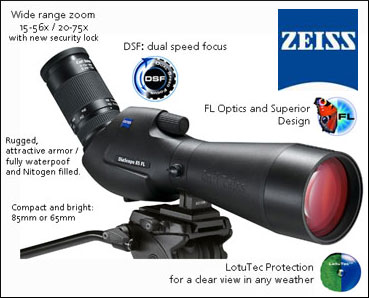 The current Zeiss DiaScope models were launched in 2010 and won Field & Stream’s Best of the Best award, Outdoor Life’s Editor’s Choice award, Petersen’s Hunting’s Editor’s Choice award and the prestigious international Red Dot Design Award. It has many impressive features, including one-piece construction, full armor, and an innovative Dual Speed Focus System (DSF). For those seeking extreme magnification, the DiaScope has an edge over other premium spotting scopes — MORE POWER. The DiaScope’s 20-75x eyepiece remains the most powerful on the market today.
 Camera Land’s One-Penny Tripod Promo


 Being like many shooters out there I’m always looking for that better mousetrap in regard to seeing 6mm bullet holes at extended yardages. That’s how I ended up with the Pentax PF100-ED. Recently I had been hearing rumblings here and there from other shooters and on various websites raving about the Kowa TSN 883/884 spotting scopes. In fact right here on AccurateShooter.com’s Daily Bulletin it was reported that the Kowa Prominar was rated number one by the Cornell Ornithology lab in their 2008 Scope Quest — a detailed review of 36 spotting scopes. However, they did not compare all spotting scopes that were available at that time. The super expensive Leica 82mm Televid APO HD was missing, along with my Pentax PF100-ED. The Cornell test also was geared more toward birders than shooters, but it was enough to pique my interest in regard to the Kowa, which features an 88mm objective with Pure Flourite Crystal (PFC) main lens elements.


 Swarovski Spotting Scopes


