At the request of our readers, we provide select “Deals of the Week”. Every Monday morning we offer our Best Bargain selections. Here are some of the best deals on firearms, hardware, reloading components, and shooting accessories. Be aware that sale prices are subject to change, and once clearance inventory is sold, it’s gone for good. You snooze you lose.
1. Sportsman’s Guide — CCI .22 LR Ammo, $3.49 per Box!
This is the cheapest price we’ve seen in a long time for name-brand .22 LR Rimfire ammo. The sale price of $3.49 per 50-ct box works out to just seven cents a round for this 40gr CCI Blazer rimfire ammo. At that price can enjoy rimfire plinking without worrying about cost — just like the “good old days”. Member price is even lower — $3.32 per box. Grab this CCI Ammo at this rock-bottom price before it sells out.
2. Amazon — Howard Leight Electronic Muffs, $38.76
Every shooter should own a pair of Electronic muffs, even if you prefer shooting with earplugs and/or standard muffs. Electronic muffs are great when you are doing spotting duties or are working near the firing line. They allow you to hear ordinary conversations while still providing vital hearing protection. Right now Amazon.com has the Howard Leight Impact Sport Electronic Muffs on sale for just $38.76, with free Prime Shipping. This is good deal — these NRR 22 muffs are currently Amazon’s #1 seller in the category. See All Price Options. For another $7.99 you can get a handy Zippered Carry Case for these Electronic Muffs
NOTE: For regular, sustained shooting we recommend muffs and/or earplugs with a higher NRR rating.
There’s a new line of primers on the market, produced by Czech factory Sellier & Bellot. You can save up to 30% compared to name-brand American primers. For example, the S&B Small rifle primers are now just $19.99 at Cabelas.com, compared to $28.00 for CCI Small Rifle Primers at Powder Valley. We’ve shot the S&B pistol ammo and it was very reliable so we wouldn’t hesitate to use these primers for practice ammo in rifle or pistol. This is an attractive option for high-volume reloaders.
This is a very good mat at an attractive price. This thickly-padded mat has twin side wings for gear. Sale priced at $44.99 at Cabela’s, this offers great value for the money. With 1/2″-thick padding, this mat is comfortable, and the large side wings keep your gear off damp, mucky, or dusty ground. The left wing has a zippered compartment while the right wing has a large pouch that can hold ammo box, rangefinder, or other gear. Up front is a handy bipod stop. Deployed, the mat is an ample 73-1/2″ long x 35-1/2″ wide. The mat rolls up into a convenient package complete with adjustable shoulder strap. With a Lifetime Guarantee, this mat has earned very positive user reviews — 4.8 out of 5 stars. One owner declared: “This is a great shooting mat … rivals many other mats in a much higher price range. The added wing area has plenty of room for ammo, elbows and miscellaneous gear. It has two sewn-in bipod stops and the padding is just right. It is very well built, love it!” — LHeffy.
Here’s a good deal on a modular rifle for the Precision Rifle Series (PRS) Factory Class. This Tikka TSR-1 features a versatile folding McRees Precision Stock. On sale this week for $1499.99 at Cabelas.com, this TSR-1 is $300 Ccheaper than Tikka’s new T3 X TAC A1. In fact the TSR-1 may be preferred by shooters who prefer a slimmer foreend or need a folding stock. ($1798.00 at Eurooptic.com). PRS Factory Class shooters should definitely consider the TSR-1 at $1499.99. Other vendors are currently charging up to $1935.00 for the TSR-1.
6. GSL Technology — $200 Discount on Sound Suppressors
Many guys are putting off purchase of a suppressor in hopes that Congress will eliminate the $200.00 Federal tax stamp currently required for “can” purchases. Relying on poiliticians to perform is problematical to say the least. Here’s an alternative — the folks at GSL Technology are offering $200.00 off high-grade suppressors. So, in effect, the suppressor-maker is picking up the tab for your $200.00 Tax Stamp. NOTE: This special offer is good for Online Purchases Only and the Offer Expires at 11:59 pm on April 30, 2017.
If you shoot long range, you need a scope level. This Discovery scope level is fully CNC-machined to close tolerances for a good fit. It is available with inner diameters to fit scopes with either 1″ or 30mm main tubes. The 1″ version is just $12.95 while the 30mm model is $13.95. You could easily pay $35.00 or more for a 30mm scope level. Purchasers have praised this product: 89% of verified buyers rated this five stars.
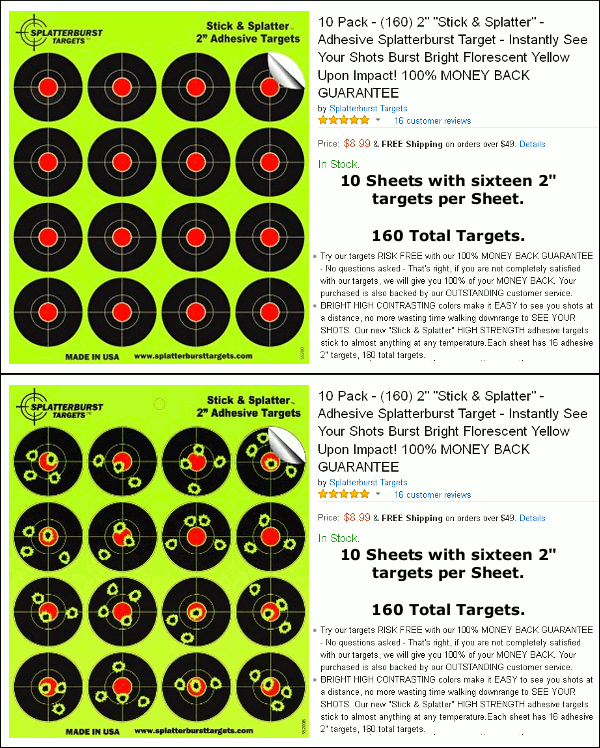
8. Amazon — Ten-Pack of 2″-Diameter Splatter Targets, $8.99
We use these splatter targets for fun shoots and practice at 300 and 400 yards. When hit, each shot displays as a bright, neon-green/yellow circle. That makes it easy to spot your shots, even with relatively low-power optics. These targets also work great for handgun practice at shorter distances. For just $8.99 you get ten sheets each with 16 stick-on circles — a total of 160 target bulls.
In this excellent video from SilencerCo.com, NFL Pro Bowl Tackle Fletcher Cox works with LG Outfitters to stalk and harvest Nilgai Antelope using a suppressed rifle. “Nilgai are pretty special animals — they’re from India. Originally brought down by the King Ranch in the 1930s, they’ve just gone nomadic and they’re all over South Texas.” — Leeroy Gonzales, LG Outfitters.
Click below to watch the video.
“Hunting goes back to the way you approach things. You’ve gotta have a game plan.”
As all committed hunters know, the majority of the hunt is in the preparation. Selecting your gear, choosing the perfect location, waking up before dawn, posting up to patiently wait…
Fletcher Cox is all too familiar with putting time and effort into perfecting his craft and honing the execution. As a Pro Bowl defensive tackle for the Philadelphia Eagles, Cox knows that dedication and practice make for the best possible outcome.
Fletcher Cox confirms his Zero before the hunt.
Only the split-second trigger pull is the actual act of the harvest. The rest? That’s the game plan. Here (1:42) Fletcher Cox makes a successful shot on a Nilgai: “We got meat on the ground boys…”
In the near future, there could be changes in the way the Bureau of Alcohol, Tobacco, Firearms, and Explosives (ATF) treats sound suppressors (aka “moderators” or “silencers”). An official government White Paper, dated 1/20/17, was recently leaked to the press and revealed by the Washington Post.
The ATF White Paper makes some key points about suppressors:
1. 42 States currently allow silencers.
2. Silencers are not a threat to public safety, and are rarely used in criminal activities.
3. The inclusion of suppressors in the NFA is “archaic” and should be reevaluated.
4. The definition of regulated suppressor components should be narrowed, so that only key items are regulated as opposed to “any combination of [silencer] parts”.
5. A change in Federal law removing silencers from regulation under the NFA would save resources, allowing the ATF to focus on reducing actual gun-related crime.
Here is the operative text of the ATF White Paper:
Current Federal law requires ATF to regulate silencers under the NFA. This requires a Federal tax payment of $200 for transfers, ATF approval, and entry of the silencer into a national NFA database. In the past several years, opinions about silencers have changed across the United States. Their use to reduce noise at shooting ranges and applications within the sporting and hunting industry are now well recognized.
At present, 42 states generally allow silencers to be used for sporting purposes. The wide acceptance of silencers and corresponding changes in state laws have created substantial demand across the country. This surge in demand has caused ATF to have a significant backlog on silencer applications. ATF’s processing time is now approximately 8 months. ATF has devoted substantial resources in attempts to reduce processing times, spending over $1 million annually in overtime and temporary duty expenses, and dedicating over 33 additional full-time and contract positions since 2011 to support NFA processing. Despite these efforts, NFA processing times are widely viewed by applicants and the industry as far too long, resulting in numerous complaints to Congress. Since silencers account for the vast majority of NFA applications, the most direct way to reduce processing times is to reduce the number of silencer applications. In light of the expanding demand and acceptance of silencers, however, that volume is unlikely to diminish unless they are removed from the NFA. While DOJ and ATF have historically not supported removal of items from the NFA, the change in public acceptance of silencers arguably indicates that the reason for their inclusion in the NFA is archaic and historical reluctance to removing them from the NFA should be reevaluated.
ATF’s experience with the criminal use of silencers also supports reassessing their inclusion in the NFA. On average in the past 10 years, ATF has only recommended 44 defendants a year for prosecution on silencer-related violations; of those, only approximately 6 of the defendants had prior felony convictions. Moreover, consistent with this low number of prosecution referrals, silencers are very rarely used in criminal shootings. Given the lack of criminality associated with silencers, it is reasonable to conclude that they should not be viewed as a threat to public safety necessitating NFA classification, and should be considered for reclassification under the [Gun Control Act] (GCA].
If such a change were to be considered, a revision in the definition of a silencer would be important. The current definition of a silencer extends to “any combination of [silencer] parts”, as well as “any part intended only for use in” a silencer. Compared to the definition of a firearm, which specifies the frame or receiver is the key regulated part, any individual silencer part is generally regulated just as if it were a completed silencer. Revising the definition could eliminate many of the current issues encountered by silencer manufacturers and their parts suppliers. Specifically, clarifying when a part or combination of parts meets a minimum threshold requiring serialization would be useful.
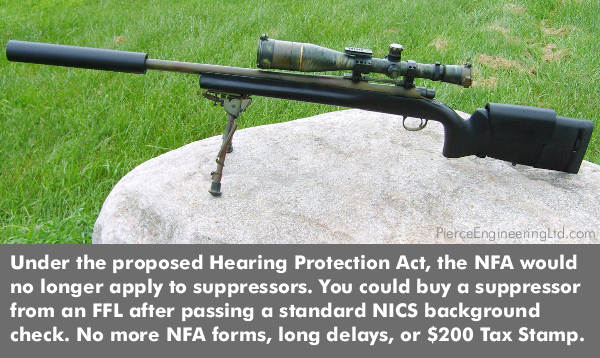
We may see a big change in how sound suppressors are regulated in the future, if new legislation from the Congressional Sportsmen’s Caucus (CSC) becomes law. On January 10, 2017, Rep. Jeff Duncan (SC) and Rep. John “Judge” Carter (TX) introduced H.R. 367, the Hearing Protection Act (HPA). This law would remove suppressors (aka “moderators”) from National Firearms Act (NFA) control, eliminating requirements of extensive paperwork, and purchase of a tax stamp. If the Hearing Protection Act becomes law, suppressors could be purchased through an FFL (after a NICS background check), just like a normal, non-NFA firearm. This would make suppressors more affordable in the 42 states where suppressors are legal to own. What’s more, the new legislation includes a provision to refund the $200 transfer tax to applicants who purchased a suppressor after Oct. 22, 2015.
Suppressors function by trapping the expanding gasses at the muzzle, allowing them to slowly cool in a baffled chamber. On average, suppressors reduce the noise of a gunshot by 20-35 decibels (dB), roughly the same sound reduction as earplugs or earmuffs. In addition to hearing protection, suppressors also mitigate noise complaints from those who live near shooting ranges.
“Many gun owners and sportsmen suffer severe hearing loss after years of shooting, and yet the tool necessary to reduce such loss is onerously regulated and taxed. It doesn’t make any sense,” said Chris W. Cox, executive director, NRA-ILA. “The Duncan-Carter Hearing Protection Act would allow people easier access to suppressors, which would help them to better protect their hearing.”
Guns.com explained how the Hearing Protection Act will change current law: “Since 1934, the federal government has treated devices designed to muffle or suppress the report of firearms as Title II devices that required registration under the National Firearms Registration and Transfer Record and mandated transfers that included a $200 tax stamp. The Duncan-Carter bill would repeal this requirement and treat suppressors as firearms — which would allow them to be transferred through any regular federal firearms license holders to anyone not prohibited from possessing them after the buyer passes an FBI instant background check.”
This video discusses an earlier version of the Hearing Protection Act, H.R. 3799:
“For the past five years, the Congressional Sportsmen’s Foundation (CSF) has worked alongside the state legislative sportsmen’s caucuses in the National Assembly of Sportsmen’s Caucuses, the American Suppressor Association, and many other partners at the state level to normalize the use of suppressors throughout the nation,” said CSF President Jeff Crane. A similar bill was introduced last year by Rep. Matt Salmon (AZ) but that legislation never made it out of committee.
If you have purchased a suppressor in the last year, the HPA could put money back in your pocket. As drafted, the HPA also includes a provision to refund the $200 transfer tax to applicants who purchased a suppressor after October 22, 2015.
This Sunday, December 4, 2016, Tom Gresham’s GunTalk Radio will feature a discussion of suppressors, aka “silencers”, “cans”, or “sound moderators”. With firearms industry experts, Tom will discuss the current regulations for suppressors, as well as efforts to remove silencers from the list of NFA items requiring expensive tax stamps and cumbersome paperwork. With the Republican gains in the November election, there are renewed calls for changes in the laws regulating suppressors. In fact, many suppressor advocates say now is the time for sound moderators to be removed from NFA control altogether, so that suppressors could purchased “over the counter” just like scopes, slings, or other common shooting/hunting accessories.
How Suppressors Work — The Science of Silencers
Suppressors are a valuable accessory for general-purpose rifles, so we would like to see suppressors legal in all 50 states. In addition, we believe the USA should follow the lead of European nations which promote the use of sound suppressors for safety reasons. In most European countries, for example, you can purchase a suppressor easily. There are no difficult barriers to ownership, onerous background checks, or special taxes. The Europeans seem to understand that suppressors protect the hearing of shooters (and bystanders), while suppressor use also dramatically reduces “noise pollution” concerns for shooting ranges in urban/suburban areas. The Europeans also understand that sporting/hunting use of suppressors does NOT increase criminal or gang activity. It is time for the USA to adopt these more enlightened viewpoints.
About Tom Gresham’s GunTalk Radio:
In its 21st year of national syndication, Tom Gresham’s GunTalk radio show airs live on Sundays from 2:00 PM to 5:00 PM Eastern, and runs on more than 200 stations every week. Listen live on a radio station near you or via live streaming from one of GunTalk’s Syndicated Audio Stations. After airing live, all GunTalk Radio Shows can also be downloaded as podcasts.
Muzzle brakes are controversial. Some people swear by them, while others swear at them. Still, there’s no question that a good brake can reduce felt recoil up to 45%. And likewise, the best brakes, when installed properly, seem to have no negative effect on accuracy.
Roy Bertalotto has done considerable experimentation with muzzle brakes, testing dozens of brake designs on his own rifles over the past few years. Roy’s article, Adventures with Muzzle Brakes, discusses various aspects of muzzle brake design and performance. Roy doesn’t claim that his testing is definitive, but his article is definitely worth a read. Here are some of Roy’s interesting findings:
Exit Hole Diameter
“Best accuracy and effectiveness of the brake was obtained with a hole .020″ over bullet diameter. If the exit hole is too small, such as +.005″ over bullet diameter, accuracy suffers. If the depth of the exit hole is too shallow, the metal around the hole will erode very quickly.”
Hole Placement
“The most effective braking was with a brake 1″ in diameter with a 3/4″ exit hole on each side, just in front of the muzzle. The bullet passes through a cone of 35 degrees before it exits the brake. (Like the tank example), Incredible reduction of recoil. But loud and ugly. Very easy to make since you don’t need a spin fixture or a dividing head.”
Bottom Gas Venting Helps Accuracy
“In my tests, not having holes all around the brake effects accuracy a bit. I believe it does something to the bullet by the air pushed ahead of the bullet creating unequal turbulence in the bullet path. I’ve tried a few brakes where I drilled only holes on the top, test fired, and then completed holes on the bottom and in every case, accuracy improved.” Below are spiral-ported brakes crafted by Clay Spencer.
Brakes Work Best with High-Pressure Cartridges
“The higher the pressure of the particular round, the more effective the brake. I have over 20 rifles with brakes. The 220 Swift is the king of reduction. Followed very closely by the 25-06, 6mm Remington, any Weatherby small bore. With a proper brake and a hot handload under a 40 gr bullet, the Swift will move 1/2″ to the rear and 0 muzzle rise! Big boomers with low pressure like 45-70s and shot guns benefit the least.” [Editor’s Note: Roy is judging effectiveness by the percentage of recoil reduction rather than absolute levels of recoil. Obviously if you start with a heavier-recoiling round, the absolute amount of recoil energy reduction is greater. Roy is really talking about efficiency–brakes are most efficient when used with high-pressure cartridges.]
Installation is Key to Accuracy
Roy’s findings are fascinating and suggest that further study of muzzle brakes is warranted. But we can all agree that precision installation of the brake is essential for accuracy. A poorly-installed, mis-aligned brake will degrade accuracy, that is well-known.
Harrell’s Precision has made thousands of muzzle brakes, in many styles and port arrangements. The Harrell brothers offer some good advice for gunsmiths installing brakes: “Muzzle brakes aren’t magic, they reduce recoil by redirecting exiting gas. What’s important is that they are straight and the threads are perpendicular with the base. The only way to get the base and threads perpendicular is to thread, not tap, them on a lathe.”
Tactical ace Zak Smith of Thunder Beast Arms employs a simple, handy means to store his elevation and wind dift data — a laminated data card. To make one, first generate a come-up table, using one of the free online ballistics programs such as JBM Ballistics. You can also put the information in an Excel spreadsheet or MS Word table and print it out. You want to keep it pretty small.
Above is a sample of a data card. For each distance, the card includes drop in inches, drop in MOA, drop in mils. It also shows drift for a 10-mph cross wind, expressed three ways–inches, MOA, and mils. Zak explained that “to save space… I printed data every 50 yards. For an actual data-card, I recommend printing data every 20 or 25 yards.” But Zak also advised that you’ll want to customize the card format to keep things simple: “The sample card has multiple sets of data to be more universal. But if you make your own data card, you can reduce the chance of a mistake by keeping it simple. Because I use scopes with MILS, my own card (photo below left) just has three items: range, wind, drop in MILS only.”
Once you have the card you can fold it in half and then have it laminated at a local office store or Kinko’s. You can keep this in your pocket, tape it to your stock, or tie the laminated card to your rifle. If you regularly shoot at both low and high elevations, you may want to create multiple cards (since your ballistics change with altitude). To learn more about ballistic tables and data cards, check out the excellent Practical Long-Range Rifle Shooting–Part 1 article on Zak’s website. This article offers many other insights as well–including valuable tips on caliber and rifle selection.
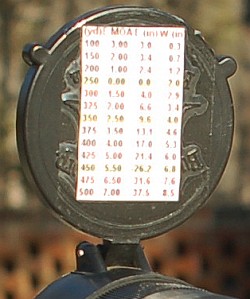
Scope-Cover Mounted Ballistics Table
Another option is to place your ballistics card on the back of the front flip-up scope cover. This set-up is used by Forum member Greg C. (aka “Rem40X”). With your ‘come-up’ table on the flip-up cover you can check your windage and elevation drops easily without having to move out of shooting position.
Greg tells us: “Placing my trajectory table on the front scope cover has worked well for me for a couple of years and thought I’d share. It’s in plain view and not under my armpit. And the table is far enough away that my aging eyes can read it easily. To apply, just use clear tape on the front objective cover.”
In this article, Gun Watch Editor Dean Weingarten interviews SilencerCo Founder/CEO Josh Waldron. Started in 2008, SilencerCo is an amazing success story. The company now sells 18,000 silencers a month. To put that in perspective, a decade ago, the entire domestic suppressor industry was selling 18,000 suppressors a YEAR. SilencerCo now controls 65% of the suppressor market in the USA, and its business is growing 100% a year.
This growth is remarkable considering that suppressors remain highly regulated and costly to acquire. The National Firearms Act (NFA), passed in 1934, imposes significant restrictions and requires a $200 tax to be paid on each silencer sold.
At the NRA Annual Meeting in Louisville, Kentucky, I was able to talk to Josh Waldron, CEO of SilencerCo. Josh is more than a visionary. He is a man who acted on his vision, and is changing the gun culture and the national culture.
I [visited] the SilencerCo booth during the NRA Annual Meeting. I was told that SilencerCo produces about 65% of the silencers in the United States. The company is growing so fast that it was hard to keep up with the number of employees, currently about 330 and rising quickly. There is no doubt that SilencerCo holds a dominant market share and is growing at an exceptionally fast rate. I asked Josh about the future of silencers and silencer legislation.
Q: Do you have a plan, and can you tell me about it?
“It starts as education. Ever since we started the company in 2008, we have had a focus on education and advocacy. When I first started the company… only 18,000 silencers were sold in the United States each year, and that was every manufacturer.”
“From the time we have started until now, there were 18,000 then, we are now selling about 18,000 silencers every month, just SilencerCo.”
“In the last five years, this has been the fastest growing segment of the firearms industry.”
When I first started the company… only 18,000 silencers were sold in the United States each YEAR [from] every manufacturer. We are now selling about 18,000 silencers every MONTH, just SilencerCo. — Josh Waldron
“People are just starting to understand. This is not a ‘cool accessory’ as much as it is a personal protection/personal safety device, just as you would consider any other device that keeps you safe while you shoot, such as safety glasses. It is really the only true way to hunt while you protect your hearing. As we continue to educate the market, it grows exponentially. A guy will get one who has never had one before, he brings it home, he shows his friends, and they say ‘Oh my gosh, I want to buy one!’ Every time we get suppressors out there, the snowball continues to grow and get bigger and bigger.”
Q: Your market share is dominant. Your sales growth is exponential, isn’t it?
“Yes … pretty amazing. We are growing 100% every year.”
WATCH X-Ray View of Shots Through Silencer (28,000 frames per second, 22 Sparrow)
Q: Do you fear that removal of suppressors from the NFA (National Firearms Act) will cut into your profit margin?
“I don’t think so. We don’t get to take full benefit of the economies of scale. We have to order materials on a small-batch basis. As we increase the number of suppressors going out the door we decrease the amount that it costs us. We haven’t pushed it to the level where are seeing those economies of scale.”
“We are always going to be a top-shelf brand. We are never going to discount our brand. We will be a leader in the industry, continually. I do believe there will be a lot of new entrants to the industry. I do not think that will hurt our brand or hurt our market.”
Q: I saw the Maxim 9, SilencerCo’s integrally-suppressed pistol, at the SHOT Show in Las Vegas. Is the Maxim 9 in production yet?
“It is not in production yet. Projects of this size take a lot of research and development. They take a lot of torture testing. We have to put it through a lot of standard testing. We use outside firms that come in and test and evaluate, so that we can hold our heads up high and say ‘This is a duty grade weapon’. We are not going to release it until it is.”
“I do not want to be marketing to our men and women in uniform, and saying this is a safe way to shoot until we can say this is a perfect firearm for them. The amount of testing is extremely rigorous. We are on schedule. We will release it, probably in December.”
Q: Is the Maxim 9 your entry into a future market of integrally-suppressed firearms?
“Yes. Our intention with the Maxim brand is to have integrally-suppressed firearms in that brand. We are talking everything from shotguns to rifles to pistols. The pistol is a good place to start because it is the holy grail of integrally suppressed guns that everyone has wanted. It is extremely difficult to do. People have tried it and failed, years and years, for decades, and this is the first time it has actually been viable and real. We are very excited about that, and very proud of that. We are going to move into new calibers as soon as this one starts shipping. We are very excited to expand that line.”
“Do I think the gun companies will compete? They can try. Number one, our IQ is amazing around this product. We spent a lot of time researching every firearm, every handgun that you can think of. How the mechanisms worked, and why. We had to be thorough. Which is why we designed the gun from the ground up. We went into every single style of this type of firearm, and other types of handguns as well, and really, truly understand how it needed to be designed. We had to take every mechanism, the guide rods, the springs, the things that are in front of the chamber in a conventional handgun, and move them behind the chamber. That was our biggest challenge. Do I think that some of those guys will start competing and get around our IQ? It will be a lot harder for them than for us. Because we are the ones who figured it out in the first place, and we have a lot of patents around that.”
Q: Rifles have had a lot of [suppressor] solutions … for a long time.
“We will get into those lines, the rifle lines. The difference is that we will design the gun, just the same way as we did for the Maxim 9. We will design the gun for the suppressor instead of putting on a suppressor designed for the gun, so our guns will be better.”
“There are about 400 million firearms in the U.S. right now. Most of those were not designed with a suppressor in mind. There is a huge market for retrofitted suppressors.”
“Which is what we have been doing for the last eight years, it is what we have done as a company which is providing solutions for firearms that already exist. The field is ready to harvest as far as creating a new platform. A new platform that has never been done before this, that was designed from the ground up with the intention of being suppressed, integrally suppressed.”
Q: You say you are going to stay on the high end. I looked at some of the markets. There is a lot of low end potential out there.
“There is. It is something that I am just not interested in. Number one, I do not know how to make something that is not the best.”
“It is impossible to know what the percentage of the market the high end will be. It is important to me to make the best product in the world. I am a brand guy. My brand is very important to me to so if I am making things that are less than the best, that is not ever something that I want. I always want to be top shelf.”
Q: Are you exporting much?
“We export, yes. We can’t export to the commercial market. Only to the military and law enforcement. It is a State Department thing.
“We have a bill right now, it is called the Suppressor Export Act. Congressman Jeff Stewart is the one that is sponsoring that bill for us. It would ensure that the State Department would have to allow us to take part in the world market, that is available, that we are not able to take part in right now. We can only export to law enforcement and military, but not to the commercial market. But with this bill, we would be able to export to everybody. If there is a country where it is legal to have suppressors, we would be allowed to export to them.”
“There are suppressor manufacturers all over the world, and they sell all over the world. The United States is the only place where they are this regulated. It is just crazy. You can go to the UK, where it is really hard to own a gun, and you can buy a suppressor over the counter, without a background check.”
“We are behind the curve when it comes to the rest of the world.”
Here’s good news for suppressor owners in the Great Lakes state. The Michigan legislature has approved the use of suppressors for hunting. On February 11th, Michigan became the 38th state to allow for the use of firearm suppressors while hunting when the Natural Resources Commission (NRC) voted 4 – 1 to approve an amended version of Wildlife Conservation Order Amendment No. 1 of 2016. The measure became effective immediately.
The American Suppressor Association led a coalition working to legalize suppressor hunting in Michigan. Other organizations involved were the National Rifle Association (NRA), the Congressional Sportsmen’s Foundation (CSF), Michigan United Conservation Clubs (MUCC), and Safari Club International (SCI).
“We are incredibly excited that hunters in the great state of Michigan can now use suppressors to help protect their hearing while they’re in the field,” said Knox Williams, President of the American Suppressor Association. “It was a pleasure working to educate the NRC Commissioners and members of the DNR on the realities of suppressor use. We applaud their decision to remove the prohibition on suppressor hunting without the two restrictive provisions. In doing so, they have done their part to ensure that the next generation of hunters does not have to sacrifice their hearing.”
Our friend Paul Phillips (above), is pleased with this change: “With this new Law that passed in Michigan Today, I will be hunting with my GEMTECH arrow silencer. I can’t wait for Spring to start Shooting ELR.”
This X-ray photograph reveals a variety of suppressor baffle configurations:
Report by NSSF
Apparently, today’s shooters like the sounds of silence. Americans are buying and licensing more suppressors and other NFA (National Firearms Act) items than ever before. The number of NFA applications filed with the NFA Branch at ATF continues to rise. With a greatly increased staff of 25 Legal Instrument Examiners, the backlog of NFA forms has been whittled down from more than 80,000 to about 36,000. Much of the intense increase in interest in NFA items is focused on silencers. According to ATF’s 2011 Commerce in Firearms Report, as of December 2010 there were 284,087 lawfully registered silencers in the United States. As of March 2014, there were 571,750. That’s means the number of registered suppressor more than doubled in three and a quarter years. And 2015 will probably be a record year for suppressor sales.
A Brief History of Suppressors (aka “Silencers”)
Hiram Percy Maxim, the son of Hiram Stevens Maxim (inventor of the Maxim machine gun) created the first firearm sound suppressors. An early advertisement for his Maxim Silencer Company explained that the hot propellant gases from discharging the firearm “are made to whirl around inside the Silencer,” and cannot leave the silencer until they have slowed down enough to not produce a loud noise. Initially, silencers were inexpensive and easy to obtain. Before the adoption of the National Firearms Act in 1934, Mr. Maxim sold a variety of silencer designs priced from $5.00 to $9.50. These were shipped in the U.S. Mail, without restrictions. Things are much different today — to own a suppressor, one must obtain federal approval and pay a special tax.
Silencers consist of a few basic parts. The CTD Shooter’s Log explains: “The envelope is the cylindrical metal tube in which the other components are stuffed. Inside the envelope are the expansion chamber and baffles. The expansion chamber is a relatively big empty space surrounding the muzzle, and the baffles are like coffee cups stacked on top of each other with a hole drilled through the middle of them for the bullet to pass through. This is where most of the ‘magic’ happens within the silencer.”


 Every shooter should own a pair of Electronic muffs, even if you prefer shooting with earplugs and/or standard muffs. Electronic muffs are great when you are doing spotting duties or are working near the firing line. They allow you to hear ordinary conversations while still providing vital hearing protection. Right now Amazon.com has the Howard Leight Impact Sport Electronic Muffs on sale for just $38.76, with free Prime Shipping. This is good deal — these NRR 22 muffs are currently Amazon’s #1 seller in the category. See All Price Options. For another $7.99 you can get a handy Zippered Carry Case for these Electronic Muffs






 Scope-Cover Mounted Ballistics Table


 This X-ray photograph reveals a variety of suppressor baffle configurations:


