G.A. Precision (G.A.P.) has announced a new three-lug action, the Tempest. This unit features a large bolt knob with extended, curved bolt handle (similar to the bolt handle on the Accuracy International AX). Up front the Tempest boasts an integral recoil lug with extended front tenon section — for better support of heavy barrels. The Tempest’s distinctive feature is its three-lug bolt. Compared to a two-lug bolt, a three-lugger allows a short, 60° bolt lift (fewer degrees of lift to release). Like the G.A.P. Templar action, the new Tempest sports a Rem 700 footprint, though stock inletting would have to be altered slightly for the integral lug/tenon design.
Sorry guys, G.A.P. has not yet announced a retail price or delivery date (we did ask, but the folks at G.A.P. don’t even have a wholesale price from the 3rd-party manufacturer yet). Whatever it costs, the Tempest action will be popular. It has already inspired nearly 300 likes on the G.A.P. Facebook page.
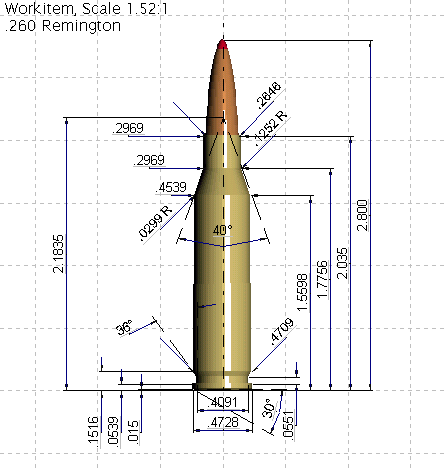
The AR-10 was designed to handle the 7.62×51/.308 Winchester and other .308 “family” cartridges such as the .243 Win and .260 Remington. Our friend Dennis Santiago recently put together an AR-10 to shoot the accurate .260 Rem cartridge. Here is his initial report:
AR-10 Platform Chambered for .260 Remingtonby Dennis Santiago
I was very curious to see how the .260 works in the AR-10 compared to a .308. I’ve always thought about chambering a bolt gun in .260 but before doing so I thought it’d be good to try it using a less expensive entry point. With an AR platform’s easy interchanging of barrels, it seem like the best way to test out the .260 Rem chambering. So far, it’s most impressive.
DPMS LR-308 in .260 Remington getting function cycle tuned and zeroed
I took the AR-10-type .260 Rem a step closer to being ready for matches yesterday. The first order of business was to confirm which buffer spring to use with both the 123 grain and 140 grain bullet loads. My .260 Rem loads, on average, are using 4-5 grains less powder than the .308 loads. In a semi-automatic action that means less gas/energy to work the mechanics. The solution in an AR-10 platform is to either cut coils in the .308 spring or use a weaker AR-15 buffer spring; yup they are not the same. In this case, a CS flat spring for the AR-15 did the trick.
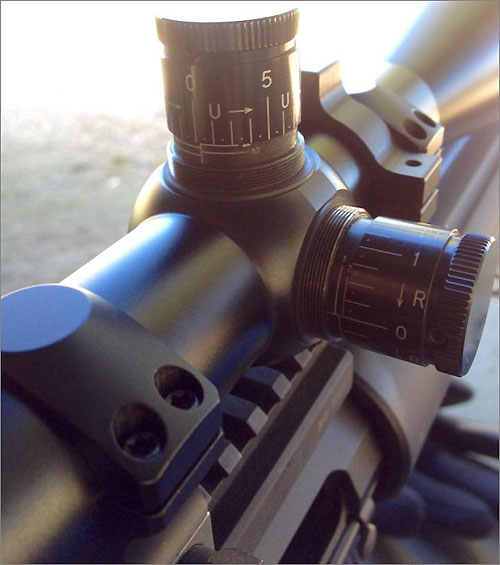
I also put a very nice NightForce Benchrest 12-42x56mm scope that came via friend Mark Gravitt on it and got zeros. This scope’s 1/8th MOA clicks are nice. The AR-10 had previously mounted a NightForce F1, a more “field tactical” 3-15X system. This 12-42X scope now sets this gun up as more of a target cannon. Field of view is limited when your minimum magnification is twelve. Maybe I’ll put an auxiliary red dot on it just to find the target.
Pet Loads: H4350 and Lapua 123gr Scenars Comment by Daily Bulletin Editor
Over a two-year period, this Editor put a lot of rounds through a .260 Remington. I did a ton of load testing with that Savage-actioned rifle (before it was rebarreled as a 6mmBR Norma). I tried two dozen load recipes with five different powders and bullets ranging from 100 grains to 142 grains. Hodgdon H4350 was my “go-to” powder. As many 260 Rem shooters have discovered, H4350 is a winner in the .260 Rem. This propellant delivered the lowest ES in my rifle and nothing beat H4350 for consistent accuracy with bullets in the 120-140 grain range. My most accurate load was with Lapua 123gr Scenars, pushed by H4350 and CCI 250 primers. The 123gr Scenars worked well jumped as well as seated into the lands. Best accuracy, in my 24″-barreled .260 Rem, was right about 2950 fps. Other powders work well, but H4350 is a very good choice for the .260 Remington (as well as the smaller 6.5×47 Lapua cartridge).
Can a budget-priced Savage shoot like a Sako TRG 22? Well, adding a custom “pre-fit” barrel and a state-of-the-art chassis system can transform a “Plain Jane” Savage into a serious tactical rifle. And now Kinetic Research Group (KRG) offers a new fully-adjustable chassis that’s just the ticket for a Savage tactical conversion. Just get a used Savage action, spin on a Criterion, Pac-Nor, or Shilen pre-fit barrel, and add the new 180-Alpha Chassis from KRG.
In 2015 KRG will introduce the NEW 180-Alpha Chassis for Savage rifles. This fully-adjustable, light-weight (3.4 lbs) chassis fits Savage short action rifles with 4.4″ action bolt spacing. If you like user-configurable stocks, you’ll love the 180-Alpha. It features tool-less cheek-piece height adjustment, spacer Length-of-Pull (LOP) adjustment, buttpad height adjustment, and plenty of accessory mounting positions. Suggested retail price for the 180-Alpha is $770.00 in either bottom bolt-release or side bolt-release action configuration.
Compare KRG’s 180-Alpha Chassis to the hardware on the real deal — a Sako TRG 22 with adjustable, folding stock (model JRSM416, shown below). This SAKO TRG22 rifle in .308 Winchester retails for $5,198.00. With KRG’s 180-Alpha chassis you can put together an ergonomically-similar tactical rifle for thousands less.
Using the KRG Chassis, a take-off Savage action, and a premium pre-fit barrel, you can build a similar system for under $1600.00. Here’s how we get that figure: $370.00 for Criterion pre-fit barrel, $400.00 for action (YMMV), and $770.00 for stock (Total $1540.00).
KRG produces other adjustable, modular chassis systems for bolt-action rifles. KRG’s popular Whiskey 3 Chassis system fits the Tikka T3, Remington® 700™, Sako M995, Badger M2008, and 700 Long Action. The value-priced KRG X-RAY Chassis fits the Rem 700 Short Action, and Tikka T3.
New Product Tip by EdLongrange. We welcome reader submissions.
Got Bipod? If you’re in need of an adjustable two-legged friend for the front of your favorite rifle(s), Midsouth has you covered. Right now Midsouth Shooters Supply has a wide selection of Harris Bipods in stock at attractive prices. For example, the Harris 6″-9″ BR model with leg notch is just $69.68. That’s ten bucks cheaper than we’ve found elsewhere. From small to tall, Midsouth carries Harris bipods for your intended applications. Midsouth also sells a variety of authentic Harris mounting adapters, including rail adapters, and flat fore-end adapters.
Got fifty bucks? Well that’ll buy you an AR Lower this week. Quite simply, this is the best AR deal we’ve seen this year, and one of the best values on a firearm receiver we can remember. Right now, while supplies last, Brownells.com is offering Bushmaster-brand AR-15 stripped lower receivers for just $49.99. You read that right — you can get a major manufacturer AR lower for under fifty bucks. That’s a savings of $120.00 off the normal price. Get them while you can.
NOTE: Stripped lowers are considered the firearm, so this must be delivered to an FFL-holder. It is fairly easy to complete the lower with readily available parts and the trigger group of your choice.
Bushmaster Stripped Lower Receiver Product Description
Receiver is a rigid 7075 T6 aluminum forging with extra metal in the right places for added strength without unnecessary bulk. Features a beefy, M16A2-pattern reinforced area around the front pivot pin, a strengthening ridge over the receiver extension threads, and a ridge around the mag release button to guard against accidental magazine drop by preventing unintentional button activation. Bead blasted after machining to ensure a uniform, non-reflective surface before application of lusterless black military hardcoat A8625, Type III, Class 2 anodized finish that adds surface strength and resists abrasion. A final, nickel acetate seal coat provides extra protection against corrosion. Stripped lower is the perfect companion for Bushmaster Lower Receiver Parts Kit, available separately
MIL or MOA — which angular measuring system is better for target ranging (and hold-offs)? In a recent article on his PrecisionRifleBlog.com website, Cal Zant tackles that question. Analyzing the pros and cons of each, Zant concludes that both systems work well, provided you have compatible click values on your scope. Zant does note that a 1/4 MOA division is “slightly more precise” than 1/10th mil, but that’s really not a big deal: “Technically, 1/4 MOA clicks provide a little finer adjustments than 1/10 MIL. This difference is very slight… it only equates to 0.1″ difference in adjustments at 100 yards or 1″ at 1,000 yards[.]” Zant adds that, in practical terms, both 1/4-MOA clicks and 1/10th-MIL clicks work well in the field: “Most shooters agree that 1/4 MOA or 1/10 MIL are both right around that sweet spot.”
Zant does note that a whopping 94% of shooters in the Precision Rifle Series (PRS) used a mil-based reticle. However, Zant says: “This does NOT mean MIL is better. It just means MIL-based scopes are more popular.” Zant agrees with Bryan Litz’s take on the subject: “You can’t really go wrong with either (MIL or MOA). They’re both equally effective, it comes down to how well you know the system. If you’re comfortable with MOA, I wouldn’t recommend switching to MIL. I have a few MIL scopes but primarily because they’re on rifles used for military evaluation projects, and that community is now mostly converted to MILS, so when in Rome….”
We recommend you read Zant’s complete article which is very thorough and is illustrated with helpful graphics. Here are the key points Zant makes in his MIL vs. MOA analysis:
MIL vs. MOA — Key Points
There are a handful of minor differences/trade-offs between MIL & MOA, but there are no inherent advantage to either system. Most people blow the small differences WAY out of proportion….Here are the biggest differences and things to keep in mind:
Whatever you decide, go with matching turret/reticle (i.e. MIL/MIL or MOA/MOA)
1/4 MOA adjustments are slightly more precise than 1/10 MIL.
MIL values are slightly easier to communicate.
If you think in yards/inches the math for range estimation is easier with MOA. If you think in meters/cm the math is easier with MIL.
When your shooting partners are using one system, there can be some advantage to having the same system.
Around 90% of the PRS competitors use MIL.
There are more product options (with ranging reticles) in MIL.
Range Card Print-Outs
Zant makes an interesting practical point regarding range card print-outs. He suggests the MIL System may be easier to read: “You can see in the range card examples below, 1/4 MOA adjustments take up more room and are a little harder to read than 1/10 MIL adjustments.”
Most of us are familiar with McMillan’s popular “A” series of tactical gunstocks. The original A-2 is a still-popular “tactical classic”. The A-3, a modified, lighter version of the A-2, is probably the most widely-used field sniper stock. The A-4, originally designed for the USMC, features a butthook on the underside of the stock — a feature you now see on many other tactical designs.
In addition to its conventional A-series stocks (A2-A5), McMillan now offers two very different tactical stock designs: the A-TH and the TPR. These stocks are designed to work well for off-hand as well as prone shooting. They offer many of the advantages of a chassis-style stock with durable, user-friendly fiberglass construction. If you are planning a tactical rifle project for the Precision Rifle Series or other application, you may want to consider the A-TH and the TPR.
McMillan A-TH Thumbhole Stock
The A-TH stock was created after numerous customer requests for a thumbhole stock in McMillan’s tactical line. It uses a flat, square-type forearm very similar to the popular A-3 but with textured grooves on the sides for better grip when shooting off-hand. The butt-hook also has texture and a thumb groove for enhanced grip and control when shooting off a bench or prone. The ergonomics of the pistol grip are designed to put the shooter’s hand in the most natural and comfortable position. The A-TH must be ordered with one of the integral cheekpiece options and is available in right hand only. It can be inletted for most Remington, Sako, Tikka, and Savage blind magazine type actions and for barrel contours up to a 1.250″ straight blank. Color shown: Tan, Dark tan, Olive vertical marbling.
McMillan TPR Stock
In designing the pistol grip TPR stock, McMillan came up with something completely different — not just another “A” series variant. The design evolved from a desire to create a stock that offers everything that a straight line chassis stock offers along with the enhanced accuracy, vibration damping, and recoil reduction characteristics of a fiberglass stock. Fully ambidextrous, the TPR can be inletted for most Remington 700 type actions and Savage blind magazine actions. The forearm can be inletted for most barrel contours up to a 1.350″ diameter straight contour and has enough depth for installation of a Versa-Pod bipod stud. Color shown: 50% olive, 25% black, 25% tan marble.
The GAP Grind is a hugely popular tactical match held annually at the K&M Precision Rifle Training facility in Florida. Sponsored by G.A. Precision and Bushnell, the GAP Grind attracts top tactical shooters from around the country. Held 29 – 31 August, the 2014 GAP Grind saw 164 shooters and 82 teams battle it out. Watch the video from the 2013 Grind to see what all the fuss is about….
Watch GAP Grind 2013 Video
GAP Grind Guns by Giddings
Shelley Giddings, a skilled shooter of both firearms and cameras, attended the 2014 GAP Grind last week. While there, Shelley snapped some cool images of state-of-the-art tactical rifles. Here is a Giddings Gallery of Grind Guns. You can find more GAP Grind pix on Shelly’s Facebook Page.
Click any photo below to see a full-screen version.
Forum member Cody H. (aka “Willys46″) provided this report on his new Russo-stocked 6-6.5×47 Rifle.
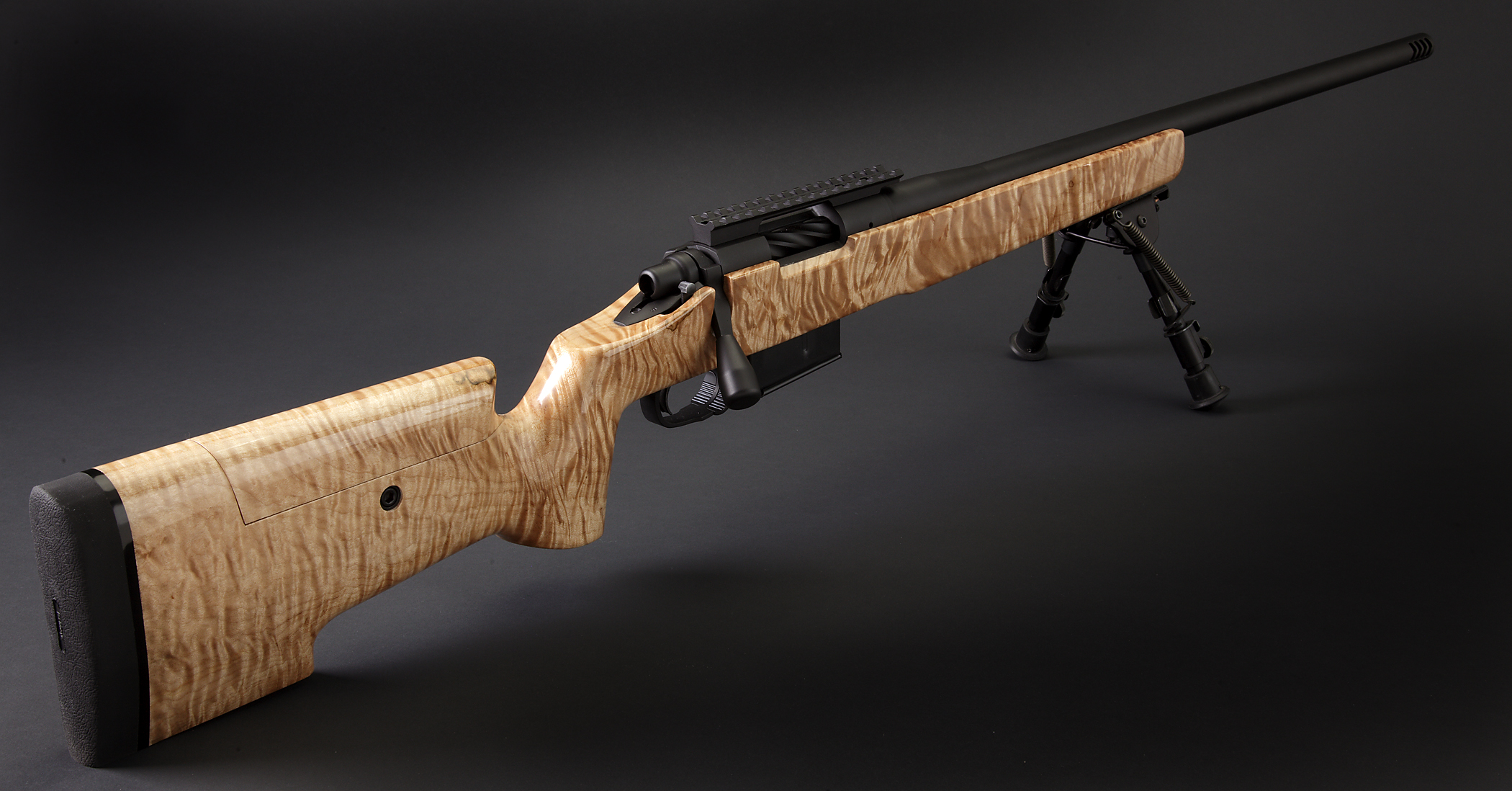
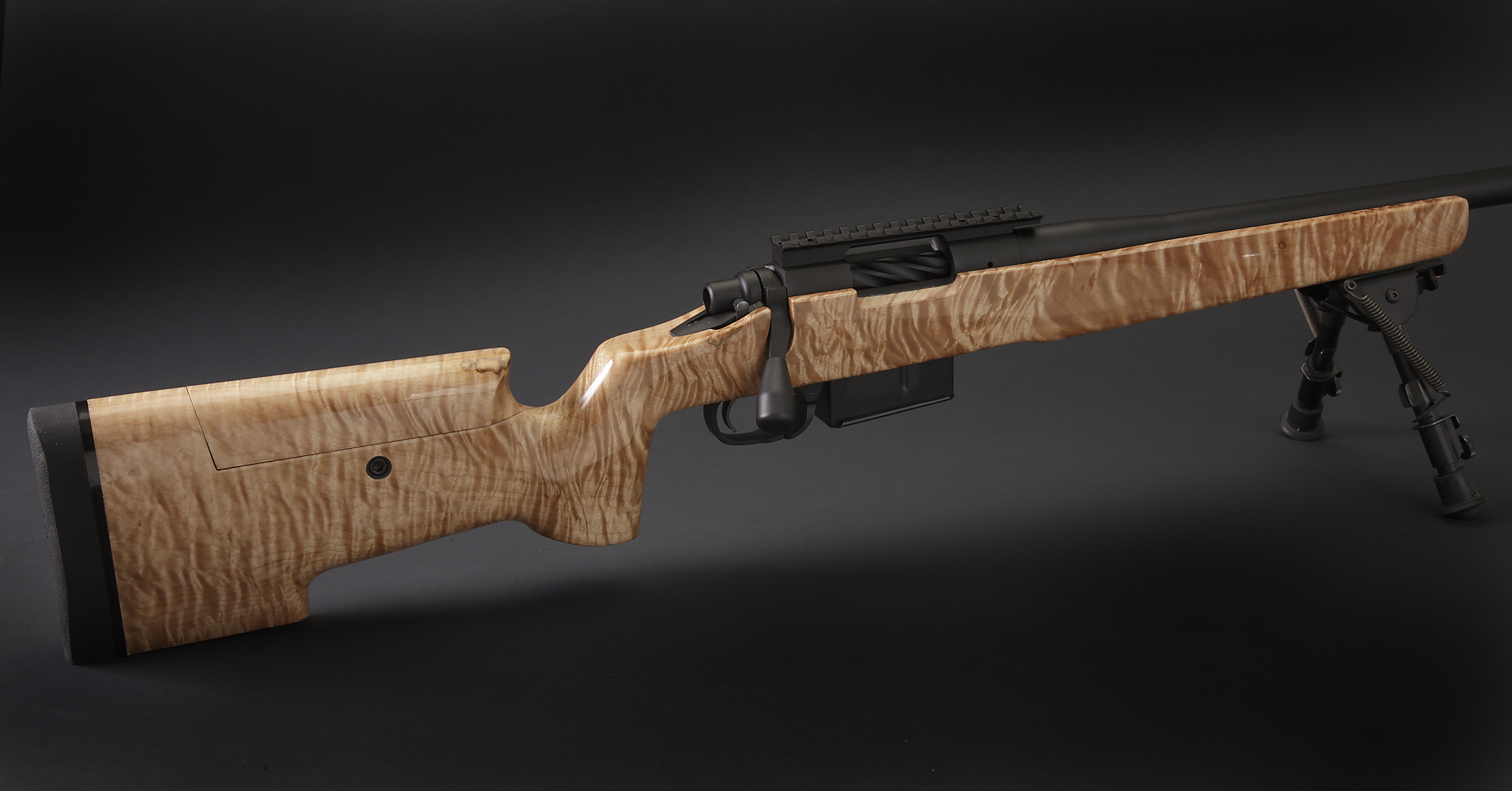
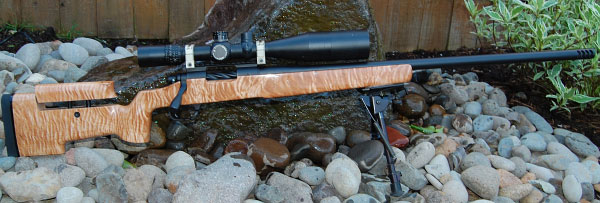
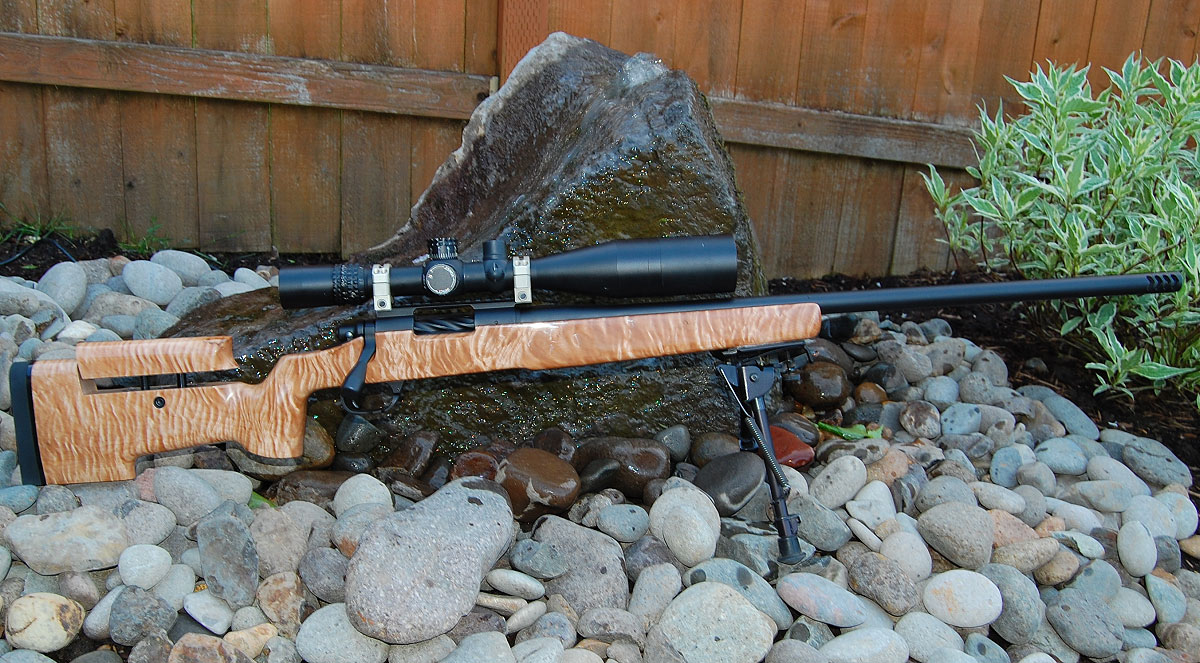
Joel Russo out of Harrisburg, PA is taking modern technology and new stock designs and mating them with Old World materials and craftsmanship. The result: rifles that shoot true and look seriously sharp. Russo got his start making laminated wood stocks for budget-minded tactical rifle shooters with his popular A5-L design. Motivated by his passion for woodworking and a mindset for detail, Russo has shifted his focus from the run-of-the-mill laminates to create shootable works of art in some of the most highly figured, beautiful, exotic and domestic woods. Russo has come to feel that if he as a craftsman is going to spend precious time creating something out of wood, it should be for something worthy of his personal investment.
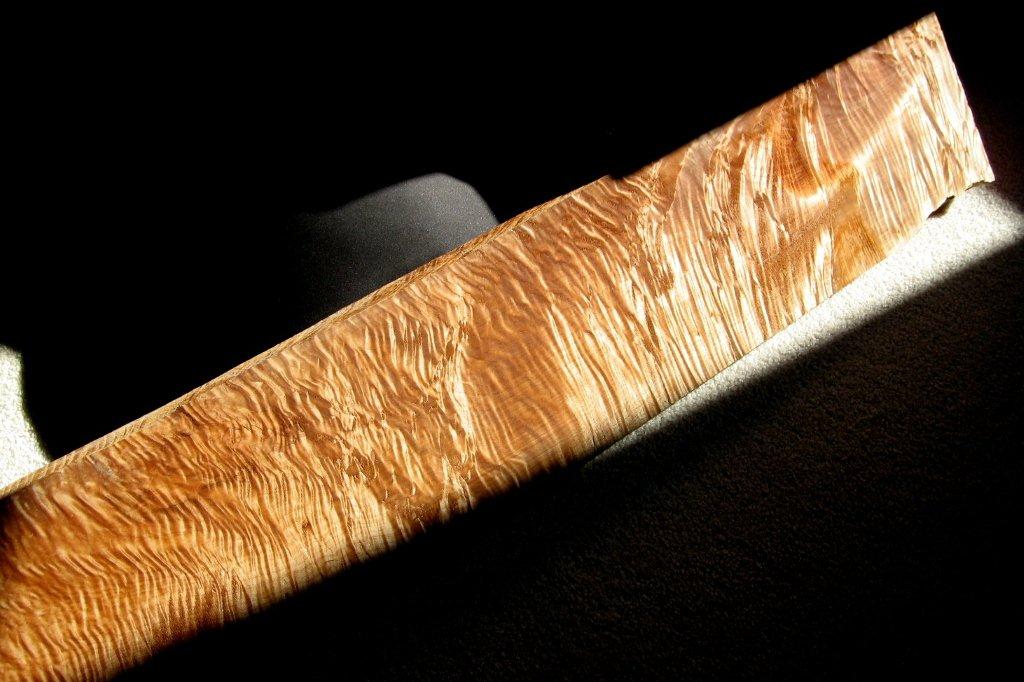
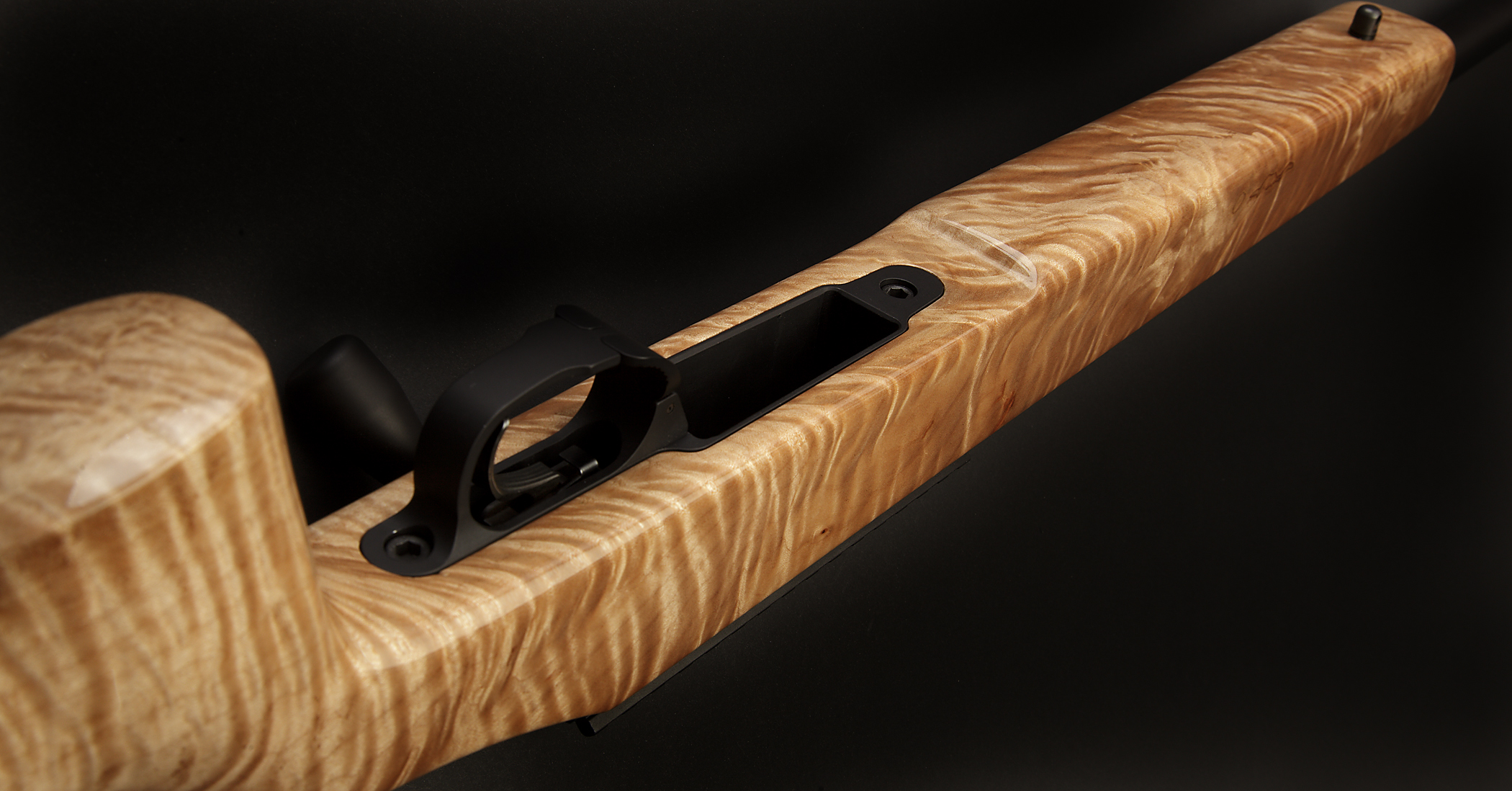
Take, for example, a recent Russo stock that started its life as a highly figured piece of Curly Maple harvested in the Pacific Northwest. After CNC inletting, profiling, pillar- and glass-bedding, the stock was meticulously finished to showcase the wood’s beauty. This stunning stock was commissioned for my new 6-6.5×47 Precision Field Rifle [Editor: it’s just too pretty to be labeled ‘tactical’]. Have a look….
Rifle Specifications: Remington 700 short action with R&D Precision bottom metal. Bartlein Barrel (Sendero Contour). Joel Russo Stock in A3-5 pattern (A5 buttstock with A3 fore-end). Barrel chambering/fitting (6-6.5X47 Lapua) by Steve Kostanich.
How does it shoot? Cody reports: “I’ve had the rifle two weeks, and sent about 200 rounds down range so far. I could not be happier with the performance of the whole package. The 6-6.5×47 Lapua chambering really makes it a pleasure to shoot with its low recoil and accuracy potential. With the fitted muzzle brake, recoil is minimal. The ballistics of 105gr Berger hybrids at 3100 fps make the wind at 600 yards very manageable. As for the stock, the slimmer fore-end holds the bipod much nicer than my old A5L. The lighter weight also makes it more maneuverable in different shooting positions.”
NOTE: Hi-Rez Gallery images may take some time to load. Be patient — it’s worth the wait.
Cody Talks About His Rifle and Joel Russo’s Work
Click Play Button to Hear Audio
Like any artist, Russo carefully considers where to begin. Deciding where the stock will be cut out of the wood blank can take days. He must determine where the forend and pistol grip will lay to be sure the true beauty of the wood will transfer to the stock design. After Russo cuts the rough pattern out of the blank, it’s off to the CNC mill for barrel and action inletting. The stock is almost completely inletted but still in the rough; enough material remains for Russo to hand-blend the wood and metal for that all-important fit and finish. Then it’s off to the duplicator, which cuts out the stock in the specified pattern.
With inletting completed, the action is pillar- and glass-bedded, then readied for final shaping. The tang/pistol grip area demands careful work for a perfect look and feel. It takes hours with files and rasps to get everything just right. Once material is removed it’s a done deal so patience with the tools is a must. Russo is a very painstaking woodworker, and as an artisan and champion shooter himself, he wants the tang to melt into the pistol grip for the perfect look and feel.
Once the major wood removal is complete, Russo begins surface sanding. To make the finish come out smooth and flat, a sanding block is a must. With the density change in figured wood, some sections will be softer and so material is removed more quickly, making for a very wavy finish. When Russo is satisfied with the final sanding he starts the finishing process.
Russo generally does a hand-rubbed TUNG Oil finish. Since this stock is for a tactical competition rifle, and I wanted to preserve the natural blond color of the Maple, a clear coat finish was in order. In all fairness the maple would look even better with a darker oil finish, which allows the deep grain and figure to come out, creating an almost 3-D effect. A hand rubbed oil finish can take months to be applied properly. The shorter application time was another advantage for this particular build.
Clear coat maintains the original color of the wood while being comparatively easy to apply with basic paint-spraying tools. If you scratch the surface, it’s a simple matter to buff it out just like you would a car door ding. After a numerous coats are applied then it is wet-sanded just like the finish on a classic hot rod. The finer the sandpaper grit, the shiner the finish. For the maple stock project, a higher-than-typical gloss finish was selected because the wood kept looking better the shiner it got. Want it shinier? All you have to do is invest a little more time in sanding and polishing. Sometimes Russo works his way to 6000 grit sandpaper.
Walk-Around Video Showing Beautiful Wood
After final wet-sanding of the clear-coat, the finished stock is one even a millionaire would be proud to shoot. With the advent of fiberglass composite materials and assembly-line production methods, there are fewer true craftsmen like Joel who can start with a block of wood and some metal and create a complete rifle. So it’s refreshing that wood artisans like Russo are keeping alive the craftsman tradition. To see more examples of Joel Russo’s work, visit www.RussoRifleStocks.com.
Victor Company USA, manufacturer of tactical “skins” for AI rifle chassis, has introduced a new tactical stock for Ruger’s popular 10/22. Victor Company’s new Titan 1022 Precision Rimfire Stock features a vertical-style grip and a wide, beavertail forearm with molded nibs for enhanced grip. In the rear, the buttstock features a cut-out for the user’s off hand with a deeper “keel” for riding the bags. This stock should work well for the Tactical Rimfire game. We also bet many varmint shooters will order these stocks — a Ruger 10/22 never looked so good. This product, set for release in July, 2014, is so new we don’t have pricing yet. Visit www.victorcompanyusa.com for more details in a week or two.
Victor Company 1022 Precision Rimfire Stock (CLICK photo for full-size image.)




 Most of us are familiar with McMillan’s popular “A” series of tactical gunstocks. The original A-2 is a still-popular “tactical classic”. The A-3, a modified, lighter version of the A-2, is probably the most widely-used field sniper stock. The A-4, originally designed for the USMC, features a butthook on the underside of the stock — a feature you now see on many other tactical designs.
 McMillan A-TH Thumbhole Stock