For a prone shooter, particularly on dusty, dirty or sandy ground, muzzle blast is a major bummer. Muzzle blast can be very disturbing — not just for the trigger-puller but for persons on either side of the gun as well. Some muzzle brakes send a huge shockwave back towards the shooter, and others send blast towards the ground, kicking dirt and debris into the prone shooter’s face. If there was a way to illustrate those factors — shockwave and debris — that might help shooters select one brake design over another.
Cal Zant at PrecisionRifleBlog.com applied a unique blend of creativity and resourcefulness to try to answer that question for 20+ muzzle brakes. Using high-speed photography and household products, he captured the blast pattern of 20+ different brake designs for easy side-by-side comparison. Can you figure out how Cal managed to show muzzle brake blasts so clearly? His “hi-viz” solution, revealed in the article, is very clever. See the eye-opening results for 20+ brakes, with illustrative photos, by visiting the Precision Rifle Blog Muzzle Brake Ground Signature Test Page.
Can a budget-priced Savage shoot like a Sako TRG 22? Well, adding a custom “pre-fit” barrel and a state-of-the-art chassis system can transform a “Plain Jane” Savage into a serious tactical rifle. And now Kinetic Research Group (KRG) offers a new fully-adjustable chassis that’s just the ticket for a Savage tactical conversion. Just get a used Savage action, spin on a Criterion, Pac-Nor, or Shilen pre-fit barrel, and add the new 180-Alpha Chassis from KRG.
KRG offers 180-Alpha Chassis for Savage rifles. This fully-adjustable, light-weight (3.5 lbs) chassis fits Savage short action rifles with 4.4″ action bolt spacing. The 180-Alpha features tool-less cheek-piece height adjustment, spacer Length-of-Pull (LOP) adjustment, buttpad height adjustment, and plenty of accessory mounting positions. Suggested retail price for the 180-Alpha starts at $768.00 for the side bolt-release version. A bottom-release model is slightly more.
Compare KRG’s 180-Alpha Chassis to the hardware on the real deal — a Sako TRG 22 with adjustable, folding stock (model JRSM416, shown below). This SAKO TRG22 rifle in .308 Winchester retails for $5,198.00. With KRG’s 180-Alpha chassis you can put together an ergonomically-similar tactical rifle for thousands less.
Using the KRG Chassis, a take-off Savage action, and a premium pre-fit barrel, you can build a similar system for around $1540.00. Here’s how we get that figure: $370.00 for Criterion pre-fit barrel, $400.00 for action (YMMV), and $768.00 for stock (Total $1538.00).
KRG produces other adjustable, modular chassis systems for bolt-action rifles. KRG’s popular Whiskey 3 Chassis system fits the Tikka T3, Remington® 700™, Sako M995, Badger M2008, and 700 Long Action. The KRG X-RAY Chassis fits the Rem 700 Short Action, and Tikka T3, and the 180 X-RAY fits the CZ-455, Howa 1500, and Weatherby Vanguard platforms.
Product Tip by EdLongrange. We welcome reader submissions.
Here’s an item for tactical and Precision Rifle Series (PRS) shooters. Howa is releasing a new rifle with a modular metal chassis. The new Howa HCR (Howa Chassis Rifle) combines a Howa 1500 barreled action with a modern, fully-adjustable aluminum chassis. The Howa’s MSRP is $1299.00, so the HCR is directly competitive with the Ruger Precision Rifle (RPR). Available chamberings are: .223 Remington, .243 Winchester, 6.5 Creedmoor, and .308 Winchester.
Mounted on an AR-style buffer tube system, the Howa HCR utilizes the fully adjustable LUTH-AR MBA-3 stock. Length of Pull is adjustable form 12.5″ to 16.75″. Comb height is also adjustable to fine tune for scope height-over-bore. Weight with a 24″ barrel is 10.2 pounds (before optics), so this Howa HCR is lighter that some similar rifles on the market.
Howa HCR Features
• Howa 1500 Barreled Action with 20″ and 24″ Heavy Barrel options
• Black 6061-T6 Aluminum Chassis with Free-Float M-LOK Forend
• LUTH AR Buttstock with LOP Adjustment (12.5″ to 16.75″) and Adjustable Comb
• 10-RD ACCURATE Detachable, Teflon-coated Steel Magazine
• Two-Stage H.A.C.T. Trigger
• 3 Position Safety
The HOWA HCR features an adjustable, two-stage HACT trigger, set for about 3 pounds (combined stages). Crisp and repeatable, this is an excellent trigger for a factory gun. In our opinion, the HACT trigger is clearly superior to the trigger on the Ruger RPR, as well as the Savage AccuTrigger. And there is no annoying Glock-style safety lever in the middle of the trigger blade.
Available in .223 Rem, .243 Win, 6.5 Creedmoor and .308 Win chamberings.
NOTE: For all chamberings, 24″ barrels are offered, with 20″ options for the .223 Rem and .308 Win as well. Twist rates are 1:9″ for .223 Rem, 1:10″ for .243 Win, 1:8″ for 6.5 Creedmoor, and 1:10″ for .308 Win. We think .243 Win shooters will NOT be happy with the 1:10″ twist. We would prefer to see a 1:8″-twist for the .243 Win so it can shoot the 105-115 grain 6mm bullets. Most competitive 6mm shooters will want a true 8-twist or even a 1:7.5″.
Looking for a great price on an excellent hunting rifle? Here is the Tikka Deal of the Decade. EuroOptic.com has received nearly 3,500 Tikka T3 rifles, which will be sold at deep discounts as part of an inventory clearance program by Beretta, Tikka’s parent company. The Tikka T3 is a good, stout rifle with a smooth, 3-lug action, crisp trigger, and quality barrel. Accuracy is typically well under 1 MOA (for three shots). T3 barreled actions also are a good “core” for a tactical build. The strong T3 action handles detachable magazines, and fits a variety of third-party stocks such as McRees Precision G7 and G10 chassis systems.
Our friend Jason Baney of EuroOptic.com tells us: “We have two tractor-trailer loads of Tikka T3 rifles (about 3500 units) dropping here today…and the sale prices are amazingly low. I am sure it will take a day or so to get all the rifles in the system, then they will show in stock. Everything currently showing on our site should either be in stock or coming in stock this week. Feel free to order/backorder through the link below, or give us a shout.”
With McMillan’s new “Inlet Ready” series of fiberglass stocks, you can get a customized McMillan stock in just two to four weeks. Use the web-based stock selector in McMillan’s online Retail Store.
To get to the Inlet Ready section, from the McMillan Home Page click “Retail Store“, then select “Stocks in Inventory” from the left-hand column. After clicking “Stocks in Inventory” from the left column, select “Inlet Ready” from the sub-menu. This video explains how to order your Inlet Ready stock for delivery in two to four weeks:
Get Free Shipping with Orders Over $400.00
Here’s another way you can save on purchases of McMillan stocks and shooting accessories. Go to McMillan’s online Retail Store. Choose stocks, bipods, gun cases, ammunition, apparel, triggers, and other items offered for sale. Then, during check-out, use Promo CODE mcm16. This will provide FREE Shipping if your total order is $400.00 or more.
NOTE: Free shipping applies to orders over $400, standard ground delivery in the Continental USA. Shipping charges on previous orders will not be reimbursed. This offer cannot be combined with other promotions or offers.
Product and Sale tip from EdLongrange. We welcome reader submissions.
Have you been bitten by the PRS Bug? Our friends, Ed Mobley and Steve Lawrence, aka the “6.5 Guys”, have written an excellent article on getting started in practical/tactical competition. If you are new to the game, these tips can help you save money, progress faster, and have more fun. Here are article highlights, but we recommend you read the full story,5 Tips for Attending Your First Precision Rifle Match, onwww.65guys.com.
We often meet people who are new to long range precision shooting, and want to improve their knowledge and skill level. However, they aren’t sure if they are ready to sign up to compete in a match. They often ask, “What knowledge or skills are necessary to compete in a match?” Others may state, “I need to purchase this gear or that gear before I can attend a match”. For those guys who have a strong interest in precision rifle shooting, and who wish to check out a precision rifle match, below are Five Tips to make it a positive experience.
TIP ONE: Make Plans and Commit to Go
First you need to start by finding a match to attend. This may entail a little bit of research and investigative work on your part to find what matches are scheduled in the next few months. We recommend starting with any match that may be within a reasonable driving distance. This may likely be a local “club” match, many of which are held on a regular basis. These make great venues because it will provide an opportunity to meet some of the regular attendees as well as shooters that are from your geographic area. Additionally, most of the smaller matches are a little more relaxed in terms of level of competitiveness.
Once you decide on the match you want to attend, do your homework. This means finding out if you need to pre-register or pre-pay the match fee. Commit to going by registering for the match and putting it on your schedule. Be sure to find other useful information for questions such as:
— What time should I arrive?
— Is there a mandatory safety briefing for new shooters at that venue?
— What is the travel time required to get to the match site?
— How many stages will there be?
— Is there a description of the stages available before the match?
— How many rounds should you bring?
— Are there special equipment requirements? (E.g. do you need chamber flags, is there a pistol stage?)
TIP TWO: Bring What You Have
(Don’t Spend a Fortune at the Start)
Some new shooters often assume they need a custom match rifle or all of the miscellaneous shooting gear associated with long range precision shooting to compete in match. While having a Kestrel weather meter and a high quality laser range finder and other shooting accoutrements are invaluable kit, you will find other shooters at your first match that will provide you with the information and coaching you need to get on target.
In fact, the only gear you really need to bring is a scoped rifle with a bipod and ammo capable of consistently shooting within one MOA. Also, be sure to know the ballistic drops or have a ballistic drop table prepared for your rifle/ammo to dial the correct DOPE on your scope for different target ranges. Many of the other participants at the match will be willing to let you borrow a support bag, bipod, tripod or other gear if you need one — just ask. Don’t use the excuse of not having the right gear to delay getting out to a match!
One reason not to make a big initial investment in a new rifle and assorted gear before competing, is we’ve seen a number of people come into the sport and try it for a year and then make the decision to move on to something else.
TIP THREE: Be Prepared to Learn
As a new shooter at a match, there is no better opportunity to learn. We often look to our local club matches as a group ‘training’ session to prepare for the bigger matches. You will find competitors at all levels of skill and many of your fellow shooters will enthusiastically provide helpful advice once they learn you are new to the sport. Take advantage of the opportunity to ask questions if you would like ideas for how to engage a stage, but also be sure to do more listening than talking as you receive guidance and tips from more experienced competitors.
Watch and observe other shooters and how they approach and ‘game’ a specific stage or course of fire. You’ll begin to recognize which shooting positions work best for different scenarios, and maybe even come up with some new ones that no one has thought of before.
Seeing what the better shooters do is an invaluable instructional tool. You can use your smart phone’s video camera to record other shooters (with their permission). When you’re ready to shoot, ask another shooter to record your performance. Watching yourself will point out needed areas of improvement.
After each match conduct an informal after action review and summarize for yourself the things that went well and what you should continue to do. You should also identify the specific shooting skills you should develop and make a plan to integrate the appropriate practice drills into your practice sessions. Finally, if you maintain a shooter’s data book or journal you’ll want to note things such as:
After Action Review – How you did, what went well, things you need to work on in practice. Stage Observations – Successful methods used for specific courses of fire. Note barricades, positions used, specific gear used for stages. Gear Observations – How your rifle/gear performed, what new items you should add to your “buy list”.
TIP FOUR: Be Safe and Have Fun
You’ve all heard a parent or teacher say, “It’s all fun and games until someone loses an eye.” The same can be said of the shooting sports. Safe handling of firearms is the number one rule at any match, and comes before the FUN part in terms of importance.
Before all matches start there will always be some form of a mandatory safety briefing. Make sure you know, understand, and follow any unique safety protocols for the match you attend. Some matches require all rifles have chamber flags inserted and are stowed in bags/cases while not on the firing line — other matches may not. If you run afoul of any safety rules, you risk the chance of being disqualified from a stage or worse, the entire match.
The second rule is simply have fun. This starts with having a good attitude throughout the day. Keep in mind that as a new competitor you should think of a match as a solid day of practice and training. If you blow a stage, use it as an opportunity to diagnose what you could have done differently or what you need to improve on — then smile and drive on.
Any day at the range or shooting is a good day. A match is an opportunity to hang out with like-minded people who are passionate about shooting and impacting targets far-far away. Life is great when you are doing what you enjoy!
TIP FIVE: Make Friends
There is no better way to meet lots of precision rifle shooters and make friends than at a match. The people that attend the tactical precision matches on a regular basis are those that have ‘fallen into the deep end of the pool’ and are really into the sport. As a result, they have become part of the local precision shooting community. As you strike up conversations at the match, find out if your new-found friends visit specific forum boards or social media outlets, or if there are other matches they attend.
Precision shooters tend to congregate and share information in different corners of the Internet. It will serve you well to meet some of the guys in person at matches and be able to connect a face to a screen name. As you develop your friendships and develop a level of trust, you will find opportunities become available to shoot with others in your local area, or get ‘read-in’ on a secret honey-hole of a spot to shoot long distance. Additionally, the local shooting community will often find it more convenient to sell or trade gear and equipment locally than deal with buyers/sellers that are out of state.
Tactical ace Zak Smith of Thunder Beast Arms employs a simple, handy means to store his elevation and wind dift data — a laminated data card. To make one, first generate a come-up table, using one of the free online ballistics programs such as JBM Ballistics. You can also put the information in an Excel spreadsheet or MS Word table and print it out. You want to keep it pretty small.
Above is a sample of a data card. For each distance, the card includes drop in inches, drop in MOA, drop in mils. It also shows drift for a 10-mph cross wind, expressed three ways–inches, MOA, and mils. Zak explained that “to save space… I printed data every 50 yards. For an actual data-card, I recommend printing data every 20 or 25 yards.” But Zak also advised that you’ll want to customize the card format to keep things simple: “The sample card has multiple sets of data to be more universal. But if you make your own data card, you can reduce the chance of a mistake by keeping it simple. Because I use scopes with MILS, my own card (photo below left) just has three items: range, wind, drop in MILS only.”
Once you have the card you can fold it in half and then have it laminated at a local office store or Kinko’s. You can keep this in your pocket, tape it to your stock, or tie the laminated card to your rifle. If you regularly shoot at both low and high elevations, you may want to create multiple cards (since your ballistics change with altitude). To learn more about ballistic tables and data cards, check out the excellent Practical Long-Range Rifle Shooting–Part 1 article on Zak’s website. This article offers many other insights as well–including valuable tips on caliber and rifle selection.
Scope-Cover Mounted Ballistics Table
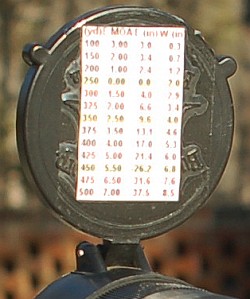
Another option is to place your ballistics card on the back of the front flip-up scope cover. This set-up is used by Forum member Greg C. (aka “Rem40X”). With your ‘come-up’ table on the flip-up cover you can check your windage and elevation drops easily without having to move out of shooting position.
Greg tells us: “Placing my trajectory table on the front scope cover has worked well for me for a couple of years and thought I’d share. It’s in plain view and not under my armpit. And the table is far enough away that my aging eyes can read it easily. To apply, just use clear tape on the front objective cover.”
The Ruger Precision Rifle (RPR) has been a hot seller since it was first released. All versions (.243 Win, 6.5 Creedmoor, and .308 Win) have been in high demand, with the 6.5 Creedmoor probably being the hardest to find. The RPR represents a solid value, and it is the logical “default” choice for the new Production Class in the Precision Rifle Series. (NOTE: If you spend around $1400 for the RPR, then add a $950.00 6-24x50mm Viper PST, you’re still well under the $3000.00 Production Class price limit for rifle and optic combined.)
In this video, Gavin Gear of UltimateReloader.com, along with Ed and Steve of 6.5Guys.com, review the Ruger Precision Rifle (RPR) in 6.5 Creedmoor. This particular rifle was fitted with the Vortex Viper PST 6-24x50mm scope. Together, Gavin and the 6.5 Guys give their opinions on the rifle, the 6.5mm chambering, and the Vortex optic. They provide candid evaluations (of rifle and optic) based on field tests with targets from 100 to 1000 yards.
Gavin tells us: “The Ruger Precision Rifle is a great rifle platform. I’ve had some great groups right out of the box, and have had no problems staying on target at ranges of 1000 yards and beyond. To me, the Ruger Precision Rifle is an ‘easy buy’ for the new competitive shooter or practical field shooter. But what about optics? It can be very confusing and overwhelming when shopping for ‘just the right scope’. There are so many great scopes on the market it can be staggering to take in all of the options. We wanted to give you some hands-on impressions of one of the most popular picks for optics for the Ruger Precision Rifle and similar rifles in the ~$1000 price range: the Vortex Viper PST 6-24×50 riflescope.”
Gavin was very pleased with the Vortex Viper PST: “Having used this scope in a variety of scenarios, ranges, and over the course of more than 1/2 of a year, I’m confident with not only the scope itself, but the entire package: Rifle + Scope + Mount (rings).”
MidwayUSA has just introduced a new compact shooting mat that should work great for varmint hunters as well as tactical competitors. The new MidwayUSA Lightweight Tactical Shooting Mat rolls up into a very compact 15″x 8″ package that fits into a handy carry pouch. Despite its light weight and portability, this mat has some nice features: 5 millimeter-thick close-cell foam padding, four corner tie-downs, and a water resistant, non-skid bottom. The rugged, abrasion-resistant exterior is constructed of 400D PVC-coated polyester fabric on top, with 1200D PVC-coated polyester on the bottom. There is also a data card pocket.
The price is right — as an introductory special, MidwayUSA is offering this new Lightweight Tactical Shooting Mat for just $29.99. You read that right — you can purchase the mat for just $29.99, thirty bucks off the regular $59.99 price. That’s a great deal…
When not in use, the mat conveniently stores in its included MOLLE-compatible, zippered pouch. Unrolled, the mat is 69″ long and 30.25″ wide. Rolled dimensions are 15″ x 8″. The MidwayUSA Lightweight Tactical Shooting Mat is currently offered in three colors: faded olive drab, black, and coyote tan (featured above).
Are you fed up with all the “Tacticool” nonsense? Do you wonder about guys who are more into “macho” fashion statements than actually learning effective gun-handling skills? Are you tired of the whole “tactical lifestyle” silliness? Well so is respected firearms trainer David Spaulding. In this refreshingly frank and candid video, Dave speaks the “plain truth” about firearms training, pistols in particular.
Great “No-BS” Video — David Spaulding Calls Out Firearms Training Nonsense:
David explains that you don’t need to dress up like a Spec Ops Warrior. You don’t need a beard and you don’t need to wear tactical pants and combat boots. Jeans and sneakers work just fine.
David also says that too many people are caught up in hardware “one-upsmanship”. Get the pistol that works best for you — it doesn’t matter if it’s not the one used by Delta Force. Likewise, get the holster that fits YOU best, even if it’s not on the cover of Guns & Ammo magazine.
Most importantly, David says that, to be truly proficient with any firearm, you must TRAIN with that firearm in real life. Surfing the web won’t substitute for actual training time, David says. AccurateShooter.com agrees wholeheartedly — while this website provides a wealth of info on reloading, marksmanship, and other topics, you still need to get out to the range and train. There is no substitute for actual trigger time, preferably under the guidance of a competent mentor or instructor.
“The fact remains [that] if you really understood the psychological and financial trauma that occurs to someone when they take a life, you won’t want to do it. So the fascination with war-fighting, and gear, and killing people just does not make sense.
I’ll have people that contact me and say ‘What kind of trousers were you wearing?’ Who cares! They’re [just] a pair of pants…” — David Spaulding


 The HOWA HCR features an adjustable, two-stage HACT trigger, set for about 3 pounds (combined stages). Crisp and repeatable, this is an excellent trigger for a factory gun. In our opinion, the HACT trigger is clearly superior to the trigger on the Ruger RPR, as well as the Savage AccuTrigger. And there is no annoying Glock-style safety lever in the middle of the trigger blade.





 Scope-Cover Mounted Ballistics Table


