|
|
September 25th, 2010
It’s been over a year since Sebastian Reist drove out to Pennsylvania to participate in the 2009 Williamsport 1000-yard BR school. A talented professional photographer, Sebastian did a superb job capturing the highlights of his Williamsport 1K training weekend in a marvelous slideshow, complete with sound track. Photos and slideshow courtesy www.sreistphotography.com.
Please enable Javascript and Flash to view this VideoPress video.
If you haven’t viewed this video when we first ran it, you’re in for a treat. Sebastian captured some talented shooters in “mid-string” and he snapped some beautiful photos of the Williamsport facility. This is the same range where Matt Kline set a Williamsport 1000-yard world record, placing 10 shots from his 300 WSM heavy gun in just 2.815″. All shots were well-centered up for a 100-4X score. If you want to “run with the big dogs” in 1000-yard Benchrest competition, the Williamsport facility is a great place to learn. A lot has changed in the past 40 years. Compare the current deluxe covered shooting bays with Williamsport, circa 1968.

February 20th, 2010
Caldwell recently sent us some new pre-printed targets that we really like. The new Caldwell Tip Top Targets have a combination of features we’ve never seen before in pre-packaged targets. First, the targets are printed on a unique, plasticized card stock — just slightly thinner than a business card. The plasticized material is very rip-resistant (if you really try, you can make a small tear on the edge, but it takes a LOT of deliberate effort). The plasticized material makes the targets 100% weatherproof, though you can still write on the surface. At the bottom of the targets, Caldwell includes a labeled data entry area where you can record firearm type, shooting conditions, distance, group size, load info, and chron data. Very Handy! The targets even come pre-punched for a 3-ring binder. That’s great if you want to save your targets. The 8″ Sight-In Tip Top Targets cost $7.49 for 25-pack, or $24.99 for 100 targets.

Bullets Punch Perfect Circles on New Target
What makes these “Tip-Top Targets” really unique is the way bullet holes appear. When a bullet passes through a normal paper target, the paper can rip. At best you get a fairly round hole but with a fuzzy, uneven edge. With these Tip Top Targets, the bullet hole looks like it was made with a hole punch. No more ragged, fuzzy edges. If you’ve ever shot wadcutter rounds from a pistol into a paper target, that’s the effect here. But the bullet hole edges are even MORE sharp and uniform. As a result, you can measure your group sizes quickly, with great precision.
Overall, we think the Tip Top Target is a real step forward. Caldwell did a great job with this product. The new material does not tear, does not get soggy in wet conditions, and does not flap around in the wind. The new material delivers crisp, uniform bullet holes for easy group measurement, and the 1″ square gridlines let you quickly estimate your group size.
Caldwell Tip Top Targets are offered in six (6) different versions: large, Inverted “T” for iron-sighted rifles or pistols; 4″-diam. Bullseyes; 8″-diam. single Bullseye; 100-yard Benchrest Target; 200-yard Benchrest Target; and 8″ Sight-in Target with 1″ grid (shown in photos).
We really like the layout of the sight-in target. In has five different aim points with a central diamond split by horizontal and vertical lines running through the points of the diamond. The diamond, which measures 1/4″ on a side, provides a VERY precise aiming point. Just line up your cross-hairs with the heavy black lines and you should be able to shoot bugholes with this target. It’s a very good design, with good contrast in the center of each aiming square.
Is there anything we would change on the Sight-In Target we sampled? Yes… First, we’d like to see a long-range version with an all-white background so that bullet holes are easier to see at long distances. Second, we’d modify the data entry table so you could list results for multiple loads. See our FREE Targets Page for paper targets with multiple load-entry/chron data boxes.
Review Disclosure: Caldwell provided a free 25-ct pack of 8″ Sight-In Targets for testing.
January 25th, 2010
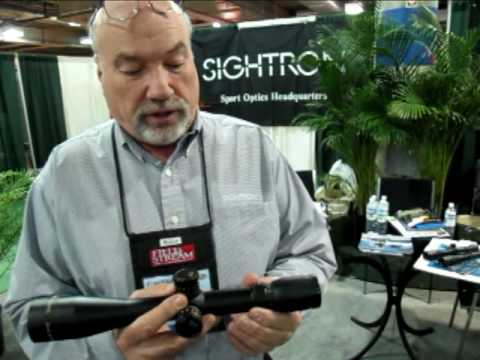
At SHOT Show, Sightron rolled out its much-awaited 10-50x60mm, and it looks good. Currently available in either a Fine-Cross-Hair (FCH) reticle, or FCH with target dot, the new unit has 1/8 MOA clicks and 50 MOA of windage and elevation. Priced under $1000.00, this is a good value compared to other premium optics with similar max magnification.
Affordable High-Magnification Long-Range Optic
With a “street price” under $995.00, the Sightron 10-50 could become hugely popular in 600/1000-yard benchrest and F-Class shooting. The big new zoom features a jumbo 60mm objective, 30mm maintube, and 1/8 MOA clicks. Nearly 17″ long and weighing 28.9 ounces, make no mistake, this is a BIG piece of glass. If the new 10-50×60mm SIII Sightron is as good as the 8-32×50mm LR SIII we tested in 2009, this should be a fantastic scope for the money.

New Tactical Scopes with Rear Parallax Control
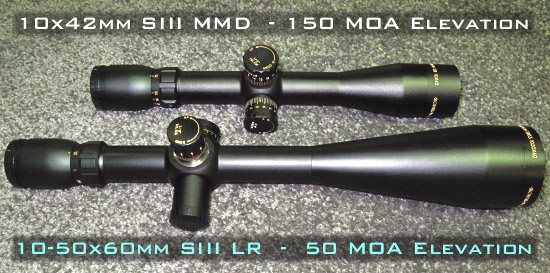
Sightron had another much smaller, but equally impressive, scope on hand. It was the 10X model from the new SIII Tactical series which includes 16X and 20X versions also. The new SIII fixed-power Tactical Sightrons feature a modified mildot (MMD) reticle with 1/4 MOA clicks. These scopes (10X, 16X, and 20X) all boast an amazing 150 MOA of total elevation (and windage). We repeat: 150 MOA of total up/down travel. That allows you to shoot well past 1000 yards without needed an angled scope base. The parallax control is at the back, where you’d normally find a zoom ring. The position is actually very handy. With the parallax (focus) control near the rear eyepiece, you can easily set the parallax with your firing hand without moving out of position. These new fixed-power Tactical Scopes will retail for about $550.00.
December 28th, 2009
Here’s a colorful new target that’s ideal for rimfire or centerfire silhouette shooters. Birchwood Casey’s new Dirty Bird™ Multi-Color Splattering Animal Pack target features correct shapes of NRA metallic animal silhouettes. That way you can practice your marksmanship without having to haul around a set of metal targets.
When a Dirty Bird animal silhouette target is hit, the color associated with each animal shape creates a ring around each bullet hole. Chickens burst in yellow, pigs burst in orange, turkeys burst in red, and rams burst in pink. Each target sheet is 8″ x 8″. Suggested retail prices is $12.20 for a pack of 20 targets (item 35822-MCA-20). These targets can be shot at 25 yards with iron sights, or at longer distances with scoped rifles.

Birchwood Casey Sues Battenfeld
In related news, Birchwood Laboratories, Inc. has filed suit against Battenfeld Technologies, Inc. over the recent issuance of a patent to Battenfeld for their reactive targets and method of target manufacturing. “We feel the United States Patent Office was given insufficient information by Battenfeld during the application process, which resulted in the patent being awarded improperly,” said Mike Wenner, Vice President, Birchwood Casey.
“Shoot-N-C® targets have been in production since 1996 and have been the #1 name brand target on the market since their introduction. We intend to vigorously… protect our business model.” Shoot-N-C and Dirty Bird® targets feature a special coating that flakes off during impact, leaving a bright halo ring around each bullet hole on the target.
July 16th, 2009
Reactive targets — whether balloons, steel gongs, or clay birds — always add fun to a range session. But precision shooters may want something more challenging (i.e. smaller) than a clay bird when shooting inside 300 yards. For a change of pace, try shooting at small reactive targets attached to your target board.
 Necco Wafers and Paint Balls Necco Wafers and Paint Balls
We’ve seen folks shoot at candy NECCO® Wafers at 100 yards. When hit, these disintegrate nicely but don’t offer much of a visual display. For serious “splat factor”, some shooters use paint balls as targets. Glued to a cardboard backer, the paintballs explode dramatically when hit. Unfortunately paintballs make a really big mess, and your rangemaster might not be happy with the residue. Accordingly, we suggest you leave the paintballs to the “gravel pit”-type plinking ranges.
Pool Cue Chalks — Cheap, Fun, Dramatic
If you’re looking for a nice small target that makes a nice big cloud of color when hit, try pool cue chalks. You know, those little blue cubes you use to dust the end of billiard cues. Measuring about 7/8″ per side, billiard chalks make very challenging targets at 100 and 200 yards. When you hit them, if you nail the circular “dimple” in the middle, they disintegrate impressively, tossing blue “smoke” in all directions.

To see actual hits on chalk at 100 and 200 yards, watch the video below. The movie-maker, Phil of the Random Nuclear Strikes Blog, cautions that: “You’ll notice (in the video) that some of the hits are ‘wiffs’ instead of ‘poofs’. If you look at the picture above, you’ll see the 1/2 inch dimple in the cube face. If you don’t put the bullet in that dimple, it’ll ‘wiff’ on you.”
Pool cue chalks are inexpensive. You can buy a dozen chalks online for about $3.00 — just 25 cents each. And the prices drop with more quantity. One gross of chalks (that’s 144 pieces) costs just $23.00 at ozonebilliards.com.
June 25th, 2009
California Varmint Silhouette matches are the focus of our current main feature story on AccurateShooter.com. After reading that story you might say: “Looks like fun, but how can I avoid going downrange everytime I knock down the targets?” Well, if your club already has a fixed steel plate or a gong at 500 or 600 yards, you can just shoot at it and look for the “splash marks” from bullet impact (if you can’t hear the hit). Bring a can of white paint and re-paint the target every so often. Shooting range steel is fun, but we’ve found most of the “semi-permanent” long-range steel targets at clubs are pretty large. You want something more the size of a varmint to provide a better challenge. You could set out some clay birds of course — but again that requires you to traipse down-range every dozen rounds or so.

Affordable Self-Resetting Armored Poppers
To duplicate the fun of a varmint silhouette match, we recommend self-resetting pop-up targets. These are sold by LV Steel and other target makers. Contructed of “AR500″ hardened steel, the LV poppers are rugged and very durable. The armored LV Steel targets can stand up to repeated hits from a 300 Win Mag. Shown below is LV Steel’s #4 (10″ x 6″) spring-loaded “paddle” popper. The video shows it soaking up repeated hits from a 300 Win Mag at 100 yards. Such self-resetting poppers are small enough that you could carry 2 or 3 in your car or truck easily. That way you can set up your own long-range “steel challenge” whenever you go shooting. The same poppers can also be used for pistol practice. LV Steel’s #4 paddle, made of 5/8″-thick steel, costs $150.00 and is designed to ship in a UPS flat-rate box. LV Steel makes a wide variety of other metallic targets.

June 11th, 2009
Recent visitors to the AccurateShooter.com site may not know that we have an entire set of FREE TARGETS. There are sight-in targets, load development targets, Benchrest Targets, NRA Highpower targets, Scope Testing Targets, even a special set of Fun Targets.
Most of the targets come bundled in .zip archives, so you can easily download multiple targets with one click. The targets are saved in .pdf format, so they are easy to print and the scale is correct no matter what your screen resolution.
Here Forum member FireMedic shows some fine shootin’ with our basic Accuracy Target. With small, red diamonds and extended black lines, this target allows very precise aiming at 100 and 200 yards. The gray dot on top provides a reference point for a 200-yard zero. FireMedic reports: “My 30″, 12 twist, 3 groove does pretty good for an old Savage chambered in .308 Win.” With an average group size of 0.208 inches we’d have to agree. Great Shootin’ FireMedic!

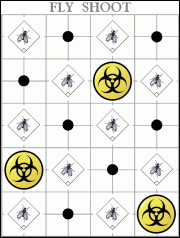
Here are two fun targets you might enjoy. The Atomic Target was originally created as a contest for our readers. The design is by Michael Forester of Auckland, New Zealand. Hit the bigger green and red neutrons, then try your luck with the smaller electrons. In the center, go for true “bug-holes” with our Fly Shoot Target. Watch out for the bio-hazard rings!
You’ll find other excellent, downloadable training targets on the U.S. Palma Team Website, www.uspalma.com. More than 50 free targets are offered, all in easy-printing .pdf format. Shown below is the “inside-out” fun target from the U.S. Palma Team site.

May 30th, 2009
 At long range, small bullet holes are much easier to see in the white than in the black. When you’re practicing at long range on high power targets, one way to enhance your ability to see your bullet holes is to print a “negative” version of the regulation bullseye target. Forum member Watercam has a new Pentax PF-80ED. With the Pentax he can see 6mm bullet holes in the white at 600 yards, but holes in the black are only visible out to 400 yards or so. Accordingly, Watercam uses a modified “reversed” black-to-white target for 600-yard practice. Watercam writes: At long range, small bullet holes are much easier to see in the white than in the black. When you’re practicing at long range on high power targets, one way to enhance your ability to see your bullet holes is to print a “negative” version of the regulation bullseye target. Forum member Watercam has a new Pentax PF-80ED. With the Pentax he can see 6mm bullet holes in the white at 600 yards, but holes in the black are only visible out to 400 yards or so. Accordingly, Watercam uses a modified “reversed” black-to-white target for 600-yard practice. Watercam writes:
“I just received my Pentax PF-80ED-A angled spotting scope the other day and it is awesome. Great quality. I traded a straight Kowa 77mm fluorite for it through SWFA.com. Eye relief with the Pentax 10-60 power zoom is 18-22mm (much more than the Kowa zoom), so I can use glasses with no problem. The view through the Pentax is very sharp and contrasty with great color.
With my 6mm and limited mirage I’m seeing defined, 6mm holes in the white out to 600. In the black, I can see bullets holes at about 400 with my eyes. I am printing reverse-color targets for training without a pit partner at the 600-yard line.”

If you’re not concerned with official scoring rings, you can use an all-white target with a bright, fluorescent target dot in the middle. A 2″- or 3″-diameter stick-on target dot is highly visible at 600 yards. Birchwood Casey Target Spots® assortment #33928-TSA offers neon orange target dots in 1″, 2″, and 3″ diameters.

April 8th, 2009
 Our own Asst. Editor, Jason Baney, runs a popular “postal match” called “Smack the Smiley”. Four times a year (Spring/Summer/Fall/Winter) you can shoot an official target at your own range, and then submit it for judging. Over $2000.00 in prizes will be awarded for each 2009 seasonal match. You can compete with shooters from across the continent. Our own Asst. Editor, Jason Baney, runs a popular “postal match” called “Smack the Smiley”. Four times a year (Spring/Summer/Fall/Winter) you can shoot an official target at your own range, and then submit it for judging. Over $2000.00 in prizes will be awarded for each 2009 seasonal match. You can compete with shooters from across the continent.
Jason started the Smiley matches in 2004. Since 2006, a share of monies collected from entry fees have been donated to American military marksmen via AmericanSnipers.org. These donations have totaled over $5000.00.
Jason is accepting entries for the current Spring Match. Order your targets now. The Spring Match officially starts April 13, 2009. Your finished Spring targets must be returned (postmarked) by May 26, 2009. Targets will be scored and ranked on shooting forums including SnipersHide.com, West Coast Tactical, SnipersParadise, and the main contest site, SmackTheSmiley.com
Smack the Smiley Prizes
Prizes donated by manufacturers are raffled off, lottery-style, after each match. This means that every participant has a chance at winning a valuable prize. The prize list totals over $2000.00 in value for each Smack the Smiley match. You’re smart to shoot all four seasonal matches (Spring/Summer/Fall/Winter). A four-match Aggregate will be tallied this year with a possible prize for the Aggregate winner.
CLICK HERE for Smack The Smiley 4-Season Match Calendar
Smack The Smiley Postal Match Rules
● There are two classes, rimfire and centerfire, with no other rifle restrictions. Rimfire guns shoot at 50 yards, while centerfire rifles shoot at 100 yards.
● All rifles must be shot from the ground, either sitting or prone position, with NO tripod rests allowed. Only bipods or other field expedient rests are allowed.
● You must shoot official targets only, ordered from SmackTheSmiley.com. These cost $3.50 each with a max of 4 targets per class. One dollar ($1) from each target goes to Americansnipers.org.

March 10th, 2009
 Here’s a good deal if you’re looking for reliable, fixed-focal length optic for benchrest competition. MidwayUSA has knocked $43.79 off the price of Sightron SII 36x42mm BRD target scopes — they are now on sale for just $369.99. These same scopes sell elsewhere for up to $450.00. We’ve used this scope model on rimfire and centerfire benchrest rifles from 50 yards to 600 yards, and it worked well. The 1/8-MOA clicks were repeatable and the front-parallax adjustment worked “as advertised”. Here’s a good deal if you’re looking for reliable, fixed-focal length optic for benchrest competition. MidwayUSA has knocked $43.79 off the price of Sightron SII 36x42mm BRD target scopes — they are now on sale for just $369.99. These same scopes sell elsewhere for up to $450.00. We’ve used this scope model on rimfire and centerfire benchrest rifles from 50 yards to 600 yards, and it worked well. The 1/8-MOA clicks were repeatable and the front-parallax adjustment worked “as advertised”.

Newer Model Available
The scope that is on sale is the SII model that has been available for quite some time. Be aware that Sightron recently introduced an updated “Big Sky” version of its 36-power target scope. This is officially the SIIB 36×42 BRD. This newer SIIB version is slightly longer than the earlier model, and the new model has a bit more eye relief. The main difference is that the earlier model has more elevation adjustment — 50 MOA vs. 40 MOA.
| Scope Model |
Length |
Weight |
Relief |
Elevation Travel |
Price |
| SII 36×42 BR D (older) |
15.3″ |
17.3 oz. |
3.4 |
50 MOA |
$369.99 on sale |
| SIIB 36×42 BRD (newer) |
15.6″ |
17.3 oz. |
3.7 |
40 MOA |
$580.00 average |
|