|
|
November 27th, 2015

Geissele Automatics, respected maker triggers and firearm accessories, is offering some very attractive specials on Black Friday and Cyber Monday. On Friday 11/27 get 25% AR triggers. On Monday get a complete Geissele AR 2-Stage Trigger (GS2) for just $115.00. These normally retail for $165.00, so you save fifty bucks. In addition to these great deals, you can get 50% off Geissele gear, and 30% off Reaction Blocks (used for assembling AR platform rifles).
This Deal is Available on FRIDAY 11/27/2015 ONLY:

This Deal is Available on MONDAY 11/30/2015 ONLY:
Other Black Friday Geissele Specials:
 |
 |
October 7th, 2015

For years, Timney triggers have been popular drop-in upgrades for hunting rifles, rimfire rifles, and AR platform rifles. To meet the demand for its many trigger products, Timney Triggers has expanded its operation, adding state-of-the-art CNC machines and other high-end, automated equipment. A far cry from the dank gun factories of the 1950s and 1960s, Timney’s Arizona production center now resembles the squeaky-clean, ultra-modern facilities where electronics are assembled.
Today’s Timney factory is all about computerized automation. Timney Triggers’ owner John Vehr states that it would take 60 or more trained machinists and metal-workers to produce as many triggers as can Timney’s modern machines. Timney does employ two dozen workers, but they are assigned tasks that the computerized machines can’t do as well or better.
If you want to see how Timney triggers are made this days, check out Tom McHale’s recent account of his visit to the Timney Factory in Scottsdale, Arizona. McHale explains how the triggers are designed and fabricated, and 20 high-rez photos illustrate the production process and machinery.
September 9th, 2015

There’s a new two-stage trigger for Remington and Rem-clone actions from CADEX Defense of Canada. The new CADEX DX2 double-stage trigger adjusts from 1.5 to 5.0 lbs pull weight. Both stages can be adjusted separately through allen-head screws located on the front of the trigger body. The trigger shoe also adjusts fore and aft. The CADEX DX2 is offered in both a standard version (no safety or bolt release) and a version with integral safety and bolt release. The cost of the standard DX2 is 267.95 Canadian dollars, or $202.62 U.S. Dollars at current exchange rates. Add forty dollars (Canadian) for the version with safety and bolt release.

DX2 Dimensions: 7.21cm x 4.42cm x 1.22cm | With Safety/Bolt Release: 7.65cm x 5.23cm x 3.35cm
DX2 Weight: 37.5 grams | With Safety/Bolt Release: 52 grams
Frank Green Tries the CADEX Two-Stage
Frank Green of Bartlein Barrels recently acquired one of the CADEX two-stage triggers and he likes it. Here is his report:
“My CADEX two-stage trigger arrived[.] I installed it into my Badger M2008 action/rifle in 6 Creedmoor. Initial impression is that it’s very nice. You can adjust each stage for pull of weight. You can adjust the position of the trigger shoe and [adjust] for over-travel as well. I think the pricing on the trigger is going to be very competitive and it will be a nice option out there for another two-stage trigger.
I installed it and made no adjustments. Checked it for function and measured some pull weights while the barreled action was out of the stock. Reassembled the whole rifle and again made some pull weight measurements. I recorded the last five and they came in at 2.09, 2.15, 2.15, 2.1 and 2.12 pounds. The little variance I’m going to chalk it up to me and how I pulled on the trigger scale …but it broke clean.”

 Installation Considerations Installation Considerations
Frank Green said there may be some clearance issues with some trigger guards: “The CADEX trigger shoe assembly is a tad longer than a stock Remington. In my trigger guard it barely bottomed out/touched in the guard but functioned just fine but to give it a little room I milled .010″ off the bottom of the shoe. My trigger guard is a Defiance. I’d have to throw the trigger onto a Remington rifle/trigger guard assembly and a Badger bottom metal to see if it does the same thing but [this] is minor in my opinion.
You need a T6 Allen wrench to adjust the trigger shoe location. I had to move my shoe forward just a tad from how it came out of the package. When pulling the trigger it would just touch the back of the trigger guard.”
December 16th, 2014
 Ernie Paull from California was an active competition shooter for many years. However, his eyesight has declined so he has turned his attention to providing components for shooters and gunsmiths. Through his Ernie the Gunsmith website, Paull sells a variety of useful products including gun trigger springs, pillar-bedding kits, Accu-Risers, and pillar installation tools. This Bulletin post focuses on Ernie’s trigger springs. Ernie offers springs for a wide variety of rifles: Browning (A-Bolt, A-Bolt 22), CZ (m452), Kimber, Remington (XR100, XCR, 7, 700, 722, 788, 7600 and more), Ruger (77, 77-22, LC6), Tikka (T-3), Weatherby (MK-V), and Winchester (M-70). Ernie Paull from California was an active competition shooter for many years. However, his eyesight has declined so he has turned his attention to providing components for shooters and gunsmiths. Through his Ernie the Gunsmith website, Paull sells a variety of useful products including gun trigger springs, pillar-bedding kits, Accu-Risers, and pillar installation tools. This Bulletin post focuses on Ernie’s trigger springs. Ernie offers springs for a wide variety of rifles: Browning (A-Bolt, A-Bolt 22), CZ (m452), Kimber, Remington (XR100, XCR, 7, 700, 722, 788, 7600 and more), Ruger (77, 77-22, LC6), Tikka (T-3), Weatherby (MK-V), and Winchester (M-70).
Springs start at just $6.95. Ernie also sells springs for the Rem-compatible Shilen Benchrest trigger, as well as Rem 700 ejector springs and trigger alignment springs. For Rem 700 rifles, Paull makes a spring that fits all Remington M-7 and M-700 triggers including the 2007-vintage X Mark-PRO trigger (but not the newer X Mark-PRO trigger introduced in 2009). Ernie says: “on average, installation of his Model-700 spring will reduce factory triggers’ weight of pull by 1½ to 2½ lbs with no other changes. The exact amount of creep, over-travel, and weight of pull are dependent upon the type and amount of tuning accomplished by your gunsmith.”
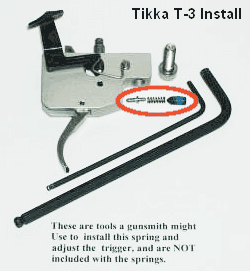 We often hear requests from Tikka T-3 owners asking how they can reduce their trigger pull weight. Paull offers a Tikka T-3 varmint trigger spring which can reduce the pull weight significantly. The photo at left shows the Tikka T-3 trigger assembly. We often hear requests from Tikka T-3 owners asking how they can reduce their trigger pull weight. Paull offers a Tikka T-3 varmint trigger spring which can reduce the pull weight significantly. The photo at left shows the Tikka T-3 trigger assembly.
While there is more to a good trigger job (in most cases) than just a spring swap, you need to have the proper rate spring when adjusting trigger pull weight downwards. NOTE: For safety reasons, we recommend you consult a competent gunsmith before modifying factory triggers. We stress the word competent…
Ernie has observed that some gunsmiths try to lighten trigger pulls by modifying factory springs in questionable ways: “I have worked with gunsmiths in the past who, when the subject turned to trigger springs, preferred to clip them, grind them, heat them, bend them, smash them, or simply back out the weight of pull screw until there was no or almost no pressure on the spring. With any of these methods, you get a spring whose rate is rapidly rising as the trigger is pulled. As the trigger is released, the spring rate rapidly decreases as it approaches full or near-full extension. A more uniform weight of pull will be achieved when the trigger spring is compressed within its normal working range throughout the entire movement of the trigger. In the long run, the benefits of saved time, plus more uniform and reliable results, will more than offset the cost of these [replacement] springs. If you want a lighter trigger pull, you need a lighter trigger spring.”
December 6th, 2014
 According to a CNBC report, Remington has agreed to replace (or upgrade) the triggers on 7.85 million Remington rifles including ALL Remington 700s, and a dozen other models including the Model Seven, Sportsman 78, 673, 710, 715, 770, 600, 660, XP-100, 721, 722, and 725. CNBC reported that, as part of the settlement of a class action lawsuit, Remington has agreed to provide trigger replacements (or other solutions) to all owners of the affected rifle models. While Remington is not specifically recalling all the affected firearms, Big Green has committed to offering trigger upgrades (or other compensation) on millions of firearms produced over many decades. In a released statement, Remington insisted it was not “recalling” the affected rifles, but Remington did offer to replace the triggers on request. This corrective program could, potentially, involve millions of rifles (though we doubt that most Rem 700 and Model Seven owners will actually request trigger modifications.) According to a CNBC report, Remington has agreed to replace (or upgrade) the triggers on 7.85 million Remington rifles including ALL Remington 700s, and a dozen other models including the Model Seven, Sportsman 78, 673, 710, 715, 770, 600, 660, XP-100, 721, 722, and 725. CNBC reported that, as part of the settlement of a class action lawsuit, Remington has agreed to provide trigger replacements (or other solutions) to all owners of the affected rifle models. While Remington is not specifically recalling all the affected firearms, Big Green has committed to offering trigger upgrades (or other compensation) on millions of firearms produced over many decades. In a released statement, Remington insisted it was not “recalling” the affected rifles, but Remington did offer to replace the triggers on request. This corrective program could, potentially, involve millions of rifles (though we doubt that most Rem 700 and Model Seven owners will actually request trigger modifications.)
Affected Remington Products: Model 700, Seven, Sportsman 78, 673, 710, 715, 770, 600, 660, XP-100, 721, 722 and 725.
According to CNBC: “America’s oldest gun manufacturer, Remington, has agreed to replace millions of triggers in its most popular product — the Model 700 rifle. While insisting its action is not a recall of the iconic gun, Remington says in a statement that it is agreeing to make the changes ‘to avoid the uncertainties and expense of protracted litigation.’ The settlement involves a class action suit brought in 2013 by Ian Pollard of Concordia, Missouri, who claimed his Remington 700 rifle fired on multiple occasions without the trigger being pulled.”
According to the Montana Standard, the proposed Remington class action settlement will include model-by-model solutions:
— For Models 700, Seven, Sportsman 78 and 673 rifles, Remington will remove the original Walker trigger mechanism and replace it with a new X-Mark Pro mechanism.
— For Models 710, 715 and 770, Remington will remove the original trigger mechanism and replace it with a Model 770 connector-less mechanism.
— For Models 600, 660, XP-100, 721, 722 and 725, Remington will provide vouchers of $12.50 or $10, depending on the model, redeemable for Remington products.
— For Models 700 and Seven rifles made between May 2006 and April 9, 2014 with an X-Mark Pro trigger mechanism, Remington will retro-fit a new, improved assembly.

Under the terms of the settlement (which must ultimately receive Court approval), Remington will pay for the parts and labor involved to replace or fix trigger mechanisms, at no cost to the owner. The scope of the settlement may include rifles which previously had trigger upgrades done by owners. According to CNBC, “For guns that cannot be retrofitted, the company plans to offer vouchers for Remington products”. LINK: Related Story with Mis-Fire Demo Video.
CLICK HERE to view Remington Proposed Settlement Document (PDF file)
Will This be a Thirty Million-Dollar Fix?
How much will the trigger fix program cost Remington? That is hard to predict. However, Remington Outdoors (previously known as “The Freedom Group”) told its investors last month that it had allocated $29.7 million for a “Model 700 settlement reserve”.
July 20th, 2014
 Trigger Blue-Printing — Why It Can Be Important Trigger Blue-Printing — Why It Can Be Important
by Thomas “Speedy” Gonzalez
To Blueprint or Not? That is the Question.
I often get asked is it really necessary to blueprint a custom match trigger. “Abolutely” is my answer. Here is an example that demonstrates why. After I completed a recent rifle project, the gun’s owner and I took the rifle to the range to break-in the barrel. But we quickly noticed a problem. The owner Alex L’s first statement was: “This trigger sucks — better blueprint it when you get back.”
Not only did the trigger feel rough and scratchy, but it failed to hold the cocking piece 2 out of 10 times when cocking the rifle for the next shot. Not good.
No matter what we tried at the range, the problem persisted. As soon as we returned from the range, I had to take the trigger apart to solve the mystery.
As soon as I opened her up on the operating table it was evident to me where the problem was. I have only seen the inside of about 3000 of these rascals and the head of the Over-Travel Screw stuck out like a sore thumb. The head of the Over-Travel Screw was nearly twice as thick as its other brothers and sisters. This caused the relationship between travel adjustment and sear engagement to be nearly impossible to adjust. And that, in turn, created a serious safety issue.
To remedy the situation, I replaced the screw with [another screw with] standard head thickness and ALL PROBLEMS DISAPPEARED… Amazing! Had I blue-printed this trigger before going to shoot, this never would have happened.
 
So, should one blueprint a trigger? I say “Hell yeah” if you are serious about competiting and winning. Otherwise be prepared for the worst. — Speedy
April 11th, 2014
This Article Originally Appeared in Sinclair International’s The Reloading Press.
Pre-Season Gun Maintenance,
by Ron Dague, Sinclair International
 I give my rifles a pre-season check before the shooting season starts. This starts with a general inspection starting with the butt-plate or recoil pad and making sure that all the screws and adjustable parts (on an adjustable butt-plate) move freely up or down and side to side. If you got caught in rain some of these screws and adjustable parts may not move when needed. I disassemble parts as needed and put rust preventative or a light oil and/or grease on threads and sliding parts. On rifles with recoil pads and fixed butt-plates, make sure the screws are tight and that holes in the stock aren’t stripped out. Make sure there are no cracks in the stock and around the butt-plate. If the recoil pad is glued-on, just make sure it hasn’t come loose. I give my rifles a pre-season check before the shooting season starts. This starts with a general inspection starting with the butt-plate or recoil pad and making sure that all the screws and adjustable parts (on an adjustable butt-plate) move freely up or down and side to side. If you got caught in rain some of these screws and adjustable parts may not move when needed. I disassemble parts as needed and put rust preventative or a light oil and/or grease on threads and sliding parts. On rifles with recoil pads and fixed butt-plates, make sure the screws are tight and that holes in the stock aren’t stripped out. Make sure there are no cracks in the stock and around the butt-plate. If the recoil pad is glued-on, just make sure it hasn’t come loose.
Next I take the action out of the stock and check for cracks and wear marks. I look at the bedding to make sure that oils and cleaning solvents have not damaged the bedding. While the action is out of the stock, I look for any surface rust or dirt/dust in the recoil lug area and magazine well. Clean as needed and repair or re-bed if needed.
Trigger Assembly and Action
 With the barreled action out of the stock, it is a good time to spray out the trigger with cleaner. I use Ronson oil or lighter fluid. [Editor’s Note: Some trigger-makers advise against using any kind of lubricant, grease or oil — so plain lighter fluid is preferred.] After the trigger is cleaned you may want to check the trigger pull weight. If you don’t feel comfortable doing this, take it to a gun smith and have it checked. It is worth every penny to not have a trigger issue and/or a safety malfunction. I also take the bolt apart and clean the firing pin spring and bolt housing with Gun Scrubber or automotive brake cleaner. Then lube the firing pin-spring and firing pin with light oil. I use Kel Lube and/or Butch’s gun oil. Put a small dab of gun grease on the [bolt locking lugs] and cocking ramp. With the barreled action out of the stock, it is a good time to spray out the trigger with cleaner. I use Ronson oil or lighter fluid. [Editor’s Note: Some trigger-makers advise against using any kind of lubricant, grease or oil — so plain lighter fluid is preferred.] After the trigger is cleaned you may want to check the trigger pull weight. If you don’t feel comfortable doing this, take it to a gun smith and have it checked. It is worth every penny to not have a trigger issue and/or a safety malfunction. I also take the bolt apart and clean the firing pin spring and bolt housing with Gun Scrubber or automotive brake cleaner. Then lube the firing pin-spring and firing pin with light oil. I use Kel Lube and/or Butch’s gun oil. Put a small dab of gun grease on the [bolt locking lugs] and cocking ramp.
I will also spray the outside of the action and barrel and give that a light coating of oil for rust prevention. I clean the action with Sinclair’s action cleaning tool. Don’t forget to clean the bore. Even though you didn’t fire the rifle, this makes sure nothing obstructs your barrel.
Checking Metal Fixtures and Fasteners
 Next I look at the trigger guard and hinged floor plate and make sure it works as designed. Make sure there are no cracks in the trigger guard from an accidental drop. Check guard screws and /or action screws for tightness and tighten to proper spec. There are torque specs for this, but on wood stocks the wood can crush and this should be checked throughout the year as weather change can affect this. My entire collection of rifles are bedded and I just tighten them just snug with screw driver or Allen wrench. The rimfire rifles have a spec of 55 to 74 inch/lbs and I think would carry over to center fire as well. I would caution you about torque wrenches as you need a good quality wrench, and read the directions on how to use it. You can over torque if not careful. Check the swivel studs and bipod to make sure there tight as well. You may want to take scope off and check the base screws and check the rings. Next I look at the trigger guard and hinged floor plate and make sure it works as designed. Make sure there are no cracks in the trigger guard from an accidental drop. Check guard screws and /or action screws for tightness and tighten to proper spec. There are torque specs for this, but on wood stocks the wood can crush and this should be checked throughout the year as weather change can affect this. My entire collection of rifles are bedded and I just tighten them just snug with screw driver or Allen wrench. The rimfire rifles have a spec of 55 to 74 inch/lbs and I think would carry over to center fire as well. I would caution you about torque wrenches as you need a good quality wrench, and read the directions on how to use it. You can over torque if not careful. Check the swivel studs and bipod to make sure there tight as well. You may want to take scope off and check the base screws and check the rings.
Test Fire the Rifle After Maintenance
After all cleaning and is done and everything is reassembled, take a few rounds out to the range and test fire to make sure everything works as it should. Don’t forget to run 3-5 rounds through the magazine at least two times for function. I look at this as preventive maintenance on the rifle. If you give it a look over you shouldn’t have any trouble during the rifle matches or hunting trip.
Ron Dague
Certified Reloading Instructor
Certified Range Safety Officer
Email: rond [at] sinclairintl.com
Phone: 800-717-8211
June 21st, 2013
Precision rifle shooters don’t have to hit a big-league fastball, or launch a top-fuel dragster in the blink of an eye. Nonetheless, reaction times are important in our sport — both for competitive shooters and hunters. Want to catch that prairie dog before he slips down his hole? You’ll need to be quick. Want to win at short-range benchrest? Then you’ll need to watch your windflags and respond quickly to a change. Miss a major wind-shift and you could ruin your whole weekend.
Here’s a fun test of reaction times from HumanBenchmark.com. The way it works is that, after clicking “Start”, you wait until the background color changes from red to green. The instant you see green, immediately click your mouse. The average (median) reaction time is 215 milliseconds. Hint: If you keep your finger “preloaded” in contact with your mouse button you can shave some milliseconds — but don’t “jump the gun”.
CLICK HERE for Reaction Time Test >>>>>>>>

Tips for Faster Times
Here are three tips to speed up your reaction times:
1) Respond to the color change (by itself), rather than wait to read the word “CLICK!” after the box shifts to green.
2) Try focusing at the corner of the box, rather than the center. This may help you react “without thinking”.
3) Have your index finger “poised and ready” over the left button–you can shave milliseconds by very slightly depressing the button before you actually click.
September 14th, 2011
Sinclair Int’l is offering some good deals right now. First, Sinclair has the new Rock River Arms 2-Stage AR15 match trigger marked down to $99.00 from $120.00. If you’re building a black rifle, here’s a chance to save twenty bucks. Click the image below to get the discount.
 
Sinclair is also running a sale now on Hornady BTHP Match Bullets. We’ve heard positive reports on the new match bullets with the Advance Manufacturing Process (AMP) jackets. Our friend John Adams has tested some of Hornady’s new 6mm 105-grainers with AMP Jackets. John says they shoot very accurately and are extremely uniform. John tells us: “I’m impressed by the new Hornady 105s. They are some of the most uniform bullets I’ve ever sampled. I absolutely stopped sorting them because the base to ogive measurements were so consistent.”

September 10th, 2011
Timney Triggers has introduced a new drop-in trigger for the Savage Axis/Edge line of rifles. The new Timney Axis/Edge trigger (Model 633) is CNC machined from solid steel and then case-hardened. The Model 633 Axis/Edge trigger fully adjustable for pull weight, sear engagement (creep) and over-travel. The trigger’s pull weight can be adjusted from 1.5 to 4 pounds, an ideal range for a hunting rifle. Midsouth Shooters Supply has the Model 633 trigger in stock now.

The Timney Axis/Edge trigger retails for $104.95 for the standard blued version and is also available nickel-plated for $114.95. Each trigger is hand-assembled, calibrated, and tested before shipping. Timney offers a lifetime warranty on all of their products. Triggers are Made in the USA.
Story tip by EdLongrange. We welcome reader submissions.
|


